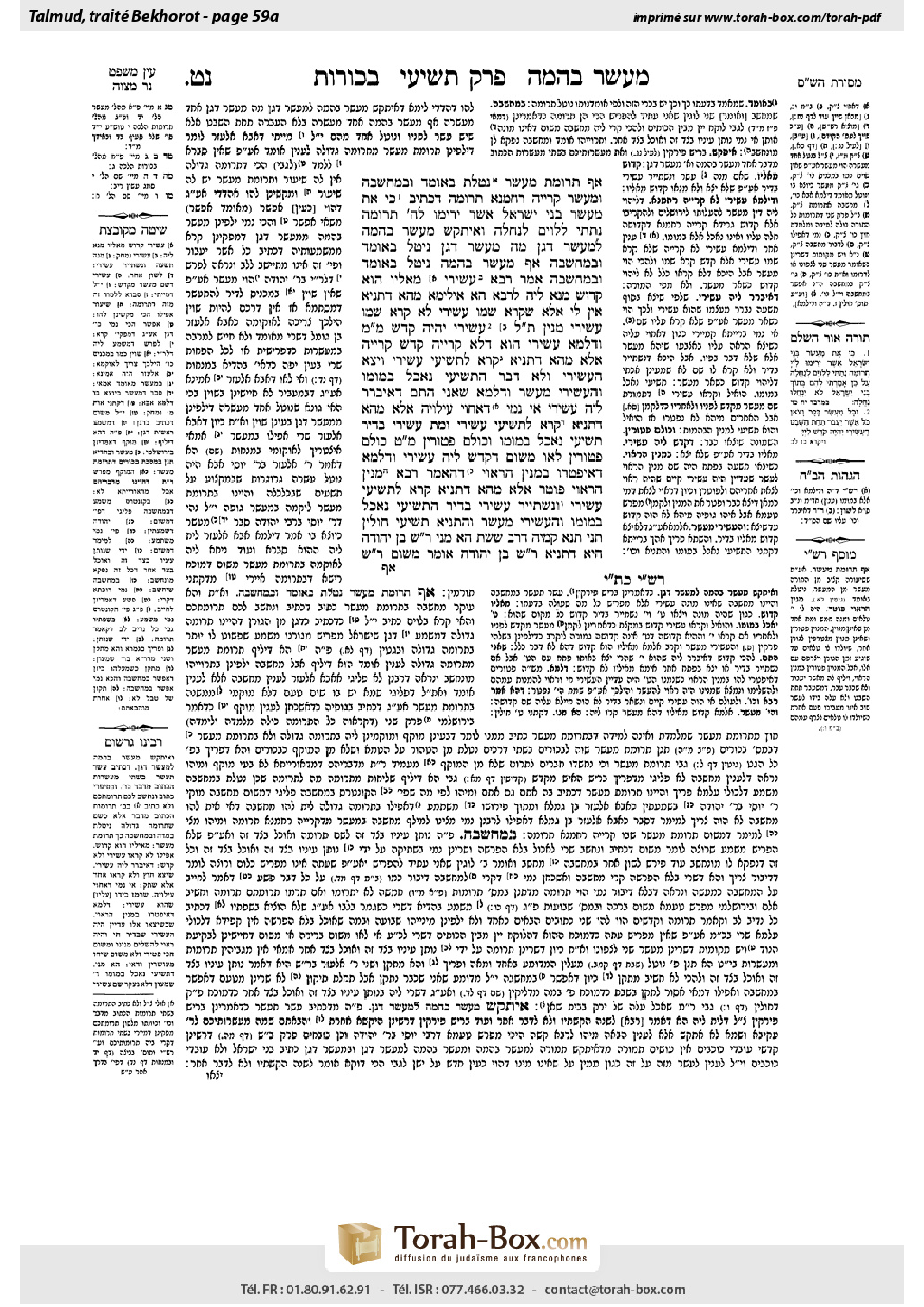
Bekhorot 59a: Talmud study for Daf Yomi
Study the Talmud for Daf Yomi with scanned pages, Hebrew text, English translations from Sefaria and AI-generated French translations.
Passage selection and English or AI-generated French translation are available where the scan has annotations. Daf Study is independent of Torah-Box and Sefaria.
Browse Bekhorot · בכורות · All tractatesBekhorot 59a text and translations
This page of Bekhorot includes the Aramaic text, an English translation and an AI-generated French translation, alongside the scan above.
בכורות נ״ט א · Aramaic and Hebrew text
אַף תְּרוּמַת מַעֲשֵׂר נִטֶּלֶת בְּאוֹמֶד וּבְמַחְשָׁבָה, וּמַעֲשֵׂר קַרְיֵיהּ רַחֲמָנָא תְּרוּמָה, דִּכְתִיב: ״כִּי אֶת מַעְשַׂר בְּנֵי יִשְׂרָאֵל אֲשֶׁר יָרִימוּ לַה׳ תְּרוּמָה נָתַתִּי לַלְוִיִּם לְנַחֲלָה״, וְאִיתַּקַּשׁ מַעְשַׂר בְּהֵמָה לְמַעֲשֵׂר דָּגָן, מָה מַעְשַׂר דָּגָן נִיטָּל בְּאוֹמֶד וּבְמַחְשָׁבָה — אַף מַעְשַׂר בְּהֵמָה נִיטָּל בְּאוֹמֶד וּבְמַחְשָׁבָה.
אָמַר רָבָא: עֲשִׂירִי מֵאֵלָיו הוּא קָדוֹשׁ. מְנָא לֵיהּ לְרָבָא הָא? אִילֵּימָא מֵהָא דְּתַנְיָא: אֵין לִי אֶלָּא שֶׁקָּרָא שְׁמוֹ ״עֲשִׂירִי״, לֹא קָרָא שְׁמוֹ ״עֲשִׂירִי״ מִנַּיִן? תַּלְמוּד לוֹמַר: ״עֲשִׂירִי יִהְיֶה קֹדֶשׁ״ — מִכׇּל מָקוֹם.
וְדִלְמָא ״עֲשִׂירִי״ הוּא דְּלָא קַרְיֵיהּ, ״קֹדֶשׁ״ קַרְיֵיהּ! אֶלָּא מֵהָא דְּתַנְיָא: קָרָא לַתְּשִׁיעִי ״עֲשִׂירִי״, וְיָצָא הָעֲשִׂירִי וְלֹא דִּבֵּר — הַתְּשִׁיעִי נֶאֱכָל בְּמוּמוֹ, וְהָעֲשִׂירִי מַעֲשֵׂר.
וְדִלְמָא שָׁאנֵי הָתָם, דְּאִיבָּרַר לֵיהּ עֲשִׂירִי, אִי נָמֵי, דְּאַחְוִי עִילָּוֵיהּ!
אֶלָּא מֵהָא דְּתַנְיָא: קָרָא לַתְּשִׁיעִי ״עֲשִׂירִי״, וּמֵת עֲשִׂירִי בַּדִּיר — תְּשִׁיעִי נֶאֱכָל בְּמוּמוֹ, וְכוּלָּם פְּטוּרִין. מַאי טַעְמָא כּוּלָּם פְּטוּרִין, לָאו מִשּׁוּם דִּקְדַשׁ לֵיהּ עֲשִׂירִי?
וְדִלְמָא דְּאִיפְּטַרוּ בְּמִנְיָן הָרָאוּי, דְּהָאָמַר רָבָא: מִנְיָן הָרָאוּי פּוֹטֵר!
אֶלָּא מֵהָא דְּתַנְיָא: קָרָא לַתְּשִׁיעִי ״עֲשִׂירִי״, וְנִשְׁתַּיֵּיר עֲשִׂירִי בַּדִּיר — הַתְּשִׁיעִי נֶאֱכָל בְּמוּמוֹ, וְהָעֲשִׂירִי מַעֲשֵׂר. וְהָתַנְיָא: תְּשִׁיעִי חוּלִּין!
תָּנֵי תַּנָּא קַמֵּיהּ דְּרַב שֵׁשֶׁת: הָא מַנִּי? רַבִּי שִׁמְעוֹן בֶּן יְהוּדָה הִיא, דְּתַנְיָא: רַבִּי שִׁמְעוֹן בֶּן יְהוּדָה אוֹמֵר מִשּׁוּם רַבִּי שִׁמְעוֹן:
Bekhorot 59a · English translation
so too, teruma of the tithe may be taken by estimate and by thought. And this ruling of Abba Elazar ben Gomel’s also applies to tithes of the grain, because the Merciful One calls tithe “teruma,” as it is written: “For the tithe of the children of Israel, which they set apart as teruma for the Lord, I have given to the Levites for an inheritance” (Numbers 18:24). And animal tithe is juxtaposed to grain tithe, as is derived from the verse: “You shall tithe a tithe” (Deuteronomy 14:22; see 53b). Just as grain tithe is separated by estimate and by thought, so too, animal tithe is separated by estimate and by thought. For this reason, Rabbi Yosei, son of Rabbi Yehuda, maintains that even with regard to an animal that was not counted, if it was separated as tithe the separation is valid.
Rava says: If one counted nine animals and the tenth animal remains in the pen, it is sacred as the animal tithe of its own accord, even if it does not leave the pen and was not counted. The Gemara asks: From where does Rava derive this halakha? If we say he derives it from that which is taught in the aforementioned baraita, this is problematic. The Gemara cites the baraita again: And I have derived only that an animal that one explicitly called by the name of the tenth one is the animal tithe. From where do I derive that the tenth animal is sanctified even if one did not explicitly call it the tenth one? The verse states: “The tenth shall be sacred,” i.e., it shall be sacred in any case, even if it was not called the tenth. The suggestion is that Rava understands from here that the tenth is sacred even if it was not counted, provided there was a counting. Consequently, it makes no difference whether or not the owner called it the tenth or left it in the pen.
The Gemara rejects this suggestion: But perhaps this baraita is referring specifically to a case where he did not call that animal the tenth, but he did call it sanctified. Rather, the Gemara suggests that Rava derives it from that which is taught in a baraita: If one erred and called the ninth animal the tenth, and the tenth animal emerged from the pen but the owner did not speak, the ninth animal is not sanctified and is not brought as an offering. But since it was called the tenth, it may be eaten only once it develops a blemish. And the tenth animal is the animal tithe. It is possible that Rava maintains that just as the tenth is sacred in this case, when the owner remained silent, the same applies if he left it in the pen.
The Gemara rejects this suggestion as well: But perhaps it is different there, as the tenth animal was selected when it emerged from the pen, despite the fact that it was not counted verbally. Alternatively, the reason it is sanctified is that he pointed at it as it emerged, although he did not explicitly say that it was the tenth animal. Conversely, in a case where it remained in the pen perhaps it does not have any sanctity at all.
Rather, the Gemara suggests that Rava derives his halakha from that which is taught in a baraita: If one erred and called the ninth animal the tenth, and the tenth animal died in the pen, the ninth animal may be eaten only once it develops a blemish, and all the other animals are exempt from having to be tithed again. The Gemara clarifies this ruling: What is the reason that all the other animals are exempt? Is it not because the tenth animal is sanctified of its own accord, even without emerging from the pen?
The Gemara rejects this suggestion as well: But perhaps the other animals are exempt because they were counted in a tally that is fit to reach ten. As doesn’t Rava say: A tally fit to reach ten exempts from the obligation of tithe? If one began counting lambs for the purpose of tithing and at that stage the group was fit to be tithed, but ultimately he was unable to separate the tithe, e.g., if one of the animals died and there were only nine left, those that were counted while the tally was fit to reach ten are exempt from being tithed. Moreover, the owner is not required to include them in the tithe on the following occasion.
Rather, the Gemara suggests that Rava derives his halakha from that which is taught in a baraita: If one erred and called the ninth animal the tenth, and the tenth animal remained in the pen, the ninth animal may be eaten only once it develops a blemish, and the tenth animal is the animal tithe. The tenth animal has sanctity even though it has not left the pen. The Gemara asks: But isn’t it taught in a baraita that in such a case the ninth animal is non-sacred?
A tanna taught before Rav Sheshet: In accordance with whose opinion is this? It is in accordance with the opinion of Rabbi Shimon ben Yehuda, as it is taught in a baraita that Rabbi Shimon ben Yehuda says in the name of Rabbi Shimon:
Bekhorot 59a · Traduction française (IA)
De même, la terouma des dixièmes peut être prise par estimation et par pensée. Et cette décision d'Abba Elazar ben Gomel s'applique également aux dixièmes de céréale, car l'Éternel appelle le dixième « terouma », comme il est écrit : « Pour le dixième des enfants d'Israël, qu'ils ont séparé comme terouma pour l'Éternel, j'ai donné aux Lévites en héritage » (Nombres 18:24). Et le dixième d'animal est juxtaposé au dixième de céréale, comme on le déduit de la parole : « Tu donneras un dixième » (Deutéronome 14:22 ; voir 53b). Comme le dixième de céréale est séparé par estimation et par pensée, de même le dixième d'animal est séparé par estimation et par pensée. C'est pourquoi le Rabbi Yosei, fils du Rabbi Yehuda, affirme que même concernant un animal qui n'a pas été compté, si on l'a séparé comme dixième, la séparation est valide.
Rava dit : Si l'on a compté neuf animaux et que le dixième reste dans la cour, il est sacré de lui-même, même s'il ne quitte pas la cour et n'a pas été compté. La Guemara demande : D'où Rava dérive-t-il cette halakha ? Si nous disons qu'il la dérive de ce qui est enseigné dans la baraïta mentionnée précédemment, cela pose un problème. La Guemara cite à nouveau la baraïta : Et j'ai déduit seulement que l'animal que l'on a explicitement appelé par le nom du dixième est le dixième d'animal. D'où déduit-on que le dixième animal est sanctifié même si l'on n'a pas explicitement appelé l'animal le dixième ? La parole dit : « Le dixième sera sacré », c'est-à-dire qu'il sera sacré dans tous les cas, même s'il n'a pas été appelé le dixième. La suggestion est que Rava comprend d'ici que le dixième est sacré même s'il n'a pas été compté, à condition qu'il y ait eu un comptage. Ainsi, cela n'a pas d'importance que l'owner l'ait appelé le dixième ou l'ait laissé dans la cour.
La Guemara rejette cette suggestion : Mais peut-être cette baraïta fait référence spécifiquement à un cas où il n'a pas appelé cet animal le dixième, mais il l'a appelé sanctifié. Plutôt, la Guemara suggère que Rava le dérive de ce qui est enseigné dans une baraïta : Si l'on a commis une erreur et qu'on a appelé le neuvième animal le dixième, et que l'animal dixième est sorti de la cour mais que l'propriétaire n'a pas parlé, le neuvième animal n'est pas sanctifié et ne peut pas être offert. Mais puisque l'on l'a appelé le dixième, il peut être mangé seulement une fois qu'il développe une tache. Et l'animal dixième est le dixième d'animal. Il est possible que Rava maintienne que, comme le dixième est sacré dans ce cas, lorsque l'propriétaire a resté silencieux, cela s'applique également si l'on l'a laissé dans la cour.
La Guemara rejette cette suggestion également : Mais peut-être cela est différent là-bas, car l'animal dixième a été sélectionné lorsqu'il est sorti de la cour, malgré le fait qu'il n'ait pas été compté verbalement. Alternativement, la raison pour laquelle il est sanctifié est qu'on a désigné cet animal lorsqu'il est sorti, bien qu'on n'ait pas explicitement dit qu'il était l'animal dixième. À l'inverse, dans un cas où il est resté dans la cour, peut-être il n'a pas de sanctité du tout.
Plutôt, la Guemara suggère que Rava dérive sa halakha de ce qui est enseigné dans une baraïta : Si l'on a commis une erreur et qu'on a appelé le neuvième animal le dixième, et que l'animal dixième est mort dans la cour, le neuvième animal peut être mangé seulement une fois qu'il développe une tache, et tous les autres animaux sont exemptés de devoir être tithés à nouveau. La Guemara clarifie cette décision : Quelle est la raison pour laquelle tous les autres animaux sont exemptés ? N'est-ce pas parce que l'animal dixième est sanctifié de lui-même, même sans sortir de la cour ?
La Guemara rejette cette suggestion également : Mais peut-être les autres animaux sont exemptés parce qu'ils ont été comptés dans un recensement adapté à atteindre dix. N'est-ce pas que Rava dit : Un recensement adapté à atteindre dix exempté de l'obligation de dixième ? Si l'on a commencé à compter des agneaux à l'effet de tithé et à ce stade le groupe était adapté à être tithé, mais finalement l'on n'a pas pu séparer le dixième, par exemple si un animal est mort et qu'il reste neuf, ceux qui ont été comptés pendant que le recensement était adapté à atteindre dix sont exemptés de devoir être tithés. De plus, l'propriétaire n'est pas tenu de les inclure dans le dixième à l'occasion suivante.
Plutôt, la Guemara suggère que Rava dérive sa halakha de ce qui est enseigné dans une baraïta : Si l'on a commis une erreur et qu'on a appelé le neuvième animal le dixième, et que l'animal dixième reste dans la cour, le neuvième animal peut être mangé seulement une fois qu'il développe une tache, et l'animal dixième est le dixième d'animal. L'animal dixième a une sanctité même s'il n'a pas quitté la cour. La Guemara demande : Mais n'est-ce pas enseigné dans une baraïta que dans ce cas le neuvième animal n'est pas sacré ?
Un tanna a enseigné avant Rav Sheshet : Selon quel avis est-ce ? C'est selon l'avis du Rabbi Shimon ben Yehuda, comme il est enseigné dans une baraïta que le Rabbi Shimon ben Yehuda dit au nom du Rabbi Shimon :
Traduction française générée par IA à partir de l’édition anglaise de Sefaria. Vérifie toujours un passage avec le texte source.
Text from Sefaria: William Davidson Edition - Vocalized Aramaic (CC BY NC); William Davidson Edition - English (CC BY NC).