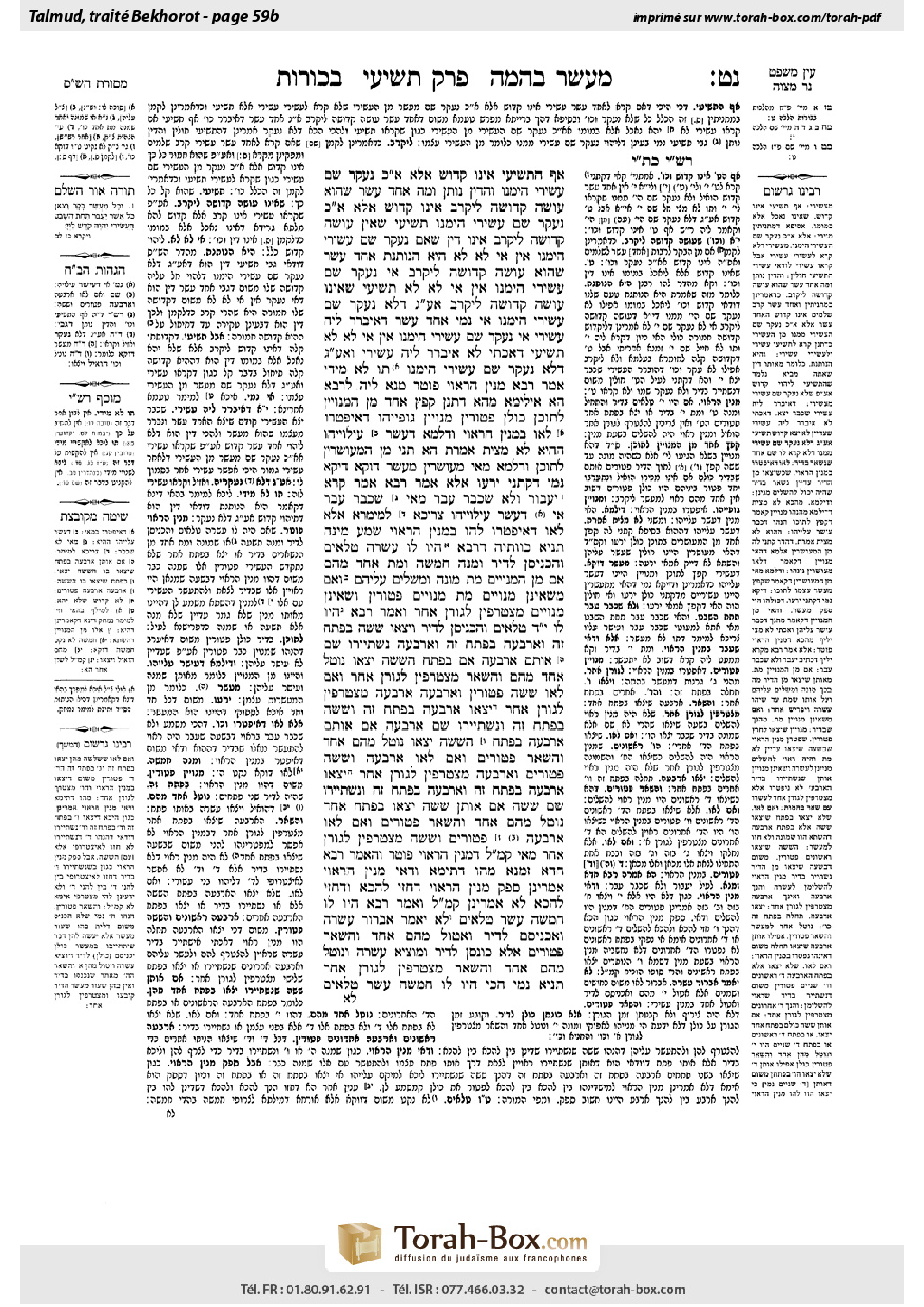
Bekhorot 59b: Talmud study for Daf Yomi
Study the Talmud for Daf Yomi with scanned pages, Hebrew text, English translations from Sefaria and AI-generated French translations.
Passage selection and English or AI-generated French translation are available where the scan has annotations. Daf Study is independent of Torah-Box and Sefaria.
Browse Bekhorot · בכורות · All tractatesBekhorot 59b text and translations
This page of Bekhorot includes the Aramaic text, an English translation and an AI-generated French translation, alongside the scan above.
בכורות נ״ט ב · Aramaic and Hebrew text
אַף הַתְּשִׁיעִי אֵינוֹ קָדוֹשׁ אֶלָּא אִם כֵּן נֶעֱקַר שֵׁם עֲשִׂירִי הֵימֶנּוּ, וְהַדִּין נוֹתֵן.
וּמָה אַחַד עָשָׂר שֶׁהוּא עוֹשֶׂה קְדוּשָּׁה לִיקְרַב, אֵינוֹ קָדוֹשׁ אֶלָּא אִם כֵּן נֶעֱקַר שֵׁם ״עֲשִׂירִי״ הֵימֶנּוּ, תְּשִׁיעִי שֶׁאֵין עוֹשֶׂה קְדוּשָּׁה לִיקְרַב — אֵינוֹ דִּין שֶׁאִם נֶעֱקַר שֵׁם ״עֲשִׂירִי״ הֵימֶנּוּ — אִין, אִי לָא — לָא?
הִיא הַנּוֹתֶנֶת! אַחַד עָשָׂר שֶׁהוּא עוֹשֶׂה קְדוּשָּׁה לִיקְרַב, אִי נֶעֱקַר שֵׁם עֲשִׂירִי הֵימֶנּוּ — אִין, אִי לָא — לָא; תְּשִׁיעִי שֶׁאֵינוֹ עוֹשֶׂה קְדוּשָּׁה לִיקְרַב, אַף עַל גַּב דְּלָא נֶעֱקַר שֵׁם עֲשִׂירִי הֵימֶנּוּ.
אִי נָמֵי, אַחַד עָשָׂר, דְּאִיבָּרַר לֵיהּ עֲשִׂירִי — אִי נֶעֱקַר שֵׁם עֲשִׂירִי הֵימֶנּוּ — אִין, אִי לָא — לָא.
תְּשִׁיעִי, דְּאַכַּתִּי לָא אִיבָּרַר לֵיהּ עֲשִׂירִי, וְאַף עַל גַּב דְּלָא נֶעֱקַר שֵׁם ״עֲשִׂירִי״ הֵימֶנּוּ, תּוּ לָא מִידִּי.
אָמַר רָבָא: מִנְיָן הָרָאוּי פּוֹטֵר. מְנָא לֵיהּ לְרָבָא הָא? אִילֵּימָא מֵהָא דִּתְנַן: קָפַץ אֶחָד מִן הַמְּנוּיִין לְתוֹכָן — כּוּלָּן פְּטוּרִין. מְנוּיִין גּוּפַיְיהוּ דְּאִיפְּטַרוּ — לָאו בְּמִנְיָן הָרָאוּי?
וְדִלְמָא דְּעַשַּׂר עִילָּוַיְיהוּ!
הָהִיא לָא מָצֵית אָמְרַתְּ, הָא תָּנֵי: מִן הַמְעוּשָּׂרִין לְתוֹכָן!
וְדִלְמָא מַאי ״מְעוּשָּׂרִין״? מַעֲשֵׂר דַּוְקָא, דַּיְקָא נָמֵי דְּקָתָנֵי ״יִרְעוּ״!
אֶלָּא אָמַר רָבָא: אָמַר קְרָא ״יַעֲבוֹר״, וְלֹא שֶׁכְּבָר עָבַר. מַאי שֶׁכְּבָר עָבַר? אִי דְּעַשַּׂר עִילָּוַיְיהוּ — צְרִיכָא לְמֵימְרָא? אֶלָּא לָאו דְּאִיפְּטַרוּ לְהוּ בְּמִנְיָן הָרָאוּי? שְׁמַע מִינַּהּ.
תַּנְיָא כְּוָותֵיהּ דְּרָבָא: הָיוּ לוֹ עֲשָׂרָה טְלָאִים וְהִכְנִיסָן לַדִּיר, וּמָנֶה חֲמִשָּׁה, וּמֵת אֶחָד מֵהֶם — אִם מִן הַמְּנוּיִים מֵת — מוֹנֶה וּמַשְׁלִים עֲלֵיהֶם, וְאִם מִשֶּׁאֵינָן מְנוּיִים מֵת — מְנוּיִים פְּטוּרִין, וְשֶׁאֵינָן מְנוּיִים מִצְטָרְפִין לַגּוֹרֶן אַחֵר.
וְאָמַר רָבָא: הָיוּ לוֹ אַרְבָּעָה עָשָׂר טְלָאִים וְהִכְנִיסָן לְדִיר, וְיָצְאוּ שִׁשָּׁה בְּפֶתַח זֶה, וְאַרְבָּעָה בְּפֶתַח זֶה, וְאַרְבָּעָה נִשְׁתַּיְּירוּ שָׁם. אוֹתָם אַרְבָּעָה, אִם בְּפֶתַח הַשִּׁשָּׁה יָצְאוּ — נוֹטֵל אֶחָד מֵהֶם, וְהַשְּׁאָר מִצְטָרְפִין לְגוֹרֶן אַחֵר;
וְאִם לָאו — שִׁשָּׁה פְּטוּרִין, וְאַרְבָּעָה אַרְבְּעָה מִצְטָרְפִין לְגוֹרֶן אַחֵר.
יָצְאוּ אַרְבָּעָה בְּפֶתַח זֶה, וְשִׁשָּׁה בְּפֶתַח זֶה, וְנִשְׁתַּיְּירוּ שָׁם אַרְבָּעָה — אִם אוֹתָם אַרְבָּעָה בְּפֶתַח הַשִּׁשָּׁה יָצְאוּ — נוֹטֵל מֵהֶם אֶחָד, וְהַשְּׁאָר פְּטוּרִים; וְאִם לָאו — אַרְבָּעָה וְשִׁשָּׁה פְּטוּרִים, וְאַרְבָּעָה מִצְטָרְפִין לְגוֹרֶן אַחֵר.
יָצְאוּ אַרְבָּעָה בְּפֶתַח זֶה, וְאַרְבָּעָה בְּפֶתַח זֶה, וְנִשְׁתַּיְּירוּ שָׁם שִׁשָּׁה — אִם אוֹתָן שִׁשָּׁה יָצְאוּ בְּפֶתַח אֶחָד — נוֹטֵל מֵהֶם אֶחָד וְהַשְּׁאָר פְּטוּרִים; וְאִם לָאו — אַרְבָּעָה פְּטוּרִים, וְשִׁשָּׁה מִצְטָרְפִין לְגוֹרֶן אַחֵר.
מַאי קָא מַשְׁמַע לַן, דְּמִנְיָן הָרָאוּי פּוֹטֵר? וְהָאַמְרַהּ רָבָא חֲדָא זִמְנָא! מַהוּ דְּתֵימָא: וַדַּאי מִנְיָן הָרָאוּי אָמְרִינַן, סְפֵק מִנְיָן הָרָאוּי, דַּחֲזֵי לְהָכָא וְדַחֲזֵי לְהָכָא — לָא אָמְרִינַן, קָא מַשְׁמַע לַן.
וְאָמַר רָבָא: הָיוּ לוֹ חֲמִשָּׁה עָשָׂר טְלָאִים, לֹא יֹאמַר: אֶבְרוֹר עֲשָׂרָה וְאַכְנִיסֵם לַדִּיר וְאֶטּוֹל מֵהֶם אֶחָד, וְהַשְּׁאָר פְּטוּרִים, אֶלָּא כּוֹנְסָן לַדִּיר, וּמוֹצִיא עֲשָׂרָה, וְנוֹטֵל מֵהֶם אֶחָד, וְהַשְּׁאָר מִצְטָרְפִין לְגוֹרֶן אַחֵר. תַּנְיָא נָמֵי הָכִי: הָיוּ לוֹ חֲמִשָּׁה עָשָׂר טְלָאִים,
Bekhorot 59b · English translation
Even the ninth that was accidentall y designated as the tenth is not sanctified and may be eaten before it develops a blemish, unless the name of the tenth is removed from the tenth animal, i.e., if the owner erred also in that he called the tenth animal the ninth. And logical reasoning leads to this conclusion.
The Gemara explains the logical reasoning: The halakha is that if one designated the ninth animal as the tenth, and the tenth as the tenth, and the eleventh as the tenth, then the eleventh is not consecrated. This is because in any situation where the name of the tenth was not removed from the tenth animal, the eleventh, which was called the tenth, is not consecrated. And if the eleventh animal, which becomes sanctified to be sacrificed as a peace offering, as stated in the mishna on 60a, is sanctified only if the name of the tenth is removed from the tenth animal, then with regard to the ninth animal, which does not become sanctified to be sacrificed but is eaten once it develops a blemish, is it not logical that if the name of the tenth is removed from the actual tenth animal, then yes, the ninth animal has sanctity and may be eaten only once it develops a blemish, but if not, then it is not sanctified at all and may be eaten even without a blemish?
The Gemara rejects this logical derivation: That claim itself provides support for the contrary opinion. With regard to the eleventh animal, which becomes sanctified with a stringent sanctity to be sacrificed as a peace offering, if the name of the tenth is removed from the actual tenth animal, then yes, the eleventh becomes sanctified, but if the designation of being the tenth is not removed from the tenth, then the eleventh does not become sanctified. But with regard to the ninth animal, which does not become sanctified with the stringent sanctity to be sacrificed, one can say that even though the name of the tenth animal is not removed from the tenth animal, nevertheless the ninth becomes sanctified.
Alternatively, there is another distinction between the two cases. With regard to the eleventh animal, which is sanctified only after the tenth animal has been selected, as it has emerged from the pen, one can claim that if the name of the tenth is removed from the tenth animal, then yes, the eleventh becomes sanctified, but if the name of the tenth is not removed from the tenth animal, the eleventh does not become sanctified.
But with regard to the ninth animal, which becomes sanctified at a time when the tenth animal has not yet been selected, as the tenth animal has not yet left the pen, if the owner accidentally designated that ninth animal as the tenth it becomes sanctified, and in such a case this is the halakha even though the name of the tenth animal is not removed from the actual tenth animal. The Gemara adds that there is nothing more to add to that explanation, and the opinion of Rabbi Shimon ben Yehuda in the name of Rabbi Shimon is rejected.
Rava says: A tally fit to reach ten exempts the animals that have been counted from being tithed. The Gemara asks: From where does Rava derive this halakha? If we say he derives it from that which we learned in the mishna, this is problematic. The Gemara cites the relevant statement of the mishna: If before one completed tithing his animals, one of those counted jumped back into the pen among the animals that were not yet counted, all those in the pen are exempt from being tithed, as each of them could be the animal that was already counted. The Gemara clarifies: With regard to this halakha concerning which the counted animals themselves are exempt, is it not because they were counted with a tally fit to reach ten?
The Gemara rejects this suggestion: But perhaps this is referring to a case where the tenth animal also came out of the pen, and the owner tithed it on behalf of the others that were counted. If so, they are not exempt simply because they were counted with a tally fit to reach ten but because they were actually tithed.
The Gemara counters: You cannot say that the mishna is addressing a situation where one of the animals for which tithe had already been separated jumped back in, as the latter clause of the mishna teaches: If one of those animals that had been tithed jumped back into the pen among the animals that were not yet counted. This indicates that in the situation described in the first clause the animals had been counted but not yet tithed.
The Gemara rejects this claim: But perhaps, what is the meaning of the term: Animals that had been tithed? This is referring specifically to the tenth animal, which is the actual tithe. And accordingly, the language of the mishna is also precise, as it teaches: All the animals must graze until they become unfit for sacrifice, and thereafter they may be eaten in their blemished state by their owner. Concerning animal tithe, this halakha applies specifically to the tenth animal when it reentered the pen, and not to the other nine. Therefore, the Gemara has not yet found a source for Rava’s halakha.
Rather, Rava says the verse states: “Whatever passes under the rod, the tenth shall be sacred to the Lord” (Leviticus 27:32). This indicates that only an animal that will pass under the rod must be tithed, but not an animal that has already passed under the rod. Rava elaborates: What it the meaning of: An animal that has already passed? If it means that one has separated tithe for it, is it necessary for a verse to state this? Of course an animal that has been tithed does not need to be tithed again. Rather, is it not referring to a case where the animals have become exempt through a tally fit to reach ten? Conclude from this that a tally fit to reach ten renders an animal exempt from being tithed.
It is taught in a baraita in accordance with the opinion of Rava: In a case where one had ten lambs and he brought them into the pen and counted five, and then one of them died, if one of those animals that had been counted died, he continues to count and completes the tithe for them. But if one of the animals that had not been counted died, those animals that had been counted are exempt, and those animals that had not been counted combine with animals born later, to be tithed in another designated time of gathering.
§ And Rava says: In a case where one had fourteen lambs and brought them into the pen, and six of the lambs emerged first, through this opening on one side of the pen, and four lambs emerged afterward through that opening on the other side of the pen, and four lambs remained there, if those four that remained came out by the opening through which the six lambs emerged, he takes the last one of them as animal tithe. And the remainder, i.e., the four that emerged through the other opening, combine with animals born later, to be tithed in another designated time of gathering.
But if not, i.e., if the last four remained in the pen or came out through the same opening through which the other four lambs emerged, then the six that emerged first are exempt from animal tithe, as they were part of a tally fit to reach ten; and the four that came out next, from the other opening, and the last four, combine with animals born later, to be tithed in another designated time of gathering.
Rava continues: In a case where four of the fourteen lambs emerged first, through this opening on one side of the pen, and six lambs came out afterward through that other opening, and four lambs remained there, if those four that remained come out by the opening through which the six lambs emerged, the owner takes the last one of them as animal tithe, and the remainder, i.e., the four that went out of the other opening, are exempt, as they were part of a tally fit to reach ten. But if not, i.e., if the last four emerge via the same opening as the first four, the four that came out first and the six that emerged through the other opening are exempt, as there were enough lambs left to complete the ten when all these left. And the four that went out last combine with animals born later, to be tithed in another designated time of gathering.
Rava continues: In a case where four of the fourteen lambs emerged first, through this opening, and four lambs came out afterward through that other opening, and six lambs remained there, if those six that remained come out through any one opening, he takes one of them as animal tithe, and the remainder, i.e., the four that went out of the other opening, are exempt, as they were part of a tally fit to reach ten. But if not, i.e., if the six remain in the pen, the four sheep that emerged on this side and the four that came out on that side are exempt. And the six that remain combine with animals born later, to be tithed in another designated time of gathering.
The Gemara asks: What is Rava teaching us? Is he teaching that any animal that comes out of the pen as part of a tally fit to reach ten is exempt? But didn’t Rava say that already once? The Gemara answers: Rava’s statement is necessary, lest you say that only if the animals emerge as part of a tally that is definitely fit to reach ten do we say they are exempt. But if they come out as part of a tally with regard to which it is uncertain whether it is fit to reach ten, such as in this case where the remaining animals are fit to come out here and are fit to come out there, and therefore the first animals might not be part of a counting that will reach ten, we do not say they are exempt. Therefore, Rava teaches us that even a tally that is uncertain to reach ten exempts the animals from tithe.
§ And Rava says: If one had fifteen lambs, he may not say: I will separate ten and bring them into the pen, and I will take one of them as animal tithe, and the rest will be exempt. Rather, he must bring them all into the pen, and remove ten of them by causing them to emerge from the opening, and take one of them, i.e., the one that emerges tenth, as animal tithe. And the remainder combine with animals born later, to be tithed in another designated time of gathering. This is also taught in a baraita: If one had fifteen lambs,
Bekhorot 59b · Traduction française (IA)
Même le neuvième, qui a été accidentellement désigné comme le dixième, n'est pas sanctifié et peut être mangé avant qu'il ne développe une tache, à moins que le nom du dixième ne soit retiré de l'animal dixième, c'est-à-dire si l'owner s'est également trompé en appelant l'animal dixième le neuvième. Et la raison logique mène à cette conclusion.
La Guemara explique la raison logique : La halakha est que si l'on a désigné l'animal neuvième comme le dixième, et le dixième comme le dixième, et le onzième comme le dixième, alors le onzième n'est pas sanctifié. Cela est dû au fait que dans toute situation où le nom du dixième n'a pas été retiré de l'animal dixième, le onzième, qui a été appelé le dixième, n'est pas sanctifié. Et si l'animal onzième, qui devient sanctifié pour être sacrifié comme offrande de paix, comme indiqué dans la Michna du 60a, est sanctifié uniquement si le nom du dixième est retiré de l'animal dixième, alors concernant l'animal neuvième, qui ne devient pas sanctifié pour être sacrifié mais est mangé une fois qu'il développe une tache, est-il logique que si le nom du dixième est retiré de l'animal dixième, alors oui, l'animal neuvième est sanctifié et peut être mangé uniquement une fois qu'il développe une tache, mais si ce n'est pas le cas, alors il n'est pas sanctifié du tout et peut être mangé même sans tache ?
La Guemara rejette cette dérivation logique : Cette affirmation elle-même fournit un soutien à l'opinion contraire. Concernant l'animal onzième, qui devient sanctifié avec une sanctification stricte pour être sacrifié comme offrande de paix, si le nom du dixième est retiré de l'animal dixième, alors oui, l'animal onzième devient sanctifié, mais si la désignation d'être le dixième n'est pas retirée de l'animal dixième, alors l'animal onzième ne devient pas sanctifié. Mais concernant l'animal neuvième, qui ne devient pas sanctifié avec la sanctification stricte pour être sacrifié, on peut dire que même si le nom de l'animal dixième n'est pas retiré de l'animal dixième, néanmoins l'animal neuvième devient sanctifié.
Une autre distinction existe entre les deux cas. Concernant l'animal onzième, qui est sanctifié seulement après que l'animal dixième ait été sélectionné, puisqu'il est sorti de la basse-cour, on peut affirmer que si le nom du dixième est retiré de l'animal dixième, alors oui, l'animal onzième devient sanctifié, mais si le nom du dixième n'est pas retiré de l'animal dixième, l'animal onzième ne devient pas sanctifié.
Mais concernant l'animal neuvième, qui devient sanctifié à un moment où l'animal dixième n'a pas encore été sélectionné, puisqu'il n'a pas encore quitté la basse-cour, si l'owner a accidentellement désigné cet animal neuvième comme le dixième, il devient sanctifié, et dans ce cas, c'est la halakha même si le nom de l'animal dixième n'est pas retiré de l'animal dixième. La Guemara ajoute que rien n'ajoute à cette explication, et l'opinion de Rabbi Shimon ben Yehuda en nom de Rabbi Shimon est rejetée.
Rava dit : Un décompte suffisant pour atteindre dix exempt les animaux comptés de la tithes. La Guemara demande : D'où Rava tire-t-il cette halakha ? Si nous disons qu'il la tire de ce que nous avons appris dans la Michna, cela est problématique. La Guemara cite l'affirmation pertinente de la Michna : Si avant que l'propriétaire n'ait achevé la tithes, l'un des animaux comptés est revenu dans la basse-cour parmi les animaux non encore comptés, tous ceux dans la basse-cour sont exemptés de la tithes, car chacun d'eux pourrait être l'animal déjà compté. La Guemara clarifie : Concernant cette halakha concernant laquelle les animaux comptés eux-mêmes sont exemptés, n'est-ce pas parce qu'ils ont été comptés avec un décompte suffisant pour atteindre dix ?
La Guemara rejette cette suggestion : Mais peut-être s'agit-il d'un cas où l'animal dixième est également sorti de la basse-cour, et l'propriétaire a tithé celui-ci à la place des autres comptés. Si c'est le cas, ils ne sont pas exemptés simplement parce qu'ils ont été comptés avec un décompte suffisant pour atteindre dix, mais parce qu'ils ont été tithés effectivement.
La Guemara contredit : Vous ne pouvez pas dire que la Michna s'adresse à un cas où l'un des animaux pour lesquels la tithes avait déjà été séparée est revenu dans la basse-cour, car la dernière partie de la Michna enseigne : Si l'un de ces animaux qui avait été tithé est revenu dans la basse-cour parmi les animaux non encore comptés. Cela indique que dans le cas décrit dans la première partie, les animaux avaient été comptés mais pas encore tithés.
La Guemara rejette cette affirmation : Mais peut-être, quelle est la signification du terme : animaux tithés ? Cela fait référence spécifiquement à l'animal dixième, qui est la véritable tithes. Et ainsi, la langue de la Michna est précise, car elle enseigne : Tous les animaux doivent paître jusqu'à ce qu'ils deviennent inaptes à la sacrifice, et ensuite ils peuvent être mangés dans leur état blemi par leur propriétaire. Concernant la tithes des animaux, cette halakha s'applique spécifiquement à l'animal dixième lorsqu'il est revenu dans la basse-cour, et non aux autres neuf. Ainsi, la Guemara n'a pas encore trouvé une source pour la halakha de Rava.
Plutôt, Rava dit que le verset dit : « Tout ce qui passe sous le bâton, le dixième sera saint au Seigneur » (Lévitique 27:32). Cela indique que seul un animal qui passera sous le bâton doit être tithé, mais pas un animal qui a déjà passé sous le bâton. Rava développe : Quelle est la signification de : un animal qui a déjà passé ? Si cela signifie que l'on a séparé la tithes pour lui, est-il nécessaire que le verset le stipule ? Bien sûr, un animal tithé ne doit pas être tithé à nouveau. Plutôt, n'est-ce pas ce qui fait référence à un cas où les animaux sont devenus exemptés grâce à un décompte suffisant pour atteindre dix ? Concluez-en que un décompte suffisant pour atteindre dix rend un animal exempt de la tithes.
Il est enseigné dans une baraïta selon l'opinion de Rava : Dans un cas où l'on avait dix agneaux et qu'on les avait introduits dans la cour et comptés cinq, et qu'un d'entre eux mourut, si l'un des animaux déjà comptés est mort, il continue à compter et accomplit l'offrande de dixième pour eux. Mais si l'un des animaux non comptés est mort, ceux qui avaient été comptés sont exemptés, et ceux qui n'avaient pas été comptés s'unissent avec les animaux nés plus tard, pour être tithés à une autre époque déterminée de rassemblement.
§ Et Rava dit : Dans un cas où l'on avait quatorze agneaux et qu'on les avait introduits dans la cour, et six d'entre eux sont sortis d'abord par cette ouverture d'un côté de la cour, et quatre agneaux sont sortis ensuite par cette autre ouverture de l'autre côté de la cour, et quatre agneaux restaient là, si ces quatre qui restaient sortent par l'ouverture par laquelle les six agneaux étaient sortis, l'propriétaire prend le dernier d'entre eux comme offrande de dixième. Et les restants, c'est-à-dire les quatre qui étaient sortis par l'autre ouverture, s'unissent avec les animaux nés plus tard, pour être tithés à une autre époque déterminée de rassemblement.
Mais si ce n'est pas le cas, c'est-à-dire si les quatre derniers restaient dans la cour ou sortaient par la même ouverture par laquelle les quatre autres agneaux étaient sortis, alors les six qui étaient sortis d'abord sont exemptés de l'offrande de dixième, car ils faisaient partie d'un comptage suffisant pour atteindre dix ; et les quatre qui sont sortis ensuite, de l'autre ouverture, et les quatre derniers, s'unissent avec les animaux nés plus tard, pour être tithés à une autre époque déterminée de rassemblement.
Rava continue : Dans un cas où quatre des quatorze agneaux sont sortis d'abord par cette ouverture d'un côté de la cour, et six agneaux sont sortis ensuite par cette autre ouverture, et quatre agneaux restaient là, si ces quatre qui restaient sortent par l'ouverture par laquelle les six agneaux sont sortis, l'propriétaire prend le dernier d'entre eux comme offrande de dixième, et les restants, c'est-à-dire les quatre qui sont sortis de l'autre ouverture, sont exemptés, car ils faisaient partie d'un comptage suffisant pour atteindre dix. Mais si ce n'est pas le cas, c'est-à-dire si les quatre derniers sortent par la même ouverture que les quatre premiers, les quatre qui sont sortis d'abord et les six qui sont sortis par l'autre ouverture sont exemptés, car il y avait suffisamment d'agneaux restants pour compléter les dix lorsque tous ces agneaux sont sortis. Et les quatre qui sont sortis en dernier s'unissent avec les animaux nés plus tard, pour être tithés à une autre époque déterminée de rassemblement.
Rava continue : Dans un cas où quatre des quatorze agneaux sont sortis d'abord par cette ouverture, et quatre agneaux sont sortis ensuite par cette autre ouverture, et six agneaux restaient là, si ces six qui restaient sortent par une seule ouverture, l'propriétaire prend l'un d'entre eux comme offrande de dixième, et les restants, c'est-à-dire les quatre qui sont sortis de l'autre ouverture, sont exemptés, car ils faisaient partie d'un comptage suffisant pour atteindre dix. Mais si ce n'est pas le cas, c'est-à-dire si les six restent dans la cour, les quatre agneaux qui sont sortis d'un côté et les quatre qui sont sortis de l'autre côté sont exemptés. Et les six qui restent s'unissent avec les animaux nés plus tard, pour être tithés à une autre époque déterminée de rassemblement.
La Guemara demande : Qu'est-ce que Rava nous enseigne ? Est-ce qu'il nous apprend que tout animal qui sort de la cour faisant partie d'un comptage suffisant pour atteindre dix est exempt ? Mais n'avait-il pas déjà dit cela ? La Guemara répond : L'enseignement de Rava est nécessaire, afin que l'on ne dise pas que seul un comptage dont on est certain qu'il atteint dix permet de dire qu'ils sont exemptés. Mais si les animaux sortent faisant partie d'un comptage dont on n'est pas certain qu'il atteint dix, comme dans ce cas où les animaux restants sont aptes à sortir ici et là, et donc les premiers animaux ne sont pas nécessairement partie d'un comptage qui atteint dix, on ne dit pas qu'ils sont exemptés. Ainsi, Rava nous enseigne que même un comptage dont on n'est pas certain qu'il atteint dix exempté les animaux de l'offrande de dixième.
§ Et Rava dit : Si l'on avait quinze agneaux, l'on ne peut pas dire : Je séparerai dix et je les introduirai dans la cour, et je prendrai l'un d'entre eux comme offrande de dixième, et les autres seront exemptés. Plutôt, l'on doit introduire tous dans la cour, et enlever dix d'entre eux en les faisant sortir par l'ouverture, et prendre l'un d'entre eux, c'est-à-dire celui qui sort dixième, comme offrande de dixième. Et les restants s'unissent avec les animaux nés plus tard, pour être tithés à une autre époque déterminée de rassemblement. Cela est également enseigné dans une baraïta : Si l'on avait quinze agneaux,
Traduction française générée par IA à partir de l’édition anglaise de Sefaria. Vérifie toujours un passage avec le texte source.
Text from Sefaria: William Davidson Edition - Vocalized Aramaic (CC BY NC); William Davidson Edition - English (CC BY NC).