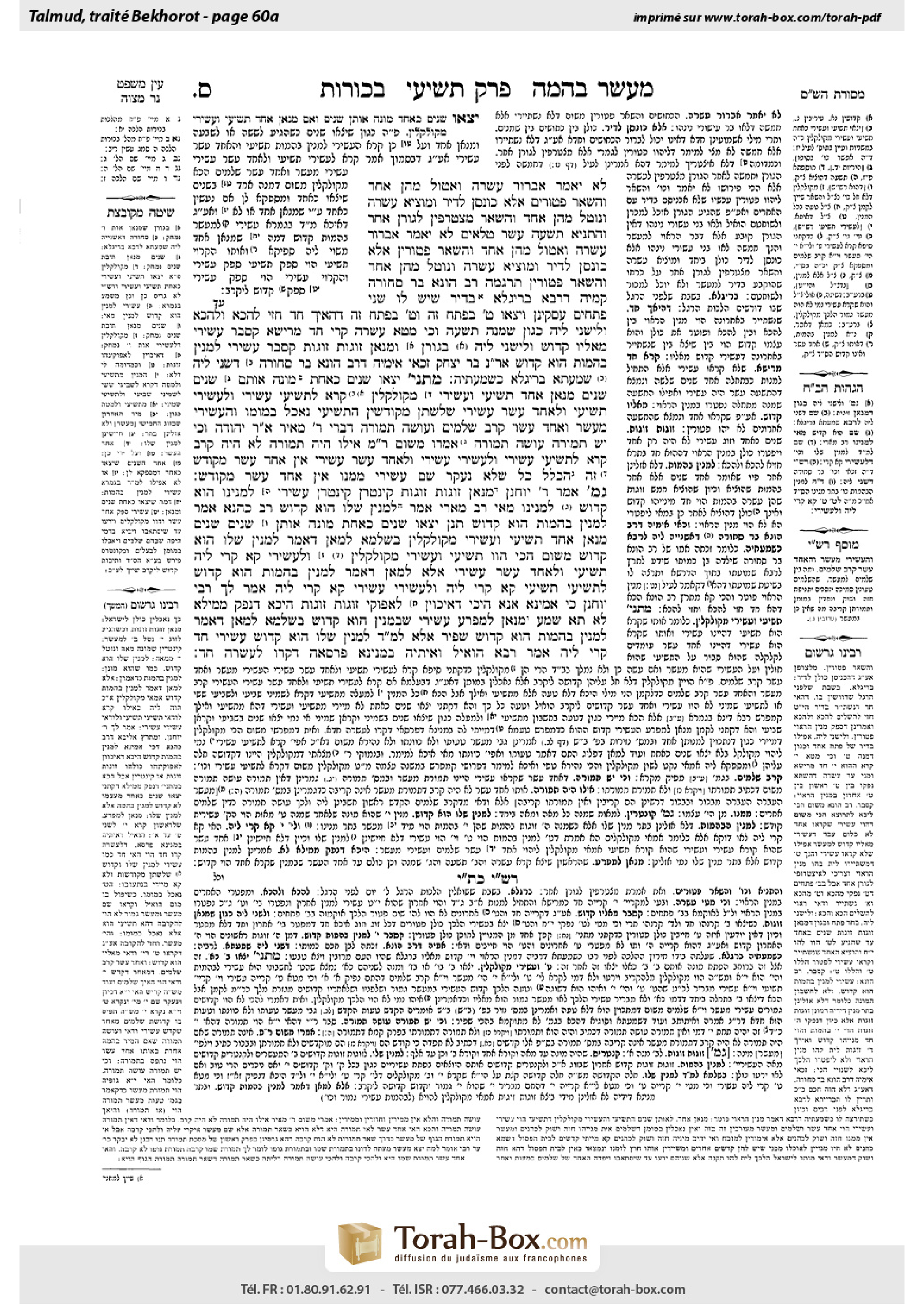
Bekhorot 60a: Talmud study for Daf Yomi
Study the Talmud for Daf Yomi with scanned pages, Hebrew text, English translations from Sefaria and AI-generated French translations.
Passage selection and English or AI-generated French translation are available where the scan has annotations. Daf Study is independent of Torah-Box and Sefaria.
Browse Bekhorot · בכורות · All tractatesBekhorot 60a text and translations
This page of Bekhorot includes the Aramaic text, an English translation and an AI-generated French translation, alongside the scan above.
בכורות ס׳ א · Aramaic and Hebrew text
לֹא יֹאמַר: אֶבְרוֹר עֲשָׂרָה וְאֶטּוֹל מֵהֶן אֶחָד וְהַשְּׁאָר פְּטוּרִים, אֶלָּא כּוֹנְסָן לַדִּיר, וּמוֹצִיא עֲשָׂרָה, וְנוֹטֵל מֵהֶן אֶחָד, וְהַשְּׁאָר מִצְטָרְפִין לְגוֹרֶן אַחֵר.
וְהָתַנְיָא: תִּשְׁעָה עָשָׂר טְלָאִים, לֹא יֹאמַר: אֶבְרוֹר עֲשָׂרָה וְאֶטּוֹל מֵהֶן אֶחָד, וְהַשְּׁאָר פְּטוּרִין, אֶלָּא כּוֹנְסָן לַדִּיר, וּמוֹצִיא עֲשָׂרָה וְנוֹטֵל מֵהֶן אֶחָד, וְהַשְּׁאָר פְּטוּרִין.
תַּרְגְּמַהּ רַב הוּנָא בַּר סְחוֹרָה קַמֵּיהּ דְּרָבָא בְּרִיגְלָא: בְּדִיר שֶׁיֵּשׁ לוֹ שְׁנֵי פְתָחִים עָסְקִינַן, וְיָצְאוּ תִּשְׁעָה בְּפֶתַח זֶה וְתִשְׁעָה בְּפֶתַח זֶה, דְּהַאיְךְ חַד חָזֵי לְהָכָא וּלְהָכָא.
וְלִישַׁנֵּי לֵיהּ: כְּגוֹן שֶׁמָּנָה תִּשְׁעָה, וְכִי מְטָא עֲשָׂרָה קָרֵי ״חַד״ מֵרֵישָׁא! קָסָבַר: עֲשִׂירִי מֵאֵלָיו קָדוֹשׁ.
וְלִישַׁנֵּי לֵיהּ בְּגוֹרֶן, וּמְנָאָן זוּגוֹת זוּגוֹת! קָסָבַר: עֲשִׂירִי לְמִנְיָן בְּהֵמוֹת הוּא קָדוֹשׁ.
אָמַר רַב נַחְמָן בַּר יִצְחָק: זְכַאי אִימֵּיהּ דְּרַב הוּנָא בַּר סְחוֹרָה, דְּשַׁנִּי לֵיהּ שְׁמַעְתָּא בְּרִיגְלָא כִּשְׁמַעְתֵּיהּ.
מַתְנִי׳ יָצְאוּ שְׁנַיִם כְּאַחַת — מוֹנֶה אוֹתָם שְׁנַיִם שְׁנַיִם, מְנָאָן אֶחָד — תְּשִׁיעִי וַעֲשִׂירִי מְקוּלְקָלִין.
קָרָא לַתְּשִׁיעִי ״עֲשִׂירִי״, וְלָעֲשִׂירִי ״תְּשִׁיעִי״, וְלָאַחַד עָשָׂר ״עֲשִׂירִי״ — שְׁלָשְׁתָּן מְקוּדָּשִׁין: הַתְּשִׁיעִי נֶאֱכָל בְּמוּמוֹ, וְהָעֲשִׂירִי מַעֲשֵׂר, וְאַחַד עָשָׂר קָרֵב שְׁלָמִים וְעוֹשֶׂה תְּמוּרָה, דִּבְרֵי רַבִּי מֵאִיר.
אָמַר רַבִּי יְהוּדָה: וְכִי יֵשׁ תְּמוּרָה עוֹשָׂה תְּמוּרָה? אָמְרוּ מִשּׁוּם רַבִּי מֵאִיר: אִילּוּ הָיָה תְּמוּרָה — לֹא הָיָה קָרֵב. קָרָא לַתְּשִׁיעִי ״עֲשִׂירִי״, וְלָעֲשִׂירִי ״עֲשִׂירִי״, וְלָאַחַד עָשָׂר ״עֲשִׂירִי״ — אֵין אַחַד עָשָׂר מְקוּדָּשׁ. זֶה הַכְּלָל: כֹּל שֶׁלֹּא נֶעֱקַר שֵׁם עֲשִׂירִי מִמֶּנּוּ, אֵין אַחַד עָשָׂר מְקוּדָּשׁ.
גְּמָ׳ אָמַר רַבִּי יוֹחָנָן: מְנָאָן זוּגוֹת זוּגוֹת, קִינְטָרִין קִינְטָרִין — עֲשִׂירִי לְמִנְיָנוֹ הוּא קָדוֹשׁ.
״לְמִנְיָנוֹ״ מַאי? רַב מָארִי אָמַר: לַמִּנְיָן שֶׁלּוֹ הוּא קָדוֹשׁ, רַב כָּהֲנָא אָמַר: לְמִנְיַן בְּהֵמוֹת הוּא קָדוֹשׁ.
תְּנַן: יָצְאוּ שְׁנַיִם כְּאַחַת — מוֹנֶה אוֹתָן שְׁנַיִם שְׁנַיִם. מְנָאָן אֶחָד — תְּשִׁיעִי וַעֲשִׂירִי מְקוּלְקָלִין.
בִּשְׁלָמָא לְמַאן דְּאָמַר: לַמִּנְיָן שֶׁלּוֹ הוּא קָדוֹשׁ, מִשּׁוּם הָכִי הָווּ תְּשִׁיעִי וַעֲשִׂירִי מְקוּלְקָלִין, וְלָעֲשִׂירִי קָא קָרֵי לֵיהּ ״תְּשִׁיעִי״, וְלָאַחַד עָשָׂר ״עֲשִׂירִי״. אֶלָּא לְמַאן דְּאָמַר: לְמִנְיַן בְּהֵמוֹת הוּא קָדוֹשׁ, לַתְּשִׁיעִי ״תְּשִׁיעִי״ קָא קָרֵי לֵיהּ, וְלָעֲשִׂירִי ״עֲשִׂירִי״ קָא קָרֵי לֵיהּ!
אָמַר לָךְ רַבִּי יוֹחָנָן: כִּי אָמֵינָא אֲנָא — הֵיכִי דְּאִיכַּוֵּין לְאַפּוֹקֵי זוּגוֹת זוּגוֹת, הֵיכָא דִּנְפַק מִמֵּילָא — לָא.
תָּא שְׁמַע: מְנָאָן לְמַפְרֵעַ — עֲשִׂירִי שֶׁבְּמִנְיָן הוּא קָדוֹשׁ. בִּשְׁלָמָא לְמַאן דְּאָמַר לְמִנְיַן בְּהֵמוֹת הוּא קָדוֹשׁ — שַׁפִּיר, אֶלָּא לְמַאן דְּאָמַר לַמִּנְיָן שֶׁלּוֹ הוּא קָדוֹשׁ, עֲשִׂירִי ״חַד״ קָרֵי לֵיהּ!
אָמַר רָבָא: הוֹאִיל וְאִיתֵיהּ בְּמִנְיָנָא פָּרְסָאָה, דְּקָרוּ לְעַשְׂרָה ״חַד״.
Bekhorot 60a · English translation
he may not say: I will separate ten and bring them into the pen, and I will take one of them as animal tithe, and the rest will be exempt. Rather, he must bring them all into the pen and remove ten of them by causing them to emerge from the opening, and take one of them, the tenth one, as animal tithe. And the remainder combine with animals born later, to be tithed in another designated time of gathering.
The Gemara asks: But isn’t it taught in a baraita that if one has nineteen lambs he may not say: I will separate ten and bring them into the pen, and I will take one of them as animal tithe and the rest will be exempt; rather, he must bring them all into the pen and remove ten of them by causing them to emerge from the opening, and take one of them, the tenth one, and the remainder are exempt? According to this baraita, the remainder are not combined with animals born later.
Rav Huna bar Seḥora interpreted the baraita before Rava at the time of the Festival discourse: We are dealing with a pen that has two openings. And nine of the lambs emerged through this opening and nine of them went out through that opening, and this last one remaining in the pen is fit to come out here or to come out there. Therefore, all the lambs emerged as part of a tally fit to reach ten.
The Gemara challenges: But let him teach instead that the baraita is referring to a case where he counted nine, and when the tenth lamb arrived to be counted he called it number one and began counting again from the start. In such a case he designated only the nineteenth lamb that emerged as number ten, and therefore all the other lambs are exempt. The Gemara explains that Rav Huna bar Seḥora holds that the tenth animal to come out of the pen is sanctified of its own accord, even if it was designated as number one.
The Gemara challenges: But let him teach instead that the baraita is referring to a case of a designated time for gathering the animals, and that the pen has only one opening, but he counted them pair by pair, i.e., he called the first pair number one, the second pair number two, and so on. In this manner, the nineteenth lamb would be designated as number ten and thereby exempt the others. The Gemara explains that Rav Huna bar Seḥora holds that the tenth according to the number of animals is sanctified, regardless of how he counts them. Accordingly, one of the fifth pair would be the tithed animal, and the remaining nine would not be considered part of a tally fit to reach ten.
Rav Naḥman bar Yitzḥak said with regard to this incident: The mother of Rav Huna bar Seḥora merited to give birth to such a son, who explained the halakha before Rava at the time of the Festival discourse in accordance with Rava’s own halakha.
MISHNA: If two animals emerged as one, one counts them as twos, i.e., as though they came out one after the other. If he mistakenly counted two of the animals at the beginning or in the middle of the ten as one, and then continued his count, the ninth and the tenth are flawed, as he called the tenth: Ninth, and he called the eleventh: Tenth.
If he mistakenly called the ninth: Tenth, and the tenth: Ninth, and the eleventh: Tenth, the three of them are sacred, although each has a different halakhic status. The ninth is eaten in its blemished state; and the tenth is animal tithe, which is sacrificed in the Temple and eaten by its owner; and the eleventh is sacrificed as a peace offering, from which the breast and the thigh are given to the priest. And the eleventh renders a non-sacred animal that is exchanged for the peace offering consecrated as a substitute and he sacrifices it as a peace offering; this is the statement of Rabbi Meir.
Rabbi Yehuda said: The eleventh animal itself, which he called tenth, is a substitute for animal tithe, and does a substitute render another animal a substitute? Everyone agrees that a substitute is created only in exchange for an originally consecrated animal. The Sages said in the name of Rabbi Meir: The eleventh animal is not considered a substitute for the animal tithe, since if it were a substitute it would not be sacrificed, as the substitute for an animal tithe is not sacrificed. If one called the ninth animal: Tenth, and the tenth: Tenth, and the eleventh: Tenth, the eleventh is not consecrated. This is the principle: In any situation where the name of the tenth was not removed from the tenth animal, the eleventh that was called the tenth is not consecrated.
GEMARA: Rabbi Yoḥanan says: If one counted the animals pair by pair, i.e., he called the first pair: One, and the second pair: Two, and so on, or if one counted them hundred [kinteran] by hundred, the tenth according to his number is sanctified.
The Gemara asks: When Rabbi Yoḥanan says that the tenth is sanctified according to his number, what does he mean? Rav Mari says: It is sanctified according to his counting, i.e., all the animals in whichever pair or group he calls: Ten, are sanctified, e.g., the tenth pair, which consists of the nineteenth and twentieth animals. Rav Kahana says: It is sanctified according to the number of animals, regardless of how he designates them.
The Gemara cites support for Rav Mari’s opinion. We learned in the mishna: If two animals emerged as one, one counts them as twos. If he mistakenly counted a pair of animals in the middle as one and continued his count, the ninth and the tenth are flawed, as he called the tenth: Ninth, and the eleventh: Tenth.
Granted, according to the one who says: It is sanctified according to his counting, i.e., Rav Mari, it is due to that reason that the ninth and the tenth are flawed, because the number by which one designates them is significant, and he called the tenth animal the ninth, and the eleventh he designated as tenth. But according to the one who says that the animal is sanctified according to the number of animals regardless of how the owner designates each one, i.e., Rav Kahana, why are they flawed? It should be considered as though he called the ninth animal the ninth, and the tenth animal he called: Tenth.
The Gemara answers that according to Rav Kahana, Rabbi Yoḥanan could have said to you: When I said the designation goes according to the animal I was referring only to a case where he intended to take out the animals pair by pair, and he did not err. In such a case his designation is nullified and the animals are sanctified in accordance with the order they left the pen. But with regard to a case where the animal emerged by itself and the owner miscounted I did not say the designation goes according to the number of the animal, as the Torah explicitly includes a case where the sanctification follows a mistaken designation (see 60b).
The Gemara suggests: Come and hear another proof from a baraita: If one counted them backward, i.e., ten, nine, eight, and so on, the tenth animal in the numbering, which he designated as number one, is sanctified. Granted, according to the one who says that the tithe is sanctified according to the number of animals regardless of how he designates each animal, i.e., Rav Kahana, this works out well, as the tenth animal is sanctified. But according to the one who says it is sanctified according to his counting, i.e., Rav Mari, why is the tenth animal sanctified? After all, he called the tenth animal number one.
Rava said: The tenth animal is sanctified according to Rav Mari because it has been counted as number ten in Persian counting, as they call the tenth one in their language by the term one, i.e., they count only in units of ten, and call these units: One. Therefore, in this case there is no contradiction between the designation and the number of the animal.
Bekhorot 60a · Traduction française (IA)
il ne peut pas dire : je séparerai dix et je les mènerai dans l'enclos, et je prendrai l'un d'entre eux comme dîme animale, et le reste sera exempt. Il faut plutôt qu'il les mène tous dans l'enclos et qu'il en sorte dix en les faisant sortir par l'ouverture, et qu'il prenne l'un d'entre eux, le dixième, comme dîme animale. Et le reste s'unira aux bêtes nées plus tard, pour être tithées à un autre moment désigné pour la collecte.
La Guemara pose la question : Mais n'est-il pas enseigné dans une baraïta que si l'on a dix-neuf agneaux, on ne peut pas dire : je séparerai dix et je les mènerai dans l'enclos, et je prendrai l'un d'entre eux comme dîme animale, et le reste sera exempt ; il faut plutôt qu'il les mène tous dans l'enclos et qu'il en sorte dix en les faisant sortir par l'ouverture, et qu'il prenne l'un d'entre eux, le dixième, et le reste sera exempt. Selon cette baraïta, le reste ne s'unira pas aux bêtes nées plus tard.
Rav Huna bar Seḥora interpréta la baraïta devant Rava lors du discours de la fête : Nous sommes en présence d'un enclos ayant deux ouvertures. Et neuf des agneaux sont sortis par cette ouverture et neuf d'entre eux sont sortis par celle-ci, et ce dernier restant dans l'enclos est digne de sortir ici ou là. Ainsi, tous les agneaux sont sortis dans un décompte digne de parvenir à dix.
La Guemara conteste : Mais qu'il enseigne plutôt que la baraïta fait référence à un cas où l'on a compté neuf, et lorsque le dixième agneau est arrivé pour être compté, on l'a appelé numéro un et on a recommencé le décompte. Dans ce cas, on a désigné seulement l'agneau numéro dix-neuf qui est sorti comme dîme animale, et ainsi tous les autres agneaux sont exemptés. La Guemara explique que Rav Huna bar Seḥora considère que l'animal dixième à sortir de l'enclos est sanctifié de lui-même, même s'il a été désigné comme numéro un.
La Guemara conteste : Mais qu'il enseigne plutôt que la baraïta fait référence à un cas de moment désigné pour la collecte des bêtes, et que l'enclos a une seule ouverture, mais qu'on les a comptés par paires, c'est-à-dire qu'on a appelé la première paire numéro un, la deuxième paire numéro deux, etc. Ainsi, l'agneau numéro dix-neuf serait désigné comme numéro dix et donc exempterait les autres. La Guemara explique que Rav Huna bar Seḥora considère que l'animal dixième selon le nombre est sanctifié, indépendamment de la manière dont on compte. Ainsi, l'un des agneaux de la cinquième paire serait la dîme animale, et les neuf restants ne seraient pas considérés comme faisant partie d'un décompte digne de parvenir à dix.
Rav Naḥman bar Yitzḥak dit à propos de cet incident : La mère de Rav Huna bar Seḥora méritait de donner naissance à un tel fils, qui expliqua la halakha devant Rava lors du discours de la fête selon la halakha propre à Rava.
MICHNA : Si deux bêtes sont sorties en une, on les compte comme des paires, c'est-à-dire comme si elles étaient sorties l'une après l'autre. Si l'on a compté par erreur deux bêtes au début ou en milieu du décompte des dix comme une seule, et qu'on a continué le décompte, alors le neuvième et le dixième sont défectueux, car on a appelé le dixième : neuvième, et l'on a appelé le onzième : dixième.
Si l'on a appelé par erreur le neuvième : dixième, et le dixième : neuvième, et le onzième : dixième, les trois sont sacrés, bien que chacun ait un statut halakhique différent. Le neuvième est mangé dans son état déficient ; le dixième est la dîme animale, qui est sacrifiée dans le Temple et mangé par son propriétaire ; et le onzième est sacrifié comme offrande de paix, dont les côtes et la cuisse sont donnés au prêtre. Et le onzième rend un animal non sacré échangé pour l'offrande de paix consacrée comme substitut, et il le sacrifie comme offrande de paix ; c'est la déclaration de Rabbi Meir.
Rabbi Yehuda dit : L'agneau onzième, qu'il a appelé dixième, est un substitut pour la dîme animale, et un substitut rend-il un autre animal un substitut ? Tout le monde convient qu'un substitut est créé uniquement en échange d'un animal déjà consacré. Les Sages disent en nom de Rabbi Meir : L'agneau onzième n'est pas considéré comme un substitut pour la dîme animale, car s'il l'était, il ne serait pas sacrifié, car le substitut d'une dîme animale n'est pas sacrifié. Si l'on a appelé l'agneau neuvième : dixième, et l'agneau dixième : dixième, et l'agneau onzième : dixième, l'agneau onzième n'est pas consacré. C'est le principe : Dans tout cas où le nom du dixième n'a pas été retiré de l'animal dixième, l'agneau onzième appelé dixième n'est pas consacré.
GUEMARA : Rabbi Yoḥanan dit : Si l'on compte les bêtes par paires, c'est-à-dire qu'on appelle la première paire : un, la deuxième paire : deux, et ainsi de suite, ou si l'on compte les bêtes par centaines, le dixième selon son décompte est sanctifié.
La Guemara pose la question : Lorsque Rabbi Yoḥanan dit que le dixième est sanctifié selon son décompte, de quoi parle-t-il ? Rav Mari dit : Il est sanctifié selon son décompte, c'est-à-dire que tous les animaux dans la paire ou le groupe qu'il appelle : dix, sont sanctifiés, par exemple, la dixième paire, qui comprend les dix-neuvième et vingtième animaux. Rav Kahana dit : Il est sanctifié selon le nombre d'animaux, indépendamment de la manière dont on les désigne.
La Guemara cite un soutien pour l'opinion de Rav Mari. Nous avons appris dans la mishna : Si deux animaux sont sortis en un, on les compte comme des paires. Si l'on a compté par erreur une paire au milieu comme une seule et a continué le décompte, le neuvième et le dixième sont défectueux, car on a appelé le dixième : neuvième, et l'on a appelé le onzième : dixième.
D'accord, selon celui qui dit : Il est sanctifié selon son dénombrement, c'est-à-dire Rav Mari, c'est pour cette raison que le neuvième et le dixième sont imparfaits, car le nombre par lequel on désigne ces animaux est important, et il a appelé l'animal dixième le neuvième, et l'animal onzième il l'a désigné comme dixième. Mais selon celui qui dit que l'animal est sanctifié selon le nombre d'animaux indépendamment de la manière dont l'propriétaire désigne chaque animal, c'est-à-dire Rav Kahana, pourquoi sont-ils imparfaits ? Il devrait être considéré comme s'il avait appelé l'animal neuvième le neuvième, et l'animal dixième il l'avait appelé : Dixième.
La Guemara répond que selon Rav Kahana, Rabbi Yoḥanan aurait pu dire à l'égard de vous : Lorsque j'ai dit que la désignation dépend de l'animal, je veux dire uniquement dans le cas où il avait l'intention de sortir les animaux par paires, et qu'il n'avait pas commis d'erreur. Dans ce cas, sa désignation est annulée et les animaux sont sanctifiés selon l'ordre dans lequel ils sont sortis de la basse-cour. Mais concernant le cas où l'animal est sorti tout seul et que l'propriétaire a mal compté, je n'ai pas dit que la désignation dépend du nombre de l'animal, car la Torah inclut explicitement un cas où la sanctification suit une désignation erronée (voir 60b).
La Guemara suggère : Viens écouter une autre preuve d'une baraïta : Si l'on compte en sens inverse, c'est-à-dire dix, neuf, huit, et ainsi de suite, l'animal dixième dans le dénombrement, que l'on a désigné comme premier, est sanctifié. D'accord, selon celui qui dit que la dîme est sanctifiée selon le nombre d'animaux indépendamment de la manière dont l'propriétaire désigne chaque animal, c'est-à-dire Rav Kahana, cela s'explique bien, car l'animal dixième est sanctifié. Mais selon celui qui dit qu'il est sanctifié selon son dénombrement, c'est-à-dire Rav Mari, pourquoi l'animal dixième est-il sanctifié ? Après tout, il a appelé l'animal dixième le premier.
Rava dit : L'animal dixième est sanctifié selon Rav Mari car il a été compté comme dixième dans le système de comptage perse, car ils appellent le dixième « un » dans leur langue, c'est-à-dire qu'ils comptent uniquement par dizaines et appellent ces unités « un ». Ainsi, dans ce cas, il n'y a pas de contradiction entre la désignation et le nombre de l'animal.
Traduction française générée par IA à partir de l’édition anglaise de Sefaria. Vérifie toujours un passage avec le texte source.
Text from Sefaria: William Davidson Edition - Vocalized Aramaic (CC BY NC); William Davidson Edition - English (CC BY NC).