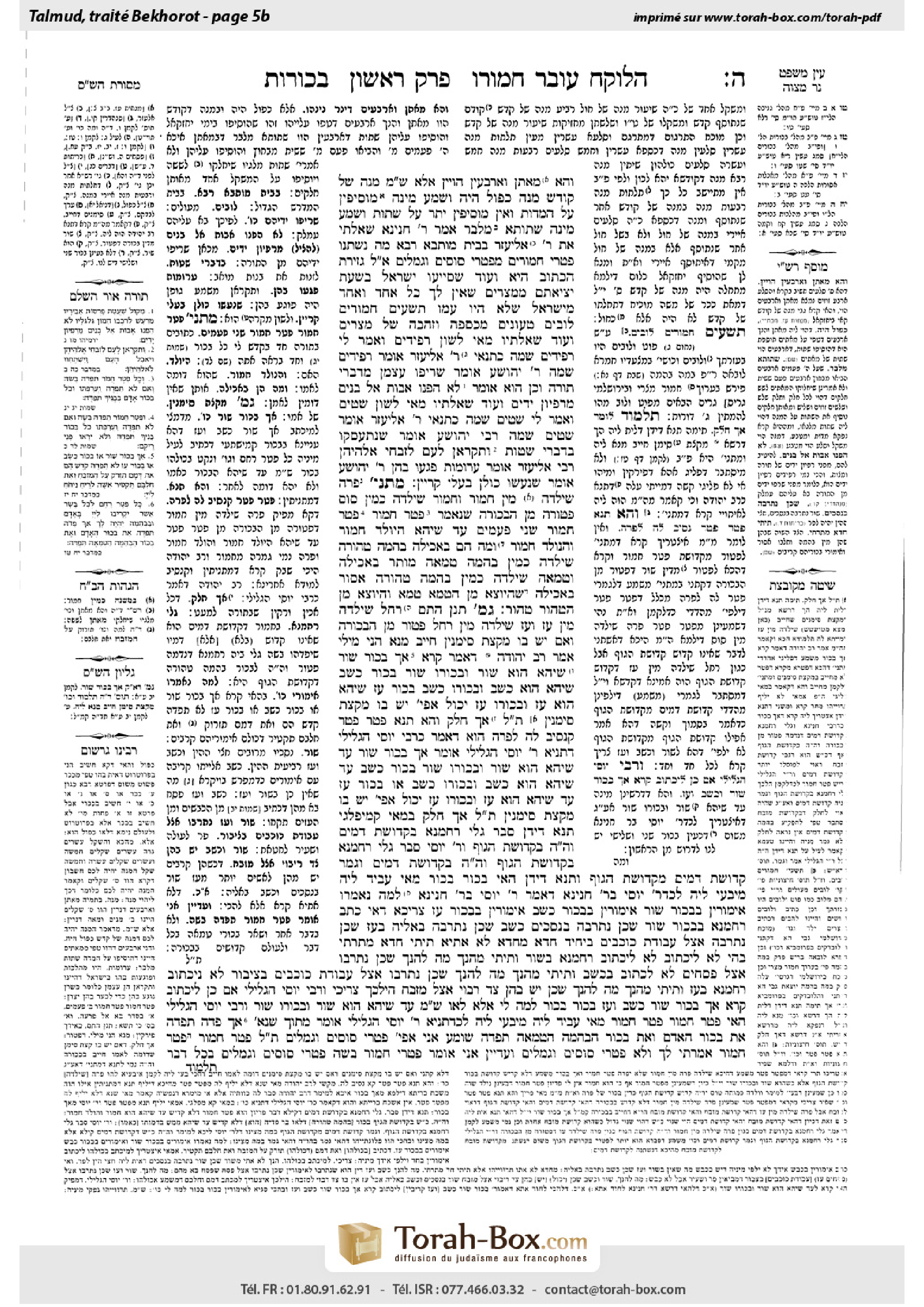
Bekhorot 5b: Talmud study for Daf Yomi
Study the Talmud for Daf Yomi with scanned pages, Hebrew text, English translations from Sefaria and AI-generated French translations.
Passage selection and English or AI-generated French translation are available where the scan has annotations. Daf Study is independent of Torah-Box and Sefaria.
Browse Bekhorot · בכורות · All tractatesBekhorot 5b text and translations
This page of Bekhorot includes the Aramaic text, an English translation and an AI-generated French translation, alongside the scan above.
בכורות ה׳ ב · Aramaic and Hebrew text
וְהָא מָאתַן וְאַרְבְּעִין הָוְיָין! אֶלָּא שְׁמַע מִינַּהּ: מָנֶה שֶׁל קוֹדֶשׁ מָנֶה כָּפוּל הָיָה.
וּשְׁמַע מִינַּהּ, מוֹסִיפִין עַל הַמִּדּוֹת, וְאֵין מוֹסִיפִין יָתֵר עַל שְׁתוּת, וּשְׁמַע מִינַּהּ שְׁתוּתָא מִלְּבַר.
אָמַר רַבִּי חֲנִינָא: שָׁאַלְתִּי אֶת רַבִּי אֱלִיעֶזֶר בְּבֵית מוֹתְבָא רַבָּא, מָה נִשְׁתַּנּוּ פִּטְרֵי חֲמוֹרִים מִפִּטְרֵי סוּסִים וּגְמַלִּים? אָמַר לִי: גְּזֵירַת הַכָּתוּב הִיא, וְעוֹד שֶׁסִּיְּיעוּ יִשְׂרָאֵל בִּשְׁעַת יְצִיאָתָם מִמִּצְרַיִם, שֶׁאֵין לָךְ כׇּל אֶחָד וְאֶחָד מִיִּשְׂרָאֵל שֶׁלֹּא הָיוּ עִמּוֹ תִּשְׁעִים חֲמוֹרִים לוּבִים טְעוּנִים מִכַּסְפָּהּ וּזְהָבָהּ שֶׁל מִצְרַיִם.
וְעוֹד שְׁאִלְתִּיו: מַאי לְשׁוֹן ״רְפִידִים״? וְאָמַר לִי: רְפִידִים שְׁמָהּ. כְּתַנָּאֵי: רַבִּי אֱלִיעֶזֶר אוֹמֵר: רְפִידִים שְׁמָהּ, רַבִּי יְהוֹשֻׁעַ אוֹמֵר: שֶׁרִיפּוּ עַצְמָן מִדִּבְרֵי תוֹרָה, וְכֵן הוּא אוֹמֵר: ״לֹא הִפְנוּ אָבוֹת אֶל בָּנִים מֵרִפְיוֹן יָדָיִם״.
וְעוֹד שְׁאִלְתִּיו: מַאי לְשׁוֹן ״שִׁטִּים״? וְאָמַר לִי: שִׁטִּים שְׁמָהּ. כְּתַנָּאֵי: רַבִּי אֱלִיעֶזֶר אוֹמֵר: שִׁטִּים שְׁמָהּ, רַבִּי יְהוֹשֻׁעַ אוֹמֵר: שֶׁנִּתְעַסְקוּ בְּדִבְרֵי שְׁטוּת.
״וַתִּקְרֶאןָ לָעָם לְזִבְחֵי אֱלֹהֵיהֶן״ — רַבִּי אֱלִיעֶזֶר אוֹמֵר: עֲרוּמּוֹת פָּגְעוּ בָּהֶן, רַבִּי יְהוֹשֻׁעַ אוֹמֵר: שֶׁנַּעֲשׂוּ כּוּלָּן בַּעֲלֵי קְרָיִין.
מַתְנִי׳ פָּרָה שֶׁיָּלְדָה מִין חֲמוֹר, וַחֲמוֹר שֶׁיָּלְדָה כְּמִין סוּס — פְּטוּרָה מִן הַבְּכוֹרָה, שֶׁנֶּאֱמַר: ״פֶּטֶר חֲמוֹר״ ״פֶּטֶר חֲמוֹר״ שְׁנֵי פְּעָמִים, עַד שֶׁיְּהֵא הַיּוֹלֵד חֲמוֹר וְהַנּוֹלָד חֲמוֹר.
וּמַה הֵם בַּאֲכִילָה? בְּהֵמָה טְהוֹרָה שֶׁיָּלְדָה כְּמִין בְּהֵמָה טְמֵאָה — מוּתָּר בַּאֲכִילָה, וּטְמֵאָה שֶׁיָּלְדָה כְּמִין בְּהֵמָה טְהוֹרָה — אָסוּר בַּאֲכִילָה, שֶׁהַיּוֹצֵא מִן הַטָּמֵא — טָמֵא, וְהַיּוֹצֵא מִן הַטָּהוֹר — טָהוֹר.
גְּמָ׳ תְּנַן הָתָם: רָחֵל שֶׁיָּלְדָה מִין עֵז, וְעֵז שֶׁיָּלְדָה מִין רָחֵל — פָּטוּר מִן הַבְּכוֹרָה, וְאִם יֵשׁ בּוֹ מִקְצָת סִימָנִין — חַיָּיב.
מְנָא הָנֵי מִילֵּי? אָמַר רַב יְהוּדָה, דְּאָמַר קְרָא: ״אַךְ בְּכוֹר שׁוֹר״ — שֶׁיְּהֵא הוּא שׁוֹר וּבְכוֹרוֹ שׁוֹר, ״בְּכוֹר כֶּשֶׂב״ — שֶׁיְּהֵא הוּא כֶּשֶׂב וּבְכוֹרוֹ כֶּשֶׂב, ״בְּכוֹר עֵז״ — שֶׁיְּהֵא הוּא עֵז וּבְכוֹרוֹ עֵז.
יָכוֹל אֲפִילּוּ יֵשׁ בּוֹ מִקְצָת סִימָנִין? תַּלְמוּד לוֹמַר: ״אַךְ״ — חִלֵּק.
וְהָא תַּנָּא ״פֶּטֶר״ ״פֶּטֶר״ קָנָסֵיב לַהּ, לְפָרָה!
הוּא דְּאָמַר כְּרַבִּי יוֹסֵי הַגְּלִילִי, דְּתַנְיָא: רַבִּי יוֹסֵי הַגְּלִילִי אוֹמֵר: ״אַךְ בְּכוֹר שׁוֹר״ — עַד שֶׁיְּהֵא הוּא שׁוֹר וּבְכוֹרוֹ שׁוֹר, ״בְּכוֹר כֶּשֶׂב״ — עַד שֶׁיְּהֵא הוּא כֶּשֶׂב וּבְכוֹרוֹ כֶּשֶׂב, ״אוֹ בְכוֹר עֵז״ — עַד שֶׁיְּהֵא הוּא עֵז וּבְכוֹרוֹ עֵז.
יָכוֹל אֲפִילּוּ יֵשׁ בּוֹ מִקְצָת סִימָנִין? תַּלְמוּד לוֹמַר: ״אַךְ״ — חִלֵּק.
בְּמַאי קָמִיפַּלְגִי? תַּנָּא דִידַן סָבַר: גַּלִּי רַחֲמָנָא בִּקְדוּשַּׁת דָּמִים, וְהוּא הַדִּין בִּקְדוּשַּׁת הַגּוּף.
וְרַבִּי יוֹסֵי סָבַר: גַּלִּי רַחֲמָנָא בִּקְדוּשַּׁת הַגּוּף, וְהוּא הַדִּין בִּקְדוּשַּׁת דָּמִים, וְגָמַר קְדוּשַּׁת דָּמִים מִקְּדוּשַּׁת הַגּוּף.
וְתַנָּא דִידַן, הַאי ״בְּכוֹר״ ״בְּכוֹר״ מַאי עָבֵיד לֵיהּ? מִיבְּעֵי לֵיהּ לְכִדְרַבִּי יוֹסֵי בְּרַבִּי חֲנִינָא.
דְּאָמַר רַבִּי יוֹסֵי בְּרַבִּי חֲנִינָא: לָמָּה נֶאֶמְרוּ אֵימוּרִין בִּבְכוֹר שׁוֹר, אֵימוּרִין בִּבְכוֹר כֶּשֶׂב, אֵימוּרִין בִּבְכוֹר עֵז?
צְרִיכָא, דְּאִי כְּתַב רַחֲמָנָא בִּבְכוֹר שׁוֹר — שֶׁכֵּן נִתְרַבָּה בִּנְסָכִים.
כֶּשֶׂב — שֶׁכֵּן נִתְרַבָּה בְּאַלְיָה.
בְּעֵז — שֶׁכֵּן נִתְרַבָּה אֵצֶל עֲבוֹדָה זָרָה בְּיָחִיד.
חֲדָא מֵחֲדָא לָא אָתְיָא, תֵּיתֵי חֲדָא מִתַּרְתֵּי!
בְּהֵי לָא לִיכְתּוֹב? לָא לִיכְתּוֹב רַחֲמָנָא בְּשׁוֹר, וְתֵיתֵי מֵהָנָךְ — מָה לְהָנָךְ, שֶׁכֵּן נִתְרַבּוּ אֵצֶל פְּסָחִים!
לָא לִכְתּוֹב בְּכֶשֶׂב, וְתֵיתֵי מֵהָנָךְ — מָה לְהָנָךְ שֶׁכֵּן נִתְרַבּוּ אֵצֶל עֲבוֹדָה זָרָה בְּצִיבּוּר!
לָא נִיכְתּוֹב רַחֲמָנָא בְּעֵז, וְתֵיתֵי מֵהָנָךְ — מָה לְהָנָךְ שֶׁכֵּן יֵשׁ בָּהֶן צַד רִבּוּי אֵצֶל מִזְבֵּחַ! הִילְכָּךְ צְרִיכִי.
וְרַבִּי יוֹסֵי הַגְּלִילִי, אִם כֵּן לִיכְתּוֹב קְרָא ״אַךְ בְּכוֹר שׁוֹר כֶּשֶׂב וְעֵז״, ״בְּכוֹר״ ״בְּכוֹר״ לְמָה לִי? אֶלָּא לָאו שְׁמַע מִינַּהּ: עַד שֶׁיְּהֵא הוּא שׁוֹר וּבְכוֹרוֹ שׁוֹר.
וְרַבִּי יוֹסֵי הַגְּלִילִי, הַאי ״פֶּטֶר חֲמוֹר״ ״פֶּטֶר חֲמוֹר״ מַאי עָבֵיד לֵיהּ?
מִיבְּעֵי לֵיהּ לְכִדְתַנְיָא: רַבִּי יוֹסֵי הַגְּלִילִי אוֹמֵר, מִתּוֹךְ שֶׁנֶּאֱמַר ״אַךְ פָּדֹה תִפְדֶּה אֶת בְּכוֹר הָאָדָם וְאֵת בְּכוֹר הַבְּהֵמָה הַטְּמֵאָה תִּפְדֶּה״, שׁוֹמֵעַ אֲנִי אֲפִילּוּ פִּטְרֵי סוּסִים וּגְמַלִּים? תַּלְמוּד לוֹמַר ״פֶּטֶר חֲמוֹר״ — פֶּטֶר חֲמוֹר אָמַרְתִּי לְךָ, וְלֹא פִּטְרֵי סוּסִים וּגְמַלִּים.
וַעֲדַיִין אֲנִי אוֹמֵר: פִּטְרֵי חֲמוֹר בְּשֶׂה, פִּטְרֵי סוּסִים וּגְמַלִּים בְּכׇל דָּבָר.
Bekhorot 5b · English translation
But each shekel consists of four dinars, and therefore sixty shekels is equivalent to two hundred and forty dinars, not a maneh, which is generally worth one hundred dinars. Rather, learn from this verse a number of matters: First, learn that the maneh of the Sanctuary to which Ezekiel was referring was a maneh that was double its standard value. Therefore, it was worth fifty shekels, which is equivalent to two hundred dinars.
And furthermore, as Ezekiel stated that the maneh will be sixty dinars, not fifty, learn from it that a community may increase measures, but they may not increase them by more than one-sixth. And learn from it that the one-sixth is calculated from the outside, i.e., it is one-sixth of the final sum, which is one-fifth of the previous sum. Therefore, adding one-fifth of the original fifty shekels, which is ten shekels, to the total equals sixty shekels. It is from this sum that the one-sixth from the outside, ten shekels, is calculated.
§ The Gemara returns to discussing the redemption of firstborn donkeys: Rabbi Ḥanina said: I asked Rabbi Eliezer in the great study hall: In what way are firstborn donkeys different from firstborn horses and camels, i.e., other non-kosher animals, which are not redeemed? Rabbi Eliezer said to me: It is a Torah edict. And furthermore, donkeys assisted the Jewish people at the time of their exodus from Egypt, as there was not one member of the Jewish people that did not have ninety Nubian donkeys with him, which were considered to be of superior quality, laden with the silver and gold of the Egyptians.
Rabbi Ḥanina continues: And furthermore, I also asked Rabbi Eliezer: What is the meaning of the term: “Rephidim,” in the verse: “Then came Amalek, and fought with Israel in Rephidim” (Exodus 17:8)? And he said to me that Rephidim was its name, i.e., of the location. The Gemara comments that this answer is like one side of a dispute between tanna’im: Rabbi Eliezer says that its actual name was Rephidim. Rabbi Yehoshua says: This moniker is an allusion to the fact that the Jewish people became lax [rippu] with regard to the statements of the Torah in Rephidim, and so it says: “The fathers look not back to their children because of feebleness [rifyon] of hands” (Jeremiah 47:3).
And furthermore, I also asked him the following question: What is the meaning of the term “Shittim” in the verse: “And Israel dwelled in Shittim” (Numbers 25:1)? And he said to me that Shittim was its name. The Gemara comments that this answer is like one side of a dispute between tanna’im: Rabbi Eliezer says: Shittim is the actual name of the place. Rabbi Yehoshua says: This moniker is an allusion to the fact that they were engaged in matters of nonsense [shetut], i.e., prostitution and idol worship (see Numbers, chapter 25).
The same tanna’im also dispute the meaning of another verse discussing that incident. With regard to the verse: “And they called [vatikrena] the people to the offerings of their gods” (Numbers 25:2), Rabbi Eliezer says: Naked women encountered them, which is how they were convinced to engage in idol worship. Rabbi Yehoshua says that they all became those who experienced seminal emissions [kerayyin] resulting from the lust they experienced.
MISHNA: A cow that gave birth to a donkey of sorts and a donkey that gave birth to a horse of sorts are exempt from their offspring being counted a firstborn, as it is stated: “And every firstborn of a donkey you shall redeem with a lamb” (Exodus 13:13); “and the firstborn of a donkey you shall redeem with a lamb” (Exodus 34:20). The Torah states this halakha twice, indicating that one is not obligated unless both the birth mother is a donkey and the animal born is a donkey.
And what is the halakhic status of offspring that are unlike the mother animal with regard to their consumption? In the case of a kosher animal that gave birth to a non-kosher animal of sorts, its consumption is permitted. And in the case of a non-kosher animal that gave birth to a kosher animal of sorts, its consumption is prohibited. This is because that which emerges from the non-kosher animal is non-kosher and that which emerges from the kosher animal is kosher.
GEMARA: With regard to the issue of a kosher animal that gave birth to a donkey of sorts and its firstborn status, the Gemara comments: We learned in a mishna there (16b): A ewe that gave birth to a goat of sorts and a goat that gave birth to a ewe of sorts are exempt from the mitzva of the firstborn. And if the offspring has some of the characteristics of its mother, it is obligated, i.e., subject to the obligations of firstborn status.
The Gemara asks: From where are these matters derived? Rav Yehuda says they are derived from a verse, as the verse states with regard to a firstborn kosher animal: “But the firstborn of an ox, or the firstborn of a lamb, or the firstborn of a goat, you shall not redeem, they are holy” (Numbers 18:17). The word firstborn seems superfluous in this verse, as it is clear from the context that it is referring to a firstborn. Therefore, the phrase “the firstborn of an ox” is interpreted as teaching that it must be an ox and its firstborn must be an ox in order for firstborn status to apply. Likewise, the phrase “the firstborn of a lamb” teaches that it must be a lamb and its firstborn a lamb, and not another animal. Similarly, the phrase “the firstborn of a goat” teaches that it must be a goat and its firstborn a goat.
One might have thought that even if the offspring has some of the characteristics of the mother it should still be exempt, as it does not entirely resemble the mother. Therefore, the verse states: “But,” indicating that the Torah makes a distinction with regard to this principle, in that it does not apply when the offspring has some of the characteristics of the mother; and the offspring therefore does have firstborn status.
The Gemara asks: But doesn’t the tanna of the mishna here cite the verses “firstborn,” “firstborn,” from Exodus (13:13, 34:20), with regard to the case of a cow that gave birth to a donkey of sorts, as teaching that the offspring has no firstborn status? Why, then, does Rav Yehuda resort to interpreting a different verse?
The Gemara answers that this interpretation was not suggested originally by Rav Yehuda; rather, he says it in accordance with the opinion of Rabbi Yosei HaGelili, as it is taught in a baraita: Rabbi Yosei HaGelili says the phrase “but the firstborn of an ox” indicates that the offspring does not have firstborn status unless it is an ox and its firstborn is an ox. The phrase “the firstborn of a lamb” indicates that the offspring does not have firstborn status unless it is a lamb and its firstborn is a lamb. Likewise, the phrase “or the firstborn of a goat” indicates that the offspring does not have firstborn status unless it is a goat and its firstborn is a goat.
One might have thought that even if the offspring has some of the characteristics of the mother this principle that it must be entirely like the mother applies, and it does not have firstborn status. Therefore, the verse states: “But,” indicating that the Torah makes a distinction with regard to this principle, in that it does not apply when the offspring has some of the characteristics of the mother; and the offspring therefore does have firstborn status.
The Gemara asks: With regard to what matter do the tanna of the mishna and Rabbi Yosei HaGelili disagree, and therefore derive this halakha from different verses? The Gemara answers: The tanna of our mishna holds that the Merciful One revealed in the Torah that a firstborn donkey, which is subject to sanctity that inheres in its value in that a lamb is given to the priest to redeem it, does not have firstborn status unless it resembles its mother, and the same is true with regard to a kosher firstborn animal, which has inherent sanctity and is sacrificed on the altar.
And Rabbi Yosei HaGelili holds that the Merciful One revealed that a kosher firstborn animal, which is subject to inherent sanctity, does not have firstborn status unless it resembles its mother, and the same is true with regard to a donkey, which has sanctity that inheres in its value, and he derives the halakha of sanctity that inheres in its value from the halakha of inherent sanctity.
The Gemara asks: And as for the tanna of our mishna, what does he do with this repetition of the word: “Firstborn,” “firstborn,” employed both with regard to an ox and with regard to a lamb and goat, from which Rabbi Yosei HaGelili derives this halakha? The Gemara answers: He requires it to teach the halakha of burning the sacrificial portions of the animal on the altar, which is mentioned in this verse: “And you shall make their fat burn” (Numbers 18:17), in accordance with the interpretation of Rabbi Yosei, son of Rabbi Ḥanina.
As Rabbi Yosei, son of Rabbi Ḥanina, says: Why were sacrificial portions stated with regard to a firstborn ox, and the sacrificial portions are mentioned again with regard to a firstborn lamb, and the sacrificial portions are mentioned again with regard to a firstborn goat?
It is necessary, as had the Merciful One written the halakha of burning the sacrificial portions on the altar only with regard to a firstborn ox, one might have said only an ox’s sacrificial portions are burned, as an ox offering has more wine libations than a lamb or a goat. Therefore, perhaps the additional obligation of burning the sacrificial portions applies only to an ox.
Likewise, if this halakha had been written only with regard to a lamb, one might have thought only a lamb’s portions are burned, as it has more sacrificial portions than other animals because its tail is also included.
Likewise, if it had been written only with regard to a goat, one might have thought the burning of the portions applies only in that case, as it has an increased applicability with regard to the case of an individual guilty of idol worship, who brings a goat as a sin offering; unlike one who commits other sins unwittingly, for which a lamb may be brought.
The Gemara challenges: The halakha with regard to one of these cases, i.e., an ox, lamb, or goat offering, evidently cannot be derived from one of the others. Why not derive one of them from the other two?
The Gemara responds: With regard to which case shall the Torah not write this halakha? If the Merciful One shall not write it with regard to an ox, and one should derive it from these other cases, that derivation is not valid. What is notable about these offerings, i.e., a lamb and a goat? They are notable in that they have an increased applicability with regard to the Paschal offering, for which a lamb or a goat is suitable but not an ox.
If the Merciful One should not write this halakha with regard to a lamb, and one should derive it from these cases of an ox and a goat, that derivation is not valid either. What is notable about these offerings, i.e., an ox and a goat? They are notable in that they have an increased applicability with regard to a case where the entire Jewish community is guilty of unwitting idol worship, as in such a case the community brings an ox as a burnt offering and a goat as a sin offering (see Numbers 15:24), but not a lamb.
If the Merciful One shall not write the obligation to burn the sacrificial portions with regard to a goat, and one should derive it from these cases of an ox and a lamb, that derivation is not valid either. What is notable about these offerings, namely, an ox and a lamb? They are notable in that they have an element of increase with regard to the altar, as the libations for an ox are larger than those for a goat; and also the tail of a lamb, but not that of a goat, is a sacrificial portion. The Gemara concludes: Therefore, all three cases are necessary.
The Gemara asks: And how does Rabbi Yosei HaGelili interpret this verse as teaching that a firstborn must resemble its mother in order to have firstborn status? Isn’t the verse necessary to teach the halakha of burning the sacrificial portions upon the altar? The Gemara answers: If it is so that the verse teaches only that halakha, let the verse write: But a firstborn ox, lamb, or goat. Why do I need the word “firstborn” to be repeated with regard to a lamb, and the word “firstborn” to be repeated again with regard to a goat? Rather, isn’t it correct to conclude from here that the mother is not subject to having its offspring counted as a firstborn unless it resembles its mother, e.g., the mother is an ox and its firstborn is an ox?
The Gemara asks: And as for Rabbi Yosei HaGelili, what does he do with this phrase: “Firstborn of a donkey,” “firstborn of a donkey,” mentioned twice in Exodus, from which the tanna of the mishna derives that the offspring must resemble its mother in order to have firstborn status?
The Gemara answers that he requires that phrase for that which is taught in a baraita: Rabbi Yosei HaGelili says that since it is stated: “Yet you shall redeem the firstborn of man, and the firstborn of non-kosher animals you shall redeem” (Numbers 18:15), I would derive that even firstborn horses and camels must be redeemed, as they too are non-kosher animals. Therefore, the verse states: “Firstborn of a donkey,” which indicates I said to you that firstborn status applies to a firstborn donkey, but not to firstborn horses or camels.
And still I can say that the phrase “firstborn of a donkey” merely indicates that firstborn donkeys alone are redeemed by means of a lamb, while firstborn horses and camels are redeemed by means of any other item.
Bekhorot 5b · Traduction française (IA)
Mais chaque siclo est composé de quatre dinars, et donc soixante siclos équivaut à deux cent quarante dinars, pas un maneh, qui vaut généralement cent dinars. En réalité, apprends de cette versette plusieurs choses : premièrement, apprends que le maneh du Sanctuaire auquel Ézéchiel faisait référence était un maneh double de sa valeur normale. Ainsi, il valait cinquante siclos, ce qui équivaut à deux cent dinars.
Et de plus, comme Ézéchiel affirmait que le maneh serait soixante dinars, pas cinquante, apprends-en que la communauté peut augmenter les mesures, mais pas plus d'un sixième. Apprends aussi que ce sixième est calculé à partir de l'extérieur, c'est-à-dire qu'il s'agit du sixième de la somme finale, qui est le cinquième de la somme précédente. Ainsi, en ajoutant le cinquième des cinquante siclos, soit dix siclos, à la somme totale, on obtient soixante siclos. C'est à partir de cette somme que l'on calcule le sixième à l'extérieur, dix siclos.
§ Le Guemara reprend la discussion sur le rachat des premiers-nés d'ânes : Rabbi Ḥanina dit : J'ai interrogé Rabbi Eliezer dans la grande salle de étude : En quoi les premiers-nés d'ânes diffèrent-ils des premiers-nés de chevaux et de chameaux, c'est-à-dire d'autres animaux non-kosher, qui ne sont pas rachetés ? Rabbi Eliezer m'a répondu : C'est un décret de la Torah. Et de plus, les ânes ont aidé le peuple juif lors de leur exode d'Égypte, car aucun membre du peuple juif n'avait un membre qui ne possédait pas soixante-dix ânes nubiens, considérés comme de qualité supérieure, chargés d'argent et d'or des Égyptiens.
Rabbi Ḥanina continue : Et de plus, j'ai également interrogé Rabbi Eliezer : Quelle est la signification du terme « Rephidim » dans la versette : « Alors vint Amalék, et combattit contre Israël à Rephidim » (Exode 17:8) ? Et il m'a répondu que Rephidim était le nom de l'endroit. Le Guemara commente que cette réponse est comme l'une des deux parties d'un débat entre les tannaïm : Rabbi Eliezer dit que le nom réel était Rephidim. Rabbi Yéhoshua dit : Ce surnom fait référence au fait que le peuple juif s'est relâché [rippu] par rapport aux paroles de la Torah à Rephidim, et donc il dit : « Les pères ne regardent pas leurs enfants à cause de la faiblesse [rifyon] des mains » (Jérémie 47:3).
Et de plus, j'ai également posé cette question : Quelle est la signification du terme « Shittim » dans la versette : « Et Israël demeurait à Shittim » (Nombres 25:1) ? Et il m'a répondu que Shittim était le nom de l'endroit. Le Guemara commente que cette réponse est comme l'une des deux parties d'un débat entre les tannaïm : Rabbi Eliezer dit : Shittim est le nom réel de l'endroit. Rabbi Yéhoshua dit : Ce surnom fait référence au fait qu'ils se sont occupés de choses absurdes [shetut], c'est-à-dire de prostitution et d'idolâtrie (voir Nombres, chapitre 25).
Les mêmes tannaïm disputent également la signification d'une autre versette concernant cet incident. Concernant la versette : « Et ils appelèrent [vatikrena] le peuple aux offrandes de leurs dieux » (Nombres 25:2), Rabbi Eliezer dit : Des femmes nues les ont rencontrés, ce qui les a convaincus de pratiquer l'idolâtrie. Rabbi Yéhoshua dit que tous sont devenus ceux qui ont eu des émissions séminales [kerayyin] en raison de la luxure qu'ils ont ressentie.
MICHNA : Une vache qui a donné naissance à un âne et un âne qui a donné naissance à un cheval sont exemptés de la comptabilité de leur descendance comme premier-né, car il est dit : « Et chaque premier-né d'une ânesse tu dois racheter avec un agneau » (Exode 13:13) ; « et le premier-né d'une ânesse tu dois racheter avec un agneau » (Exode 34:20). La Torah répète cette halakha deux fois, indiquant qu'on n'est pas tenu de racheter à moins que la mère soit une ânesse et l'animal né soit un âne.
Et quel est le statut halakhique des descendants qui diffèrent de la mère en ce qui concerne leur consommation ? Dans le cas d'un animal kasher qui a donné naissance à un animal non-kasher, sa consommation est permise. Et dans le cas d'un animal non-kasher qui a donné naissance à un animal kasher, sa consommation est interdite. Cela est dû au fait que ce qui sort d'un animal non-kasher est non-kasher et ce qui sort d'un animal kasher est kasher.
GUEMARA : Concernant la question d'un animal kasher qui a donné naissance à un âne et de son statut de premier-né, le Guemara commente : Nous avons appris dans une mishna là (16b) : Une agnelle qui a donné naissance à un chameau et un chameau qui a donné naissance à une agnelle sont exemptés de la mitsva du premier-né. Et si l'offspring a certains caractéristiques de sa mère, il est tenu, c'est-à-dire soumis aux obligations du statut de premier-né.
Le Guemara pose la question : D'où sont dérivés ces enseignements ? Rav Yéhuda dit qu'ils sont dérivés d'une versette, car la versette dit concernant un premier-né d'animal kasher : « Mais le premier-né d'un bœuf, ou le premier-né d'une brebis, ou le premier-né d'un chameau, tu ne dois pas racheter, ils sont saints » (Nombres 18:17). Le mot « premier-né » semble superflu dans cette versette, car il est clair du contexte qu'il s'agit d'un premier-né. Ainsi, la phrase « le premier-né d'un bœuf » est interprétée comme enseignant qu'il doit être un bœuf et son premier-né doit être un bœuf pour que le statut de premier-né s'applique. De même, la phrase « le premier-né d'une brebis » enseigne qu'il doit être une brebis et son premier-né une brebis, pas un autre animal. De même, la phrase « le premier-né d'un chameau » enseigne qu'il doit être un chameau et son premier-né un chameau.
On pouvait penser que même si l'offspring a certains caractéristiques de la mère, il devrait toujours être exempt, car il ne ressemble pas entièrement à la mère. Ainsi, la versette dit : « Mais », indiquant que la Torah fait une distinction concernant ce principe, en ce sens qu'il ne s'applique pas lorsque l'offspring a certains caractéristiques de la mère ; et l'offspring a donc le statut de premier-né.
La Guemara pose la question : Mais ne cite-t-on pas, ici, le tanna de la mitsna, les versets « premier-né », « premier-né », du Lévitique (13:13, 34:20), concernant le cas d’une vache qui a donné naissance à un âne, pour enseigner que l’offspring n’a pas le statut de premier-né ? Pourquoi, alors, Rav Yehuda recourt-il à une autre interprétation ?
La Guemara répond que cette interprétation n’a pas été suggérée initialement par Rav Yehuda ; plutôt, il la formule selon l’opinion de Rabbi Yosei HaGelili, comme il est enseigné dans une baraïta : Rabbi Yosei HaGelili dit que la phrase « mais le premier-né d’une vache » indique que l’offspring n’a pas le statut de premier-né à moins qu’il ne soit une vache et que son premier-né soit une vache. La phrase « le premier-né d’un agneau » indique que l’offspring n’a pas le statut de premier-né à moins qu’il ne soit un agneau et que son premier-né soit un agneau. De même, la phrase « ou le premier-né d’un chameau » indique que l’offspring n’a pas le statut de premier-né à moins qu’il ne soit un chameau et que son premier-né soit un chameau.
On aurait pu penser que même si l’offspring possède certains caractères de la mère, ce principe selon lequel il doit être entièrement semblable à la mère s’applique, et il n’a pas le statut de premier-né. Ainsi, le verset dit : « Mais », indiquant que la Torah fait une distinction concernant ce principe, en ce qu’il ne s’applique pas lorsque l’offspring possède certains caractères de la mère ; et l’offspring a donc le statut de premier-né.
La Guemara pose la question : À propos de quelle matière les tanna de la mitsva et Rabbi Yosei HaGelili s’opposent-ils, et pourquoi dérivent-ils cette halakha à partir de versets différents ? La Guemara répond : Le tanna de notre mitsva affirme que l’Éternel a révélé dans la Torah que le premier-né d’un âne, qui est soumis à une sanctité qui réside dans sa valeur, car un agneau est donné au prêtre pour le racheter, n’a pas le statut de premier-né à moins qu’il ressemble à sa mère, et c’est pareil pour un animal kasher premier-né, qui a une sanctité intrinsèque et est sacrifié sur l’autel.
Et Rabbi Yosei HaGelili affirme que l’Éternel a révélé que le premier-né d’un animal kasher, qui est soumis à une sanctité intrinsèque, n’a pas le statut de premier-né à moins qu’il ressemble à sa mère, et c’est pareil pour un âne, qui a une sanctité qui réside dans sa valeur, et il dérive la halakha de la sanctité qui réside dans sa valeur à partir de la halakha de la sanctité intrinsèque.
La Guemara pose la question : Et concernant le tanna de notre mitsva, qu’en fait-il de cette répétition du mot « premier-né », « premier-né », employée à la fois concernant une vache et concernant un agneau et un chameau, à partir de laquelle Rabbi Yosei fils de Rabbi Ḥanina dérive cette halakha ? La Guemara répond : Il exige cela pour enseigner la halakha de la brûlaison des parties sacrificielles de l’animal sur l’autel, mentionnée dans ce verset : « Et tu feras brûler leur graisse » (Nombres 18:17), selon l’interprétation de Rabbi Yosei, fils de Rabbi Ḥanina.
Rabbi Yosei, fils de Rabbi Ḥanina, dit : Pourquoi les parties sacrificielles sont-elles mentionnées concernant un premier-né de vache, et les parties sacrificielles sont mentionnées à nouveau concernant un premier-né d’agneau, et les parties sacrificielles sont mentionnées à nouveau concernant un premier-né de chameau ?
Il est nécessaire, car si l’Éternel avait écrit la halakha de la brûlaison des parties sacrificielles sur l’autel uniquement concernant un premier-né de vache, on aurait pu penser que seulement les parties sacrificielles de la vache sont brûlées, car l’offrande de vache a plus de libations de vin que celle d’agneau ou de chameau. Ainsi, peut-être l’obligation supplémentaire de brûler les parties sacrificielles s’applique uniquement à la vache.
De même, si cette halakha avait été écrite uniquement concernant un agneau, on aurait pu penser que seulement les parties sacrificielles de l’agneau sont brûlées, car il a plus de parties sacrificielles que d’autres animaux en raison de sa queue.
De même, si elle avait été écrite uniquement concernant un agneau, on aurait pu penser que la brûlaison des parties s’applique uniquement dans ce cas, car elle a une applicabilité accrue concernant le cas d’un individu coupable d’idolâtrie, qui offre un agneau comme sacrifice expiatoire ; contrairement à celui qui commet d’autres péchés sans connaissance, pour lequel un chameau peut être offert.
La Guemara conteste : La halakha concernant l’un de ces cas, c’est-à-dire un offrande de vache, d’agneau ou de chameau, ne peut évidemment pas être dérivée d’un autre. Pourquoi ne pas dériver l’un d’eux des deux autres ?
La Guemara répond : Concernant quel cas l’Éternel n’a-t-il pas écrit cette halakha ? Si l’Éternel n’avait pas écrit cette halakha concernant une vache, et qu’on devait la dériver de ces autres cas, cette dérivation ne serait pas valide. Qu’est-ce qui rend ces offrandes notables, c’est-à-dire l’agneau et le chameau ? Ils sont notables en ce qu’ils ont une applicabilité accrue concernant l’offrande pascal, pour laquelle un agneau ou un chameau est adapté mais pas une vache.
Si l’Éternel n’avait pas écrit cette halakha concernant un agneau, et qu’on devait la dériver de ces cas d’ox et de bouc, cette dérivation ne serait pas valide non plus. Qu’est-ce qui rend ces offrandes notables, c’est-à-dire l’ox et le bouc ? Ils sont notables en ce qu’ils ont une applicabilité accrue concernant le cas où toute la communauté juive est coupable d’idolâtrie involontaire, comme dans ce cas la communauté offre un ox comme offrande brûlée et un bouc comme sacrifice expiatoire (voir Nombres 15:24), mais pas un agneau.
Si le Miséricordieux ne rédige pas l'obligation de brûler les parties sacrificielles concernant un bouc, et qu'on en déduirait cela à partir des cas d'un taureau et d'une agnelle, cette déduction n'est pas valable non plus. Qu'est-ce qui est remarquable à propos de ces offrandes, à savoir un taureau et une agnelle ? Ce qui est remarquable, c'est qu'ils ont un élément d'augmentation par rapport à l'autel, car les libations pour un taureau sont plus importantes que celles pour un bouc ; et aussi la queue d'une agnelle, mais pas celle d'un bouc, est une partie sacrificielle. La Guemara conclut : Ainsi, les trois cas sont nécessaires.
La Guemara demande : Et comment Rabbi Yosei HaGelili interprète-t-il cette versette pour enseigner que le premier-né doit ressembler à sa mère afin d'avoir le statut de premier-né ? N'est-ce pas ce verset qui est nécessaire pour enseigner la halakha de brûler les parties sacrificielles sur l'autel ? La Guemara répond : Si c'est ainsi que le verset enseigne seulement cette halakha, que le verset écrive : Mais un premier-né de taureau, d'agneau ou de bouc. Pourquoi ai-je besoin du mot « premier-né » être répété concernant un agneau, et le mot « premier-né » être répété à nouveau concernant un bouc ? Plutôt, n'est-ce pas correct de conclure d'ici que la mère n'est pas soumise à ce que son enfant soit compté comme premier-né à moins qu'il ne ressemble à sa mère, c'est-à-dire que la mère est un taureau et son premier-né est un taureau.
La Guemara demande : Et concernant Rabbi Yosei HaGelili, que fait-il avec cette phrase : « Premier-né d'un âne », « premier-né d'un âne », mentionnée deux fois dans l'Exode, à partir de laquelle le tanna de la michna déduit que l'enfant doit ressembler à sa mère afin d'avoir le statut de premier-né ?
La Guemara répond qu'il exige cette phrase pour ce qui est enseigné dans une baraïta : Rabbi Yosei HaGelili dit que puisque cela est dit : « Et vous redonnerez le premier-né de l'homme, et le premier-né des animaux non-kosher vous redonnerez » (Nombres 18:15), je déduirais que même les premiers-nés de chevaux et de chameaux doivent être rachetés, car ils sont aussi des animaux non-kosher. Ainsi, le verset dit : « Premier-né d'un âne », ce qui indique que je vous dis que le statut de premier-né s'applique à un premier-né d'âne, mais pas aux premiers-nés de chevaux ou de chameaux.
Et encore, je peux dire que la phrase « premier-né d'un âne » indique simplement que seuls les premiers-nés d'ânes sont rachetés par un agneau, tandis que les premiers-nés de chevaux et de chameaux sont rachetés par n'importe quel autre objet.
Traduction française générée par IA à partir de l’édition anglaise de Sefaria. Vérifie toujours un passage avec le texte source.
Text from Sefaria: William Davidson Edition - Vocalized Aramaic (CC BY NC); William Davidson Edition - English (CC BY NC).