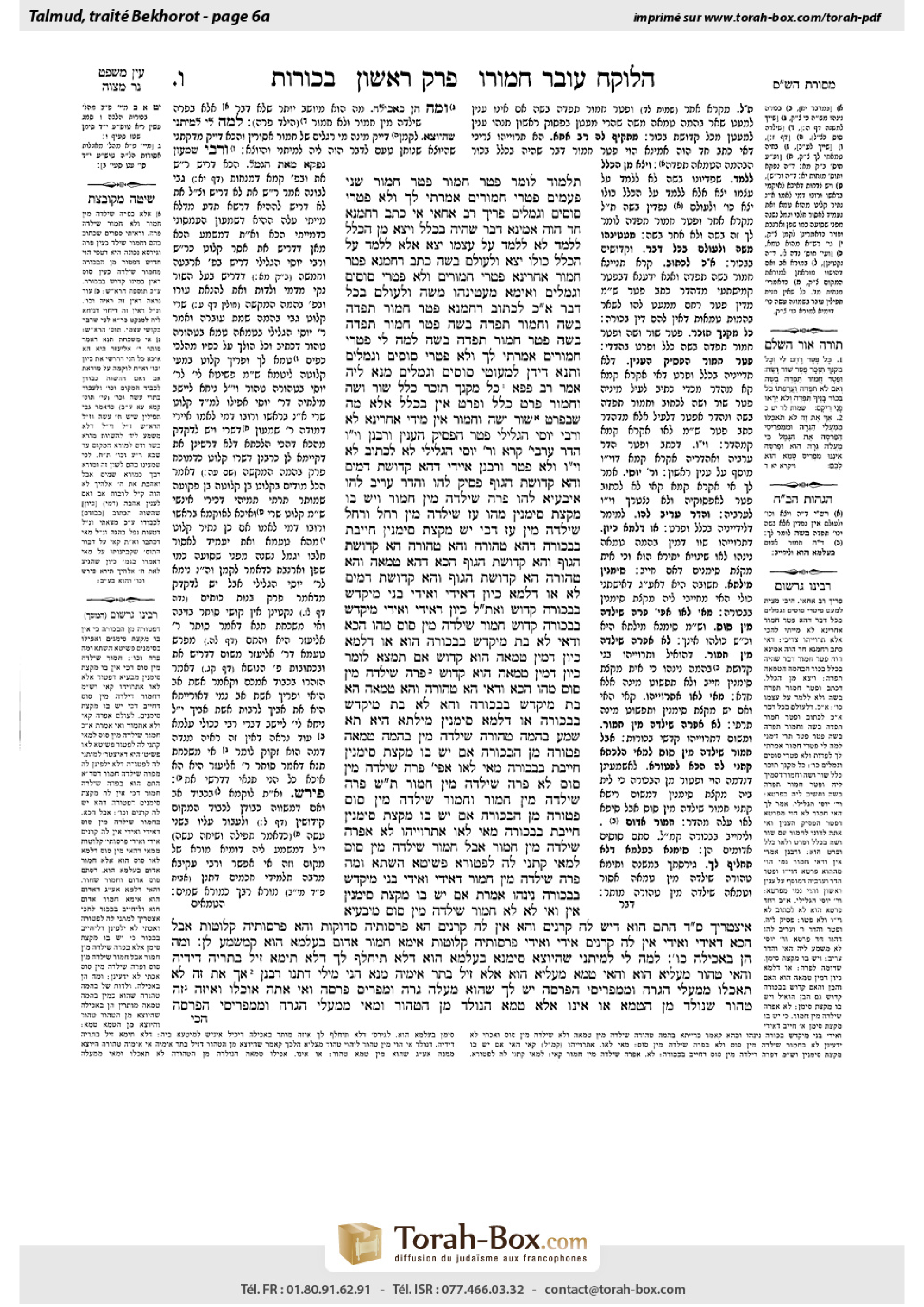
Bekhorot 6a: Talmud study for Daf Yomi
Study the Talmud for Daf Yomi with scanned pages, Hebrew text, English translations from Sefaria and AI-generated French translations.
Passage selection and English or AI-generated French translation are available where the scan has annotations. Daf Study is independent of Torah-Box and Sefaria.
Browse Bekhorot · בכורות · All tractatesBekhorot 6a text and translations
This page of Bekhorot includes the Aramaic text, an English translation and an AI-generated French translation, alongside the scan above.
בכורות ו׳ א · Aramaic and Hebrew text
תַּלְמוּד לוֹמַר: ״פֶּטֶר חֲמוֹר״ ״פֶּטֶר חֲמוֹר״ שְׁנֵי פְּעָמִים — פִּטְרֵי חֲמוֹרִים אָמַרְתִּי לְךָ, וְלֹא פִּטְרֵי סוּסִים וּגְמַלִּים.
פָּרֵיךְ רַב אַחַאי: אִי כְּתַב רַחֲמָנָא חַד, הֲוָה אָמֵינָא דָּבָר שֶׁהָיָה בַּכְּלָל, וְיָצָא מִן הַכְּלָל לְלַמֵּד, לֹא לְלַמֵּד עַל עַצְמוֹ יָצָא אֶלָּא לְלַמֵּד עַל הַכְּלָל כּוּלּוֹ יָצָא, וּלְעוֹלָם בְּשֶׂה.
כְּתַב רַחֲמָנָא ״פֶּטֶר חֲמוֹר״ אַחֲרִינָא, פִּטְרֵי חֲמוֹרִים וְלֹא פִּטְרֵי סוּסִים וּגְמַלִּים, וְאֵימָא: מַעֲטִינְהוּ מֹשֶׁה, וּלְעוֹלָם בְּכׇל דָּבָר!
אִם כֵּן, לִכְתּוֹב רַחֲמָנָא: ״פֶּטֶר חֲמוֹר תִּפְדֶּה בְשֶׂה״ וַ״חֲמוֹר תִּפְדֶּה בְשֶׂה״. ״פֶּטֶר חֲמוֹר תִּפְדֶּה בְשֶׂה״, ״פֶּטֶר חֲמוֹר תִּפְדֶּה בְשֶׂה״ לְמָה לִי? פִּטְרֵי חֲמוֹרִים אָמַרְתִּי לְךָ, וְלֹא פִּטְרֵי סוּסִים וּגְמַלִּים.
וְתַנָּא דִידַן, לְמַעוֹטֵי סוּסִים וּגְמַלִּים, מְנָא לֵיהּ?
אָמַר רַב פָּפָּא: כׇּל מִקְנְךָ תִּזָּכָר — כָּלַל, שׁוֹר וָשֶׂה וַחֲמוֹר — פָּרַט, כְּלָל וּפְרָט — אֵין בַּכְּלָל אֶלָּא מַה שֶּׁבַּפְּרָט, שׁוֹר וָשֶׂה וַחֲמוֹר — אִין, מִידֵּי אַחֲרִינָא — לָא.
וְרַבִּי יוֹסֵי הַגְּלִילִי? ״פֶּטֶר״ הִפְסִיק הָעִנְיָן, וְרַבָּנַן? וָי״ו הֲדַר עָרְבֵיהּ קְרָא.
וְרַבִּי יוֹסֵי הַגְּלִילִי? לָא לִכְתּוֹב לָא וָי״ו וְלָא ״פֶּטֶר״.
וְרַבָּנַן? אַיְּידֵי דְּהָא קְדוּשַּׁת דָּמִים, וְהָא קְדוּשַּׁת הַגּוּף — פָּסֵיק לְהוּ וַהֲדַר עָרֵיב לְהוּ.
אִיבַּעְיָא לְהוּ: פָּרָה שֶׁיָּלְדָה מִין חֲמוֹר, וְיֵשׁ בּוֹ מִקְצָת סִימָנִין — מַהוּ?
עֵז שֶׁיָּלְדָה מִין רָחֵל, וְרָחֵל שֶׁיָּלְדָה מִין עֵז, דְּכִי יֵשׁ מִקְצָת סִימָנִין — חַיֶּיבֶת בִּבְכוֹרָה, דְּהָא טְהוֹרָה וְהָא טְהוֹרָה, הָא קְדוּשַּׁת הַגּוּף וְהָא קְדוּשַּׁת הַגּוּף.
הָכָא, דְּהָא טְמֵאָה וְהָא טְהוֹרָה, הָא קְדוּשַּׁת הַגּוּף וְהָא קְדוּשַּׁת דָּמִים — לָא, אוֹ דִלְמָא: כֵּיוָן דְּאִידֵּי וְאִידֵּי בְּנֵי מִיקְדָּשׁ בִּבְכוֹרָה — קָדוֹשׁ?
וְאִם תִּמְצֵי לוֹמַר: כֵּיוָן דְּאִידֵּי וְאִידֵּי מִיקְדָּשׁ בִּבְכוֹרָה קָדוֹשׁ, חֲמוֹר שֶׁיָּלְדָה מִין סוּס מַהוּ? הָכָא וַדַּאי לָא בַּת מִיקְדָּשׁ בִּבְכוֹרָה הוּא, אוֹ דִלְמָא כֵּיוָן דְּמִין טְמֵאָה הוּא קָדוֹשׁ?
אִם תִּמְצָא לוֹמַר: כֵּיוָן דְּמִין טְמֵאָה הוּא קָדוֹשׁ, פָּרָה שֶׁיָּלְדָה מִין סוּס מַהוּ? הָכָא וַדַּאי הָא טְהוֹרָה וְהָא טְמֵאָה, הָא בַּת מִיקְדָּשׁ בִּבְכוֹרָה וְהָא לָא בַּת מִיקְדָּשׁ בִּבְכוֹרָה, אוֹ דִלְמָא סִימָנִין מִילְּתָא הִיא?
תָּא שְׁמַע: בְּהֵמָה טְהוֹרָה שֶׁיָּלְדָה מִין בְּהֵמָה טְמֵאָה — פְּטוּרָה מִן הַבְּכוֹרָה, אִם יֵשׁ בּוֹ מִקְצָת סִימָנִין — חַיֶּיבֶת בִּבְכוֹרָה. מַאי לָאו אֲפִילּוּ פָּרָה שֶׁיָּלְדָה מִין סוּס? לֹא, פָּרָה שֶׁיָּלְדָה מִין חֲמוֹר.
תָּא שְׁמַע: פָּרָה שֶׁיָּלְדָה מִין חֲמוֹר, וַחֲמוֹר שֶׁיָּלְדָה מִין סוּס — פְּטוּרָה מִן הַבְּכוֹרָה, אִם יֵשׁ בּוֹ מִקְצָת סִימָנִין — חַיֶּיבֶת בִּבְכוֹרָה. מַאי לָאו אַתַּרְוַיְיהוּ? לָא, אַפָּרָה שֶׁיָּלְדָה מִין חֲמוֹר.
אֲבָל חֲמוֹר שֶׁיָּלְדָה מִין סוּס, לְמַאי קָתָנֵי לַהּ? לִפְטוּרָא? פְּשִׁיטָא! הַשְׁתָּא, וּמָה פָּרָה שֶׁיָּלְדָה מִין חֲמוֹר, דְּאִידֵּי וְאִידֵּי בְּנֵי מִיקְדָּשׁ בִּבְכוֹרָה נִינְהוּ, אָמְרַתְּ: אִם יֵשׁ בּוֹ מִקְצָת סִימָנִין — אִין, וְאִי לָא — לָא, חֲמוֹר שֶׁיָּלְדָה מִין סוּס מִיבַּעְיָא?
אִיצְטְרִיךְ, סָלְקָא דַּעְתָּךְ: הָתָם הוּא דְּיֵשׁ לָהּ קַרְנַיִם, וְהָא אֵין לָהּ קַרְנַיִם; הָא פַּרְסוֹתֶיהָ סְדוּקוֹת, וְהָא פַּרְסוֹתֶיהָ קְלוּטוֹת.
אֲבָל הָכָא, דְּאִידֵּי וְאִידֵּי אֵין לָהּ קַרְנַיִם, אִידֵּי וְאִידֵּי פַּרְסוֹתֶיהָ קְלוּטוֹת, אֵימָא חֲמוֹר אָדוֹם בְּעָלְמָא הוּא, קָמַשְׁמַע לַן.
וּמָה הֵן בַּאֲכִילָה כּוּ׳. לְמָה לִי לְמִיתְנֵי ״שֶׁהַיּוֹצֵא״?
סִימָנָא בְּעָלְמָא הוּא, דְּלָא תִּיחַלַּף לָךְ, דְּלָא תֵּימָא: זִיל בָּתְרֵיהּ דִּידֵיהּ, וְהַאי טָהוֹר מְעַלְּיָא הוּא, וְהַאי טָמֵא מְעַלְּיָא הוּא, אֶלָּא זִיל בָּתַר אִימֵּיהּ.
מְנָא הָנֵי מִילֵּי? דְּתָנוּ רַבָּנַן: ״אַךְ אֶת זֶה לֹא תֹאכְלוּ מִמַּעֲלֵי הַגֵּרָה וּמִמַּפְרִיסֵי הַפַּרְסָה״ — יֵשׁ לְךָ שֶׁהוּא מַעֲלֵה גֵרָה וּמַפְרִיס פַּרְסָה וְאִי אַתָּה אוֹכְלוֹ, וְאֵיזֶה זֶה? טָהוֹר שֶׁנּוֹלַד מִן הַטָּמֵא. אוֹ אֵינוֹ אֶלָּא טָמֵא הַנּוֹלָד מִן הַטָּהוֹר, וּמַאי ״מִמַּעֲלֵי הַגֵּרָה וּמִמַּפְרִיסֵי הַפַּרְסָה״?
Bekhorot 6a · English translation
Therefore, the verse states the phrase: “Firstborn of a donkey” (Exodus 13:13), “firstborn of a donkey” (Exodus 34:20), mentioning it a total of two times. The additional usage of the term indicates I said to you that firstborn status applies only to firstborns of donkeys, but not to firstborns of horses or camels.
Rav Aḥai refutes this claim: How can the extra verse alone indicate that other firstborn non-kosher animals do not have firstborn status? If the Merciful One had written the term “firstborn of a donkey” once, I would say a firstborn donkey is an item that was included in a generalization of all non-kosher animals, but emerged from the generalization to teach that it must be redeemed by means of a lamb. According to the principles of exegesis, it emerged from the generalization to teach not just about itself, but emerged to teach about the entire generalization. And accordingly, all non-kosher animals should actually be redeemed by means of a lamb as well.
Therefore, the Merciful One writes: “Firstborn of a donkey,” another time, to teach that only firstborn donkeys must be redeemed by means of a lamb, but not firstborn horses or camels. And therefore I can say that perhaps the earlier suggestion is correct: The Torah excluded firstborn horses and camels from being redeemed by means of a lamb, but actually, they must still be redeemed by means of any other item.
The Gemara answers: If it is so that the Torah excludes horses and camels only from redemption by means of a lamb but not from redemption in general, let the Merciful One write: Firstborn of a donkey you shall redeem with a lamb, and: A donkey you shall redeem with a lamb, which would suffice. Why do I need the verse to state: “A firstborn of a donkey you shall redeem with a lamb,” “a firstborn of a donkey you shall redeem with a lamb,” using the same phrase both times? It is necessary to teach that I said to you that firstborn status applies only to firstborns of donkeys, but not to firstborns of horses or camels.
The Gemara asks: And as for the tanna of our mishna, who derived from the repetition of the phrase “firstborn of a donkey” that the mitzva of redeeming a firstborn donkey applies only if the mother and offspring are both donkeys, from where does he derive that the Torah excludes horses and camels from firstborn status?
Rav Pappa said it is derived from the verse: “From all your livestock you shall take the males, the firstborn of the ox and lamb. And the firstborn of a donkey you shall redeem with a lamb” (Exodus 34:19–20). The phrase “From all your livestock you shall take the males” is a generalization, and the reference to an ox and a lamb and a donkey is a detail. According to the principles of exegesis, in the case of a generalization and a detail, the generalization is referring only to that which is specified in the detail.Therefore, an ox and a lamb and a donkey, yes, their offspring have firstborn status, but anything else, no, it does not have firstborn status.
The Gemara asks: And as for Rabbi Yosei HaGelili, how does he respond to this claim? The Gemara answers: He holds that a donkey is not included in the generalization “From all your livestock you shall take the males,” as the word “firstborn” in the phrase “and the firstborn of a donkey,” indicates that the Torah interrupts the matter, i.e., the list of details. The Gemara asks: And as for the Rabbis, how do they respond to this claim? The Gemara answers: The letter vav, meaning “and,” in the phrase “and the firstborn of a donkey,” indicates that the verse returns and combines the donkey with the other animals as having firstborn status.
The Gemara asks: And as for Rabbi Yosei HaGelili, how does he respond? The Gemara answers: He holds that if the donkey was indeed included in the delineation of the other animals that follows the generalization, the Torah would write neither the letter vav nor the word “firstborn,” and it still would be included.
The Gemara asks: And as for the Rabbis, how do they respond to this claim? The Gemara answers: Since this, a firstborn donkey, has sanctity that inheres in its value and must be redeemed by means of a lamb, and that, a firstborn ox and lamb, possess inherent sanctity and are sacrificed upon the altar, the word “firstborn” must interpose between them, and the verse must combine them again with the letter vav for “and,” which indicates that a donkey is also included in the delineation that defines the generalization “From all your livestock you shall take the males.”
§ The Gemara previously cited the mishna (16b) that rules that a ewe that gave birth to a goat of sorts and a goat that gave birth to a ewe of sorts are exempt from the mitzva of the firstborn. And if the offspring has some of the characteristics of its mother, it is subject to the obligations of firstborn status. A dilemma was raised before the Sages about a related matter: In the case of a cow that gave birth to a donkey of sorts, where the mishna (5b) ruled that the offspring does not have firstborn status, and it has some of the characteristics of the mother, what is the halakha?
The Gemara explains the dilemma: When the mishna states with regard to a goat that gave birth to a ewe of sorts and a ewe that gave birth to a goat of sorts, that when it has some of the characteristics of the mother, it is obligated, i.e., subject to the obligations of firstborn status, perhaps this is because a ewe and a goat are somewhat similar; as this one is a kosher animal and that one is a kosher animal. Likewise, this one has inherent sanctity and may be sacrificed on the altar, and that one has inherent sanctity.
But here, in the case of a cow that gave birth to a donkey of sorts, perhaps the halakha would be different, as this, the offspring, resembles a non-kosher animal, and that, the mother, is a kosher animal. Likewise, the firstborns of this species, the cow, possess inherent sanctity, and the firstborns of that species, the donkey, have sanctity that inheres in its value. Therefore, perhaps the offspring does not have firstborn status, even if it has some of the characteristics of the mother. Or perhaps it can be reasoned that since both this cow and that donkey are sanctified with firstborn status, the offspring is sanctified with firstborn status.
And if you say that since both this cow and that donkey are sanctified with firstborn status, the offspring is also sanctified with firstborn status if it has some characteristics of the mother, then what is the halakha in a case of a donkey that gave birth to a horse of sorts? Perhaps here the offspring certainly does not have firstborn status, as a horse is not sanctified with firstborn status. Or perhaps one can reason that since the mother is a member of a non-kosher species, as is the offspring, the offspring should be sanctified with firstborn status, as it has some characteristics of the mother, which is a donkey.
The Gemara raises an additional dilemma about a related case: If you say in the previous case that since it is a non-kosher species it is sanctified, then what is the halakha in the case of a cow that gave birth to a horse of sorts? Here, one can say there certainly is no reason for the offspring to have firstborn status, as this cow is kosher and that horse is non-kosher. And in addition, this cow is sanctified with firstborn status and that horse is not sanctified with firstborn status. Or perhaps one can reason that having some of the characteristics of the mother is a significant matter and the offspring does have firstborn sanctity.
The Gemara suggests: Come and hear a proof from a baraita: A kosher animal that gave birth to a non-kosher animal of sorts is exempt from its offspring being counted a firstborn. If the offspring has some of the characteristics of the mother it is obligated, i.e., subject to the obligations of firstborn status. What, does this not include even the case of a cow that gave birth to a horse of sorts? No, it is referring to a case such as where a cow that gave birth to a donkey of sorts, where both species are subject to the sanctity of the firstborn.
The Gemara suggests: Come and hear another proof from a baraita: In the case of a cow that gave birth to a donkey of sorts or a donkey that gave birth to a horse of sorts, each of the mothers is exempt from their offspring being counted a firstborn. If the offspring has some of the characteristics of the mother, it is obligated, i.e., subject to the obligations of firstborn status. What, is the last clause not referring to both cases of the baraita? If so, this resolves two of the dilemmas about offspring that have some characteristics of the mother. The Gemara responds: No, it is referring only to the case of a cow that gave birth to a donkey of sorts, so only that dilemma is resolved.
The Gemara asks: But if so, for what purpose does the baraita teach the case of a donkey that gave birth to a horse of sorts? If it is to exempt the offspring from being accounted firstborn status when it does not have some of the characteristics of its mother, that halakha is obvious for the following reason: And now, if in the case of a cow that gave birth to a donkey of sorts, where both this species and that species are sanctified with firstborn status, you said that if the offspring has some of the characteristics of its mother then yes, it has firstborn status, and if it does not have such characteristics, then no, the offspring does not have firstborn status, then in the case of a donkey that gave birth to a horse of sorts, which generally is not sanctified with firstborn status, is it necessary to state that the horse does not have firstborn status unless it has some of the characteristics of its mother?
The Gemara answers: It was necessary to teach that case in addition to that of a cow that gave birth to a donkey of sorts, as it might enter your mind that there, in the case of the cow that gave birth to a donkey of sorts, the offspring does not have firstborn status because a cow and donkey are entirely different from one another, as a cow has horns, and this animal, a donkey, does not have horns. Moreover, with regard to that animal, a cow, its hooves are split, but with regard to this animal, a donkey, its hooves are closed [kelutot].
But here, in the case of a donkey that gave birth to a horse of sorts, where a similarity does exist between the mother and its offspring, as this one and that one both do not have horns, and with regard to both this one and that one its hooves are closed, I can say that this offspring is merely a red donkey, i.e., a donkey with the coloring of a horse, and has firstborn status. Therefore, the tanna teaches us that it is a different species from that of the mother, and does not have firstborn status.
§ The mishna teaches with regard to an animal whose offspring resembles a different species: And what is the offspring’s halakhic status with regard to its consumption? In the case of a kosher animal that gave birth to a non-kosher animal of sorts, its consumption is permitted. And in the case of a non-kosher animal that gave birth to a kosher animal of sorts, its consumption is prohibited. This is because that which emerges from the non-kosher animal is non-kosher and that which emerges from the kosher animal is kosher. The Gemara asks: Why do I need the mishna to teach the concluding phrase: This is because that which emerges from the non-kosher animal is non-kosher and that which emerges from the kosher animal is kosher?
The Gemara answers: It is merely a mnemonic to ensure that you do not mistakenly reverse the halakha in these two cases, so that you do not say: Follow its appearance, and therefore this offspring that looks like a kosher animal is a full-fledged kosher animal, despite being born to a non-kosher animal; and that one that looks like a non-kosher animal is a full-fledged non-kosher animal, despite its mother being a kosher animal. Rather, the mishna teaches that one must follow the status of its mother.
The Gemara asks: From where are these matters derived? The Gemara answers: They are derived from a verse, as the Sages taught that when the verse states: “Nevertheless these shall you not eat, of them that chew the cud, or of them that split the hoof” (Leviticus 11:4), this verse indicates that you have an animal that chews the cud and has split hooves, but nevertheless you may not eat it. And which is this? It is a kosher animal that was born from a non-kosher animal. Or perhaps it excludes only a non-kosher animal that does not chew the cud or have split hooves that was born from a kosher animal, and if so what is the explanation of the verse “of them that chew the cud, or of them that split the hoof”?
Bekhorot 6a · Traduction française (IA)
Par conséquent, la Sainte Écriture mentionne la phrase : « Premier-né d'un âne » (Exode 13:13), « premier-né d'un âne » (Exode 34:20), en la mentionnant à deux reprises. L'usage supplémentaire de cette expression indique que je vous dis que le statut de premier-né s'applique uniquement aux premier-nés d'ânes, mais pas aux premier-nés de chevaux ou de chameaux.
Rav Aḥai réfute cette affirmation : Comment une seule mention supplémentaire de cette expression peut-elle indiquer que les autres animaux non-kosher ne sont pas soumis au statut de premier-né ? Si le Miséricordieux avait écrit « premier-né d'un âne » une seule fois, je dirais qu'un premier-né d'âne est un cas inclus dans une généralisation concernant tous les animaux non-kosher, mais qui émerge de cette généralisation pour enseigner qu'il doit être racheté par un agneau. Selon les principes d'exégèse, il émerge de cette généralisation pour enseigner non seulement à son sujet, mais pour enseigner à l'ensemble de la généralisation. Ainsi, tous les animaux non-kosher devraient être rachetés par un agneau également.
Par conséquent, le Miséricordieux écrit : « Premier-né d'un âne », une autre fois, pour enseigner que seul le premier-né d'âne doit être racheté par un agneau, mais pas les premier-nés de chevaux ou de chameaux. Et ainsi, je peux dire que peut-être l'avis précédent est correct : la Torah exclut les premier-nés de chevaux et de chameaux du rachat par un agneau, mais en réalité, ils devraient être rachetés par un autre objet également.
La Guemara répond : Si c'est ainsi que la Torah exclut les chevaux et les chameaux uniquement du rachat par un agneau mais pas du rachat en général, que le Miséricordieux ait écrit : « Premier-né d'un âne, tu le rachèteras par un agneau », et : « Un âne, tu le rachèteras par un agneau », ce qui suffirait. Pourquoi ai-je besoin de la mention : « Premier-né d'un âne, tu le rachèteras par un agneau », en utilisant la même formule à deux reprises ? Il est nécessaire d'enseigner que je vous dis que le statut de premier-né s'applique uniquement aux premier-nés d'ânes, mais pas aux premier-nés de chevaux ou de chameaux.
La Guemara pose la question : Et concernant le tanna de notre mitsna, qui a tiré de la répétition de la formule « premier-né d'un âne » que la mitsva de racheter un premier-né d'âne s'applique uniquement si la mère et l'offspring sont tous deux des ânes, d'où tire-t-il qu'il faut exclure les chevaux et les chameaux du statut de premier-né ?
Rav Pappa dit qu'il est tiré de la verset : « De tous vos bétail, vous prendrez les mâles, le premier-né de l'ox et du agneau. Et le premier-né d'un âne, tu le rachèteras par un agneau » (Exode 34:19–20). La formule « De tous vos bétail, vous prendrez les mâles » est une généralisation, et la mention de l'ox et de l'agneau et de l'âne est un détail. Selon les principes d'exégèse, dans le cas d'une généralisation et d'un détail, la généralisation se réfère uniquement à ce qui est spécifié dans le détail. Ainsi, l'ox et l'agneau et l'âne, oui, leurs descendants ont le statut de premier-né, mais tout autre animal, non, il n'a pas de statut de premier-né.
La Guemara pose la question : Et concernant Rabbi Yosei HaGelili, comment répond-il à cette affirmation ? La Guemara répond : Il considère que l'âne n'est pas inclus dans la généralisation « De tous vos bétail, vous prendrez les mâles », car le mot « premier-né » dans la formule « et le premier-né d'un âne » indique que la Torah interrompt la matière, c'est-à-dire la liste des détails. La Guemara pose la question : Et concernant les Rabbins, comment répondent-ils à cette affirmation ? La Guemara répond : La lettre vav, signifiant « et », dans la formule « et le premier-né d'un âne », indique que la Sainte Écriture revient et combine l'âne avec les autres animaux pour avoir le statut de premier-né.
La Guemara pose la question : Et concernant Rabbi Yosei HaGelili, comment répond-il ? La Guemara répond : Il considère que si l'âne était effectivement inclus dans la délimitation des autres animaux qui suit la généralisation, la Torah n'aurait pas écrit ni la lettre vav ni le mot « premier-né », et il aurait tout de même été inclus.
La Guemara pose la question : Et concernant les Rabbins, comment répondent-ils à cette affirmation ? La Guemara répond : Puisque ce premier-né d'âne a une sanctité inhérente et doit être racheté par un agneau, et que ce premier-né d'ox et d'agneau possède une sanctité inhérente et est sacrifié sur l'autel, le mot « premier-né » doit s'interposer entre eux, et la Sainte Écriture doit les combiner à nouveau avec la lettre vav pour « et », ce qui indique que l'âne est également inclus dans la délimitation qui définit la généralisation « De tous vos bétail, vous prendrez les mâles ».
§ La Guemara a précédemment cité la mitsva (16b) qui règle que une brebis qui a donné naissance à un bouc de sorte et un bouc qui a donné naissance à une brebis de sorte sont exemptés de la mitsva du premier-né. Et si l'offspring a certains caractéristiques de sa mère, il est soumis aux obligations du statut de premier-né. Un dilemme a été soulevé devant les Sages concernant une affaire liée : dans le cas d'une vache qui a donné naissance à un âne de sorte, où la mitsva (5b) a décidé que l'offspring n'a pas de statut de premier-né, et qu'il a certains caractéristiques de la mère, quelle est la halakha ?
La Guemara explique le dilemme : Lorsque la mitsva mentionne, concernant un bouc qui a donné naissance à une brebis de sorte et une brebis qui a donné naissance à un bouc de sorte, que lorsqu'il a certains caractéristiques de la mère, il est obligé, c'est-à-dire soumis aux obligations du statut de premier-né, peut-être c'est parce que la brebis et le bouc sont quelque peu semblables ; puisque l'un est un animal kasher et l'autre est un animal kasher. De même, l'un a une sanctité inhérente et peut être sacrifié sur l'autel, et l'autre a une sanctité inhérente.
Mais ici, dans le cas d'une vache qui a donné naissance à un âne, peut-être la halakha serait-elle différente, car cet animal, l'offspring, ressemble à un animal non-kosher, et celle-ci, la mère, est un animal kosher. De même, les premiers-nés de cette espèce, la vache, possèdent une sanctité inhérente, et les premiers-nés de cette espèce, l'âne, ont une sanctité qui réside dans leur valeur. Ainsi, peut-être l'offspring n'a pas le statut de premier-né, même s'il possède certains caractéristiques de la mère. Ou peut-être peut-on raisonner que puisque cette vache et cet âne sont sanctifiés avec le statut de premier-né, l'offspring est également sanctifié avec le statut de premier-né.
Et si vous dites que puisque cette vache et cet âne sont sanctifiés avec le statut de premier-né, l'offspring est également sanctifié avec le statut de premier-né s'il possède certains caractéristiques de la mère, alors quelle est la halakha dans le cas d'un âne qui a donné naissance à un cheval ? Peut-être ici l'offspring n'a certainement pas le statut de premier-né, car un cheval n'est pas sanctifié avec le statut de premier-né. Ou peut-être peut-on raisonner que puisque la mère appartient à une espèce non-kosher, comme l'offspring, l'offspring devrait être sanctifié avec le statut de premier-né, car il possède certains caractéristiques de la mère, qui est un âne.
La Guemara soulève un autre dilemme concernant un cas similaire : Si vous dites dans le cas précédent que puisque c'est une espèce non-kosher, il est sanctifié, alors quelle est la halakha dans le cas d'une vache qui a donné naissance à un cheval ? Ici, on peut dire qu'il n'y a certainement pas de raison pour que l'offspring ait le statut de premier-né, car cette vache est kosher et ce cheval est non-kosher. Et en plus, cette vache est sanctifiée avec le statut de premier-né et ce cheval n'est pas sanctifié avec le statut de premier-né. Ou peut-être peut-on raisonner que posséder certains caractéristiques de la mère est une affaire importante et l'offspring a le statut de premier-né.
La Guemara suggère : Venez écouter une preuve tirée d'une baraïta : Un animal kasher qui a donné naissance à un animal non-kasher est exempté de l'obligation de compter son petit comme premier-né. Si le petit possède certains caractéristiques de la mère, il est tenu, c'est-à-dire soumis aux obligations du statut de premier-né. Qu'est-ce que cela ne comprend pas même le cas d'une vache qui a donné naissance à un cheval ? Non, il s'agit d'un cas tel que celui d'une vache qui a donné naissance à un âne, où les deux espèces sont soumises à la sanctité du premier-né.
La Guemara suggère : Venez écouter une autre preuve tirée d'une baraïta : Dans le cas d'une vache qui a donné naissance à un âne ou d'un âne qui a donné naissance à un cheval, chaque mère est exemptée de l'obligation de compter son petit comme premier-né. Si le petit possède certains caractéristiques de la mère, il est tenu, c'est-à-dire soumis aux obligations du statut de premier-né. Qu'est-ce que cela ne fait pas référence aux deux cas de la baraïta ? Si c'est le cas, cela résout deux des dilemmes concernant les petits qui possèdent certains caractéristiques de la mère. La Guemara répond : Non, cela fait référence uniquement au cas d'une vache qui a donné naissance à un âne, donc seul ce dilemme est résolu.
La Guemara demande : Mais si c'est ainsi, à quel but la baraïta enseigne-t-elle le cas d'un âne qui a donné naissance à un cheval ? Si c'est pour exempter l'offspring de l'obligation de premier-né lorsque celui-ci ne possède pas certains caractéristiques de sa mère, cette halakha est évidente pour la raison suivante : Et maintenant, si dans le cas d'une vache qui a donné naissance à un âne, où les deux espèces sont sanctifiées avec le statut de premier-né, vous dites que si l'offspring possède certains caractéristiques de sa mère alors oui, il a le statut de premier-né, et si ce n'est pas le cas, alors non, l'offspring n'a pas le statut de premier-né, alors dans le cas d'un âne qui a donné naissance à un cheval, qui n'est généralement pas sanctifié avec le statut de premier-né, est-il nécessaire de dire que le cheval n'a pas le statut de premier-né sauf s'il possède certains caractéristiques de sa mère ?
La Guemara répond : Il était nécessaire d'enseigner ce cas en plus de celui d'une vache qui a donné naissance à un âne, car cela pourrait entrer dans votre esprit que, dans le cas de la vache qui a donné naissance à un âne, l'offspring n'a pas le statut de premier-né car la vache et l'âne sont entièrement différents les uns des autres, car la vache a des cornes, et cet animal, l'âne, n'a pas de cornes. De plus, concernant cet animal, la vache, ses sabots sont fendus, mais concernant cet animal, l'âne, ses sabots sont clos [kelutot].
Mais ici, dans le cas d'un âne qui a donné naissance à un animal ressemblant à un cheval, où une ressemblance existe entre la mère et son petit, car ce dernier et celui-ci n'ont pas de cornes, et concernant les deux, leurs sabots sont clos, je peux dire que cet animal est simplement un âne rouge, c'est-à-dire un âne avec la couleur d'un cheval, et a le statut de premier-né. Ainsi, le tanna nous enseigne que c'est une espèce différente de celle de la mère, et n'a pas le statut de premier-né.
§ La michna enseigne concernant un animal dont l'offspring ressemble à une autre espèce : Et quel est le statut halakhique de l'offspring en ce qui concerne sa consommation ? Dans le cas d'un animal kasher qui a donné naissance à un animal non-kasher, sa consommation est permise. Et dans le cas d'un animal non-kasher qui a donné naissance à un animal kasher, sa consommation est interdite. Cela est dû au fait que ce qui sort de l'animal non-kasher est non-kasher et ce qui sort de l'animal kasher est kasher. La Guemara demande : Pourquoi ai-je besoin de la michna pour enseigner la conclusion : Cela est dû au fait que ce qui sort de l'animal non-kasher est non-kasher et ce qui sort de l'animal kasher est kasher ?
La Guemara répond : C’est simplement un moyen mnémotechnique pour s’assurer que l’on ne transpose pas à tort la halakha dans ces deux cas, afin de ne pas dire : Suivez son apparence, et donc cet descendant qui ressemble à un animal kasher est un animal kasher complet, malgré avoir été né d’un animal non kasher ; et celui qui ressemble à un animal non kasher est un animal non kasher complet, malgré que sa mère soit un animal kasher. En réalité, la miqna enseigne que l’on doit suivre le statut de sa mère.
La Guemara demande : D’où sont tirés ces enseignements ? La Guemara répond : Ils sont tirés d’un verset, car les Sages ont enseigné que lorsque le verset dit : « Cependant, vous ne mangerez pas ces-ci, de ceux qui ruminent ou de ceux qui divisent le sabot » (Lévitique 11:4), ce verset indique qu’il y a un animal qui rume et qui divise le sabot, mais néanmoins on ne doit pas le manger. Et lequel est-ce ? C’est un animal kasher né d’un animal non kasher. Ou peut-être que cela exclut seulement un animal non kasher qui ne rume pas ou ne divise pas le sabot né d’un animal kasher, et si c’est ainsi, quelle est l’explication du verset « de ceux qui ruminent, ou de ceux qui divisent le sabot » ?
Traduction française générée par IA à partir de l’édition anglaise de Sefaria. Vérifie toujours un passage avec le texte source.
Text from Sefaria: William Davidson Edition - Vocalized Aramaic (CC BY NC); William Davidson Edition - English (CC BY NC).