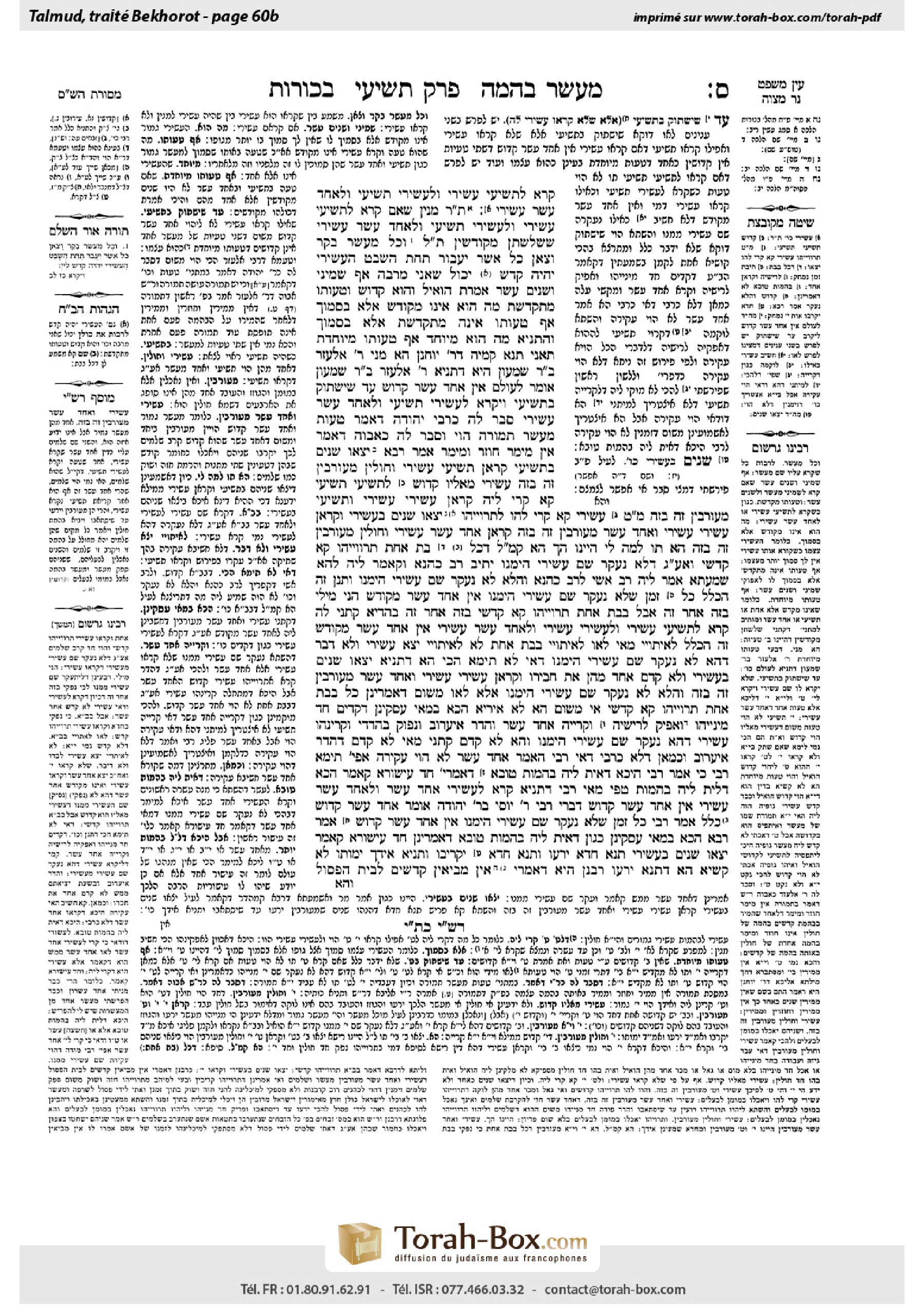
Bekhorot 60b: Talmud study for Daf Yomi
Study the Talmud for Daf Yomi with scanned pages, Hebrew text, English translations from Sefaria and AI-generated French translations.
Passage selection and English or AI-generated French translation are available where the scan has annotations. Daf Study is independent of Torah-Box and Sefaria.
Browse Bekhorot · בכורות · All tractatesBekhorot 60b text and translations
This page of Bekhorot includes the Aramaic text, an English translation and an AI-generated French translation, alongside the scan above.
בכורות ס׳ ב · Aramaic and Hebrew text
קָרָא לַתְּשִׁיעִי ״עֲשִׂירִי״, וְלָעֲשִׂירִי ״תְּשִׁיעִי״, וְלָאַחַד עָשָׂר ״עֲשִׂירִי״. תָּנוּ רַבָּנַן: מִנַּיִן שֶׁאִם קָרָא לַתְּשִׁיעִי ״עֲשִׂירִי״, וְלָעֲשִׂירִי ״תְּשִׁיעִי״, וְלָאַחַד עָשָׂר ״עֲשִׂירִי״, שֶׁשְּׁלָשְׁתָּן מְקוּדָּשִׁין?
תַּלְמוּד לוֹמַר: ״וְכׇל מַעְשַׂר בָּקָר וָצֹאן כֹּל אֲשֶׁר יַעֲבוֹר תַּחַת הַשָּׁבֶט הָעֲשִׂירִי יִהְיֶה קֹּדֶשׁ״, יָכוֹל שֶׁאֲנִי מְרַבֶּה אַף שְׁמִינִי וּשְׁנֵים עָשָׂר?
אָמְרַתְּ: הוֹאִיל וְהוּא קָדוֹשׁ, וְטָעוּתוֹ מִתְקַדֶּשֶׁת, מָה הוּא אֵינוֹ מְקוּדָּשׁ אֶלָּא בְּסָמוּךְ, אַף טָעוּתוֹ אֵינָהּ מִתְקַדֶּשֶׁת אֶלָּא בְּסָמוּךְ.
וְהָתַנְיָא: מָה הוּא מְיוּחָד, אַף טָעוּתוֹ מְיוּחֶדֶת!
תָּאנֵי תַּנָּא קַמֵּיהּ דְּרַבִּי יוֹחָנָן: הָא מַנִּי? רַבִּי אֶלְעָזָר בְּרַבִּי שִׁמְעוֹן הִיא, דְּתַנְיָא: רַבִּי אֶלְעָזָר בְּרַבִּי שִׁמְעוֹן אוֹמֵר: לְעוֹלָם אֵין אַחַד עָשָׂר קָדוֹשׁ עַד שֶׁיִּשְׁתּוֹק בַּתְּשִׁיעִי, וְיִקְרָא לָעֲשִׂירִי ״תְּשִׁיעִי״, וְלָאַחַד עָשָׂר ״עֲשִׂירִי״.
סָבַר לַהּ כְּרַבִּי יְהוּדָה, דְּאָמַר: טָעוּת מַעֲשֵׂר תְּמוּרָה הָוֵי, וְסָבַר לַהּ כַּאֲבוּהּ, דְּאָמַר: אֵין מֵימֵר חוֹזֵר וּמֵימֵר.
אָמַר רָבָא: יָצְאוּ שְׁנַיִם בַּתְּשִׁיעִי, קְרָאָן ״תְּשִׁיעִי״ — עֲשִׂירִי וְחוּלִּין מְעוֹרָבִין זֶה בָּזֶה, עֲשִׂירִי מֵאֵלָיו קָדוֹשׁ, לַתְּשִׁיעִי ״תְּשִׁיעִי״ קָא קָרֵי לֵיהּ.
קְרָאָן ״עֲשִׂירִי״, עֲשִׂירִי וּתְשִׁיעִי מְעוֹרָבִין זֶה בָּזֶה. מַאי טַעְמָא? ״עֲשִׂירִי״ קָא קָרֵי לְהוּ לְתַרְוַיְיהוּ.
יָצְאוּ שְׁנַיִם בָּעֲשִׂירִי וּקְרָאָן ״עֲשִׂירִי״, עֲשִׂירִי וְאַחַד עָשָׂר מְעוֹרָבִין זֶה בָּזֶה. קְרָאָן ״אַחַד עָשָׂר״, עֲשִׂירִי וְחוּלִּין מְעוֹרָבִין זֶה בָּזֶה.
הָא תּוּ לְמָה לִי? הַיְינוּ הָךְ! הָא קָא מַשְׁמַע לַן: דְּכֹל בַּת אַחַת תַּרְוַויְיהוּ קָא קָדְשִׁי, וְאַף עַל גַּב דְּלֹא נֶעֱקַר שֵׁם ״עֲשִׂירִי״ הֵימֶנּוּ.
יָתֵיב רַב כָּהֲנָא וְקָאָמַר לֵיהּ לְהָא שְׁמַעְתָּא, אֲמַר לֵיהּ רַב אָשֵׁי לְרַב כָּהֲנָא: וַהֲלֹא לֹא נֶעֱקַר שֵׁם ״עֲשִׂירִי״ הֵימֶנּוּ, וּתְנַן זֶה הַכְּלָל: כׇּל זְמַן שֶׁלֹּא נֶעֱקַר שֵׁם ״עֲשִׂירִי״ הֵימֶנּוּ — אֵין אַחַד עָשָׂר מְקוּדָּשׁ! הָנֵי מִילֵּי בְּזֶה אַחַר זֶה, אֲבָל בְּבַת אַחַת — תַּרְוַיְיהוּ קָא קָדְשִׁי.
זֶה אַחַר זֶה — בְּהֶדְיָא קָתָנֵי לַהּ: קָרָא לַתְּשִׁיעִי ״עֲשִׂירִי״, וְלָעֲשִׂירִי ״עֲשִׂירִי״, וְלָאַחַד עָשָׂר ״עֲשִׂירִי״ — אֵין אַחַד עָשָׂר מְקוּדָּשׁ. ״זֶה הַכְּלָל״ לְאֵיתוֹיֵי מַאי? לָאו לְאֵיתוֹיֵי בְּבַת אַחַת?
לָא, לְאֵיתוֹיֵי יָצָא עֲשִׂירִי וְלֹא דִּבֵּר, דְּהָא לֹא נֶעֱקַר שֵׁם ״עֲשִׂירִי״ הֵימֶנּוּ.
דְּאִי לָא תֵּימָא הָכִי, הָא דְּתַנְיָא: יָצְאוּ שְׁנַיִם בָּעֲשִׂירִי, וְלֹא קָדַם אֶחָד מֵהֶן אֶת חֲבֵירוֹ, וּקְרָאָן ״עֲשִׂירִי״ — עֲשִׂירִי וְאַחַד עָשָׂר מְעוֹרָבִין זֶה בָּזֶה, וַהֲלֹא לֹא נֶעֱקַר שֵׁם עֲשִׂירִי הֵימֶנּוּ! אֶלָּא לָאו מִשּׁוּם דְּאָמְרִינַן: כֹּל בְּבַת אַחַת תַּרְוַיְיהוּ קָא קָדְשִׁי.
אִי מִשּׁוּם הָא לָא אִירְיָא, הָכָא בְּמַאי עָסְקִינַן? דִּקְדֵים חַד מִינַּיְיהוּ וְאַפֵּיק לְרֵישֵׁיהּ, וְקַרְיֵיהּ ״אַחַד עָשָׂר״, וַהֲדַר אִיעָרוּב וּנְפוּק בַּהֲדָדֵי, וּקְרִינְהוּ ״עֲשִׂירִי״, דְּהָא נֶעֱקַר שֵׁם עֲשִׂירִי הֵימֶנּוּ.
וְהָא ״לֹא קָדַם״ קָתָנֵי! מַאי ״לֹא קָדַם״? דַּהֲדַר אִיעָרוּב.
וּכְמַאן? דְּלָא כְּרַבִּי, דְּאִי רַבִּי — הָאָמַר: ״אַחַד עָשָׂר״ לָא הָוֵי עֲקִירָה!
אֲפִילּוּ תֵּימָא רַבִּי, כִּי אָמַר רַבִּי הֵיכָא דְּאִית לֵיהּ בְּהֵמוֹת טוּבָא, דְּאָמְרִינַן: חַד עִישּׂוּרָא קָאָמַר, הָכָא דְּלֵית לֵיהּ בְּהֵמוֹת טְפֵי.
מַאי רַבִּי? דְּתַנְיָא: קָרָא לַעֲשִׂירִי ״אַחַד עָשָׂר״, וְלָאַחַד עָשָׂר ״עֲשִׂירִי״ — אֵין אַחַד עָשָׂר קָדוֹשׁ, דִּבְרֵי רַבִּי. רַבִּי יוֹסֵי בְּרַבִּי יְהוּדָה אוֹמֵר: אַחַד עָשָׂר קָדוֹשׁ. כְּלָל אָמַר רַבִּי: כׇּל זְמַן שֶׁלֹּא נֶעֱקַר שֵׁם עֲשִׂירִי הֵימֶנּוּ — אֵין אַחַד עָשָׂר קָדוֹשׁ. אָמַר רָבָא: הָכָא בְּמַאי עָסְקִינַן? כְּגוֹן דְּאִית לֵיהּ בְּהֵמוֹת טוּבָא, דְּאָמְרִינַן: חַד עִישּׂוּרָא קָאָמַר.
יָצְאוּ שְׁנַיִם בָּעֲשִׂירִי, תָּנֵי חֲדָא: יִרְעוּ, וְתַנְיָא אִידַּךְ: יִקְרְיבוּ, וְתַנְיָא אִידַּךְ: יָמוּתוּ.
לָא קַשְׁיָא, הָא דְּתַנְיָא יִרְעוּ — רַבָּנַן הִיא, דְּאָמְרִי: אֵין מְבִיאִין קָדָשִׁים לְבֵית הַפְּסוּל״
Bekhorot 60b · English translation
§ The mishna teaches: If he mistakenly called the ninth: Tenth, and the tenth: Ninth, and the eleventh: Tenth, all three are sacred, although each has a different halakhic status. The Gemara cites a relevant baraita: The Sages taught: From where is it derived that if one mistakenly called the ninth animal: Tenth, and the tenth animal: Ninth, and the eleventh animal: Tenth, that all three of them are sanctified?
The verse states: “And all the tithe of the herd or the flock, whatever passes under the rod, the tenth shall be sacred to the Lord” (Leviticus 27:32). This indicates that the tenth animal that passes under the rod is imbued with sanctity, in addition to any animal that the owner designates as the tenth. One might have thought that I include even the eighth animal or the twelfth animal, if they were mistakenly designated as the tenth.
You said in response that since the tenth animal is sanctified and the animal that he designated by mistake as the tenth is sanctified, their statuses should be compared: Just as the tenth animal is sanctified only with an animal that was close to the number ten, i.e., it itself was the tenth, so too, an animal that was designated by mistake is sanctified only if it is close to the number ten, i.e., if it is the ninth or eleventh, but not if it is the eighth or the twelfth.
The mishna teaches that if one mistakenly designated the ninth and the eleventh animals as the tenth they are both sanctified. The Gemara raises a difficulty: But isn’t it taught in a baraita that just as the tenth animal itself is unique, i.e., it is only one, so too, an animal that was designated by mistake is unique, i.e., only one additional animal receives the sanctity, but not both the ninth and the eleventh?
The Gemara answers that a tanna taught before Rabbi Yoḥanan: In accordance with whose opinion is this baraita? It is in accordance with the opinion of Rabbi Elazar, son of Rabbi Shimon, as it is taught in a baraita that Rabbi Elazar, son of Rabbi Shimon, says: The eleventh animal is never sanctified unless the owner is silent when the ninth animal leaves the pen, i.e., he does not designate it as the tenth, and he subsequently calls the tenth animal the ninth and the eleventh animal the tenth. But if he had already designated the ninth animal as the tenth, the eleventh cannot become sanctified.
The Gemara further explains that Rabbi Elazar, son of Rabbi Shimon, holds in accordance with the opinion of Rabbi Yehuda, who says: When the owner makes a mistake in designating animal tithe, e.g., if one designates the ninth animal as the tenth, the designated animal has the status of a substitute animal. And Rabbi Elazar also holds in accordance with the opinion of his father, Rabbi Shimon, who says: One cannot effect substitution on one animal by substituting it for a specific offering, and again effect substitution, on another animal, by substituting it for the same offering, and if one attempts to do so the second animal does not become consecrated. Therefore, if one mistakenly called the ninth animal the tenth, that ninth animal has sanctity; but if he also calls the eleventh animal the tenth, this designation has no effect.
§ Rava says: If two animals emerged from the pen together as the ninth, and he called them both the ninth, then the tenth, i.e., the tithe, and a non-sacred animal are considered intermingled with each other. Rava elaborates: The tenth is sanctified of its own accord, despite the fact that he called it the ninth. And the animal that came out ninth is non-sacred, as it came out ninth and he called it the ninth. Since there is no way to determine which animal is which, neither of them can be brought as an offering, and they must both be left to graze until they develop a blemish.
If two animals emerged from the pen together as the ninth, and he called them both the tenth, then the tenth, i.e., the tithe, and the ninth animal, which he designated as the tenth, are intermingled with each other. What is the reason? He called both of them the tenth. The tenth has the sanctity of the tithe while the ninth was designated as the tenth, and therefore may not be eaten until it develops a blemish. Since there is no way to determine which animal is which, neither can be sacrificed, but they must both be left to graze until they develop a blemish.
If two animals emerged from the pen together as the tenth, and he called them both the tenth, then the tenth, and the eleventh animal, which he designated as the tenth, are intermingled with each other. If he called them both the eleventh, the tenth and a non-sacred animal are intermingled with each other.
The Gemara asks: Why do I need this additional case? This reasoning for the halakha in the case where the animals emerged together as the tenth is identical to that of the first case, where the animals emerged together as the ninth. The Gemara answers: This latter clause teaches us that in every case where two animals emerge as one they are both sanctified, and this is the halakha even though the name of the tenth was not removed from the tenth animal. This situation is not included in the principle of the mishna: In any situation where the name of the tenth was not removed from the tenth animal, the eleventh that was called tenth is not consecrated.
The Gemara relates that Rav Kahana sat and recited this halakha. Rav Ashi said to Rav Kahana: But the name of the tenth has not been removed from it. And didn’t we learn in the mishna that this is the principle: In any situation where the name of the tenth was not removed from the tenth animal, the eleventh that was called tenth is not consecrated? Rav Kahana replied to Rav Ashi: This statement, that the designation of tenth must be removed, applies only when the animals leave the pen one after the other. But if two animals emerge from the pen at the same time, and he simultaneously designated the tenth and eleventh as tithe, both of them are sanctified.
The Gemara raises a difficulty: How can the mishna be explained as referring only to a case where the animals left the pen one after the other? After all, the mishna teaches explicitly: If one called the ninth animal: Tenth, and the tenth: Tenth, and the eleventh: Tenth, the eleventh is not consecrated. This is the principle: In any situation where the name of the tenth was not removed from the tenth animal, the eleventh that was called tenth is not consecrated. What does the phrase: This is the principle, serve to include? Does it not serve to include a case where the tenth and eleventh animals leave the pen at the same time? And if so, it is teaching that in such a case the eleventh animal is not sanctified.
Rav Kahana would answer: No; it serves not to include that case, but to include a situation where the tenth animal emerged from the pen and the owner did not speak at all, and when the eleventh animal came out he designated it as the tenth. Therefore, the eleventh animal is not sanctified, as he did not remove the name of the tenth from the tenth animal. But if the tenth and eleventh animals came out at the same time, and he designated them both as the tenth, they are both sanctified.
The Gemara adds that this must be the case, because if you do not say this explanation of the mishna there is a problem with that which is taught in a baraita: If two animals emerged from the pen together as the tenth, and one did not come out before the other, and he called them both the tenth, the tenth and eleventh animals are intermingled with each other. One is sacred with the sanctity of the animal tithe while the other is a peace offering, but there is no way to determine which animal is which. The Gemara explains the problem here: How can this baraita be reconciled with the mishna? He did not remove the name of the tenth from the tenth animal. Rather, is it not due to the fact that we say: In any case where two animals come out of the pen at the same time both of them are sanctified?
Rav Ashi would rebut this claim: If it is due to that reason there is no conclusive argument. Here we are dealing with a case where one of the two animals came out before the other and brought its head out from the pen, and the owner called that animal the eleventh, and afterward it became intermingled with the other animals, and the last two animals came out together, and he called them both the tenth animal. In such a case both animals are sanctified, as the name of the tenth was removed from the tenth animal when he mistakenly called it the eleventh animal.
The Gemara raises a difficulty with regard to this explanation: How can one interpret the baraita as referring to a case where one animal put its head out before the other? But isn’t it taught explicitly in the baraita: And one did not come out before the other? The Gemara answers: What does the baraita mean when it states: And one did not come out before the other? It means that it did not come out completely, but returned and became intermingled with the other animals.
The Gemara asks: And in accordance with whose opinion is this baraita taught? It is not taught in accordance with the opinion of Rabbi Yehuda HaNasi. As, if it reflects the opinion of Rabbi Yehuda HaNasi there is a difficulty. Doesn’t Rabbi Yehuda HaNasi say: If one called the tenth animal the eleventh, it is not considered a removal of the name of the tenth from the tenth animal?
The Gemara answers: You may even say that the baraita is in accordance with the opinion of Rabbi Yehuda HaNasi, as when Rabbi Yehuda HaNasi said his statement he was referring only to a case where the owner has many animals to tithe. The reason is that we say that when he said: Aḥad asar, eleventh, his intention was to say: Ḥad issura, one group of ten, i.e., that this tenth animal completes one set of ten animals, not that it is the eleventh. Here it is referring to a situation where he does not have many animals to tithe, and therefore he could not have been speaking of more than one set of ten, in which case Rabbi Yehuda HaNasi agrees that calling it the eleventh removes its status as the tenth.
The Gemara asks: To what statement of Rabbi Yehuda HaNasi is the Gemara referring? As it is taught in a baraita: If one called the tenth animal the eleventh and the eleventh animal the tenth, the eleventh animal is not sanctified; this is the statement of Rabbi Yehuda HaNasi. Rabbi Yosei, son of Rabbi Yehuda, says: The eleventh animal is sanctified. Rabbi Yehuda HaNasi said a principle: As long as the name of the tenth has not been removed from the tenth animal, the eleventh animal is not sanctified. To clarify why the eleventh animal is not sanctified according to Rabbi Yehuda HaNasi even though the name of the tenth was removed from the tenth animal when it was called the eleventh, Rava said: Here we are dealing with a case where he has many animals, and the reason is that we say that when he said: Aḥad asar, his intention was to say: Ḥad issura.
§ The Gemara returns to the earlier discussion. The baraita teaches: If two animals emerged from the pen together as the tenth, and one did not come out before the other, and he called them both the tenth, the tenth and eleventh animals are intermingled with each other. The Gemara notes that there is apparently a dispute between tanna’im as to how these animals must be treated. One tanna taught that both animals must be left to graze until they develop a blemish, and then they may be eaten by the owner. And one tanna taught that both animals must be sacrificed. And it is taught in another baraita that both animals must die.
The Gemara resolves the apparent contradiction. It is not difficult: This ruling, of the tanna who taught that both animals must be left to graze until they develop a blemish, is in accordance with the opinion of the Rabbis, who say: One may not bring sacrificial animals to a situation where the time in which they may be eaten is decreased, thereby increasing the likelihood of disqualification. If both animals were to be sacrificed they would have to be eaten in accordance with the stringencies of both the animal tithe offering and the peace offering. They would have to be eaten within two days, like a peace offering, while the breast and the thigh would be given to the priests, as in the case of an animal tithe offering. Since only priests may eat those portions it is possible that they would be unable to eat them within the permitted time, and the remaining meat would become disqualified.
Bekhorot 60b · Traduction française (IA)
§ La Michna enseigne : Si l'on a appelé par erreur le neuvième : Dixième, et le dixième : Neuvième, et le onzième : Dixième, les trois sont sacrés, bien que chacun ait un statut halakhique différent. La Guemara cite une baraïta pertinente : Les Sages enseignent : D'où tire-t-on que si l'on a appelé par erreur le neuvième animal : Dixième, et le dixième animal : Neuvième, et le onzième animal : Dixième, alors les trois sont sanctifiés ?
La versette dit : « Et toute la dîme du troupeau ou du bétail, tout ce qui passe sous le bâton, le dixième sera sacré au Seigneur » (Lévitique 27:32). Cela indique que l'animal dixième qui passe sous le bâton est sanctifié, en plus de tout animal que l'owner désigne comme dixième. On aurait pu penser que l'on inclut même l'animal huitième ou le douzième, s'ils avaient été désignés par erreur comme dixième.
Vous avez répondu que puisque l'animal dixième est sanctifié et l'animal désigné par erreur comme dixième est sanctifié, leurs statuts doivent être comparés : Tout comme l'animal dixième est sanctifié uniquement avec un animal proche du nombre dix, c'est-à-dire lui-même étant le dixième, de même, un animal désigné par erreur est sanctifié uniquement s'il est proche du nombre dix, c'est-à-dire s'il est le neuvième ou le onzième, mais pas s'il est le huitième ou le douzième.
La mitsva enseigne que si l'on a désigné par erreur les neuvième et le onzième animaux comme dixième, ils sont tous deux sanctifiés. La Guemara soulève une difficulté : N'est-ce pas enseigné dans une baraïta que tout comme l'animal dixième lui-même est unique, c'est-à-dire qu'il est seul, de même, un animal désigné par erreur est unique, c'est-à-dire qu'un seul animal supplémentaire reçoit la sanctité, mais pas les neuvième et le onzième ?
La Guemara répond que tanna a enseigné avant Rabbi Yoḥanan : Selon quel avis est-ce cette baraïta ? C'est selon l'avis de Rabbi Elazar, fils de Rabbi Shimon, comme il est enseigné dans une baraïta que Rabbi Elazar, fils de Rabbi Shimon, dit : L'animal onzième n'est jamais sanctifié à moins que l'propriétaire ne soit silencieux lorsque l'animal neuvième sort de la cour, c'est-à-dire qu'il ne le désigne pas comme dixième, et ensuite il appelle l'animal dixième le neuvième et l'animal onzième le dixième. Mais si l'propriétaire avait déjà désigné l'animal neuvième comme dixième, l'animal onzième ne peut pas devenir sanctifié.
La Guemara explique davantage que Rabbi Elazar, fils de Rabbi Shimon, adopte l'avis de Rabbi Yehuda, qui dit : Lorsque l'propriétaire fait une erreur dans la désignation de la dîme, par exemple si l'on désigne l'animal neuvième comme dixième, l'animal désigné a le statut d'un animal de substitution. Et Rabbi Elazar adopte également l'avis de son père, Rabbi Shimon, qui dit : On ne peut pas substituer un animal par un autre pour un sacrifice spécifique, et à nouveau substituer un autre animal par le même sacrifice, et si l'on tente de le faire, le second animal ne devient pas sanctifié. Ainsi, si l'on a appelé par erreur l'animal neuvième comme dixième, cet animal neuvième est sanctifié ; mais si l'on appelle également l'animal onzième comme dixième, cette désignation n'a aucun effet.
§ Rava dit : Si deux animaux sortent ensemble de la cour comme le neuvième, et il les appelle tous les deux le neuvième, puis le dixième, c'est-à-dire la dîme, et un animal non sacré, ils sont considérés comme mélangés entre eux. Rava explique : Le dixième est sanctifié de lui-même, malgré le fait qu'il l'ait appelé le neuvième. Et l'animal qui est sorti neuvième est non sacré, car il est sorti neuvième et il l'a appelé le neuvième. Puisqu'il n'y a aucun moyen de déterminer quel animal est quel, ni l'un ni l'autre ne peut être offert en sacrifice, et ils doivent tous deux rester pour paître jusqu'à ce qu'ils développent une tache.
Si deux animaux sortent ensemble de la cour comme le neuvième, et il les appelle tous les deux le dixième, alors le dixième, c'est-à-dire la dîme, et l'animal neuvième, qui a été désigné comme dixième, sont mélangés entre eux. Quelle est la raison ? Il a appelé tous les deux le dixième. Le dixième a la sanctité de la dîme tandis que l'animal neuvième a été désigné comme dixième, et donc ne peut pas être mangé jusqu'à ce qu'il développe une tache. Puisqu'il n'y a aucun moyen de déterminer quel animal est quel, aucun ne peut être sacrifié, mais ils doivent tous deux rester pour paître jusqu'à ce qu'ils développent une tache.
Si deux animaux sortent ensemble de la cour comme le dixième, et il les appelle tous les deux le dixième, alors le dixième, et l'animal onzième, qui a été désigné comme dixième, sont mélangés entre eux. Si il les appelle tous les deux le onzième, le dixième et un animal non sacré sont mélangés entre eux.
La Guemara pose la question : Pourquoi ai-je besoin de ce cas supplémentaire ? Ce raisonnement concernant la halakha dans le cas où les animaux sortent ensemble comme le dixième est identique à celui du premier cas, où les animaux sortent ensemble comme le neuvième. La Guemara répond : Cette dernière clause nous apprend que dans chaque cas où deux animaux sortent ensemble, ils sont tous deux sanctifiés, et c'est la halakha même si le nom du dixième n'a pas été retiré de l'animal dixième. Cette situation n'est pas incluse dans le principe de la mitsna : Dans tout cas où le nom du dixième n'a pas été retiré de l'animal dixième, l'animal onzième désigné comme dixième n'est pas sanctifié.
La Guemara rapporte que Rav Kahana s'est assis et a récité cette halakha. Rav Ashi a dit à Rav Kahana : Mais le nom du dixième n'a pas été retiré de lui. Et n'avons-nous pas appris dans la mitsna que c'est le principe : Dans tout cas où le nom du dixième n'a pas été retiré de l'animal dixième, l'animal onzième désigné comme dixième n'est pas sanctifié ? Rav Kahana a répondu à Rav Ashi : Cette déclaration, que la désignation du dixième doit être retirée, s'applique uniquement lorsque les animaux sortent de la cour l'un après l'autre. Mais si deux animaux sortent de la cour en même temps, et qu'il désigne simultanément le dixième et l'onzième comme dîme, les deux sont sanctifiés.
La Guemara soulève une difficulté : Comment peut-on expliquer la michna comme se référant uniquement à un cas où les animaux sortent un après l'autre de l'enclos ? Après tout, la michna enseigne explicitement : Si l'on appelait le neuvième animal : Dixième, et le dixième : Dixième, et le onzième : Dixième, le onzième n'est pas consacré. C'est le principe : Dans tout cas où le nom du dixième n'a pas été retiré de l'animal dixième, le onzième appelé dixième n'est pas consacré. À quoi sert la phrase : C'est le principe ? N'est-ce pas pour inclure un cas où le dixième et le onzième animal sortent ensemble de l'enclos ? Et si c'est le cas, cela enseigne que dans ce cas, l'onzième animal n'est pas sanctifié.
Rav Kahana répondrait : Non ; cela ne sert pas à inclure ce cas, mais à inclure un cas où l'animal dixième est sorti de l'enclos et que l'propriétaire n'a pas parlé du tout, et lorsque l'onzième animal est sorti, il l'a désigné comme le dixième. Ainsi, l'onzième animal n'est pas sanctifié, car il n'a pas retiré le nom du dixième de l'animal dixième. Mais si les dixième et onzième animaux sont sortis en même temps, et qu'il les a désignés tous les deux comme le dixième, ils sont tous les deux sanctifiés.
La Guemara ajoute que cela doit être le cas, car si l'on ne dit pas cette explication de la michna, il y a un problème avec ce qui est enseigné dans une baraïta : Si deux animaux sont sortis ensemble de l'enclos comme le dixième, et l'un n'est pas sorti avant l'autre, et qu'il les a appelés tous les deux le dixième, les dixième et onzième animaux sont mélangés entre eux. L'un est sacré avec la sanctité de l'offrande de la dixième part, l'autre est une offrande de paix, mais il n'y a aucun moyen de déterminer lequel est lequel. La Guemara explique le problème ici : Comment cette baraïta peut-elle être conciliée avec la michna ? Il n'a pas retiré le nom du dixième de l'animal dixième. Plutôt, n'est-ce pas à cause du fait que nous disons : Dans tout cas où deux animaux sortent ensemble de l'enclos, les deux sont sanctifiés ?
Rav Ashi réfute cette affirmation : Si c'est pour cette raison, il n'y a pas d'argument concluant. Ici, nous sommes en présence d'un cas où l'un des deux animaux est sorti avant l'autre et a sorti sa tête de l'enclos, et l'propriétaire a appelé cet animal l'onzième, et ensuite il s'est mêlé aux autres animaux, et les deux derniers animaux sont sortis ensemble, et il a appelé les deux dixième. Dans ce cas, les deux animaux sont sanctifiés, car le nom du dixième a été retiré de l'animal dixième lorsqu'il l'a appelé par erreur l'onzième.
La Guemara soulève une difficulté concernant cette explication : Comment peut-on interpréter la baraïta comme se référant à un cas où un animal a sorti sa tête avant l'autre ? Mais n'est-ce pas enseigné explicitement dans la baraïta : Et l'un n'est pas sorti avant l'autre ? La Guemara répond : À quoi la baraïta fait-elle référence lorsqu'elle dit : Et l'un n'est pas sorti avant l'autre ? Elle signifie que l'un n'est pas sorti complètement, mais est revenu et s'est mêlé aux autres animaux.
La Guemara demande : Et selon l'opinion de qui est enseignée cette baraïta ? Elle n'est pas enseignée selon l'opinion de Rabbi Yehuda HaNasi. Car, si elle reflète l'opinion de Rabbi Yehuda HaNasi, il y a une difficulté. N'est-ce pas que Rabbi Yehuda HaNasi dit : Si l'on a appelé l'animal dixième l'onzième, cela ne constitue pas un retrait du nom du dixième de l'animal dixième ?
La Guemara répond : On peut même dire que la baraïta est selon l'opinion de Rabbi Yehuda HaNasi, car lorsque Rabbi Yehuda HaNasi a dit sa déclaration, il faisait référence uniquement à un cas où l'propriétaire a de nombreux animaux à sanctifier. La raison est que nous disons que lorsqu'il a dit : Aḥad asar, eleventh, son intention était de dire : Ḥad issura, une groupe de dix, c'est-à-dire que cet animal dixième complète un groupe de dix animaux, pas qu'il est l'onzième. Ici, il s'agit d'un cas où il n'a pas de nombreux animaux à sanctifier, et donc il ne pouvait pas avoir parlé de plus d'un groupe de dix, dans ce cas Rabbi Yehuda HaNasi accepte que l'appelation à l'onzième retire son statut de dixième.
La Guemara demande : À quelle déclaration de Rabbi Yehuda HaNasi fait-elle référence ? Car il est enseigné dans une baraïta : Si l'on a appelé l'animal dixième l'onzième et l'animal onzième le dixième, l'animal onzième n'est pas sanctifié ; c'est la déclaration de Rabbi Yehuda HaNasi. Rabbi Yosei, fils de Rabbi Yehuda, dit : L'animal onzième est sanctifié. Rabbi Yehuda HaNasi a dit un principe : Tant que le nom du dixième n'a pas été retiré de l'animal dixième, l'animal onzième n'est pas sanctifié. Pour clarifier pourquoi l'animal onzième n'est pas sanctifié selon Rabbi Yehuda HaNasi même si le nom du dixième a été retiré de l'animal dixième lorsqu'il a été appelé l'onzième, Rava a dit : Ici, nous sommes en présence d'un cas où il a de nombreux animaux, et la raison est que nous disons que lorsqu'il a dit : Aḥad asar, son intention était de dire : Ḥad issura.
§ La Guemara reprend la discussion précédente. La baraïta enseigne : Si deux animaux sortent ensemble de l'enclos comme le dixième, et que l'un n'est pas sorti avant l'autre, et qu'on les appelle tous les deux le dixième, les dixième et onzième animaux sont mélangés entre eux. La Guemara note qu'il y a apparemment un désaccord entre les tannaïm sur la manière dont ces animaux doivent être traités. Un tanna a enseigné que les deux animaux doivent être laissés paître jusqu'à ce qu'ils développent une tache, puis ils peuvent être mangés par l'owner. Et un tanna a enseigné que les deux animaux doivent être sacrifiés. Et il est enseigné dans une autre baraïta que les deux animaux doivent mourir.
La Guemara résout l'apparente contradiction. Ce n'est pas difficile : cette décision du tanna, qui a enseigné que les deux animaux doivent être laissés paître jusqu'à ce qu'ils développent une imperfection, s'inscrit dans l'opinion des Rabbins, qui disent : on ne doit pas présenter des animaux sacrés dans une situation où la durée pendant laquelle ils peuvent être mangés est réduite, ce qui augmente le risque de disqualification. Si les deux animaux étaient à sacrifier, ils devraient être mangés conformément aux stricteurs des offrandes de titres et des offrandes de paix. Ils devraient être mangés dans un délai de deux jours, comme une offrande de paix, tandis que le sein et le cuisse seraient donnés aux prêtres, comme dans le cas d'une offrande de titre. Puisque seul les prêtres peuvent manger ces parties, il est possible qu'ils ne puissent pas les manger dans le délai autorisé, et la viande restante deviendrait disqualifiée.
Traduction française générée par IA à partir de l’édition anglaise de Sefaria. Vérifie toujours un passage avec le texte source.
Text from Sefaria: William Davidson Edition - Vocalized Aramaic (CC BY NC); William Davidson Edition - English (CC BY NC).