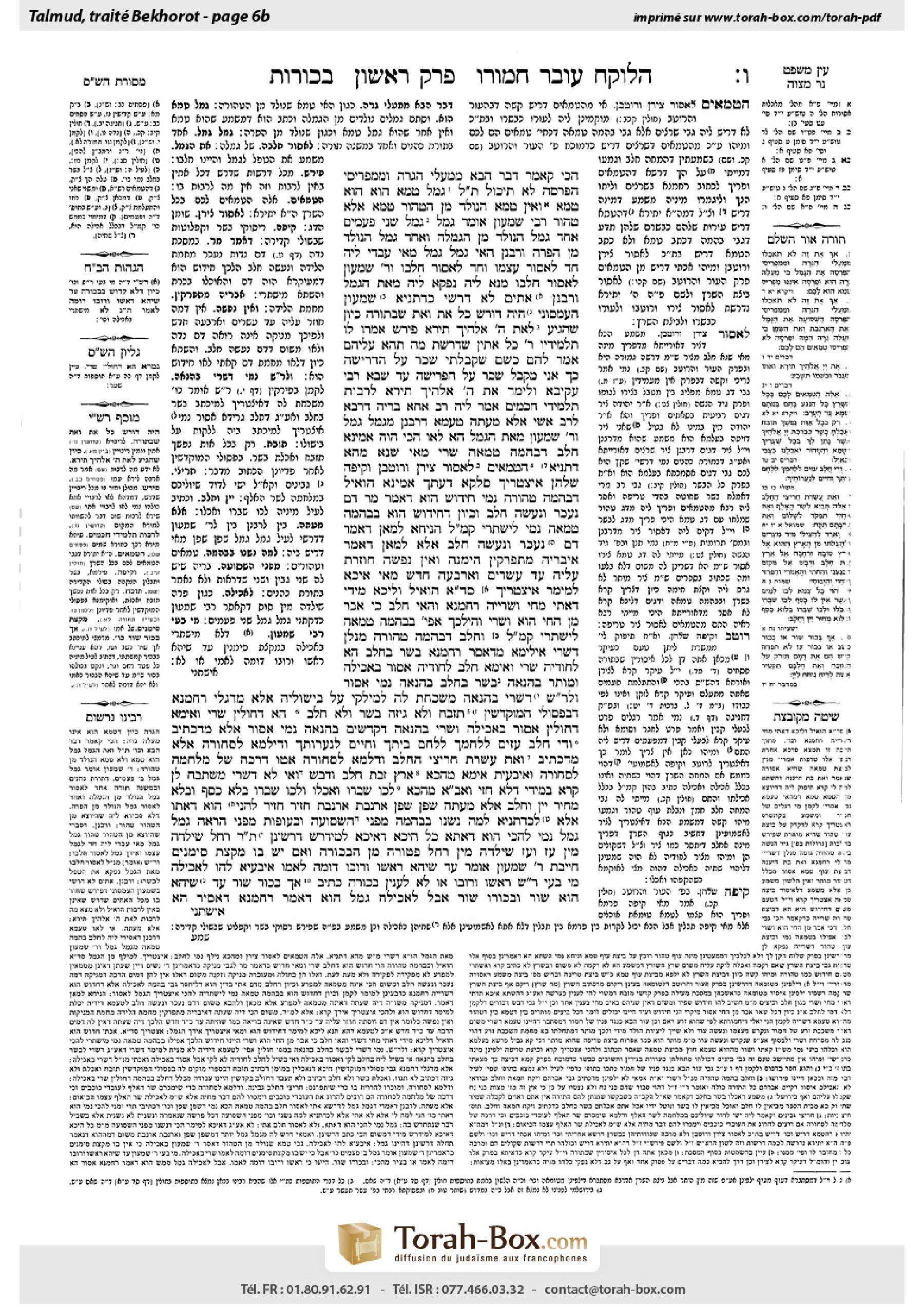
Bekhorot 6b: Talmud study for Daf Yomi
Study the Talmud for Daf Yomi with scanned pages, Hebrew text, English translations from Sefaria and AI-generated French translations.
Passage selection and English or AI-generated French translation are available where the scan has annotations. Daf Study is independent of Torah-Box and Sefaria.
Browse Bekhorot · בכורות · All tractatesBekhorot 6b text and translations
This page of Bekhorot includes the Aramaic text, an English translation and an AI-generated French translation, alongside the scan above.
בכורות ו׳ ב · Aramaic and Hebrew text
הָכִי קָאָמַר: דָּבָר הַבָּא מִמַּעֲלֵי הַגֵּרָה וּמִמַּפְרִיסֵי הַפַּרְסָה לָא תֵּיכוּל, תַּלְמוּד לוֹמַר: ״גָּמָל... טָמֵא הוּא״ — הוּא טָמֵא, וְאֵין טָמֵא הַנּוֹלָד מִן הַטָּהוֹר טָמֵא אֶלָּא טָהוֹר.
רַבִּי שִׁמְעוֹן אוֹמֵר: ״גָּמָל״ ״גָּמָל״ שְׁנֵי פְּעָמִים, אֶחָד גָּמָל הַנּוֹלָד מִן הַגְּמַלָּה, וְאֶחָד גָּמָל הַנּוֹלָד מִן הַפָּרָה.
וְרַבָּנַן, הַאי ״גָּמָל״ ״גָּמָל״ מַאי עָבְדִי לֵיהּ? חַד לֶאֱסוֹר עַצְמוֹ, וְחַד לֶאֱסוֹר חֲלָבוֹ. וְרַבִּי שִׁמְעוֹן, לֶאֱסוֹר חֲלָבוֹ מְנָא לֵיהּ? נָפְקָא לֵיהּ מֵ״אֶת הַגָּמָל״. וְרַבָּנַן, ״אֶתִּים״ לָא דָּרְשִׁי.
כִּדְתַנְיָא: שִׁמְעוֹן הָעַמְסוֹנִי הָיָה דּוֹרֵשׁ כׇּל ״אֵת״ וָ״אֵת״ שֶׁבַּתּוֹרָה, כֵּיוָן שֶׁהִגִּיעַ לְ״אֶת ה׳ אֱלֹהֶיךָ תִּירָא״ פֵּירַשׁ. אָמְרוּ לוֹ תַּלְמִידָיו: רַבִּי, כׇּל ״אֶתִּין״ שֶׁדָּרַשְׁתָּ מָה תְּהֵא עֲלֵיהֶם? אָמַר לָהֶם: כְּשֵׁם שֶׁקִּבׇּלְתִּי שָׂכָר עַל הַדְּרִישָׁה, כָּךְ אֲנִי מְקַבֵּל שָׂכָר עַל הַפְּרִישָׁה.
עַד שֶׁבָּא רַבִּי עֲקִיבָא וְלִימֵּד: ״אֶת ה׳ אֱלֹהֶיךָ תִּירָא״ — לְרַבּוֹת תַּלְמִידֵי חֲכָמִים.
אֲמַר לֵיהּ רַב אַחָא בְּרֵיהּ דְּרָבָא לְרַב אָשֵׁי: אֶלָּא מֵעַתָּה, טַעְמָא דְרַבָּנַן מִ״גָּמָל״ ״גָּמָל״, וְרַבִּי שִׁמְעוֹן מֵ״אֶת הַגָּמָל״, הָא לָאו הָכִי הֲוָה אָמֵינָא חָלָב דִּבְהֵמָה טְמֵאָה שְׁרֵי?
מַאי שְׁנָא מֵהָא דְּתַנְיָא: ״הַטְּמֵאִים״ — לֶאֱסוֹר צִירָן, וְרוֹטְבָן, וְקֵיפֶה שֶׁלָּהֶן?
אִיצְטְרִיךְ, סָלְקָא דַּעְתָּךְ אָמֵינָא: הוֹאִיל דִּבְהֵמָה טְהוֹרָה נָמֵי חִידּוּשׁ הוּא, דְּאָמַר מַר: דָּם נֶעְכָּר וְנַעֲשֶׂה חָלָב, וְכֵיוָן דְּחִידּוּשׁ הוּא — בִּבְהֵמָה טְמֵאָה נָמֵי לִישְׁתְּרֵי, קָא מַשְׁמַע לַן.
הָנִיחָא לְמַאן דְּאָמַר דָּם נֶעְכָּר וְנַעֲשֶׂה חָלָב, אֶלָּא לְמַאן דְּאָמַר אֵיבָרֶיהָ מִתְפָּרְקִין הֵימֶנָּה וְאֵין נַפְשָׁהּ חוֹזֶרֶת עָלֶיהָ עַד עֶשְׂרִים וְאַרְבָּעָה חֹדֶשׁ, מַאי אִיכָּא לְמֵימַר?
אִיצְטְרִיךְ, סָלְקָא דַּעְתָּךְ אָמֵינָא: הוֹאִיל וְלֵיכָּא מִידֵּי דְּאָתֵי מֵחַי וְשַׁרְיֵיהּ רַחֲמָנָא, וְהַאי חָלָב כִּי אֵבֶר מִן הַחַי הוּא, וּשְׁרֵי, וְהִילְכָּךְ אֲפִילּוּ בִּבְהֵמָה טְמֵאָה לִישְׁתְּרֵי, קָא מַשְׁמַע לַן.
וְחָלָב דִּבְהֵמָה טְהוֹרָה מְנָלַן דִּשְׁרֵי? אִילֵימָא מִדַּאֲסַר רַחֲמָנָא ״בָּשָׂר בְּחָלָב״, הָא לְחוּדֵיהּ שְׁרֵי, וְאֵימָא: חָלָב לְחוּדֵיהּ אָסוּר בַּאֲכִילָה וּמוּתָּר בַּהֲנָאָה, בָּשָׂר בְּחָלָב — בַּהֲנָאָה נָמֵי אָסוּר!
וּלְרַבִּי שִׁמְעוֹן, דְּשָׁרֵי בַּהֲנָאָה, מַשְׁכַּחַתְּ לַהּ לְמִילְקֵי עַל בִּישּׁוּלֵיהּ!
אֶלָּא מִדְּגַלִּי רַחֲמָנָא דְּבִפְסוּלֵי הַמּוּקְדָּשִׁין, ״תִּזְבַּח״ — וְלֹא גִּיזָּה, ״בָּשָׂר״ — וְלֹא חָלָב, הָא דְּחוּלִּין שְׁרֵי.
וְאֵימָא: דְּחוּלִּין אָסוּר בַּאֲכִילָה וּשְׁרֵי בַּהֲנָאָה, דְּקָדָשִׁים בַּהֲנָאָה נָמֵי אָסוּר!
אֶלָּא, מִדִּכְתִיב: ״וְדֵי חֲלֵב עִזִּים לְלַחְמְךָ לְלֶחֶם בֵּיתֶךָ וְחַיִּים לְנַעֲרוֹתֶיךָ״.
וְדִילְמָא לִסְחוֹרָה? אֶלָּא מִדִּכְתִיב ״וְאֵת עֲשֶׂרֶת חֲרִיצֵי הֶחָלָב״.
וְדִלְמָא לִסְחוֹרָה? אַטּוּ דַּרְכָּהּ שֶׁל מִלְחָמָה לִסְחוֹרָה?!
וְאִיבָּעֵית אֵימָא מֵהָכָא: ״אֶרֶץ זָבַת חָלָב וּדְבָשׁ״, וְאִי לָא דִּשְׁרֵי, מִשְׁתַּבַּח לַן קְרָא בְּמִידֵּי דְּלָא חֲזֵי? וְאִיבָּעֵית אֵימָא מֵהָכָא: ״לְכוּ שִׁבְרוּ וֶאֱכֹלוּ, וּלְכוּ שִׁבְרוּ בְּלֹא כֶסֶף וּבְלֹא מְחִיר יַיִן וְחָלָב״.
אֶלָּא מֵעַתָּה, ״שָׁפָן״ ״שָׁפָן״, ״אַרְנֶבֶת״ ״אַרְנֶבֶת״, ״חֲזִיר״ ״חֲזִיר״, לְהָנֵי הוּא דְּאָתוּ?
אֶלָּא לְכִדְתַנְיָא: לָמָּה נִשְׁנוּ בַּבְּהֵמָה — מִפְּנֵי ״הַשְּׁסוּעָה״, וּבָעוֹפוֹת — מִפְּנֵי ״הָרָאָה״.
״גָּמָל״ ״גָּמָל״ נָמֵי לְהָכִי הוּא דַּאֲתָא! כֹּל הֵיכָא דְּאִיכָּא לְמִידְרָשׁ דָּרְשִׁינַן.
תָּנוּ רַבָּנַן: רָחֵל שֶׁיָּלְדָה מִין עֵז, וְעֵז שֶׁיָּלְדָה מִין רָחֵל — פְּטוּרָה מִן הַבְּכוֹרָה, וְאִם יֵשׁ בּוֹ מִקְצָת סִימָנִים — חַיֶּיבֶת. רַבִּי שִׁמְעוֹן אוֹמֵר: עַד שֶׁיְּהֵא רֹאשׁוֹ וְרוּבּוֹ דּוֹמֶה לְאִמּוֹ.
אִיבַּעְיָא לְהוּ: לַאֲכִילָה, מִי בָּעֵי רַבִּי שִׁמְעוֹן רֹאשׁוֹ וְרוּבּוֹ, אוֹ לָא?
לְעִנְיַן בְּכוֹרָה, כְּתִיב: ״אַךְ בְּכוֹר שׁוֹר״, עַד שֶׁיְּהֵא הוּא שׁוֹר וּבְכוֹרוֹ שׁוֹר. אֲבָל לַאֲכִילָה, גָּמָל הוּא דְּאָמַר רַחֲמָנָא דַּאֲסִיר, הָא
Bekhorot 6b · English translation
This is what it is saying: You shall not eat a being that comes from one of those animals that chew their cud and have split hooves if it itself does not have the signs of being kosher. To counter this, the continuation of the verse states: “The camel…is impure for you” (Leviticus 11:4). This indicates that a camel itself is non-kosher, but a non-kosher animal that is born from a kosher animal is not non-kosher; rather, it is kosher.
Rabbi Shimon says it is stated: “Camel” (Leviticus 11:4), “camel” (Deuteronomy 14:7), teaching the term two times with regard to the prohibition of consumption. This teaches that both a camel that is born from a camel and a camel that is born from a cow are non-kosher. According to Rabbi Shimon, a non-kosher animal born to a kosher animal is forbidden for consumption, in contrast to the ruling in the mishna.
The Gemara asks: And as for the Rabbis in the baraita, who disagree with Rabbi Shimon, what do they do with this repetition of “camel,” “camel”? The Gemara answers that one of the verses is written to prohibit the camel itself and one is written to prohibit the female camel’s milk. The Gemara asks: And as for Rabbi Shimon, from where does he derive that a camel’s milk is forbidden? The Gemara answers: He derives it from the phrase “the camel [et hagamal].” The verse could have stated just the term “hagamal.” The addition of the word “et” teaches that the prohibition applies also to its milk. And the Rabbis do not interpret instances of “et” as a means to derive new halakhot; they consider it to be an ordinary part of the sentence structure and not a source for exegetical exposition.
As it is taught in a baraita: Shimon HaAmasoni would interpret each and every occurrence of the word “et” in the Torah, deriving additional halakhot with regard to the particular subject matter. Once he reached the verse: “You shall fear the Lord your God” (Deuteronomy 6:13), which is written with the added word “et,” he withdrew from this method of exposition, as whose fear could be an extension of the fear of God? His students said to him: Our teacher, what will be with all the occurrences of “et” that you interpreted until now? Shimon HaAmasoni said to them: Just as I received reward for the exposition, so I receive reward for my withdrawal from using this method of exposition.
The word “et” in this verse was not explained until Rabbi Akiva came and taught: “You shall fear the Lord your God”; the word “et” in the verse serves to include Torah scholars, i.e., that one is commanded to fear them just as one fears God. In any event, Shimon HaAmasoni no longer derived additional halakhot from “et.” The Rabbis follow the conclusion of Shimon HaAmasoni that “et” is not expounded.
Rav Aḥa, son of Rava, said to Rav Ashi: If that is so, that the reason of the Rabbis for the halakha that a camel’s milk is forbidden is that it is derived from the words “camel,” “camel,” written twice, and Rabbi Shimon derives it from “the camel [et hagamal],” then could it be reasoned that if not for this derivation I would say that milk of a non-kosher animal is permitted?
In what way is this case different from that which is taught in a baraita: The Torah states with regard to the prohibition against eating creeping animals: “These are they that are impure [hateme’im] to you among all the creeping animals” (Leviticus 11:31). The Sages interpret the letter heh in the term “that are impure [hateme’im]” to prohibit their juice that oozes from their body and their gravy that is produced when they are cooked, and sediments of their flesh that congeal at the bottom of the dish when cooked. Evidently, any liquid that emerges from a non-kosher animal is forbidden.
Rav Ashi responded: The additional exposition to derive that camel’s milk is forbidden was necessary, because it might enter your mind to say it may be permitted, since the permissibility of consumption of the milk of a kosher animal is also a novelty. The milk originates from the blood, which is forbidden for consumption, as the Master said that the reason a nursing woman does not experience menstruation is because the blood is spoiled and becomes milk. Since it is a novelty that the Torah permits milk despite its origins, it might enter your mind to say that with regard to a non-kosher animal it should also be permitted. Therefore, the verse teaches us that it is forbidden.
The Gemara challenges: This works out well according to the one who says that a nursing woman does not menstruate because the blood is spoiled and becomes milk. But according to the one who says that the milk does not originate from blood, but rather the reason she does not menstruate is because her limbs become disjointed and her soul, i.e., her health, does not return to her until twenty-four months later, what is there to say? Why does the Torah employ a verse to render forbidden the milk of a non-kosher animal?
The Gemara answers: It was necessary, because it might enter your mind to say it may be permitted; since generally speaking there is nothing that comes from a living animal that the Merciful One permits, and yet this milk of a kosher animal is similar to a limb severed from the living and is nevertheless permitted, the permissibility of milk is a novelty of the Torah. And consequently it might enter your mind to say that even the milk of a non-kosher animalshould be permitted in line with that novelty. Therefore, the verse teaches us that it is forbidden.
§ The Gemara asks: And from where do we derive that the milk of a kosher animal is in fact permitted? If we say that it is derived from the fact that the Merciful One prohibits eating meat that was cooked in milk, indicating that milk by itself is permitted, one can reject this proof and say that milk alone is forbidden only for consumption but permitted with regard to deriving benefit from it. By contrast, meat that was cooked in milk is forbidden with regard to deriving benefit from it as well.
And according to Rabbi Shimon, who deems meat that was cooked in milk permitted with regard to deriving benefit from it, you find a reason for the Torah to mention the prohibition of meat and milk together, even if milk alone is forbidden as well, and that is in order to render one liable to receive lashes for cooking them together, which would not apply to cooking milk alone.
Rather, one can prove that milk is permitted for consumption since the Merciful One revealed that with regard to disqualified consecrated animals that were redeemed: “You may slaughter and eat meat” (Deuteronomy 12:15). This verse is interpreted in the following manner: “You may slaughter,” but you may not use its wool from shearing. You may eat its “meat,” but you may not consume its milk. It can be inferred from here that milk of non-sacred kosher animals is permitted.
The Gemara rejects this proof: But one could say the distinction between non-sacred milk and milk from sacrificial animals is not with regard to the permissibility of consumption. Rather, milk of non-sacred animals is forbidden for consumption but is permitted with regard to deriving benefit from it, but the milk of sacrificial animals is forbidden with regard to deriving benefit as well.
Rather, proof may be brought that milk is permitted from the fact that it is written: “And there will be goats’ milk enough for your food, for the food of your household, and maintenance for your maidens” (Proverbs 27:27). According to the verse, goats’ milk serves as food, and therefore must be kosher.
The Gemara rejects the proof: But perhaps the verse is referring to selling the milk as merchandise and using the money to buy food, and not to consuming the milk itself. Rather, proof may be brought from the fact that it is written with regard to Jesse’s instructions to his son David upon sending him with provisions for his brothers, who were at war against the Philistines: “And these ten cheeses you shall bring to the captain of their thousand” (I Samuel 17:18), which indicates they ate dairy products.
The Gemara rejects this proof as well: But perhaps this verse too means the captain can sell the cheese as merchandise. The Gemara responds: Is that to say that it is the norm during war to engage in commerce? Clearly the cheese was meant for consumption, which proves it is permitted to eat dairy products.
And if you wish, say instead that proof may be brought from here: The Torah praises Eretz Yisrael as: “A land flowing with milk and honey” (Exodus 3:17), and if milk was not permitted, would the verse praise the land to us with an item that is not suitable for consumption? And if you wish, say instead a proof from here: “Come, buy, and eat; and come, buy wine and milk without money and without price” (Isaiah 55:1).
§ The Gemara returns to the dispute between Rabbi Shimon and the Rabbis, who interpret the repetition of the word “camel” as indicating the prohibitions against eating a camel born from a cow and consuming its milk, respectively, and asks: But if that is so, that the repetition indicates these halakhot, then with regard to the words: “Hare,” “hare,” “rock badger,” “rock badger,” “swine,” “swine” (see Leviticus 11:5–7; Deuteronomy 14:7–8), which are all mentioned twice as being forbidden, do these words come to teach these halakhot as well?
The Gemara explains: They are necessary only for that which is taught in a baraita: Why were all of the non-kosher animals and birds repeated in Deuteronomy (14:7–20), after having been mentioned already in Leviticus (11:10–20)? With regard to the animals, it is because of the shesua (see Deuteronomy 14:7), an animal with two backs and two spines, which is not mentioned in Leviticus, and with regard to the birds, it is because of the ra’a (see Deuteronomy 14:13).
The Gemara challenges: If so, then the double reference of “camel,” “camel,” also comes for this purpose of teaching about the shesua, and not to teach a separate halakha about the camel. The Gemara explains: Nevertheless, anywhere that it is possible to interpret the verse as teaching an additional halakha, we interpret it in that manner. Only where there is no possibility of such an interpretation is the concept of repeating the passage merely to introduce one additional detail invoked.
§ The Gemara discusses an additional source that cites the opinion of Rabbi Shimon: The Sages taught in a baraita that in the case of a ewe that gave birth to a goat of sorts and a goat that gave birth to a ewe of sorts, in each case the mother is exempt from its offspring being counted a firstborn. And if it has some of the characteristics of its mother, the mother is obligated, i.e., subject to accounting its offspring a firstborn. Rabbi Shimon says: The offspring does not have firstborn status unless its head and the majority of its body are similar to the appearance of its mother.
A dilemma was raised before the Sages: With regard to the permissibility of eating a non-kosher animal that was born to a kosher animal, does Rabbi Shimon require its head and most of its body to resemble its mother, or not, and possessing some of the characteristics of its mother suffices?
The Gemara explains: With regard to the halakha of firstborn status, it is written: “But the firstborn of an ox” (Numbers 18:17), which indicates that it does not have firstborn status unless it is an ox and its firstborn is an ox. If its head and most of its body do not resemble an ox, it does not have firstborn status according to Rabbi Shimon. But with regard to consumption, where Rabbi Shimon holds a camel born to a kosher animal is forbidden, perhaps it is only an ordinary-looking camel that the Merciful One states is forbidden, but if
Bekhorot 6b · Traduction française (IA)
C’est ce que l’on dit : Tu ne mangeras point d’animal qui vient d’un de ces animaux qui ruminent et qui ont des pieds partagés, à moins qu’il ne possède les signes de la pureté. Pour contredire cela, la continuation du verset dit : « Le chameau… est impur pour vous » (Lévitique 11:4). Cela montre que le chameau lui-même est impur, mais un animal impur né d’un animal pur n’est pas impur ; il est pur.
Rabbi Shimon dit : il est dit : « Le chameau » (Lévitique 11:4), « le chameau » (Dt 14:7), enseignant le terme deux fois concernant l’interdiction de la consommation. Cela enseigne que tant le chameau né d’un chameau que le chameau né d’une vache est impur. Selon Rabbi Shimon, un animal impur né d’un animal pur est interdit à la consommation, contrairement à la décision du mitsva.
Le Guemara demande : Et quant aux Rabbins dans la baraïta, qui s’opposent à Rabbi Shimon, que font-ils avec cette répétition de « chameau », « chameau » ? Le Guemara répond qu’un des versets est écrit pour interdire le chameau lui-même et l’autre pour interdire le lait de la femelle chameau. Le Guemara demande : Et quant à Rabbi Shimon, d’où tire-t-il qu’il est interdit de boire le lait du chameau ? Le Guemara répond : Il tire cela de la phrase « le chameau [et hagamal] ». Le verset aurait pu simplement dire « hagamal ». L’ajout du mot « et » enseigne que l’interdiction s’applique également à son lait. Et les Rabbins ne considèrent pas les occurrences de « et » comme une source pour l’interprétation exégétique ; ils les considèrent comme une simple partie de la structure de la phrase.
Comme il est enseigné dans une baraïta : Shimon HaAmasoni interpréterait chaque occurrence du mot « et » dans la Torah, dérivant des halakhot supplémentaires concernant la matière particulière. Une fois qu’il est arrivé au verset : « Vous craignez le Seigneur votre Dieu » (Dt 6:13), qui est écrit avec l’ajout du mot « et », il a renoncé à cette méthode d’explication, car la crainte pouvait être une extension de la crainte de Dieu ? Ses élèves lui dirent : Notre maître, que deviendra tout ce que tu as interprété jusqu’à présent ? Shimon HaAmasoni répondit : Comme j’ai reçu une récompense pour l’explication, ainsi je reçois une récompense pour mon retrait de cette méthode d’explication.
Le mot « et » dans ce verset n’a pas été expliqué jusqu’à ce que Rabbi Akiva vienne et enseigne : « Vous craignez le Seigneur votre Dieu » ; le mot « et » dans le verset sert à inclure les sages, c’est-à-dire que l’on est commandé à craindre eux comme on craint Dieu. En tout cas, Shimon HaAmasoni ne dérivait plus des halakhot supplémentaires à partir de « et ». Les Rabbins suivent la conclusion de Shimon HaAmasoni que « et » n’est pas expouné.
Rav Acha, fils de Rava, dit à Rav Ashi : Si c’est ainsi, que la raison des Rabbins pour la halakha que le lait du chameau est interdit est que cela est dérivé des mots « chameau », « chameau », écrits deux fois, et Rabbi Shimon le dérive de « le chameau [et hagamal] », alors pourrait-on raisonner que si ce n’était pas pour cette dérivation, je dirais que le lait d’un animal impur est permis ?
Dans quelle mesure cette situation diffère-t-elle de celle enseignée dans une baraïta : La Torah dit concernant l’interdiction de manger les animaux rampants : « Ces sont ceux qui sont impurs [hateme’im] pour vous parmi tous les animaux rampants » (Lévitique 11:31). Les Sages interprètent la lettre heh dans le terme « qui sont impurs [hateme’im] » pour interdire leur jus qui s’écoule de leur corps, leur bouillon produit lorsqu’ils sont cuits, ainsi que les dépôts de leur chair qui se solidifient au fond du plat lors de la cuisson. Évidemment, toute liquide qui sort d’un animal non-kosher est interdite.
Rav Ashi répondit : L’explication supplémentaire pour dériver que le lait du chameau est interdit était nécessaire, car cela pourrait entrer dans votre esprit de dire qu’il est permis, puisque la permissibilité de la consommation du lait d’un animal kasher est aussi une nouveauté. Le lait provient du sang, qui est interdit à la consommation, comme le Maître dit que la raison pour laquelle une femme allaitant ne connaît pas la menstruation est que le sang est corrompu et devient du lait. Puisque c’est une nouveauté que la Torah permet le lait malgré ses origines, cela pourrait entrer dans votre esprit de dire que concernant un animal non-kosher il devrait être permis également. Par conséquent, le verset nous enseigne qu’il est interdit.
Le Guemara conteste : Cela s’applique bien selon celui qui dit que la femme allaitant ne connaît pas la menstruation parce que le sang est corrompu et devient du lait. Mais selon celui qui dit que le lait ne provient pas du sang, mais plutôt que la raison pour laquelle elle ne connaît pas la menstruation est que ses membres deviennent disjoints et son âme, c’est-à-dire sa santé, ne revient pas à elle jusqu’à vingt-quatre mois plus tard, que dire ? Pourquoi la Torah utilise-t-elle un verset pour rendre interdit le lait d’un animal non-kosher ?
Le Guemara répond : Il était nécessaire, car cela pourrait entrer dans votre esprit de dire qu’il est permis ; puisque généralement il n’y a rien qui vient d’un animal vivant que le Bienveillant permet, et pourtant ce lait d’un animal pur est semblable à un membre séparé de l’animal vivant et est toutefois permis, la permissibilité du lait est une nouveauté de la Torah. Et par conséquent cela pourrait entrer dans votre esprit de dire que même le lait d’un animal impur devrait être permis en suivant cette nouveauté. Par conséquent, le verset nous enseigne qu’il est interdit.
§ Le Guemara demande : D’où dérivons-nous que le lait d’un animal pur est effectivement permis ? Si nous disons qu’il est dérivé du fait que le Bienveillant interdit de manger de la viande cuite avec du lait, indiquant que le lait seul est permis, on peut rejeter cette preuve et dire que le lait seul est interdit seulement à la consommation mais permis concernant l’usage en dérivant un bénéfice. À l’inverse, la viande cuite avec du lait est interdite concernant l’usage en dérivant un bénéfice également.
Et selon Rabbi Shimon, qui considère que la viande cuite avec du lait est permise en ce qui concerne l'acquisition de bénéfice, vous trouvez une raison pour que la Torah mentionne la prohibition de la viande et du lait ensemble, même si le lait seul est également interdit, et cela afin de rendre l'individu responsable de recevoir des coups de fouet pour avoir cuisiné ensemble, ce qui ne s'appliquerait pas à la cuisson du lait seul.
Au contraire, on peut démontrer que le lait est permis à la consommation, car l'Éternel a révélé cela concernant les animaux consacrés non validés qui ont été rachetés : « Vous pouvez tuer et manger de la viande » (Deutéronome 12:15). Cette verset est interprété ainsi : « Vous pouvez tuer », mais vous ne pouvez pas utiliser sa laine. Vous pouvez manger sa « viande », mais vous ne pouvez pas consommer son lait. On peut en déduire ici que le lait des animaux non sacrés et halal est permis.
La Guemara rejette cette preuve : Mais on pourrait dire que la distinction entre le lait non sacré et le lait des animaux sacrés ne concerne pas la permisibilité de la consommation. En réalité, le lait des animaux non sacrés est interdit à la consommation mais permis en ce qui concerne l'acquisition de bénéfice, tandis que le lait des animaux sacrés est interdit en ce qui concerne l'acquisition de bénéfice également.
Au contraire, on peut apporter une preuve que le lait est permis, car il est écrit : « Il y aura assez de lait de chèvre pour votre nourriture, pour la nourriture de votre maison, et pour la subsistance de vos servantes » (Proverbes 27:27). Selon ce verset, le lait de chèvre sert de nourriture, et par conséquent doit être kosher.
La Guemara rejette cette preuve : Mais peut-être ce verset fait référence à la vente du lait comme marchandise et à l'utilisation de l'argent pour acheter de la nourriture, et non à la consommation du lait lui-même. Au contraire, on peut apporter une preuve à partir du fait qu'il est écrit concernant les instructions de Jésaias à son fils David lorsqu'il l'envoyait avec des provisions pour ses frères, qui étaient en guerre contre les Philistins : « Et ces dix fromages, tu les apporteras au chef de leur centaine » (1 Rois 17:18), ce qui indique qu'ils mangeaient des produits laitiers.
La Guemara rejette cette preuve également : Mais peut-être ce verset aussi signifie que le chef peut vendre le fromage comme marchandise. La Guemara répond : Est-ce que cela signifie que c'est la norme pendant la guerre d'engager dans le commerce ? Évidemment, le fromage était destiné à la consommation, ce qui prouve qu'il est permis de manger des produits laitiers.
Et si vous le souhaitez, dites plutôt que la preuve peut être apportée à partir de là : La Torah loue la Terre d'Israël comme : « Une terre qui coule en lait et en miel » (Exode 3:17), et si le lait n'était pas permis, serait-ce que le verset louerait la terre à nous avec un objet non adapté à la consommation ? Et si vous le souhaitez, dites plutôt une preuve à partir de là : « Viens, achète, et mange ; viens, achète du vin et du lait sans argent et sans prix » (Yachout 55:1).
§ La Guemara revient au débat entre Rabbi Shimon et les Rabbins, qui interprètent la répétition du mot « chameau » comme indiquant les prohibitions contre la consommation du chameau et la consommation de son lait, respectivement, et demande : Mais si c'est ainsi, c'est-à-dire que la répétition indique ces halakhot, alors concernant les mots : « Chien », « chien », « bête de pierre », « bête de pierre », « porc », « porc » (voir Lévitique 11:5–7 ; Deutéronome 14:7–8), qui sont tous mentionnés deux fois comme interdits, ces mots viennent-ils enseigner ces halakhot également ?
La Guemara explique : Ils sont nécessaires uniquement pour ce qui est enseigné dans une baraïta : Pourquoi les animaux non halal et les oiseaux sont-ils répétés dans Deutéronome (14:7–20), après avoir été mentionnés déjà dans Lévitique (11:10–20) ? Concernant les animaux, c'est à cause de la shesua (voir Deutéronome 14:7), un animal avec deux dos et deux vertèbres, qui n'est pas mentionné dans Lévitique, et concernant les oiseaux, c'est à cause du ra’a (voir Deutéronome 14:13).
La Guemara soulève un défi : Si c'est ainsi, alors la répétition du mot « chameau », « chameau », vient aussi pour ce but de l'enseignement sur la Chéma, et non pour enseigner une halakha séparée sur le chameau. La Guemara explique : Néanmoins, partout où il est possible d'interpréter le verset comme enseignant une halakha supplémentaire, on l'interprète ainsi. Seulement là où il n'y a pas de possibilité d'une telle interprétation, le concept de répétition du passage est simplement pour introduire un détail supplémentaire.
§ La Guemara discute d'une autre source qui cite l'opinion de Rabbi Shimon : Les Sages ont enseigné dans une baraïta que dans le cas d'une brebis qui a donné naissance à un bouc et d'un bouc qui a donné naissance à une brebis, dans chaque cas la mère est exemptée de l'obligation de compter son petit comme premier-né. Et si elle a certains des caractéristiques de sa mère, la mère est obligée, c'est-à-dire soumise à l'obligation de compter son petit comme premier-né. Rabbi Shimon dit : Le petit ne possède pas le statut de premier-né à moins que sa tête et la majorité de son corps ressemblent à l'apparence de sa mère.
Un dilemme a été soulevé devant les Sages : Concernant la permisibilité de manger un animal non kasher né d'un animal kasher, exige-t-il Rabbi Shimon que sa tête et la majorité de son corps ressemblent à sa mère, ou non, et posséder certains des caractéristiques de sa mère suffit ?
La Guemara explique : Concernant la halakha du statut de premier-né, il est écrit : « Mais le premier-né d'un bœuf » (Nombres 18:17), ce qui indique qu'il ne possède pas le statut de premier-né à moins qu'il soit un bœuf et son premier-né soit un bœuf. Si sa tête et la majorité de son corps ne ressemblent pas à un bœuf, il ne possède pas le statut de premier-né selon Rabbi Shimon. Mais concernant la consommation, où Rabbi Shimon considère qu'un chameau né d'un animal halal est interdit, peut-être s'agit-il simplement d'un chameau ordinaire que l'Éternel a déclaré interdit, mais si
Traduction française générée par IA à partir de l’édition anglaise de Sefaria. Vérifie toujours un passage avec le texte source.
Text from Sefaria: William Davidson Edition - Vocalized Aramaic (CC BY NC); William Davidson Edition - English (CC BY NC).