Bekhorot 7a: Talmud study for Daf Yomi
Study the Talmud for Daf Yomi with scanned pages, Hebrew text, English translations from Sefaria and AI-generated French translations.
Passage selection and English or AI-generated French translation are available where the scan has annotations. Daf Study is independent of Torah-Box and Sefaria.
Browse Bekhorot · בכורות · All tractatesBekhorot 7a text and translations
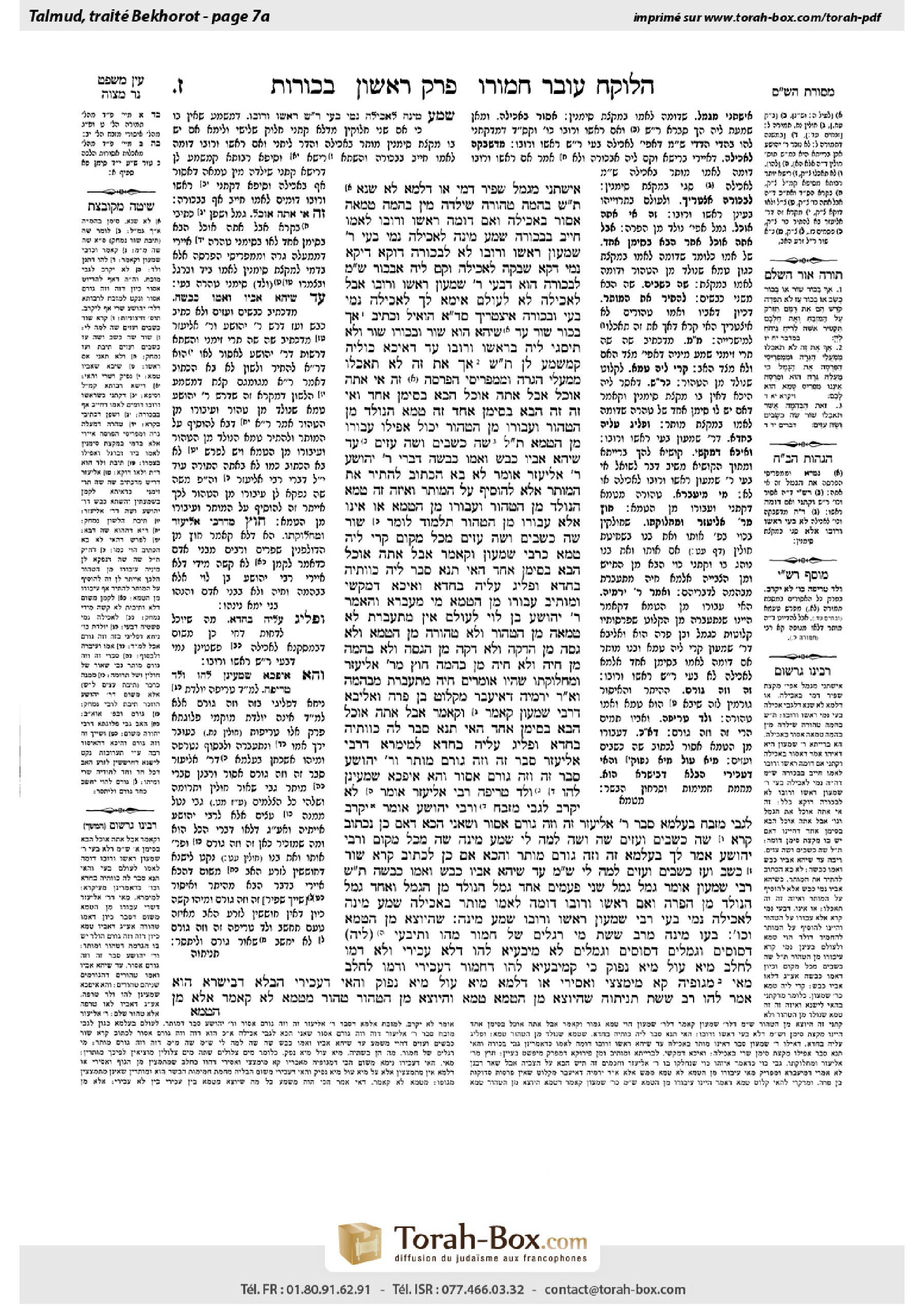
This page of Bekhorot includes the Aramaic text, an English translation and an AI-generated French translation, alongside the scan above.
בכורות ז׳ א · Aramaic and Hebrew text
אִישְׁתַּנִּי מִגָּמָל שַׁפִּיר דָּמֵי, אוֹ דִלְמָא לָא שְׁנָא?
תָּא שְׁמַע: בְּהֵמָה טְהוֹרָה שֶׁיָּלְדָה מִין בְּהֵמָה טְמֵאָה — אָסוּר בַּאֲכִילָה, וְאִם דּוֹמֶה רֹאשׁוֹ וְרוּבּוֹ לְאִמּוֹ — חַיָּיב בִּבְכוֹרָה. שְׁמַע מִינַּהּ: לַאֲכִילָה נָמֵי בָּעֵי רַבִּי שִׁמְעוֹן רֹאשׁוֹ וְרוּבּוֹ!
לָא, לִבְכוֹרָה דַּוְקָא. דַּיְקָא נָמֵי, דְּקָא שָׁבְקַהּ לַאֲכִילָה וְקָם לֵיהּ אַבְּכוֹר. שְׁמַע מִינַּהּ: לִבְכוֹרָה הוּא דְּבָעֵי רַבִּי שִׁמְעוֹן רֹאשׁוֹ וְרוּבּוֹ, אֲבָל לַאֲכִילָה — לָא.
לְעוֹלָם אֵימָא לָךְ: לַאֲכִילָה נָמֵי בָּעֵי, וּבְכוֹרָה אִיצְטְרִיךְ, סָלְקָא דַּעְתָּךְ אָמֵינָא: הוֹאִיל וּכְתִיב ״אַךְ בְּכוֹר שׁוֹר״, עַד שֶׁיְּהֵא הוּא שׁוֹר וּבְכוֹרוֹ שׁוֹר, וְלֹא תִּיסְגֵּי לֵיהּ בְּרֹאשׁוֹ וְרוּבּוֹ עַד דְּאִיכָּא כּוּלֵּיהּ, קָמַשְׁמַע לַן.
תָּא שְׁמַע: ״אַךְ אֶת זֶה לֹא תֹאכְלוּ מִמַּעֲלֵי הַגֵּרָה וּמִמַּפְרִיסֵי הַפַּרְסָה״, זֶה — אִי אַתָּה אוֹכֵל, אֲבָל אַתָּה אוֹכֵל הַבָּא בְּסִימָן אֶחָד.
וְאִי זֶה זֶה הַבָּא בְּסִימָן אֶחָד? זֶה טָמֵא הַנּוֹלָד מִן הַטָּהוֹר, וְעִבּוּרוֹ מִן הַטָּהוֹר.
יָכוֹל אֲפִילּוּ עִבּוּרוֹ מִן הַטָּמֵא? תַּלְמוּד לוֹמַר: ״שֵׂה כְשָׂבִים וְשֵׂה עִזִּים״, עַד שֶׁיְּהֵא אָבִיו כֶּבֶשׂ וְאִמּוֹ כִּבְשָׂה, דִּבְרֵי רַבִּי יְהוֹשֻׁעַ.
רַבִּי אֱלִיעֶזֶר אוֹמֵר: לֹא בָּא הַכָּתוּב לְהַתִּיר אֶת הַמּוּתָּר, אֶלָּא לְהוֹסִיף עַל הַמּוּתָּר, וְאֵיזֶה זֶה? טָמֵא הַנּוֹלָד מִן הַטָּהוֹר וְעִבּוּרוֹ מִן הַטָּמֵא. אוֹ אֵינוֹ אֶלָּא עִבּוּרוֹ מִן הַטָּהוֹר? תַּלְמוּד לוֹמַר: ״שׁוֹר שֵׂה כְשָׂבִים וְשֵׂה עִזִּים״ מִכׇּל מָקוֹם.
קָרֵי לֵיהּ ״טָמֵא״, כְּרַבִּי שִׁמְעוֹן, וְקָאָמַר: אֲבָל אַתָּה אוֹכֵל הַבָּא בְּסִימָן אֶחָד!
הַאי תַּנָּא סָבַר לֵיהּ כְּוָותֵיהּ בַּחֲדָא, וּפְלִיג עֲלֵיהּ בַּחֲדָא.
וְאִיכָּא דְּמַקְשֵׁי וּמוֹתֵיב: עִבּוּרוֹ מִן הַטָּמֵא — מִי מִעַבְּרָא?
וְהָאָמַר רַבִּי יְהוֹשֻׁעַ בֶּן לֵוִי: לְעוֹלָם אֵין מִתְעַבֶּרֶת לֹא טְמֵאָה מִן הַטָּהוֹר, וְלֹא טְהוֹרָה מִן הַטָּמֵא, וְלֹא גַּסָּה מִן הַדַּקָּה, וְלֹא דַּקָּה מִן הַגַּסָּה, וְלֹא בְּהֵמָה מִן חַיָּה, וְלֹא חַיָּה מִן בְּהֵמָה.
חוּץ מֵרַבִּי אֱלִיעֶזֶר וּמַחְלוּקְתּוֹ, שֶׁהָיוּ אוֹמְרִים חַיָּה מִתְעַבֶּרֶת מִבְּהֵמָה!
וְאָמַר רַבִּי יִרְמְיָה: דְּאִיעַבַּר מִקָּלוּט בֶּן פָּרָה, וְאַלִּיבָּא דְּרַבִּי שִׁמְעוֹן קָאָמַר, וְקָאָמַר: אֲבָל אַתָּה אוֹכֵל הַבָּא בְּסִימָן אֶחָד!
הַאי תַּנָּא סָבַר לַהּ כְּוָותֵיהּ בַּחֲדָא, וּפְלִיג עֲלֵיהּ בַּחֲדָא.
לְמֵימְרָא, דְּרַבִּי אֱלִיעֶזֶר סָבַר: זֶה וָזֶה גּוֹרֵם — מוּתָּר, וְרַבִּי יְהוֹשֻׁעַ סָבַר: זֶה וָזֶה גּוֹרֵם — אָסוּר?
וְהָא אִיפְּכָא שָׁמְעִינַן לְהוּ: וְלַד טְרֵיפָה, רַבִּי אֱלִיעֶזֶר אוֹמֵר: לֹא יִקְרַב לְגַבֵּי מִזְבֵּחַ, וְרַבִּי יְהוֹשֻׁעַ אוֹמֵר: יִקְרַב לְגַבֵּי מִזְבֵּחַ!
בְּעָלְמָא סָבַר רַבִּי אֱלִיעֶזֶר: זֶה וָזֶה גּוֹרֵם — אָסוּר, וְשָׁאנֵי הָכָא, דְּאִם כֵּן נִכְתּוֹב קְרָא: ״שֵׂה כְשָׂבִים וְעִזִּים״, ״שֵׂה״ ״וְשֵׂה״ לְמָה לִי? שְׁמַע מִינַּהּ: שֶׂה — מִכׇּל מָקוֹם.
וְרַבִּי יְהוֹשֻׁעַ אָמַר לְךָ: בְּעָלְמָא זֶה וָזֶה גּוֹרֵם — מוּתָּר, וְהָכָא אִם כֵּן לִכְתּוֹב קְרָא: ״שׁוֹר כֶּשֶׂב וָעֵז״, ״כְּשָׂבִים וְעִזִּים״ לְמָה לִי? שְׁמַע מִינַּהּ עַד שֶׁיְּהֵא אָבִיו כֶּבֶשׂ וְאִמּוֹ כִּבְשָׂה.
תָּא שְׁמַע: רַבִּי שִׁמְעוֹן אוֹמֵר, ״גָּמָל״ ״גָּמָל״ שְׁנֵי פְּעָמִים — אֶחָד גָּמָל הַנּוֹלָד מִן הַגָּמָל, וְאֶחָד גָּמָל הַנּוֹלָד מִן הַפָּרָה, וְאִם רֹאשׁוֹ וְרוּבּוֹ דּוֹמֶה לְאִמּוֹ — מוּתָּר בַּאֲכִילָה.
שְׁמַע מִינַּהּ, לַאֲכִילָה נָמֵי בָּעֵי רַבִּי שִׁמְעוֹן רֹאשׁוֹ וְרוּבּוֹ, שְׁמַע מִינַּהּ.
שֶׁהַיּוֹצֵא מִן הַטָּמֵא וְכוּ׳. בְּעוֹ מִינַּהּ מֵרַב שֵׁשֶׁת: מֵי רַגְלַיִם שֶׁל חֲמוֹר, מַהוּ?
וְתִיבְּעֵי לֵיהּ דְּסוּסִים וּגְמַלִּים? דְּסוּסִים וּגְמַלִּים לָא מִיבַּעְיָא לְהוּ, דְּלָא עֲכִירִי וְלָא דָּמוּ לְחָלָב, מַיָּא עוּל מַיָּא נְפוּק. כִּי קָמִיבַּעְיָא לְהוּ דַּחֲמוֹר, דַּעֲכִירִי וְדָמוּ לְחָלָב, מַאי? מִגּוּפֵיהּ קָא מִימַּצְצִי וַאֲסִירִי, אוֹ דִלְמָא מַיָּא עוּל מַיָּא נְפוּק, וְהַאי דַּעֲכִירִי — הַבְלָא דְּבִישְׂרָא הוּא?
אֲמַר לְהוּ רַב שֵׁשֶׁת, תְּנֵיתוּה: שֶׁהַיּוֹצֵא מִן הַטָּמֵא — טָמֵא, וְהַיּוֹצֵא מִן הַטָּהוֹר — טָהוֹר. ״מִטָּמֵא״ לָא קָאָמַר, אֶלָּא ״מִן
Bekhorot 7a · English translation
it is different from an ordinary camel and has some characteristics of its mother, perhaps it is permitted to eat it. Or perhaps there is no difference, and with regard to consumption Rabbi Shimon also requires that its head and the majority of its body resemble its mother.
The Gemara suggests: Come and hear a proof from a baraita: With regard to a kosher animal that gave birth to a non-kosher animal of sorts, the offspring is forbidden for consumption, in accordance with the opinion of Rabbi Shimon; but if its head and the majority of its body are similar to its mother, it is obligated in, i.e., subject to the obligations of, firstborn status. Learn from it that with regard to consumption, Rabbi Shimon also requires that its head and the majority of its body resemble the mother.
The Gemara rejects the proof: No, the requirement that its head and the majority of its body resemble the mother is relevant specifically with regard to firstborn status. The Gemara comments: The language of the baraita is also precise, as the tanna leaves the halakha of consumption with which he began and addresses the halakha of firstborn status. Learn from it that it is with regard to firstborn status that Rabbi Shimon requires that its head and the majority of its body resemble the mother, but with regard to consumption he does not require this, and even a partial similarity suffices.
The Gemara rejects this conclusion as well: Actually, I will say to you that with regard to the permissibility of consumption he also requires that its head and the majority of its body be similar to the mother. But it was necessary to state this condition specifically with regard to the halakha of firstborn status, as it might enter your mind to say that since it is written: “But the firstborn of an ox” (Numbers 18:17), perhaps firstborn status does not apply unless it is an ox and its firstborn is an ox, and a resemblance of the offspring’s head and the majority of its body to the mother does not suffice unless its whole body has the appearance of an ox. Therefore, the tanna teaches us that a resemblance of its head and the majority of its body to the mother do suffice.
The Gemara suggests: Come and hear a proof from a baraita: The Torah states: “Nevertheless these shall you not eat from them that only chew the cud, or from them that only have a split hoof: The camel” (Leviticus 11:4). The phrase: “From them that only chew the cud,” which is referring to animals that are forbidden for consumption, indicates that a camel or other non-kosher animal that is born to a kosher animal is forbidden. Furthermore, the word “these” teaches that concerning these animals that resemble a non-kosher animal, you may not eat them when they are born to a kosher animal, but you may eat a non-kosher animal that comes with one characteristic of its mother.
And which animal is this that comes with one characteristic of its mother? This is a non-kosher animal that is born from a kosher female animal and its impregnation came from a kosher male animal.
The baraita continues: One might have thought that even if its conception came from a non-kosher male animal it should be permitted. Therefore, the verse states: “These are the beasts which you may eat: “The ox, the sheep [seh kesavim], and goat [veseh izzim]” (Deuteronomy 14:4). The plural form of “kesavim” and “izzim” indicates that a lamb is not kosher unless its father is a male lamb and its mother is a female lamb. This is the statement of Rabbi Yehoshua.
Rabbi Eliezer says: Offspring whose father and mother are both kosher are permitted, and this verse which renders permitted an offspring that partially resembles its mother does not come to permit that which is permitted, i.e., where both parents are kosher, but it comes rather to add to that which is permitted; and which case is this? It is a case of a non-kosher animal that is born from a kosher animal and its conception came from a non-kosher animal. Or perhaps it permits only an animal whose conception came from a kosher animal? The verse states: “The ox, the sheep [seh kesavim], and goat [veseh izzim].” The repetition of the word seh indicates that it is permitted to be eaten in any case, even if only its mother was a ewe.
In any event, the tanna of this baraita refers to a non-kosher animal that was born to a kosher animal as non-kosher, in accordance with the opinion of Rabbi Shimon, who deems a camel that was born to a cow forbidden to eat, and he says: But you may eat a non-kosher animal that comes with one characteristic that is similar to its mother. Apparently, Rabbi Shimon does not require that the head and the majority of the body resemble the mother for it to be rendered fit for consumption.
The Gemara responds: No proof may be brought from here, as this tanna holds in accordance with the opinion of Rabbi Shimon with regard to one matter, where a kosher animal gave birth to a non-kosher animal, maintaining that it is forbidden, and disagrees with his opinion with regard to one other matter, where the animal has some characteristics of the mother, in which case this tanna deems it permitted to be eaten. Concerning the second matter, Rabbi Shimon deems it forbidden unless the head and majority of the body resemble the mother.
The Gemara comments that there are those who raise a difficulty with this baraita and resolve it, thereby resolving the dilemma concerning the opinion of Rabbi Shimon: The baraita states that the kosher animal’s impregnation came from a non-kosher animal. Can a kosher animal become pregnant from a non-kosher animal?
But doesn’t Rabbi Yehoshua ben Levi say: A non-kosher animal never becomes pregnant from a kosher one, e.g., a camel from an ox, nor a kosher animal from a non-kosher one, e.g., a cow from a horse, nor a large animal from a small animal, e.g., a cow from a goat, nor a small one from a large one, e.g., a ewe from an ox, nor a domesticated animal from an undomesticated animal, e.g., a goat from a deer, nor an undomesticated animal from a domesticated animal, e.g., a gazelle from a goat.
With regard to all these cases, everyone agrees that pregnancy is impossible except for Rabbi Eliezer and his disputants, who would say that an undomesticated animal can become pregnant from a domesticated animal (see Ḥullin 79b). Those Sages disagree with regard to whether slaughtering the offspring of a gazelle that became pregnant from a goat is included in the prohibition against slaughtering a mother and its offspring on the same day.
And Rabbi Yirmeya says in response to the difficulty: When the baraita discusses the case of a kosher animal that became pregnant from a non-kosher animal, the reference is to a case where the kosher animal became pregnant from an animal with closed hooves that is the offspring of a cow. A cow can become pregnant from such an animal because the mother of that animal was a cow. And the tanna of the baraita said his opinion in accordance with the opinion of Rabbi Shimon, that a non-kosher animal that was born from a kosher animal is considered non-kosher, and he says: But you may eat that which comes with one characteristic of its mother. Apparently, Rabbi Shimon does deem permitted the consumption of an animal with some characteristics similar to its mother.
The Gemara responds: This tanna holds in accordance with the opinion of Rabbi Shimon with regard to one matter, where a kosher animal gave birth to a non-kosher animal, maintaining that it is forbidden, and disagrees with his opinion with regard to one other matter, where the animal has some characteristics of the mother, in which case this tanna deems it fit for consumption. Concerning the second matter, Rabbi Shimon deems it forbidden unless the head and majority of the body resemble the mother.
§ The Gemara asks concerning the dispute between Rabbi Eliezer and Rabbi Yehoshua in the baraita: Is this to say that Rabbi Eliezer holds that when both this and that cause it, i.e., both permitted and forbidden items contribute to a result, the result is permitted, and he therefore permits the consumption of the offspring of a kosher animal that became pregnant from a non-kosher animal; and Rabbi Yehoshua holds that when both this and that cause it, it is forbidden?
But we have heard them saying the opposite: With regard to the offspring of an animal with a wound that will cause it to die within twelve months [tereifa] and is forbidden to be eaten or sacrificed as an offering upon the altar, Rabbi Eliezer says: The offspring may not be sacrificed upon the altar either, despite the fact that its father is kosher, and Rabbi Yehoshua says: The offspring may be sacrificed upon the altar despite the fact that its mother is a tereifa, since its father is kosher.
The Gemara answers: Generally, Rabbi Eliezer holds that when both this and that cause the result, it is forbidden. But it is different here in the case of a kosher animal that became pregnant from a non-kosher animal, because if it is so, i.e., that the offspring is forbidden, let the verse write: Sheep and goats [seh kesavim ve’izzim]. Why do I need the verse to repeat the term “seh” in the phrase “seh kesavim veseh izzim”? Learn from it that a seh is permitted in any case, i.e., even if only the mother is kosher it is permitted to eat the offspring.
And as for Rabbi Yehoshua, he could have said to you: Generally, if both this and that cause the result it is permitted. But here it is different, as if so, i.e., if the offspring of a kosher animal that became pregnant from a non-kosher animal is permitted, let the verse write: These are the animals that you may eat: An ox, a lamb, and a goat. Why do I need it to state: “Seh kesavim veseh izzim,” in the plural? Learn from it that the offspring may not be eaten unless its father is a male lamb and its mother is a female lamb.
§ The Gemara returns to the dilemma of whether Rabbi Shimon permits the consumption of the offspring of a kosher animal that resembles a non-kosher animal but has some of the characteristics of its mother. Come and hear a proof from a baraita: Rabbi Shimon says it is stated: “Camel” (Leviticus 11:4), “camel” (Deuteronomy 14:7), i.e., the term is written two times with regard to the prohibition against consumption. This teaches that both a camel that is born from a camel and a camel that is born from a cow are non-kosher. And if in the latter case its head and the majority of its body are similar to its mother, it is permitted for consumption.
Learn from it that not only with regard to firstborn status, but with regard to consumption as well Rabbi Shimon requires that its head and the majority of its body resemble the mother, and a partial resemblance does not suffice. The Gemara concludes: Indeed, learn from it that this is so.
§ The mishna (5b) teaches: This is because that which emerges from the non-kosher animal is non-kosher and that which emerges from the kosher animal is kosher. The Sages raised a dilemma before Rav Sheshet: With regard to the urine of a donkey, what is the halakha? Is it forbidden, like the milk of a donkey?
The Gemara asks: And should they raise the dilemma also with regard to the urine of horses and camels? The Gemara answers: With regard to the urine of horses and camels they did not raise the dilemma, as their urine is not turbid and consequently is not similar to milk. Rather, water enters their body and water exits their body. When they raised the dilemma it was concerning the urine of a donkey, which is turbid and is consequently similar to milk. What is the halakha? Does it get excreted from its body, and it is therefore forbidden, or perhaps water enters and water exits, and the fact that it is turbid is due to the heat of the flesh?
Rav Sheshet said to them: You learned the answer in the mishna: This is because that which emerges from the non-kosher animal is non-kosher and that which emerges from the kosher animal is kosher. From the fact that it does not state: That which emerges from a non-kosher animal [mittamei], meaning from the body of a non-kosher animal, but rather it says: From
Bekhorot 7a · Traduction française (IA)
Il est différent d'un camélidé ordinaire et possède certaines caractéristiques de sa mère, peut-être est-il permis de le manger. Ou peut-être il n'y a pas de différence, et concernant la consommation, le maître Shimon exige également que sa tête et la majorité de son corps ressemblent à celle de sa mère.
La Guemara suggère : Viens écouter une preuve tirée d'une baraïta : Concernant un animal kasher qui a donné naissance à un animal non-kasher, l'offspring est interdit à la consommation, selon l'opinion du maître Shimon ; mais si sa tête et la majorité de son corps ressemblent à celle de sa mère, il est tenu de, c'est-à-dire soumis aux obligations du statut de premier-né. Apprends-en que concernant la consommation, le maître Shimon exige également que sa tête et la majorité de son corps ressemblent à celle de sa mère.
La Guemara rejette cette preuve : Non, la condition que sa tête et la majorité de son corps ressemblent à celle de sa mère est pertinente spécifiquement concernant le statut de premier-né. La Guemara commente : La formulation de la baraïta est aussi précise, car le tanna laisse la halakha de la consommation, celle avec laquelle il a commencé, et aborde la halakha du statut de premier-né. Apprends-en que c'est concernant le statut de premier-né que le maître Shimon exige que sa tête et la majorité de son corps ressemblent à celle de sa mère, mais concernant la consommation, il ne requiert pas cela, et même une ressemblance partielle suffit.
La Guemara rejette cette conclusion également : En réalité, je te dis que concernant la permissibilité de la consommation, il exige également que sa tête et la majorité de son corps ressemblent à celle de sa mère. Mais il était nécessaire d'énoncer cette condition spécifiquement concernant la halakha du statut de premier-né, car il pourrait entrer en toi l'idée que puisque cela est écrit : « Mais le premier-né d'un bœuf » (Nombres 18:17), peut-être le statut de premier-né ne s'applique pas à moins qu'il ne soit un bœuf et son premier-né soit un bœuf, et une ressemblance de la tête et de la majorité du corps de l'offspring à celle de sa mère ne suffit pas à moins que tout son corps ait l'apparence d'un bœuf. Ainsi, le tanna nous enseigne que la ressemblance de sa tête et de la majorité de son corps à celle de sa mère suffit.
La Guemara suggère : Viens écouter une preuve tirée d'une baraïta : La Torah dit : « Cependant, vous ne mangerez pas de ceux qui ruminent seulement, ou qui ont seulement un sabot divisé : le chameau » (Lévitique 11:4). La phrase : « De ceux qui ruminent seulement », qui fait référence aux animaux interdits à la consommation, indique que le chameau ou tout autre animal non-kasher né d'un animal kasher est interdit. De plus, le mot « ces » enseigne que concernant ces animaux qui ressemblent à un animal non-kasher, vous ne pouvez pas les manger lorsqu'ils sont nés d'un animal kasher, mais vous pouvez manger un animal non-kasher qui possède une caractéristique de sa mère.
Quel animal est-ce qui possède une caractéristique de sa mère ? C'est un animal non-kasher né d'une femelle kasher et dont la fécondation provient d'un mâle kasher.
La baraïta continue : On pourrait penser que même si sa conception provient d'un mâle non-kasher, il devrait être permis. Ainsi, la Sainte Écriture dit : « Ces bêtes sont celles que vous pouvez manger : l'ox, le mouton [seh kesavim], et le chèvre [veseh izzim] » (Deutéronome 14:4). La forme plurielle de « kesavim » et « izzim » indique qu'un agneau n'est pas kasher à moins que son père soit un mâle agneau et sa mère soit une femelle agneau. C'est l'opinion du maître Yéhoshua.
Le maître Éliezer dit : Les descendants dont les parents sont tous kashers sont permis, et cette versette qui rend permis un descendant partiellement ressemblant à sa mère ne vient pas permettre ce qui est déjà permis, c'est-à-dire où les deux parents sont kashers, mais elle vient plutôt ajouter à ce qui est permis ; et dans quel cas est-ce ? C'est le cas d'un animal non-kasher né d'un animal kasher et dont la conception provient d'un animal non-kasher. Ou peut-être permet-elle seulement un animal dont la conception provient d'un animal kasher ? La Sainte Écriture dit : « L'ox, le mouton [seh kesavim], et le chèvre [veseh izzim]. » La répétition du mot « seh » indique qu'il est permis de le manger dans tous les cas, même si seulement sa mère était une brebis.
En tout cas, le tanna de cette baraïta fait référence à un animal non-kasher né d'un animal kasher comme non-kasher, selon l'opinion du maître Shimon, qui considère un chameau né d'une vache comme interdit à la consommation, et il dit : Mais vous pouvez manger un animal non-kasher qui possède une caractéristique similaire à celle de sa mère. Apparemment, le maître Shimon ne requiert pas que la tête et la majorité du corps ressemblent à celle de sa mère pour qu'il soit considéré comme permis à la consommation.
La Guemara répond : Aucune preuve ne peut être tirée de là, car ce tanna suit l'opinion du maître Shimon concernant une question, où un animal kasher a donné naissance à un animal non-kasher, en affirmant qu'il est interdit, et s'oppose à son opinion concernant une autre question, où l'animal possède certaines caractéristiques de sa mère, dans ce cas le tanna considère qu'il est permis de le manger. Concernant la deuxième question, le maître Shimon considère qu'il est interdit à moins que la tête et la majorité du corps ressemblent à celle de sa mère.
La Guemara commente que certains soulevent une difficulté avec cette baraïta et la résolvent, résolvant ainsi le dilemme concernant l'opinion du maître Shimon : La baraïta dit que la fécondation de l'animal kasher provient d'un animal non-kasher. Un animal kasher peut-il être fécondé par un animal non-kasher ?
Mais n’est-ce pas que Rabbi Yéhoshua ben Lévi dit : Un animal non-kosher ne peut jamais donner naissance à un animal kosher, par exemple un chameau d’un bœuf, ni un animal kosher à un animal non-kosher, par exemple une vache d’un cheval, ni un animal grand à un animal petit, par exemple une vache d’un agneau, ni un animal petit à un animal grand, par exemple une brebis d’un bœuf, ni un animal domestiqué d’un animal sauvage, par exemple un agneau d’un cerf, ni un animal sauvage d’un animal domestiqué, par exemple un gazelle d’un agneau.
Concernant toutes ces situations, tout le monde convient que la grossesse est impossible, sauf pour Rabbi Eléazar et ses disputants, qui affirment que l’animal sauvage peut donner naissance à un animal domestiqué (voir Hullin 79b). Ces Sages s’opposent quant à la question de savoir si l’abattage des petits d’un gazelle devenu enceinte d’un agneau est inclus dans l’interdiction d’abattre une mère et ses petits le même jour.
Et Rabbi Yirmeyah répond à cette difficulté en disant : Lorsque la baraïta parle du cas d’un animal kosher devenu enceinte d’un animal non-kosher, il s’agit d’un cas où l’animal kosher est devenu enceinte d’un animal à pieds de fer qui est l’enfant d’une vache. Une vache peut devenir enceinte d’un tel animal car la mère de cet animal était une vache. Et le tanna de la baraïta a exprimé son opinion conformément à l’opinion de Rabbi Shim'on, qui considère qu’un animal non-kosher né d’un animal kosher est considéré comme non-kosher, et il dit : Mais vous pouvez manger ce qui partage une caractéristique de sa mère. Apparemment, Rabbi Shim'on considère que l’animal est permis à consommer s’il partage certaines caractéristiques de sa mère.
La Guemara répond : Ce tanna suit l’opinion de Rabbi Shimon concernant une seule question, à savoir quand un animal kasher donne naissance à un animal non-kasher, en affirmant qu’il est interdit, et s’oppose à son opinion concernant une autre question, à savoir quand l’animal partage certaines caractéristiques de sa mère, dans ce cas ce tanna considère qu’il est permis de le consommer. Concernant la deuxième question, Rabbi Shimon considère qu’il est interdit à moins que la tête et la majorité du corps ressemblent à la mère.
§ La Guemara pose une question concernant le débat entre Rabbi Eléazar et Rabbi Yéhoshua dans la baraïta : Est-ce que cela signifie que Rabbi Eléazar affirme que quand à la fois cela et cela causent un résultat, c’est-à-dire quand des choses permises et interdites contribuent à un résultat, le résultat est permis, et qu’il permet donc la consommation des petits d’un animal kasher devenu enceinte d’un animal non-kasher ; et Rabbi Yéhoshua affirme que quand à la fois cela et cela causent un résultat, il est interdit ?
Mais nous avons entendu qu’ils disaient l’inverse : Concernant les petits d’un animal blessé qui mourra dans les douze mois [tereifa] et qui est interdit à manger ou à sacrifier sur l’autel, Rabbi Eléazar dit : Les petits ne peuvent pas être sacrifiés sur l’autel non plus, malgré le fait que leur père est kasher, et Rabbi Yéhoshua dit : Les petits peuvent être sacrifiés sur l’autel malgré le fait que leur mère est un tereifa, car leur père est kasher.
La Guemara répond : Généralement, Rabbi Eléazar affirme que quand à la fois cela et cela causent un résultat, il est interdit. Mais ici, dans le cas d’un animal kosher devenu enceinte d’un animal non-kosher, c’est différent, car si c’était le cas, c’est-à-dire que l’animal est interdit, la Bible aurait dû écrire : Bœufs et brebis [seh kesavim ve’izzim]. Pourquoi ai-je besoin de répéter le terme « seh » dans la phrase « seh kesavim veseh izzim » ? Apprends-en que le « seh » est permis dans tous les cas, c’est-à-dire même si seulement la mère est kosher, il est permis de manger les petits.
Et concernant Rabbi Yéhoshua, il aurait pu te dire : Généralement, si à la fois cela et cela causent un résultat, il est permis. Mais ici, c’est différent, car si c’était le cas, c’est-à-dire si les petits d’un animal kosher devenu enceinte d’un animal non-kosher sont permis, la Bible aurait dû écrire : Ces sont les animaux que vous pouvez manger : un bœuf, une brebis et un agneau. Pourquoi ai-je besoin de dire : « seh kesavim veseh izzim », au pluriel ? Apprends-en que les petits ne peuvent pas être mangés à moins que leur père soit un petit agneau mâle et leur mère une petite agnelle.
§ La Guemara revient à la question de savoir si Rabbi Shim'on permet la consommation des petits d’un animal kosher qui ressemble à un animal non-kosher mais qui partage certaines caractéristiques de sa mère. Viens écouter une preuve d’une baraïta : Rabbi Shim'on dit qu’il est dit : « Chameau » (Lévitique 11:4), « chameau » (Dn 14:7), c’est-à-dire que le terme est écrit deux fois concernant l’interdiction de la consommation. Cela enseigne que tant un chameau né d’un chameau qu’un chameau né d’une vache est non-kosher. Et si dans le second cas sa tête et la majorité de son corps ressemblent à sa mère, il est permis à la consommation.
Apprends-en que non seulement concernant le statut de premier-né, mais aussi concernant la consommation, le maître Rabbi Shimon exige que sa tête et la majorité de son corps ressemblent à la mère, et une ressemblance partielle ne suffit pas. La Guemara conclut : En effet, apprends-en que c’est ainsi.
§ La Michna (5b) enseigne : C’est parce que ce qui sort de l’animal non-kosher est non-kosher et ce qui sort de l’animal kosher est kosher. Les Sages ont posé un dilemme devant Rav Sheshet : Concernant l’urine d’un âne, quelle est la halakha ? Est-elle interdite, comme le lait d’un âne ?
La Guemara pose la question : Et devrait-on aussi poser ce dilemme concernant l'urine des chevaux et des dromadaires ? La Guemara répond : On n'a pas posé ce dilemme concernant l'urine des chevaux et des dromadaires, car leur urine n'est pas trouble et n'est donc pas semblable au lait. En effet, de l'eau entre dans leur corps et de l'eau en sort. Lorsqu'on a posé ce dilemme, c'était concernant l'urine d'un âne, qui est trouble et est donc semblable au lait. Quelle est la halakha ? L'urine est-elle expulsée du corps et est-elle donc interdite, ou bien l'eau entre et l'eau en sort, et le fait qu'elle soit trouble est dû à la chaleur du corps ?
Rav Sheshet dit à ceux-ci : Vous avez appris la réponse dans la mitsna : Cela est parce que ce qui sort de l'animal non-kosher est non-kosher et ce qui sort de l'animal kosher est kosher. Du fait qu'on ne dit pas : Ce qui sort de l'animal non-kosher [mittamei], c'est-à-dire de la chair de l'animal non-kosher, mais plutôt on dit : De
Traduction française générée par IA à partir de l’édition anglaise de Sefaria. Vérifie toujours un passage avec le texte source.
Text from Sefaria: William Davidson Edition - Vocalized Aramaic (CC BY NC); William Davidson Edition - English (CC BY NC).