Bekhorot 7b: Talmud study for Daf Yomi
Study the Talmud for Daf Yomi with scanned pages, Hebrew text, English translations from Sefaria and AI-generated French translations.
Passage selection and English or AI-generated French translation are available where the scan has annotations. Daf Study is independent of Torah-Box and Sefaria.
Browse Bekhorot · בכורות · All tractatesBekhorot 7b text and translations
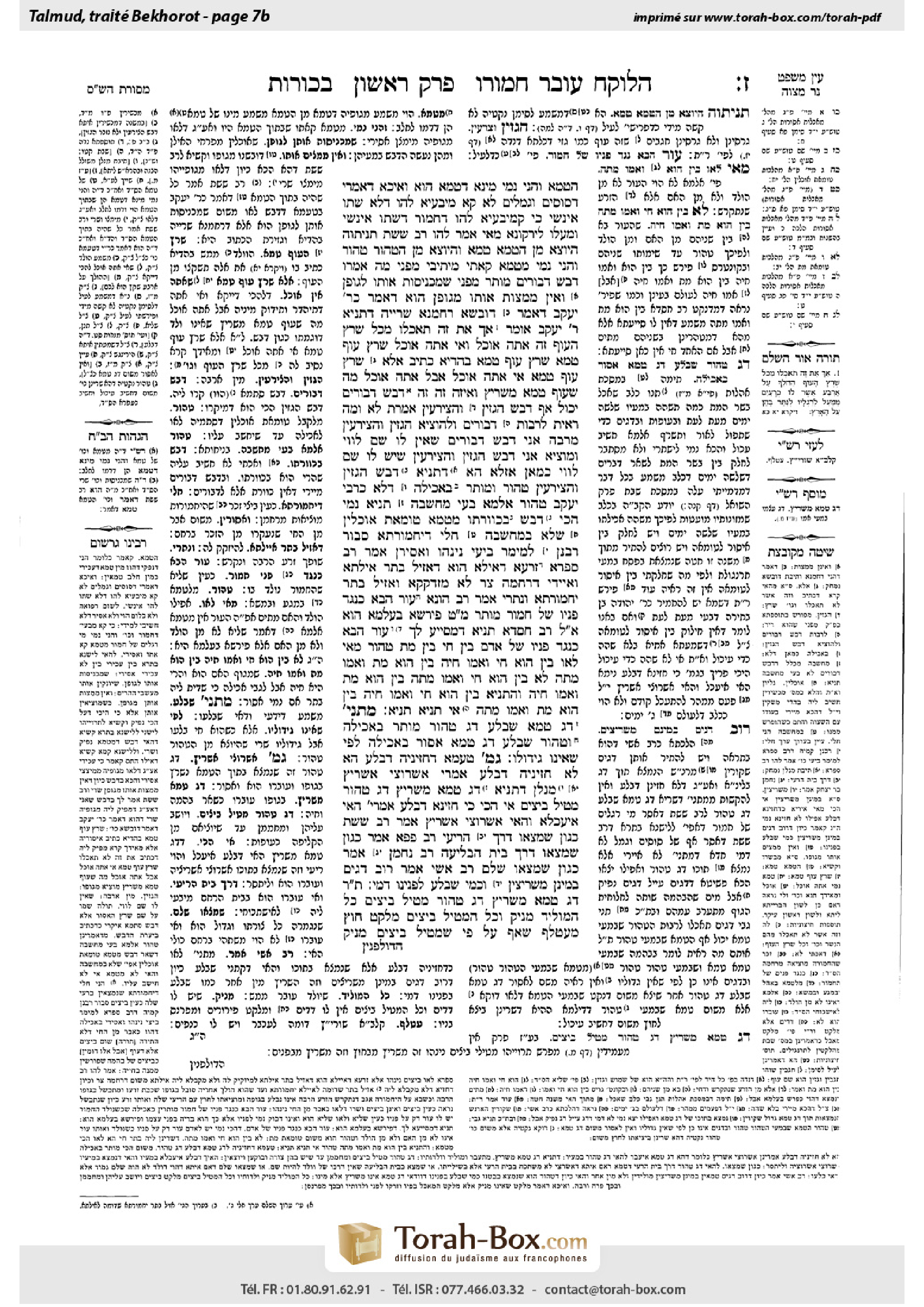
This page of Bekhorot includes the Aramaic text, an English translation and an AI-generated French translation, alongside the scan above.
בכורות ז׳ ב · Aramaic and Hebrew text
הַטָּמֵא״, וְהָנֵי נָמֵי מִינָא דְּטָמֵא הוּא.
וְאִיכָּא דְּאָמְרִי, דְּסוּסִים וּגְמַלִּים לָא קָא מִיבַּעְיָא לְהוּ, דְּלָא שָׁתוּ אִינָשֵׁי. כִּי קָמִיבַּעְיָא לְהוּ דַּחֲמוֹר, דְּשָׁתוּ אִינָשֵׁי וּמְעַלּוּ לְיַרְקוֹנָא, מַאי?
אֲמַר לְהוּ רַב שֵׁשֶׁת, תְּנֵיתוּהָ: הַיּוֹצֵא מִן הַטָּמֵא טָמֵא, וְהַיּוֹצֵא מִן הַטָּהוֹר טָהוֹר — וְהָנֵי נָמֵי מִטָּמֵא קָאָתֵי.
מֵיתִיבִי: מִפְּנֵי מָה אָמְרוּ דְּבַשׁ דְּבוֹרִים מוּתָּר? מִפְּנֵי שֶׁמַּכְנִיסוֹת אוֹתוֹ לְגוּפָן, וְאֵין מְמַצּוֹת אוֹתוֹ מִגּוּפָן.
הוּא דְּאָמַר כְּרַבִּי יַעֲקֹב, דְּאָמַר: דּוּבְשָׁא רַחֲמָנָא שַׁרְיֵיהּ.
דְּתַנְיָא, רַבִּי יַעֲקֹב אוֹמֵר: ״אַךְ אֶת זֶה תֹּאכְלוּ מִכֹּל שֶׁרֶץ הָעוֹף״ — זֶה אַתָּה אוֹכֵל, וְאִי אַתָּה אוֹכֵל שֶׁרֶץ עוֹף טָמֵא.
שֶׁרֶץ עוֹף טָמֵא בְּהֶדְיָא כְּתִיב! אֶלָּא שֶׁרֶץ עוֹף טָמֵא אִי אַתָּה אוֹכֵל, אֲבָל אַתָּה אוֹכֵל מַה שֶּׁעוֹף טָמֵא מַשְׁרִיץ, וְאֵיזֶה זֶה? זֶה דְּבַשׁ דְּבוֹרִים.
יָכוֹל אַף דְּבַשׁ הַגַּזִּין וְהַצִּירְעִין? אָמַרְתָּ: לֹא. וּמָה רָאִיתָ לְרַבּוֹת דְּבוֹרִים, וּלְהוֹצִיא הַגַּזִּין וְהַצִּירְעִין? מְרַבֶּה אֲנִי דְּבַשׁ דְּבוֹרִים שֶׁאֵין לוֹ שֵׁם לְוַוי, וּמוֹצִיא אֲנִי דְּבַשׁ הַגַּזִּין וְהַצִּירְעִין שֶׁיֵּשׁ לוֹ שֵׁם לְוַוי.
כְּמַאן אָזְלָא הָא דְּתַנְיָא: דְּבַשׁ הַגַּזִּין וְהַצִּירְעִין טָהוֹר וּמוּתָּר בַּאֲכִילָה? דְּלָא כְּרַבִּי יַעֲקֹב.
טָהוֹר — אַלְמָא בָּעֵי מַחְשָׁבָה. תַּנְיָא נָמֵי הָכִי: דְּבַשׁ בְּכַוַּורְתּוֹ מְטַמֵּא טוּמְאַת אֳוכָלִין שֶׁלֹּא בְּמַחְשָׁבָה.
חָלֵי דְּיַחְמוּרְתָּא, סְבוּר רַבָּנַן לְמֵימַר: בֵּיעֵי נִינְהוּ וַאֲסִירָן. אָמַר רַב סָפְרָא: זַרְעָא דְּאַיָּלָא הוּא, דְּאָזֵיל בָּתַר אַיָּלְתָּא, וְאַיְּידֵי דְּרַחְמָהּ צַר לָא מִזְדַּקְקָא, וְאָזֵיל בָּתַר יַחְמוּרְתָּא וְנָתְרִי.
אָמַר רַב הוּנָא: עוֹר הַבָּא כְּנֶגֶד פָּנָיו שֶׁל חֲמוֹר — מוּתָּר, מַאי טַעְמָא? פִּירְשָׁא בְּעָלְמָא הוּא.
אֲמַר לֵיהּ רַב חִסְדָּא: תַּנְיָא דִּמְסַיַּע לָךְ: עוֹר הַבָּא כְּנֶגֶד פָּנָיו שֶׁל אָדָם, בֵּין חַי בֵּין מֵת — טָהוֹר. מַאי לָאו בֵּין הוּא חַי וְאִמּוֹ חַיָּה, בֵּין הוּא מֵת וְאִמּוֹ מֵתָה?
לָא, בֵּין הוּא חַי וְאִמּוֹ מֵתָה, בֵּין הוּא מֵת וְאִמּוֹ חַיָּה. וְהָתַנְיָא: בֵּין הוּא חַי וְאִמּוֹ חַיָּה, בֵּין הוּא מֵת וְאִמּוֹ מֵתָה! אִי תַּנְיָא, תַּנְיָא.
מַתְנִי׳ דָּג טָמֵא שֶׁבָּלַע דָּג טָהוֹר, מוּתָּר בַּאֲכִילָה, וְטָהוֹר שֶׁבָּלַע דָּג טָמֵא, אָסוּר בַּאֲכִילָה, לְפִי שֶׁאֵינוֹ גִּידּוּלוֹ.
גְּמָ׳ טַעְמָא דַּחֲזֵינֵיהּ דִּבְלַע, הָא לָא חֲזֵינֵיהּ דִּבְלַע — אָמְרִי: אַשְׁרוֹצֵי אַשְׁרֵיץ.
מְנָלַן? דְּתַנְיָא: דָּג טָמֵא מַשְׁרִיץ, דָּג טָהוֹר מֵטִיל בֵּיצִים. אִי הָכִי, כִּי חָזֵינָא דִּבְלַע אָמְרִינַן: הַאי אִיעַכַּלָא, וְהַאי אַשְׁרוֹצֵי אַשְׁרֵיץ!
אָמַר רַב שֵׁשֶׁת: כְּגוֹן שֶׁמְּצָאוֹ דֶּרֶךְ הָרֶיעִי. רַב פָּפָּא אָמַר: כְּגוֹן שֶׁמְּצָאוֹ דֶּרֶךְ בֵּית הַבְּלִיעָה. רַב נַחְמָן אָמַר: כְּגוֹן שֶׁמְּצָאוֹ שָׁלֵם.
רַב אָשֵׁי אָמַר: רוֹב דָּגִים בְּמִינָן מַשְׁרִיצִין, וּכְמִי שֶׁבָּלַע לְפָנֵינוּ דָּמֵי.
תָּנוּ רַבָּנַן: דָּג טָמֵא — מַשְׁרִיץ, דָּג טָהוֹר — מֵטִיל בֵּיצִים, כָּל הַמּוֹלִיד — מֵנִיק, וְכׇל הַמֵּטִיל בֵּיצִים — מְלַקֵּט, חוּץ מֵעֲטַלֵּף שֶׁאַף עַל פִּי שֶׁמֵּטִיל בֵּיצִים — מֵנִיק.
Bekhorot 7b · English translation
the non-kosher animal [min hattamei], one can infer that any type [min] of non-kosher substance is included. And these fluids, i.e., the urine of a donkey, are also a type of non-kosher substance, as they resemble the milk of a donkey, which is forbidden.
And there are those who say there is a different version of the discussion about the urine of a donkey: With regard to the urine of horses and camels, the students of Rav Sheshet did not raise the dilemma, because people do not drink it. When they raised the dilemma it was with regard to the urine of a donkey, which people drink and which is beneficial for curing jaundice. What, then, is the halakha?
Rav Sheshet said to them: You learned the answer to your dilemma in the mishna: That which emerges from the non-kosher animal is non-kosher and that which emerges from the kosher animal is kosher, and these fluids also come from a donkey, which is non-kosher. Therefore, they are forbidden.
The Gemara raises an objection from a baraita: For what reason did the Sages say that the honey of bees is permitted? It is because they bring the nectar from the flowers into their body, but they do not excrete it from their body as a bodily excretion. So too, the urine of a donkey is not an excretion produced by the body itself. Rather, it is simply ejected in the same form that it entered the body. Why, then, should it be forbidden?
The Gemara answers: Rav Sheshet stated his answer in accordance with the opinion of Rabbi Ya’akov, who says that with regard to honey, the Merciful One permits it as an exception to the principle that a substance that emerges from a non-kosher animal is non-kosher.
This is as it is taught in a baraita: Rabbi Ya’akov says that it is stated: “Yet these may you eat of all winged creatures” (Leviticus 11:21). The word “these” indicates that you may eat these, but you may not eat a non-kosher winged creature.
The Gemara asks: Why is this inference necessary? The prohibition against eating a non-kosher winged creature is written explicitly: “All winged creatures that go upon all fours are a repugnance to you” (Leviticus 11:20). Rather, the inference must be understood as follows: You may not eat a non-kosher winged creature, but you may eat that which a non-kosher winged creature discharges from its body, and what is that? That is the honey of bees.
The Gemara cites the continuation of the baraita: One might have thought that even the honey of gizzin and wasps should be permitted. Nevertheless, you should say no. The baraita asks: And what did you see to include the honey of bees as being permitted to eat and to exclude the honey of gizzin and wasps as being forbidden? The baraita answers: I include the honey of bees, as its name does not have a modifier, i.e., the word honey alone always refers to the honey of bees. And I exclude the honey of gizzin and wasps, which have a modifier, i.e., one must always add the word gizzin or wasp to specify these particular types of honey.
The Gemara comments: In accordance with whose opinion is that which is taught in a baraita: The honey of gizzin and wasps is not susceptible to ritual impurity and is permitted for consumption? It is not in accordance with the opinion of Rabbi Ya’akov.
The Gemara infers from the expression: Is not susceptible to ritual impurity, that apparently, in order for the honey of gizzin and wasps to become susceptible to ritual impurity it requires specific intention to eat it, which renders it food. Furthermore, the baraita indicates that honey from bees does not require specific intention to eat it in order for it to become susceptible, because it is normally used for food. This is also taught in a baraita: The honey of bees that is still in its hive is susceptible to ritual impurity as food even without intent.
§ The Gemara discusses additional cases of animal secretions. With regard to chunks that are discharged from the womb of a female fallow deer, the Sages thought to say that they are its egg cells, and therefore are forbidden as a limb severed from a living animal. Rav Safra said: It is the semen of a hart, which pursues the hind, but since the hind’s womb is narrow it does not mate with the hart, and instead the hart pursues the female fallow deer and mates with it, and chunks of its semen that have hardened fall out of the fallow deer’s body.
Rav Huna says: The skin that emerges opposite the face of a donkey when it is born, i.e., the fetal sac that envelopes it during birth, is permitted to be consumed. What is the reason? It is merely a secretion, and is not an integral part of the mother or the offspring.
Rav Ḥisda said to him: That which is taught in a baraita supports your opinion: The skin that emerges opposite the face of a person, i.e., a newborn baby, whether the newborn is alive or dead, is ritually pure and does not transmit ritual impurity imparted by a corpse. What, is it not the case that whether it is alive and its mother is alive or whether it is dead and its mother is dead, it is not considered a part of the body of the fetus or the mother, but merely a secretion, and therefore even when they are both dead it does not transmit impurity?
Rav Huna answered him: No, there is no proof from this baraita, as it may mean that whether it is alive and its mother is dead or whether it is dead and its mother is alive, meaning only one is alive, the skin is ritually pure. But if both are dead it is impure. Rav Ḥisda said to him: But isn’t it taught in a baraita that whether it is alive and its mother is alive or whether it is dead and its mother is dead, the skin is pure? Rav Huna said to Rav Ḥisda: If this baraita is taught, it is taught, and I cannot dispute it.
MISHNA: In the case of a non-kosher fish that swallowed a kosher fish, consumption of the kosher fish is permitted. And in the case of a kosher fish that swallowed a non-kosher fish, consumption of the non-kosher fish is prohibited due to the fact that the host fish is not the place of its development.
GEMARA: The Gemara infers from the language of the mishna: In the case of a non-kosher fish that swallowed a kosher fish: The reason consumption of the kosher fish is permitted is that we saw that the non-kosher fish swallowed the kosher fish. But if we did not see it swallow the kosher fish we say that perhaps the non-kosher fish spawned the kosher fish, and it is forbidden.
From where do we derive that we must have this concern? As it is taught in a baraita: A non-kosher fish spawns offspring, while a kosher fish lays eggs from which the offspring hatch. The Gemara challenges: If so, even when we saw it swallowing a kosher fish we should say that that fish that it swallowed was digested, and this one, which was found inside of the non-kosher fish, it spawned, and should be forbidden.
Rav Sheshet says: It is referring to a case where one found the kosher fish in the digestive tract, which is not where the non-kosher fish normally spawns its offspring. Rav Pappa says similarly: It is referring to a case where one found the kosher fish in the passageway of the gullet. Rav Naḥman says: It is referring to a case where one found it whole and in complete form, and not as a newly hatched fish.
Rav Ashi says: Do not infer from the mishna that it is referring to a case where the non-kosher fish was seen swallowing the kosher fish. Rather, the reason it is permitted to consume the swallowed fish is that the majority of fish spawn offspring of their own species, and therefore the case of a kosher fish discovered inside a non-kosher fish is considered as if the non-kosher fish had swallowed the kosher fish in our presence.
§ The Gemara cites the entirety of the previously mentioned baraita. The Sages taught that a non-kosher fish spawns its offspring, while a kosher fish lays eggs. Any animal that gives birth to its offspring nurses them, and any animal that lays eggs gathers food and feeds it to its young. This applies to all animals except for a bat [atallef ], as although it lays eggs, it nurses its young.
Bekhorot 7b · Traduction française (IA)
L'animal non-kosher [min hattamei], on peut en déduire que toute sorte [min] de substance non-kosher est incluse. Et ces fluides, c'est-à-dire l'urine d'un âne, sont aussi une sorte de substance non-kosher, car elles ressemblent au lait d'un âne, qui est interdit.
Et certains disent qu'il existe une version différente de la discussion concernant l'urine d'un âne : En ce qui concerne l'urine des chevaux et des dromadaires, les élèves de Rav Sheshet n'ont pas soulevé ce dilemme, car les gens ne boivent pas cela. Lorsqu'ils ont soulevé ce dilemme, c'était concernant l'urine d'un âne, qui est buvable et bénéfique pour guérir la jaunisse. Quel est donc la halakha ?
Rav Sheshet dit à eux : Vous avez appris la réponse à votre dilemme dans la mitsna : Ce qui sort de l'animal non-kosher est non-kosher et ce qui sort de l'animal kosher est kosher, et ces fluides proviennent aussi d'un âne, qui est non-kosher. Ainsi, ils sont interdits.
La Guemara soulève une objection tirée d'une baraïta : Pour quelle raison les Sages ont-ils dit que le miel des abeilles est permis ? C'est parce qu'ils ramènent le nectar des fleurs dans leur corps, mais ils ne l'excrètent pas de leur corps comme une excrétion corporelle. De même, l'urine d'un âne n'est pas une excrétion produite par le corps lui-même. Elle est simplement évacuée sous la même forme qu'elle a pénétré dans le corps. Pourquoi, alors, devrait-elle être interdite ?
La Guemara répond : Rav Sheshet a formulé sa réponse conformément à l'opinion de Rabbi Ya'akov, qui affirme que concernant le miel, l'Éternel le permet comme exception au principe selon lequel une substance qui sort d'un animal non-kosher est non-kosher.
C'est ce qui est enseigné dans une baraïta : Rabbi Ya'akov dit que cela est dit : « Et ces bêtes vous sont permises de toutes les volatiles » (Lévitique 11:21). Le mot « ces » indique que vous pouvez manger ces bêtes, mais vous ne pouvez pas manger une volatile non-kosher.
La Guemara pose la question : Pourquoi cette déduction est-elle nécessaire ? L'interdiction de manger un volatile non-kosher est explicitement écrite : « Toutes les volatiles qui marchent sur quatre pieds sont un dégoût pour vous » (Lévitique 11:20). Plutôt, cette déduction doit être comprise ainsi : Vous ne pouvez pas manger un volatile non-kosher, mais vous pouvez manger ce qui sort du corps d'un volatile non-kosher, et que cela est ? C'est le miel des abeilles.
La Guemara cite la continuation de la baraïta : On aurait pu penser que même le miel des gizzin et des guêpes devrait être permis. Cependant, vous devriez dire non. La baraïta demande : Et qu'avez-vous vu pour inclure le miel des abeilles comme permis à manger et exclure le miel des gizzin et des guêpes comme interdit ? La baraïta répond : J'inclure le miel des abeilles, car son nom ne contient pas de modificateur, c'est-à-dire que le mot « miel » seul désigne toujours le miel des abeilles. Et j'exclure le miel des gizzin et des guêpes, qui contiennent un modificateur, c'est-à-dire qu'on doit toujours ajouter le mot gizzin ou guêpe pour spécifier ces types particuliers de miel.
La Guemara commente : Selon l'opinion de qui est-ce que cela est enseigné dans une baraïta : Le miel des gizzin et des guêpes n'est pas susceptible de souillure rituelle et est permis à la consommation ? Ce n'est pas selon l'opinion de Rabbi Ya’akov.
La Guemara déduit de l'expression : « n'est pas susceptible de souillure rituelle », que visiblement, afin que le miel des gizzin et des guêpes devienne susceptible de souillure rituelle, il faut une intention spécifique pour le manger, ce qui le rend aliment. De plus, la baraïta indique que le miel des abeilles ne nécessite pas une intention spécifique pour le manger afin de devenir susceptible, car il est normalement utilisé comme aliment. C'est aussi enseigné dans une baraïta : Le miel des abeilles qui est encore dans son ruche est susceptible de souillure rituelle comme aliment même sans intention.
§ La Guemara discute d'autres cas de sécrétions animales. En ce qui concerne les morceaux émis par le ventre d'une femelle cerf, les Sages pensaient dire qu'ils sont ses cellules ovariennes, et donc interdits comme un membre séparé d'un animal vivant. Rav Safra dit : C'est le sperme d'un cerf, qui poursuit la biche, mais puisque le ventre de la biche est étroit, il ne s'accouple pas avec le cerf, et au lieu de cela, le cerf poursuit la femelle cerf et s'accouple avec elle, et des morceaux de son sperme durci tombent du corps de la femelle cerf.
Rav Huna dit : La peau qui sort face à la face d'un âne lorsqu'il est né, c'est-à-dire le sac fœtal qui l'enveloppe pendant la naissance, est permise à la consommation. Quelle est la raison ? C'est simplement une sécrétion, et n'est pas une partie intégrale de la mère ou de l'offspring.
Rav Ḥisda dit à lui : Ce qui est enseigné dans une baraïta soutient votre opinion : La peau qui sort face à la face d'une personne, c'est-à-dire un nouveau-né, qu'il soit vivant ou mort, est rituellement pure et ne transmet pas la souillure rituelle imposée par un cadavre. Qu'est-ce que cela ne serait pas le cas, que qu'il soit vivant et sa mère soit vivante ou qu'il soit mort et sa mère soit morte, il ne serait pas considéré comme une partie du corps du fœtus ou de la mère, mais simplement une sécrétion, et donc même lorsqu'ils sont tous les deux morts, il ne transmet pas la souillure ?
Rav Huna répondit à lui : Non, il n'y a pas de preuve à partir de cette baraïta, car cela pourrait signifier que qu'il soit vivant et sa mère soit morte ou qu'il soit mort et sa mère soit vivante, c'est-à-dire que seul l'un est vivant, la peau est rituellement pure. Mais si les deux sont morts, elle est impure. Rav Ḥisda dit à lui : Mais n'est-il pas enseigné dans une baraïta que qu'il soit vivant et sa mère soit vivante ou qu'il soit mort et sa mère soit morte, la peau est pure ? Rav Huna dit à Rav Ḥisda : Si cette baraïta est enseignée, elle est enseignée, et je ne peux pas la contester.
MICHNA : Dans le cas d'un poisson non-kosher qui a englouti un poisson kosher, la consommation du poisson kosher est permise. Et dans le cas d'un poisson kosher qui a englouti un poisson non-kosher, la consommation du poisson non-kosher est interdite, car le poisson hôte n'est pas le lieu de son développement.
GUEMARA : La Guemara déduit de la formulation de la Michna : Dans le cas d'un poisson non-kosher qui a englouti un poisson kosher : la raison pour laquelle la consommation du poisson kosher est permise est que nous avons vu que le poisson non-kosher avait englouti le poisson kosher. Mais si nous n'avons pas vu cela, nous disons que peut-être le poisson non-kosher a pondu le poisson kosher, et il est interdit.
D'où déduit-on que nous devons avoir cette préoccupation ? Comme il est enseigné dans une baraïta : un poisson non-kosher pond ses petits, tandis qu'un poisson kosher pond des œufs dont les petits émergent. La Guemara conteste : Si c'est ainsi, même lorsqu'on a vu qu'il engloutissait un poisson kosher, on devrait dire que ce poisson qu'il avait englouti avait été digéré, et celui qui était trouvé à l'intérieur du poisson non-kosher a été pondu, et devrait être interdit.
Rav Sheshet dit : Il s'agit d'un cas où l'on a trouvé le poisson kosher dans le tractus digestif, ce qui n'est pas le lieu où le poisson non-kosher pond généralement ses petits. Rav Pappa dit de même : Il s'agit d'un cas où l'on a trouvé le poisson kosher dans le passage de l'œsophage. Rav Naḥman dit : Il s'agit d'un cas où l'on a trouvé le poisson entier et en bon état, et non comme un petit nouveau-né.
Rav Ashi dit : Ne déduisez pas de la Michna que cela s'applique à un cas où le poisson non-kosher a été vu engloutir le poisson kosher. Plutôt, la raison pour laquelle il est permis de consommer le poisson englouti est que la plupart des poissons pondent des petits de leur propre espèce, et donc le cas d'un poisson kosher trouvé à l'intérieur d'un poisson non-kosher est considéré comme si le poisson non-kosher avait englouti le poisson kosher devant nous.
§ La Guemara cite l'intégralité de la baraïta mentionnée précédemment. Les Sages enseignent que le poisson non-kosher pond ses petits, tandis que le poisson kosher pond des œufs. Tout animal qui donne naissance à ses petits les nourrit, et tout animal qui pond des œufs réunit de la nourriture et la donne à ses petits. Cela s'applique à tous les animaux sauf le bat [atallef], car bien qu'il pond des œufs, il nourrit ses petits.
Traduction française générée par IA à partir de l’édition anglaise de Sefaria. Vérifie toujours un passage avec le texte source.
Text from Sefaria: William Davidson Edition - Vocalized Aramaic (CC BY NC); William Davidson Edition - English (CC BY NC).