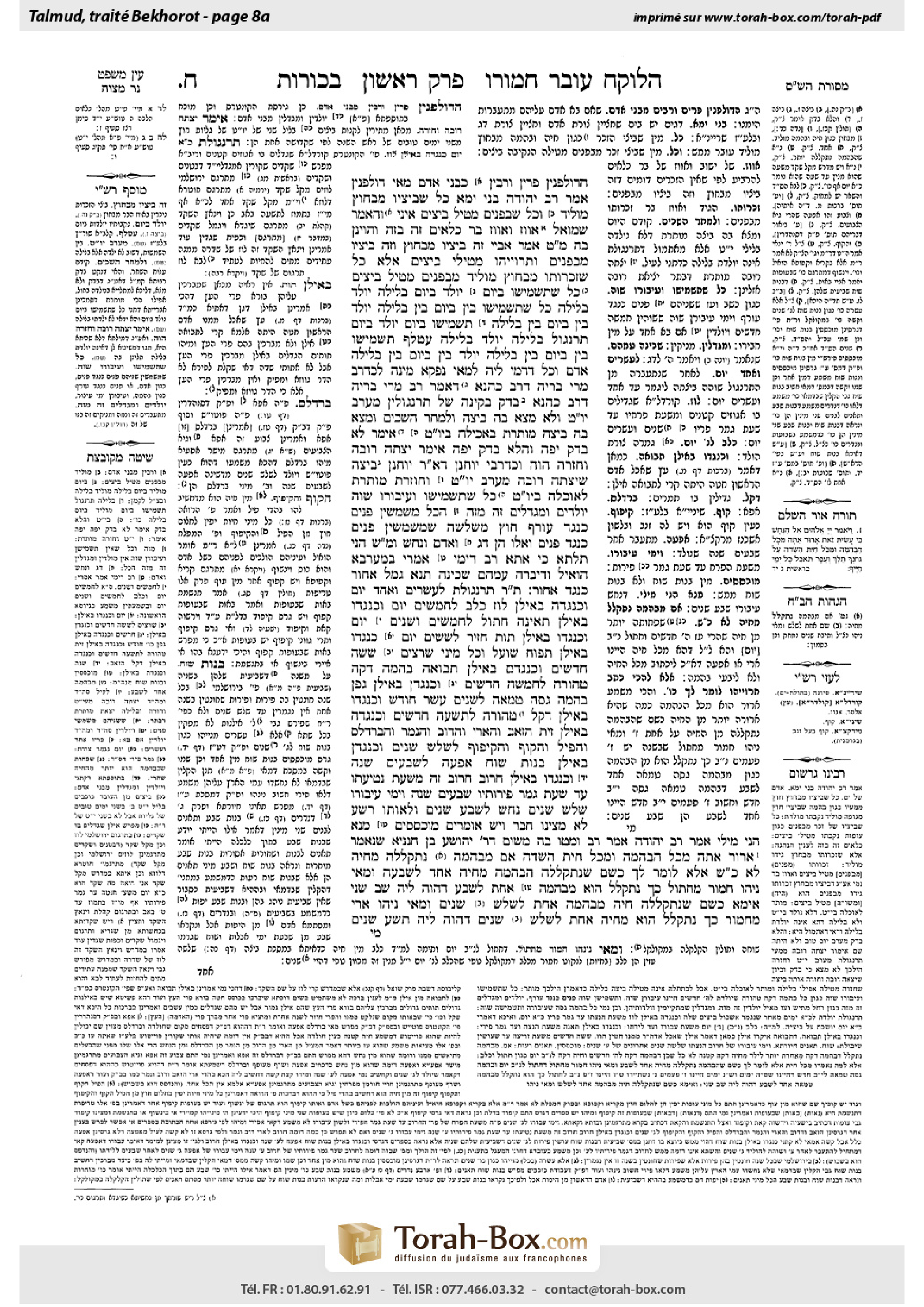
Bekhorot 8a: Talmud study for Daf Yomi
Study the Talmud for Daf Yomi with scanned pages, Hebrew text, English translations from Sefaria and AI-generated French translations.
Passage selection and English or AI-generated French translation are available where the scan has annotations. Daf Study is independent of Torah-Box and Sefaria.
Browse Bekhorot · בכורות · All tractatesBekhorot 8a text and translations
This page of Bekhorot includes the Aramaic text, an English translation and an AI-generated French translation, alongside the scan above.
בכורות ח׳ א · Aramaic and Hebrew text
הַדּוֹלְפָנִין פָּרִין וְרָבִין כִּבְנֵי אָדָם. מַאי דּוֹלְפָנִין? אָמַר רַב יְהוּדָה: בְּנֵי יַמָּא.
כֹּל שֶׁבֵּיצָיו מִבַּחוּץ — מוֹלִיד, וְכֹל שֶׁבִּפְנִים — מֵטִיל בֵּיצִים.
אִינִי? וְהָאָמַר שְׁמוּאֵל: אֲוָוז וַאֲוָוז בָּר כִּלְאַיִם זֶה בָּזֶה, וְהָוֵינַן בָּהּ: מַאי טַעְמָא? אָמַר אַבָּיֵי: זֶה בֵּיצָיו מִבַּחוּץ, וְזֶה בֵּיצָיו מִבִּפְנִים, וְתַרְוַיְיהוּ מְטִילֵי בֵּיצִים!
אֶלָּא, כֹּל שֶׁזַּכְרוּתוֹ מִבַּחוּץ — מוֹלִיד, מִבִּפְנִים — מֵטִיל בֵּיצִים.
כֹּל שֶׁתַּשְׁמִישׁוֹ בַּיּוֹם — יוֹלֵד בַּיּוֹם, בַּלַּיְלָה — יוֹלֵד בַּלַּיְלָה, כֹּל שֶׁתַּשְׁמִישׁוֹ בֵּין בַּיּוֹם בֵּין בַּלַּיְלָה — יוֹלֵד בֵּין בַּיּוֹם בֵּין בַּלַּיְלָה.
תַּשְׁמִישׁוֹ בַּיּוֹם יוֹלֵד בַּיּוֹם — תַּרְנְגוֹל, בַּלַּיְלָה יוֹלֵד בַּלַּיְלָה — עֲטַלֵּף, תַּשְׁמִישׁוֹ בֵּין בַּיּוֹם בֵּין בַּלַּיְלָה יוֹלֵד בֵּין בַּיּוֹם בֵּין בַּלַּיְלָה — אָדָם וְכֹל דְּדָמֵי לֵיהּ.
לְמַאי נָפְקָא מִינַּהּ? לְכִדְרַב מָרִי בְּרֵיהּ דְּרַב כָּהֲנָא, דְּאָמַר רַב מָרִי בְּרֵיהּ דְּרַב כָּהֲנָא: בָּדַק בְּקִינָּה שֶׁל תַּרְנְגוֹלִין מֵעֶרֶב יוֹם טוֹב וְלֹא מָצָא בָּהּ בֵּיצָה, וּלְמָחָר הִשְׁכִּים וּמָצָא בָהּ בֵּיצָה — מוּתֶּרֶת בַּאֲכִילָה בְּיוֹם טוֹב, אֵימַר: לֹא בָּדַק יָפֶה.
וַהֲלֹא בָּדַק יָפֶה! אֵימַר: יָצְתָה רוּבָּהּ וְחָזְרָה הֲוָה, וְכִדְרַבִּי יוֹחָנָן, דְּאָמַר רַבִּי יוֹחָנָן: בֵּיצָה שֶׁיָּצְתָה רוּבָּהּ מֵעֶרֶב יוֹם טוֹב וְחוֹזֶרֶת — מְוֻתֶּרֶת לְאוֹכְלָהּ בְּיוֹם טוֹב.
כֹּל שֶׁתַּשְׁמִישׁוֹ וְעִיבּוּרוֹ שָׁוֶה — יוֹלְדִים וּמְגַדְּלִים זֶה מִזֶּה. הַכֹּל מְשַׁמְּשִׁין פָּנִים כְּנֶגֶד עוֹרֶף, חוּץ מִשְּׁלֹשָׁה שֶׁמְּשַׁמְּשִׁין פָּנִים כְּנֶגֶד פָּנִים, וְאֵלּוּ הֵן: דָּג, וְאָדָם, וְנָחָשׁ.
וּמַאי שְׁנָא הָנֵי תְּלָתָא? כִּי אֲתָא רַב דִּימִי אָמְרִי בְּמַעְרְבָא: הוֹאִיל וְדִיבְּרָה עִמָּהֶם שְׁכִינָה.
תָּנָא: גָּמָל — אָחוֹר כְּנֶגֶד אָחוֹר.
תָּנוּ רַבָּנַן: תַּרְנְגוֹלֶת — לְעֶשְׂרִים וְאֶחָד יוֹם, וּכְנֶגְדָּהּ בָּאִילָן — לוּז, כֶּלֶב — לַחֲמִשִּׁים יוֹם, וּכְנֶגְדּוֹ בָּאִילָן — תְּאֵינָה, חָתוּל — לַחֲמִשִּׁים וּשְׁנַיִם יוֹם, וּכְנֶגְדּוֹ בָּאִילָן — תּוּת, חֲזִיר — לְשִׁשִּׁים יוֹם, כְּנֶגְדּוֹ בָּאִילָן — תַּפּוּחַ, שׁוּעָל וְכׇל מִינֵי שְׁרָצִים — שִׁשָּׁה חֳדָשִׁים, וּכְנֶגְדָּם בָּאִילָן — תְּבוּאָה.
בְּהֵמָה דַּקָּה טְהוֹרָה — לַחֲמִשָּׁה חֳדָשִׁים, וּכְנֶגְדָּן בָּאִילָן — גֶּפֶן. בְּהֵמָה גַּסָּה טְמֵאָה — לִשְׁנֵים עָשָׂר חוֹדֶשׁ, וּכְנֶגְדּוֹ בָּאִילָן — דֶּקֶל. טְהוֹרָה — לְתִשְׁעָה חֳדָשִׁים, וּכְנֶגְדָּהּ בָּאִילָן — זַיִת. הַזְּאֵב וְהָאֲרִי וְהַדּוֹב וְהַנָּמֵר וְהַבַּרְדְּלָס וְהַפִּיל וְהַקּוֹף וְהַקִּיפוֹף — לְשָׁלֹשׁ שָׁנִים, וּכְנֶגְדָּן בָּאִילָן — בְּנוֹת שׁוּחַ.
אֶפְעֶה לְשִׁבְעִים שָׁנָה, וּכְנֶגְדּוֹ בָּאִילָן — חָרוּב. חָרוּב זֶה, מִשְּׁעַת נְטִיעָתוֹ עַד שְׁעַת גְּמַר פֵּירוֹתָיו — שִׁבְעִים שָׁנָה, וִימֵי עִיבּוּרוֹ שָׁלֹשׁ שָׁנִים. נָחָשׁ לְשֶׁבַע שָׁנִים, וּלְאוֹתוֹ רָשָׁע לֹא מָצִינוּ חָבֵר. וְיֵשׁ אוֹמְרִים: מוֹכְסָסִים.
מְנָא הָנֵי מִילֵּי? אָמַר רַב יְהוּדָה אָמַר רַב, וּמָטוּ בָּהּ מִשּׁוּם דְּרַבִּי יְהוֹשֻׁעַ בֶּן חֲנַנְיָא, שֶׁנֶּאֱמַר: ״אָרוּר אַתָּה מִכׇּל הַבְּהֵמָה וּמִכֹּל חַיַּת הַשָּׂדֶה״. אִם מִבְּהֵמָה נִתְקַלְּלָה, מֵחַיָּה לֹא כׇּל שֶׁכֵּן?
אֶלָּא, לוֹמַר לָךְ: כְּשֵׁם שֶׁנִּתְקַלְּלָה הַבְּהֵמָה מֵחַיָּה, אֶחָד לְשִׁבְעָה, וּמַאי נִיהוּ? חֲמוֹר מֵחָתוּל, כָּךְ נִתְקַלֵּל הוּא מִבְּהֵמָה, אַחַת לְשֶׁבַע, דְּהָוֵה לֵיהּ שַׁב שְׁנֵי.
אֵימָא: כְּשֵׁם שֶׁנִּתְקַלְּלָה חַיָּה מִבְּהֵמָה, אַחַת לְשָׁלֹשׁ שָׁנִים, וּמַאי נִיהוּ? אֲרִי מֵחֲמוֹר, כָּךְ נִתְקַלֵּל הוּא מֵחַיָּה אַחַת לְשָׁלֹשׁ שָׁנִים, דְּהָוֵה לֵיהּ תֵּשַׁע שָׁנִים.
Bekhorot 8a · English translation
The dulfanin reproduce like people. The Gemara asks: What are dulfanin? Rav Yehuda says: They are creatures that are called sons of the sea.
The baraita continues: In the case of any male animal whose testicles are external, the female gives birth to live offspring, and in the case of any male animal whose testicles are internal, the female lays eggs.
The Gemara asks: Is that so? But doesn’t Shmuel say that a domestic goose and a wild goose are considered diverse kinds, and one may not mate them with each other. And we discussed it: What is the reason? Abaye said: In the case of this one, the male wild goose, its testicles are external, and in the case of that one, the domestic goose, its testicles are internal. The Gemara comments: And yet both geese lay eggs. Evidently, the fact that the male’s testicles are external does not prove that the female gives birth.
Rather, the baraita must mean the following: With regard to any animal whose male reproductive organ is external, the female gives birth, and in the case of any male animal whose reproductive organ is internal, the female lays eggs. Although the testicles of the male wild goose are external, its reproductive organ is internal.
§ The baraita continues to discuss matters of animal procreation: Any species whose sexual intercourse occurs only during the daytime gives birth only during the daytime; any species whose intercourse occurs only at night gives birth only at night; any species whose intercourse occurs both during the daytime and at night gives birth both during the daytime and at night.
The Gemara elaborates: The statement that any species whose intercourse occurs during the daytime gives birth during the daytime is referring to a chicken. The statement that any species whose intercourse occurs at night gives birth at night is referring to a bat. The statement that any species whose intercourse occurs both during the daytime and at night gives birth both during the daytime and at night is referring to a human and any creature that is similar to him.
The Gemara asks: What halakhic difference is there whether an animal gives birth during the daytime or at night? The Gemara answers: The difference is with regard to that which Rav Mari, son of Rav Kahana, said. As Rav Mari, son of Rav Kahana, said: If one examined a chicken’s nest on a Festival eve and did not find an egg in it, and the following day, on the Festival, he rose early, before dawn, and found an egg in it, consumption of the egg is permitted on the Festival. It is not considered an egg that was laid on the Festival, which is forbidden (see Beitza 2a), as chickens do not lay eggs at night. Although he examined the nest before the Festival and failed to find an egg there, one is compelled to say that he did not examine the nest carefully.
The Gemara challenges: But he did examine the nest carefully, as the baraita states that he examined it. The Gemara explains: One must say that this was a case where most of the egg emerged on the eve of the Festival and returned inside its mother before the examination. And this ruling is in accordance with the opinion of Rabbi Yoḥanan, as Rabbi Yoḥanan says: In a case where most of the egg emerged on the eve of the Festival and returned inside its mother it is permitted to eat it on the Festival, as once most of it emerged it is considered to have been laid already.
§ The baraita continues: Any two animals of different species whose manner of intercourse and time of gestation are identical can have offspring together and can raise, i.e., nurse, the young of each other. With regard to the manner of intercourse, all species engage in intercourse with the face of the male opposite the back of the neck of the female, meaning that the male comes from behind the female, except for three species that engage in intercourse face-to-face, and they are these: Fish, and humans, and the snake.
The Gemara asks: And what is different about these three? When Rav Dimi came from Eretz Yisrael to Babylonia he reported that they say in the West, Eretz Yisrael, the following explanation: They are different because the Divine Presence spoke with them. This occurred when the fish swallowed the prophet Jonah (see Jonah 2:11), when Adam and other prophets were spoken to by God, and when the snake caused Adam and Eve to sin (see Genesis 3:14).
A tanna taught: A camel engages in intercourse back to back with its mate.
§ The Gemara cites a baraita that discusses the length of gestation for various animals. The Sages taught that a chicken hatches after twenty-one days, and corresponding to it in length of gestation with regard to trees is the almond, which ripens twenty-one days after the budding of the flower. A dog gives birth after fifty days, and corresponding to it with regard to trees is the fig. A cat gives birth after fifty-two days, and corresponding to it with regard to trees is the mulberry. A pig gives birth after sixty days, and corresponding to it with regard to trees is the apple. A fox and all types of creeping animals give birth after six months, and corresponding to them with regard to trees, i.e., plants, is grain.
Small kosher livestock, such as sheep or goats, give birth after five months, and corresponding to them with regard to trees is the grapevine. Large non-kosher livestock, such as camels or donkeys, give birth after twelve months, and corresponding to them with regard to trees is the date palm. Large kosher livestock, such as cows, give birth after nine months, and corresponding to them with regard to trees is the olive. The wolf, and the lion, and the bear, and the leopard, and the bardelas, and the elephant, and the monkey, and the long-tailed ape give birth after three years, and corresponding to them with regard to trees is the white fig.
The baraita continues: A viper gives birth after seventy years, and corresponding to it with regard to trees is the carob. In the case of this carob, the period from the time of its planting until the time of the ripening of its fruit is seventy years, and the length of its gestation is three years. A snake is born after seven years, and for that wicked animal we have not found a counterpart among trees. And some say that mukhsasim are the equivalent, as they ripen after seven years.
The Gemara asks: From where is this matter, that the gestation period of a snake is seven years, derived? Rav Yehuda says that Rav says, and some determined it to be in the name of Rabbi Yehoshua ben Ḥananya: It is derived from that which is stated with regard to the punishment of the snake for causing Adam and Eve to sin: “Cursed are you from among all animals, and from among all beasts of the field” (Genesis 3:14), in that your gestation period should be longer than all of them. Now, why does the verse mention the beasts of the field, i.e., undomesticated animals? If the snake was cursed more than the domesticated animals, then all the more so is it not clear that it was cursed more than the undomesticated animals? The shortest gestation period of domesticated animals, which is five months for a goat, is longer than the shortest gestation period among undomesticated animals, which is fifty-two days for a cat.
Rather, the verse mentions the beasts of the field to tell you: Just as the domesticated animals were cursed more than the undomesticated animals by a proportion of one to seven; the Gemara interjects: And with regard to what case is that? It is with regard to a donkey, whose gestation period as mentioned is twelve months, compared to a cat, whose gestation period is fifty-two days. Seven times longer than fifty-two days is 364 days, which means that the gestation period of the donkey, which is one year, is almost exactly seven times longer than that of the cat. Rav Yehuda continues: So too, the snake was cursed more than domesticated animals, i.e., the donkey, in a proportion of one to seven, which is a total of seven years.
The Gemara challenges: Say that the verse can be interpreted as follows: Just as the undomesticated animals were cursed more than the domesticated animals by a measure of one year to three years; the Gemara interjects: And in what case is that? It is in the case of a lion, whose gestation period is three years, compared to a donkey, whose gestation period is one year. The Gemara continues its challenge: So too, the snake was cursed more than the undomesticated animals, i.e., the lion, by a proportion of one year to three years, which is nine years.
Bekhorot 8a · Traduction française (IA)
Les dulfanin se reproduisent comme les humains. La Guemara pose la question : Quels sont les dulfanin ? Rav Yéhuda dit : Ce sont des créatures appelées enfants de la mer.
La baraïta continue : Dans le cas d'un animal mâle dont les testicules sont externes, la femelle donne naissance à des petits vivants, et dans le cas d'un animal mâle dont les testicules sont internes, la femelle pond des œufs.
La Guemara pose la question : C'est ainsi ? Mais ne dit pas Shmuel que la gosse domestique et la gosse sauvage sont considérées comme des espèces différentes, et qu'on ne peut pas les faire se reproduire ensemble. Et nous avons discuté cela : Quelle est la raison ? Abaye dit : Dans le cas de cette dernière, le gosse sauvage mâle, ses testicules sont externes, et dans le cas de celle-ci, la gosse domestique, ses testicules sont internes. La Guemara commente : Et pourtant, les deux gosses pondent des œufs. Évidemment, le fait que les testicules du mâle soient externes ne prouve pas que la femelle donne naissance.
Plutôt, la baraïta doit signifier ceci : Concernant tout animal dont l'organe reproducteur mâle est externe, la femelle donne naissance, et dans le cas d'un animal mâle dont l'organe reproducteur est interne, la femelle pond des œufs. Bien que les testicules du gosse sauvage mâle soient externes, son organe reproducteur est interne.
§ La baraïta continue à discuter des questions de procréation animale : Toute espèce dont l'acte sexuel a lieu uniquement pendant la journée donne naissance uniquement pendant la journée ; toute espèce dont l'acte sexuel a lieu uniquement la nuit donne naissance uniquement la nuit ; toute espèce dont l'acte sexuel a lieu à la fois pendant la journée et la nuit donne naissance à la fois pendant la journée et la nuit.
La Guemara développe : L'affirmation que toute espèce dont l'acte sexuel a lieu pendant la journée donne naissance pendant la journée fait référence à un poulet. L'affirmation que toute espèce dont l'acte sexuel a lieu la nuit donne naissance la nuit fait référence à un chauve-souris. L'affirmation que toute espèce dont l'acte sexuel a lieu à la fois pendant la journée et la nuit donne naissance à la fois pendant la journée et la nuit fait référence à un humain et toute créature semblable à lui.
La Guemara pose la question : Quelle différence halakhique y a-t-il selon que l'animal donne naissance pendant la journée ou la nuit ? La Guemara répond : La différence concerne ce que Rav Mari, fils de Rav Kahana, a dit. Rav Mari, fils de Rav Kahana, a dit : Si l'on a examiné le nid d'un poulet le soir de la fête et n'a pas trouvé d'œuf dedans, et le lendemain, la fête, il s'est levé tôt, avant l'aube, et a trouvé un œuf dedans, la consommation de l'œuf est permise pendant la fête. Il n'est pas considéré comme un œuf qui a été pondu pendant la fête, ce qui est interdit (voir Beitza 2a), car les poulets ne pondent pas d'œufs la nuit. Bien qu'il ait examiné le nid avant la fête et n'ait pas trouvé d'œuf dedans, il faut dire qu'il n'a pas examiné le nid avec soin.
La Guemara conteste : Mais il a examiné le nid avec soin, comme la baraïta le dit qu'il l'a fait. La Guemara explique : On doit dire que c'était un cas où la plupart de l'œuf était sortie le soir de la fête et est rentrée dans sa mère avant l'examen. Et cette décision est en conformité avec l'opinion de Rabbi Yoḥanan, comme Rabbi Yoḥanan dit : Dans un cas où la plupart de l'œuf est sortie le soir de la fête et est rentrée dans sa mère, il est permis de le manger pendant la fête, car une fois que la plupart d'entre eux est sortie, on le considère comme ayant été pondu déjà.
§ La baraïta continue : Toute paire d'animaux d'espèces différentes dont la manière d'acte sexuel et le temps de gestation sont identiques peuvent avoir des descendants ensemble et peuvent élever, c'est-à-dire allaiter, les petits de l'autre. Concernant la manière d'acte sexuel, toutes les espèces ont un acte sexuel avec le visage du mâle opposé au cou de la femelle, c'est-à-dire que le mâle vient de derrière la femelle, sauf trois espèces qui ont un acte sexuel face à face, et elles sont ces trois : les poissons, les humains et le serpent.
La Guemara pose la question : Et qu'est-ce qui est différent dans ces trois ? Quand Rav Dimi est venu de la Terre d'Israël vers Babylone, il rapporta que l'on disait en Occident, en Terre d'Israël, l'explication suivante : Ils sont différents car la Présence divine a parlé avec eux. Cela s'est produit lorsque le poisson a avalé le prophète Jonas (voir Jonas 2:11), lorsque Adam et d'autres prophètes ont été parlés par Dieu, et lorsque le serpent a causé la chute d'Adam et Ève (voir Genèse 3:14).
Un tanna enseigna : Le chameau a un acte sexuel dos à dos avec son partenaire.
§ La Guemara cite une baraïta qui discute de la durée de la gestation pour divers animaux. Les Sages enseignèrent que le poussin éclos après vingt-et-un jours, et correspondant à lui en durée de gestation concernant les arbres est l'amandier, qui mûrit vingt-et-un jours après l'apparition des fleurs. Le chien donne naissance après cinquante jours, et correspondant à lui concernant les arbres est le figuier. Le chat donne naissance après cinquante-deux jours, et correspondant à lui concernant les arbres est le mûrier. Le porc donne naissance après soixante jours, et correspondant à lui concernant les arbres est la pomme. Le renard et tous les types d'animaux rampants donnent naissance après six mois, et correspondant à eux concernant les arbres, c'est-à-dire les plantes, est le blé.
Les petits animaux kasher, tels que les moutons ou les chèvres, donnent naissance après cinq mois, et correspondant à eux concernant les arbres est la vigne. Les grands animaux non-kasher, tels que les chameaux ou les ânes, donnent naissance après douze mois, et correspondant à eux concernant les arbres est le palmier dattier. Les grands animaux kasher, tels que les vaches, donnent naissance après neuf mois, et correspondant à eux concernant les arbres est l'olivier. Le loup, le lion, l'ours, le léopard, le bardelas, l'éléphant, le singe et le singe à longue queue donnent naissance après trois ans, et correspondant à eux concernant les arbres est le figue blanc.
La baraïta continue : Une vipère donne naissance après soixante-dix ans, et en ce qui concerne les arbres, c'est le carob. En ce cas, la période entre le moment de sa plantation et celui de la maturité de ses fruits est de soixante-dix ans, et la durée de sa gestation est de trois ans. Un serpent est né après sept ans, et pour cet animal malveillant, nous n'avons pas trouvé d'équivalent parmi les arbres. Et certains disent que les mukhsasim sont équivalents, car ils mûrissent après sept ans.
La Guemara pose la question : D'où est tiré ce fait que la durée de la gestation d'un serpent est de sept ans ? Rav Yehuda dit que Rav dit, et certains l'ont déterminé dans le nom de Rabbi Yehoshua ben Hananya : Il est tiré de ce qui est dit concernant la punition du serpent pour avoir causé la chute d'Adam et Ève : « Vous serez maudits parmi tous les animaux, et parmi toutes les bêtes de la campagne » (Genèse 3:14), en ce sens que votre durée de gestation devrait être plus longue que celle de tous les autres. Maintenant, pourquoi la Sainte Écriture mentionne-t-elle les bêtes de la campagne, c'est-à-dire les animaux non domestiques ? Si le serpent a été maudis plus que les animaux domestiques, alors encore davantage ne devrait-il pas être clair qu'il a été maudis plus que les animaux non domestiques ? La durée de la gestation la plus courte des animaux domestiques, qui est de cinq mois pour un bouc, est plus longue que la durée de la gestation la plus courte parmi les animaux non domestiques, qui est de cinquante-deux jours pour un chat.
Plutôt, la Sainte Écriture mentionne les bêtes de la campagne pour te dire : Comme les animaux domestiques ont été maudits plus que les animaux non domestiques dans un rapport de un à sept ; la Guemara interjette : Et à quel cas cela s'applique-t-il ? C'est au cas d'un âne, dont la durée de gestation est mentionnée comme étant douze mois, comparé à un chat, dont la durée de gestation est de cinquante-deux jours. Sept fois cinquante-deux jours font trois cent soixante-quatre jours, ce qui signifie que la durée de la gestation de l'âne, qui est un an, est presque exactement sept fois plus longue que celle du chat. Rav Yehuda continue : De même, le serpent a été maudis plus que les animaux domestiques, c'est-à-dire l'âne, dans un rapport de un à sept, ce qui fait un total de sept ans.
La Guemara conteste : Disons que la Sainte Écriture peut être interprétée ainsi : Comme les animaux non domestiques ont été maudits plus que les animaux domestiques dans un rapport d'un an à trois ans ; la Guemara interjette : Et à quel cas cela s'applique-t-il ? C'est au cas d'un lion, dont la durée de gestation est de trois ans, comparé à un âne, dont la durée de gestation est d'un an. La Guemara continue sa contestation : De même, le serpent a été maudis plus que les animaux non domestiques, c'est-à-dire le lion, dans un rapport d'un an à trois ans, ce qui fait neuf ans.
Traduction française générée par IA à partir de l’édition anglaise de Sefaria. Vérifie toujours un passage avec le texte source.
Text from Sefaria: William Davidson Edition - Vocalized Aramaic (CC BY NC); William Davidson Edition - English (CC BY NC).