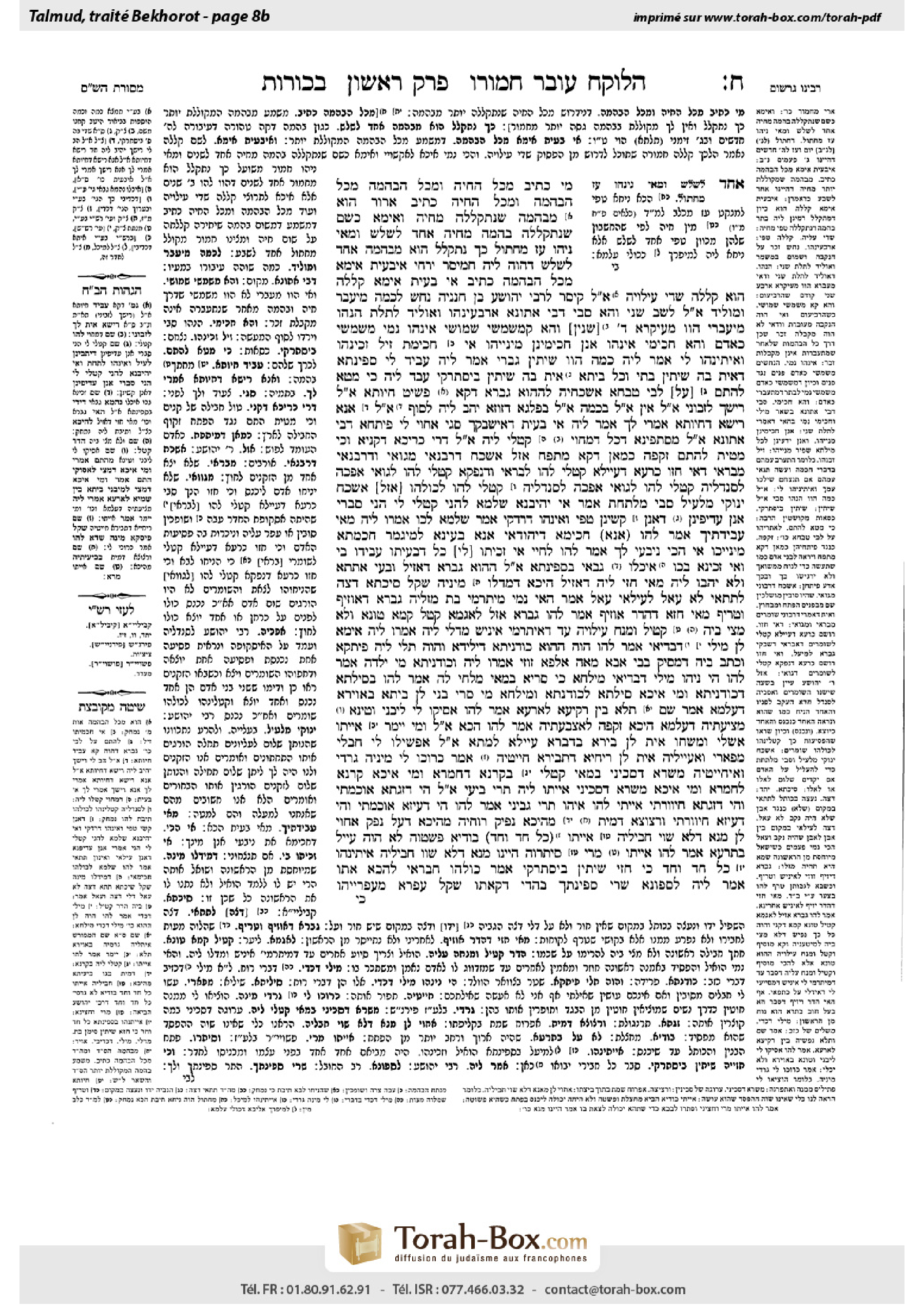
Bekhorot 8b: Talmud study for Daf Yomi
Study the Talmud for Daf Yomi with scanned pages, Hebrew text, English translations from Sefaria and AI-generated French translations.
Passage selection and English or AI-generated French translation are available where the scan has annotations. Daf Study is independent of Torah-Box and Sefaria.
Browse Bekhorot · בכורות · All tractatesBekhorot 8b text and translations
This page of Bekhorot includes the Aramaic text, an English translation and an AI-generated French translation, alongside the scan above.
בכורות ח׳ ב · Aramaic and Hebrew text
מִי כְּתִיב ״מִכׇּל הַחַיָּה וּמִכׇּל הַבְּהֵמָה״? ״מִכׇּל הַבְּהֵמָה וּמִכֹּל הַחַיָּה״ כְּתִיב! אָרוּר הוּא מִבְּהֵמָה שֶׁנִּתְקַלְּלָה מֵחַיָּה.
וְאֵימָא: כְּשֵׁם שֶׁנִּתְקַלְּלָה בְּהֵמָה מֵחַיָּה אֶחָד לְשָׁלֹשׁ, וּמַאי נִיהוּ? עֵז מֵחָתוּל, כָּךְ נִתְקַלֵּל הוּא מִבְּהֵמָה אֶחָד לְשָׁלֹשׁ, דְּהָוֵה לֵיהּ חֲמֵיסַר יַרְחֵי!
אִיבָּעֵית אֵימָא: ״מִכׇּל הַבְּהֵמָה״ כְּתִיב. אִי בָּעֵית אֵימָא: קְלָלָה הוּא, קְלָלָה שְׁדִי עִילָּוֵיהּ.
אֲמַר לֵיהּ קֵיסָר לְרַבִּי יְהוֹשֻׁעַ בֶּן חֲנַנְיָה: נָחָשׁ לְכַמָּה מִיעַבַּר וּמוֹלֵיד? אֲמַר לֵיהּ: לְשַׁב שְׁנֵי. וְהָא סָבֵי דְּבֵי אַתּוּנָא אַרְבְּעִינְהוּ, וְאוֹלִיד לִתְלָת! הָנְהוּ מִיעַבְּרִי הֲווֹ מֵעִיקָּרָא אַרְבַּע. וְהָא קָמְשַׁמְּשִׁי שַׁמּוֹשֵׁי! אִינְהוּ נָמֵי מְשַׁמְּשִׁי כְּאָדָם.
וְהָא חַכִּימֵי אִינְהוּ? אֲנַן חֲכִימִינַן מִינַּיְיהוּ. אִי חֲכִימַתְּ, זִיל זַכִּינְהוּ וְאַיְתִינְהוּ לִי! אֲמַר לֵיהּ: כַּמָּה הָווּ? שִׁיתִּין גַּבְרֵי.
אֲמַר לֵיהּ: עֲבֵיד לִי סְפִינְתָּא דְּאִית בַּהּ שִׁיתִּין בָּתֵּי, וְכֹל בֵּיתָא אִית בַּהּ שִׁיתִּין בִּיסְתַּרְקֵי. עֲבַד לֵיהּ. כִּי מְטָא לְהָתָם לְבֵי טַבָּחָא, אַשְׁכְּחֵיהּ לְהָהוּא גַּבְרָא דְּקָא פָשֵׁיט חֵיוְתָא. אֲמַר לֵיהּ: רֵישָׁךְ לְזַבּוֹנֵי? אֲמַר לֵיהּ: אִין. אֲמַר לֵיהּ: בְּכַמָּה? אֲמַר לֵיהּ: בְּפַלְגָא דְּזוּזָא. יְהַב לֵיהּ.
לְסוֹף, אֲמַר לֵיהּ: אֲנָא רֵישָׁא דְּחֵיוְתָא אֲמַרִי לָךְ? אֲמַר לֵיהּ: אִי בָּעֵית דְּאֶשְׁבְּקָךְ סַגִּי אַחְוִי לִי פִּיתְחָא דְּבֵי אַתּוּנָא. אֲמַר לֵיהּ: מִסְתְּפֵינָא דְּכֹל דְּמַחְוֵי קָטְלִי לֵיהּ. אֲמַר לֵיהּ: דְּרִי כְּרִיכָא דִּקְנֵיא, וְכִי מָטֵית לְהָתָם זִקְפֵהּ כְּמַאן דְּקָא מִתְּפַח.
אַשְׁכַּח דַּרְבְּנָאֵי מִגַּוַּאי וְדַרְבְּנָאֵי מִבָּרַאי, דְּאִי חָזוּ כַּרְעָא דְּעָיְילָא — קָטְלִי לְהוּ לְבָרַאי, וּדְנָפְקָא — קָטְלִי לְהוּ לְגַוַּאי.
אַפְכֵהּ לְסַנְדָּלֵיהּ — קָטְלִי לְהוּ לְגַוָּאֵי, אַפְכֵהּ לְסַנְדָּלֵיהּ — קָטְלִי לְהוּ לְכוּלְּהוּ.
אַשְׁכַּח יָנוֹקֵי מִלְּעֵיל, סָבֵי מִלְּתַחַת. אֲמַר: אִי יָהֵיבְנָא שְׁלָמָא לְהָנֵי, קָטְלִי לִי הָנֵי, סָבְרִי: אֲנַן עֲדִיפִינַן, דַּאֲנַן קַשִּׁינַן טְפֵי וְאִינְהוּ דַּרְדַּקֵּי.
אֲמַר: שְׁלָמָא לְכוּ. אֲמַרוּ לֵיהּ: מַאי עֲבִידְתָּיךְ? אֲמַר לְהוּ: אֲנָא חַכִּימָא דִיהוּדָאֵי אֲנָא, בָּעֵינָא לְמִיגְמַר חֻכְמְתָא מִינַּיְיכוּ. אִי הָכִי, נִיבְעֵי לָךְ! אֲמַר לְהוּ: לְחַיֵּי, אִי זָכֵיתוּ — כֹּל דְּבָעֵיתוּ עֲבִידוּ בִּי, וְאִי זָכֵינָא בְּכוּ — אִיכְלוּ גַּבַּאי בִּסְפִינְתָּא.
אֲמַרוּ לֵיהּ: הַהוּא גַּבְרָא דְּאָזֵיל וּבָעֵי אִתְּתָא וְלָא יָהֲבוּ לֵיהּ, מַאי חֲזֵי לֵיהּ דְּאָזֵיל הֵיכָא דְּמִדְּלוּ מִינָּיהּ? שְׁקַל סִיכְּתָא, דָּצַהּ לְתַתַּאי — לָא עָאל, לְעִילַּאי — עָאל. אֲמַר: הַאי נָמֵי מִיתְרְמֵי בַּת מַזָּלֵיהּ.
גַּבְרָא דְּאוֹזֵיף וְטָרֵיף, מַאי חֲזָא דַּהֲדַר אוֹזֵיף? אֲמַר לְהוּ: גַּבְרָא אֲזַל לְאַגְמָא, קְטַל קַמָּא טוּנָא וְלָא מָצֵי בֵּיהּ, קָטֵיל וּמַנַּח עִילָּוֵיהּ, עַד (דְּאִיתְרְמִי) [דְּמִיתְרְמֵי] אִינִישׁ מַדְלֵי לֵיהּ.
אֲמַרוּ לֵיהּ: אֵימָא לַן מִילֵּי דִּבְדִיאִי! אֲמַר לְהוּ: הֲוָה הַהִוא כּוּדַנְיְתָא דִּילִידָא, וַהֲוָה תְּלֵי לֵיהּ פִּיתְקָא, וּכְתַב בֵּיהּ דְּמַסֵּיק בְּבֵי אַבָּא מְאָה אַלְפָּא זוּזֵי. אֲמַרוּ לֵיהּ: וְכוּדַנְיְתָא מִי יָלְדָה? אֲמַר לְהוּ: (הֵי נִיהוּ) [הָנֵי נִינְהוּ] מִילֵּי דִבְדִיאִי.
מִילְחָא כִּי סָרְיָא, בְּמַאי מָלְחִי לַהּ? אֲמַר לְהוּ: בְּסִילְתָּא דְכוּדַנְיְתָא. וּמִי אִיכָּא סִילְתָּא לְכוּדַנְתָּא? וּמִילְחָא מִי סְרֵי?
בְּנִי לַן בֵּיתָא בַּאֲוִירָא דְּעָלְמָא! אָמַר שֵׁם, תְּלָא בֵּין רְקִיעָא לְאַרְעָא. אֲמַר לְהוּ: אַסִּיקוּ לִי לִיבְנֵי וְטִינָא. מְצִיעֲתֵיהּ דְּעָלְמָא הֵיכָא? זַקְפַהּ לְאֶצְבַּעְתֵּיהּ, אֲמַר לְהוּ: הָכָא. אֲמַרוּ לֵיהּ: וּמִי יֵימַר? אַיְיתוֹ אַשְׁלֵי וּמְשַׁחוּ.
אִית לַן בֵּירָא בְּדַבְרָא, עַיְילֵאּ לְמָתָא! אֲמַר לְהוּ: אַפְשִׁילוּ לִי חַבְלֵי מִפָּארֵי וַאֲעַיְּילֵיהּ. אִית לַן רִיחְיָא דִּתְבִירָא, חַיְּיטַיהּ. אֲמַר: כְּרוּכוּ לִי מִינַּיהּ גַּרְדֵי וְאִיחַיְּיטַיהּ.
מְשָׁרָא דְּסַכִּינֵי בְּמַאי קָטְלִי? בְּקַרְנָא דַּחֲמָרָא. וּמִי אִיכָּא קַרְנָא לַחֲמָרָא? וּמִי אִיכָּא מְשָׁרָא דְּסַכִּינֵי?
אַיְיתוֹ לֵיהּ תְּרֵי בֵּיעֵי, אֲמַרוּ לֵיהּ: הֵי דְּזַגְתָּא אוּכַּמְתִּי וְהֵי דְּזַגְתָּא חִיוַּורְתִּי? אַיְיתִי לְהוּ אִיהוּ תְּרֵי גְּבִינֵי, אֲמַר לְהוּ: הֵי דְּעִיזָּא אוּכַּמְתִּי וְהֵי דְּעִיזָּא חִיוַּורְתִּי?
וַרְצוּצָא דְּמִית, מֵהֵיכָא נָפֵיק רוּחֵיהּ? מֵהֵיכָא דְּעָל נְפַק. אַחְוִי לַן מָנָא דְּלָא שָׁוֵי חֲבִילֵיהּ! אַיְיתִי (כֹּל חַד וְחַד) בּוּדְיָא, פַּשְׁטֵיהּ. לָא הֲוָה עָיֵיל בְּתַרְעָא. אֲמַר לְהוּ: אַיְיתוֹ מָרֵי סִיתְרוּהּ. הַיְינוּ מָנָא דְּלָא שָׁוֵי חֲבִילֵיהּ.
אַיְתִינְהוּ כֹּל חַד וְחַד, כִּי חָזֵי שִׁיתִּין בִּיסְתַּרְקֵי, אָמַר: כּוּלְּהוּ חַבְרַאי לְהָכָא אָתוּ. אֲמַר לֵיהּ לְסָפוֹנָא: שְׁרִי סְפִינְתָּךְ. בַּהֲדֵי דְּקָאָתוּ שְׁקַל עַפְרָא מֵעַפְרַיְיהוּ.
Bekhorot 8b · English translation
The Gemara responds: Is it written: Cursed are you from among all beasts, and from among all animals? No, it is written: “From among all animals, and from among all beasts,” meaning that it is cursed from among the domesticated animals, which were cursed from among the undomesticated animals.
The Gemara challenges: Why must it mean that the snake was cursed more than the donkey in the same proportion that the donkey was cursed more than the cat? But say instead that just as the domesticated animals were cursed more than the undomesticated animals by a measure of one to three; the Gemara interjects: And in what case is that? It is in the case of a goat, whose gestation period is five months, compared to a cat, whose gestation period is fifty-two days. The Gemara continues its challenge: So too, the snake was cursed more than the domesticated animals, i.e., the goat, by a proportion of one to three, which is fifteen months.
The Gemara answers: If you wish, say that it is written: “Cursed are you from among all animals,” including the most accursed of them, i.e., the donkey. If you wish, say instead that since it is a curse that the snake received here, the verse imposes upon it the most extreme curse that can be derived from the text.
§ With regard to the gestation time of a snake, the Gemara relates that the Roman emperor said to Rabbi Yehoshua ben Ḥananya: In the case of a snake, after how long a period of gestation does it give birth? Rabbi Yehoshua ben Ḥananya said to him: After seven years. The emperor said to him: But the elders, i.e., the sages, of the school of Athens bred snakes and they gave birth after three years. Rabbi Yehoshua ben Ḥananya responded: Those snakes were already pregnant from beforehand for four years. The emperor asked: But they engaged in intercourse, and animals do so only in order to give birth, not when they are already pregnant. Rabbi Yehoshua responded: Snakes also engage in intercourse like people, i.e., they do not do so solely for reproduction.
The emperor said to him: But how can you disagree with the sages of Athens? Aren’t they wise? Rabbi Yehoshua ben Ḥananya responded: We are wiser than they. The emperor said: If you are wiser than they, then go defeat them in debate and bring them to me. Rabbi Yehoshua said to him: How many are there? The emperor answered: Sixty men.
Rabbi Yehoshua ben Ḥananya said to him: Construct a ship that has sixty rooms for me, and each room should have sixty mattresses [bistarkei] in it. The emperor constructed it for him. Rabbi Yehoshua then set out on the ship for Athens. When he arrived there, he entered a butcher shop and found a certain man, the butcher, flaying an animal. Rabbi Yehoshua said to him: Is your head for sale? The butcher said to him: Yes it is. Rabbi Yehoshua said to him: For how much is it being sold? The butcher said to him: For half a dinar. Rabbi Yehoshua gave him the money.
After Rabbi Yehoshua paid the butcher, he said to him: Did I say to you that I wanted the head of the animal? I was referring to your head, and you must now keep your word and give me your head. Rabbi Yehoshua said to him: If you wish for me to let you be, go and show me the entrance to the school of the sages of Athens. The butcher said to him: I am afraid, as they kill anyone who shows its location to another. Rabbi Yehoshua said to him: Carry a bundle of reeds, and when you arrive there, stand it up like one who is resting, to mark the location. The butcher did this, and Rabbi Yehoshua successfully found the entrance.
Rabbi Yehoshua found guards stationed on the inside and guards stationed on the outside to ensure that no one could enter or exit. They also spread sand on the ground in the entranceway so that they could detect if anyone entered or left. If they saw footsteps that were entering they would kill the outer guards for allowing people to enter, and if they saw footsteps that were exiting they would kill the inner guards for allowing people to leave.
Rabbi Yehoshua reversed his sandal so it was facing away from the entrance, walked on the sand, and snuck away, thereby creating the appearance of someone who had left the building. When the authorities saw the footsteps, they killed the inner guards. Rabbi Yehoshua then returned, reversed his sandal, and made footsteps in the sand indicating that someone had entered the building. They then killed all the guards, including the outer ones, and Rabbi Yehoshua succeeded in entering the building.
Rabbi Yehoshua found the younger sages sitting in the upper, more prominent section, and the elder ones in the lower section. He said to himself: I must first greet the younger sages, as they are sitting in the upper section, prior to the elder sages; but if I greet these younger sages first, those elder sages will kill me, as they maintain: We are better, because we are older and they are children.
Rabbi Yehoshua said: Greetings to you, but did not directly address either group. They said to him: What are you doing here? Rabbi Yehoshua said to them: I am a Sage of the Jews, and I desire to learn wisdom from you. They said to him: If so, we will ask you questions and see if you are worthy of this privilege. Rabbi Yehoshua said to them: Very well. If you win, you may do to me anything you wish, and if I defeat you, then eat with me on my ship.
The sages of Athens said to him: In the case of a certain man who goes and asks to marry a woman and her family does not give her to him, why would he see fit to go to a family that is greater than the first? Rabbi Yehoshua took a peg and stuck it into the lower part of the wall, but it did not go in. He then stuck it into the upper portion of the wall where there was a hole, and it went in. He said to them: In this case too, where he goes to a more distinguished family than the first, perhaps he will find the girl destined for him.
The sages of Athens asked him another question: In the case of a man who lends money to an individual and the borrower does not repay the loan, and the lender repossesses the borrower’s property as payment instead, why would he see fit to lend to others again? Rabbi Yehoshua said to them: This is what people do: If a man goes to the pond, initially cuts a bundle of reeds, but finds that he cannot lift it, he does not stop cutting wood. Instead, he cuts more wood and places it upon the first, until a person happens to pass by and helps him raise it upon his shoulders, so that he can carry it home. So too, a person continues to lend based on the assumption that he will eventually find an appropriate borrower.
The sages of Athens said to him: Say to us a matter of nonsense. Rabbi Yehoshua said to them: There was a certain mule that gave birth, and a note was hanging on the newborn mule’s neck and on it was written that it is owed 100,000 dinars by its father’s household. They said to him: But can a mule give birth? Rabbi Yehoshua said to them: This is why it is a matter of nonsense, as it is impossible for a mule to give birth.
The sages of Athens then asked another question: When salt is spoiling, with what does one salt it to preserve it? Rabbi Yehoshua said to them: With the placenta of a mule. They said to him: But is there a placenta of a mule? Rabbi Yehoshua said to them: And does salt spoil?
They said to him: Build us a house in the air of the world. Rabbi Yehoshua uttered a Name of God and hovered between the sky and the earth. He said to them: Bring up to me bricks and mortar and I will build you a house here. They asked him: Where is the center of the world? Rabbi Yehoshua raised his finger and said to them: Here. They said to him: And who says that you are correct? He said to them: Bring ropes and measure.
They said to him: We have a pit in the field; bring it to the city. Rabbi Yehoshua said to them: Braid ropes made of bran for me and I will bring it to the city with them. They then said to him: We have a mill that broke; sew it back together. Rabbi Yehoshua said to them: Pull out threads from the mill for me and I will sew them together.
They asked him another question: With what does one harvest a field of knives? Rabbi Yehoshua answered: With the horn of a donkey. They said to him: But is there such an item as a horn of a donkey? He said to them: But is there such a thing as a field of knives?
They brought him two eggs and said to him: Which is the egg of a black hen and which is the egg of a white hen? Rabbi Yehoshua brought them two cheeses, and said to them: Which is the cheese from the black goat and which is from the white goat?
They asked him: And in the case of a chick that dies inside the egg, from where does its spirit exit? Rabbi Yehoshua said to them: From where it enters, it departs. They said to him: Show us a utensil that is not worth the damage that it causes. Rabbi Yehoshua said to them: Each one of you bring a mat and spread it out. When they did so, each mat did not enter the gate due to its size. Rabbi Yehoshua said to them: Bring axes and break the gate so that you can bring it inside. This is a utensil that is not worth its damage.
§ After Rabbi Yehoshua defeated the sages of Athens in debate, he brought them to his ship as they had agreed. He then brought each one to a different room. When each one saw the sixty mattresses in his room, he said to himself: All of my colleagues are coming here, and waited for them without attempting to leave. Rabbi Yehoshua said to the sailor: Release your ship, i.e., begin sailing. While they were coming to the emperor in Rome, he took out some dirt that he had taken from the dirt of Athens.
Bekhorot 8b · Traduction française (IA)
La Guemara répond : Est-il écrit : « Maudits sois-tu parmi tous les animaux, et parmi toutes les bêtes ? » Non, il est écrit : « Parmi tous les animaux, et parmi toutes les bêtes », ce qui signifie qu’il est maudit parmi les animaux domestiques, qui eux-mêmes sont maudits parmi les animaux sauvages.
La Guemara soulève un doute : Pourquoi doit-il signifier que le serpent est maudit plus que le cheval dans la même proportion que le cheval est maudit plus que le chat ? Mais disons plutôt que, puisque les animaux domestiques sont maudits plus que les animaux sauvages dans un rapport de un à trois ; la Guemara interrompt : Et dans quel cas cela est-il ? C’est dans le cas d’un bouc, dont la période de gestation est de cinq mois, comparé à un chat, dont la période de gestation est de cinquante-deux jours. La Guemara continue son défi : De même, le serpent est maudit plus que les animaux domestiques, c’est-à-dire le bouc, dans un rapport de un à trois, ce qui correspond à quinze mois.
La Guemara répond : Si tu le veux, dis qu’il est écrit : « Maudits sois-tu parmi tous les animaux », y compris le plus maudit d’entre eux, c’est-à-dire le chameau. Si tu le veux, dis plutôt qu’en raison d’une malédiction qu’il a reçue ici, la versette impose sur lui la malédiction la plus extrême que l’on puisse déduire du texte.
§ En ce qui concerne la période de gestation du serpent, la Guemara rapporte que l’empereur romain dit à Rabbi Yéhoshua ben Hananyah : Dans le cas du serpent, après combien de temps de gestation donne-t-il naissance ? Rabbi Yéhoshua ben Hananyah répondit à lui : Après sept ans. L’empereur dit à lui : Mais les anciens, c’est-à-dire les sages, de l’école d’Athènes ont élevé des serpents et ils ont donné naissance après trois ans. Rabbi Yéhoshua ben Hananyah répondit : Ces serpents étaient déjà enceintes depuis quatre ans. L’empereur demanda : Mais ils ont eu des relations sexuelles, et les animaux le font uniquement pour donner naissance, pas quand ils sont déjà enceintes. Rabbi Yéhoshua répondit : Les serpents aussi ont des relations sexuelles comme les humains, c’est-à-dire qu’ils ne le font pas uniquement pour la reproduction.
L’empereur dit à lui : Mais comment peux-tu être en désaccord avec les sages d’Athènes ? Ne sont-ils pas sages ? Rabbi Yéhoshua ben Hananyah répondit : Nous sommes plus sages qu’eux. L’empereur dit : Si vous êtes plus sages qu’eux, alors va les battre en débat et amène-les-moi. Rabbi Yéhoshua dit à lui : Combien y en a-t-il ? L’empereur répondit : Soixante hommes.
Rabbi Yéhoshua ben Hananyah dit à lui : Construis un navire qui ait soixante chambres pour moi, et chaque chambre devrait avoir soixante matelas [bistarkei] à l’intérieur. L’empereur le construisit pour lui. Rabbi Yéhoshua partit alors sur le navire pour Athènes. Lorsqu’il arriva là-bas, il entra dans une boucherie et trouva un certain homme, le boucher, dépecant un animal. Rabbi Yéhoshua dit à lui : La tête est-elle à vendre ? Le boucher dit à lui : Oui, elle l’est. Rabbi Yéhoshua dit à lui : Pour combien est-elle vendue ? Le boucher dit à lui : Pour demi-dinar. Rabbi Yéhoshua lui donna l’argent.
Après que Rabbi Yéhoshua eut payé le boucher, il lui dit : Ai-je dit à toi que je voulais la tête de l’animal ? Je faisais référence à ta tête, et tu dois maintenant tenir parole et me donner ta tête. Rabbi Yéhoshua lui dit : Si tu veux que je te laisse tranquille, va et montre-moi l’entrée de l’école des sages d’Athènes. Le boucher lui dit : J’ai peur, car ils tuent quiconque montre leur localisation à un autre. Rabbi Yéhoshua lui dit : Porte un faisceau de roseaux, et quand tu arriveras là, debout-le comme celui qui repose, pour marquer la localisation. Le boucher fit cela, et Rabbi Yéhoshua réussit à trouver l’entrée.
Rabbi Yéhoshua trouva des gardes postés à l’intérieur et des gardes postés à l’extérieur pour s’assurer que personne ne puisse entrer ou sortir. Ils étalèrent aussi du sable sur le sol à l’entrée pour pouvoir détecter si quelqu’un entrait ou sortait. S’ils voyaient des empreintes qui entraient, ils tuaient les gardes extérieurs pour avoir permis à quelqu’un d’entrer, et s’ils voyaient des empreintes qui sortaient, ils tuaient les gardes intérieurs pour avoir permis à quelqu’un de sortir.
Rabbi Yéhoshua retourna son sandale de sorte qu’elle soit tournée en direction opposée à l’entrée, marcha sur le sable, et s’échappa discrètement, créant l’illusion d’une personne qui avait quitté le bâtiment. Lorsque les autorités virent les empreintes, ils tuèrent les gardes intérieurs. Rabbi Yéhoshua revint alors, retourna son sandale, et fit des empreintes sur le sable indiquant que quelqu’un avait entré dans le bâtiment. Ils tuèrent alors tous les gardes, y compris les gardes extérieurs, et Rabbi Yéhoshua réussit à entrer dans le bâtiment.
Rabbi Yéhoshua trouva les jeunes sages assis dans la section supérieure, plus prestigieuse, et les anciens dans la section inférieure. Il se dit : Je dois d’abord saluer les jeunes sages, car ils sont assis dans la section supérieure avant les sages anciens ; mais si je salue ces jeunes sages en premier, les sages anciens me tueront, car ils maintiennent : Nous sommes meilleurs, car nous sommes plus âgés et ils sont des enfants.
Rabbi Yéhoshua dit : Salutations à vous, mais ne s’adressa pas directement à aucun groupe. Ils lui dirent : Que fais-tu ici ? Rabbi Yéhoshua dit à eux : Je suis un Sage des Juifs, et je désire apprendre la sagesse de vous. Ils lui dirent : Si c’est le cas, nous te poserons des questions et verrons si tu mérites ce privilège. Rabbi Yéhoshua dit à eux : Très bien. Si tu gagnes, tu peux faire ce que tu veux de moi, et si je t’affronte, alors mange avec moi sur mon navire.
Les sages d’Athènes dirent à lui : Dans le cas d’un certain homme qui va et demande à épouser une femme et sa famille ne lui donne pas la femme, pourquoi voudrait-il aller chez une famille plus grande que la première ? Rabbi Yéhoshua prit un clou et le planta dans la partie inférieure du mur, mais il ne rentra pas. Il planta alors le clou dans la partie supérieure du mur où il y avait un trou, et il rentra. Il dit à eux : Dans ce cas aussi, où il va chez une famille plus distinguée que la première, peut-être trouvera-t-il la fille destinée à lui.
Les sages d'Athènes lui posèrent une autre question : Dans le cas d'un homme qui prête de l'argent à un individu et que le prêteur ne rembourse pas le prêt, et que le prêteur récupère la propriété du débiteur comme paiement à la place, pourquoi voudrait-il prêter à d'autres à nouveau ? Rabbi Yéhoshua leur dit : C'est ainsi que les gens font : Si un homme va à la mare, il commence par couper un faisceau de roseaux, mais il découvre qu'il ne peut pas le porter, il ne s'arrête pas à couper du bois. Il continue à couper du bois et le place sur le premier, jusqu'à ce qu'un passant vienne l'aider à le porter sur ses épaules, de sorte qu'il puisse le ramener chez lui. De même, une personne continue à prêter en supposant qu'elle trouvera un débiteur approprié à un moment donné.
Les sages d'Athènes dirent à lui : Dites-nous une affaire de sottise. Rabbi Yéhoshua leur dit : Il y avait un âne qui avait donné naissance, et un papier était accroché au cou du petit âne et sur ce papier était écrit qu'il est dû 100 000 drachmes par la famille du père. Ils dirent à lui : Mais un âne peut-il donner naissance ? Rabbi Yéhoshua leur dit : C'est pourquoi c'est une affaire de sottise, car il est impossible qu'un âne donne naissance.
Les sages d'Athènes posèrent alors une autre question : Lorsque le sel se corrompt, avec quoi le salit-on pour le conserver ? Rabbi Yéhoshua leur dit : Avec le placenta d'un âne. Ils dirent à lui : Mais existe-t-il un placenta d'un âne ? Rabbi Yéhoshua leur dit : Et le sel se corrompt-il ?
Ils lui dirent : Construisez-nous une maison dans l'air du monde. Rabbi Yéhoshua prononça un Nom de Dieu et flotta entre le ciel et la terre. Il leur dit : Apportez-moi des briques et du mortier et je construirai une maison ici. Ils lui demandèrent : Où est le centre du monde ? Rabbi Yéhoshua leva son doigt et leur dit : Ici. Ils lui dirent : Et qui affirme que vous avez raison ? Il leur dit : Apportez des cordes et mesurez.
Ils lui dirent : Nous avons un puits dans le champ ; amenez-le en ville. Rabbi Yéhoshua leur dit : Tissez des cordes en blé pour moi et je l'amènerai en ville avec elles. Ils dirent ensuite à Rabbi Yéhoshua : Nous avons une meule qui a cassé ; réparez-la. Rabbi Yéhoshua leur dit : Extraites des fils de la meule pour moi et je les coudrai ensemble.
Ils lui posèrent une autre question : Avec quoi récolte-t-on un champ de couteaux ? Rabbi Yéhoshua répondit : Avec le cor d'un âne. Ils lui dirent : Mais existe-t-il un tel objet, un cor d'un âne ? Il leur dit : Mais existe-t-il un tel objet, un champ de couteaux ?
Ils lui apportèrent deux œufs et lui dirent : Quel est l'œuf de la poule noire et quel est celui de la poule blanche ? Rabbi Yéhoshua leur apporta deux fromages et leur dit : Quel est le fromage du bouc noir et quel est celui du bouc blanc ?
Ils lui demandèrent : Et dans le cas d'un poussin qui meurt à l'intérieur de l'œuf, d'où sort son âme ? Rabbi Yéhoshua leur dit : D'où il entre, il sort. Ils lui dirent : Montrez-nous un ustensile qui n'est pas digne du préjudice qu'il cause. Rabbi Yéhoshua leur dit : Chacun d'entre vous apporte un tapis et étale-le. Lorsqu'ils le firent, chaque tapis ne pouvait pas entrer dans la porte en raison de sa taille. Rabbi Yéhoshua leur dit : Apportez des haches et brisez la porte afin que vous puissiez le ramener à l'intérieur. Cet ustensile n'est pas digne du préjudice qu'il cause.
§ Après que Rabbi Yéhoshua eut vaincu les sages d'Athènes dans le débat, il les conduisit à son bateau comme ils l'avaient convenu. Il conduisit ensuite chacun d'eux dans une pièce différente. Lorsque chacun vit les soixante matelas dans sa pièce, il se dit : Tous mes collègues viennent ici, et attendit qu'ils arrivent sans tenter de partir. Rabbi Yéhoshua dit au marin : Libérez votre bateau, c'est-à-dire commencez à naviguer. Alors qu'ils allaient vers l'empereur à Rome, il sortit un peu de terre qu'il avait ramassée de la terre d'Athènes.
Traduction française générée par IA à partir de l’édition anglaise de Sefaria. Vérifie toujours un passage avec le texte source.
Text from Sefaria: William Davidson Edition - Vocalized Aramaic (CC BY NC); William Davidson Edition - English (CC BY NC).