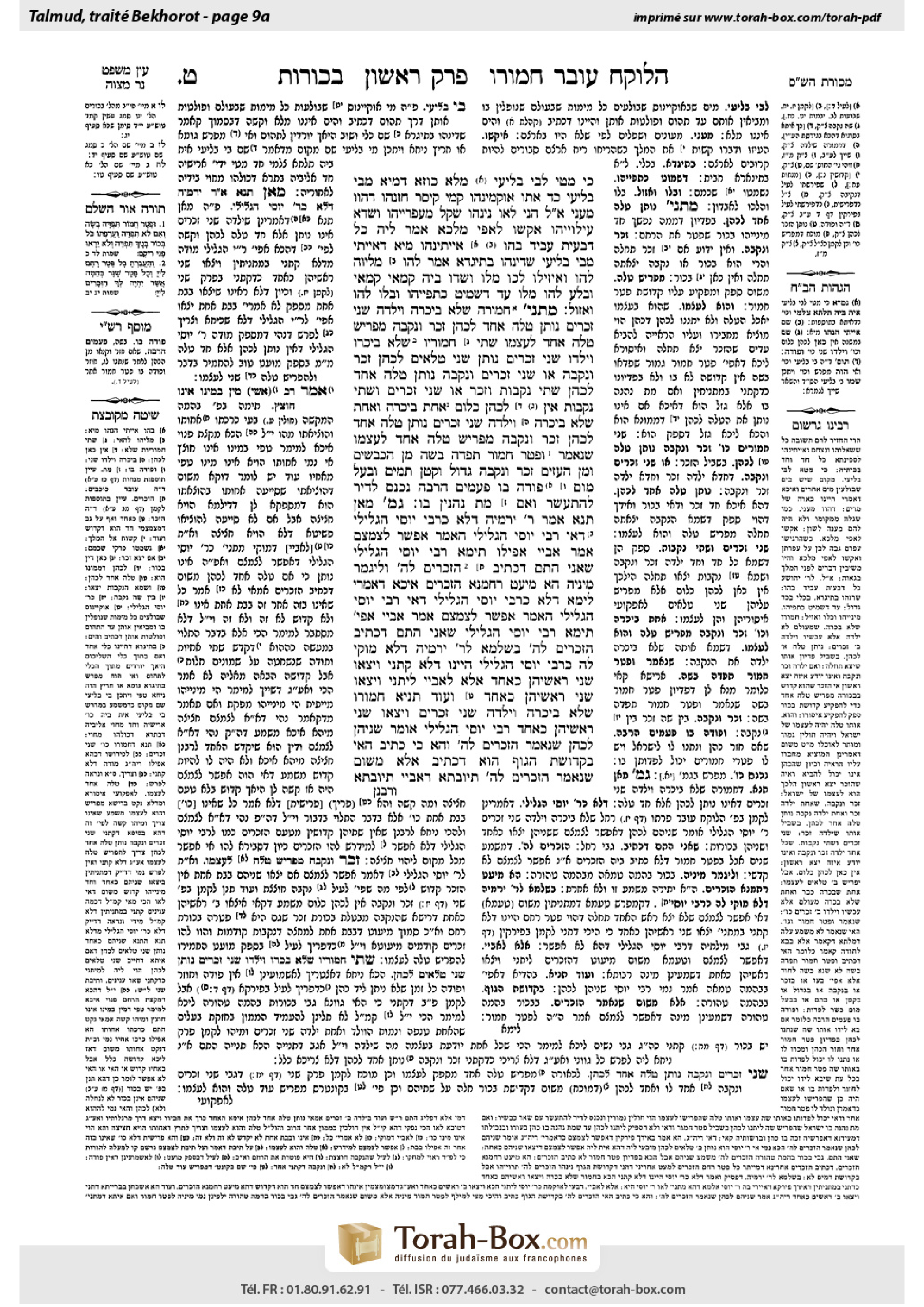
Bekhorot 9a: Talmud study for Daf Yomi
Study the Talmud for Daf Yomi with scanned pages, Hebrew text, English translations from Sefaria and AI-generated French translations.
Passage selection and English or AI-generated French translation are available where the scan has annotations. Daf Study is independent of Torah-Box and Sefaria.
Browse Bekhorot · בכורות · All tractatesBekhorot 9a text and translations
This page of Bekhorot includes the Aramaic text, an English translation and an AI-generated French translation, alongside the scan above.
בכורות ט׳ א · Aramaic and Hebrew text
כִּי מָטֵי לְבֵי בְלִיעֵי, מְלָא כּוּזָא דְּמַיָּא מִבֵּי בְלִיעֵי. כַּד אֲתוֹ, אוֹקְמִינְהוּ קַמֵּי קֵיסָר. חֲזָנְהוּ דַּהֲווֹ מְעַנִּי, אֲמַר לֵיהּ: הָנֵי לָאו נִינְהוּ. שְׁקַל מֵעַפְרַיְיהוּ וּשְׁדָא עִילָּוַיְיהוּ, אַקְשׁוֹ לְאַפֵּי מַלְכָּא. אֲמַר לֵיהּ: כֹּל דְּבָעֵית עֲבֵיד בְּהוּ.
אַיְיתִינְהוּ מַיָּא דְּאַיְיתִי מִבֵּי בְלִיעֵי, שְׁדִינְהוּ בְּתִיגְדָּא, אֲמַר לְהוּ: מַלְיוּהּ לְהוּ וְאֵיזִילוּ לְכוּ. מְלוֹ וּשְׁדוֹ בֵּיהּ קַמָּאֵי קַמָּאֵי, וּבְלַע לְהוּ, מְלוֹ עַד דְּשָׁמֵיט כַּתְפַּיְיהוּ, וּבְלוֹ לְהוּ וַאֲזוּל.
מַתְנִי׳ חֲמוֹרָה שֶׁלֹּא בִּיכְּרָה וְיָלְדָה שְׁנֵי זְכָרִים — נוֹתֵן טָלֶה אֶחָד לַכֹּהֵן, זָכָר וּנְקֵבָה — מַפְרִישׁ טָלֶה אֶחָד לְעַצְמוֹ.
שְׁתֵּי חֲמוֹרָיו שֶׁלֹּא בִּיכְּרוּ וְיָלְדוּ שְׁנֵי זְכָרִים — נוֹתֵן שְׁנֵי טְלָאִים לַכֹּהֵן. זָכָר וּנְקֵבָה, אוֹ שְׁנֵי זְכָרִים וּנְקֵבָה — נוֹתֵן טָלֶה אֶחָד לַכֹּהֵן. שְׁתֵּי נְקֵבוֹת וְזָכָר, אוֹ שְׁנֵי זְכָרִים וּשְׁתֵּי נְקֵבוֹת — אֵין לַכֹּהֵן כְּלוּם.
אַחַת בִּיכְּרָה, וְאַחַת שֶׁלֹּא בִּיכְּרָה, וְיָלְדָה שְׁנֵי זְכָרִים — נוֹתֵן טָלֶה אֶחָד לַכֹּהֵן; זָכָר וּנְקֵבָה — מַפְרִישׁ טָלֶה אֶחָד לְעַצְמוֹ.
שֶׁנֶּאֱמַר: ״וּפֶטֶר חֲמוֹר תִּפְדֶּה בְשֶׂה״, מִן הַכְּבָשִׂים וּמִן הָעִזִּים, זָכָר וּנְקֵבָה, גָּדוֹל וְקָטָן, תָּמִים וּבַעַל מוּם, פּוֹדֶה בּוֹ פְּעָמִים הַרְבֵּה, נִכְנָס לְדִיר לְהִתְעַשֵּׂר, וְאִם מֵת — נֶהֱנִין בּוֹ.
גְּמָ׳ מַאן תַּנָּא? אָמַר רַבִּי יִרְמְיָה: דְּלָא כְּרַבִּי יוֹסֵי הַגְּלִילִי, דְּאִי רַבִּי יוֹסֵי הַגְּלִילִי — הָאָמַר אֶפְשָׁר לְצַמְצֵם!
אָמַר אַבָּיֵי: אֲפִילּוּ תֵּימָא רַבִּי יוֹסֵי הַגְּלִילִי, שָׁאנֵי הָתָם דִּכְתִיב ״הַזְּכָרִים לַה׳״.
וְלִיגְמַר מִינֵּיהּ! הָא מַיעֵט רַחֲמָנָא ״הַזְּכָרִים״.
אִיכָּא דְאָמְרִי: לֵימָא דְּלָא כְּרַבִּי יוֹסֵי הַגְּלִילִי, דְּאִי רַבִּי יוֹסֵי הַגְּלִילִי — הָאָמַר אֶפְשָׁר לְצַמְצֵם! אָמַר אַבָּיֵי: אֲפִילּוּ תֵּימָא רַבִּי יוֹסֵי הַגְּלִילִי, שָׁאנֵי הָתָם דִּכְתִיב ״הַזְּכָרִים לַה׳״.
בִּשְׁלָמָא לְרַבִּי יִרְמְיָה, דְּלָא מוֹקֵי לַהּ כְּרַבִּי יוֹסֵי הַגְּלִילִי — הַיְינוּ דְּלָא קָתָנֵי ״וְיָצְאוּ שְׁנֵי רָאשֵׁיהֶן כְּאֶחָד״, אֶלָּא לְאַבָּיֵי — לִיתְנֵי ״וְיָצְאוּ שְׁנֵי רָאשֵׁיהֶן כְּאֶחָד״!
וְעוֹד, תַּנְיָא: חֲמוֹרוֹ שֶׁלֹּא בִּיכְּרָה וְיָלְדָה שְׁנֵי זְכָרִים, וְיָצְאוּ שְׁנֵי רָאשֵׁיהֶן כְּאֶחָד, רַבִּי יוֹסֵי הַגְּלִילִי אוֹמֵר: שְׁנֵיהֶן לַכֹּהֵן, שֶׁנֶּאֱמַר ״הַזְּכָרִים לַה׳״.
וְהָא כִּי כְּתִיב הַאי, בִּקְדוּשַּׁת הַגּוּף הוּא דִּכְתִיב! אֶלָּא מִשּׁוּם שֶׁנֶּאֱמַר ״הַזְּכָרִים לַה׳״, תְּיוּבְתָּא דְאַבָּיֵי, תְּיוּבְתָּא.
Bekhorot 9a · English translation
When they reached the House of the Swallowed, a location in the sea where the water absorbs everything in its vicinity, Rabbi Yehoshua ben Ḥananya filled up a small jug of water from the House of the Swallowed. When they arrived, he presented the sages of Athens before the emperor. The emperor saw that the sages of Athens were suffering due to their having been taken captive. He said to Rabbi Yehoshua: These individuals cannot be the sages of Athens, because those sages are strong and arrogant. Rabbi Yehoshua took some of the dirt that he had taken from Athens and threw it upon them. When they smelled the scent of their own soil they began to act like themselves again, and they spoke with arrogance before the king. Upon hearing them, the emperor said to Rabbi Yehoshua: You may do with them whatever you wish.
Rabbi Yehoshua brought the water that he had brought from the House of the Swallowed and poured it into a utensil [betigada]. He said to the sages: Fill it up and go on your way. They filled and poured one by one, i.e., they filled the utensil by pouring in water numerous times, and each time the utensil swallowed up the water. They continued to fill it until their shoulders became disjointed. In this manner, the sages of Athens were defeated.
MISHNA: In the case of a female donkey that had not previously given birth and now gave birth to two male offspring, as there is no doubt that one of them is firstborn, its owner gives one lamb to the priest in redemption of that firstborn. If it gave birth to a male and a female and it is not known which was born first, he designates one lamb as firstborn in case the male was born first. Nevertheless, since it is merely a monetary debt to the priest, the burden of proof rests upon the claimant, in this case the priest. Due to that uncertainty, the priest can offer no proof and the owner keeps the lamb for himself.
If an individual has two donkeys, and both of his two donkeys had not previously given birth and they now gave birth to two males, one each, the owner gives two lambs to the priest. If they together gave birth to a male and a female or to two males and a female, he gives one lamb to the priest, as one of the males is certainly a firstborn. If they together gave birth to two females and a male or to two males and two females, the priest receives nothing, as perhaps the two firstborn were females.
If one of his donkeys had previously given birth and one had not previously given birth and they now together gave birth to two males, the owner gives one lamb to the priest as redemption for the firstborn male. If they together gave birth to a male and a female he designates one lamb for himself, as it is uncertain whether or not the male was a firstborn and the burden of proof rests upon the claimant.
From where is it derived that the firstborn of a donkey is redeemed with a lamb? It is derived from a verse, as it is stated: “And you shall redeem the firstborn of a donkey with a lamb [seh]” (Exodus 34:20). The owner may give a lamb either from sheep or from goats; from males or females, from older or younger animals, and from unblemished or blemished animals. If the priest returns the lamb to the owner, he may redeem firstborn donkeys with it many times. In a case where he designates a lamb due to uncertainty and keeps it for himself, it is his in every sense. Consequently, it enters the pen in order to be tithed with the other non-sacred animals (see Leviticus 27:32), and if it dies, one may derive benefit from its carcass.
GEMARA: With regard to the first clause of the mishna the Gemara asks: Who is the tanna who taught that if a female donkey that had never given birth before gives birth to twin males, the owner gives only one lamb to the priest? Rabbi Yirmeya says: It is not in accordance with the opinion of Rabbi Yosei HaGelili. As if it were in accordance with the opinion of Rabbi Yosei HaGelili, doesn’t he say in a later mishna (17a) with regard to a kosher animal that gave birth to two males and both their heads emerged as one, that it is possible that both births coincided precisely, and therefore both of the twins are given to the priest? According to his opinion, in the case here as well, two lambs should be given to the priest. The mishna clearly follows the opinion of the Rabbis that only one of the two is considered a firstborn.
Abaye says: You may even say that the mishna is in accordance with the opinion of Rabbi Yosei HaGelili, and it is different there with regard to a kosher animal, as it is written: “Every firstborn that you have of animals, the males shall be the Lord’s” (Exodus 13:12), i.e., the word “males” is written in the plural. This indicates that if they emerged simultaneously they both have firstborn status. By contrast, with regard to redeeming a firstborn donkey, only one has firstborn status.
The Gemara challenges: But let him derive from the halakha of a firstborn kosher animal that the halakha of a firstborn donkey is the same. The Gemara answers: The Merciful One restricted this principle to the case of a firstborn kosher animal, where it is written: “The males shall be the Lord’s.” The word “the” indicates that two males can be considered firstborn only in the case of a firstborn kosher animal.
Some say there is another version of this discussion: Let us say that the mishna is not in accordance with the opinion of Rabbi Yosei HaGelili, as if it follows the opinion of Rabbi Yosei HaGelili, doesn’t he say it is possible that both births coincide precisely, and if they were born simultaneously both are considered firstborn? Abaye says: You may even say it is in accordance with the opinion of Rabbi Yosei HaGelili, and it is different there, as it is written: “The males shall be the Lord’s.”
The Gemara asks: Granted, according to Rabbi Yirmeya, who does not interpret the mishna in accordance with the opinion of Rabbi Yosei HaGelili, that is the reason that it does not teach: And both of their heads emerged as one, as stated in the mishna where the ruling of Rabbi Yosei HaGelili is taught; according to the Rabbis who disagree with Rabbi Yosei HaGelili, this is impossible. But according to Abaye, who holds that the mishna is in accordance with the opinion of Rabbi Yosei HaGelili and such an occurrence is possible, let the mishna teach: And both of their heads emerged as one, indicating that in this case even Rabbi Yosei HaGelili agrees only one lamb is given to the priest.
Furthermore, it is taught in a baraita: If one’s donkey had not previously given birth and now gave birth to two males, and both of their heads emerged as one, Rabbi Yosei HaGelili says: Both of them are given to the priest, as it is stated: “The males shall be the Lord’s.”
The Gemara clarifies: But when this verse is written, isn’t it written with regard to a firstborn kosher animal, which has inherent sanctity, unlike a firstborn donkey? Rather, because it is stated with regard to a kosher animal: “The males shall be the Lord’s,” this serves as the basis for the halakha with regard to the firstborn of a non-kosher animal that both males can be considered firstborn. If so, the refutation of the opinion of Abaye is in fact a conclusive refutation, and the mishna is in accordance with the opinion of the Rabbis, not that of Rabbi Yosei HaGelili.
Bekhorot 9a · Traduction française (IA)
Lorsqu'ils arrivèrent à la Maison de l'Absorbant, un lieu dans la mer où l'eau absorbe tout ce qui l'entoure, Rabbi Yéhoshua ben Hanananyah remplit un petit récipient d'eau à partir de la Maison de l'Absorbant. Lorsqu'ils arrivèrent, il présenta les sages d'Athènes devant l'empereur. L'empereur vit que les sages d'Athènes souffraient en raison d'avoir été capturés. Il dit à Rabbi Yéhoshua : Ces individus ne peuvent pas être les sages d'Athènes, car ceux-ci sont forts et arrogants. Rabbi Yéhoshua prit un peu de la terre qu'il avait ramassée à Athènes et la jeta sur eux. Lorsqu'ils sentirent le parfum de leur propre terre, ils commencèrent à agir comme d'habitude et parlèrent avec arrogance devant le roi. En entendant cela, l'empereur dit à Rabbi Yéhoshua : Vous pouvez faire ce que vous voulez avec eux.
Rabbi Yéhoshua apporta l'eau qu'il avait ramenée de la Maison de l'Absorbant et le versa dans un ustensile [betigada]. Il dit aux sages : Remplissez-le et continuez votre chemin. Ils le remplirent et le vidèrent tour à tour, c'est-à-dire qu'ils remplirent l'ustensile en versant de l'eau plusieurs fois, et chaque fois l'ustensile absorbait l'eau. Ils continuèrent à le remplir jusqu'à ce que leurs épaules se délogeassent. Ainsi, les sages d'Athènes furent battus.
MICHNA : Dans le cas d'une jument qui n'avait jamais donné naissance et qui donne naissance à deux mâles, comme il n'y a aucun doute sur le fait qu'un d'entre eux est le premier-né, son propriétaire donne un agneau au prêtre en rédemption de ce premier-né. Si elle donne naissance à un mâle et à une femelle et il n'est pas connu lequel est né en premier, il désigne un agneau comme premier-né en cas où le mâle est né en premier. Cependant, puisque cela ne constitue qu'une dette monétaire pour le prêtre, la charge de la preuve incombe au plaignant, c'est-à-dire au prêtre. En raison de cette incertitude, le prêtre ne peut offrir aucune preuve et le propriétaire garde l'agneau pour lui-même.
Si un individu possède deux ânes, et que les deux ânes n'avaient jamais donné naissance et qu'ils donnent naissance à deux mâles, l'un chacun, le propriétaire donne deux agneaux au prêtre. Si ensemble ils donnent naissance à un mâle et à une femelle ou à deux mâles et à une femelle, il donne un agneau au prêtre, car l'un des mâles est certainement le premier-né. Si ensemble ils donnent naissance à deux femelles et à un mâle ou à deux mâles et à deux femelles, le prêtre reçoit rien, car peut-être les deux premiers-nés étaient des femelles.
Si l'un de ses ânes avait déjà donné naissance et l'autre n'avait pas donné naissance et qu'ils donnent naissance ensemble à deux mâles, le propriétaire donne un agneau au prêtre en rédemption du premier-né mâle. Si ensemble ils donnent naissance à un mâle et à une femelle, il désigne un agneau pour lui-même, car il est incertain si le mâle était un premier-né et la charge de la preuve incombe au plaignant.
D'où est tiré le fait que le premier-né d'un âne est racheté par un agneau ? C'est tiré d'un verset, comme il est dit : « Et tu rachèteras le premier-né d'un âne par un agneau [seh] » (Exode 34:20). Le propriétaire peut donner un agneau soit d'agneaux soit de chèvres, soit mâle soit femelle, soit âgé soit jeune, soit sans défaut soit avec défaut. Si le prêtre rend l'agneau au propriétaire, il peut racheter des premiers-nés d'ânes avec lui plusieurs fois. Dans le cas où il désigne un agneau en raison d'une incertitude et le garde pour lui-même, il lui appartient en tout sens. Ainsi, il entre dans l'enclos afin d'être tenu avec les autres animaux non sacrés (voir Lévitique 27:32), et si il meurt, on peut tirer profit de son cadavre.
GUEMARA : En ce qui concerne la première clause de la mishna, la Guemara pose la question : Qui est le tanna qui a enseigné que si une jument qui n'avait jamais donné naissance avant donne naissance à deux mâles, le propriétaire donne seulement un agneau au prêtre ? Rabbi Yirmeyah dit : Ce n'est pas selon l'opinion de Rabbi Yosei HaGelili. Comme si c'était selon l'opinion de Rabbi Yosei HaGelili, ne dit-il pas dans une autre mishna (17a) concernant un animal kasher qui a donné naissance à deux mâles et dont les têtes sont sorties en même temps, que c'est possible que les deux naissances aient eu lieu exactement en même temps, et donc les deux jumeaux doivent être donnés au prêtre ? Selon son opinion, dans le cas présent également, deux agneaux devraient être donnés au prêtre. La mishna suit clairement l'opinion des Rabbins qui considère que seul l'un des deux est considéré comme premier-né.
Abaye dit : Vous pouvez même dire que la mishna suit l'opinion de Rabbi Yosei HaGelili, et c'est différent là concernant un animal kasher, car il est écrit : « Tout premier-né que vous avez d'animaux, les mâles sont du Seigneur » (Exode 13:12), c'est-à-dire que le mot « mâles » est écrit au pluriel. Cela indique que si ils sont sortis simultanément, ils ont tous deux le statut de premier-né. À l'inverse, concernant la rédemption d'un premier-né d'âne, seul l'un d'entre eux a le statut de premier-né.
La Guemara conteste : Mais laissez-le déduire de la halakha du premier-né d'un animal kasher que la halakha du premier-né d'âne est la même. La Guemara répond : L'Éternel a limité ce principe au cas du premier-né d'un animal kasher, où il est écrit : « Les mâles sont du Seigneur ». Le mot « les » indique que deux mâles peuvent être considérés comme premier-né uniquement dans le cas d'un premier-né d'un animal kasher.
Certains disent qu'il existe une autre version de cette discussion : Disons que la mishna ne suit pas l'opinion de Rabbi Yosei HaGelili, car si elle suivait l'opinion de Rabbi Yosei HaGelili, ne dit-il pas qu'il est possible que les deux naissances coïncident exactement, et si elles sont nées en même temps, les deux sont considérés comme premier-né ? Abaye dit : Vous pouvez même dire qu'elle suit l'opinion de Rabbi Yosei HaGelili, et c'est différent là, car il est écrit : « Les mâles sont du Seigneur ».
La Guemara pose la question : Cela est admis selon Rabbi Yirmeya, qui ne suit pas la michna conformément à l'opinion de Rabbi Yosei HaGelili, ce qui explique pourquoi elle ne dit pas : Et les deux têtes sont sorties comme une, comme mentionné dans la michna où l'opinion de Rabbi Yosei HaGelili est enseignée ; selon les Rabbins qui s'opposent à Rabbi Yosei HaGelili, cela est impossible. Mais selon Abaye, qui considère que la michna suit l'opinion de Rabbi Yosei HaGelili et que telle occurrence est possible, la michna devrait enseigner : Et les deux têtes sont sorties comme une, indiquant que dans ce cas même Rabbi Yosei HaGelili est d'accord pour que seul un agneau soit donné au prêtre.
De plus, il est enseigné dans une baraïta : Si un âne n'avait pas encore donné naissance et donne maintenant naissance à deux mâles, et que les deux têtes sont sorties comme une, Rabbi Yosei HaGelili dit : Les deux sont donnés au prêtre, car il est écrit : « Les mâles appartiennent au Seigneur. »
La Guemara clarifie : Mais lorsque ce verset est écrit, n'est-il pas écrit concernant un animal kasher, qui a une sanctité intrinsèque, contrairement à un âne kasher ? Plutôt, car il est dit concernant un animal kasher : « Les mâles appartiennent au Seigneur », cela sert de fondement à la halakha concernant le premier-né d'un animal non kasher, où les deux mâles peuvent être considérés comme des premiers-nés. Si tel est le cas, la réfutation de l'opinion d'Abaye est en fait une réfutation concluante, et la michna suit l'opinion des Rabbins, pas celle de Rabbi Yosei HaGelili.
Traduction française générée par IA à partir de l’édition anglaise de Sefaria. Vérifie toujours un passage avec le texte source.
Text from Sefaria: William Davidson Edition - Vocalized Aramaic (CC BY NC); William Davidson Edition - English (CC BY NC).