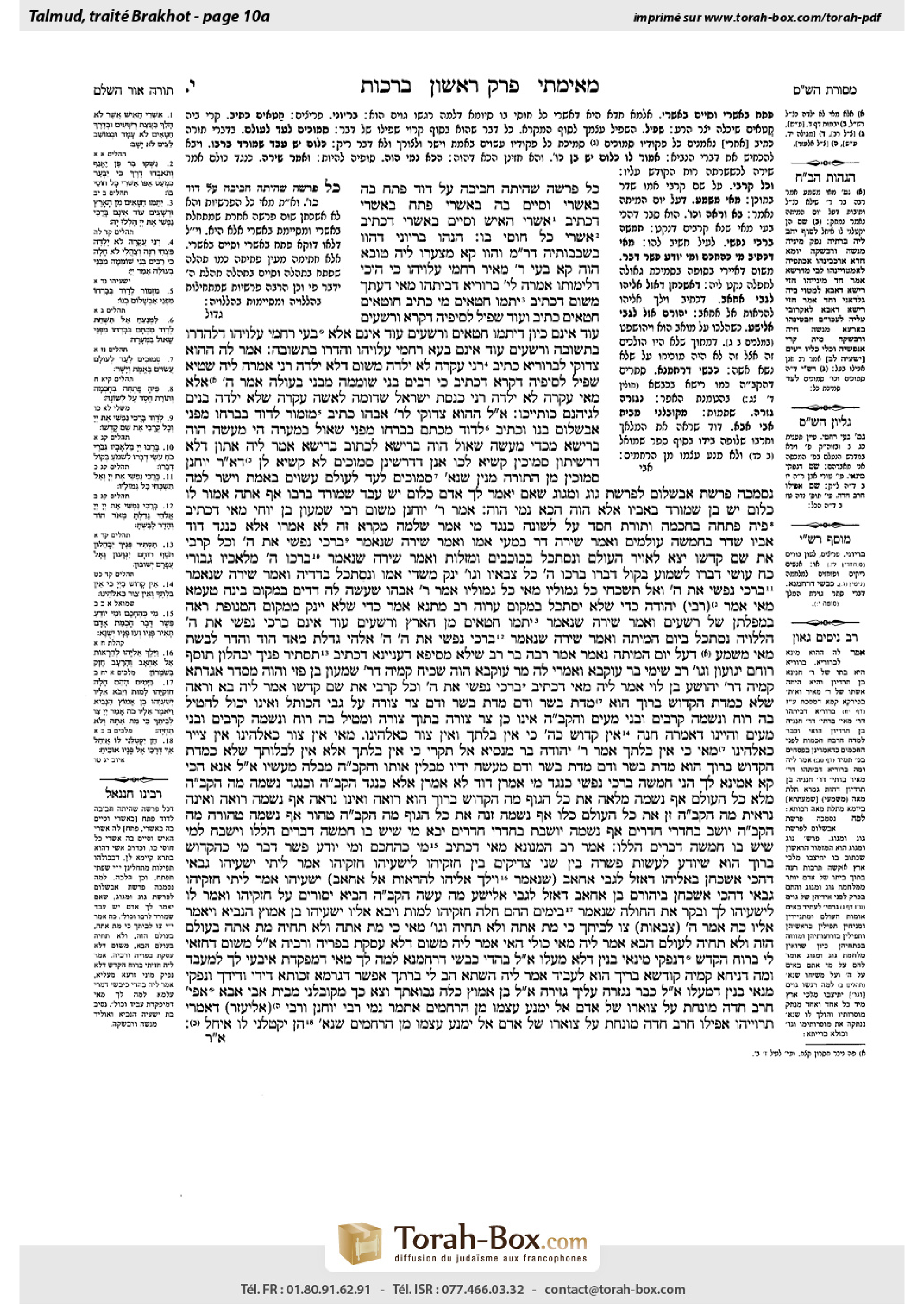
Berakhot 10a: Talmud study for Daf Yomi
Study the Talmud for Daf Yomi with scanned pages, Hebrew text, English translations from Sefaria and AI-generated French translations.
Passage selection and English or AI-generated French translation are available where the scan has annotations. Daf Study is independent of Torah-Box and Sefaria.
Browse Berakhot · ברכות · All tractatesBerakhot 10a text and translations
This page of Berakhot includes the Aramaic text, an English translation and an AI-generated French translation, alongside the scan above.
ברכות י׳ א · Aramaic and Hebrew text
כָּל פָּרָשָׁה שֶׁהָיְתָה חֲבִיבָה עַל דָּוִד, פָּתַח בָּהּ בְּ״אַשְׁרֵי״ וְסִייֵּם בָּהּ בְּ״אַשְׁרֵי״. פָּתַח בְּ״אַשְׁרֵי״, דִּכְתִיב: ״אַשְׁרֵי הָאִישׁ״. וְסִייֵּם בְּ״אַשְׁרֵי״, דִּכְתִיב: ״אַשְׁרֵי כָּל חוֹסֵי בוֹ״.
הָנְהוּ בִּרְיוֹנֵי דַּהֲווֹ בְּשִׁבָבוּתֵיהּ דְּרַבִּי מֵאִיר וַהֲווֹ קָא מְצַעֲרוּ לֵיהּ טוּבָא. הֲוָה קָא בָּעֵי רַבִּי מֵאִיר רַחֲמֵי עִלָּוַיְהוּ כִּי הֵיכִי דְּלֵימוּתוּ. אָמְרָה לֵיהּ בְּרוּרְיָא דְּבֵיתְהוּ: מַאי דַּעְתָּךְ — מִשּׁוּם דִּכְתִיב ״יִתַּמּוּ חַטָּאִים״, מִי כְּתִיב ״חוֹטְאִים״? ״חַטָּאִים״ כְּתִיב.
וְעוֹד, שְׁפֵיל לְסֵיפֵיהּ דִּקְרָא ״וּרְשָׁעִים עוֹד אֵינָם״, כֵּיוָן דְּ״יִתַּמּוּ חַטָּאִים״ ״וּרְשָׁעִים עוֹד אֵינָם״? אֶלָּא בְּעִי רַחֲמֵי עִלָּוַיְהוּ דְּלַהְדְּרוּ בִּתְשׁוּבָה, ״וּרְשָׁעִים עוֹד אֵינָם״.
בְּעָא רַחֲמֵי עִלָּוַיְהוּ, וַהֲדַרוּ בִּתְשׁוּבָה.
אֲמַר לַהּ הַהוּא מִינָא לִבְרוּרְיָא: כְּתִיב ״רָנִּי עֲקָרָה לֹא יָלָדָה״, מִשּׁוּם דְּלֹא יָלָדָה — רָנִּי?
אֲמַרָה לֵיהּ: שָׁטְיָא, שְׁפֵיל לְסֵיפֵיהּ דִּקְרָא, דִּכְתִיב: ״כִּי רַבִּים בְּנֵי שׁוֹמֵמָה מִבְּנֵי בְעוּלָה אָמַר ה׳״.
אֶלָּא מַאי ״עֲקָרָה לֹא יָלָדָה״ — רָנִּי כְּנֶסֶת יִשְׂרָאֵל שֶׁדּוֹמָה לְאִשָּׁה עֲקָרָה שֶׁלֹּא יָלְדָה בָּנִים לְגֵיהִנָּם כְּוָתַיְיכוּ.
אֲמַר לֵיהּ הָהוּא מִינָא לְרַבִּי אֲבָהוּ, כְּתִיב: ״מִזְמוֹר לְדָוִד בְּבָרְחוֹ מִפְּנֵי אַבְשָׁלוֹם בְּנוֹ״, וּכְתִיב: ״לְדָוִד מִכְתָּם בְּבָרְחוֹ מִפְּנֵי שָׁאוּל בַּמְּעָרָה״. הֵי מַעֲשֶׂה הֲוָה בְּרֵישָׁא? מִכְּדִי מַעֲשֵׂה שָׁאוּל הֲוָה בְּרֵישָׁא, לִכְתּוֹב בְּרֵישָׁא.
אֲמַר לֵיהּ: אַתּוּן דְּלָא דָּרְשִׁיתוּן סְמוּכִין — קַשְׁיָא לְכוּ, אֲנַן דְּדָרְשִׁינַן סְמוּכִים — לָא קַשְׁיָא לַן.
דְּאָמַר רַבִּי יוֹחָנָן: סְמוּכִין מִן הַתּוֹרָה מִנַּיִן — שֶׁנֶּאֱמַר: ״סְמוּכִים לָעַד לְעוֹלָם עֲשׂוּיִם בֶּאֱמֶת וְיָשָׁר״.
לָמָּה נִסְמְכָה פָּרָשַׁת אַבְשָׁלוֹם לְפָרָשַׁת גּוֹג וּמָגוֹג — שֶׁאִם יֹאמַר לְךָ אָדָם: כְּלוּם יֵשׁ עֶבֶד שֶׁמּוֹרֵד בְּרַבּוֹ?! אַף אַתָּה אֱמוֹר לוֹ: כְּלוּם יֵשׁ בֵּן שֶׁמּוֹרֵד בְּאָבִיו? אֶלָּא הֲוָה, הָכָא נָמֵי הֲוָה.
אָמַר רַבִּי יוֹחָנָן מִשּׁוּם רַבִּי שִׁמְעוֹן בֶּן יוֹחַי. מַאי דִּכְתִיב, ״פִּיהָ פָּתְחָה בְחָכְמָה וְתוֹרַת חֶסֶד עַל לְשׁוֹנָהּ״. כְּנֶגֶד מִי אָמַר שְׁלֹמֹה מִקְרָא זֶה? — לֹא אֲמָרוֹ אֶלָּא כְּנֶגֶד דָּוִד אָבִיו, שֶׁדָּר בַּחֲמִשָּׁה עוֹלָמִים, וְאָמַר שִׁירָה.
דָּר בִּמְעֵי אִמּוֹ וְאָמַר שִׁירָה, שֶׁנֶּאֱמַר: ״בָּרְכִי נַפְשִׁי אֶת ה׳ וְכָל קְרָבַי אֶת שֵׁם קָדְשׁוֹ״.
יָצָא לַאֲוִיר הָעוֹלָם וְנִסְתַּכֵּל בְּכוֹכָבִים וּמַזָּלוֹת וְאָמַר שִׁירָה, שֶׁנֶּאֱמַר: ״בָּרְכוּ ה׳ מַלְאָכָיו גִּבֹּרֵי כֹחַ עוֹשֵׂי דְבָרוֹ לִשְׁמֹעַ בְּקוֹל דְּבָרוֹ בָּרְכוּ ה׳ כָּל צְבָאָיו וְגוֹ׳״.
יָנַק מִשְּׁדֵי אִמּוֹ וְנִסְתַּכֵּל בְּדַדֶּיהָ וְאָמַר שִׁירָה, שֶׁנֶּאֱמַר: ״בָּרְכִי נַפְשִׁי אֶת ה׳ וְאַל תִּשְׁכְּחִי כָּל גְּמוּלָיו״.
מַאי ״כָּל גְּמוּלָיו״. אָמַר רַבִּי אֲבָהוּ: שֶׁעָשָׂה לָהּ דַּדִּים בִּמְקוֹם בִּינָה.
טַעְמָא מַאי? אָמַר רַב יְהוּדָה: כְּדֵי שֶׁלֹּא יִסְתַּכֵּל בִּמְקוֹם עֶרְוָה. רַב מַתְנָא אָמַר: כְּדֵי שֶׁלֹּא יִינַק מִמְּקוֹם הַטִּנּוֹפֶת.
רָאָה בְּמַפַּלְתָּן שֶׁל רְשָׁעִים, וְאָמַר שִׁירָה, שֶׁנֶּאֱמַר: ״יִתַּמּוּ חַטָּאִים מִן הָאָרֶץ וּרְשָׁעִים עוֹד אֵינָם בָּרְכִי נַפְשִׁי אֶת ה׳ הַלְלוּיָהּ״.
נִסְתַּכֵּל בְּיוֹם הַמִּיתָה, וְאָמַר שִׁירָה, שֶׁנֶּאֱמַר: ״בָּרְכִי נַפְשִׁי אֶת ה׳, ה׳ אֱלֹהַי גָּדַלְתָּ מְּאֹד הוֹד וְהָדָר לָבָשְׁתָּ״.
מַאי מַשְׁמַע דְּעַל יוֹם הַמִּיתָה נֶאֱמַר? אָמַר רַבָּה בַּר רַב שֵׁילָא, מִסֵּיפָא דְעִנְיָינָא, דִּכְתִיב: ״תַּסְתִּיר פָּנֶיךָ יִבָּהֵלוּן תֹּסֵף רוּחָם יִגְוָעוּן וְגוֹ׳״.
רַב שִׁימִי בַּר עוּקְבָא וְאָמְרִי לַהּ מָר עוּקְבָא, הֲוָה שְׁכִיחַ קַמֵּיהּ דְּרַבִּי שִׁמְעוֹן בֶּן פַּזִּי, וַהֲוָה מְסַדַּר אַגָּדָתָא קַמֵּיהּ דְּרַבִּי יְהוֹשֻׁעַ בֶּן לֵוִי. אֲמַר לֵיהּ: מַאי דִּכְתִיב, ״בָּרְכִי נַפְשִׁי אֶת ה׳ וְכָל קְרָבַי אֶת שֵׁם קָדְשׁוֹ״? אֲמַר לֵיהּ: בֹּא וּרְאֵה שֶׁלֹּא כְּמִדַּת הַקָּדוֹשׁ בָּרוּךְ הוּא מִדַּת בָּשָׂר וָדָם. מִדַּת בָּשָׂר וָדָם צָר צוּרָה עַל גַּבֵּי הַכּוֹתֶל, וְאֵינוֹ יָכוֹל לְהָטִיל בָּהּ רוּחַ וּנְשָׁמָה קְרָבַיִם וּבְנֵי מֵעַיִם. וְהַקָּדוֹשׁ בָּרוּךְ הוּא אֵינוֹ כֵּן, צָר צוּרָה בְּתוֹךְ צוּרָה וּמֵטִיל בָּהּ רוּחַ וּנְשָׁמָה קְרָבַיִם וּבְנֵי מֵעַיִם. וְהַיְינוּ דְּאָמְרָה חַנָּה: ״אֵין קָדוֹשׁ כַּה׳ כִּי אֵין בִּלְתֶּךָ וְאֵין צוּר כֵּאלֹהֵינוּ״.
מַאי ״אֵין צוּר כֵּאלֹהֵינוּ״ — אֵין צַיָּיר כֵּאלֹהֵינוּ.
מַאי ״כִּי אֵין בִּלְתֶּךָ״? אָמַר רַבִּי יְהוּדָה בַּר מְנַסְיָא: אַל תִּקְרֵי ״כִּי אֵין בִּלְתֶּךָ״, אֶלָּא ״אֵין לְבַלּוֹתֶךָ״. שֶׁלֹּא כְּמִדַּת הַקָּדוֹשׁ בָּרוּךְ הוּא מִדַּת בָּשָׂר וָדָם: מִדַּת בָּשָׂר וָדָם — מַעֲשֵׂה יָדָיו מְבַלִּין אוֹתוֹ, וְהַקָּדוֹשׁ בָּרוּךְ הוּא מְבַלֶּה מַעֲשָׂיו.
אֲמַר לֵיהּ, אֲנָא הָכִי קָא אָמֵינָא לָךְ: הָנֵי חֲמִשָּׁה ״בָּרְכִי נַפְשִׁי״ כְּנֶגֶד מִי אֲמָרָן דָּוִד? לֹא אֲמָרָן אֶלָּא כְּנֶגֶד הַקָּדוֹשׁ בָּרוּךְ הוּא וּכְנֶגֶד נְשָׁמָה.
מָה הַקָּדוֹשׁ בָּרוּךְ הוּא מָלֵא כָּל הָעוֹלָם — אַף נְשָׁמָה מְלֵאָה אֶת כָּל הַגּוּף. מָה הַקָּדוֹשׁ בָּרוּךְ הוּא רוֹאֶה וְאֵינוֹ נִרְאֶה — אַף נְשָׁמָה רוֹאָה וְאֵינָהּ נִרְאֵית. מָה הַקָּדוֹשׁ בָּרוּךְ הוּא זָן אֶת כָּל הָעוֹלָם כֻּלּוֹ — אַף נְשָׁמָה זָנָה אֶת כָּל הַגּוּף. מָה הַקָּדוֹשׁ בָּרוּךְ הוּא טָהוֹר — אַף נְשָׁמָה טְהוֹרָה. מָה הַקָּדוֹשׁ בָּרוּךְ הוּא יוֹשֵׁב בְּחַדְרֵי חֲדָרִים — אַף נְשָׁמָה יוֹשֶׁבֶת בְּחַדְרֵי חֲדָרִים. יָבֹא מִי שֶׁיֵּשׁ בּוֹ חֲמִשָּׁה דְבָרִים הַלָּלוּ וִישַׁבֵּחַ לְמִי שֶׁיֵּשׁ בּוֹ חֲמִשָּׁה דְבָרִים הַלָּלוּ.
אָמַר רַב הַמְנוּנָא: מַאי דִּכְתִיב ״מִי כְּהֶחָכָם וּמִי יוֹדֵעַ פֵּשֶׁר דָּבָר״ — מִי כְּהַקָּדוֹשׁ בָּרוּךְ הוּא שֶׁיּוֹדֵעַ לַעֲשׂוֹת פְּשָׁרָה בֵּין שְׁנֵי צַדִּיקִים, בֵּין חִזְקִיָּהוּ לִישַׁעְיָהוּ. חִזְקִיָּהוּ אֲמַר: לֵיתֵי יְשַׁעְיָהוּ גַּבַּאי, דְּהָכִי אַשְׁכְּחַן בְּאֵלִיָּהוּ דַּאֲזַל לְגַבֵּי אַחְאָב, שֶׁנֶּאֱמַר: ״וַיֵּלֶךְ אֵלִיָּהוּ לְהֵרָאוֹת אֶל אַחְאָב״. יְשַׁעְיָהוּ אֲמַר: לֵיתֵי חִזְקִיָּהוּ גַּבַּאי דְּהָכִי אַשְׁכְּחַן בִּיהוֹרָם בֶּן אַחְאָב דַּאֲזַל לְגַבֵּי אֱלִישָׁע.
מָה עָשָׂה הַקָּדוֹשׁ בָּרוּךְ הוּא — הֵבִיא יִסּוּרִים עַל חִזְקִיָּהוּ, וְאָמַר לוֹ לִישַׁעְיָהוּ: לֵךְ וּבַקֵּר אֶת הַחוֹלֶה. שֶׁנֶּאֱמַר: ״בַּיָּמִים הָהֵם חָלָה חִזְקִיָּהוּ לָמוּת וַיָּבֹא אֵלָיו יְשַׁעְיָהוּ בֶּן אָמוֹץ הַנָּבִיא וַיֹּאמֶר אֵלָיו כֹּה אָמַר ה׳ צְבָאוֹת צַו לְבֵיתֶךָ כִּי מֵת אַתָּה וְלֹא תִחְיֶה וְגוֹ׳״. מַאי ״כִּי מֵת אַתָּה וְלֹא תִחְיֶה״: מֵת אַתָּה — בָּעוֹלָם הַזֶּה, וְלֹא תִחְיֶה — לָעוֹלָם הַבָּא.
אֲמַר לֵיהּ: מַאי כּוּלֵּי הַאי? אֲמַר לֵיהּ: מִשּׁוּם דְּלָא עֲסַקְתְּ בִּפְרִיָּה וּרְבִיָּה. אֲמַר לֵיהּ: מִשּׁוּם דַּחֲזַאי לִי בְּרוּחַ הַקֹּדֶשׁ דְּנָפְקִי מִינַּאי בְּנִין דְּלָא מְעַלּוּ.
אֲמַר לֵיהּ: בַּהֲדֵי כַּבְשֵׁי דְרַחֲמָנָא לְמָה לָךְ? מַאי דְּמִפַּקְּדַתְּ אִיבְּעִי לָךְ לְמֶעְבַּד, וּמָה דְנִיחָא קַמֵּיהּ קוּדְשָׁא בְּרִיךְ הוּא — לַעֲבֵיד.
אֲמַר לֵיהּ: הַשְׁתָּא הַב לִי בְּרַתָּךְ, אֶפְשָׁר דְּגָרְמָא זְכוּתָא דִידִי וְדִידָךְ, וְנָפְקִי מִנַּאי בְּנִין דִּמְעַלּוּ. אֲמַר לֵיהּ: כְּבָר נִגְזְרָה עָלֶיךָ גְּזֵירָה. אֲמַר לֵיהּ: בֶּן אָמוֹץ, כַּלֵּה נְבוּאָתְךָ וָצֵא!
כָּךְ מְקּוּבְּלַנִי מִבֵּית אֲבִי אַבָּא, אֲפִילּוּ חֶרֶב חַדָּה מוּנַּחַת עַל צַוָּארוֹ שֶׁל אָדָם, אַל יִמְנַע עַצְמוֹ מִן הָרַחֲמִים.
אִתְּמַר נָמֵי, רַבִּי יוֹחָנָן וְרַבִּי אֱלִיעֶזֶר דְאָמְרִי תַּרְוַיְיהוּ: אֲפִילּוּ חֶרֶב חַדָּה מוּנַּחַת עַל צַוָּארוֹ שֶׁל אָדָם, אַל יִמְנַע עַצְמוֹ מִן הָרַחֲמִים. שֶׁנֶּאֱמַר: ״הֵן יִקְטְלֵנִי לוֹ אֲיַחֵל״.
Berakhot 10a · English translation
Every chapter that was dear to David, he began with “happy is” and concluded with “happy is.” He opened with “happy is,” as it is written: “Happy is the man who has not walked in the counsel of the wicked or stood in the way of sinners or sat in the dwelling place of the scornful” (Psalms 1:1). And he concluded with “happy,” as it is written at the end of the chapter: “Pay homage in purity, lest He be angry, and you perish on the way when His anger is kindled suddenly. Happy are those who take refuge in Him” (Psalms 2:12). We see that these two chapters actually constitute a single chapter.
With regard to the statement of Rabbi Yehuda, son of Rabbi Shimon ben Pazi, that David did not say Halleluya until he saw the downfall of the wicked, the Gemara relates: There were these hooligans in Rabbi Meir’s neighborhood who caused him a great deal of anguish. Rabbi Meir prayed for God to have mercy on them, that they should die. Rabbi Meir’s wife, Berurya, said to him: What is your thinking? On what basis do you pray for the death of these hooligans? Do you base yourself on the verse, as it is written: “Let sins cease from the land” (Psalms 104:35), which you interpret to mean that the world would be better if the wicked were destroyed? But is it written, let sinners cease?” Let sins cease, is written. One should pray for an end to their transgressions, not for the demise of the transgressors themselves.
Moreover, go to the end of the verse, where it says: “And the wicked will be no more.” If, as you suggest, transgressions shall cease refers to the demise of the evildoers, how is it possible that the wicked will be no more, i.e., that they will no longer be evil? Rather, pray for God to have mercy on them, that they should repent, as if they repent, then the wicked will be no more, as they will have repented.
Rabbi Meir saw that Berurya was correct and he prayed for God to have mercy on them, and they repented.
The Gemara relates an additional example of Berurya’s incisive insight: A certain heretic said to Berurya: It is written: “Sing, barren woman who has not given birth, open forth in song and cry, you did not travail, for more are the children of the desolate than the children of the married wife, said the Lord” (Isaiah 54:1). Because she has not given birth, she should sing and rejoice?
Berurya responded to this heretic’s mockery and said: Fool! Go to the end of the verse, where it is written: “For the children of the desolate shall be more numerous than the children of the married wife, said the Lord.”
Rather, what is the meaning of: “Sing, barren woman who has not given birth”? It means: Sing congregation of Israel, which is like a barren woman who did not give birth to children who are destined for Gehenna like you.
In explaining passages from Psalms, the Gemara relates another instance of a response to the question of a heretic: A certain heretic said to Rabbi Abbahu, it is written: “A Psalm of David, when he fled from his son, Absalom” (Psalms 3:1), and similarly it is said: “To the chief musician, al tashḥet, a mikhtam of David when fleeing from Saul into the cave” (Psalms 57:1). Which event was first? Since the event with Saul was first, it would have been appropriate to write it first.
Rabbi Abbahu said to him: For you, who do not employ the homiletic method of juxtaposition of verses, it is difficult. But for us, who employ the homiletic method of juxtaposition of verses, it is not difficult, as the Sages commonly homiletically infer laws and moral lessons from the juxtaposition of two verses.
Regarding the juxtaposition of verses, Rabbi Yoḥanan said: From where in the Bible is it derived that one may draw homiletical inferences from the juxtaposition of verses? As it is said: “The works of His hands in truth and justice, all His commandments are sure. Adjoined forever and ever, made in truth and uprightness” (Psalms 111:7–8). Conclude from here that it is appropriate to draw inferences from the juxtaposition of God’s commandments. Accordingly, David’s fleeing from Absalom is situated where it is in order to juxtapose it to the next chapter, which mentions the war of Gog and Magog; the second chapter of Psalms opens: “Why are the nations in an uproar?”
Why was the chapter of Absalom juxtaposed with the chapter of Gog and Magog? They are juxtaposed so that if a person should say to you, expressing doubt with regard to the prophecy of the war of Gog and Magog “against the Lord and against His anointed”: Is there a slave who rebels against his master? Is there someone capable of rebelling against God? You too say to him: Is there a son who rebels against his father and severs the relationship with the one who brought him into the world and raised him? Yet, nevertheless, there was such a son, Absalom, and so too there can be a situation where people will seek to rebel against God.
Rabbi Yoḥanan said explanations of other verses in the name of Rabbi Shimon ben Yoḥai: What is the meaning of that which is written: “She opens her mouth with wisdom, and the teaching of loving-kindness is on her tongue” (Proverbs 31:26)? The Sages explain that this chapter discusses the wisdom of Torah and those who engage in its study, so with reference to whom did Solomon say this verse? He said this verse about none other than his father, David, who was the clearest example of one who opens his mouth in wisdom, and who resided in five worlds or stages of life and his soul said a song of praise corresponding to each of them. Five times David said: “Bless the Lord, O my soul,” each corresponding to a different stage of life.
He resided in his mother’s womb, his first world, and said a song of praise of the pregnancy, as it is stated: “Of David. Bless the Lord, O my soul and all that is within me bless His holy name” (Psalms 103:1), in which he thanks God for creating all that is within his mother, i.e., her womb.
He emerged into the atmosphere of the world, his second world, looked upon the stars and constellations and said a song of praise of God for the entirety of creation, as it is stated: “Bless the Lord, His angels, mighty in strength, that fulfill His word, listening to the voice of His word. Bless the Lord, all His hosts, His servants, that do His will. Bless the Lord, all His works, in all places of His kingship, bless my soul, Lord” (Psalms 103:20–23). David saw the grandeur of all creation and recognized that they are mere servants, carrying out the will of their Creator (Ma’ayan HaBerakhot).
He nursed from his mother’s breast, his third world, and he looked upon her bosom and said a song of praise, as it is stated: “Bless the Lord, O my soul, and do not forget all His benefits [gemulav]” (Psalms 103:2). The etymological association is between gemulav and gemulei meḥalav, which means weaned from milk (Isaiah 28:9).
We still must understand, however, what is meant by all His benefits? What in particular is praiseworthy in what God provided, beyond merely providing for the infant? Rabbi Abbahu said: In contrast with most other animals, God placed her breasts near her heart, the place that is the source of understanding.
What is the reason that God did this? Rav Yehuda said: So that the nursing child would not look upon the place of his mother’s nakedness. Rav Mattana said: So that the child would not nurse from a place of uncleanliness.
He witnessed in both vision and reality the downfall of the wicked and he said a song of praise, as it is stated: “Let sinners cease from the earth, and let the wicked be no more. Bless the Lord, O my soul, Halleluya” (Psalms 104:35).
The fifth world was when David looked upon the day of death and said a song of praise, as it is stated: “Bless the Lord, O my soul. Lord my God, You are very great; You are clothed in glory and majesty” (Psalms 104:1); for even death is a time of transcendence for the righteous.
The connection between this final praise and the day of death is unclear. The Gemara asks: From where is it inferred that this verse was stated with regard to the day of death? Rabba bar Rav Sheila says: We can derive this from the verses at the end of the matter, where it is written: “You hide Your face, they vanish; You gather Your breath, they perish and return to the dust” (Psalms 104:29).
Other interpretations of this verse exist. The Gemara relates how Rav Shimi bar Ukva, and some say Mar Ukva, would regularly study before Rabbi Shimon ben Pazi, who was well versed in aggada and would arrange the aggada before Rabbi Yehoshua ben Levi.
Once, Rabbi Shimon ben Pazi said to him: What is the meaning of that which is written: “Bless the Lord, my soul, and all that is within me bless His Holy name”?
Rav Shimi bar Ukva said to Rabbi Shimon ben Pazi: Come and see that the attribute of the Holy One, Blessed be He, is not like the attribute of flesh and blood, as this verse praises the formation of man in his mother’s womb. The attribute of flesh and blood is such that he shapes a form on the wall for all to see, yet he cannot instill it with a spirit and soul, bowels and intestines. While the Holy One, Blessed be He, is not so, as God shapes one form within another form, a child in its mother’s womb, and instills it with spirit and soul, bowels and intestines. And this is the explanation of what Hannah said with regard to the birth of Samuel: “There is none holy like the Lord, for there is none like You, and there is no Rock like our God” (I Samuel 2:2).
What is the meaning of there is no rock [tzur] like our God? There is no artist [tzayyar] like our God.
The Gemara continues to interpret the rest of that verse homiletically: What is the meaning of “there is none like You”? Rabbi Yehuda ben Menasya said: Do not read the verse to mean “there is none like You [biltekha]”; rather, read it to mean “none can outlast You [levalotkha],” as the attribute of the Holy One, Blessed be He, is not like the attribute of flesh and blood: The attribute of flesh and blood is such that his creations outlast him, but the Holy One, Blessed be He, outlasts His actions.
This did not satisfy Rav Shimi bar Ukva, who said to Rabbi Shimon ben Pazi: I meant to say to you as follows: Corresponding to whom did David say these five instance of “Bless the Lord, O my soul”? He answered him: He said them about none other than the Holy One, Blessed be He, and corresponding to the soul, as the verse refers to the relationship between man’s soul and God. The five instances of “Bless the Lord, O my soul” correspond to the five parallels between the soul in man’s body and God’s power in His world.
Just as the Holy One, Blessed be He, fills the entire world, so too the soul fills the entire body.
Just as the Holy One, Blessed be He, sees but is not seen, so too does the soul see, but is not seen.
Just as the Holy One, Blessed be He, sustains the entire world, so too the soul sustains the entire body.
Just as the Holy One, Blessed be He, is pure, so too is the soul pure.
Just as the Holy One, Blessed be He, resides in a chamber within a chamber, in His inner sanctum, so too the soul resides in a chamber within a chamber, in the innermost recesses of the body.
Therefore, that which has these five characteristics, the soul, should come and praise He Who has these five characteristics.
With regard to redemption and prayer, the Gemara tells the story of Hezekiah’s illness, his prayer to God, and subsequent recuperation. Rav Hamnuna said: What is the meaning of that which is written praising the Holy One, Blessed be He: “Who is like the wise man, and who knows the interpretation [pesher] of the matter” (Ecclesiastes 8:1)? This verse means: Who is like the Holy One, Blessed be He, Who knows how to effect compromise [peshara] between two righteous individuals, between Hezekiah, the king of Judea, and Isaiah the prophet. They disagreed over which of them should visit the other. Hezekiah said: Let Isaiah come to me, as that is what we find with regard to Elijah the prophet, who went to Ahab, the king of Israel, as it is stated: “And Elijah went to appear to Ahab” (I Kings 18:2). This proves that it is the prophet who must seek out the king. And Isaiah said: Let Hezekiah come to me, as that is what we find with regard to Yehoram ben Ahab, king of Israel, who went to Elisha the prophet, as it is stated: “So the king of Israel, Jehosaphat and the king of Edom went down to him” (II Kings 3:12).
What did the Holy One, Blessed be He, do to effect compromise between Hezekiah and Isaiah? He brought the suffering of illness upon Hezekiah and told Isaiah: Go and visit the sick. Isaiah did as God instructed, as it is stated: “In those days Hezekiah became deathly ill, and Isaiah ben Amoz the prophet came and said to him: Thus says the Lord of Hosts: Set your house in order, for you will die and you will not live” (Isaiah 38:1). This seems redundant; what is the meaning of you will die and you will not live? This repetition means: You will die in this world, and you will not live, you will have no share, in the World-to-Come.
Hezekiah said to him: What is all of this? For what transgression am I being punished?
Isaiah said to him: Because you did not marry and engage in procreation.
Hezekiah apologized and said: I had no children because I envisaged through divine inspiration that the children that emerge from me will not be virtuous. Hezekiah meant that he had seen that his children were destined to be evil. In fact, his son Menashe sinned extensively, and he thought it preferable to have no children at all.
Isaiah said to him: Why do you involve yourself with the secrets of the Holy One, Blessed be He? That which you have been commanded, the mitzva of procreation, you are required to perform, and that which is acceptable in the eyes of the Holy One, Blessed be He, let Him perform, as He has so decided.
Hezekiah said to Isaiah: Now give me your daughter as my wife; perhaps my merit and your merit will cause virtuous children to emerge from me.
Isaiah said to him: The decree has already been decreed against you and this judgment cannot be changed.
Hezekiah said to him: Son of Amoz, cease your prophecy and leave. As long as the prophet spoke as God’s emissary, Hezekiah was obligated to listen to him. He was not, however, obligated to accept Isaiah’s personal opinion that there was no possibility for mercy and healing.
Hezekiah continued: I have received a tradition from the house of my father’s father, from King David, the founding father of the dynasty of kings of Judea: Even if a sharp sword rests upon a person’s neck, he should not prevent himself from praying for mercy. One may still hold out hope that his prayers will be answered, as was David himself when he saw the Angel of Destruction, but nonetheless prayed for mercy and his prayers were answered.
With regard to the fact that one should not despair of God’s mercy, the Gemara cites that it was also said that Rabbi Yoḥanan and Rabbi Eliezer both said: Even if a sharp sword is resting upon a person’s neck, he should not prevent himself from praying for mercy, as it is stated in the words of Job: “Though He slay me, I will trust in Him” (Job 13:15). Even though God is about to take his life, he still prays for God’s mercy.
Berakhot 10a · Traduction française (IA)
Chaque chapitre qui était cher à David, il commença par « heureux est » et conclut par « heureux est ». Il commença par « heureux est », comme il est écrit : « Heureux l'homme qui n'a pas marché dans le conseil des méchants ou ne s'est pas tenu sur le chemin des pécheurs ou ne s'est pas assis dans la demeure des dédaigneux » (Psaumes 1:1). Et il conclut par « heureux », comme il est écrit à la fin du chapitre : « Adorez en pureté, afin qu'il ne soit pas en colère, et vous ne périssez pas sur le chemin quand sa colère s'embrase soudainement. Heureux sont ceux qui se réfugient en Lui » (Psaumes 2:12). On voit ainsi que ces deux chapitres constituent en réalité un seul chapitre.
Concernant l'affirmation du Rabbi Yéhouda, fils du Rabbi Shimon ben Pazi, selon laquelle David n'a pas dit « Halleluya » jusqu'à ce qu'il ait vu la chute des méchants, la Guemara rapporte : Il y avait ces vandales dans le quartier du Rabbi Meir qui causaient lui beaucoup d'angoisse. Le Rabbi Meir pria Dieu de lui accorder miséricorde envers eux, qu'ils meurent. La femme du Rabbi Meir, Berurya, lui dit : Quel est ton raisonnement ? Sur quelle base pries-tu la mort de ces vandales ? Te bases-tu sur la verset, comme il est écrit : « Que les péchés cessent du sol » (Psaumes 104:35), que tu interprètes pour signifier que le monde serait meilleur si les méchants étaient détruits ? Mais est-il écrit : que les pécheurs cessent ? « Que les péchés cessent » est écrit. On devrait prier pour la fin de leurs transgressions, pas pour la mort des transgresseurs eux-mêmes.
De plus, va jusqu'à la fin du verset, où il dit : « Et les méchants ne seront plus ». Si, comme tu suggères, la fin des péchés signifie la mort des méchants, comment est-il possible que les méchants ne soient plus, c'est-à-dire qu'ils ne soient plus méchants ? Plutôt, prie pour que Dieu ait miséricorde envers eux, qu'ils se repentent, car si ils se repentent, alors les méchants ne seront plus, car ils auront repenti.
Le Rabbi Meir vit que Berurya avait raison et pria Dieu pour qu'Il ait miséricorde envers eux, et ils se repentirent.
La Guemara rapporte un autre exemple de l'acuité de l'intelligence de Berurya : Un certain hérétique dit à Berurya : « Il est écrit : « Chante, femme stérile qui n'a pas donné naissance, ouvre-toi en chantant et crie, tu n'as pas souffert, car les enfants de la stérile sont plus nombreux que les enfants de la femme mariée, dit l'Éternel » (Yachout 54:1). Comme elle n'a pas donné naissance, elle devrait chanter et se réjouir ? »
Berurya répondit à ce mépris de cet hérétique et dit : « Fous ! Va jusqu'à la fin du verset, où il est écrit : « Car les enfants de la stérile seront plus nombreux que les enfants de la femme mariée, dit l'Éternel. » »
Plutôt, quelle est la signification de : « Chante, femme stérile qui n'a pas donné naissance » ? Cela signifie : Chante la congrégation d'Israël, qui est comme une femme stérile qui n'a pas donné naissance à des enfants destinés à l'Enfer comme vous.
Dans l'explication des passages des Psaumes, la Guemara rapporte un autre exemple de réponse à la question d'un hérétique : Un certain hérétique dit au Rabbi Abbahu : Il est écrit : « Psaume de David, lorsqu'il fuyait de son fils, Absalom » (Psaumes 3:1), et de même il est dit : « Au chef musicien, al tashḥet, un mikhtam de David lorsqu'il fuyait de Saül dans la caverne » (Psaumes 57:1). Quel événement a eu lieu en premier ? Puisque l'événement avec Saül a eu lieu en premier, il aurait été approprié de l'écrire en premier.
Le Rabbi Abbahu dit à lui : Pour toi, qui ne utilizes pas la méthode d'interprétation par juxtaposition des versets, c'est difficile. Mais pour nous, qui utilisons la méthode d'interprétation par juxtaposition des versets, c'est facile, car les Sages infèrent souvent des lois et des leçons morales par la juxtaposition de deux versets.
Concernant la juxtaposition des versets, le Rabbi Yoḥanan dit : D'où dans la Bible est-il dérivé que l'on peut tirer des inférences homilétiques à partir de la juxtaposition des versets ? Comme il est dit : « Les œuvres de Ses mains en vérité et en justice, tous Ses commandements sont sûrs. Adjoignus pour l'éternité et l'éternité, faits en vérité et en droiture » (Psaumes 111:7–8). Concluez d'ici que c'est approprié d'inférer à partir de la juxtaposition des commandements de Dieu. Ainsi, la fuite de David d'Absalom est située là où elle est afin de juxtaposer avec le chapitre suivant, qui mentionne la guerre de Gog et de Magog ; le deuxième chapitre des Psaumes commence : « Pourquoi les nations sont-elles en tumulte ? »
Pourquoi le chapitre d'Absalom a-t-il été juxtaposé avec le chapitre de Gog et de Magog ? Ils sont juxtaposés afin que si une personne dit à vous, exprimant un doute concernant la prophétie de la guerre de Gog et de Magog « contre l'Éternel et contre Son Messie » : Y a-t-il un esclave qui rebelle contre son maître ? Y a-t-il quelqu'un capable de rebeller contre Dieu ? Vous dites à lui : Y a-t-il un fils qui rebelle contre son père et coupe le lien avec celui qui l'a amené dans le monde et l'a élevé ? Cependant, malgré cela, il y avait un tel fils, Absalom, et ainsi il peut y avoir une situation où les gens chercheront à rebeller contre Dieu.
Le Rabbi Yoḥanan dit les explications d'autres versets au nom du Rabbi Shimon ben Yoḥai : Quelle est la signification de ce qui est écrit : « Elle ouvre sa bouche avec la sagesse, et la doctrine de l'amour est sur sa langue » (Proverbes 31:26) ? Les Sages expliquent que ce chapitre parle de la sagesse de la Torah et de ceux qui s'y adonnent, donc à qui Solomon a-t-il dit cette versette ? Il a dit cette versette à personne d'autre qu'à son père, David, qui était l'exemple le plus clair de celui qui ouvre sa bouche en sagesse, et qui résidait dans cinq mondes ou étapes de vie, et son âme a dit un chant de louange correspondant à chacune d'entre elles. Cinq fois David a dit : « Béni soit l'Éternel, ô mon âme », chacun correspondant à une étape différente de la vie.
Il résidait dans son ventre, son premier monde, et a dit un chant de louange de la grossesse, comme il est dit : « De David. Béni soit l'Éternel, ô mon âme et tout ce qui est en moi bénisse Son nom saint » (Psaumes 103:1), dans lequel il remercie Dieu pour avoir créé tout ce qui est en sa mère, c'est-à-dire son ventre.
Il est sorti dans l'atmosphère du monde, son deuxième monde, a contemplé les étoiles et les constellations et a chanté une prière d'éloge à Dieu pour la création entière, comme il est dit : « Béni soit le Seigneur, Ses anges, puissants en force, qui accomplissent Son commandement, écoutant la voix de Son commandement. Béni soit le Seigneur, tous Ses armées, Ses serviteurs qui font Sa volonté. Béni soit le Seigneur, tous Ses ouvrages, dans toutes les lieux de Sa royauté, béni soit mon âme, Seigneur » (Psaumes 103:20–23). David a contemplé la grandeur de toute la création et a reconnu qu'ils sont simplement des serviteurs, exécutant la volonté de leur Créateur (Ma’ayan HaBerakhot).
Il a tétonné à son sein maternel, son troisième monde, et a contemplé son sein et a chanté une prière d'éloge, comme il est dit : « Béni soit le Seigneur, ô mon âme, et ne néglige pas tous Ses bénéfices [gemulav] » (Psaumes 103:2). L'association étymologique est entre gemulav et gemulei meḥalav, qui signifie être tété au lait (Isaïe 28:9).
Nous devons encore comprendre, cependant, ce que signifie tous Ses bénéfices ? Quel est en particulier ce qui mérite d'être loué dans ce que Dieu a fourni, au-delà de simplement fournir aux nouveau-nés ? Le Rabbi Abbahu a dit : Contrairement à la plupart des autres animaux, Dieu a placé ses seins près de son cœur, la source de l'intelligence.
Quelle est la raison pour laquelle Dieu a fait cela ? Rav Yéhuda a dit : Afin que l'enfant allaitant ne voie pas la place de la nudité de sa mère. Rav Mattana a dit : Afin que l'enfant ne tète pas d'une place d'impureté.
Il a vu à la fois dans la vision et dans la réalité la chute des méchants et a chanté une prière d'éloge, comme il est dit : « Que les pervers cessent de la terre, et que les méchants ne soient plus. Béni soit le Seigneur, ô mon âme, Halleluya » (Psaumes 104:35).
Le cinquième monde était lorsque David contemplait le jour de la mort et chantait une prière d'éloge, comme il est dit : « Béni soit le Seigneur, ô mon âme. Seigneur mon Dieu, Vous êtes très grand ; Vous êtes vêtu de splendeur et de majesté » (Psaumes 104:1) ; car même la mort est un moment de transcendence pour les justes.
La connexion entre ce dernier éloge et le jour de la mort est obscure. La Guemara pose la question : D'où infère-t-on que cette verset a été dit en référence au jour de la mort ? Rabba bar Rav Sheila dit : On peut en déduire cela à partir des versets à la fin de la matière, où il est écrit : « Vous cachez votre visage, ils disparaissent ; Vous rassemblez votre souffle, ils meurent et retournent en poussière » (Psaumes 104:29).
D'autres interprétations de ce verset existent. La Guemara rapporte que Rav Shimi bar Ukva, et certains disent Mar Ukva, étudiait régulièrement devant Rabbi Shimon ben Pazi, qui était très versé dans l'aggada et qui organisait l'aggada devant Rabbi Yéhoshua ben Levi. Un jour, Rabbi Shimon ben Pazi dit à lui : Quelle est la signification de ce qui est écrit : « Béni soit l'Éternel, mon âme, et tout ce qui est en moi bénisse Son nom saint » ? Rav Shimi bar Ukva dit à Rabbi Shimon ben Pazi : Viens voir que l'attribut de l'Éternel, béni soit-Il, n'est pas comme l'attribut de chair et de sang, car ce verset loue la formation de l'homme dans le ventre de sa mère. L'attribut de chair et de sang est tel que l'on façonne une forme sur un mur pour que tout le monde la voie, mais on ne peut lui insuffler un esprit et une âme, des entrailles et des intestins. L'Éternel, béni soit-Il, n'est pas ainsi, car Il façonne une forme à l'intérieur d'une autre forme, un enfant dans le ventre de sa mère, et lui insuffle un esprit et une âme, des entrailles et des intestins. Et c'est l'explication de ce que Hannah a dit concernant la naissance de Samuel : « Il n'y a pas de rocher comme l'Éternel, car il n'y a pas de semblable à Vous, et il n'y a pas de Rocher comme notre Dieu » (I Samuel 2:2).
Quelle est la signification de « il n'y a pas de rocher [tzur] comme notre Dieu » ? Il n'y a pas d'artiste [tzayyar] comme notre Dieu.
La Guemara continue d'interpréter le reste de ce verset de manière homélique : Quelle est la signification de « il n'y a pas de semblable à Vous » ? Rabbi Yéhuda ben Menassyah dit : Ne lis pas ce verset comme signifiant « il n'y a pas de semblable à Vous [biltekha] », mais comme signifiant « personne ne peut dépasser Vous [levalotkha] », car l'attribut de l'Éternel, béni soit-Il, n'est pas comme l'attribut de chair et de sang : L'attribut de chair et de sang est tel que ses créations dépassent lui, mais l'Éternel, béni soit-Il, dépassent Ses actions.
Cela n'a pas satisfait Rav Shimi bar Ukva, qui a dit à Rabbi Shimon ben Pazi : Je voulais te dire ceci : À qui correspondait David lorsqu'il a dit ces cinq fois « Béni soit l'Éternel, ô mon âme » ? Il lui a répondu : Il les a dit à personne d'autre que l'Éternel, béni soit-Il, et correspondant à l'âme, car le verset fait référence à la relation entre l'âme de l'homme et Dieu. Les cinq fois « Béni soit l'Éternel, ô mon âme » correspondent aux cinq parallèles entre l'âme dans le corps humain et la puissance de Dieu dans son monde.
Comme l'Éternel, béni soit-Il, remplit l'ensemble du monde, ainsi l'âme remplit l'ensemble du corps. Comme l'Éternel, béni soit-Il, voit mais n'est pas vu, ainsi l'âme voit mais n'est pas vue. Comme l'Éternel, béni soit-Il, soutient l'ensemble du monde, ainsi l'âme soutient l'ensemble du corps. Comme l'Éternel, béni soit-Il, est pur, ainsi l'âme est pure. Comme l'Éternel, béni soit-Il, habite une chambre dans une chambre, dans son sanctuaire intérieur, ainsi l'âme habite une chambre dans une chambre, dans les recoins les plus intimes du corps. Ainsi, celui qui possède ces cinq caractéristiques, l'âme, devrait venir et louer celui qui possède ces cinq caractéristiques.
En ce qui concerne la délivrance et la prière, la Guemara raconte l'histoire de la maladie de Chézékia, de sa prière devant Dieu et de sa guérison ultérieure. Rav Hamnuna dit : Quelle est la signification de la parole qui loue le Saint, le Bienheureux, « Qui est semblable au sage, et qui connaît l'interprétation [pesher] de l'affaire » (Ecclésiaste 8:1) ? Cette versette signifie : Qui est semblable au Saint, le Bienheureux, Qui sait effectuer un compromis [peshara] entre deux justes, entre Chézékia, roi de Juda, et Ésaïe le prophète. Ils s'entendaient sur la question de savoir qui devait rendre visite à l'autre. Chézékia disait : Qu'Ésaïe vienne chez moi, car c'est ce que nous trouvons concernant Elie le prophète, qui est allé trouver Achab, roi d'Israël, comme il est dit : « Et Elie alla se présenter à Achab » (I Rois 18:2). Cela prouve que c'est le prophète qui doit aller trouver le roi. Et Ésaïe disait : Que Chézékia vienne chez moi, car c'est ce que nous trouvons concernant Joram fils d'Achab, roi d'Israël, qui est allé trouver Eliseus le prophète, comme il est dit : « Et le roi d'Israël, Jéhoscaphat et le roi d'Edom descendirent vers lui » (II Rois 3:12).
Qu'avez-vous fait, le Saint, le Bienheureux, pour parvenir à un compromis entre Chézékia et Ésaïe ? Vous avez fait subir à Chézékia la souffrance de la maladie et vous avez dit à Ésaïe : Va visiter les malades. Ésaïe agit selon l'ordre de Dieu, comme il est dit : « Dans ces jours-là, Chézékia tomba malade et mourut, et Ésaïe ben Amoz, le prophète, vint à lui et lui dit : Ainsi parle l'Éternel, Seigneur des armées : Mise en ordre ta maison, car tu mourras et tu ne vivras pas » (Ésaïe 38:1). Cela semble redondant ; quelle est la signification de « tu mourras et tu ne vivras pas » ? Cette répétition signifie : tu mourras dans ce monde, et tu ne vivras pas, tu n'auras pas de part, dans le Monde à Venir.
Hachiaque dit à lui : Qu'est-ce que tout cela ? Pour quelle transgression suis-je puni ? Yéshaya dit à lui : Parce que tu n'as pas épousé et engagé dans la procréation. Hachiaque s'excusa et dit : J'avais pas d'enfants car j'avais prévu, par inspiration divine, que les enfants qui sortiraient de moi ne seraient pas vertueux. Hachiaque voulait dire qu'il avait vu que ses enfants étaient destinés à être mauvais. En effet, son fils Menashe pécha beaucoup, et il pensait qu'il était préférable d'avoir aucun enfant.
Yéshaya lui dit : Pourquoi t’occupes-tu des secrets du Saint des saints, béni soit-Il ? Ce que tu as été commandé, la Mitsva de la procréation, tu dois le faire, et ce qui est agréable aux yeux du Saint des saints, béni soit-Il, que Lui le fasse, car c’est ainsi qu’Il l’a décidé.
Hachiaque dit à Yéshaya : Donne-moi ta fille comme épouse ; peut-être que ma mérite et ta mérite feront naître des enfants vertueux de moi. Yéshaya lui dit : Le décret a déjà été prononcé contre toi et ce jugement ne peut être changé. Hachiaque dit : Fils d’Amoz, arrête ta prophétie et va-t’en. Aussi longtemps que le prophète parlait en tant qu’envoyé de Dieu, Hachiaque était tenu d’écouter. Il n’était cependant pas tenu d’accepter l’opinion personnelle d’Isaïah selon laquelle il n’y avait pas de possibilité de miséricorde et de guérison.
Hachéchâ continua : J’ai reçu une tradition de la maison de mon père paternel, du roi David, le fondateur de la dynastie des rois de Juda : Même si une épée aiguë repose sur le cou d’une personne, il ne doit pas se refuser à prier pour la miséricorde. On peut encore espérer que ses prières soient exaucées, comme David lui-même lorsqu’il vit l’Ange de la Destruction, mais il pria pour la misercorde et ses prières furent exaucées.
En ce qui concerne le fait qu’on ne doit pas désespérer de la miséricorde de Dieu, la Guemara cite que cela a aussi été dit que Rabbi Yoḥanan et Rabbi Elézer ont tous deux dit : Même si une épée aiguë repose sur le cou d’une personne, il ne doit pas se refuser à prier pour la miséricorde, car il est dit dans les paroles de Job : « Bien que Il me tue, je confierai ma confiance en Lui » (Job 13:15). Même si Dieu est sur le point de lui prendre la vie, il prie encore pour la miséricorde de Dieu.
Traduction française générée par IA à partir de l’édition anglaise de Sefaria. Vérifie toujours un passage avec le texte source.
Text from Sefaria: William Davidson Edition - Vocalized Aramaic (CC BY NC); William Davidson Edition - English (CC BY NC).