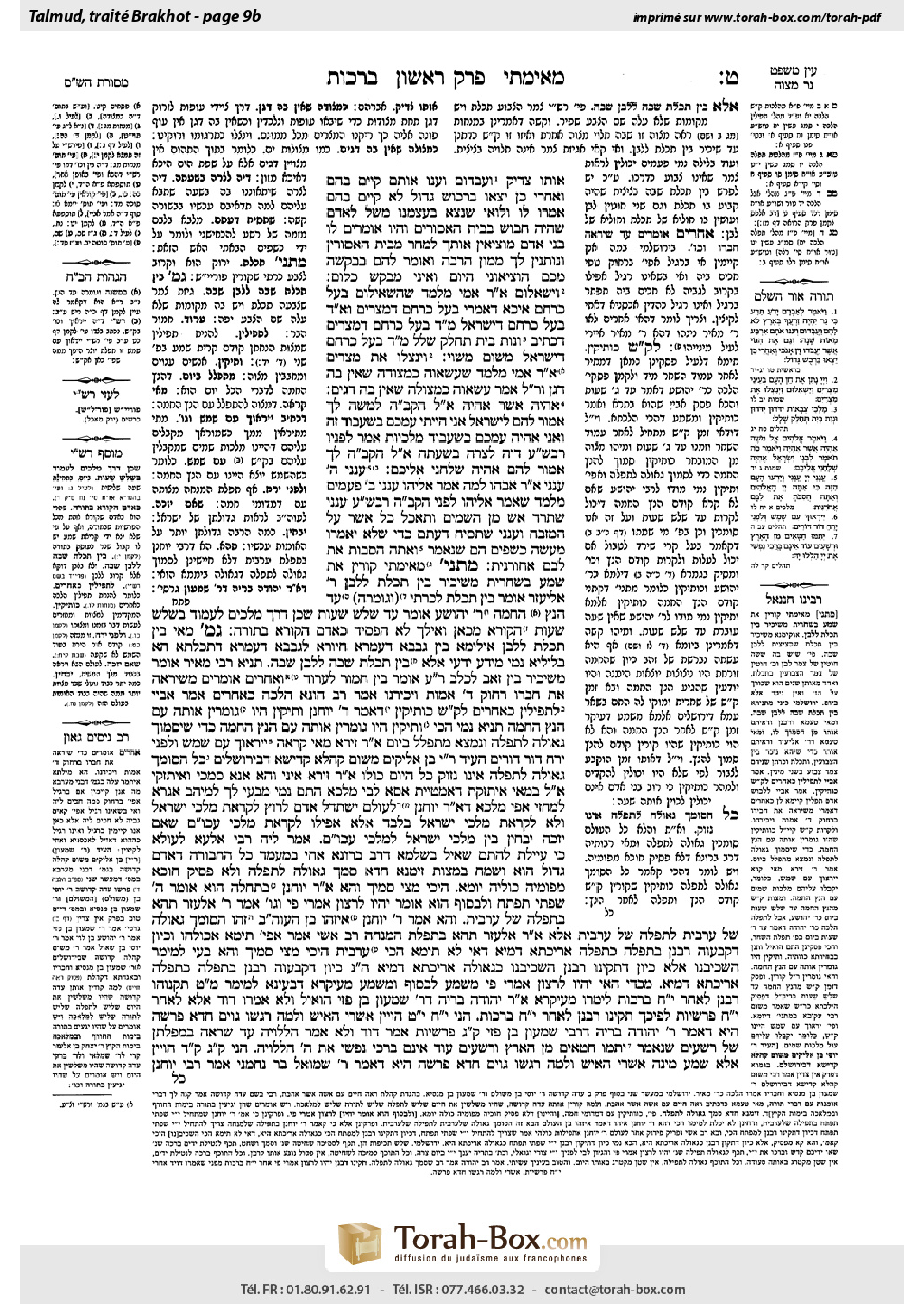
Berakhot 9b: Talmud study for Daf Yomi
Study the Talmud for Daf Yomi with scanned pages, Hebrew text, English translations from Sefaria and AI-generated French translations.
Passage selection and English or AI-generated French translation are available where the scan has annotations. Daf Study is independent of Torah-Box and Sefaria.
Browse Berakhot · ברכות · All tractatesBerakhot 9b text and translations
This page of Berakhot includes the Aramaic text, an English translation and an AI-generated French translation, alongside the scan above.
ברכות ט׳ ב · Aramaic and Hebrew text
אוֹתוֹ צַדִּיק, ״וַעֲבָדוּם וְעִנּוּ אֹתָם״ — קִייֵּם בָּהֶם, ״וְאַחֲרֵי כֵן יֵצְאוּ בִּרְכֻשׁ גָּדוֹל״ — לֹא קִייֵּם בָּהֶם.
אָמְרוּ לוֹ: וּלְוַאי שֶׁנֵּצֵא בְּעַצְמֵנוּ! מָשָׁל: לְאָדָם שֶׁהָיָה חָבוּשׁ בְּבֵית הָאֲסוּרִים וְהָיוּ אוֹמְרִים לוֹ בְּנֵי אָדָם: מוֹצִיאִין אוֹתְךָ לְמָחָר מִבֵּית הָאֲסוּרִין, וְנוֹתְנִין לְךָ מָמוֹן הַרְבֵּה, וְאוֹמֵר לָהֶם: בְּבַקָּשָׁה מִכֶּם, הוֹצִיאוּנִי הַיּוֹם, וְאֵינִי מְבַקֵּשׁ כְּלוּם.
״וַיַּשְׁאִלוּם״, אָמַר רַבִּי אַמֵּי: מְלַמֵּד שֶׁהִשְׁאִילוּם בְּעַל כָּרְחָם. אִיכָּא דְאָמְרִי בְּעַל כָּרְחָם דְּמִצְרַיִם, וְאִיכָּא דְאָמְרִי בְּעַל כָּרְחָם דְּיִשְׂרָאֵל.
מַאן דְּאָמַר בְּעַל כָּרְחָם דְּמִצְרַיִם — דִּכְתִיב: ״וּנְוַת בַּיִת תְּחַלֵּק שָׁלָל״. מַאן דְּאָמַר בְּעַל כָּרְחָם דְּיִשְׂרָאֵל — מִשּׁוּם מַשּׂוֹי.
״וַיְנַצְּלוּ אֶת מִצְרָיִם״. אָמַר רַבִּי אַמֵּי מְלַמֵּד שֶׁעֲשָׂאוּהָ כִּמְצוּדָה שֶׁאֵין בָּהּ דָּגָן, וְרֵישׁ לָקִישׁ אָמַר, עֲשָׂאוּהָ כִּמְצוּלָה שֶׁאֵין בָּהּ דָּגִים.
״אֶהְיֶה אֲשֶׁר אֶהְיֶה״, אָמַר לוֹ הַקָּדוֹשׁ בָּרוּךְ הוּא לְמֹשֶׁה, לֵךְ אֱמוֹר לָהֶם לְיִשְׂרָאֵל: אֲנִי הָיִיתִי עִמָּכֶם בְּשִׁעְבּוּד זֶה, וַאֲנִי אֶהְיֶה עִמָּכֶם בְּשִׁעְבּוּד מַלְכֻיוֹת.
אָמַר לְפָנָיו: רִבּוֹנוֹ שֶׁל עוֹלָם, דַּיָּה לַצָּרָה בִּשְׁעָתָהּ. אָמַר לוֹ הַקָּדוֹשׁ בָּרוּךְ הוּא: לֵךְ אֱמוֹר לָהֶם ״אֶהְיֶה שְׁלָחַנִי אֲלֵיכֶם״.
״עֲנֵנִי ה׳ עֲנֵנִי״. אָמַר רַבִּי אֲבָהוּ: לָמָה אָמַר אֵלִיָּהוּ עֲנֵנִי שְׁתֵּי פְּעָמִים? מְלַמֵּד שֶׁאָמַר אֵלִיָּהוּ לִפְנֵי הַקָּדוֹשׁ בָּרוּךְ הוּא: רִבּוֹנוֹ שֶׁל עוֹלָם, ״עֲנֵנִי״ — שֶׁתֵּרֵד אֵשׁ מִן הַשָּׁמַיִם וְתֹאכַל כָּל אֲשֶׁר עַל הַמִּזְבֵּחַ, וַ״עֲנֵנִי״ — שֶׁתַּסִּיחַ דַּעְתָּם, כְּדֵי שֶׁלֹּא יֹאמְרוּ מַעֲשֵׂה כְשָׁפִים הֵם. שֶׁנֶּאֱמַר: ״וְאַתָּה הֲסִבֹּתָ אֶת לִבָּם אֲחוֹרַנִּית״:
מַתְנִי׳ מֵאֵימָתַי קוֹרִין אֶת שְׁמַע בְּשַׁחֲרִית? מִשֶּׁיַּכִּיר בֵּין תְּכֵלֶת לְלָבָן. רַבִּי אֱלִיעֶזֶר אוֹמֵר: בֵּין תְּכֵלֶת לְכָרָתֵי. וְגוֹמְרָהּ, עַד הָנֵץ הַחַמָּה, רַבִּי יְהוֹשֻׁעַ אוֹמֵר עַד שָׁלֹשׁ שָׁעוֹת, שֶׁכֵּן דֶּרֶךְ מְלָכִים לַעֲמוֹד בְּשָׁלֹשׁ שָׁעוֹת.
הַקּוֹרֵא מִכָּאן וְאֵילָךְ — לֹא הִפְסִיד, כְּאָדָם הַקּוֹרֵא בַּתּוֹרָה.
גְּמָ׳ מַאי בֵּין תְּכֵלֶת לְלָבָן? אִילֵּימָא בֵּין גְּבָבָא דְעַמְרָא חִיוָּרָא לִגְבָבָא דְעַמְרָא דִתְכֵלְתָּא — הָא בְּלֵילְיָא נָמֵי מִידָּע יָדְעִי. אֶלָּא, בֵּין תְּכֵלֶת שֶׁבָּהּ לְלָבָן שֶׁבָּהּ.
תַּנְיָא: רַבִּי מֵאִיר אוֹמֵר: מִשֶּׁיַּכִּיר בֵּין זְאֵב לְכֶלֶב. רַבִּי עֲקִיבָא אוֹמֵר: בֵּין חֲמוֹר לְעָרוֹד. וַאֲחֵרִים אוֹמְרִים: מִשֶּׁיִּרְאֶה אֶת חֲבֵרוֹ רָחוֹק אַרְבַּע אַמּוֹת, וְיַכִּירֶנּוּ.
אָמַר רַב הוּנָא: הֲלָכָה כַּאֲחֵרִים. אָמַר אַבָּיֵי: לִתְפִילִּין כַּאֲחֵרִים. לִקְרִיאַת שְׁמַע כְּוָתִיקִין. דְּאָמַר רַבִּי יוֹחָנָן וָתִיקִין הָיוּ גּוֹמְרִין אוֹתָהּ עִם הָנֵץ הַחַמָּה.
תַּנְיָא נָמֵי הָכִי: וָתִיקִין הָיוּ גּוֹמְרִין אוֹתָהּ עִם הָנֵץ הַחַמָּה, כְּדֵי שֶׁיִּסְמוֹךְ גְּאוּלָּה לִתְפִלָּה, וְנִמְצָא מִתְפַּלֵּל בַּיּוֹם.
אָמַר רַבִּי זֵירָא: מַאי קְרָאָה — ״יִירָאוּךָ עִם שָׁמֶשׁ וְלִפְנֵי יָרֵחַ דּוֹר דּוֹרִים״.
הֵעִיד רַבִּי יוֹסֵי בֶּן אֶלְיָקִים מִשּׁוּם קְהָלָא קַדִּישָׁא דְבִירוּשָׁלַיִם: כָּל הַסּוֹמֵךְ גְּאוּלָּה לִתְפִלָּה אֵינוֹ נִזּוֹק כָּל הַיּוֹם כּוּלּוֹ.
אָמַר רַבִּי זֵירָא: אִינִי?! וְהָא אֲנָא סְמַכִי וְאִיתְּזַקִי! אֲמַר לֵיהּ: בְּמַאי אִיתְּזַקְתְּ — דְּאַמְטֵיִית אָסָא לְבֵי מַלְכָּא. הָתָם נָמֵי מִבְּעֵי לָךְ לְמֵיהַב אַגְרָא לְמִחְזֵי אַפֵּי מַלְכָּא, דְּאָמַר רַבִּי יוֹחָנָן: לְעוֹלָם יִשְׁתַּדֵּל אָדָם לָרוּץ לִקְרַאת מַלְכֵי יִשְׂרָאֵל. וְלֹא לִקְרַאת מַלְכֵי יִשְׂרָאֵל בִּלְבַד, אֶלָּא אֲפִילּוּ לִקְרַאת מַלְכֵי אוּמּוֹת הָעוֹלָם, שֶׁאִם יִזְכֶּה — יַבְחִין בֵּין מַלְכֵי יִשְׂרָאֵל לְמַלְכֵי אוּמּוֹת הָעוֹלָם!
אֲמַר לֵיהּ רַבִּי אִלָּעָא לְעוּלָּא: כִּי עָיְילַתְּ לְהָתָם שְׁאֵיל בִּשְׁלָמָא דְּרַב בְּרוֹנָא אֲחִי בְּמַעֲמַד כָּל הַחֲבוּרָה, דְּאָדָם גָּדוֹל הוּא וְשָׂמֵחַ בְּמִצְוֹת. זִימְנָא חֲדָא סְמַךְ גְּאוּלָּה לִתְפִלָּה וְלָא פְּסֵיק חוּכָא מִפּוּמֵּיהּ כּוּלֵּיהּ יוֹמָא.
הֵיכִי מָצֵי סָמֵיךְ? וְהָא אָמַר רַבִּי יוֹחָנָן: בַּתְּחִלָּה הוּא אוֹמֵר: ״ה׳ שְׂפָתַי תִּפְתָּח״, וּלְבַסּוֹף הוּא אוֹמֵר: ״יִהְיוּ לְרָצוֹן אִמְרֵי פִי וְגוֹ׳״!
אָמַר רַבִּי אֶלְעָזָר: תְּהֵא בִּתְפִלָּה שֶׁל עַרְבִית.
וְהָא אָמַר רַבִּי יוֹחָנָן: אֵיזֶהוּ בֶּן הָעוֹלָם הַבָּא — זֶהוּ הַסּוֹמֵךְ גְּאוּלָּה שֶׁל עַרְבִית לִתְפִלָּה שֶׁל עַרְבִית!
אֶלָּא אָמַר רַבִּי אֶלְעָזָר: תְּהֵא בִּתְפִלַּת הַמִּנְחָה.
רַב אָשֵׁי אָמַר: אֲפִילּוּ תֵּימָא אַכּוּלְּהוּ, וְכֵיוָן דְּקַבְעוּהָ רַבָּנַן בִּתְפִלָּה — כִּתְפִלָּה אֲרִיכְתָּא דָּמְיָא.
דְּאִי לָא תֵּימָא הָכִי, עַרְבִית הֵיכִי מָצֵי סָמֵיךְ, וְהָא בָּעֵי לְמֵימַר ״הַשְׁכִּיבֵנוּ״! אֶלָּא כֵּיוָן דְּתַקִּינוּ רַבָּנַן הַשְׁכִּיבֵנוּ — כִּגְאוּלָּה אֲרִיכְתָּא דָּמְיָא. הָכִי נָמֵי כֵּיוָן דְּקַבְעוּהָ רַבָּנַן בִּתְפִלָּה — כִּתְפִלָּה אֲרִיכְתָּא דָּמְיָא.
מִכְּדֵי, הַאי ״יִהְיוּ לְרָצוֹן אִמְרֵי פִי״ מַשְׁמַע לִבְסוֹף, וּמַשְׁמַע מֵעִיקָּרָא דְּבָעֵינָא לְמֵימַר. מַאי טַעְמָא תַּקְּנוּהוּ רַבָּנַן לְאַחַר שְׁמוֹנֶה עֶשְׂרֵה בְּרָכוֹת? לֵימְרוּ מֵעִיקָּרָא!
אָמַר רַבִּי יְהוּדָה בְּרֵיהּ דְּרַבִּי שִׁמְעוֹן בֶּן פַּזִּי: הוֹאִיל וְלֹא אֲמָרוֹ דָּוִד אֶלָּא לְאַחַר שְׁמוֹנֶה עֶשְׂרֵה פָּרָשִׁיּוֹת, לְפִיכָךְ תַּקִּינוּ רַבָּנַן לְאַחַר שְׁמוֹנֶה עֶשְׂרֵה בְּרָכוֹת.
הָנֵי שְׁמוֹנֶה עֶשְׂרֵה?! תְּשַׁע עֶשְׂרֵה הָוְיָן!
״אַשְׁרֵי הָאִישׁ״ וְ״לָמָּה רָגְשׁוּ גוֹיִם״ חֲדָא פָּרָשָׁה הִיא.
דְּאָמַר רַבִּי יְהוּדָה בְּרֵיהּ דְּרַבִּי שִׁמְעוֹן בֶּן פַּזִּי: מֵאָה וְשָׁלֹשׁ פָּרָשִׁיּוֹת אָמַר דָּוִד, וְלֹא אָמַר ״הַלְלוּיָהּ״ עַד שֶׁרָאָה בְּמַפַּלְתָּן שֶׁל רְשָׁעִים, שֶׁנֶּאֱמַר: ״יִתַּמּוּ חַטָּאִים מִן הָאָרֶץ וּרְשָׁעִים עוֹד אֵינָם, בָּרְכִי נַפְשִׁי אֶת ה׳ הַלְלוּיָהּ״.
הָנֵי מֵאָה וְשָׁלֹשׁ? מֵאָה וְאַרְבַּע הָוְיָין! אֶלָּא שְׁמַע מִינַּהּ ״אַשְׁרֵי הָאִישׁ״ וְ״לָמָּה רָגְשׁוּ גוֹיִם״ חֲדָא פָּרָשָׁה הִיא.
דְּאָמַר רַבִּי שְׁמוּאֵל בַּר נַחְמָנִי אָמַר רַבִּי יוֹחָנָן:
Berakhot 9b · English translation
that righteous person, Abraham, will not say: God fulfilled His pronouncement: “And they will be enslaved and afflicted,” but God did not fulfill His pronouncement: “And afterward, they will leave with great possessions.” As God said to Abraham: “Surely you shall know that your descendants will be foreigners in a land that is not theirs, and they will be enslaved and afflicted for four hundred years. And also that nation who enslaves them will I judge. And afterward, they will leave with great possessions” (Genesis 15:13–14).
The school of Rabbi Yannai continues: Israel said to Moses: If only we could get out ourselves. The Gemara offers a parable to one who was incarcerated in prison, and people would say to him: We promise, we will release you tomorrow and give you much money. He says to them: I beseech you, release me today and I ask for nothing. So too, Israel preferred leaving immediately empty handed rather than leaving later with great riches.
With regard to the spoils taken from Egypt described in the verse: “And the Lord gave the nation grace in the eyes of Egypt, and they gave them what they requested and they emptied Egypt” (Exodus 12:36), Rabbi Ami said: This teaches that the Egyptians gave them what they requested against their will. There is a dispute with regard to the question: Against whose will? Some say it was given against the will of the Egyptians, and some say it was given against the will of Israel. The proponent of each position cites support for his opinion.
The one who said that it was given against the will of the Egyptians cites the verse describing Israel’s exit from Egypt, as it is written: “And she who tarries at home divides the spoils” (Psalms 68:13). That which the woman in the verse requested from her counterpart was actually spoils taken against the will of an enemy. The one who said that it was given against the will of Israel, claims that they did not want the vessels because of the burden of carrying a heavy load on a long journey.
With regard to the continuation of the verse: And they emptied Egypt, Rabbi Ami said: This indicates that they made Egypt like a trap in which there is no grain that serves as bait to attract birds. Reish Lakish said: They made Egypt like an abyss in the sea without fish.
The Gemara proceeds to discuss the promise of redemption from Egypt that God made to Moses at the burning bush. When Moses asked God what to say when Israel asks him God’s name, “and God said to Moses: ‘I will be that I will be,’ and He said: ‘Thus you will say unto the children of Israel: I will be has sent me to you’” (Exodus 3:14). The Holy One, Blessed be He, told Moses to go and tell Israel: I was with you in this enslavement, and in this redemption, and I will be with you in the enslavement of the kingdoms in the future.
Moses said before Him: Master of the Universe, it is enough for them to endure. Let the future suffering be endured at its appointed time. There is no need to mention their future enslavement. The Holy One, Blessed be He, agreed with Moses and said to him: Go and tell the children of Israel only that, “I will be has sent me to you.”
Having explained the use of the double language of “I will be that I will be,” the Gemara proceeds to explain the double language employed by Elijah on Mount Carmel: “Answer me, Lord, answer me, that this people will know that You are the Lord, God, and You have turned their hearts backward” (I Kings 18:37). Rabbi Abbahu said: Why did Elijah say answer me twice? This repetition teaches that Elijah said before the Holy One, Blessed be He: Master of the Universe, answer me that fire will descend from heaven and consume everything that is on the altar, and answer me that You will divert their mind from devising alternative explanations for what they witnessed so that they will not say that they were acts of sorcery. As it is stated that Elijah said: “And You have turned their hearts backward,” God can restore them to the proper path as well.
MISHNA: From when does one recite Shema in the morning? From when a person can distinguish between sky-blue [tekhelet] and white.
Rabbi Eliezer says: From when one can distinguish between sky-blue and leek-green.
And one must finish reciting Shema until the end of the period when you rise, i.e., sunrise, when the sun begins to shine.
Rabbi Yehoshua says: One may recite the morning Shema until three hours of the day, which this is still considered when you rise, as that is the habit of kings to rise from their sleep at three hours of the day.
While there is a set time frame for the recitation of Shema, one who recites Shema from that time onward loses nothing. Although he does not fulfill the mitzva of reciting of Shema at its appointed time, he is nevertheless considered like one who reads the Torah, and is rewarded accordingly.
GEMARA: The mishna stated that the time for the recitation of the morning Shema begins when one can distinguish between sky-blue and white. The Gemara asks: To what is between sky-blue and white referring? If you say that it means distinguishing between a pile of white wool and a pile of sky-blue wool, wouldn’t one know the difference at night, as well? Rather, it must be a reference to ritual fringes made with sky-blue strings (see Numbers 15:38) along with white strings, and one must be able to distinguish between the sky-blue strings in the ritual fringes and the white strings in the ritual fringes.
With regard to the beginning of the time for the recitation of the morning Shema, a baraita cites additional opinions not cited in the mishna.
It was taught in a baraita:
Rabbi Meir says that the day begins when one can distinguish between two similar animals, e.g., a wolf and a dog.
Rabbi Akiva provides a different sign, and says that the day begins when there is sufficient light to distinguish between a donkey and a wild donkey.
And Aḥerim say: When one can see another person, who is merely an acquaintance (Jerusalem Talmud) from a distance of four cubits and recognize him.
Rav Huna said: The halakha is in accordance with Aḥerim. Abaye said: Regarding the time from which one may don phylacteries, a mitzva incumbent only by day, the halakha is in accordance with Aḥerim. But with regard to the recitation of Shema, one should conduct himself in accordance with the custom of the vatikin, pious individuals who were scrupulous in their performance of mitzvot. As Rabbi Yoḥanan said: The vatikin would conclude the recitation of Shema with sunrise, and one should act accordingly.
It was also taught in a baraita: The vatikin would conclude the recitation of Shema with sunrise in order to juxtapose the blessing of redemption, which immediately follows the recitation of Shema, with prayer, and pray during the day.
Regarding this custom of the vatikin, Rabbi Zeira said: What verse is the source for this tradition? “They shall fear You with the sun, and before the moon for all generations” (Psalms 72:5). This verse indicates that one should express one’s awe of Heaven, they shall fear You, immediately before sunrise, with the sun.
Rabbi Yosei ben Elyakim testified in the name of the holy community in Jerusalem, a title accorded a particular group of Sages who lived there, that one who juxtaposes redemption and prayer at sunrise will incur no harm for the entire day.
Rabbi Zeira said: Is that so? Didn’t I juxtapose redemption and prayer and nevertheless I was harmed? Rabbi Yosei ben Elyakim asked Rabbi Zeira: How were you harmed? That you brought a myrtle branch to the king’s palace? The Gemara refers to Rabbi Zeira’s responsibility as one of the respected members of the community to participate in a delegation that brought a crown of myrtle as a gift to the king, a dubious honor in which Rabbi Zeira had no interest. However, there, too, you had to pay a price in order to see the face of the king, as Rabbi Yoḥanan said: One should always strive to run to greet the kings of Israel to witness them in their glory. And not only must one run to greet the kings of Israel, but even to greet the kings of the nations of the world, so that if he will be privileged to witness the redemption of Israel, he will distinguish between the kings of Israel and the kings of the nations of the world, to see how much greater the Jewish king will be and how his rule will be manifest. Therefore, it was a privilege for Rabbi Zeira that he was allowed to see the face of the king.
Rabbi El’a said to Ulla before Ulla left for Babylonia: When you go to Babylonia, ask after my brother, Rav Beruna, in the presence of the entire group, as he is a great man who rejoices in mitzvot, and it is only fitting that he should be accorded respect. The Gemara provides proof that he was indeed a great man who rejoiced in mitzvot: Once, Rav Beruna juxtaposed redemption and prayer at sunrise, as per the custom of the vatikin (Tosafot), and laughter and joy did not cease from his mouth for the entire day.
In practice, the Gemara asks: How is one able to juxtapose redemption and prayer? Didn’t Rabbi Yoḥanan say: At the beginning of prayer, one says: “Lord, open my lips, that my mouth may declare Your glory” (Psalms 51:17), and at the end of prayer one says: “May the words of my mouth and the meditation of my heart be acceptable before You, Lord, my Rock, and my Redeemer” (Psalms 19:15). If so, the first verse is an interruption between redemption and prayer.
Rabbi Elazar said: Let this verse, “Lord, open my lips,” be recited only in the evening prayer but not in the morning prayer.
The Gemara asks: Didn’t Rabbi Yoḥanan say: Who is worthy of a place in the World-to-Come? He who juxtaposes redemption of the evening prayer to the evening prayer. Therefore, this verse from Psalms should not be recited before the evening prayer either.
Rather, Rabbi Elazar said: Let this verse: “Lord, open my lips,” be recited only before the afternoon prayer.
Rav Ashi said another explanation: Even if you say that Rabbi Yoḥanan holds that “Lord, open my lips” is recited before all prayers, including the morning and the evening prayers. Since the Sages instituted this verse, it is considered as an extended prayer; it is an inseparable part of the prayers, and if redemption is juxtaposed to this verse, it is no different than if redemption was juxtaposed to prayer directly.
Rabbi Ashi supports his claim: As if you do not say so, how does one juxtapose redemption of the evening prayer to the evening prayer? Mustn’t one recite: Help us lie down [hashkivenu] after redemption? Rather, since the Sages instituted the recitation of: Help us lie down, it is considered as an extended blessing of redemption. So, too, since the Sages instituted this verse in prayer, it is considered as an extended prayer.
With regard to the verse with which the prayer concludes, the Gemara deliberates: Now, since this verse: “May the words of my mouth and the meditation of my heart be acceptable before You,” can connote the end of prayer, petitioning God that He accept the prayer that was just recited, and it can connote the beginning of the prayer that he wants to recite: May the words of my mouth which I am about to recite be acceptable before You. If so, the question arises: Why did the Sages institute that it is to be recited after the eighteen blessings that constitute the Amida? Let it be recited at the beginning of the prayer.
Rabbi Yehuda, son of Rabbi Shimon ben Pazi, said: This verse is recited after the eighteen blessings comprising the Amida because David only said this verse after eighteen chapters of Psalms (end of ch. 19). Therefore, the Sages instituted to recite it after the eighteen blessings of the Amida.
The Gemara asks: Are these eighteen psalms? They are nineteen chapters that precede that verse.
The Gemara answers: “Happy is the man,” the first chapter of Psalms, and “Why are the nations in an uproar,” the second chapter, constitute a single chapter, so the nineteen chapters are actually eighteen.
The Gemara cites proof that the first two chapters are in fact a single chapter. As Rabbi Yehuda, son of Rabbi Shimon ben Pazi, said: David said one hundred and three chapters, and he did not say Halleluya in any of them until he saw the downfall of the wicked. Only then could David say Halleluya wholeheartedly. As it is stated: “Let sinners cease from the earth, and let the wicked be no more. Bless the Lord, my soul, Halleluya” (Psalms 104:35).
Here too, the Gemara notes that the calculation appears inaccurate: Are these one hundred and three psalms? They are one hundred and four. Rather, conclude from this that “Happy is the man” and “Why are the nations in uproar” constitute a single portion.
Additional proof that these two chapters comprise a single portion is cited from what Rabbi Shmuel bar Naḥmani said that Rabbi Yoḥanan said:
Berakhot 9b · Traduction française (IA)
Ce just homme, Abraham, ne dira pas : Dieu a accompli Sa parole : « Et ils seront esclaves et opprimés », mais Dieu n’a pas accompli Sa parole : « Et ensuite, ils partiront avec de grandes richesses ». Comme Dieu a dit à Abraham : « Assurément, tu sauras que tes descendants seront étrangers dans un pays qui n’est pas le leur, et ils seront esclaves et opprimés pendant quatre cents ans. Et aussi cette nation qui les opprime, je la jugerai. Et ensuite, ils partiront avec de grandes richesses » (Genèse 15:13–14).
L’école de Rabbi Yannai continue : Israël a dit à Moïse : Si seulement nous pouvions nous échapper nous-mêmes. La Guemara propose une parabole à celui qui était en prison, et les gens disaient à lui : Nous te promettons, nous te libérerons demain et te donnerons beaucoup d’argent. Il répondait à eux : Je t’implore, libère-moi aujourd’hui et je ne demande rien. De même, Israël préférait partir immédiatement sans avoir de choses plutôt que de partir plus tard avec de grandes richesses.
Concernant les butins pris en Égypte, décrit dans la verset : « Et l’Eternel donna à la nation une grâce aux yeux d’Égypte, et ils lui donnèrent ce qu’ils demandaient et ils vidèrent Égypte » (Exode 12:36), Rabbi Ami a dit : Cela enseigne que les Égyptiens leur donnèrent ce qu’ils demandaient contre leur volonté. Il y a un débat concernant la question : contre la volonté de qui ? Certains disent que c’était contre la volonté des Égyptiens, et d’autres disent que c’était contre la volonté d’Israël. Chacun des partisans cite un soutien à son opinion.
Celui qui dit qu’il était donné contre la volonté des Égyptiens cite le verset décrivant la sortie d’Israël d’Égypte, comme il est écrit : « Et celle qui reste à la maison partage les butins » (Psaumes 68:13). Ce que la femme du verset demandait à son homologue était en réalité des butins pris contre la volonté d’un ennemi. Celui qui dit qu’il était donné contre la volonté d’Israël affirme qu’ils ne voulaient pas les objets à cause du fardeau de porter un lourd fardeau sur un long voyage.
Concernant la continuation du verset : Et ils vidèrent Égypte, Rabbi Ami a dit : Cela indique qu’ils ont fait d’Égypte un piège où il n’y a pas de grains servant de baie pour attirer les oiseaux. Reish Lakish a dit : Ils ont fait d’Égypte un abîme dans la mer sans poissons.
La Guemara continue à discuter de la promesse de la délivrance d’Égypte que Dieu a faite à Moïse au buisson brûlant. Lorsque Moïse demanda à Dieu ce qu’il devait dire lorsque Israël lui demanderait le nom de Dieu, « et Dieu dit à Moïse : « Je serai ce que je serai », et Il dit : « Ainsi tu diras aux enfants d’Israël : Je serai celui qui t’a envoyé » » (Exode 3:14). Le Saint, le Très Haut, a dit à Moïse de partir et de dire à Israël : Je suis avec vous dans cette servitude, et dans cette délivrance, et je serai avec vous dans la servitude des royaumes à l’avenir.
Moïse a dit devant Lui : Maître du Monde, cela suffit pour eux d’endurer. Que la souffrance future soit endurée à son moment convenu. Il n’est pas nécessaire de mentionner leur servitude future. Le Saint, le Très Haut, a convenu avec Moïse et lui a dit : Partez et dites aux enfants d’Israël seulement que, « Je suis celui qui t’envoie ».
Ayant expliqué l’usage de la double expression « Je serai ce que je serai », la Guemara continue à expliquer la double expression employée par Elie sur le mont Carmel : « Réponds-moi, Seigneur, réponds-moi, afin que ce peuple sache que Tu es l’Eternel, Dieu, et Tu as retourné leurs cœurs » (I Rois 18:37). Rabbi Abbahu a dit : Pourquoi Elie a-t-il dit « réponds-moi » deux fois ? Cette répétition enseigne que Elie a dit devant le Saint, le Très Haut : Maître du Monde, réponds-moi que le feu descendra du ciel et consumera tout ce qui est sur l’autel, et réponds-moi que Tu feras tourner leur esprit de façon à ce qu’ils ne trouvent pas d’explications alternatives pour ce qu’ils ont vu, de sorte qu’ils ne diront pas qu’il s’agissait d’actes de sorcellerie. Comme il est dit que Elie a dit : « Et Tu as retourné leurs cœurs », Dieu peut aussi les ramener sur le bon chemin.
MICHNA : À partir de quand un homme récite le Chéma le matin ? À partir de quand il peut distinguer entre le ciel bleu [tekhelet] et le blanc. Rabbi Eliezer dit : À partir de quand il peut distinguer entre le ciel bleu et le bleu de la ciboule. Et il faut terminer la récitation du Chéma jusqu’à la fin de la période où l’on se lève, c’est-à-dire l’aube, quand le soleil commence à briller. Rabbi Yéhoshua dit : On peut réciter le Chéma du matin jusqu’à trois heures de la journée, ce qui est encore considéré comme le moment où l’on se lève, car c’est l’habitude des rois de se lever de leur sommeil à trois heures de la journée.
Bien qu’il existe un cadre temporel fixe pour la récitation du Chéma, celui qui récite le Chéma à partir de ce moment perd rien. Bien qu’il ne remplisse pas la mitsva de réciter le Chéma à son moment convenu, il est néanmoins considéré comme celui qui lit la Torah, et il est récompensé ainsi.
GUEMARA : La mishna a dit que le moment de la récitation du Chéma du matin commence quand on peut distinguer entre le ciel bleu et le blanc. La Guemara pose la question : À quoi fait référence la distinction entre le ciel bleu et le blanc ? Si vous dites que cela signifie distinguer entre un tas de laine blanche et un tas de laine ciel bleu, ne pourrait-on pas distinguer cela aussi la nuit ? Plutôt, cela doit faire référence aux franges rituels faits avec des fils ciel bleu (voir Nombres 15:38) ainsi que des fils blancs, et il faut être capable de distinguer entre les fils ciel bleu des franges rituelles et les fils blancs des franges rituelles. Concernant le début du moment de la récitation du Chéma du matin, un baraïta cite des opinions supplémentaires non citées dans la mishna.
Il a été enseigné dans un baraïta : Rabbi Meïr dit que le jour commence quand on peut distinguer entre deux animaux semblables, par exemple un loup et un chien. Rabbi Akiva donne un autre signe et dit que le jour commence quand il y a suffisamment de lumière pour distinguer entre un âne et un âne sauvage. Et d’autres disent : Quand on peut voir une personne, qui est simplement un connaisseur (Talmud de Jérusalem), à une distance de quatre coudées et la reconnaître.
Rav Huna a dit : La halakha suit Aḥerim. Abaye a dit : Concernant le moment à partir duquel on peut porter les phylactères, une mitsva qui s'applique uniquement le jour, la halakha suit Aḥerim. Mais concernant la récitation du Chéma, on devrait s'aligner sur la coutume des vatikin, des individus pieux qui étaient rigoureux dans l'accomplissement des mitsvot. Comme Rabbi Yoḥanan a dit : Les vatikin concluaient la récitation du Chéma avec l'aube, et on devrait agir ainsi.
Il a également été enseigné dans une baraïta : Les vatikin concluaient la récitation du Chéma avec l'aube afin de juxtaposer la bénédiction de la délivrance, qui suit immédiatement la récitation du Chéma, avec la prière, et prient pendant la journée.
Concernant cette coutume des vatikin, Rabbi Zeira a dit : Quel verset est la source de cette tradition ? « Ils craignent Toi avec le soleil, et avant la lune pour toutes les générations » (Lévitique 72:5). Ce verset indique qu'on devrait exprimer sa crainte du Ciel, « ils craignent Toi », immédiatement avant l'aube, avec le soleil.
Rabbi Yosei ben Elyakim a témoigné au nom de la communauté sainte à Jérusalem, titre accordé à un groupe particulier de Sages qui y vivaient, que celui qui associe la délivrance et la prière à l’aube ne subira aucun préjudice toute la journée.
Rabbi Zeira a dit : Est-ce ainsi ? N’ai-je pas associé la délivrance et la prière et néanmoins j’ai été blessé ? Rabbi Yosei ben Elyakim a demandé à Rabbi Zeira : Comment as-tu été blessé ? Que tu aies apporté une branche de laurier au palais du roi ? La Guemara fait référence à la responsabilité de Rabbi Zeira comme membre respecté de la communauté à participer à une délégation qui apportait une couronne de laurier en tant que cadeau au roi, une honneur douteux dans lequel Rabbi Zeira n’avait aucun intérêt. Cependant, là encore, il fallait payer un prix pour voir le visage du roi, comme Rabbi Yoḥanan a dit : On devrait toujours chercher à courir pour saluer les rois d’Israël afin de les voir dans leur gloire. Et non seulement devait-on courir pour saluer les rois d’Israël, mais même pour saluer les rois des nations du monde, afin que s’il était privilégié de voir la délivrance d’Israël, il puisse distinguer entre les rois d’Israël et les rois des nations du monde, pour voir combien le roi juif est plus grand et combien son règne sera manifeste. Ainsi, c’était un privilège pour Rabbi Zeira qu’il ait été autorisé à voir le visage du roi.
Rabbi El’a a dit à Ulla avant que Ulla ne parte en Babylonie : Quand tu iras en Babylonie, demande après mon frère, Rav Beruna, devant l’ensemble du groupe, car il est un homme grand qui se réjouit des mitsvot, et il est tout à fait approprié qu’il soit honoré. La Guemara fournit une preuve que c’était bel et bien un homme grand qui se réjouissait des mitsvot : Une fois, Rav Beruna a associé la délivrance et la prière à l’aube, conformément à la coutume des vatikin (Tosafot), et le rire et la joie n’ont pas cessé de ses lèvres toute la journée.
En pratique, la Guemara pose la question : Comment peut-on juxtaposer la délivrance et la prière ? N'a-t-on pas dit que Rabbi Yoḥanan : Au début de la prière, on dit : « Seigneur, ouvre mes lèvres, afin que mes lèvres proclament ta gloire » (Psaumes 51:17), et à la fin de la prière, on dit : « Que les paroles de ma bouche et la méditation de mon cœur soient agréables devant Toi, Seigneur, mon Roch, et mon Rédempteur » (Psaumes 19:15). Si c'est ainsi, le premier verset est une interruption entre la délivrance et la prière.
Rabbi Elazar a dit : Ce verset, « Seigneur, ouvre mes lèvres », doit être récité uniquement dans la prière du soir, mais pas dans la prière du matin.
La Guemara pose la question : N'a-t-on pas dit que Rabbi Yoḥanan : Qui mérite une place dans le Monde à Venir ? Celui qui juxtapose la délivrance de la prière du soir à la prière du soir. Donc, ce verset des Psaumes ne doit pas être récité avant la prière du soir non plus.
Rabbi Elazar a dit : Ce verset, « Seigneur, ouvre mes lèvres », doit être récité uniquement avant la prière de l'après-midi.
Rav Ashi a dit une autre explication : Même si vous dites que Rabbi Yoḥanan considère que « Seigneur, ouvre mes lèvres » est récité avant toutes les prières, y compris la prière du matin et la prière du soir. Puisque les Sages ont institué ce verset, il est considéré comme une prière prolongée ; il fait partie intégrante des prières, et si la délivrance est juxtaposée à ce verset, cela ne diffère pas de la juxtaposition de la délivrance à la prière directement.
Rav Ashi soutient sa thèse en disant : Comme si vous ne disiez pas cela, comment peut-on juxtaposer la délivrance de la prière du soir à la prière du soir ? N'aurait-on pas dû dire : Aide-nous à nous allonger [hashkivenu] après la délivrance ? Plutôt, puisque les Sages ont institué la récitation de : Aide-nous à nous allonger, cela est considéré comme une bénédiction prolongée de la délivrance. De même, puisque les Sages ont institué ce verset dans la prière, il est considéré comme une prière prolongée.
Concernant le verset avec lequel la prière se termine, la Guemara discute : Maintenant, puisque ce verset : « Que les paroles de ma bouche et la méditation de mon cœur soient agréables devant Toi », peut désigner la fin de la prière, prière que Dieu accepte la prière que l'on vient de réciter, et peut désigner le début de la prière que l'on veut réciter : « Que les paroles de ma bouche que je vais réciter soient agréables devant Toi ». Si c'est ainsi, la question se pose : Pourquoi les Sages ont-ils institué que cela soit récité après les dix-huit bénédictions qui constituent l'Amida ? Que ce soit récité au début de la prière ?
Rabbi Yehuda, fils de Rabbi Shimon ben Pazi, a dit : Ce verset est récité après les dix-huit bénédictions composant l'Amida car David a dit ce verset après dix-huit chapitres des Psaumes (fin du chapitre 19). Donc, les Sages ont institué de le réciter après les dix-huit bénédictions de l'Amida.
La Guemara pose la question : Sont-ce ces dix-huit psaumes ? Ce sont dix-neuf chapitres qui précèdent ce verset.
La Guemara répond : « Heureux l’homme », premier chapitre des Psaumes, et « Pourquoi les nations s’agitent-elles », deuxième chapitre, constituent un seul chapitre, donc les dix-neuf chapitres sont en réalité dix-huit.
La Guemara cite une preuve que les deux premiers chapitres sont en effet un seul chapitre. Comme le dit Rabbi Yéhouda, fils de Rabbi Shimon ben Pazi : David a dit cent trois chapitres, et il n’a pas dit « Halleluya » dans aucun d’entre eux jusqu’à ce qu’il ait vu la chute des méchants. Ce n’est qu’alors que David a pu dire « Halleluya » avec sincérité. Comme il est dit : « Que les méchants cesseront de la terre, et que les méchants ne soient plus. Béni soit l’Éternel, mon âme, Halleluya » (Psaumes 104:35).
On note également ici que le calcul semble inexact : sont-ce cent trois psaumes ? Ce sont cent quatre. Concluez plutôt de cela que « Heureux l’homme » et « Pourquoi les nations s’agitent-elles » constituent une seule portion.
Une autre preuve que ces deux chapitres forment une seule portion est citée à partir de ce que Rabbi Shmuel bar Naḥmani a dit que Rabbi Yoḥanan avait dit :
Traduction française générée par IA à partir de l’édition anglaise de Sefaria. Vérifie toujours un passage avec le texte source.
Text from Sefaria: William Davidson Edition - Vocalized Aramaic (CC BY NC); William Davidson Edition - English (CC BY NC).