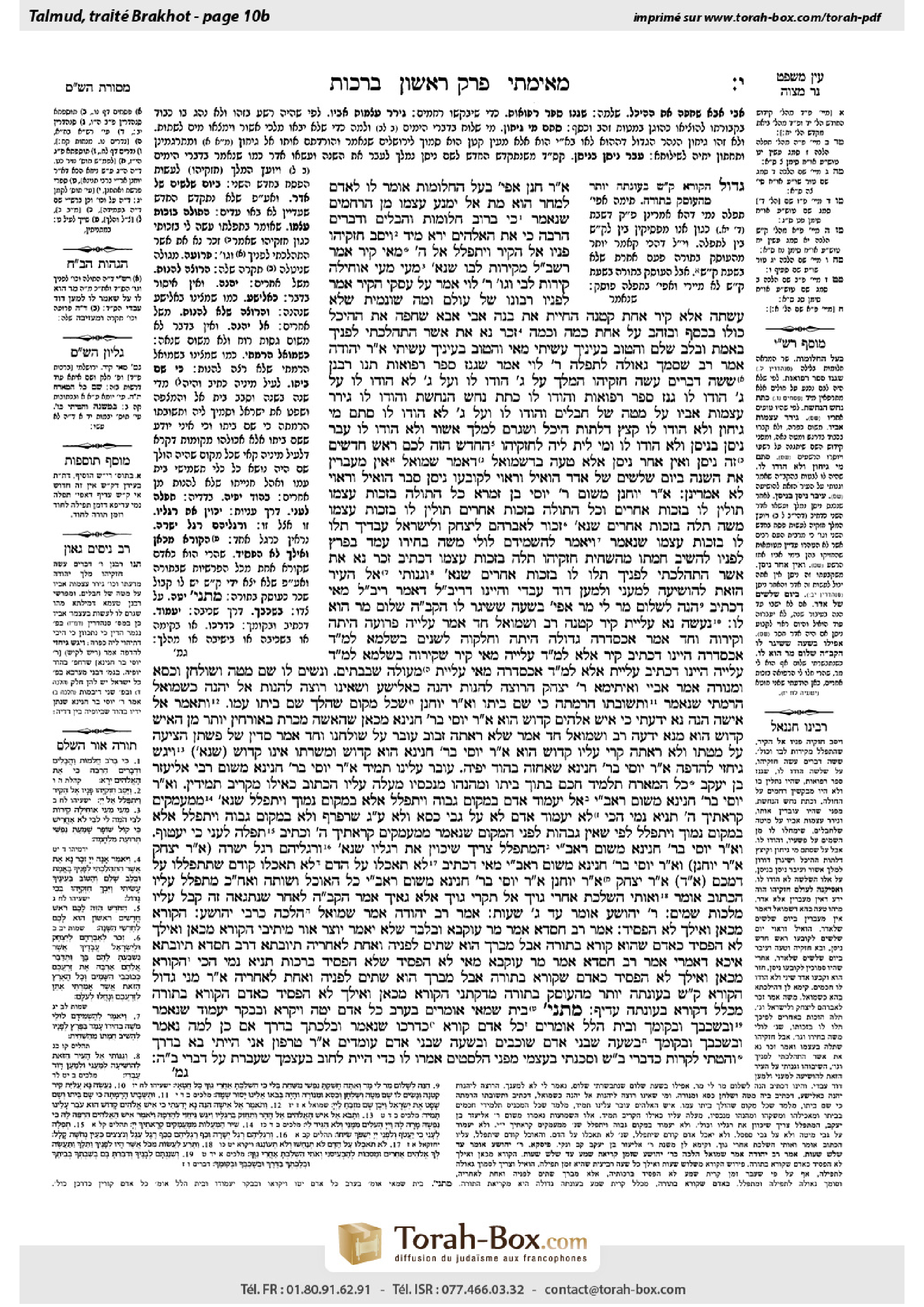
Berakhot 10b: Talmud study for Daf Yomi
Study the Talmud for Daf Yomi with scanned pages, Hebrew text, English translations from Sefaria and AI-generated French translations.
Passage selection and English or AI-generated French translation are available where the scan has annotations. Daf Study is independent of Torah-Box and Sefaria.
Browse Berakhot · ברכות · All tractatesBerakhot 10b text and translations
This page of Berakhot includes the Aramaic text, an English translation and an AI-generated French translation, alongside the scan above.
ברכות י׳ ב · Aramaic and Hebrew text
אָמַר רַבִּי חָנָן: אֲפִילּוּ בַּעַל הַחֲלוֹמוֹת אוֹמֵר לוֹ לְאָדָם לְמָחָר הוּא מֵת — אַל יִמְנַע עַצְמוֹ מִן הָרַחֲמִים. שֶׁנֶּאֱמַר: ״כִּי בְרֹב חֲלֹמוֹת וַהֲבָלִים וּדְבָרִים הַרְבֵּה כִּי אֶת הָאֱלֹהִים יְרָא״.
מִיָּד ״וַיַּסֵּב חִזְקִיָּהוּ פָּנָיו אֶל הַקִּיר וַיִּתְפַּלֵּל אֶל ה׳״.
מַאי ״קִיר״? אָמַר רַבִּי שִׁמְעוֹן בֶּן לָקִישׁ: מִקִּירוֹת לִבּוֹ, שֶׁנֶּאֱמַר: ״מֵעַי מֵעַי אוֹחִילָה קִירוֹת לִבִּי וְגוֹ׳״.
רַבִּי לֵוִי אָמַר: עַל עִסְקֵי הַקִּיר, אָמַר לְפָנָיו: רִבּוֹנוֹ שֶׁל עוֹלָם, וּמָה שׁוּנַמִּית שֶׁלֹּא עָשְׂתָה אֶלָּא קִיר אַחַת קְטַנָּה הֶחֱיֵיתָ אֶת בְּנָהּ, אֲבִי אַבָּא שֶׁחִפָּה אֶת הַהֵיכָל כּוּלּוֹ בְּכֶסֶף וּבְזָהָב עַל אַחַת כַּמָּה וְכַמָּה. ״זְכָר נָא אֵת אֲשֶׁר הִתְהַלַּכְתִּי לְפָנֶיךָ בֶּאֱמֶת וּבְלֵב שָׁלֵם וְהַטּוֹב בְּעֵינֶיךָ עָשִׂיתִי״.
מַאי ״וְהַטּוֹב בְּעֵינֶיךָ עָשִׂיתִי״? אָמַר רַב יְהוּדָה אָמַר רַב: שֶׁסָּמַךְ גְּאוּלָּה לִתְפִלָּה. רַבִּי לֵוִי אָמַר: שֶׁגָּנַז סֵפֶר רְפוּאוֹת.
תָּנוּ רַבָּנַן: שִׁשָּׁה דְבָרִים עָשָׂה חִזְקִיָּהוּ הַמֶּלֶךְ, עַל שְׁלֹשָׁה הוֹדוּ לוֹ, וְעַל שְׁלֹשָׁה לֹא הוֹדוּ לוֹ.
עַל שְׁלֹשָׁה הוֹדוּ לוֹ: גָּנַז סֵפֶר רְפוּאוֹת — וְהוֹדוּ לוֹ. כִּתֵּת נְחַשׁ הַנְּחשֶׁת — וְהוֹדוּ לוֹ. גֵּירַר עַצְמוֹת אָבִיו עַל מִטָּה שֶׁל חֲבָלִים — וְהוֹדוּ לוֹ.
וְעַל שְׁלֹשָׁה לֹא הוֹדוּ לוֹ: סָתַם מֵי גִיחוֹן — וְלֹא הוֹדוּ לוֹ. קִצֵּץ דַּלְתוֹת הֵיכָל וְשִׁגְּרָם לְמֶלֶךְ אַשּׁוּר — וְלֹא הוֹדוּ לוֹ. עִבֵּר נִיסָן בְּנִיסָן — וְלֹא הוֹדוּ לוֹ.
וּמִי לֵית לֵיהּ לְחִזְקִיָּהוּ, ״הַחֹדֶשׁ הַזֶּה לָכֶם רֹאשׁ חֳדָשִׁים״: זֶה נִיסָן וְאֵין אַחֵר נִיסָן?!
אֶלָּא, טְעָה בְּדִשְׁמוּאֵל דְּאָמַר שְׁמוּאֵל, אֵין מְעַבְּרִין אֶת הַשָּׁנָה בְּיוֹם שְׁלֹשִׁים שֶׁל אֲדָר, הוֹאִיל וְרָאוּי לְקוֹבְעוֹ נִיסָן. סָבַר: ״הוֹאִיל וְרָאוּי״ — לָא אָמְרִינַן.
אָמַר רַבִּי יוֹחָנָן מִשּׁוּם רַבִּי יוֹסֵי בֶּן זִמְרָא: כָּל הַתּוֹלֶה בִּזְכוּת עַצְמוֹ — תּוֹלִין לוֹ בִּזְכוּת אֲחֵרִים. וְכָל הַתּוֹלֶה בִּזְכוּת אֲחֵרִים — תּוֹלִין לוֹ בִּזְכוּת עַצְמוֹ.
מֹשֶׁה תָּלָה בִּזְכוּת אֲחֵרִים, שֶׁנֶּאֱמַר: ״זְכֹר לְאַבְרָהָם לְיִצְחָק וּלְיִשְׂרָאֵל עֲבָדֶיךָ״. תָּלוּ לוֹ בִּזְכוּת עַצְמוֹ, שֶׁנֶּאֱמַר: ״וַיֹּאמֶר לְהַשְׁמִידָם לוּלֵי מֹשֶׁה בְחִירוֹ עָמַד בַּפֶּרֶץ לְפָנָיו לְהָשִׁיב חֲמָתוֹ מֵהַשְׁחִית״.
חִזְקִיָּהוּ תָּלָה בִּזְכוּת עַצְמוֹ, דִּכְתִיב: ״זְכָר נָא אֵת אֲשֶׁר הִתְהַלַּכְתִּי לְפָנֶיךָ״, תָּלוּ לוֹ בִּזְכוּת אֲחֵרִים, שֶׁנֶּאֱמַר: ״וְגַנּוֹתִי אֶל הָעִיר הַזֹּאת לְהוֹשִׁיעָהּ לְמַעֲנִי וּלְמַעַן דָּוִד עַבְדִּי״. וְהַיְינוּ דְּרַבִּי יְהוֹשֻׁעַ בֶּן לֵוִי. דְּאָמַר רַבִּי יְהוֹשֻׁעַ בֶּן לֵוִי: מַאי דִּכְתִיב ״הִנֵּה לְשָׁלוֹם מָר לִי מָר״ — אֲפִילּוּ בְּשָׁעָה שֶׁשִּׁיגֵּר לוֹ הַקָּדוֹשׁ בָּרוּךְ הוּא שָׁלוֹם, מָר הוּא לוֹ.
״נַעֲשֶׂה נָא עֲלִיַּת קִיר קְטַנָּה״.
רַב וּשְׁמוּאֵל, חַד אָמַר: עֲלִיָּיה פְּרוּעָה הָיְתָה, וְקֵירוּהָ. וְחַד אָמַר: אַכְסַדְרָה גְּדוֹלָה הָיְתָה וְחִלְּקוּהָ לִשְׁנַיִם.
בִּשְׁלָמָא לְמַאן דְּאָמַר אַכְסַדְרָה, הַיְינוּ דִּכְתִיב ״קִיר״ אֶלָּא לְמַאן דְּאָמַר עֲלִיָּיה, מַאי ״קִיר״?
שֶׁקֵּירוּהָ.
בִּשְׁלָמָא לְמַאן דְּאָמַר עֲלִיָּיה, הַיְינוּ דִּכְתִיב ״עֲלִיַּית״. אֶלָּא לְמַאן דְּאָמַר אַכְסַדְרָה, מַאי ״עֲלִיַּית״?
״מְעוּלָּה״ שֶׁבַּבָּתִּים.
״וְנָשִׂים לוֹ שָׁם מִטָּה וְשֻׁלְחָן וְכִסֵּא וּמְנוֹרָה״.
אָמַר אַבָּיֵי, וְאִיתֵּימָא רַבִּי יִצְחָק: הָרוֹצֶה לֵהָנוֹת — יֵהָנֶה, כֶּאֱלִישָׁע. וְשֶׁאֵינוֹ רוֹצֶה לֵהָנוֹת — אַל יֵהָנֶה, כִּשְׁמוּאֵל הָרָמָתִי. שֶׁנֶּאֱמַר: ״וּתְשׁוּבָתוֹ הָרָמָתָה כִּי שָׁם בֵּיתוֹ״, וְאָמַר רַבִּי יוֹחָנָן: שֶׁכָּל מָקוֹם שֶׁהָלַךְ שָׁם — בֵּיתוֹ עִמּוֹ.
״וַתֹּאמֶר אֶל אִישָׁהּ הִנֵּה נָא יָדַעְתִּי כִּי אִישׁ אֱלֹהִים קָדוֹשׁ הוּא״, אָמַר רַבִּי יוֹסֵי בְּרַבִּי חֲנִינָא: מִכָּאן שֶׁהָאִשָּׁה מַכֶּרֶת בְּאוֹרְחִין יוֹתֵר מִן הָאִישׁ.
״קָדוֹשׁ הוּא״: מְנָא יָדְעָה? רַב וּשְׁמוּאֵל. חַד אָמַר: שֶׁלֹּא רָאֲתָה זְבוּב עוֹבֵר עַל שֻׁלְחָנוֹ, וְחַד אָמַר: סָדִין שֶׁל פִּשְׁתָּן הִצִּיעָה עַל מִטָּתוֹ וְלֹא רָאֲתָה קֶרִי עָלָיו.
״קָדוֹשׁ הוּא״ אָמַר רַבִּי יוֹסֵי בְּרַבִּי חֲנִינָא: הוּא קָדוֹשׁ וּמְשָׁרְתוֹ אֵינוֹ קָדוֹשׁ. שֶׁנֶּאֱמַר: ״וַיִּגַּשׁ גֵּיחֲזִי לְהָדְפָהּ״, אָמַר רַבִּי יוֹסֵי בְּרַבִּי חֲנִינָא: שֶׁאֲחָזָהּ בְּהוֹד יָפְיָהּ.
״עוֹבֵר עָלֵינוּ תָּמִיד״, אָמַר רַבִּי יוֹסֵי בְּרַבִּי חֲנִינָא מִשּׁוּם רַבִּי אֱלִיעֶזֶר בֶּן יַעֲקֹב: כָּל הַמְאָרֵחַ תַּלְמִיד חָכָם בְּתוֹךְ בֵּיתוֹ וּמְהַנֵּהוּ מִנְּכָסָיו — מַעֲלֶה עָלָיו הַכָּתוּב כְּאִילּוּ מַקְרִיב תְּמִידִין.
וְאָמַר רַבִּי יוֹסֵי בְּרַבִּי חֲנִינָא מִשּׁוּם רַבִּי אֱלִיעֶזֶר בֶּן יַעֲקֹב: אַל יַעֲמוֹד אָדָם בְּמָקוֹם גָּבוֹהַּ וְיִתְפַּלֵּל, אֶלָּא בְּמָקוֹם נָמוּךְ וְיִתְפַּלֵּל. שֶׁנֶּאֱמַר: ״מִמַּעֲמַקִּים קְרָאתִיךָ ה׳״.
תַּנְיָא נָמֵי הָכִי: לֹא יַעֲמוֹד אָדָם לֹא עַל גַּבֵּי כִּסֵּא, וְלֹא עַל גַּבֵּי שְׁרַפְרַף, וְלֹא בְּמָקוֹם גָּבוֹהַּ, וְיִתְפַּלֵּל, אֶלָּא בְּמָקוֹם נָמוּךְ, וְיִתְפַּלֵּל. לְפִי שֶׁאֵין גַּבְהוּת לִפְנֵי הַמָּקוֹם. שֶׁנֶּאֱמַר ״מִמַּעֲמַקִּים קְרָאתִיךָ ה׳״. וּכְתִיב: ״תְּפִלָּה לְעָנִי כִי יַעֲטֹף״.
וְאָמַר רַבִּי יוֹסֵי בְּרַבִּי חֲנִינָא מִשּׁוּם רַבִּי אֱלִיעֶזֶר בֶּן יַעֲקֹב: הַמִּתְפַּלֵּל צָרִיךְ שֶׁיְּכַוֵּין אֶת רַגְלָיו, שֶׁנֶּאֱמַר: ״וְרַגְלֵיהֶם רֶגֶל יְשָׁרָה״.
(אָמַר רַבִּי יִצְחָק אָמַר רַבִּי יוֹחָנָן) וְאָמַר רַבִּי יוֹסֵי בְּרַבִּי חֲנִינָא מִשּׁוּם רַבִּי אֱלִיעֶזֶר בֶּן יַעֲקֹב: מַאי דִּכְתִיב, ״לֹא תֹאכְלוּ עַל הַדָּם״ — לֹא תֹאכְלוּ קוֹדֶם שֶׁתִּתְפַּלְּלוּ עַל דִּמְכֶם.
אִיכָּא דְאָמְרִי: אָמַר רַבִּי יִצְחָק, אָמַר רַבִּי יוֹחָנָן, אָמַר רַבִּי יוֹסֵי בְּרַבִּי חֲנִינָא מִשּׁוּם רַבִּי אֱלִיעֶזֶר בֶּן יַעֲקֹב: כָּל הָאוֹכֵל וְשׁוֹתֶה, וְאַחַר כָּךְ מִתְפַּלֵּל עָלָיו הַכָּתוּב אוֹמֵר: ״וְאֹתִי הִשְׁלַכְתָּ אַחֲרֵי גַוֶּךָ״, אַל תִּקְרֵי ״גַּוֶּיךָ״ אֶלָּא ״גֵּאֶיךָ״. אָמַר הַקָּדוֹשׁ בָּרוּךְ הוּא: לְאַחַר שֶׁנִּתְגָּאָה זֶה קִבֵּל עָלָיו מַלְכוּת שָׁמַיִם.
רַבִּי יְהוֹשֻׁעַ אוֹמֵר עַד שָׁלֹשׁ שָׁעוֹת. אָמַר רַב יְהוּדָה אָמַר שְׁמוּאֵל: הֲלָכָה כְּרַבִּי יְהוֹשֻׁעַ.
הַקּוֹרֵא מִכָּאן וְאֵילָךְ, לֹא הִפְסִיד.
אָמַר רַב חִסְדָּא אָמַר מָר עוּקְבָא: וּבִלְבַד שֶׁלֹּא יֹאמַר יוֹצֵר אוֹר.
מֵיתִיבִי: הַקּוֹרֵא מִכָּאן וְאֵילָךְ לֹא הִפְסִיד, כְּאָדָם שֶׁהוּא קוֹרֵא בַּתּוֹרָה, אֲבָל מְבָרֵךְ הוּא שְׁתַּיִם לְפָנֶיהָ וְאַחַת לְאַחֲרֶיהָ. תְּיוּבְתָּא דְרַב חִסְדָּא, תְּיוּבְתָּא.
אִיכָּא דְאָמְרִי אָמַר רַב חִסְדָּא אָמַר מָר עוּקְבָא: מַאי ״לֹא הִפְסִיד״ — שֶׁלֹּא הִפְסִיד בְּרָכוֹת. תַּנְיָא נָמֵי הָכִי: הַקּוֹרֵא מִכָּאן וְאֵילָךְ לֹא הִפְסִיד כְּאָדָם שֶׁקּוֹרֵא בַּתּוֹרָה, אֲבָל מְבָרֵךְ הוּא שְׁתַּיִם לְפָנֶיהָ וְאַחַת לְאַחֲרֶיהָ.
אָמַר רַבִּי מָנִי: גָּדוֹל הַקּוֹרֵא קְרִיאַת שְׁמַע בְּעוֹנָתָהּ יוֹתֵר מֵהָעוֹסֵק בַּתּוֹרָה. מִדְּקָתָנֵי: הַקּוֹרֵא מִכָּאן וְאֵילָךְ לֹא הִפְסִיד כְּאָדָם הַקּוֹרֵא בַּתּוֹרָה. מִכְּלַל דְּקוֹרֵא בְּעוֹנָתָהּ — עָדִיף.
מַתְנִי׳ בֵּית שַׁמַּאי אוֹמְרִים: בָּעֶרֶב — כָּל אָדָם יַטֶּה וְיִקְרָא. וּבַבֹּקֶר יַעֲמוֹד, שֶׁנֶּאֱמַר: ״וּבְשָׁכְבְּךָ וּבְקוּמֶךָ״.
וּבֵית הִלֵּל אוֹמְרִים: כָּל אָדָם קוֹרֵא כְּדַרְכּוֹ. שֶׁנֶּאֱמַר ״וּבְלֶכְתְּךָ בַדֶּרֶךְ״.
אִם כֵּן לָמָּה נֶאֱמַר ״וּבְשָׁכְבְּךָ וּבְקוּמֶךָ״ — בְּשָׁעָה שֶׁבְּנֵי אָדָם שׁוֹכְבִים וּבְשָׁעָה שֶׁבְּנֵי אָדָם עוֹמְדִים.
אָמַר רַבִּי טַרְפוֹן: אֲנִי הָיִיתִי בָּא בַּדֶּרֶךְ וְהִטֵּתִי לִקְרוֹת כְּדִבְרֵי בֵּית שַׁמַּאי. וְסִכַּנְתִּי בְּעַצְמִי מִפְּנֵי הַלִּסְטִים.
אָמְרוּ לוֹ: כְּדַי הָיִיתָ לָחוּב בְּעַצְמְךָ, שֶׁעָבַרְתָּ עַל דִּבְרֵי בֵּית הִלֵּל.
Berakhot 10b · English translation
Similarly, Rabbi Ḥanan said: Even if the master of dreams, in a true dream, an angel (Ma’ayan HaBerakhot) tells a person that tomorrow he will die, he should not prevent himself from praying for mercy, as it is stated: “For in the multitude of dreams and vanities there are many words; but fear God” (Ecclesiastes 5:6). Although the dream may seem real to him, that is not necessarily the case, and one must place his trust in God.
Having heard Isaiah’s harsh prophecy, immediately “Hezekiah turned his face toward the wall and prayed to the Lord” (Isaiah 38:2).
The Gemara asks: What is meant by the word “wall [kir]” in this context? Why did Hezekiah turn his face to a wall? Rabbi Shimon ben Lakish said: This symbolically alludes to the fact that Hezekiah prayed to God from the chambers [kirot] of his heart, as it is stated elsewhere: “My anguish, my anguish, I am in pain. The chambers of my heart. My heart moans within me” (Jeremiah 4:19).
Rabbi Levi said: Hezekiah intended to evoke matters relating to a wall, and he said before God: Master of the Universe, and if the woman from Shunem, who made only a single small wall on the roof for the prophet Elisha, and you revived her son, all the more so should you bring life to the descendant of my father’s father, King Solomon, who covered the entire Temple Sanctuary with silver and gold. In his prayer, Hezekiah said: “Please, Lord, please remember that I walked before You in truth, and with a complete heart, and what was good in Your eyes I did. And Hezekiah wept sore” (Isaiah 38:3).
The Gemara asks: To what specific action was he referring when he said: “And what was good in your sight I did”? Various opinions are offered: Mentioning Hezekiah’s merits, Rav Yehuda said in the name of Rav that he juxtaposed redemption and prayer at sunrise instead of sleeping late, as was the custom of most kings (Iyyun Ya’akov). Rabbi Levi said: He suppressed the Book of Remedies upon which everyone relied.
The Sages taught: King Hezekiah performed six innovative actions. With regard to three the Sages agreed with him, and with regard to three they did not agree with him.
With regard to three actions the Sages agreed with him:
He suppressed the Book of Remedies, and they agreed with him.
He ground the copper snake through which miracles were performed for Israel (Numbers 21:9), destroying it because it had been used in idol worship (II Kings 18:4), and they agreed with him.
He dragged the bones of his evil father, King Ahaz, on a bed of ropes; meaning he did not accord his father a funeral fit for a king (II Chronicles 28:27), and they agreed with him.
Yet, with regard to three other innovations, the Sages of his generation did not agree with him:
He stopped up the waters of the Gihon, the Pool of Siloam, diverting its water into the city by means of a tunnel (II Chronicles 32:30), and they did not agree with him.
He cut off the doors of the Sanctuary and sent them to the king of Assyria (II Kings 18:16), and they did not agree with him.
He intercalated Nisan in Nisan, creating a leap year by adding an extra month during the month of Nisan. That intercalation must be performed before the end of Adar (II Chronicles 30:2).
With regard to his intercalation of Nisan, the Gemara asks: Did Hezekiah not accept the halakha: “This month will be for you the first of the months; it shall be the first for you of the months of the year” (Exodus 12:2)? By inference, this first month is Nisan, and no other month is Nisan. How could Hezekiah add an additional Nisan in violation of Torah law?
The Gemara answers that the scenario was different. Rather, Hezekiah erred with regard to the halakhic opinion ascribed in later generations to Shmuel, as Shmuel said: One may not intercalate the year on the thirtieth day of Adar, since it is fit to establish it as the New Moon of Nisan. On the thirtieth day of each month, those who witnessed the new moon would come and testify before the court, which, based on their testimony, would declare that day the first day of the next month. Therefore, one may not declare a leap year on the thirtieth day of Adar, as it could potentially become the first of Nisan. Therefore, the Sages of Hezekiah’s generation did not agree with his decision to intercalate the year on the thirtieth of Adar. Hezekiah held that we do not say: Since that day is fit to establish it as the New Moon is reason enough to refrain from intercalation of the year.
Stemming from the analysis of Hezekiah’s prayer, Rabbi Yoḥanan said in the name of Rabbi Yosei ben Zimra: Anyone who bases his prayer or request upon his own merit, when God answers his prayer, it is based upon the merit of others. And anyone who modestly bases his prayer or request upon the merit of others, when God answers his prayer, it is based upon his own merit.
The Gemara cites proof from Moses. When he prayed to God for forgiveness after the incident of the Golden Calf, he based his request upon the merit of others, as it is stated: “Remember Abraham, Isaac and Israel your servants, to whom You swore upon Yourself, and told them: I will increase your descendants like the stars of the heavens, and all of this land of which I have spoken, I will give to your descendants and they will inherit it forever” (Exodus 32:13). Yet when this story is related, God’s forgiveness of Israel is based upon Moses’ own merit, as it is stated: “And He said He would destroy them, had Moses, His chosen, not stood before Him in the breach to turn back His destructive fury, lest He should destroy them” (Psalms 106:23).
Hezekiah, however, based his request upon his own merit, as it is written: “Please, remember that I walked before You” (Isaiah 38:3). When God answered his prayers, it was based upon the merit of others with no mention made of Hezekiah’s own merit, as it is stated: “And I will protect this city to save it, for My sake and for the sake of David, My servant” (II Kings 19:34). And that is what Rabbi Yehoshua ben Levi said. As Rabbi Yehoshua ben Levi said: What is the meaning of that which is written: “Behold, for my peace I had great bitterness; but You have, in love to my soul, delivered it from the pit of corruption; for You have thrown all my sins behind Your back” (Isaiah 38:17)? This verse teaches that even when the Holy One, Blessed be He, sent him peace and told him that he would recover from his illness, it was bitter for him, because God did not take his merit into consideration.
Having mentioned the chamber on the roof built for Elisha by the woman from Shunem, the Gemara now describes the entire event. The woman from Shunem suggested to her husband: “Let us make, I pray thee, a small chamber on the roof, and let us place a bed, table, stool and candlestick for him there, and it will be, when he comes to us, that he will turn in there” (II Kings 4:10).
Rav and Shmuel argued over the meaning of small chamber. One of them said: They had an uncovered second story on their roof, over which they built a ceiling; and one of them said: There was an enclosed veranda [akhsadra] and they divided it in half.
The Gemara comments: Granted, according to the one who said that it was an enclosed veranda which they divided in two, it makes sense that the term wall [kir] was written. However, according to the one who said that they had an open second story, what is the meaning of wall?
The Gemara responds: The one who said that they had an uncovered second story interprets kir not as wall but as ceiling meaning that they built a ceiling [kirui] over it.
On the other hand, granted, according to the one who said that they had an uncovered second story, it makes sense that the term second story [aliyat] was written. But according to the one who said that it was an enclosed veranda, what is the meaning of the term second story?
The Gemara responds: The one who said that it was an enclosed veranda interprets aliyat not as second story, but as the most outstanding [me’ula] of the rooms.
Incidental to this discussion, the Gemara analyzes the statement made by the woman from Shunem to her husband with regard to the provisions that they would place in the room for Elisha: “And let us place a bed, table, stool and candlestick for him there.”
Abaye, and some say Rabbi Yitzḥak, said: A great man who seeks to enjoy the contributions of those who seek to honor him may enjoy those gifts, as Elisha enjoyed gifts given him by the woman from Shunem, among others. And one who does not seek to enjoy these gifts should not enjoy them, as was the practice of the prophet Samuel from Rama, who would not accept gifts from anyone at all. From where do we know that this was Samuel’s custom? As it is stated: “And he returned to Rama, for there was his house, and there he judged Israel, and he built an altar to the Lord” (I Samuel 7:17). And similarly, Rabbi Yoḥanan said: Every place where Samuel went, his house was with him, so he would have everything that he needed and not be forced to benefit from public contributions. One may opt to conduct himself in accordance with either of these paths.
Regarding the woman from Shunem: “And she said to her husband: Behold now, I perceive that he is a holy man of God who passes by us continually” (II Kings 4:9). Rabbi Yosei, son of Rabbi Ḥanina, said: From here, where the woman from Shunem perceived the prophet’s greatness before her husband did, derive that a woman recognizes the character of her guests more than a man does.
The Gemara notes that the woman from Shunem said that “he is holy.” The Gemara asks: From where did she know that he was holy? Rav and Shmuel disagreed over this. One of them said: She never saw a fly pass over his table; and the other said: She spread a white linen sheet on his bed, and despite that even the smallest stain is visible on white linen, and nocturnal seminal emissions are not uncommon, she never saw the residue of a seminal emission on it.
With regard to the verse: “He is holy,” Rabbi Yosei, son of Rabbi Ḥanina, said: The woman from Shunem intimated that: He is holy, but his attendant, Geihazi, is not holy, as she saw no indication of holiness in him (Iyyun Ya’akov). Here too, she correctly perceived the character of her guest, as it is later stated: “And Geihazi approached her to push her away [lehodfa]” (II Kings 4:27). And Rabbi Yosei, son of Rabbi Ḥanina, said: He grabbed her by the majesty of her beauty [hod yofya], meaning that when he pushed her he grabbed her breasts in a licentious manner.
With regard to the phrasing of the verse: “He is a holy man of God who passes by us continually,” Rabbi Yosei, son of Rabbi Ḥanina, said in the name of Rabbi Eliezer ben Ya’akov: From this verse we derive that one who hosts a Torah scholar in his home and lets him enjoy his possessions, the verse ascribes to him credit as if he is sacrificing the daily [tamid] offering, as the verse states: “Passes by us continually [tamid].”
With regard to the halakhot of prayer, Rabbi Yosei, son of Rabbi Ḥanina, said in the name of Rabbi Eliezer ben Ya’akov: A person should not stand in a high place and pray; rather, he should stand in a low place and pray, as it is stated: “I called to You, Lord, from the depths” (Psalms 130:1).
That was also taught in a baraita: One should neither stand upon a chair nor upon a stool, nor in a high place and pray. Rather, one should stand in a low place and pray, for there is no haughtiness before God. As it is stated: “I called to You, Lord, from the depths” and it is written: “A prayer for the impoverished, when he is faint and pours out his complaint before God” (Psalms 102:1). It is appropriate to feel impoverished when praying and make one’s requests humbly.
And Rabbi Yosei, son of Rabbi Ḥanina, said in the name of Rabbi Eliezer ben Ya’akov: When praying, one should align his feet next to each other, as a single foot, in order to model oneself after the angels, with regard to whom it is stated: “And their feet were a straight foot” (Ezekiel 1:7).
Rabbi Yitzḥak said that Rabbi Yoḥanan said and Rabbi Yosei, son of Rabbi Ḥanina, said in the name of Rabbi Eliezer ben Ya’akov: What is the meaning of that which is written: “You shall not eat with the blood” (Leviticus 19:26)? You may not eat before you pray for your blood. One may not eat before he prays.
Others say that Rabbi Yitzḥak said that Rabbi Yoḥanan said that Rabbi Yosei, son of Rabbi Ḥanina, said in the name of Rabbi Eliezer ben Ya’akov: One who eats and drinks and later prays, about him the verse states the rebuke of the prophet in the name of God: “And Me you have cast behind your back” (I Kings 14:9). One who sees to his own bodily needs by eating and drinking before prayer casts God aside, according his arrogance and ego priority over God (Maharsha). Indeed, do not read your back [gavekha]; rather, your pride [ge’ekha]. The Holy One, Blessed be He, said: After this one has become arrogant and engaged in satisfying his own needs, he only then accepted upon himself the kingdom of Heaven.
We learned in the mishna that Rabbi Yehoshua says: One may recite the morning Shema until three hours of the day. Rav Yehuda said that Shmuel said: The halakha is in accordance with the opinion of Rabbi Yehoshua.
We also learned in the mishna that one who recites Shema from that time onward loses nothing; although he does not fulfill the mitzva of reciting of Shema at its appointed time, he is nevertheless considered like one who reads the Torah, and is rewarded accordingly.
With regard to this ruling, Rav Ḥisda said that Mar Ukva said: This only applies provided one does not recite: Who forms light [yotzer or], or the rest of the blessings recited along with Shema, as they pertain only to the fulfillment of the mitzva of reciting of the morning Shema; after the third hour, they are inappropriate.
The Gemara raises an objection to Rav Ḥisda’s statement from a baraita: One who recites Shema from that time onward loses nothing, and is considered like one who reads Torah, but he recites two blessings beforehand and one blessing thereafter.This directly contradicts Rav Ḥisda’s statement, and the Gemara notes: Indeed, the refutation of the statement of Rav Ḥisda is a conclusive refutation, and Rav Ḥisda’s opinion is rejected in favor of that of the baraita.
Some say that Rav Ḥisda said that Mar Ukva said the opposite: What is the meaning of: Loses nothing, in the mishna? This means that one who recites Shema after the third hour does not lose the opportunity to recite the blessings and is permitted to recite them although the time for the recitation of Shema has passed. That was also taught in a baraita: One who recites Shema after this time loses nothing, and is considered like one who reads the Torah, but he recites two blessings beforehand and one thereafter.
With regard to our mishna, Rabbi Mani said: Greater is one who recites Shema at its appropriate time than one who engages in Torah study. A proof is cited based on what was taught in the mishna: One who recites Shema after this time loses nothing and is considered like one who reads the Torah. This is proven by inference, since one who recites Shema at its appointed time is greater than one who does not, and one who does not is equal to one who reads the Torah, when one recites Shema at its appointed time he fulfills two mitzvot, that of Torah study and that of the recitation of Shema.
MISHNA: Beit Shammai and Beit Hillel disputed the proper way to recite Shema. Beit Shammai say: One should recite Shema in the manner indicated in the text of Shema itself. Therefore, in the evening every person must recline on his side and recite Shema, in fulfillment of the verse: “When you lie down,” and in the morning he must stand and recite Shema, in fulfillment of the verse: When you rise, as it is stated: “When you lie down, and when you rise.”
And Beit Hillel say: Every person recites Shema as he is, and he may do so in whatever position is most comfortable for him, both day and night, as it is stated: “And when you walk along the way,” when one is neither standing nor reclining (Me’iri).
If so, according to Beit Hillel, why was it stated: “When you lie down, and when you rise”? This is merely to denote time; at the time when people lie down and the time when people rise.
With regard to this halakha, Rabbi Tarfon said: Once, I was coming on the road when I stopped and reclined to recite Shema in accordance with the statement of Beit Shammai. Although Rabbi Tarfon was a disciple of Beit Hillel, he thought that fulfilling the mitzva in accordance with the opinion of Beit Shammai would be a more meticulous fulfillment of the mitzva, acceptable to all opinions. Yet in so doing, I endangered myself due to the highwaymen [listim] who accost travelers.
The Sages said to him: You deserved to be in a position where you were liable to pay with your life, as you transgressed the statement of Beit Hillel. This statement will be explained in the Gemara.
Berakhot 10b · Traduction française (IA)
De même, le Rabbi Hanan a dit : Même si le maître des songes, dans un rêve véritable, un ange (Ma’ayan HaBerakhot) dit à une personne qu'il mourra demain, il ne devrait pas se priver de prier pour la miséricorde, car il est dit : « Car dans la multitude de rêves et de vanités, il y a beaucoup de paroles ; mais craignez Dieu » (Ecclésiaste 5:6). Bien que le rêve puisse sembler réel à ses yeux, cela n’est pas nécessairement le cas, et l’on doit placer sa confiance en Dieu.
Ayant entendu la prophétie sévère d’Isaïas, immédiatement « Hezqiahou tourna son visage vers le mur et pria le Seigneur » (Isaïas 38:2).
Le Guemara demande : Quel sens donne-t-on au mot « mur [kir] » dans ce contexte ? Pourquoi Hezqiahou a-t-il tourné son visage vers un mur ? Le Rabbi Simon ben Lakish a dit : Cela fait allusion symboliquement au fait que Hezqiahou pria Dieu depuis les chambres [kirot] de son cœur, comme il est dit ailleurs : « Mon affliction, mon affliction, je suis en douleur. Les chambres de mon cœur. Mon cœur gémit en moi » (Jérémie 4:19).
Rabbi Levi said: Hezekiah intended to evoke matters relating to a wall, and he said before God: Master of the Universe, and if the woman from Shunem, who made only a single small wall on the roof for the prophet Elisha, and you revived her son, all the more so should you bring life to the descendant of my father’s father, King Solomon, who covered the entire Temple Sanctuary with silver and gold. In his prayer, Hezekiah said: “Please, Lord, please remember that I walked before You in truth, and with a complete heart, and what was good in Your eyes I did. And Hezekiah wept sore” (Isaiah 38:3).
The Guemara asks: To what specific action was he referring when he said: “And what was good in your sight I did”? Various opinions are offered: Mentioning Hezekiah’s merits, Rav Yehuda said in the name of Rav that he juxtaposed redemption and prayer at sunrise instead of sleeping late, as was the custom of most kings (Iyyun Ya’akov). Rabbi Levi said: He suppressed the Book of Remedies upon which everyone relied.
The Sages taught: King Hezekiah performed six innovative actions. With regard to three the Sages agreed with him, and with regard to three they did not agree with him.
Concernant trois actions, les Sages étaient d’accord avec lui : Il a supprimé le Livre des Remèdes, et ils étaient d’accord avec lui. Il a écrasé le serpent de cuivre par lequel des miracles avaient été accomplis pour Israël (Nombres 21:9), le détruisant car il avait été utilisé dans l’idolâtrie (II Rois 18:4), et ils étaient d’accord avec lui. Il a fait traîner les os de son père mauvais, le roi Achaz, sur un lit de corde ; cela signifie qu’il n’a pas accordé à son père un enterrement digne d’un roi (II Chroniques 28:27), et ils étaient d’accord avec lui.
Cependant, concernant trois autres innovations, les Sages de son époque ne s’accordaient pas avec lui : Il a bouché les eaux du Gihon, le Puits de Siloam, déviant ses eaux vers la ville par le biais d’un tunnel (II Chroniques 32:30), et ils ne s’accordaient pas avec lui. Il a coupé les portes du Sanctuaire et les a envoyées au roi d’Assyrie (II Rois 18:16), et ils ne s’accordaient pas avec lui. Il a intercalé Nisan en Nisan, créant une année bissextile en ajoutant un mois supplémentaire durant le mois de Nisan. Cette intercalation doit être effectuée avant la fin d’Adar (II Chroniques 30:2).
Concernant son intercalation de Nisan, le Guemara demande : Hezqiahou n’a-t-il pas accepté la halakha : « Ce mois-là sera pour vous le premier des mois ; il sera le premier pour vous des mois de l’année » (Exode 12:2) ? Par l’inférence, ce premier mois est Nisan, et aucun autre mois n’est Nisan. Comment Hezqiahou a-t-il pu ajouter un Nisan supplémentaire en violation de la loi divine ?
Le Guemara répond que la situation était différente. Plutôt, Hezqiahou s’est trompé concernant l’opinion halakhique attribuée à Shmuel dans les générations ultérieures, car Shmuel a dit : On ne peut pas intercaler l’année le trentième jour d’Adar, car il est convenable de l’établir comme le Nouveau-Mois de Nisan. Le trentième jour de chaque mois, ceux qui ont vu la nouvelle lune viennent témoigner devant la cour, qui, basé sur leur témoignage, déclare que jour le premier jour du mois suivant. Par conséquent, on ne peut pas déclarer une année bissextile le trentième jour d’Adar, car cela pourrait potentiellement devenir le premier de Nisan. Par conséquent, les Sages de l’époque d’Hezqiahou ne s’accordaient pas avec sa décision d’intercaler l’année le trentième d’Adar. Hezqiahou pensait que nous ne disons pas : Puisque ce jour est convenable pour l’établir comme le Nouveau-Mois, c’est une raison suffisante pour ne pas intercaler l’année.
Découlant de l’analyse de la prière d’Hezqiahou, Rabbi Yoḥanan a dit en nom de Rabbi Yosei ben Zimra : Quiconque base sa prière ou sa demande sur ses propres mérites, lorsque Dieu répond à sa prière, c’est sur les mérites d’autrui. Et quiconque modestement base sa prière ou sa demande sur les mérites d’autrui, lorsque Dieu répond à sa prière, c’est sur ses propres mérites.
Le Guemara cite une preuve tirée de Moïse. Lorsqu’il pria Dieu pour l’indulgence après l’incident du bœuf d’or, il basa sa demande sur les mérites d’autrui, comme il est dit : « Souviens-toi d’Abraham, d’Isaac et d’Israël tes serviteurs, auxquels tu as fait serment toi-même, et qui t’ont dit : Je multiplierai ta descendance comme les étoiles du ciel, et toute cette terre dont je t’ai parlé, je la donnerai à ta descendance, et ils hériteront d’elle pour toujours » (Exode 32:13). Cependant, lorsqu’on rapporte cette histoire, la miséricorde de Dieu envers Israël est basée sur les mérites de Moïse, comme il est dit : « Et il dit qu’il les détruirait, si Moïse, son élu, ne s’était pas tenu devant lui dans la défaite pour tourner son courroux destructeur, de peur qu’il ne les détruisse » (Psaumes 106:23).
Hachia, cependant, s'est fondé sur sa propre mérite pour formuler sa prière, comme il est écrit : « Priez, souvenez-vous que j'ai marché devant toi » (Yachout 38:3). Lorsque Dieu a répondu à ses prières, c'était en vertu du mérite d'autrui, sans mention de son propre mérite, comme il est dit : « Et je protégerai cette ville pour la sauver, pour mon compte et pour le compte de David, mon serviteur » (Royaume des Cieux 19:34). Et c'est ce que dit le Rabbi Yéhoshua ben Levi. Comme le Rabbi Yéhoshua ben Levi a dit : Quelle est la signification de ce qui est écrit : « Regarde, pour ma paix j'ai éprouvé une grande amertume ; mais toi, dans l'amour de mon âme, tu m'as sauvé de la fosse de la corruption ; car tu as jeté tous mes péchés derrière ton dos » (Yachout 38:17) ? Cette versette enseigne que même lorsque le Saint, béni soit-il, lui a envoyé la paix et lui a dit qu'il allait guérir de sa maladie, cela lui a semblé amer, car Dieu n'avait pas pris son mérite en compte.
Ayant mentionné la chambre sur le toit construite pour Elie par la femme de Shunem, la Guemara décrit maintenant l'ensemble de l'événement. La femme de Shunem a dit à son mari : « Faisons, je t'implore, une petite chambre sur le toit, et mettons un lit, une table, un siège et une lampe pour lui là-bas, et cela sera, lorsqu'il viendra chez nous, qu'il se reposer là » (Royaume des Cieux 4:10).
Rav et Shmuel ont débattu sur la signification de la petite chambre. L'un d'eux a dit : Ils avaient un étage supérieur découvert sur leur toit, sur lequel ils avaient construit un plafond ; et l'autre a dit : Il y avait une véranda [akhsadra] et ils l'avaient divisée en deux.
La Guemara commente : D'accord, selon celui qui a dit qu'il s'agissait d'une véranda close que l'on avait divisée en deux, cela a un sens, car le terme « mur [kir] » a été écrit. Cependant, selon celui qui a dit qu'il s'agissait d'un étage supérieur découvert, quelle est la signification du terme « mur » ?
La Guemara répond : Celui qui a dit qu'il s'agissait d'un étage supérieur découvert interprète « kir » non pas comme un mur, mais comme un plafond, c'est-à-dire qu'ils avaient construit un plafond [kirui] sur ce toit.
D'un autre côté, d'accord, selon celui qui a dit qu'il s'agissait d'un étage supérieur découvert, cela a un sens, car le terme « étage supérieur [aliyat] » a été écrit. Mais selon celui qui a dit qu'il s'agissait d'une véranda close, quelle est la signification du terme « étage supérieur » ?
La Guemara répond : Celui qui a dit qu'il s'agissait d'une véranda close interprète « aliyat » non pas comme un étage supérieur, mais comme le plus remarquable [me’ula] des pièces.
Incidental à cette discussion, la Guemara analyse l'affirmation faite par la femme de Shunem à son mari concernant les provisions qu'ils placeraient dans la pièce pour Elie : « Et mettons un lit, une table, un siège et une lampe pour lui là. »
Abaye, et certains disent Rabbi Yitzhak, a dit : Un grand homme qui cherche à profiter des contributions de ceux qui le honorent peut profiter de ces dons, comme Elie a profité des dons faits à lui par la femme de Shunem, parmi d'autres. Et celui qui ne cherche pas à profiter de ces dons ne devrait pas en profiter, comme c'était la pratique du prophète Samuel de Rama, qui ne recevait aucun don de personne. D'où savons-nous que c'était la coutume de Samuel ? Comme il est dit : « Et il est retourné à Rama, car c'était sa maison, et là il a jugé Israël, et il a construit un autel au Seigneur » (I Samuel 7:17). De même, Rabbi Yoḥanan a dit : Partout où Samuel allait, sa maison était avec lui, donc il avait tout ce dont il avait besoin et ne devait pas se servir des contributions publiques. On peut opter pour se conduire selon l'une ou l'autre de ces voies.
Concernant la femme de Shunem : « Et elle dit à son mari : Regarde maintenant, je perçois qu'il est un homme saint de Dieu qui passe continuellement devant nous » (Rois 2 4:9). Rabbi Yosei, fils de Rabbi Ḥanina, a dit : D'où l'on déduit que la femme de Shunem percevait la grandeur du prophète avant son mari, on déduit que la femme reconnaît le caractère de ses invités plus qu'un homme ne le fait.
La Guemara note que la femme de Shunem a dit que « il est saint ». La Guemara demande : D'où savait-elle qu'il était saint ? Rav et Shmuel ont eu un désaccord à ce sujet. L'un d'eux a dit : Elle n'avait jamais vu un moucheron passer sur sa table ; et l'autre a dit : Elle avait étendu un linge blanc sur son lit, et malgré cela, même la plus petite tache est visible sur un linge blanc, et les émissions nocturnes de semence ne sont pas rares, elle n'avait jamais vu la trace d'une émission de semence sur ce linge.
Concernant la versette : « Il est saint », Rabbi Yosei, fils de Rabbi Ḥanina, a dit : La femme de Shunem a suggéré que : Il est saint, mais son serviteur, Geihazi, n'est pas saint, car elle n'avait pas vu de signe de sainteté en lui (Iyyun Ya’akov). Ici aussi, elle a correctement perçu le caractère de son hôte, comme il est dit plus tard : « Et Geihazi s'est approché d'elle pour la pousser [lehodfa] » (Rois 2 4:27). Et Rabbi Yosei, fils de Rabbi Ḥanina, a dit : Il l'a saisie par la majesté de sa beauté [hod yofya], c'est-à-dire qu'en la poussant, il a saisi ses seins de manière licencieuse.
Concernant la formulation de la versette : « Il est un homme saint de Dieu qui passe continuellement devant nous », Rabbi Yosei, fils de Rabbi Ḥanina, a dit en nom de Rabbi Eliezer ben Ya'akov : De cette versette, on déduit que celui qui accueille un savant de la Torah chez lui et lui permet d'apprécier ses biens, la versette lui attribue un mérite comme s'il sacrifiait l'offrande quotidienne [tamid], comme la versette le dit : « passe continuellement devant nous [tamid] ».
Concernant les halakhot de la prière, Rabbi Yosei, fils de Rabbi Ḥanina, a dit en nom de Rabbi Eliezer ben Ya'akov : Une personne ne devrait pas prier d'un lieu élevé, mais plutôt d'un lieu bas, comme il est dit : « J'ai invoqué le Seigneur, des profondeurs » (Psaumes 130:1).
Cela a également été enseigné dans une baraïta : On ne doit ni se tenir sur une chaise, ni sur un tabouret, ni sur un lieu élevé pour prier. Plutôt, on doit se tenir sur un lieu bas et prier, car il n'y a pas d'arrogance devant Dieu. Comme il est dit : « Je t'ai invoqué, Seigneur, des profondeurs » et il est écrit : « Une prière du pauvre, lorsqu'il est épuisé et verse ses larmes devant Dieu » (Psaumes 102:1). Il est approprié de se sentir pauvre lors de la prière et de formuler ses demandes humblement.
Et Rabbi Yosei, fils de Rabbi Ḥanina, a dit en nom de Rabbi Eliezer ben Ya’akov : Lors de la prière, on doit aligner ses pieds l'un à côté de l'autre, comme un seul pied, afin de s'identifier aux anges, dont il est dit : « Et leurs pieds étaient un seul pied » (Ezéchiel 1:7).
Rabbi Yitzḥak a dit que Rabbi Yoḥanan a dit et Rabbi Yosei, fils de Rabbi Ḥanina, a dit en nom de Rabbi Eliezer ben Ya’akov : Quelle est la signification de ce qui est écrit : « Tu ne mangeras pas avec le sang » (Lévitique 19:26) ? Tu ne dois pas manger avant d'avoir prié pour ton sang. On ne doit pas manger avant de prier.
D'autres disent que Rabbi Yitzḥak a dit que Rabbi Yoḥanan a dit que Rabbi Yosei, fils de Rabbi Ḥanina, a dit en nom de Rabbi Eliezer ben Ya'akov : Celui qui mange et boit et prie ensuite, à son sujet la parole du prophète dit en nom de Dieu : « Et toi, tu as mis derrière ton dos » (I Rois 14:9). Celui qui s'occupe de ses besoins corporels en mangeant et en buvant avant la prière met Dieu de côté, selon son arrogance et son orgueil, prioritaires sur Dieu (Maharsha). En effet, ne lis pas ton dos [gavekha] ; plutôt, ton orgueil [ge'ekha]. Le Saint, le Très Haut, a dit : Après que l'homme ait été arrogant et s'être occupé de ses besoins, il n'a accepté que alors le royaume du Ciel.
Nous avons appris dans la Michna que Rabbi Yehoshua dit : On peut réciter le Chéma matinal jusqu'à trois heures de la journée. Rav Yehuda a dit que Shmuel a dit : La halakha suit l'opinion de Rabbi Yehoshua.
Nous avons également appris dans la Michna que celui qui récite le Chéma à partir de ce moment perd rien ; bien qu'il ne remplisse pas la mitsva de réciter le Chéma à l'heure appropriée, il est considéré comme celui qui lit la Torah, et est récompensé ainsi.
Concernant cette décision, Rav Ḥisda a dit que Mar Ukva a dit : Cela ne s'applique que si l'on ne récite pas : Celui qui forme la lumière [yotzer or], ou les autres bénédictions récitées avec le Chéma, car elles concernent uniquement la remplissage de la mitsva de réciter le Chéma matinal ; après la troisième heure, elles sont inappropriées.
La Guemara soulève une objection contre l'affirmation de Rav Ḥisda à partir d'une baraïta : Celui qui récite le Chéma à partir de ce moment perd rien et est considéré comme celui qui lit la Torah, mais il récite deux bénédictions avant et une après. Cela contredit directement l'affirmation de Rav Ḥisda, et la Guemara note : En effet, la réfutation de l'affirmation de Rav Ḥisda est une réfutation concluante, et l'opinion de Rav Ḥisda est rejetée en faveur de celle de la baraïta.
Certains disent que Rav Ḥisda a dit que Mar Ukva a dit l'opposé : Quelle est la signification de : perd rien, dans la mitsna ? Cela signifie que celui qui récite le Chéma après la troisième heure ne perd pas l'opportunité de réciter les bénédictions et est autorisé à les réciter même si le moment de la récitation du Chéma est passé. Cela a également été enseigné dans une baraïta : Celui qui récite le Chéma après ce moment perd rien et est considéré comme celui qui lit la Torah, mais il récite deux bénédictions avant et une après.
Concernant notre mitsna, Rabbi Mani a dit : Celui qui récite le Chéma à l'heure appropriée est supérieur à celui qui s'engage dans l'étude de la Torah. Une preuve est citée basée sur ce qui a été enseigné dans la mitsna : Celui qui récite le Chéma après ce moment perd rien et est considéré comme celui qui lit la Torah. Cela est prouvé par déduction, car celui qui récite le Chéma à l'heure appropriée est supérieur à celui qui ne le fait pas, et celui qui ne le fait pas est égal à celui qui lit la Torah. Lorsque l'on récite le Chéma à l'heure appropriée, on accompli deux mitsvot, celle de l'étude de la Torah et celle de la récitation du Chéma.
MITSNA : Beit Shammai et Beit Hillel ont disputé la manière appropriée de réciter le Chéma. Beit Shammai disent : On doit réciter le Chéma selon la manière indiquée dans le texte du Chéma lui-même. Ainsi, le soir, chaque personne doit s'allonger sur le côté et réciter le Chéma, en accomplissement de la parole : « Quand tu te couches », et le matin, il doit se tenir debout et réciter le Chéma, en accomplissement de la parole : « Quand tu te lèves », comme il est dit : « Quand tu te couches, et quand tu te lèves. »
Et Beit Hillel disent : Chacun récite le Chéma selon sa position, et il peut le faire dans toute position qui lui convient, jour et nuit, comme il est dit : « Et quand tu marches sur la route », lorsque l'on n'est ni debout ni allongé (Me’iri).
Si tel est le cas, selon Beit Hillel, pourquoi a-t-on dit : « Quand tu te couches, et quand tu te lèves » ? Cela est simplement pour indiquer le temps ; à l'époque où les gens se couchent et à l'époque où les gens se lèvent.
Concernant cette halakha, Rabbi Tarfon a dit : Un jour, je marchais sur la route lorsque j'ai arrêté et m'allongé pour réciter le Chéma selon l'affirmation de Beit Shammai. Bien que Rabbi Tarfon fût un disciple de Beit Hillel, il pensait que remplir la mitsva selon l'opinion de Beit Shammai serait une accomplissement plus minutieux de la mitsva, acceptable pour toutes les opinions. Cependant, en agissant ainsi, j'ai mis en danger ma vie en raison des voleurs de la route qui s'adressent aux voyageurs.
Les Sages ont dit à lui : Tu méritais d'être dans une situation où tu étais tenu de donner ta vie, car tu as transgressé l'affirmation de Beit Hillel. Cette affirmation sera expliquée dans la Guemara.
Traduction française générée par IA à partir de l’édition anglaise de Sefaria. Vérifie toujours un passage avec le texte source.
Text from Sefaria: William Davidson Edition - Vocalized Aramaic (CC BY NC); William Davidson Edition - English (CC BY NC).