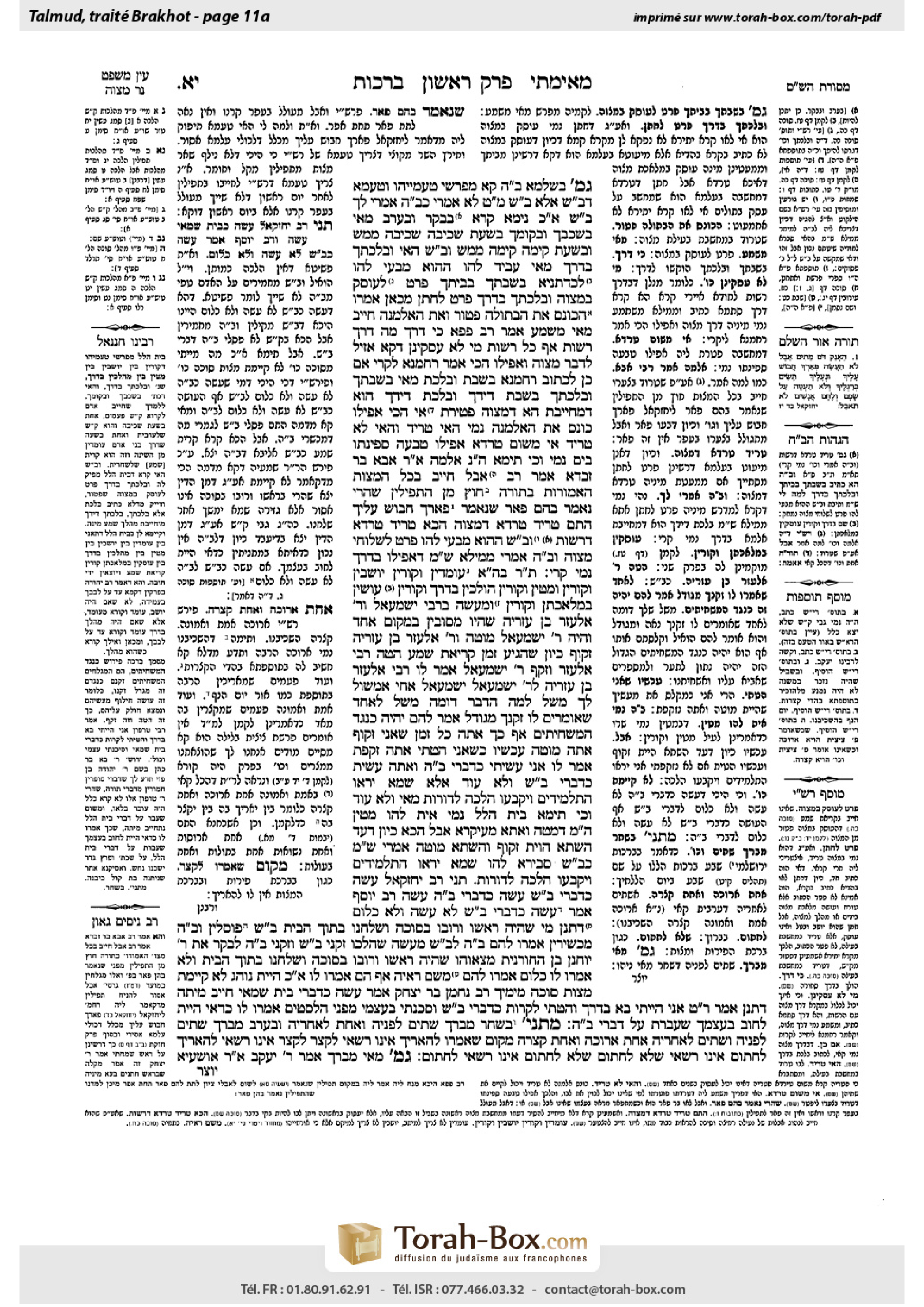
Berakhot 11a: Talmud study for Daf Yomi
Study the Talmud for Daf Yomi with scanned pages, Hebrew text, English translations from Sefaria and AI-generated French translations.
Passage selection and English or AI-generated French translation are available where the scan has annotations. Daf Study is independent of Torah-Box and Sefaria.
Browse Berakhot · ברכות · All tractatesBerakhot 11a text and translations
This page of Berakhot includes the Aramaic text, an English translation and an AI-generated French translation, alongside the scan above.
ברכות י״א א · Aramaic and Hebrew text
גְּמָ׳ בִּשְׁלָמָא בֵּית הִלֵּל — קָא מְפָרְשִׁי טַעְמַיְיהוּ וְטַעְמָא דְּבֵית שַׁמַּאי, אֶלָּא בֵּית שַׁמַּאי — מַאי טַעְמָא לָא אָמְרִי כְּבֵית הִלֵּל?
אָמְרִי לָךְ בֵּית שַׁמַּאי: אִם כֵּן, נֵימָא קְרָא ״בַּבֹּקֶר וּבָעֶרֶב״, מַאי ״בְּשָׁכְבְּךָ וּבְקוּמֶךָ״? בִּשְׁעַת שְׁכִיבָה — שְׁכִיבָה מַמָּשׁ, וּבִשְׁעַת קִימָה — קִימָה מַמָּשׁ.
וּבֵית שַׁמַּאי: הַאי ״וּבְלֶכְתְּךָ בַדֶּרֶךְ״, מַאי עֲבִיד לְהוּ?
הָהוּא מִבְּעֵי לְהוּ, לְכִדְתַנְיָא: ״בְּשִׁבְתְּךָ בְּבֵיתֶךָ״ — פְּרָט לְעוֹסֵק בְּמִצְוָה, ״וּבְלֶכְתְּךָ בַדֶּרֶךְ״ — פְּרָט לְחָתָן. מִכָּאן, אָמְרוּ: הַכּוֹנֵס אֶת הַבְּתוּלָה — פָּטוּר, וְאֶת הָאַלְמָנָה — חַיָּיב.
מַאי מַשְׁמַע?
אָמַר רַב פָּפָּא: כִּי דֶרֶךְ. מָה דֶּרֶךְ רְשׁוּת, אַף כֹּל רְשׁוּת.
מִי לָא עָסְקִינַן דְּקָא אָזֵיל לִדְבַר מִצְוָה, וַאֲפִילּוּ הָכִי אָמַר רַחֲמָנָא: לִקְרֵי. אִם כֵּן לִכְתּוֹב רַחֲמָנָא ״בְּשֶׁבֶת וּבְלֶכֶת״ מַאי ״בְּשִׁבְתְּךָ וּבְלֶכְתְּךָ״? — בְּשֶׁבֶת דִּידָךְ וּבְלֶכֶת דִּידָךְ הוּא דְּמִחַיְּיבַתְּ, הָא דְּמִצְוָה פְּטִירַתְּ.
אִי הָכִי אֲפִילּוּ כּוֹנֵס אֶת הָאַלְמָנָה נָמֵי?
הַאי טְרִיד, וְהַאי לָא טְרִיד.
אִי מִשּׁוּם טִרְדָּא, אֲפִילּוּ טָבְעָה סְפִינָתוֹ בַּיָּם נָמֵי! וְכִי תֵּימָא: הָכִי נָמֵי, אַלְּמָה אָמַר רַבִּי אַבָּא בַּר זַבְדָּא אָמַר רַב: אָבֵל חַיָּיב בְּכָל הַמִּצְוֹת הָאֲמוּרוֹת בַּתּוֹרָה, חוּץ מִן הַתְּפִילִּין, שֶׁהֲרֵי נֶאֱמַר בָּהֶם ״פְּאֵר״, שֶׁנֶּאֱמַר: ״פְּאֵרְךָ חֲבוֹשׁ עָלֶיךָ״?!
הָתָם טְרִיד טִרְדָּא דְמִצְוָה, הָכָא טְרִיד טִרְדָּא דִרְשׁוּת.
וּבֵית שַׁמַּאי?
הָהוּא מִבְּעֵי לְהוּ — פְּרָט לִשְׁלוּחֵי מִצְוָה.
וּבֵית הִלֵּל אָמְרִי: מִמֵּילָא שְׁמַע מִינַּהּ דַּאֲפִילּוּ בַדֶּרֶךְ נָמֵי קָרֵי.
תָּנוּ רַבָּנַן, בֵּית הִלֵּל אוֹמְרִים: עוֹמְדִין וְקוֹרִין, יוֹשְׁבִין וְקוֹרִין, וּמַטִּין וְקוֹרִין, הוֹלְכִין בַּדֶּרֶךְ וְקוֹרִין, עוֹשִׂין בִּמְלַאכְתָּן וְקוֹרִין. וּמַעֲשֶׂה בְּרַבִּי יִשְׁמָעֵאל וְרַבִּי אֶלְעָזָר בֶּן עֲזַרְיָה, שֶׁהָיוּ מְסוּבִּין בְּמָקוֹם אֶחָד, וְהָיָה רַבִּי יִשְׁמָעֵאל מוּטֶּה, וְרַבִּי אֶלְעָזָר בֶּן עֲזַרְיָה זָקוּף. כֵּיוָן שֶׁהִגִּיעַ זְמַן קְרִיאַת שְׁמַע, הִטָּה רַבִּי אֶלְעָזָר וְזָקַף רַבִּי יִשְׁמָעֵאל. אָמַר לוֹ רַבִּי אֶלְעָזָר בֶּן עֲזַרְיָה לְרַבִּי יִשְׁמָעֵאל: יִשְׁמָעֵאל אָחִי, אֶמְשׁוֹל לְךָ מָשָׁל לְמָה הַדָּבָר דּוֹמֶה — מָשָׁל לְאֶחָד שֶׁאוֹמְרִים לוֹ זְקָנְךָ מְגוּדָּל! אָמַר לָהֶם: יִהְיֶה כְּנֶגֶד הַמַּשְׁחִיתִים. אַף כָּךְ אַתָּה, כָּל זְמַן שֶׁאֲנִי זָקוּף — אַתָּה מוּטֶּה, עַכְשָׁיו כְּשֶׁאֲנִי הִטֵּתִי אַתָּה זָקַפְתָּ.
אָמַר לוֹ: אֲנִי עָשִׂיתִי כְּדִבְרֵי בֵּית הִלֵּל, וְאַתָּה עָשִׂיתָ כְּדִבְרֵי בֵּית שַׁמַּאי. וְלֹא עוֹד אֶלָּא שֶׁמָּא יִרְאוּ הַתַּלְמִידִים וְיִקְבְּעוּ הֲלָכָה לְדוֹרוֹת.
מַאי ״וְלֹא עוֹד״?
וְכִי תֵּימָא: בֵּית הִלֵּל נָמֵי אִית לְהוּ מַטִּין, הָנֵי מִילֵּי דְּמַטֵּה וַאֲתָא מֵעִיקָּרָא. אֲבָל הָכָא, כֵּיוָן דְּעַד הַשְׁתָּא הֲוֵית זָקוּף וְהַשְׁתָּא מוּטֶּה, אָמְרִי: שְׁמַע מִינַּהּ כְּבֵית שַׁמַּאי סְבִירָא לְהוּ, שֶׁמָּא יִרְאוּ הַתַּלְמִידִים וְיִקְבְּעוּ הֲלָכָה לְדוֹרוֹת.
תָּנֵי רַב יְחֶזְקֵאל: עָשָׂה כְּדִבְרֵי בֵּית שַׁמַּאי — עָשָׂה, כְּדִבְרֵי בֵּית הִלֵּל — עָשָׂה.
רַב יוֹסֵף אָמַר: עָשָׂה כְּדִבְרֵי בֵּית שַׁמַּאי — לֹא עָשָׂה וְלֹא כְלוּם. דִּתְנַן: מִי שֶׁהָיָה רֹאשׁוֹ וְרוּבּוֹ בַּסּוּכָּה וְשֻׁלְחָנוֹ בְּתוֹךְ הַבַּיִת, בֵּית שַׁמַּאי פּוֹסְלִין, וּבֵית הִלֵּל מַכְשִׁירִין.
אָמְרוּ לָהֶם בֵּית הִלֵּל לְבֵית שַׁמַּאי: מַעֲשֶׂה שֶׁהָלְכוּ זִקְנֵי בֵּית שַׁמַּאי וְזִקְנֵי בֵּית הִלֵּל לְבַקֵּר אֶת רַבִּי יוֹחָנָן בֶּן הַחוֹרָנִית, מְצָאוּהוּ שֶׁהָיָה רֹאשׁוֹ וְרוּבּוֹ בַּסּוּכָּה וְשֻׁלְחָנוֹ בְּתוֹךְ הַבַּיִת, וְלֹא אָמְרוּ לוֹ כְּלוּם.
אָמְרוּ לָהֶם: וּמִשָּׁם רְאָיָה?! אַף הֵם אָמְרוּ לוֹ: אִם כֵּן הָיִיתָ נוֹהֵג לֹא קִייַּמְתָּ מִצְוַת סוּכָּה מִיָּמֶיךָ.
רַב נַחְמָן בַּר יִצְחָק אָמַר: עָשָׂה כְּדִבְרֵי בֵּית שַׁמַּאי — חַיָּיב מִיתָה. דִּתְנַן, אָמַר רַבִּי טַרְפוֹן: אֲנִי הָיִיתִי בָּא בַּדֶּרֶךְ וְהִטֵּתִי לִקְרוֹת כְּדִבְרֵי בֵּית שַׁמַּאי וְסִכַּנְתִּי בְּעַצְמִי מִפְּנֵי הַלִּסְטִים, אָמְרוּ לוֹ: כְּדַאי הָיִיתָ לָחוּב בְּעַצְמְךָ, שֶׁעָבַרְתָּ עַל דִּבְרֵי בֵּית הִלֵּל.
מַתְנִי׳ בַּשַּׁחַר מְבָרֵךְ שְׁתַּיִם לְפָנֶיהָ וְאַחַת לְאַחֲרֶיהָ. וּבָעֶרֶב מְבָרֵךְ שְׁתַּיִם לְפָנֶיהָ וּשְׁתַּיִם לְאַחֲרֶיהָ. אַחַת אֲרוּכָּה וְאַחַת קְצָרָה.
מָקוֹם שֶׁאָמְרוּ לְהַאֲרִיךְ — אֵינוֹ רַשַּׁאי לְקַצֵּר, לְקַצֵּר — אֵינוֹ רַשַּׁאי לְהַאֲרִיךְ. לַחְתּוֹם — אֵינוֹ רַשַּׁאי שֶׁלֹּא לַחְתּוֹם, שֶׁלֹּא לַחְתּוֹם — אֵינוֹ רַשַּׁאי לַחְתּוֹם.
גְּמָ׳ מַאי מְבָרֵךְ?
אָמַר רַבִּי יַעֲקֹב אָמַר רַבִּי אוֹשַׁעְיָא:
Berakhot 11a · English translation
GEMARA: The Gemara begins by clarifying the rationale for Beit Shammai’s opinion. Granted, Beit Hillel explain the rationale for their opinion and the rationale for Beit Shammai’s opinion. Beit Hillel explain both the verse that ostensibly supports Beit Shammai’s opinion: When you lie down, at the time when people lie down, etc., and the verse that proves that their own explanation is more reasonable: “And when you walk along the way.” However, what is the reason that Beit Shammai do not state their opinion in accordance with the opinion of Beit Hillel?
The Gemara answers, Beit Shammai could have said to you: If so that the verse means only to denote the time for the recitation of Shema, as claimed by Beit Hillel, then let the verse say: “In the morning and in the evening.” What is the meaning of the ambiguous formulation: “When you lie down, and when you rise”? It must mean that at the time of lying down one must recite Shema while actually lying down, and at the time of arising one must recite Shema while actually risen.
The Gemara continues, asking: And what do Beit Shammai do with this verse: “And when you walk along the way,” which Beit Hillel use to prove that every person recites Shema as he is?
The Gemara answers: Beit Shammai need this verse in order to derive other halakhot, as it was taught in a baraita which interpreted this verse that the obligation to recite Shema applies when you sit in your home, to the exclusion of one who is engaged in performance of a mitzva, who is exempt from the recitation of Shema; and when you walk along the way, to the exclusion of a groom, who is also exempt from the recitation of Shema. The baraita adds that from here, from this interpretation of the verses, they said: One who marries a virgin is exempt from the recitation of Shema on his wedding night, but one who marries a widow is obligated.
The Gemara clarifies the meaning of this baraita, and asks: From where may it be inferred that the verse, when you walk along the way, exempts a groom from the obligation to recite Shema?
Rav Pappa said that we learn: Like the way; just as the journey along a specific way described in the verse is voluntary and involves no mitzva, so too all of those who are obligated to recite Shema are engaged in voluntary activities. However, one engaged in the performance of a mitzva, like a groom, is exempt from the obligation to recite Shema.
The Gemara asks: Are we not dealing with a case where one walks along the way to perform a mitzva? The Torah did not designate the objective of his walk and, nevertheless, the Torah said to recite Shema, indicating that one is obligated even if he set out to perform a mitzva. Rather, the proof is from the formulation of the verse. If so, that the intention was to obligate in all cases, let the Torah write: When sitting and when walking. What is the meaning of: When you sit and when you walk? Certainly these additions come to emphasize in your sitting down and in your walking, meaning that when one does this for his own purposes and of his own volition, he is obligated to recite Shema, but when he does with the objective of performing a mitzva, he is exempt from reciting Shema, as in that case he is sitting or walking at God’s behest.
The conclusion is that anyone engaged in the performance of a mitzva is exempt from the recitation of Shema. If so, even one who marries a widow should be exempt, for he, too, is engaged in performance of a mitzva. That, however, contradicts the baraita.
The Gemara responds that there is nevertheless a distinction between one marrying a virgin and one marrying a widow. One who marries a virgin is preoccupied by his concern lest he discover that his bride is not a virgin, while one who marries a widow is not preoccupied. The conclusion is that the groom is exempt from reciting Shema because he is preoccupied.
The Gemara asks: If the exemption is due to preoccupation, then even one who is preoccupied because his ship sank at sea should also be exempt. The Gemara reinforces its question: And if you say that in this case as well, when one’s ship sank at sea, one is exempt, why then did Rabbi Abba bar Zavda say that Rav said: A mourner is obligated in all the mitzvot mentioned in the Torah except for the mitzva to don phylacteries, from which a mourner is exempt, as the term splendor is stated with regard to phylacteries, as it is stated: “Make no mourning for the dead, bind your splendor upon yourself” (Ezekiel 24:17). It is inappropriate for a mourner to wrap himself in phylacteries, with regard to which, the term splendor was employed (Tosafot). If a mourner, who is clearly pained and preoccupied, is obligated to recite Shema, then certainly all others who are preoccupied, even one whose ship sank at sea, whose loss was merely monetary (Birkat Hashem), should be obligated. Why, then, is a groom exempted because of his preoccupation and one who lost his property is not?
The Gemara answers: Nevertheless, there is a distinction between the cases. For there, in the case of a groom, he is preoccupied with the preoccupation of a mitzva that he must perform; here, in the case of a ship lost at sea, he is preoccupied with the preoccupation of a voluntary act that he chooses to perform.
Here, the Gemara returns to its initial question: And how do Beit Shammai explain the passage: “When you walk along the way” (Rashash)?
The Gemara answers: Beit Shammai need this passage in order to exclude one who is on the path to perform a mitzva from the obligation to recite Shema.
Beit Hillel also agree that one engaged in the performance of a mitzva is exempt from reciting Shema? If so, the halakha that they derived from: When you walk along the way lacks a source and is therefore unfounded. And Beit Hillel say: Derive from this halakha itself that one who is not an agent in the performance of a mitzva recites Shema even along the way.
The Sages taught in a baraita that Beit Hillel say: One may recite Shema in any situation: Standing and reciting, sitting and reciting, reclining and reciting, walking and reciting and even working and reciting. And in the Tosefta an incident is related where two tanna’im, Rabbi Yishmael and Rabbi Elazar ben Azarya, who were both disciples of Beit Hillel, were reclining at a meal in one place together with their students, and Rabbi Yishmael was reclined as was the customary dining position, and Rabbi Elazar ben Azarya was upright. When the time to recite the evening Shema arrived, Rabbi Elazar reclined to recite Shema in accordance with the opinion of Beit Shammai, while Rabbi Yishmael sat upright to recite Shema. Rabbi Elazar ben Azarya appeared to take offense, and said to Rabbi Yishmael: Yishmael, my brother, I will tell you a parable to which this is similar. It is comparable to a situation where one to whom people say as a compliment: Your beard is full and suits you. That man says to them: May it be against those who shave and destroy their beards, i.e., the only reason I grow my beard is to irritate those who cut their own (Rashba). You are the same. As long as I am upright, you are reclined, and now when I reclined lauding your conduct and emulating you, you sat upright as if to demonstrate that whatever I do, you do the opposite.
Rabbi Yishmael said to him: I acted in accordance with the opinion of Beit Hillel, according to whom one may recite Shema in any position, while you acted in accordance with the opinion of Beit Shammai. I am the one who acted in accordance with the halakha. And furthermore, I was concerned lest the students see your conduct and establish the halakha for generations accordingly. It was therefore necessary for me to demonstrate that there is no obligation to do so.
The Gemara asks: What is the meaning of: And furthermore? Why was it necessary for Rabbi Yishmael to add additional justification for his actions when the reason that he acted in accordance with the opinion of Beit Hillel was sufficient?
The Gemara answers: It was necessary for him to add this reason, as if you say: Beit Hillel also hold that one is permitted to recite Shema while reclining and Rabbi Yishmael could have remained reclining even in accordance with the opinion of Beit Hillel, but this only applies when one had already been reclining originally, in which case it is like any other position. However, here, since until now he had been upright, and now he is reclined, the students will say: Conclude from this, that they hold in accordance with the opinion of Beit Shammai. Due to the concern that the students might see and establish the halakha for generations in accordance with the opinion of Beit Shammai, it was necessary for Rabbi Yishmael to sit upright.
Rav Yeḥezkel taught: One who acted in accordance with the opinion of Beit Shammai has acted appropriately and is not in violation of the halakha. One who acted in accordance with the opinion of Beit Hillel acted appropriately as well. According to this opinion, Beit Hillel and Beit Shammai agree that one who acted in accordance with the opinion of the other fulfilled his obligation. Although the halakha was ruled in accordance with the opinion of Beit Hillel, Beit Hillel would agree that one who acted in accordance with the opinion of Beit Shammai fulfilled his obligation.
However, Rav Yosef said: One who acts in accordance with the opinion of Beit Shammai has done nothing and must repeat Shema in accordance with the opinion of Beit Hillel, as we learned in the mishna with regard to the halakhot of a sukka: One who had his head and most of his body in the sukka, and his table upon which he was eating inside the house, Beit Shammai invalidate his action, as he is liable to be drawn after the table and end up eating outside the sukka. And Beit Hillel validate his action, since his head and most of his body remain inside the sukka.
Beit Hillel said to Beit Shammai as a proof: There was an incident where the elders of Beit Shammai and the elders of Beit Hillel went on Sukkot to visit Rabbi Yoḥanan ben HaḤoranit. They found him with his head and most of his body in the sukka and his table inside the house and they said nothing to him. In other words, even Beit Shammai did not object.
Beit Shammai said to them: And is there proof from there? That is not what happened, rather they said to him explicitly: If you have been accustomed to act in this manner, you have never in your life fulfilled the mitzva of sukka. We see that Beit Shammai held that anyone who did not act in accordance with their opinion, did not fulfill his obligation at all. Similarly, since Beit Hillel’s opinion was accepted as halakha, anyone who acts in accordance with the opinion of Beit Shammai fails to fulfill his obligation.
Rav Naḥman bar Yitzḥak stated an even more extreme opinion: One who acted in accordance with the opinion of Beit Shammai has acted so egregiously that he is liable to receive the death penalty, as we learned in our mishna that Rabbi Tarfon said to his colleagues: Once, I was coming on the road when I stopped and reclined to recite Shema in accordance with the statement of Beit Shammai. Yet in so doing, I endangered myself due to the highwaymen who accost travelers. The Sages said to him: You deserved to be in a position where you were liable to pay with your life, as you transgressed the statement of Beit Hillel.
MISHNA: From the laws of the recitation of Shema itself, the mishna proceeds to discuss the blessings recited in conjunction with Shema. Here, the order is established: In the morning when reciting Shema, one recites two blessings beforehand, the first on the radiant lights and the second the blessing on the love of Torah, and one thereafter, which begins with: True and Firm [emet veyatziv]. And in the evening one recites two blessings beforehand, on the radiant lights and on the love of God, and two thereafter, the blessing of redemption: True and Faithful [emet ve’emuna], and the blessing: Help us lie down. With regard to the blessing: True and Faithful, whether one recites it in its long formula and whether one recites it in its short formula, he fulfills his obligation (Tosafot).
However, the general principle is: Where the Sages said to recite a long blessing, one may not shorten it, and so too, wherever they said to recite a short blessing, one may not lengthen it. Where the Sages said that a blessing must conclude with a second blessing at the end, he may not fail to conclude with that blessing. Similarly, if the Sages said that a blessing must not conclude with a second blessing, one may not conclude with a blessing.
GEMARA: The Gemara begins by determining the formula of the two blessings preceding the morning Shema. The Gemara asks: What blessing does one recite?
Rabbi Ya’akov said in the name of Rabbi Oshaya: The blessing focuses on the verse:
Berakhot 11a · Traduction française (IA)
GUEMARA : La Guemara commence par clarifier la raison du point de vue de Beit Shammai. Bien que Beit Hillel expliquent la raison de leur propre opinion et celle de Beit Shammai, Beit Hillel expliquent à la fois le verset qui semble soutenir le point de vue de Beit Shammai : « Quand tu te couches, à l'heure où les gens se couchent, etc. », et le verset qui prouve que leur propre explication est plus rationnelle : « Et quand tu marches sur la route ». Cependant, quelle est la raison pour laquelle Beit Shammai ne déclare pas leur opinion conformément à celle de Beit Hillel ?
La Guemara répond : Beit Shammai aurait pu dire à toi : Si le verset signifie seulement l'heure de la récitation du Chéma, comme le prétend Beit Hillel, alors que le verset dise : « Le matin et le soir ». Quelle est la signification de la formulation ambiguë : « Quand tu te couches, et quand tu t'élèves » ? Il doit signifier que l'on doit réciter le Chéma lorsqu'on est effectivement couché, et lorsqu'on est effectivement debout.
La Guemara continue en demandant : Et qu'est-ce que Beit Shammai fait avec ce verset : « Et quand tu marches sur la route », que Beit Hillel utilisent pour prouver que chaque personne récite le Chéma selon sa situation ?
La Guemara répond : Beit Shammai a besoin de ce verset pour déduire d'autres halakhot, comme il a été enseigné dans une baraïta qui interprète ce verset : l'obligation de réciter le Chéma s'applique lorsque l'on est assis chez soi, excluant celui qui est engagé dans la performance d'une mitsva, qui est exempt de la récitation du Chéma ; et lorsque l'on marche sur la route, excluant le mari, qui est également exempt de la récitation du Chéma. La baraïta ajoute que d'après cette interprétation des versets, ils ont dit : Celui qui épouse une vierge est exempt de la récitation du Chéma lors de sa nuit de mariage, mais celui qui épouse une veuve est tenu de la réciter.
La Guemara clarifie le sens de cette baraïta et demande : D'où peut-on déduire que le verset « quand tu marches sur la route » exempt le mari de l'obligation de réciter le Chéma ?
Rav Pappa a dit que nous apprenons : Comme la route ; tout comme le trajet le long d'une route spécifique décrit dans le verset est volontaire et ne comporte pas de mitsva, ainsi tous ceux qui sont tenus de réciter le Chéma sont engagés dans des activités volontaires. Cependant, celui qui est engagé dans la performance d'une mitsva, comme un mari, est exempt de l'obligation de réciter le Chéma.
La Guemara demande : Ne sommes-nous pas en présence d’un cas où l’on marche sur la route pour accomplir une mitsva ? La Torah n’a pas désigné l’objectif de son trajet et, néanmoins, la Torah dit de réciter le Chéma, indiquant que l’on est tenu même s’il est parti accomplir une mitsva. Cependant, la preuve vient de la formulation du verset. Si donc l’intention était d’obliger dans tous les cas, la Torah aurait dû écrire : Quand tu t’assieds et quand tu marches. Quelle est la signification de : Quand tu t’assieds et quand tu marches ? Ces additions viennent certainement souligner ton assise et ton marche, signifiant que lorsque l’on fait cela pour ses propres desseins et de sa propre volonté, l’on est tenu de réciter le Chéma, mais lorsque l’on le fait avec l’objectif d’accomplir une mitsva, l’on est exempt de la récitation du Chéma, comme dans ce cas l’on s’assied ou marche à la volonté de Dieu.
La conclusion est que celui qui est engagé dans la performance d’une mitsva est exempt de la récitation du Chéma. Si tel est le cas, même celui qui épouse une veuve devrait être exempt, car il est également engagé dans la performance d’une mitsva. Cela, cependant, contredit la baraïta.
La Guemara répond que toutefois il existe une distinction entre celui qui épouse une vierge et celui qui épouse une veuve. Celui qui épouse une vierge est préoccupé par sa crainte de découvrir que sa fiancée n’est pas vierge, tandis que celui qui épouse une veuve n’est pas préoccupé. La conclusion est que le mari est exempt de la récitation du Chéma car il est préoccupé.
La Guemara demande : Si l'exemption est due à la préoccupation, alors même celui dont le bateau a coulé en mer devrait être exempt. La Guemara renforce sa question : Et si tu dis que dans ce cas également, lorsque le bateau d'une personne a coulé en mer, l'on est exempt, pourquoi alors Rabbi Abba bar Zavda a-t-il dit que Rav a dit : Le veuf est tenu de toutes les mitsvot mentionnées dans la Torah sauf la mitsva de porter les phylactères, d'où le veuf est exempt, car le terme « splendeur » est utilisé concernant les phylactères, comme il est dit : « Ne pleurez pas pour les morts, enveloppez-vous de votre splendeur » (Ezechiel 24:17). Il est inapproprié pour un veuf de s'envelopper de phylactères, concernant lesquels le terme « splendeur » a été utilisé (Tosafot). Si un veuf, qui est clairement affecté et préoccupé, est tenu de réciter le Chéma, alors certainement tous ceux qui sont préoccupés, même celui dont le bateau a coulé en mer, dont la perte est simplement financière (Birkat Hashem), devraient être tenu. Pourquoi alors le mari est-il exempté à cause de sa préoccupation et celui qui a perdu ses biens ne l'est pas ?
La Guemara répond : Toutefois, il existe une distinction entre les cas. En effet, dans le cas du mari, il est préoccupé par la préoccupation d'une mitsva qu'il doit accomplir ; ici, dans le cas du bateau perdu en mer, il est préoccupé par la préoccupation d'une action volontaire qu'il choisit d'accomplir.
Ici, la Guemara revient à sa question initiale : Et comment Beit Shammai explique-t-il le passage : « Quand tu marches sur la route » (Rashash) ?
La Guemara répond : Beit Shammai a besoin de ce passage afin d'exclure celui qui est sur le chemin d'accomplir une mitsva de l'obligation de réciter le Chéma.
Beit Hillel est-il également d'accord sur le fait que celui qui est engagé dans la performance d'une mitsva est exempt de la récitation du Chéma ? Si tel est le cas, la halakha qu'ils ont déduite à partir de : « Quand tu marches sur la route » manque de source et est donc non fondée. Et Beit Hillel disent : Déduisez de cette halakha elle-même que celui qui n'est pas un agent dans la performance d'une mitsva récite le Chéma même sur la route.
Les Sages ont enseigné dans une baraïta que Beit Hillel disent : On peut réciter le Chéma dans toute situation : debout et récitant, assis et récitant, allongé et récitant, marchant et récitant, même en travaillant et récitant. Et dans la Tosefta, un incident est rapporté où deux tanna’im, Rabbi Yishmael et Rabbi Elazar ben Azarya, qui étaient tous deux disciples de Beit Hillel, étaient assis lors d'un repas dans un même lieu avec leurs élèves, et Rabbi Yishmael était assis selon la position habituelle lors des repas, tandis que Rabbi Elazar ben Azarya était allongé. Lorsque l'heure de réciter le Chéma du soir est arrivée, Rabbi Elazar s'est allongé pour réciter le Chéma conformément à l'opinion de Beit Shammai, tandis que Rabbi Yishmael s'est assis debout pour réciter le Chéma. Rabbi Elazar ben Azarya a semblé prendre ombrage et a dit à Rabbi Yishmael : Yishmael, mon frère, je te raconterai une comparaison similaire à cette situation. C'est comparable à une situation où à quelqu'un on dit en compliment : Ta barbe est pleine et te va bien. Ce homme répond à ceux-ci : Que cela soit contre ceux qui rasent et détruisent leur barbe, c'est-à-dire que la seule raison pour laquelle je cultive ma barbe est pour irriter ceux qui se rasent (Rashba). Tu es le même. Aussi longtemps que je suis debout, tu es allongé, et maintenant que je suis allongé pour louer ton comportement et t'imiter, tu es debout comme si tu voulais montrer que ce que je fais, tu fais l'inverse.
Rabbi Yishmael a dit à lui : J'ai agi conformément à l'opinion de Beit Hillel, selon laquelle on peut réciter le Chéma dans toute position, tandis que tu as agi conformément à l'opinion de Beit Shammai. Je suis celui qui a agi selon la halakha. Et de plus, j'avais peur que les élèves voient ton comportement et établissent la halakha pour les générations à venir selon ce dernier. Il était donc nécessaire pour moi de montrer qu'il n'y a pas d'obligation à le faire.
Le Guemara demande : Quelle est la signification de : Et de plus ? Pourquoi était-il nécessaire pour Rabbi Yishmael d'ajouter une justification supplémentaire à ses actions lorsque la raison pour laquelle il agissait selon l'opinion de Beit Hillel était suffisante ?
Le Guemara répond : Il était nécessaire qu'il ajoute cette raison, car si tu dis : Beit Hillel aussi considère que l'on peut réciter le Chéma en position allongée et Rabbi Yishmael aurait pu rester allongé conformément à l'opinion de Beit Hillel, mais cela ne s'applique que lorsque l'on était déjà allongé d'origine, ce qui est comme toute autre position. Cependant, ici, puisque jusqu'à présent il était debout, et maintenant il est allongé, les élèves diront : Concluez-en, qu'ils suivent l'opinion de Beit Shammai. En raison de la crainte que les élèves puissent voir et établir la halakha pour les générations à venir selon l'opinion de Beit Shammai, il était nécessaire pour Rabbi Yishmael de s'asseoir debout.
Rav Yeḥezkel enseigna : Celui qui agit selon l'opinion de Beit Shammai a agi correctement et n'a pas violé la halakha. Celui qui agit selon l'opinion de Beit Hillel a également agi correctement. Selon cette opinion, Beit Hillel et Beit Shammai s'accordent sur le fait que celui qui agit selon l'opinion de l'autre a accompli son obligation. Bien que la halakha ait été décidée selon l'opinion de Beit Hillel, Beit Hillel serait d'accord pour dire que celui qui agit selon l'opinion de Beit Shammai a accompli son obligation.
Cependant, Rav Yosef dit : Celui qui agit selon l'opinion de Beit Shammai a fait rien et doit répéter le Chéma selon l'opinion de Beit Hillel, comme nous l'avons appris dans la mishna concernant les halakhot du sukka : Celui qui avait sa tête et la plus grande partie de son corps dans le sukka, et sa table sur laquelle il mangeait à l'intérieur de la maison, Beit Shammai invalide son action, car il est tenu de suivre la table et finir par manger à l'extérieur du sukka. Et Beit Hillel valide son action, car sa tête et la plus grande partie de son corps restent dans le sukka.
Beit Hillel a dit à Beit Shammai comme preuve : Il y avait un incident où les anciens de Beit Shammai et les anciens de Beit Hillel sont allés à Sukkot pour rendre visite à Rabbi Yoḥanan ben HaḤoranit. Ils le trouvèrent avec sa tête et la plus grande partie de son corps dans le sukka et sa table à l'intérieur de la maison, et ils ne dirent rien à lui. En d'autres termes, même Beit Shammai n'a pas objecté.
Beit Shammai a dit à eux : Et y a-t-il une preuve ? Ce n'est pas ce qui s'est produit, plutôt ils lui dirent explicitement : Si tu as l'habitude d'agir ainsi, tu n'as jamais accompli la mitsva de la sukka dans toute ta vie. Nous voyons que Beit Shammai considérait que quiconque n'agissait pas selon leur opinion n'avait pas accompli son obligation. De même, puisque l'opinion de Beit Hillel a été adoptée comme halakha, quiconque agit selon l'opinion de Beit Shammai ne remplissait pas son obligation.
Rav Naḥman bar Yitzḥak a exprimé un avis encore plus extrême : Celui qui agit selon l'opinion de Beit Shammai a agi de manière si grave qu'il est tenu responsable de la peine de mort, comme nous l'avons appris dans notre mitsva que Rabbi Tarfon dit à ses collègues : Un jour, je marchais sur la route lorsque j'ai arrêté et m'allongé pour réciter le Chéma selon l'affirmation de Beit Shammai. Cependant, en le faisant, j'ai mis ma vie en danger en raison des voleurs qui s'adressent aux voyageurs. Les Sages dirent à lui : Tu méritais d'être dans une situation où tu étais tenu de payer avec ta vie, car tu as transgressé l'affirmation de Beit Hillel.
MICHNA : À partir des lois de la prière du Chéma, la michna passe à l'examen des bénédictions prononcées en association avec le Chéma. Ici, l'ordre est établi : le matin, lors de la prière du Chéma, on prononce deux bénédictions avant, la première sur les lumières splendides et la seconde sur l'amour de la Torah, et une après, qui commence par : Vrai et Solide [émét véyatziv]. Et le soir, on prononce deux bénédictions avant, sur les lumières splendides et sur l'amour de Dieu, et deux après, la bénédictions de la délivrance : Vrai et Fidèle [émét ve’emuna], et la bénédictions : Aide-nous à nous allonger. En ce qui concerne la bénédictions : Vrai et Fidèle, qu'on prononce cette bénédictions dans sa formule longue ou dans sa formule courte, il rempli son obligation (Tosafot).
Cependant, le principe général est : là où les Sages ont dit de prononcer une bénédictions longue, on ne peut pas la raccourcir, et de même, là où ils ont dit de prononcer une bénédictions courte, on ne peut pas l'allonger. Là où les Sages ont dit qu'une bénédictions doit se terminer par une autre bénédictions, on ne peut pas négliger de terminer par cette bénédictions. De même, si les Sages ont dit qu'une bénédictions ne doit pas se terminer par une autre bénédictions, on ne peut pas terminer par une bénédictions.
GUEMARA : La Guemara commence par déterminer la formule des deux bénédictions précédant la prière du Chéma du matin. La Guemara pose la question : quelle bénédictions prononce-t-on ?
Rabbi Ya’akov a dit en nom de Rabbi Oshaya : la bénédiction se concentre sur la verset :
Traduction française générée par IA à partir de l’édition anglaise de Sefaria. Vérifie toujours un passage avec le texte source.
Text from Sefaria: William Davidson Edition - Vocalized Aramaic (CC BY NC); William Davidson Edition - English (CC BY NC).