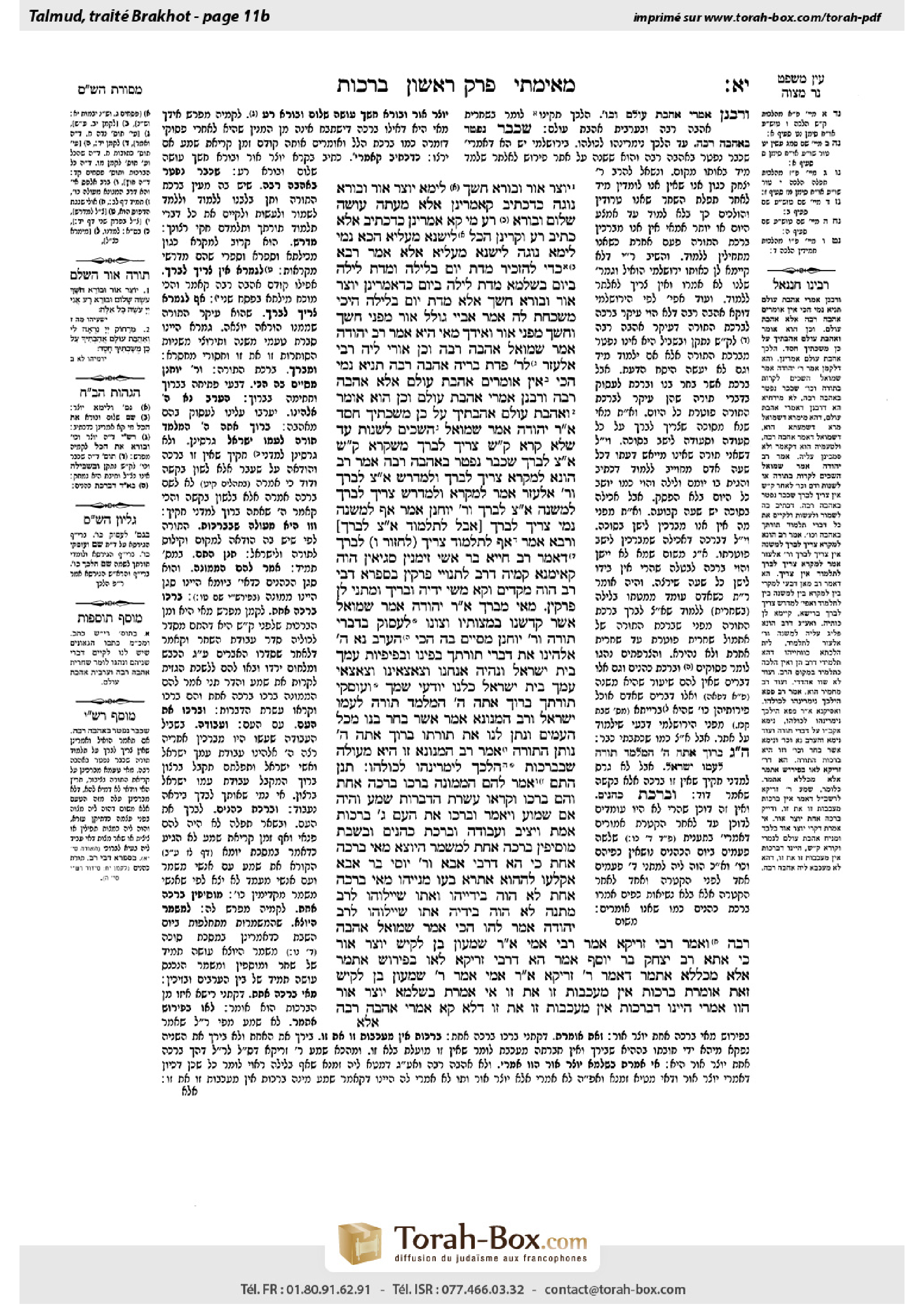
Berakhot 11b: Talmud study for Daf Yomi
Study the Talmud for Daf Yomi with scanned pages, Hebrew text, English translations from Sefaria and AI-generated French translations.
Passage selection and English or AI-generated French translation are available where the scan has annotations. Daf Study is independent of Torah-Box and Sefaria.
Browse Berakhot · ברכות · All tractatesBerakhot 11b text and translations
This page of Berakhot includes the Aramaic text, an English translation and an AI-generated French translation, alongside the scan above.
ברכות י״א ב · Aramaic and Hebrew text
״יוֹצֵר אוֹר וּבוֹרֵא חֹשֶׁךְ״.
לֵימָא: ״יוֹצֵר אוֹר וּבוֹרֵא נוֹגַהּ״!
כְּדִכְתִיב קָאָמְרִינַן.
אֶלָּא מֵעַתָּה ״עֹשֶׂה שָׁלוֹם וּבוֹרֵא רָע״, מִי קָא אָמְרִינַן כְּדִכְתִיב?! אֶלָּא כְּתִיב ״רַע״ וְקָרֵינַן ״הַכֹּל״ לִישָּׁנָא מְעַלְּיָא, הָכָא נָמֵי לֵימָא ״נוֹגַהּ״, לִישָּׁנָא מְעַלְּיָא!
אֶלָּא אָמַר רָבָא: כְּדֵי לְהַזְכִּיר מִדַּת יוֹם בַּלַּיְלָה וּמִדַּת לַיְלָה בַּיּוֹם.
בִּשְׁלָמָא מִדַּת לַיְלָה בַּיּוֹם כִּדְאָמְרִינַן: ״יוֹצֵר אוֹר וּבוֹרֵא חֹשֶׁךְ״, אֶלָּא מִדַּת יוֹם בַּלַּיְלָה, הֵיכִי מַשְׁכַּחַתְּ לַהּ?
אָמַר אַבָּיֵי: ״גּוֹלֵל אוֹר מִפְּנֵי חֹשֶׁךְ וְחֹשֶׁךְ מִפְּנֵי אוֹר״.
וְאִידָּךְ מַאי הִיא? אָמַר רַב יְהוּדָה אָמַר שְׁמוּאֵל: ״אַהֲבָה רַבָּה״. וְכֵן אוֹרִי לֵיהּ רַבִּי אֶלְעָזָר לְרַבִּי פְּדָת בְּרֵיהּ, ״אַהֲבָה רַבָּה״.
תַּנְיָא נָמֵי הָכִי: אֵין אוֹמְרִים ״אַהֲבַת עוֹלָם״, אֶלָּא ״אַהֲבָה רַבָּה״. וְרַבָּנַן אָמְרִי אַהֲבַת עוֹלָם, וְכֵן הוּא אוֹמֵר: ״וְאַהֲבַת עוֹלָם אֲהַבְתִּיךְ עַל כֵּן מְשַׁכְתִּיךְ חָסֶד״.
אָמַר רַב יְהוּדָה אָמַר שְׁמוּאֵל: הִשְׁכִּים לִשְׁנוֹת, עַד שֶׁלֹּא קָרָא קְרִיאַת שְׁמַע — צָרִיךְ לְבָרֵךְ. מִשֶּׁקָּרָא קְרִיאַת שְׁמַע — אֵינוֹ צָרִיךְ לְבָרֵךְ, שֶׁכְּבָר נִפְטַר בְּ״אַהֲבָה רַבָּה״.
אָמַר רַב הוּנָא: לַמִּקְרָא צָרִיךְ לְבָרֵךְ, וְלַמִּדְרָשׁ — אֵינוֹ צָרִיךְ לְבָרֵךְ.
וְרַבִּי אֶלְעָזָר אָמַר: לַמִּקְרָא וְלַמִּדְרָשׁ צָרִיךְ לְבָרֵךְ, לַמִּשְׁנָה — אֵינוֹ צָרִיךְ לְבָרֵךְ.
וְרַבִּי יוֹחָנָן אָמַר: אַף לַמִּשְׁנָה נָמֵי צָרִיךְ לְבָרֵךְ [אֲבָל לַתַּלְמוּד, אֵינוֹ צָרִיךְ לְבָרֵךְ].
וְרָבָא אָמַר: אַף לַתַּלְמוּד צָרִיךְ (לַחֲזוֹר וּלְבָרֵךְ) [לְבָרֵךְ].
דְּאָמַר רַב חִיָּיא בַּר אָשֵׁי: זִימְנִין סַגִּיאִין הֲוָה קָאֵימְנָא קַמֵּיהּ דְּרַב לְתַנּוֹיֵי פִּרְקִין בְּ״סִפְרָא דְבֵי רַב״, הֲוָה מַקְדֵּים וְקָא מָשֵׁי יְדֵיהּ, וּבָרֵיךְ, וּמַתְנֵי לַן פִּרְקִין.
מַאי מְבָרֵךְ? אָמַר רַב יְהוּדָה אָמַר שְׁמוּאֵל: ״אֲשֶׁר קִדְּשָׁנוּ בְּמִצְוֹתָיו וְצִוָּנוּ לַעֲסוֹק בְּדִבְרֵי תוֹרָה״.
וְרַבִּי יוֹחָנָן מְסַיֵּים בַּהּ הָכִי ״הַעֲרֵב נָא ה׳ אֱלֹהֵינוּ אֶת דִּבְרֵי תוֹרָתְךָ בְּפִינוּ וּבְפִיפִיּוֹת עַמְּךָ בֵּית יִשְׂרָאֵל וְנִהְיֶה אֲנַחְנוּ וְצֶאֱצָאֵינוּ וְצֶאֱצָאֵי עַמְּךָ בֵּית יִשְׂרָאֵל כֻּלָּנוּ יוֹדְעֵי שְׁמֶךָ וְעוֹסְקֵי תוֹרָתֶךָ בָּרוּךְ אַתָּה ה׳ הַמְלַמֵּד תּוֹרָה לְעַמּוֹ יִשְׂרָאֵל״.
וְרַב הַמְנוּנָא אָמַר: ״אֲשֶׁר בָּחַר בָּנוּ מִכׇּל הָעַמִּים וְנָתַן לָנוּ אֶת תּוֹרָתוֹ. בָּרוּךְ אַתָּה ה׳ נוֹתֵן הַתּוֹרָה״. אָמַר רַב הַמְנוּנָא: זוֹ הִיא מְעוּלָּה שֶׁבַּבְּרָכוֹת.
הִלְכָּךְ לֵימְרִינְהוּ לְכוּלְּהוּ.
תְּנַן הָתָם: אָמַר לָהֶם הַמְמוּנֶּה: ״בָּרְכוּ בְּרָכָה אַחַת!״. וְהֵם בֵּרְכוּ. וְקָרְאוּ עֲשֶׂרֶת הַדִּבְּרוֹת, ״שְׁמַע״, ״וְהָיָה אִם שָׁמוֹעַ״, ״וַיֹּאמֶר״. וּבֵרְכוּ אֶת הָעָם שָׁלֹשׁ בְּרָכוֹת, ״אֱמֶת וְיַצִּיב״, וַעֲבוֹדָה, וּבִרְכַּת כֹּהֲנִים. וּבְשַׁבָּת מוֹסִיפִין בְּרָכָה אַחַת לַמִּשְׁמָר הַיּוֹצֵא.
מַאי ״בְּרָכָה אַחַת״? כִּי הָא דְּרַבִּי אַבָּא וְרַבִּי יוֹסֵי בַּר אַבָּא אִקְּלַעוּ לְהָהוּא אַתְרָא, בְּעוֹ מִנַּיְיהוּ: מַאי ״בְּרָכָה אַחַת״? לָא הֲוָה בִּידַיְיהוּ. וַאֲתוֹ שַׁיְילוּהוּ לְרַב מַתְנָה לָא הֲוָה בִּידֵיהּ. אֲתוֹ שַׁיְילוּהוּ לְרַב יְהוּדָה. אֲמַר לְהוּ: הָכִי אָמַר שְׁמוּאֵל, ״אַהֲבָה רַבָּה״.
וְאָמַר רַבִּי זְרִיקָא, אָמַר רַבִּי אַמֵּי, אָמַר רַבִּי שִׁמְעוֹן בֶּן לָקִישׁ: ״יוֹצֵר אוֹר״. כִּי אֲתָא רַב יִצְחָק בַּר יוֹסֵף, אָמַר, הָא דְּרַבִּי זְרִיקָא לָאו בְּפֵירוּשׁ אִתְּמַר אֶלָּא מִכְּלָלָא אִתְּמַר. דְּאָמַר רַבִּי זְרִיקָא אָמַר רַבִּי אַמֵּי, אָמַר רַבִּי שִׁמְעוֹן בֶּן לָקִישׁ: זֹאת אוֹמֶרֶת בְּרָכוֹת אֵין מְעַכְּבוֹת זוֹ אֶת זוֹ.
אִי אָמְרַתְּ בִּשְׁלָמָא ״יוֹצֵר אוֹר״ הֲווֹ אָמְרִי, הַיְינוּ דִּבְרָכוֹת אֵין מְעַכְּבוֹת זוֹ אֶת זוֹ, דְּלָא קָא אָמְרִי ״אַהֲבָה רַבָּה״.
Berakhot 11b · English translation
“Who forms light and creates darkness, Who makes peace and creates evil, I am the Lord Who does all these things” (Isaiah 45:7).
With regard to this formula of the blessing, the Gemara asks: Let him say the following formula instead: Who forms light and creates brightness, so as not to mention darkness, which has negative connotations.
The Gemara answers: We say the blessing as the verse is written in the Bible and do not alter the formula that appears in the verse.
The Gemara strongly objects: But if so, what about the continuation of the verse: “Who makes peace and creates evil”? Do we say this blessing as it is written in the Bible? Rather, it is written evil and we euphemistically recite the blessing all things to avoid mention of evil. Here, too, let us euphemistically say brightness instead of darkness.
Rather, Rava said: The reason we recite: “Who creates darkness” is in order to mention the attribute of day at night and the attribute of night during the day, and thereby unify day and night as different parts of a single entity.
The Gemara continues and asks: Granted, the attribute of night is mentioned during the day, as we say: Who forms light and creates darkness, but where do you find the attribute of day mentioned at night? In the blessing over the radiant lights recited at night there is no mention of “Who forms light.”
Abaye said: Nevertheless, the attribute of day is mentioned at night in the words: Rolling away light before the darkness and darkness before the light.
The Gemara asks: And what is the formula of the other blessing recited before Shema? Rav Yehuda said in the name of Shmuel: An abounding love [ahava rabba]. And Rabbi Elazar instructed his son, Rabbi Pedat, to also say: An abounding love.
That was also taught in a baraita: One does not recite: An eternal love [ahavat olam]; rather, one recites: An abounding love. And the Rabbis say that one recites: An eternal love, and so it says: “And an eternal love I have loved you, therefore I have drawn you with kindness” (Jeremiah 31:3).
The blessing: An abounding love, is about God’s love for us and includes praise for His giving us the Torah. Therefore, Rav Yehuda said that Shmuel said: One who arose to study, until he recites Shema he must recite a special blessing over the Torah. If he already recited Shema he need not recite that blessing, as he has exempted himself by reciting the blessing of: An abounding love, which includes the components of the blessing over the Torah.
Having mentioned the blessing recited over Torah, the Gemara focuses on a dispute over what constitutes Torah in terms of requiring a blessing. Rav Huna said: For the study of Bible, one must recite a blessing, as it is the word of God, and for halakhic midrash, the derivation of halakhot from verses, one need not recite a blessing.
And Rabbi Elazar said: For Bible and midrash, which includes halakhot derived from verses themselves, one must recite a blessing; for Mishna, which is only comprised of halakhic rulings issued by the Sages, one need not recite a blessing.
And Rabbi Yoḥanan said: Even for Mishna, which includes final, binding halakhic rulings, one must recite a blessing as well, but for Talmud, which comprises a study of the Mishna and the rationales for its rulings, one need not recite a blessing.
And Rava said: Even for Talmud, which is the means to analyze the significance of the halakhot, and is the only form of Torah study that leads one to its true meaning, one must recite a blessing.
This statement is supported by the practical halakha derived from observation of Rav’s practice. His student, Rav Ḥiyya bar Ashi, said: Many times I stood before Rav to study our chapter in the Sifra, also known as Torat Kohanim, the halakhic midrash on Leviticus, of the school of Rav, and I saw that Rav would first wash his hands, then recite a blessing, and only then he would teach us our chapter. This demonstrates that even before their study of Torat Kohanim, which, due to Rav’s explanation of the reasons behind the halakhot, was the equivalent of studying Talmud, one must recite a blessing.
The Gemara clarifies: What formula of blessings does he recite? There is a dispute over the formula of the blessings as well. Rav Yehuda said that Shmuel said: The formula of this blessing is like the standard formula for blessings recited over other mitzvot: Blessed are You, Lord our God, King of the universe, Who sanctified us with his mitzvot and commanded us to engage in matters of Torah.
And Rabbi Yoḥanan concludes the blessing by adding the following: Lord our God, make the words of Your Torah sweet in our mouths and in the mouths of Your people, the house of Israel, so that we and our descendants and the descendants of Your people, the house of Israel, may be those who know Your name and engage in Your Torah. Blessed are You, Lord, Who teaches Torah to His people Israel.
And Rav Hamnuna said an additional formula: Who has chosen us from all the peoples and given us His Torah. Blessed are You, Lord, Giver of the Torah. With regard to this formula, Rav Hamnuna said: This concise blessing is the most outstanding of all the blessings over the Torah, as it combines thanks to God for giving us the Torah as well as acclaim for the Torah and for Israel.
Since several formulas for the blessing over Torah were suggested, each with its own distinct advantage, the Gemara concludes: Therefore, let us recite them all as blessings over the Torah.
The Gemara returns to dealing with the blessings that accompany Shema, and describes the practice in the Temple. We learned there, in a mishna in tractate Tamid: In the morning the deputy High Priest appointed to oversee activity in the Temple, said to the priests who were members of the priestly watch [mishmar] on duty that week: Recite a single blessing. The members of the priestly watch recited a blessing, and read the Ten Commandments, Shema, VeHaya im Shamoa and VaYomer, the standard recitation of Shema. Additionally, they blessed the people with three blessings. These blessings were: True and Firm, the blessing of redemption recited after Shema; Avoda, service, the special blessing recited over God’s acceptance of the sacrifices with favor, similar to the blessing of Temple Service recited in the Amida prayer; and the priestly benediction, recited in the form of a prayer without the outstretched hands that usually accompany that blessing (Tosafot). And on Shabbat one blessing is added to bless the outgoing priestly watch, as the watch serving in the Temple was replaced on Shabbat.
Certain details in this mishna are not sufficiently clear. First, what is the single blessing that the deputy High Priest instructed the guards to recite? The Gemara relates: It is like the incident where Rabbi Abba and Rabbi Yosei bar Abba happened to visit a certain unnamed place, and the people there asked them: What is the single blessing mentioned in the mishna? They did not have an answer readily available. So they came and asked Rav Mattana, and he too did not have an answer readily available. They came and asked Rav Yehuda, and he told them: Shmuel said as follows: An abounding love is the single blessing recited by the priestly watch.
Rabbi Zerika said that Rabbi Ami said that Rabbi Shimon ben Lakish said a different answer: This single blessing is: Who creates light. That was how Rabbi Shimon ben Lakish’s statement was received in Babylonia, yet when Rav Yitzḥak bar Yosef came from Eretz Yisrael to Babylonia, he said that this halakha was not a direct quote of a statement by Rabbi Shimon ben Lakish. That which Rabbi Zerika said was not stated explicitly by Rabbi Shimon ben Lakish, but rather it was inferred from another statement. As Rabbi Zerika said that Rabbi Ami said that Rabbi Shimon ben Lakish said: From the expression: Recite a single blessing, in the mishna in tractate Tamid, it follows that failure to recite one of the blessings recited before Shema does not prevent one from reciting the other. This means that if only one of the blessings was recited, the obligation to recite that blessing was fulfilled, as the two blessings are not mutually dependent.
The conclusion was drawn from Rabbi Shimon ben Lakish’s statement that he held that the single blessing recited was: Who creates light. The considerations that led the Sages to that conclusion were: Granted, if you say that they would recite: Who creates light, then the conclusion of Reish Lakish, that failure to recite one of the blessings recited before Shema does not prevent one from reciting the other, is understandable, as they recited: Who creates light, and did not recite: An abounding love, and they nonetheless fulfilled their obligation.
Berakhot 11b · Traduction française (IA)
«Qui forme la lumière et crée l'obscurité, Qui fait la paix et crée le mal, Je suis le Seigneur qui fait toutes ces choses» (Isaïe 45:7).
Concernant cette formule de bénédiction, la Guemara pose la question : Qu'il dise plutôt la formule suivante : Qui forme la lumière et crée la clarté, afin de ne pas mentionner l'obscurité, qui a des connotations négatives.
La Guemara répond : Nous disons la bénédiction telle que le verset est écrit dans la Bible et nous ne modifions pas la formule qui apparaît dans le verset.
La Guemara s'oppose fermement : Mais si c'est ainsi, que devons-nous penser de la continuation du verset : « Qui fait la paix et crée le mal » ? Disons-nous cette bénédiction telle qu'elle est écrite dans la Bible ? Plutôt, il est écrit « mal » et nous récitons euphémiquement la bénédiction « toutes choses » pour éviter la mention du mal. Ici aussi, disons euphémiquement « clarté » au lieu d'« obscurité ».
Plutôt, Rava dit : La raison pour laquelle nous disons : « Qui crée l'obscurité » est afin de mentionner l'attribut du jour et de la nuit et l'attribut de la nuit pendant le jour, et ainsi unifier le jour et la nuit comme des parties différentes d'une même entité.
La Guemara continue et pose la question : D'accord, l'attribut de la nuit est mentionné pendant le jour, comme nous disons : Qui forme la lumière et crée l'obscurité, mais où trouvez-vous l'attribut du jour mentionné pendant la nuit ? Dans la bénédiction sur les lumières brillantes récitée pendant la nuit, il n'y a pas mention de « Qui forme la lumière ».
Abaye dit : Néanmoins, l'attribut du jour est mentionné la nuit dans les mots : « Éloignant la lumière avant l'obscurité et l'obscurité avant la lumière ».
La Guemara pose la question : Et quelle est la formule de la bénédiction autrement récitée avant le Chéma ? Rav Yéhuda dit au nom de Shmuel : « Un amour abondant [ahava rabba] ». Et Rabbi Eléazar instruisit son fils, Rabbi Pédat, à dire aussi : « Un amour abondant ».
Cela a également été enseigné dans une baraïta : On ne récite pas : « Un amour éternel [ahavat olam] » ; plutôt, on récite : « Un amour abondant ». Et les Rabbins disent que l'on récite : « Un amour éternel », et ainsi il est dit : « Et un amour éternel j'ai aimé toi, donc j'ai attiré toi avec de la bonté » (Jérémie 31:3).
La bénédiction : « Un amour abondant », est sur l'amour de Dieu pour nous et inclut l'éloge de Sa donnée de la Torah. Par conséquent, Rav Yéhuda dit que Shmuel dit : Celui qui s'est levé pour étudier, jusqu'à ce qu'il récite le Chéma, il doit réciter une bénédiction spéciale sur la Torah. Si il a déjà récité le Chéma, il n'a pas besoin de réciter cette bénédiction, car il s'est exempté en récitant la bénédiction : « Un amour abondant », qui inclut les composantes de la bénédiction sur la Torah.
Ayant mentionné la bénédiction récitée sur la Torah, la Guemara se concentre sur un débat sur ce qui constitue la Torah en termes de nécessité d'une bénédiction. Rav Huna dit : Pour l'étude de la Bible, il faut réciter une bénédiction, car c'est la parole de Dieu, et pour la halakha dérivée des midrashim, la dérivation des halakhot à partir des versets, il n'est pas nécessaire de réciter une bénédiction.
Et Rabbi Eléazar dit : Pour la Bible et le midrash, qui inclut les halakhot dérivés des versets eux-mêmes, il faut réciter une bénédiction ; pour la Michna, qui est composée uniquement de décisions halakhiques émises par les Sages, il n'est pas nécessaire de réciter une bénédiction.
Et Rabbi Yoḥanan dit : Même pour la Michna, qui inclut des décisions halakhiques définitives et obligatoires, il faut réciter une bénédiction également, mais pour le Talmud, qui comprend l'étude de la Michna et les raisons des décisions halakhiques, il n'est pas nécessaire de réciter une bénédiction.
Et Rava dit : Même pour le Talmud, qui est le moyen d'analyser la signification des halakhot, et est la seule forme d'étude de la Torah qui mène à sa véritable compréhension, il faut réciter une bénédiction.
Cette déclaration est soutenue par la halakha pratique dérivée de l'observation de la pratique de Rav. Son élève, Rav Ḥiyya bar Ashi, dit : Beaucoup de fois j'ai été devant Rav pour étudier notre chapitre dans le Sifra, également connu comme Torat Kohanim, le midrash halakhique sur Lévitique, de l'école de Rav, et j'ai vu que Rav lavait d'abord ses mains, puis récitait une bénédiction, et seulement alors il nous enseignait notre chapitre. Cela démontre que même avant leur étude de Torat Kohanim, qui, en raison de l'explication de Rav des raisons des halakhot, était équivalent à l'étude du Talmud, il faut réciter une bénédiction.
La Guemara clarifie : Quelle formule de bénédiction récite-t-il ? Il y a un débat sur la formule des bénédictions également. Rav Yéhuda dit que Shmuel dit : La formule de cette bénédiction est comme la formule standard des bénédictions récitées sur d'autres mitsvot : «Béni sois Tu, Seigneur notre Dieu, Roi du monde, Qui a sanctifié nous avec Ses mitsvot et nous a commandé d'engager dans les affaires de la Torah».
Et Rabbi Yoḥanan conclut la bénédiction en ajoutant ce qui suit : «Seigneur notre Dieu, fais que les paroles de Ta Torah soient douces dans nos bouches et dans les bouches de Ton peuple, la maison d'Israël, afin que nous et nos descendants et les descendants de Ton peuple, la maison d'Israël, soyons ceux qui connaissent Ton nom et qui s'engagent dans Ta Torah. Béni sois Tu, Seigneur, Qui enseigne la Torah à Son peuple d'Israël».
Et Rav Hamnuna a dit une formule supplémentaire : «Qui nous a choisis parmi tous les peuples et nous a donné Sa Torah». Béni sois Tu, Seigneur, Donateur de la Torah. Concernant cette formule, Rav Hamnuna a dit : Cette bénédiction concise est la plus excellente de toutes les bénédictions sur la Torah, car elle combine la gratitude envers Dieu pour avoir donné la Torah à nous ainsi que l'éloge de la Torah et d'Israël.
Puisque plusieurs formules pour la bénédiction sur la Torah ont été suggérées, chacune avec ses propres avantages distinctifs, la Guemara conclut : Par conséquent, nous devons les réciter toutes comme des bénédictions sur la Torah.
La Guemara reprend l'étude des bénédictions accompagnant le Chéma et décrit la pratique dans le Temple. Nous avions appris là, dans une mitsva du traité Tamid : Le matin, le grand prêtre adjoint chargé de surveiller les activités du Temple, disait aux prêtres membres de la garde religieuse de la semaine : Prononcez une seule bénédiction. Les membres de la garde religieuse prononçaient une bénédiction, puis lisaient les Dix Commandements, le Chéma, VeHaya im Shamoa et VaYomer, la prière standard du Chéma. De plus, ils bénissaient le peuple avec trois bénédictions. Ces bénédictions étaient : Vérité et Fermeté, la bénédiction de la délivrance prononcée après le Chéma ; Avoda, le service, la bénédiction spéciale prononcée sur l'acceptation favorable des sacrifices par Dieu, semblable à la bénédiction du service du Temple prononcée dans la prière Amida ; et la bénédiction sacerdotale, prononcée sous la forme d'une prière sans les mains tendues qui accompagnent habituellement cette bénédiction (Tosafot). Et le sabbat, une bénédiction supplémentaire est ajoutée pour bénir la garde religieuse qui quitte le service, car la garde religieuse en service au Temple était remplacée le sabbat.
Certains détails de cette mitsva ne sont pas suffisamment clairs. Premièrement, quelle est cette seule bénédiction que le grand prêtre adjoint a ordonné aux gardes de prononcer ? La Guemara rapporte : C'est comme l'incident où Rabbi Abba et Rabbi Yosei bar Abba ont eu l'occasion de visiter un certain lieu inconnu, et les habitants y ont demandé : Quelle est cette seule bénédiction mentionnée dans la mitsva ? Ils n'avaient pas de réponse immédiate. Ils sont donc allés demander à Rav Mattana, et lui non plus n'avait pas de réponse immédiate. Ils sont allés demander à Rav Yehuda, et il leur a dit : Shmuel a dit comme suit : L'amour abondant est la seule bénédiction prononcée par la garde religieuse.
Rabbi Zerika a dit que Rabbi Ami a dit que Rabbi Shimon ben Lakish a dit une autre réponse : Cette seule bénédiction est : Celui qui crée la lumière. C'est ainsi que la déclaration de Rabbi Shimon ben Lakish a été reçue en Babylone, toutefois lorsque Rav Yitzḥak bar Yosef est venu de la Terre d'Israël en Babylone, il a dit que cette halakha n'était pas une citation directe d'une déclaration de Rabbi Shimon ben Lakish. Ce que Rabbi Zerika a dit n'était pas explicitement dit par Rabbi Shimon ben Lakish, mais plutôt il était inféré d'une autre déclaration. Comme Rabbi Zerika a dit que Rabbi Ami a dit que Rabbi Shimon ben Lakish a dit : À partir de l'expression : Prononcez une seule bénédiction, dans la mitsva du traité Tamid, il suit que l'omission de l'une des bénédictions prononcées avant le Chéma ne bloque pas la prière de l'autre. Cela signifie que si seule une des bénédictions était prononcée, l'obligation de prononcer cette bénédiction était accomplie, car les deux bénédictions ne sont pas mutuellement dépendantes.
La conclusion a été tirée de la déclaration de Rabbi Shimon ben Lakish que celui-ci tenait que la seule bénédiction prononcée était : Celui qui crée la lumière. Les considérations qui ont conduit les Sages à cette conclusion étaient : Admettons que vous disiez qu'ils prononçaient : Celui qui crée la lumière, alors la conclusion de Reish Lakish, que l'omission d'une des bénédictions prononcées avant le Chéma ne bloque pas la prière de l'autre, est compréhensible, car ils prononçaient : Celui qui crée la lumière, et ne prononçaient pas : L'amour abondant, et ils accomplissaient toutefois leur obligation.
Traduction française générée par IA à partir de l’édition anglaise de Sefaria. Vérifie toujours un passage avec le texte source.
Text from Sefaria: William Davidson Edition - Vocalized Aramaic (CC BY NC); William Davidson Edition - English (CC BY NC).