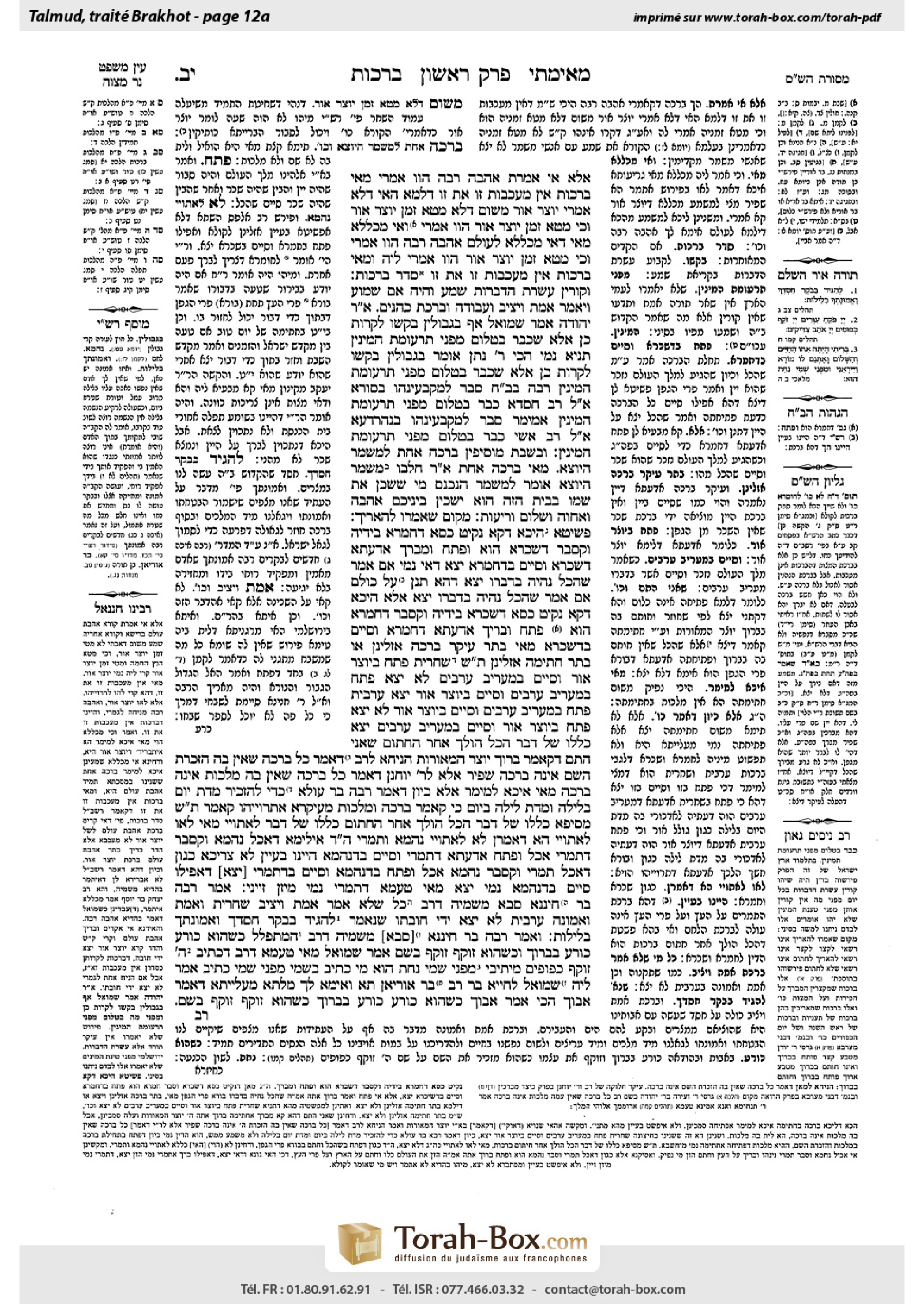
Berakhot 12a: Talmud study for Daf Yomi
Study the Talmud for Daf Yomi with scanned pages, Hebrew text, English translations from Sefaria and AI-generated French translations.
Passage selection and English or AI-generated French translation are available where the scan has annotations. Daf Study is independent of Torah-Box and Sefaria.
Browse Berakhot · ברכות · All tractatesBerakhot 12a text and translations
This page of Berakhot includes the Aramaic text, an English translation and an AI-generated French translation, alongside the scan above.
ברכות י״ב א · Aramaic and Hebrew text
אֶלָּא, אִי אָמְרַתְּ ״אַהֲבָה רַבָּה״ הֲווֹ אָמְרִי, מַאי בְּרָכוֹת אֵין מְעַכְּבוֹת זוֹ אֶת זוֹ? דִּלְמָא הַאי דְּלָא אָמְרִי ״יוֹצֵר אוֹר״ מִשּׁוּם דְּלָא מְטָא זְמַן ״יוֹצֵר אוֹר״, וְכִי מְטָא זְמַן ״יוֹצֵר אוֹר״ הֲווֹ אָמְרִי.
וְאִי מִכְּלָלָא מַאי?
דְּאִי מִכְּלָלָא, לְעוֹלָם ״אַהֲבָה רַבָּה״ הֲווֹ אָמְרִי. וְכִי מְטָא זְמַן ״יוֹצֵר אוֹר״ הֲווֹ אָמְרִי לֵיהּ. וּמַאי ״בְּרָכוֹת אֵין מְעַכְּבוֹת זוֹ אֶת זוֹ״ — סֵדֶר בְּרָכוֹת.
וְקוֹרִין עֲשֶׂרֶת הַדִּבְּרוֹת ״שְׁמַע״, ״וְהָיָה אִם שָׁמוֹעַ״, ״וַיֹּאמֶר״, ״אֱמֶת וְיַצִּיב״, וַעֲבוֹדָה, וּבִרְכַּת כֹּהֲנִים.
אָמַר רַב יְהוּדָה אָמַר שְׁמוּאֵל: אַף בִּגְבוּלִין בִּקְּשׁוּ לִקְרוֹת כֵּן, אֶלָּא שֶׁכְּבָר בִּטְּלוּם מִפְּנֵי תַּרְעוֹמֶת הַמִּינִין.
תַּנְיָא נָמֵי הָכִי, רַבִּי נָתָן אוֹמֵר: בִּגְבוּלִין בִּקְּשׁוּ לִקְרוֹת כֵּן, אֶלָּא שֶׁכְּבָר בִּטְּלוּם מִפְּנֵי תַּרְעוֹמֶת הַמִּינִין.
רַבָּה בַּר בַּר חַנָּה סְבַר לְמִקְבְּעִינְהוּ בְּסוּרָא, אֲמַר לֵיהּ רַב חִסְדָּא: כְּבָר בִּטְּלוּם מִפְּנֵי תַּרְעוֹמֶת הַמִּינִין.
אֲמֵימַר סְבַר לְמִקְבְּעִינְהוּ בִּנְהַרְדְּעָא, אֲמַר לֵיהּ רַב אָשֵׁי: כְּבָר בִּטְּלוּם מִפְּנֵי תַּרְעוֹמֶת הַמִּינִין.
וּבְשַׁבָּת מוֹסִיפִין בְּרָכָה אַחַת לַמִּשְׁמָר הַיּוֹצֵא. מַאי בְּרָכָה אַחַת? אָמַר רַבִּי חֶלְבּוֹ: מִשְׁמָר הַיּוֹצֵא אוֹמֵר לַמִּשְׁמָר הַנִּכְנָס: ״מִי שֶׁשִּׁכֵּן אֶת שְׁמוֹ בַּבַּיִת הַזֶּה, הוּא יַשְׁכִּין בֵּינֵיכֶם אַהֲבָה וְאַחְוָה וְשָׁלוֹם וְרֵיעוּת״.
מָקוֹם שֶׁאָמְרוּ לְהַאֲרִיךְ. פְּשִׁיטָא הֵיכָא דְּקָא נָקֵיט כָּסָא דְחַמְרָא בִּידֵיהּ וְקָסָבַר דְּשִׁכְרָא הוּא, וּפָתַח וּמְבָרֵךְ אַדַּעְתָּא דְשִׁכְרָא, וְסַיֵּים בִּדְחַמְרָא — יָצָא. דְּאִי נָמֵי אִם אָמַר ״שֶׁהַכֹּל נִהְיֶה בִּדְבָרוֹ״ — יָצָא. דְּהָא תְּנַן: עַל כּוּלָּם אִם אָמַר ״שֶׁהַכֹּל נִהְיֶה בִּדְבָרוֹ״ — יָצָא.
אֶלָּא הֵיכָא דְּקָא נָקֵיט כָּסָא דְשִׁכְרָא בִּידֵיהּ וְקָסָבַר דְּחַמְרָא הוּא, פְּתַח וּבָרֵיךְ אַדַּעְתָּא דְחַמְרָא, וְסַיֵּים בִּדְשִׁכְרָא, מַאי?
בָּתַר עִיקַּר בְּרָכָה אָזְלִינַן, אוֹ בָּתַר חֲתִימָה אָזְלִינַן?
תָּא שְׁמַע: שַׁחֲרִית, פָּתַח בְּ״יוֹצֵר אוֹר״ וְסִיֵּים בְּ״מַעֲרִיב עֲרָבִים״ — לֹא יָצָא. פָּתַח בְּ״מַעֲרִיב עֲרָבִים״ וְסִיֵּים בְּ״יוֹצֵר אוֹר״ — יָצָא.
עַרְבִית, פָּתַח בְּ״מַעֲרִיב עֲרָבִים״ וְסִיֵּים בְּ״יוֹצֵר אוֹר״ — לֹא יָצָא. פָּתַח בְּ״יוֹצֵר אוֹר״ וְסִיֵּים בְּ״מַעֲרִיב עֲרָבִים״ — יָצָא.
כְּלָלוֹ שֶׁל דָּבָר: הַכֹּל הוֹלֵךְ אַחַר הַחִתּוּם.
שָׁאנֵי הָתָם דְּקָאָמַר ״בָּרוּךְ יוֹצֵר הַמְּאוֹרוֹת״.
הָנִיחָא לְרַב דְּאָמַר כָּל בְּרָכָה שֶׁאֵין בָּהּ הַזְכָּרַת הַשֵּׁם אֵינָהּ בְּרָכָה — שַׁפִּיר. אֶלָּא לְרַבִּי יוֹחָנָן דְּאָמַר כָּל בְּרָכָה שֶׁאֵין בָּהּ מַלְכוּת אֵינָהּ בְּרָכָה, מַאי אִיכָּא לְמֵימַר?
אֶלָּא כֵּיוָן דְּאָמַר רַבָּה בַּר עוּלָּא: כְּדֵי לְהַזְכִּיר מִדַּת יוֹם בַּלַּיְלָה וּמִדַּת לַיְלָה בַּיּוֹם, כִּי קָאָמַר בְּרָכָה וּמַלְכוּת מֵעִיקָּרָא — אַתַּרְוַיְיהוּ קָאָמַר.
תָּא שְׁמַע מִסֵּיפָא: ״כְּלָלוֹ שֶׁל דָּבָר: הַכֹּל הוֹלֵךְ אַחַר הַחִתּוּם״. כְּלָלוֹ שֶׁל דָּבָר לְאֵתוּיֵי מַאי? לָאו לְאֵתוּיֵי הָא דַּאֲמַרַן?
לָא, לְאֵתוּיֵי נַהֲמָא וְתַמְרֵי. הֵיכִי דָמֵי? אִילֵּימָא דַּאֲכַל נַהֲמָא, וְקָסָבַר דְּתַמְרֵי אֲכַל, וּפְתַח אַדַּעְתָּא דְתַמְרֵי וְסַיֵּים בִּדְנַהֲמָא — הַיְינוּ בַּעְיָין!
לָא צְרִיכָא: כְּגוֹן דַּאֲכַל תַּמְרֵי, וְקָסָבַר נַהֲמָא אֲכַל, וּפְתַח בִּדְנַהֲמָא, וְסַיֵּים בִּדְתַמְרֵי [— יָצָא]. דַּאֲפִילּוּ סַיֵּים בִּדְנַהֲמָא — נָמֵי יָצָא.
מַאי טַעְמָא — דְּתַמְרֵי נָמֵי מֵיזָן זָיְינִי.
אָמַר רַבָּה בַּר חִינָּנָא סָבָא מִשְּׁמֵיהּ דְּרַב: כָּל שֶׁלֹּא אָמַר ״אֱמֶת וְיַצִּיב״ שַׁחֲרִית, וֶ״אֱמֶת וֶאֱמוּנָה״ עַרְבִית — לֹא יָצָא יְדֵי חוֹבָתוֹ, שֶׁנֶּאֱמַר: ״לְהַגִּיד בַּבֹּקֶר חַסְדֶּךָ וֶאֱמוּנָתְךָ בַּלֵּילוֹת״.
וְאָמַר רַבָּה בַּר חִינָּנָא [סָבָא] מִשְּׁמֵיהּ דְּרַב: הַמִּתְפַּלֵּל, כְּשֶׁהוּא כּוֹרֵעַ כּוֹרֵעַ בְּבָרוּךְ, וּכְשֶׁהוּא זוֹקֵף — זוֹקֵף בַּשֵּׁם
אָמַר שְׁמוּאֵל: מַאי טַעְמָא דְרַב — דִּכְתִיב: ״ה׳ זוֹקֵף כְּפוּפִים״.
מֵתִיבִי: ״מִפְּנֵי שְׁמִי נִחַת הוּא״.
מִי כְּתִיב ״בִּשְׁמִי״? ״מִפְּנֵי שְׁמִי״ כְּתִיב.
אֲמַר לֵיהּ שְׁמוּאֵל לְחִיָּיא בַּר רַב: בַּר אוֹרְיָאן, תָּא וְאֵימָא לְךָ מִלְּתָא מְעַלַּיְיתָא דְּאָמַר אֲבוּךְ. הָכִי אָמַר אֲבוּךְ: כְּשֶׁהוּא כּוֹרֵעַ — כּוֹרֵעַ בְּ״בָרוּךְ״, כְּשֶׁהוּא זוֹקֵף — זוֹקֵף בַּשֵּׁם.
Berakhot 12a · English translation
However, if you say that they would omit: Who creates light, and would recite: An abounding love, on what basis would you conclude that failure to recite one of the blessings recited before Shema does not prevent one from reciting the other? In that case, one could offer another reason why only a single blessing is recited. Perhaps the fact that they did not recite: Who creates light was because the time for the recitation of: Who creates light, had not yet arrived, as the sun had yet to rise. The blessings of the priestly watch are recited in the early morning hours, long before sunrise. However, afterward, when the time to recite: Who creates light arrived, they would recite it. From the conclusion drawn by Rabbi Shimon ben Lakish, that failure to recite one of the blessings recited before Shema does not prevent one from reciting the other, it is clear that the blessing recited by the members of the priestly watch was: Who creates light.
As this deductive reasoning seems coherent and convincing, the Gemara asks: And if this halakha is based on inference, and not on an explicit statement, what of it? There seems to be no other way to interpret Rabbi Shimon ben Lakish’s statement.
The Gemara answers: If this conclusion were based on an inference, one could say that actually they recited: An abounding love, and when the time to recite: Who creates light arrived, they would recite it. In that case, what is the meaning of: Failure to recite one of the blessings recited before Shema does not prevent one from reciting the other? Rabbi Shimon ben Lakish meant that failure to recite the correct order of the blessings does not prevent one from fulfilling his obligation. Even if one recites: An abounding love before: Who creates light, he fulfills his obligation. Rabbi Shimon ben Lakish did not refer to a case where only one of the blessings was recited. Consequently, one cannot infer from his statement his opinion regarding the identity of the single blessing.
The Gemara related above that the priests in the Temple read the Ten Commandments, along with the sections of Shema, VeHaya im Shamoa, VaYomer, True and Firm, Avoda, and the priestly benediction.
Rav Yehuda said that Shmuel said: Even in the outlying areas, outside the Temple, they sought to recite the Ten Commandments in this manner every day, as they are the basis of the Torah (Rambam), but they had already abolished recitation of the Ten Commandments due to the grievance of the heretics, who argued that the entire Torah, with the exception of the Ten Commandments, did not emanate from God (Jerusalem Talmud). If the Ten Commandments were recited daily, that would lend credence to their claim, so their recitation was expunged from the daily prayers.
That was also taught in a baraita that Rabbi Natan says: In the outlying areas, they sought to recite the Ten Commandments in this manner, but they had already abolished their recitation due to the grievance of the heretics.
The Gemara relates that several Sages sought to reinstitute recitation of the Ten Commandments, as Rabba bar bar Ḥana thought to institute this in the city of Sura, but Rav Ḥisda said to him: They already abolished them due to the grievance of the heretics.
So too, Ameimar thought to institute this in the city of Neharde’a. Rav Ashi, the most prominent of the Sages in that generation, said to him: They already abolished them due to the grievance of the heretics.
We learned in a mishna in tractate Tamid that on Shabbat a single blessing is added to bless the outgoing priestly watch. The Gemara asks: What is that single blessing? Rabbi Ḥelbo said: As they finished their service, the outgoing priestly watch would say to the incoming priestly watch: May He who caused His Name to dwell in this house cause love and brotherhood, peace and camaraderie to dwell among you.
We learned in the mishna: Where the Sages said to recite a long blessing, one may not shorten it, and vice-versa. The Gemara proceeds to address a particular problem arising from conclusions drawn from this mishna. Before addressing the primary problem, however, a simpler, secondary issue is raised: Obviously, in a case where one took a cup of wine in his hand and thought it was beer, and began reciting the blessing thinking it was beer, i.e., he intended to recite the appropriate blessing on beer: By Whose word all things came to be, and upon realizing that it was wine, he concluded the blessing with that which is recited over wine: Who creates the fruit of the vine, he fulfilled his obligation. In that case, even had he recited: By Whose word all things came to be, as he originally intended, he would have fulfilled his obligation, as we learned in a mishna: If one recited the general blessing: By Whose word all things came to be, over all food items, he fulfilled his obligation after the fact, even if ab initio another blessing was instituted to recite before eating that food. Therefore, if he reconsidered and concluded the blessing with the ending of the blessing over wine, he fulfilled his obligation.
However in a case where one took a cup of beer in his hand and thought it was wine, and began reciting the blessing thinking it was wine, meaning he intended to recite: Who creates the fruit of the vine, and upon realizing that it was beer he concluded the blessing with that which is recited over beer: By Whose word all things came to be, what is the halakha?
Ostensibly, this blessing is comprised of two sections. The first section, during which he intended to recite: Who creates the fruit of the vine, cannot fulfill his obligation as it is an inappropriate blessing to recite over beer. However, in the second section he recited: By Whose word all things came to be, the appropriate blessing. The dilemma, then, is: Do we follow the essence of the blessing, the first section, or do we follow the conclusion of the blessing?
Come and hear a proof from what was taught in a baraita with regard to a similar case: If, in the morning prayer, one began the blessings prior to the recitation of Shema appropriately with: Who creates light, and concluded with the formula of the evening prayer: Who brings on evenings, he did not fulfill his obligation. However, if one did the opposite, and commenced with: Who brings on evenings, and concluded with: Who creates light, he fulfilled his obligation.
Similarly, if, in the evening prayer, one commenced the recitation of Shema with: Who brings on evenings and concluded with: Who creates light, he did not fulfill his obligation. If one commenced with: Who creates light and concluded with: Who brings on evenings, he fulfilled his obligation.
The baraita summarizes that the general principle is: Everything follows the conclusion of the blessing. Based on this principle, the question with regard to a blessing recited over food and drink posed above can be resolved.
This proof is rejected: There, in the case of the blessing recited over the radiant lights, it is different, as one recites: Blessed…Who forms the radiant lights, and similarly, in the evening one recites: Blessed…Who brings on evenings. Since these are long blessings that conclude with a second blessing summarizing their content, one could assert that everything follows the conclusion. However, in the case of short blessings, such as: By Whose word all things came to be, or: Who creates the fruit of the vine, ostensibly, if there is a problem with the first part of the blessing, the entire blessing is nullified.
The distinction between the blessing recited over the radiant lights and the blessings recited over food and drink stems from the assumption that the conclusion: Blessed…Who fashions the radiant lights, is a complete, independent blessing. However, this is not necessarily so. This works out well according to Rav, who said: Any blessing that does not include mention of God’s name is not considered a blessing, and since: Who creates light, includes God’s name, it constitutes a complete, independent blessing. That works out well. However, according to Rabbi Yoḥanan, who said: Any blessing that does not include mention of God’s sovereignty, i.e., our God, King of the universe, is not considered a blessing, what can be said to distinguish between the conclusion of the blessings over food and drink and the blessing over the radiant lights? Since the conclusion: Who creates light, does not mention God’s sovereignty, it does not constitute a complete, independent blessing.
The Gemara responds: Rather, Rabbi Yoḥanan also holds that the blessing over the radiant lights is a complete blessing. Since Rabba bar Ulla said: Who creates darkness, is mentioned during the day and: Rolling away the light before the darkness, is mentioned at night in order to mention the attribute of day at night and the attribute of night in the day, the beginning of the blessing in which God’s sovereignty is mentioned day and night is appropriate to both day and night, and when one recites the blessing with God’s name and mentions God’s sovereignty at the beginning of the blessing, it refers to both day and night. Therefore, no proof can be cited from the blessing over the radiant lights to the blessings recited over food and drink.
The Gemara attempts to cite an additional proof: Come and hear another solution based on what we learned in the latter clause of the baraita cited above: The general principle is: Everything follows the conclusion of the blessing. What does the phrase: The general principle is, come to include beyond the detailed example cited in the baraita? Does it not come to include the case that we stated, that both in the case of a long blessing and the case of a short blessing, the conclusion of the blessing is the determining factor?
The Gemara rejects this: No, the principle is cited to include a case of bread and dates. The Gemara clarifies: What are the circumstances of the dilemma with regard to the blessings on these food items? If you say that it is a case where one ate bread and thought that he ate dates, and commenced reciting the blessing thinking it was dates; then, upon realizing that it was bread, he concluded the blessing with that which is recited over bread, isn’t that our dilemma, as this case is identical to the one involving wine and beer?
The Gemara answers: No; this general principle is only necessary to teach a special case, where one ate dates and thought that he ate bread, and commenced reciting the blessing thinking they were bread. Upon realizing that they were dates, he concluded the blessing with that which is recited over dates. In that case he fulfilled his obligation, as even had he concluded the blessing with that which is recited over bread, he would have fulfilled his obligation.
What is the reason that had he concluded with the blessing recited over bread he would have fulfilled his obligation to recite a blessing over dates? This is because dates also provide a person sustenance. While ab initio one should not recite the blessing for bread over dates, after the fact, if one did so, he fulfilled his obligation. It is with regard to this particular situation that the baraita established the principle: Everything follows the conclusion of the blessing. Ultimately, the dilemma regarding a blessing with an inappropriate opening and an appropriate conclusion remains unresolved.
The Gemara proceeds to discuss the formula for the blessings recited along with Shema.
Rabba bar Ḥinnana Sava said in the name of Rav: One who did not recite: True and Firm [emet veyatziv] at the beginning of the blessing of redemption that follows Shema in the morning prayer, and: True and Trustworthy [emet ve’emuna] in the evening prayer, he did not fulfill his obligation. An allusion to the difference in formulation between morning and evening is, as it is stated: “To declare Your kindness in the morning and Your faith in the nights” (Psalms 92:3). In the morning, one must mention God’s loving-kindness, while in the evening one is required to emphasize the aspect of faith.
And Rabba bar Ḥinnana Sava said in the name of Rav: One who is praying, when he bows in the appropriate places, he bows when he says: Blessed, and when he subsequently stands upright, he stands upright when he says God’s name.
Shmuel, who was Rav’s colleague and significantly outlived him, said: What is Rav’s reason for saying that one should stand upright at the mention of God’s name? As it is written: “The Lord, who raises the bowed” (Psalms 146:8); one stands upright at the mention of God’s name to recall that it is God who raises the bowed.
The Gemara raises an objection based on what we learned in praise of a priest: “And he was afraid before My name” (Malachi 2:5), indicating that one must be humbled and not upright before God’s name.
The Gemara responds: Is it written: At My name? Before My name, is written, meaning that one is humbled and bows prior to the mention of God’s name, when he says: Blessed.
The Gemara relates: Shmuel said to Ḥiyya bar Rav: Son of Torah, come and I will tell you a great saying that your father said. Your father said the following: When one bows, he bows when he says: Blessed, and when he stands upright, he stands upright when he says God’s name.
Berakhot 12a · Traduction française (IA)
Cependant, si l'on dit qu'ils auraient omis : Celui qui crée la lumière, et auraient récité : Une affection abondante, sur quelle base conclurait-on que l'omission de l'une des bénédictions récitées avant le Chéma ne bloque pas la récitation de l'autre ? Dans ce cas, on pourrait avancer une autre raison pour expliquer pourquoi seule une bénédiction est récitée. Peut-être que le fait qu'ils n'aient pas récité : Celui qui crée la lumière était dû au fait que le moment de la récitation de : Celui qui crée la lumière n'était pas encore arrivé, car le soleil n'avait pas encore levé. Les bénédictions du service des prêtres sont récitées tôt le matin, bien avant l'aube. Cependant, après cela, quand le moment de réciter : Celui qui crée la lumière est arrivé, ils le récitaient. À partir de la conclusion tirée par Rabbi Shimon ben Lakish, que l'omission de l'une des bénédictions récitées avant le Chéma ne bloque pas la récitation de l'autre, il est clair que la bénédiction récitée par les membres du service des prêtres était : Celui qui crée la lumière.
Puisque ce raisonnement déductif semble cohérent et convaincant, la Guemara pose la question : Et si cette halakha est basée sur une déduction, et non sur un énoncé explicite, qu'y a-t-il à en faire ? Il semble qu'il n'y ait pas d'autre interprétation possible de l'expression de Rabbi Shimon ben Lakish.
La Guemara répond : Si cette conclusion était basée sur une déduction, on pourrait dire qu'ils ont en réalité récité : Une tendre affection, et quand le moment de réciter : Celui qui crée la lumière est arrivé, ils le récitaient. Dans ce cas, quelle est la signification de : L'omission de l'une des bénédictions récitées avant le Chéma ne bloque pas la récitation de l'autre ? Rabbi Shimon ben Lakish voulait dire que l'omission de l'ordre correct des bénédictions ne bloque pas l'accomplissement de l'obligation. Même si l'on récite : Une tendre affection avant : Celui qui crée la lumière, on accomplit son obligation. Rabbi Shimon ben Lakish ne faisait pas référence à un cas où seule une bénédiction était récitée. Par conséquent, on ne peut pas déduire de son énoncé son avis sur l'identité de la bénédiction unique.
La Guemara rapporte ci-dessus que les prêtres dans le Temple lisaient les Dix Commandements, ainsi que les sections du Chéma, VeHaya im Shamoa, VaYomer, Véroua, Avoda, et la bénédiction des prêtres.
Rav Yehuda a dit que Shmuel a dit : Même dans les zones périphériques, en dehors du Temple, ils cherchaient à réciter les Dix Commandements ainsi chaque jour, car ils sont la base de la Torah (Rambam), mais ils avaient déjà supprimé la récitation des Dix Commandements en raison de la plainte des hérétiques, qui arguaient que toute la Torah, à l'exception des Dix Commandements, ne provenait pas de Dieu (Talmud de Jérusalem). Si les Dix Commandements étaient récités quotidiennement, cela aurait donné crédit à leur affirmation, donc leur récitation a été supprimée des prières quotidiennes.
Cela a également été enseigné dans une baraïta que Rabbi Natan dit : Dans les zones périphériques, ils cherchaient à réciter les Dix Commandements ainsi, mais ils avaient déjà supprimé leur récitation en raison de la plainte des hérétiques.
La Guemara rapporte que plusieurs Sages cherchaient à rétablir la récitation des Dix Commandements, car Rabba bar bar Ḥana pensait à instituer cela à la ville de Sura, mais Rav Ḥisda lui a dit : Ils l'ont déjà supprimé en raison de la plainte des hérétiques.
De même, Ameimar pensait à instituer cela à la ville de Neharde’a. Rav Ashi, le plus important des Sages de cette génération, lui a dit : Ils l'ont déjà supprimé en raison de la plainte des hérétiques.
Nous avons appris dans une mishna du traité Tamid que le sabbat, une bénédiction unique est ajoutée pour bénir la garde des prêtres sortants. La Guemara pose la question : Quelle est cette bénédiction unique ? Rabbi Ḥelbo a dit : À la fin de leur service, la garde des prêtres sortants disait à la garde des prêtres entrants : Que Celui qui a fait résider Son Nom dans cette maison fasse résider l'amour et l'amitié, la paix et la camaraderie parmi vous.
Nous avons appris dans la Michna : Lorsque les Sages ont dit de réciter une bénédiction longue, on ne peut pas la raccourcir, et vice versa. La Guemara aborde ensuite un problème particulier issu des conclusions tirées de cette Michna. Avant d'aborder le problème principal, cependant, un problème secondaire et plus simple est soulevé : Évidemment, dans le cas où l'on tenait une tasse de vin à la main et pensait qu'il s'agissait de bière, et commençait à réciter la bénédiction en pensant qu'il s'agissait de bière, c'est-à-dire qu'il avait l'intention de réciter la bénédiction appropriée pour la bière : Par la Parole dont toutes choses sont venues à l'être, et en réalisant qu'il s'agissait de vin, il concluait la bénédiction avec celle qui est récitée sur le vin : Celui qui crée la fruit de la vigne, il accomplissait son obligation. Dans ce cas, même s'il avait récité : Par la Parole dont toutes choses sont venues à l'être, comme il l'avait initialement prévu, il aurait accompli son obligation, comme nous l'avons appris dans une Michna : Si l'on récitait la bénédiction générale : Par la Parole dont toutes choses sont venues à l'être sur tous les aliments, il accomplissait son obligation après coup, même si une autre bénédiction avait été instituée initialement pour réciter avant de manger cet aliment. Par conséquent, s'il avait réexaminé et conclu la bénédiction avec la fin de la bénédiction sur le vin, il aurait accompli son obligation.
Cependant, dans le cas où l'on tenait une tasse de bière à la main et pensait qu'il s'agissait de vin, et commençait à réciter la bénédiction en pensant qu'il s'agissait de vin, c'est-à-dire qu'il avait l'intention de réciter : Celui qui crée la fruit de la vigne, et en réalisant qu'il s'agissait de bière, il concluait la bénédiction avec celle qui est récitée sur la bière : Par la Parole dont toutes choses sont venues à l'être, quelle est la halakha ?
A priori, cette bénédiction est composée de deux parties. La première partie, pendant laquelle il avait l'intention de réciter : Celui qui crée la fruit de la vigne, ne permet pas d'accomplir son obligation, car c'est une bénédiction inappropriée pour la bière. Cependant, dans la deuxième partie, il récitait : Par la Parole dont toutes choses sont venues à l'être, la bénédiction appropriée. Le dilemme est donc : suivons-nous l'essence de la bénédiction, la première partie, ou la conclusion de la bénédiction ?
Venez écouter une preuve tirée d'une baraïta concernant un cas similaire : Si, lors de la prière du matin, l'on commence les bénédictions avant la récitation du Chéma de manière appropriée avec : Celui qui crée la lumière, et s'achève avec la formule de la prière du soir : Celui qui fait venir les soirs, il n'a pas accompli son obligation. Cependant, si l'on fait l'inverse, et qu'on commence avec : Celui qui fait venir les soirs, et s'achève avec : Celui qui crée la lumière, il a accompli son obligation.
De même, si, lors de la prière du soir, l'on commence la récitation du Chéma avec : Celui qui fait venir les soirs et s'achève avec : Celui qui crée la lumière, il n'a pas accompli son obligation. Si l'on commence avec : Celui qui crée la lumière et s'achève avec : Celui qui fait venir les soirs, il a accompli son obligation.
La baraïta résume que le principe général est : Tout suit la conclusion de la bénédiction. Sur la base de ce principe, la question concernant une bénédiction récitée sur les aliments et les boissons évoquée ci-dessus peut être résolue.
Cette preuve est rejetée : Il y a une différence dans le cas de la bénédiction récitée sur les lumières brillantes, car l'on récite : Béni… Celui qui forme les lumières brillantes, et de même, le soir l'on récite : Béni… Celui qui fait venir les soirs. Puisque ces sont des bénédictions longues qui s'achèvent avec une autre bénédiction résumant leur contenu, on pourrait affirmer que tout suit la conclusion. Cependant, dans le cas des bénédictions courtes, telles que : Par la parole dont toutes choses sont venues à l'être, ou : Celui qui crée le fruit du raisin, apparemment, si y a un problème dans la première partie de la bénédiction, la bénédiction entière est annulée.
La distinction entre la bénédiction récitée sur les lumières brillantes et les bénédictions récitées sur les aliments et les boissons provient de l'hypothèse selon laquelle la conclusion : Béni… Celui qui façonne les lumières brillantes, est une bénédiction complète et indépendante. Cependant, cela n'est pas nécessairement vrai. Cela s'explique bien selon Rav, qui a dit : Toute bénédiction qui ne contient pas la mention du nom de Dieu n'est pas considérée comme une bénédiction, et puisque : Celui qui crée la lumière contient le nom de Dieu, elle constitue une bénédiction complète et indépendante. Cela s'explique bien. Cependant, selon Rabbi Yoḥanan, qui a dit : Toute bénédiction qui ne contient pas la mention de la souveraineté de Dieu, c'est-à-dire notre Dieu, roi du monde, n'est pas considérée comme une bénédiction, que peut-on dire pour distinguer entre la conclusion des bénédictions sur les aliments et les boissons et la bénédiction sur les lumières brillantes ? Puisque la conclusion : Celui qui crée la lumière ne mentionne pas la souveraineté de Dieu, elle ne constitue pas une bénédiction complète et indépendante.
La Guemara répond : Plutôt, Rabbi Yoḥanan considère également que la bénédiction sur les lumières brillantes est une bénédiction complète. Puisque Rabba bar Ulla a dit : Celui qui crée l'obscurité est mentionné pendant la journée et : Éloignant la lumière avant l'obscurité est mentionné la nuit afin de mentionner l'attribut du jour dans la nuit et l'attribut de la nuit dans la journée, le début de la bénédiction dans lequel la souveraineté de Dieu est mentionnée jour et nuit est approprié à la fois jour et nuit, et lorsque l'on récite la bénédiction avec le nom de Dieu et mentionne la souveraineté de Dieu au début de la bénédiction, cela se réfère à la fois jour et nuit. Ainsi, aucune preuve ne peut être tirée de la bénédiction sur les lumières brillantes pour les bénédictions récitées sur les aliments et les boissons.
La Guemara tente de citer une preuve supplémentaire : Venez écouter une autre solution basée sur ce que nous avons appris dans la dernière partie de la baraïta citée ci-dessus : Le principe général est : Tout suit la conclusion de la bénédiction. Que signifie la phrase : Le principe général est, venir inclure au-delà de l'exemple détaillé cité dans la baraïta ? N'est-ce pas venir inclure le cas que nous avons évoqué, celui où les deux, dans le cas d'une bénédiction longue et dans le cas d'une bénédiction courte, la conclusion de la bénédiction est le facteur déterminant ?
La Guemara rejette cela : Non, le principe est cité pour inclure le cas du pain et des dattes. La Guemara clarifie : Quelles sont les circonstances du dilemme concernant ces bénédictions ? Si l'on dit que c'est un cas où l'on a mangé du pain et pensait avoir mangé des dattes, et a commencé à réciter la bénédiction en pensant qu'il s'agissait de dattes ; puis, en réalisant qu'il s'agissait de pain, l'on a conclu la bénédiction avec ce qui est récité sur le pain, n'est-ce pas notre dilemme, car ce cas est identique à celui des vins et des bières ?
La Guemara répond : Non ; ce principe général est nécessaire uniquement pour enseigner un cas particulier, où l'on a mangé des dattes et pensait avoir mangé du pain, et a commencé à réciter la bénédiction en pensant qu'il s'agissait de pain. En réalisant qu'il s'agissait de dattes, l'on a conclu la bénédiction avec ce qui est récité sur les dattes. Dans ce cas, il a accompli son obligation, car même s'il avait conclu la bénédiction avec ce qui est récité sur le pain, il aurait accompli son obligation.
Quelle est la raison pour laquelle, s'il avait conclu avec la bénédiction récitée sur le pain, il aurait accompli son obligation à réciter une bénédiction sur les dattes ? C'est parce que les dattes fournissent également un aliment à la personne. Bien que d'abord on ne devrait pas réciter la bénédiction sur le pain sur les dattes, après coup, si l'on l'a fait, il a accompli son obligation. C'est à propos de cette situation particulière que la baraïta a établi le principe : Tout suit la conclusion de la bénédiction. Finalement, le dilemme concernant une bénédiction avec un début inapproprié et une conclusion appropriée reste sans résolution. La Guemara passe ensuite à discuter de la formule des bénédictions récitées avec le Chéma.
Rabba bar Ḥinnana Sava a dit en nom de Rav : Celui qui n’a pas récité : Vrai et Fermé [émét véyatziv] au début de la berakha de la délivrance qui suit le Chéma dans la prière du matin, et : Vrai et Fidèle [émét vé’emuna] dans la prière du soir, n’a pas accompli son devoir. Une allusion à la différence de formulation entre le matin et le soir est, comme il est dit : « Proclamer Ta bonté au matin et Ta foi dans les nuits » (Psaumes 92:3). Au matin, on doit mentionner la bonté de Dieu, tandis que le soir, on est tenu de souligner l’aspect de la foi.
Et Rabba bar Ḥinnana Sava a dit en nom de Rav : Celui qui prie, lorsqu’il se courbe aux endroits appropriés, se courbe lorsqu’il dit : Béni, et lorsqu’il se redresse ensuite, il se redresse lorsqu’il dit le nom de Dieu.
Shmuel, qui était le collègue de Rav et qui a significativement survécu à celui-ci, a dit : Quel est le raisonnement de Rav pour dire qu’on doit se redresser à l’évocation du nom de Dieu ? Comme il est écrit : « L’Eternel, qui soulève ceux qui sont prosternés » (Psaumes 146:8) ; on se redresse à l’évocation du nom de Dieu pour rappeler que c’est Dieu qui soulève ceux qui sont prosternés.
La Guemara émet une objection fondée sur ce que nous avons appris en l'honneur du prêtre : « Et il avait peur devant Mon nom » (Malachie 2:5), indiquant qu'on doit être humble et non se redresser devant le nom de Dieu.
La Guemara répond : Est-il écrit : Devant Mon nom ? Avant Mon nom, il est écrit, signifiant que l'on est humble et qu'on se courbe avant l'évocation du nom de Dieu, lorsqu'on dit : Béni.
La Guemara rapporte : Shmuel a dit à Ḥiyya bar Rav : Fils de la Torah, viens, je te dirai une grande parole que ton père a dite. Ton père a dit ceci : Lorsqu'on se courbe, on se courbe lorsqu'on dit : Béni, et lorsqu'on se redresse, on se redresse lorsqu'on dit le nom de Dieu.
Traduction française générée par IA à partir de l’édition anglaise de Sefaria. Vérifie toujours un passage avec le texte source.
Text from Sefaria: William Davidson Edition - Vocalized Aramaic (CC BY NC); William Davidson Edition - English (CC BY NC).