Berakhot 12b: Talmud study for Daf Yomi
Study the Talmud for Daf Yomi with scanned pages, Hebrew text, English translations from Sefaria and AI-generated French translations.
Passage selection and English or AI-generated French translation are available where the scan has annotations. Daf Study is independent of Torah-Box and Sefaria.
Browse Berakhot · ברכות · All tractatesBerakhot 12b text and translations
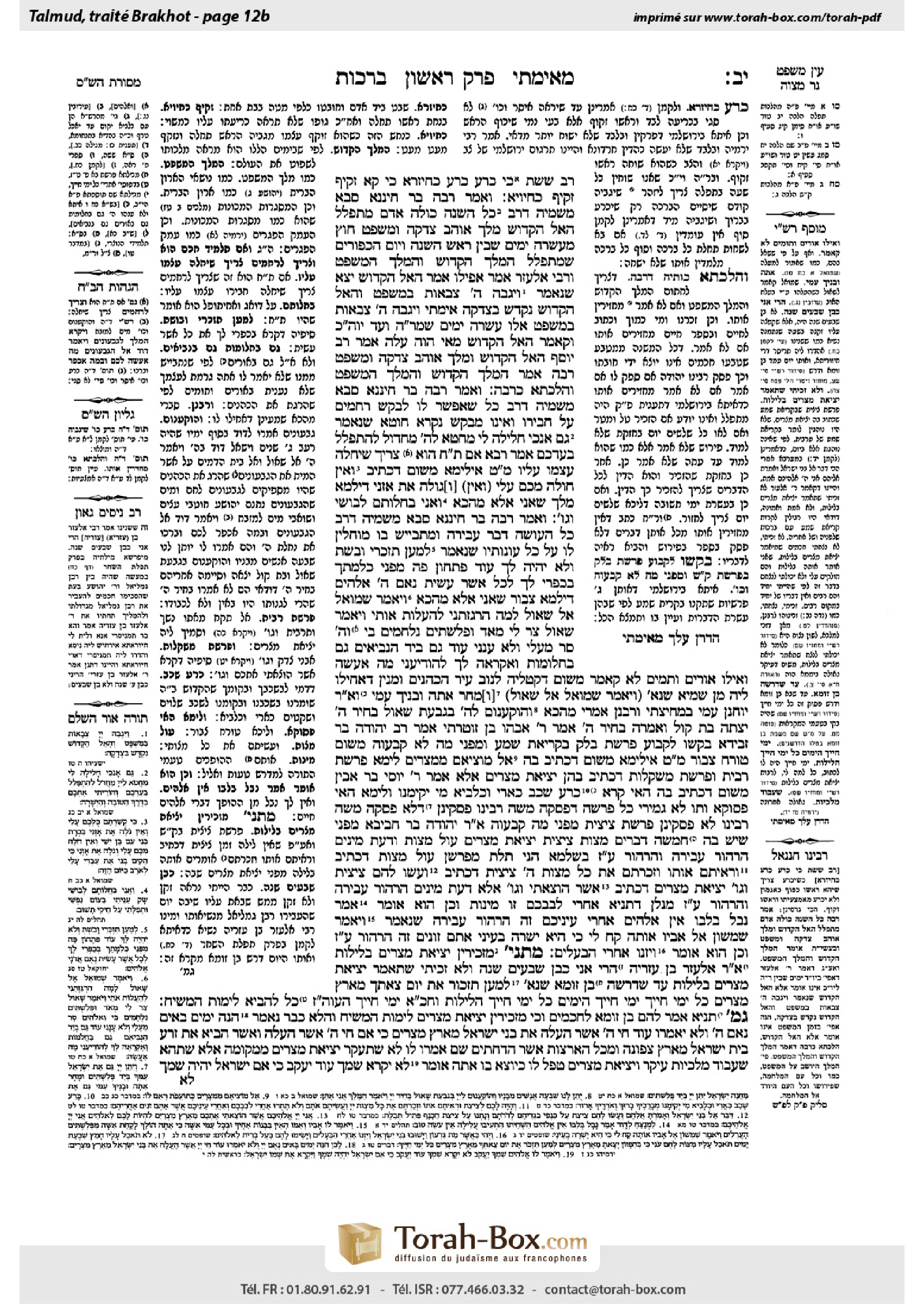
This page of Berakhot includes the Aramaic text, an English translation and an AI-generated French translation, alongside the scan above.
ברכות י״ב ב · Aramaic and Hebrew text
רַב שֵׁשֶׁת, כִּי כָּרַע — כָּרַע כְּחִיזְרָא. כִּי קָא זָקֵיף — זָקֵיף כְּחִיוְיָא.
וְאָמַר רַבָּה בַּר חִינָּנָא סָבָא מִשְּׁמֵיהּ דְּרַב כָּל הַשָּׁנָה כּוּלָּהּ אָדָם מִתְפַּלֵּל ״הָאֵל הַקָּדוֹשׁ״, ״מֶלֶךְ אוֹהֵב צְדָקָה וּמִשְׁפָּט״, חוּץ מֵעֲשָׂרָה יָמִים שֶׁבֵּין רֹאשׁ הַשָּׁנָה וְיוֹם הַכִּפּוּרִים, שֶׁמִּתְפַּלֵּל ״הַמֶּלֶךְ הַקָּדוֹשׁ״, וְ״הַמֶּלֶךְ הַמִּשְׁפָּט״.
וְרַבִּי אֶלְעָזָר אָמַר אֲפִילּוּ אָמַר ״הָאֵל הַקָּדוֹשׁ״ — יָצָא. שֶׁנֶּאֱמַר: ״וַיִּגְבַּה ה׳ צְבָאוֹת בַּמִּשְׁפָּט וְהָאֵל הַקָּדוֹשׁ נִקְדָּשׁ בִּצְדָקָה״. אֵימָתַי ״וַיִּגְבַּה ה׳ צְבָאוֹת בַּמִּשְׁפָּט״ — אֵלּוּ עֲשָׂרָה יָמִים שֶׁמֵּרֹאשׁ הַשָּׁנָה וְעַד יוֹם הַכִּפּוּרִים, וְקָאָמַר ״הָאֵל הַקָּדוֹשׁ״.
מַאי הֲוָה עֲלַהּ?
אָמַר רַב יוֹסֵף: ״הָאֵל הַקָּדוֹשׁ״ וּ״מֶלֶךְ אוֹהֵב צְדָקָה וּמִשְׁפָּט״. רַבָּה אָמַר: ״הַמֶּלֶךְ הַקָּדוֹשׁ״ וְ״הַמֶּלֶךְ הַמִּשְׁפָּט״. וְהִלְכְתָא כְּרַבָּה.
וְאָמַר רַבָּה בַּר חִינָּנָא סָבָא מִשְּׁמֵיהּ דְּרַב: כֹּל שֶׁאֶפְשָׁר לוֹ לְבַקֵּשׁ רַחֲמִים עַל חֲבֵירוֹ וְאֵינוֹ מְבַקֵּשׁ — נִקְרָא ״חוֹטֵא״. שֶׁנֶּאֱמַר: ״גַּם אָנֹכִי חָלִילָה לִּי מֵחֲטֹא לַה׳ מֵחֲדֹל לְהִתְפַּלֵּל בַּעַדְכֶם״.
אָמַר רָבָא: אִם תַּלְמִיד חָכָם הוּא, צָרִיךְ שֶׁיַּחֲלֶה עַצְמוֹ עָלָיו.
מַאי טַעְמָא? אִילֵּימָא מִשּׁוּם דִּכְתִיב: ״וְאֵין חֹלֶה מִכֶּם עָלַי וְאֵין גּוֹלֶה אֶת אָזְנִי״ — דִּילְמָא מֶלֶךְ שָׁאנֵי. אֶלָּא מֵהָכָא: ״וַאֲנִי בַּחֲלוֹתָם לְבוּשִׁי וְגוֹ׳״.
וְאָמַר רַבָּה בַּר חִינָּנָא סָבָא מִשְּׁמֵיהּ דְּרַב: כָּל הָעוֹשֶׂה דְּבַר עֲבֵירָה וּמִתְבַּיֵּישׁ בּוֹ — מוֹחֲלִין לוֹ עַל כָּל עֲוֹנוֹתָיו. שֶׁנֶּאֱמַר: ״לְמַעַן תִּזְכְּרִי וָבֹשְׁתְּ וְלֹא יִהְיֶה לָּךְ עוֹד פִּתְחוֹן פֶּה מִפְּנֵי כְּלִמָּתֵךְ בְּכַפְּרִי לָךְ לְכָל אֲשֶׁר עָשִׂית נְאֻם ה׳ אֱלֹהִים״.
דִּילְמָא צִבּוּר שָׁאנֵי. אֶלָּא מֵהָכָא: ״וַיֹּאמֶר שְׁמוּאֵל אֶל שָׁאוּל לָמָּה הִרְגַּזְתַּנִי לְהַעֲלוֹת אֹתִי וַיֹּאמֶר שָׁאוּל צַר לִי מְאֹד וּפְלִשְׁתִּים נִלְחָמִים בִּי וַה׳ סָר מֵעָלַי וְלֹא עָנָנִי עוֹד גַּם בְּיַד הַנְּבִיאִים גַּם בַּחֲלֹמוֹת וָאֶקְרָאֶה לְךָ לְהוֹדִיעֵנִי מָה אֶעֱשֶׂה״. וְאִילּוּ ״אוּרִים וְתֻמִּים״ לָא קָאָמַר.
מִשּׁוּם דְּקַטְלֵיהּ לְנוֹב עִיר הַכֹּהֲנִים.
וּמִנַּיִן דְּאַחִילוּ לֵיהּ מִן שְׁמַיָּא — שֶׁנֶּאֱמַר: ״וַיֹּאמֶר שְׁמוּאֵל אֶל שָׁאוּל (מָחָר) [וּמָחָר] אַתָּה וּבָנֶיךָ עִמִּי״, וְאָמַר רַבִּי יוֹחָנָן ״עִמִּי״ — בִּמְחִיצָתִי.
וְרַבָּנַן אָמְרִי, מֵהָכָא: ״וְהוֹקַעְנוּם לַה׳ בְּגִבְעַת שָׁאוּל בְּחִיר ה׳״. יָצְתָה בַּת קוֹל וְאָמְרָה ״בְּחִיר ה׳״.
אָמַר רַבִּי אֲבָהוּ בֶּן זוּטַרְתִּי אָמַר רַבִּי יְהוּדָה בַּר זְבִידָא: בִּקְּשׁוּ לִקְבּוֹעַ פָּרָשַׁת בָּלָק בִּקְרִיאַת שְׁמַע, וּמִפְּנֵי מָה לֹא קְבָעוּהָ — מִשּׁוּם טוֹרַח צִבּוּר.
מַאי טַעְמָא? אִילֵּימָא מִשּׁוּם דִּכְתִיב בָּהּ: ״אֵל מֹצִיאָם מִמִּצְרַיִם״ — לֵימָא פָּרָשַׁת רִבִּית וּפָרָשַׁת מִשְׁקָלוֹת דִּכְתִיב בָּהֶן יְצִיאַת מִצְרַיִם.
אֶלָּא אָמַר רַבִּי יוֹסֵי בַּר אָבִין, מִשּׁוּם דִּכְתִיב בָּהּ הַאי קְרָא: ״כָּרַע שָׁכַב כַּאֲרִי וּכְלָבִיא מִי יְקִימֶנּוּ״.
וְלֵימָא הַאי פְּסוּקָא וְתוּ לָא.
גְּמִירִי: כֹּל פָּרָשָׁה דְּפַסְקַהּ מֹשֶׁה רַבֵּינוּ — פָּסְקִינַן, דְּלָא פַּסְקַהּ מֹשֶׁה רַבֵּינוּ — לָא פָּסְקִינַן.
פָּרָשַׁת צִיצִית מִפְּנֵי מָה קְבָעוּהָ?
אָמַר רַבִּי יְהוּדָה בַּר חֲבִיבָא, מִפְּנֵי שֶׁיֵּשׁ בָּהּ חֲמִשָּׁה דְּבָרִים: מִצְוַת צִיצִית, יְצִיאַת מִצְרַיִם, עוֹל מִצְוֹת, וְדַעַת מִינִים, הִרְהוּר עֲבֵירָה, וְהִרְהוּר עֲבוֹדָה זָרָה.
בִּשְׁלָמָא הָנֵי תְּלָת מְפָרְשָׁן. עוֹל מִצְוֹת, דִּכְתִיב: ״וּרְאִיתֶם אֹתוֹ וּזְכַרְתֶּם אֶת כָּל מִצְוֹת ה׳״. צִיצִית, דִּכְתִיב: ״וְעָשׂוּ לָהֶם צִיצִית וְגוֹ׳״. יְצִיאַת מִצְרַיִם, דִּכְתִיב: ״אֲשֶׁר הוֹצֵאתִי וְגוֹ׳״. אֶלָּא: דַּעַת מִינִים, הִרְהוּר עֲבֵירָה, וְהִרְהוּר עֲבוֹדָה זָרָה — מְנָלַן?
דְּתַנְיָא: ״אַחֲרֵי לְבַבְכֶם״ — זוֹ מִינוּת, וְכֵן הוּא אוֹמֵר: ״אָמַר נָבָל בְּלִבּוֹ אֵין אֱלֹהִים״. ״אַחֲרֵי עֵינֵיכֶם״ — זֶה הִרְהוּר עֲבֵירָה, שֶׁנֶּאֱמַר: ״וַיֹּאמֶר שִׁמְשׁוֹן אֶל אָבִיו אוֹתָהּ קַח לִי, כִּי הִיא יָשְׁרָה בְעֵינָי״. ״אַתֶּם זוֹנִים״ — זֶה הִרְהוּר עֲבוֹדָה זָרָה, וְכֵן הוּא אוֹמֵר ״וַיִּזְנוּ אַחֲרֵי הַבְּעָלִים״.
מַתְנִי׳ מַזְכִּירִין יְצִיאַת מִצְרַיִם בַּלֵּילוֹת. אָמַר רַבִּי אֶלְעָזָר בֶּן עֲזַרְיָה: הֲרֵי אֲנִי כְּבֶן שִׁבְעִים שָׁנָה, וְלֹא זָכִיתִי שֶׁתֵּאָמֵר יְצִיאַת מִצְרַיִם בַּלֵּילוֹת, עַד שֶׁדְּרָשָׁהּ בֶּן זוֹמָא.
שֶׁנֶּאֱמַר ״לְמַעַן תִּזְכֹּר אֶת יוֹם צֵאתְךָ מֵאֶרֶץ מִצְרַיִם כֹּל יְמֵי חַיֶּיךָ״. ״יְמֵי חַיֶּיךָ״ — הַיָּמִים, ״כֹּל יְמֵי חַיֶּיךָ״ — הַלֵּילוֹת.
וַחֲכָמִים אוֹמְרִים: ״יְמֵי חַיֶּיךָ״ — הָעוֹלָם הַזֶּה. ״כֹּל״ — לְהָבִיא לִימוֹת הַמָּשִׁיחַ.
גְּמָ׳ תַּנְיָא, אָמַר לָהֶם בֶּן זוֹמָא לַחֲכָמִים: וְכִי מַזְכִּירִין יְצִיאַת מִצְרַיִם לִימוֹת הַמָּשִׁיחַ! וַהֲלֹא כְּבָר נֶאֱמַר ״הִנֵּה יָמִים בָּאִים נְאֻם ה׳ וְלֹא יֹאמְרוּ עוֹד חַי ה׳ אֲשֶׁר הֶעֱלָה אֶת בְּנֵי יִשְׂרָאֵל מֵאֶרֶץ מִצְרַיִם כִּי אִם חַי ה׳ אֲשֶׁר הֶעֱלָה וַאֲשֶׁר הֵבִיא אֶת זֶרַע בֵּית יִשְׂרָאֵל מֵאֶרֶץ צָפוֹנָה וּמִכֹּל הָאֲרָצוֹת אֲשֶׁר הִדַּחְתִּים שָׁם״.
אָמְרוּ לוֹ: לֹא שֶׁתֵּעָקֵר יְצִיאַת מִצְרַיִם מִמְּקוֹמָהּ, אֶלָּא שֶׁתְּהֵא שִׁעְבּוּד מַלְכֻיוֹת עִיקָּר, וִיצִיאַת מִצְרַיִם טָפֵל לוֹ.
כַּיּוֹצֵא בּוֹ אַתָּה אוֹמֵר: ״לֹא יִקָּרֵא שִׁמְךָ עוֹד יַעֲקֹב כִּי אִם יִשְׂרָאֵל יִהְיֶה שְׁמֶךָ״,
Berakhot 12b · English translation
With regard to bowing, the Gemara relates: When Rav Sheshet bowed he bowed all at once, like a cane, without delay. When he stood upright he stood upright like a snake, lifting himself slowly, demonstrating that the awe of God was upon him in the manner that he bowed and stood upright (HaBoneh).
And, with regard to the formulation of the blessings, Rabba bar Ḥinnana Sava said in the name of Rav: Throughout the year a person prays and concludes the third blessing of the Amida prayer with: The holy God, and concludes the blessing regarding the restoration of justice to Israel with: King who loves righteousness and justice, with the exception of the ten days between Rosh HaShana and Yom Kippur, the Ten Days of Atonement. These days are comprised of Rosh HaShana, Yom Kippur, and the seven days in between, when one emphasizes God’s sovereignty, and so when he prays he concludes these blessings with: The holy King and: The King of justice, i.e., the King who reveals Himself through justice.
In contrast, Rabbi Elazar said that one need not be exacting, and even if he said: The holy God during those ten days, he fulfilled his obligation, as it is stated: “And the Lord of Hosts is exalted through justice, and the holy God is sanctified through righteousness” (Isaiah 5:16). The Gemara explains: When is it appropriate to describe God with terms like: And the Lord of Hosts is exalted through justice? It is appropriate when God reveals Himself through justice, during the ten days between Rosh HaShana and Yom Kippur, yet the verse says: The holy God. This appellation sufficiently underscores God’s transcendence, and there is no need to change the standard formula.
The Gemara asks: What is the conclusion that was reached about this halakha?
Here, too, opinions differ: Rav Yosef said in accordance with the opinion of Rabbi Elazar: There is no need to change the standard formula: The holy God and: King Who loves righteousness and justice. Rabba said in accordance with the opinion of Rav: The holy King and: The King of justice. The Gemara concludes: The halakha is in accordance with the opinion of Rabba.
And Rabba bar Ḥinnana Sava said in the name of Rav: Anyone who can ask for mercy on behalf of another, and does not ask is called a sinner, as it is stated following Samuel’s rebuke of the people: “As for me, far be it from me that I should transgress against the Lord in ceasing to pray for you, but I will teach you the good and the right way” (I Samuel 12:23). Had Samuel refrained from prayer, he would have committed a sin.
Rava said: If the one in need of mercy is a Torah scholar, it is insufficient to merely pray on his behalf. Rather, one must make himself ill worrying about him.
The Gemara seeks to clarify the source of this halakha. What is the reason that one must make oneself ill over a Torah scholar in need of mercy? If you say that it is because of what Saul said to his men, as it is written: “And there is none of you that is ill over me or tells unto me” (I Samuel 22:8), meaning that because Saul was a Torah scholar, it would have been appropriate for people to make themselves ill worrying about him; this is not an absolute proof. Perhaps a king is different, and excessive worry is appropriate in that case. Rather, proof that one must make oneself ill over a Torah scholar in need for mercy is from here: When David speaks of his enemies, Doeg and Ahitophel, who were Torah scholars, he says: “But for me, when they were sick, my clothing was sackcloth, I afflicted my soul with fasting” (Psalms 35:13). One must be concerned to the extent that he dresses in sackcloth and fasts for the recovery of a Torah scholar.
And Rabba bar Ḥinnana Sava said in the name of Rav: One who commits an act of transgression and is ashamed of it, all of his transgressions are forgiven. Shame is a sign that one truly despises his transgressions and that shame has the power to atone for his actions (Rabbi Yoshiyahu Pinto), as it is stated: “In order that you remember, and be embarrassed, and never open your mouth anymore, because of your shame, when I have forgiven you for all that you have done, said the Lord, God” (Ezekiel 16:63).
However this proof is rejected: Perhaps a community is different, as a community is forgiven more easily than an individual. Rather, proof that an individual ashamed of his actions is forgiven for his transgressions is cited from here, when King Saul consulted Samuel by means of a necromancer before his final war with the Philistines: “And Samuel said to Saul, why have you angered me to bring me up? And Saul said, I am very pained, and the Philistines are waging war against me, and God has removed Himself from me and answers me no more, neither by the hands of the prophets nor by dreams. And I call to you to tell me what to do” (I Samuel 28:15). Saul says that he consulted prophets and dreams, but he did not say that he consulted the Urim VeTummim.
The reason for this is because he killed all the residents of Nov, the city of priests, and because of this transgression Saul was ashamed to consult the Urim VeTummim, which was accomplished by means of a priest.
The Gemara concludes: And from where is it derived that Saul was pardoned by God in the heavens for his transgressions? As it is stated: “And Samuel said to Saul: Tomorrow you and your sons will be with me” (I Samuel 28:19). And Rabbi Yoḥanan said: With me does not only mean that they will die, but also means, in a statement that contains an aspect of consolation, that they will be in my company among the righteous in heaven, as Saul was pardoned for his transgressions.
And the Rabbis say that proof that Saul was pardoned is derived from here, from what the Gibeonites said to David: “Let seven men of his sons be given to us and we will hang them up unto the Lord in the Giva of Saul, the chosen of the Lord” (II Samuel 21:6). Certainly the Gibeonites, who were furious at Saul, would not refer to him as the chosen of the Lord. Therefore, this phrase must be understood as having been spoken by a Divine Voice that emerged and said the chosen of the Lord, because Saul had been pardoned for his transgressions and included among the completely righteous.
The Gemara returns to the primary focus of the chapter, the recitation of Shema.
Rabbi Abbahu ben Zutarti said that Rabbi Yehuda bar Zevida said: The Sages sought to establish the blessings of Balaam that appear in the Torah portion of Balak, as part of the twice-daily recitation of Shema. And why did they not establish it there? Because extending Shema would place an encumbrance on the congregation, from which the Sages sought to refrain.
The Gemara seeks: Why did the Sages seek to add the blessings of Balaam in the first place? If you say that they did so because the exodus from Egypt is mentioned, as it is written therein: “God, who brought them forth out of Egypt, is like the horns of the wild ram” (Numbers 23:22), certainly mention of the Exodus is not unique to this Torah portion. Many other portions mention the exodus as well. Let us say the portion of usury (Leviticus 25:35–38) or the portion of weights (Leviticus 19:35–37), as the exodus from Egypt is written therein as well. In addition, they are brief and would not constitute an encumbrance on the congregation.
Rather, Rabbi Yosei bar Avin said: The reason the Sages sought to establish the portion of Balak as part of the recitation of Shema is because it is written therein: “He couched, He lay down like a lion and a lioness; who shall rouse Him? Those who bless You are blessed and those who curse You are cursed” (Numbers 24:9). This is reminiscent of what is said in Shema: When you lie down, and when you rise.
On this, the Gemara asks: And if it is important to include this as part of Shema because of this single verse, then let us say this verse and nothing more.
The Gemara rejects this: It is impossible to do this, as they learned through tradition that any portion that Moses, our teacher, divided, we too divide and read separately. However, a portion that Moses, our teacher, did not divide, we do not divide and read separately. And, as stated above, the Sages did not wish to institute the recitation of the entire portion of Balak to avoid placing an encumbrance on the congregation.
The Gemara continues: Why was the portion of ritual fringes established as part of the recitation of Shema when its content is unrelated to that of the preceding portions?
Rabbi Yehuda bar Ḥaviva said: The portion of ritual fringes was added because it includes five elements including the primary reason for its inclusion, the exodus from Egypt (Melo HaRo’im): The mitzva of ritual fringes, mention of the exodus from Egypt, the acceptance of the yoke of mitzvot, admonition against the opinions of the heretics, admonition against thoughts of the transgressions of licentiousness, and admonition against thoughts of idolatry.
The Gemara clarifies: Granted, these three are mentioned explicitly: The yoke of mitzvot is mentioned in the portion of ritual fringes, as it is written: “And you shall look upon them and remember all the mitzvot of the Lord and you shall do them” (Numbers 15:39). Ritual fringes are mentioned explicitly, as it is written: “And they will make for themselves ritual fringes” (Numbers 15:38). The exodus from Egypt is also mentioned explicitly, as it is written: “I am the Lord, your God, who took you out from the Land of Egypt” (Numbers 15:41). But where do we derive the other elements mentioned above: Admonition against the opinions of the heretics, admonition against thoughts of transgressions of licentiousness, and admonition against thoughts of idolatry?
In response, the Gemara cites a baraita where these elements were derived from allusions in the verse, “You shall stray neither after your hearts nor after your eyes, after which you would lust” (Numbers 15:39). As it was taught: “After your hearts” refers to following opinions of heresy that may arise in one’s heart. The Gemara offers a proof, as it is stated: “The fool said in his heart: ‘There is no God’; they have been corrupt, they have acted abominably; there is none who does good” (Psalms 14:1). The phrase: “After your eyes,” in this verse refers to following thoughts of transgressions of licentiousness, that a person might see and desire, as it is stated: “And Samson said to his father, ‘That one take for me, for she is upright in my eyes’” (Judges 14:3). The passage: “You shall stray after” refers to promiscuity, which in the parlance of the prophets is a metaphor for idol worship, as it is stated: “The children of Israel again went astray after the Be’alim” (Judges 8:33).
MISHNA: It is a mitzva by Torah law to mention the exodus from Egypt at night, but some held that this mitzva was, like phylacteries or ritual fringes, fulfilled only during the day and not at night. For this reason it was decided: The exodus from Egypt is mentioned at night, adjacent to the recitation of Shema. Rabbi Elazar ben Azarya said: I am approximately seventy years old, and although I have long held this opinion, I was never privileged to prevail (Me’iri) and prove that there is a biblical obligation to fulfill the accepted custom (Ra’avad) and have the exodus from Egypt mentioned at night, until Ben Zoma interpreted it homiletically and proved it obligatory.
Ben Zoma derived it as it is stated: “That you may remember the day you went out of the land of Egypt all the days of your life” (Deuteronomy 16:3). The days of your life, refers to daytime alone; however, the addition of the word all, as it is stated: All the days of your life, comes to add nights as well.
And the Rabbis, who posit that there is no biblical obligation to mention the exodus from Egypt at night, explain the word, all, differently and say: The days of your life, refers to the days in this world, all is added to include the days of the Messiah.
GEMARA: The fundamental dispute between Ben Zoma and the Sages appears in the mishna, and the baraita cites its continuation. Disputing the position of the Sages that: All the days of your life, refers to both this world and the days of the Messiah, it was taught in a baraita that Ben Zoma said to the Sages: And is the exodus from Egypt mentioned in the days of the Messiah? Was it not already said that Jeremiah prophesied that in the days of the Messiah: “Behold, days are coming, says the Lord, that they will no longer say: The Lord lives Who brought up the children of Israel out of the Land of Egypt. Rather: As the Lord lives, that brought up and led the seed of the house of Israel up out of the north country and from all the countries where I had driven them” (Jeremiah 23:7–8).
The Sages rejected this claim and they said to him that these verses do not mean that in the future the exodus from Egypt will be uprooted from its place and will be mentioned no more. Rather, redemption from the subjugation of the kingdoms will be primary and the exodus from Egypt will be secondary.
On a similar note, you say: The meaning of the expressions: It will not say, and they will no longer mention, are not absolute, as in the verse: “Your name shall no longer be called Jacob; rather, Israel will be your name” (Genesis 35:10). There, too, the meaning is
Berakhot 12b · Traduction française (IA)
Concernant l'inclination, la Guemara rapporte : Lorsque Rav Sheshet s'inclinait, il s'inclinait d'un seul coup, comme une canne, sans retard. Lorsqu'il se redressait, il se redressait comme un serpent, se levant lentement, démontrant que l'effroi de Dieu était sur lui dans la manière dont il s'inclinait et se redressait (HaBoneh).
Et, concernant la formulation des bénédictions, Rabba bar Ḥinnana Sava a dit en nom de Rav : Tout au long de l'année, une personne prie et termine la troisième bénédiction de la prière d'Amida avec : Le Dieu saint, et termine la bénédiction concernant la restauration de la justice en Israël avec : Roi qui aime la justice et la droiture, à l'exception des dix jours entre Rosh HaShana et Yom Kippur, les Dix jours de repentance. Ces jours sont composés de Rosh HaShana, Yom Kippur et les sept jours qui les séparent, lorsqu'on insiste sur la souveraineté de Dieu, et ainsi, lorsqu'il prie, il termine ces bénédictions avec : Le Roi saint et : Le Roi de justice, c'est-à-dire le Roi qui se révèle par la justice.
À l'inverse, Rabbi Elazar a dit que l'on n'avait pas besoin d'être précis, et même s'il avait dit : Le Dieu saint pendant ces dix jours, il avait accompli son obligation, car il est dit : « Et l'Éternel des armées est exalté par la justice, et le Dieu saint est sanctifié par la droiture » (Isaïe 5:16). La Guemara explique : Quand est-il approprié de décrire Dieu avec des termes comme : « Et l'Éternel des armées est exalté par la justice » ? C'est approprié quand Dieu se révèle par la justice, pendant les dix jours entre Rosh HaShana et Yom Kippur, mais la versette dit : Le Dieu saint. Cette appellation suffit à souligner la transcendance de Dieu, et il n'y a pas besoin de changer la formule standard.
La Guemara demande : Quelle est la conclusion concernant cette halakha ?
Ici aussi, les opinions diffèrent : Rav Yosef a dit conformément à l'opinion de Rabbi Elazar : Il n'y a pas besoin de modifier la formule standard : Le Dieu saint et : Le Roi qui aime la justice et la droiture. Rabba a dit conformément à l'opinion de Rav : Le Roi saint et : Le Roi de justice. La Guemara conclut : La halakha suit l'opinion de Rabba.
Et Rabba bar Ḥinnana Sava a dit en nom de Rav : Quiconque peut demander la miséricorde pour un autre et ne le fait pas est appelé un pécheur, car il est dit après la réprimande de Samuel envers le peuple : « Et moi, loin de moi est l'idée de transgresser contre l'Éternel en cesser de prier pour vous, mais je vous apprendrai le bien et la voie droite » (I Samuel 12:23). Si Samuel avait cessé de prier, il aurait commis un péché.
Rava a dit : Si celui qui a besoin de miséricorde est un savant de la Torah, il est insuffisant de prier simplement pour lui. Il faut plutôt se mettre en péril en pensant à lui.
La Guemara cherche à clarifier la source de cette halakha. Quel est le motif qui fait qu'on doit se faire mal pour un savant de la Torah qui a besoin de miséricorde ? Si vous dites que c'est à cause de ce que Saul a dit à ses hommes, comme il est écrit : « Et nul de vous n'est malade à mon sujet ou ne me dit rien » (I Samuel 22:8), c'est-à-dire que parce que Saul était un savant de la Torah, il aurait été approprié que les gens se fassent mal en pensant à lui ; cela n'est pas une preuve absolue. Peut-être un roi est différent, et l'inquiétude excessive est appropriée dans ce cas. Plutôt, la preuve que l'on doit se faire mal pour un savant de la Torah qui a besoin de miséricorde est ici : Lorsque David parle de ses ennemis, Doeg et Ahitophel, qui étaient des savants de la Torah, il dit : « Mais pour moi, lorsqu'ils étaient malades, mon vêtement était de sac, j'ai affligé mon âme par le jeûne » (Psaumes 35:13). Il faut s'inquiéter à tel point qu'on s'habille de sac et jeûne pour la guérison d'un savant de la Torah.
Et Rabba bar Ḥinnana Sava a dit en nom de Rav : Celui qui commet un acte de transgression et est honteux de cela, tous ses transgressions sont pardonnés. La honte est un signe que l'on déteste véritablement ses transgressions et que la honte a le pouvoir de faire expiation pour ses actions (Rabbi Yoshiyahu Pinto), car il est dit : « Afin que vous souveniez-vous, et soyez honteux, et ne plus jamais ouvrir la bouche, à cause de votre honte, lorsque je vous ai pardonné pour toutes vos actions, dit l'Éternel, Dieu » (Ezechiel 16:63).
Cependant cette preuve est rejetée : Peut-être une communauté est différente, car une communauté est pardonnée plus facilement qu'un individu. Plutôt, la preuve que l'individu honteux de ses actions est pardonné pour ses transgressions est citée ici, lorsque le roi Saül consultait Samuel par un necromant avant sa dernière guerre contre les Philistins : « Et Samuel dit à Saül : Pourquoi avoir irrité moi en m'appeler ? Et Saül dit : Je suis très tourmenté, et les Philistins combattent contre moi, et Dieu m'a retiré de lui et ne répond plus, ni par les mains des prophètes ni par les songes. Et je t'appelle pour te dire ce que je dois faire » (I Samuel 28:15). Saül dit qu'il avait consulté des prophètes et des songes, mais il n'a pas dit qu'il avait consulté les Urim VeTummim.
La raison de cela est qu'il avait tué tous les habitants de Nov, la ville des prêtres, et à cause de cette transgression, Saül était honteux de consulter les Urim VeTummim, qui était accompli par un prêtre.
La Guemara conclut : Et d'où est tiré que Saül a été pardonné par Dieu dans les cieux pour ses transgressions ? Comme il est dit : « Et Samuel dit à Saül : Demain vous et vos fils serez avec moi » (I Samuel 28:19). Et Rabbi Yoḥanan a dit : « Avec moi » ne signifie pas seulement qu'ils mourront, mais aussi signifie, dans une déclaration qui contient un aspect de réconfort, qu'ils seront dans ma compagnie parmi les justes au ciel, car Saül a été pardonné pour ses transgressions.
Et les Rabbins disent que la preuve que Saül a été pardonné provient d'ici, de ce que les Gibeonites dirent à David : « Donnez-nous sept fils de lui et nous suspendrons ceux-ci au Seigneur dans le Giva de Saül, le choisi du Seigneur » (II Samuel 21:6). Certes, les Gibeonites, qui étaient fâchés contre Saül, ne se seraient pas référés à lui comme au choisi du Seigneur. Par conséquent, cette phrase doit être comprise comme ayant été dite par une Voix Divine qui s'est élevée et qui a dit : « le choisi du Seigneur », car Saül avait été pardonné pour ses transgressions et inclus parmi les justes absolus. La Guemara revient au sujet principal du chapitre, la récitation du Chéma.
Rabbi Abbahu ben Zutarti dit que Rabbi Yehuda bar Zevida dit : Les Sages cherchaient à établir les bénédictions de Balaam qui apparaissent dans la portion de Balak, comme partie de la récitation quotidienne du Chéma. Et pourquoi ne les ont-ils pas établies là ? Parce que prolonger le Chéma poserait une charge sur la communauté, dont les Sages souhaitaient se dispenser.
La Guemara cherche : Pourquoi les Sages ont-ils cherché à ajouter les bénédictions de Balaam en premier lieu ? Si vous dites qu'ils l'ont fait parce que l'Exode d'Egypte est mentionné, comme il est écrit là : « Dieu, qui les a tirés d'Egypte, est comme les cornes du bouc sauvage » (Nombres 23:22), certainement la mention de l'Exode n'est pas propre à cette portion. Beaucoup d'autres portions en parlent aussi. Par exemple, la portion de l'intérêt (Lévitique 25:35-38) ou la portion des poids (Lévitique 19:35-37), car l'Exode d'Egypte y est également mentionné. De plus, elles sont brèves et ne constitueront pas une charge pour la communauté.
Plutôt, Rabbi Yosei bar Avin dit : La raison pour laquelle les Sages ont cherché à établir la portion de Balak comme partie de la récitation du Chéma est parce qu'il est écrit là : « Il s'est allongé, il s'est couché comme un lion et une lionne ; qui le réveillera ? Ceux qui vous bénissent sont bénis et ceux qui vous maudissent sont maudits » (Nombres 24:9). Cela rappelle ce qui est dit dans le Chéma : « Quand tu te couches, et quand tu te lèves. »
Sur cela, la Guemara demande : Et si c'est important d'inclure cela comme partie du Chéma à cause de ce seul verset, alors disons ce verset et rien d'autre.
La Guemara rejette cela : Cela est impossible, car ils ont appris par tradition que toute portion que Moïse, notre maître, a divisée, nous aussi nous la divisons et la lisons séparément. Cependant, une portion que Moïse, notre maître, n'a pas divisée, nous ne la divisons pas et ne la lisons pas séparément. Et, comme il a été dit ci-dessus, les Sages ne souhaitaient pas instituer la récitation de toute la portion de Balak pour éviter de poser une charge sur la communauté.
La Guemara continue : Pourquoi la portion des franges rituelles a-t-elle été établie comme partie de la récitation du Chéma, alors que son contenu n'est pas lié à celui des portions précédentes ?
Rabbi Yehuda bar Ḥaviva dit : La portion des franges rituelles a été ajoutée car elle inclut cinq éléments, dont le principal est la raison de son inclusion, l'Exode d'Egypte (Melo HaRo’im) : La mitsva des franges rituelles, la mention de l'Exode d'Egypte, l'acceptation du joug des mitsvot, l'avertissement contre les opinions des hérétiques, l'avertissement contre les pensées des transgressions de luxure, et l'avertissement contre les pensées d'idolâtrie.
La Guemara clarifie : C'est certain, ces trois sont mentionnés explicitement : Le joug des mitsvot est mentionné dans la portion des franges rituelles, comme il est écrit : « Et tu regarderas ceux-ci et tu te souviendras de toutes les mitsvot du Seigneur et tu les accompliras » (Nombres 15:39). Les franges rituelles sont mentionnées explicitement, comme il est écrit : « Et ils feront pour eux des franges rituelles » (Nombres 15:38). L'Exode d'Egypte est également mentionné explicitement, comme il est écrit : « Je suis le Seigneur, votre Dieu, qui a tiré vous d'Egypte » (Nombres 15:41). Mais d'où dérivons-nous les autres éléments mentionnés ci-dessus : l'avertissement contre les opinions des hérétiques, l'avertissement contre les pensées des transgressions de luxure, et l'avertissement contre les pensées d'idolâtrie ?
En réponse, la Guemara cite une baraïta où ces éléments ont été tirés d'allusions dans le verset : « Tu ne t'éloigneras point après ton cœur ni après tes yeux, après lesquels tu désires » (Nombres 15:39). Comme il a été enseigné : « Après ton cœur » fait référence à suivre les opinions de hérésie qui peuvent surgir dans le cœur. La Guemara offre une preuve, comme il est dit : « Le fou dit dans son cœur : « Il n'y a pas de Dieu » ; ils ont été corrompus, ils ont agi abominablement ; il n'y a personne qui fasse le bien » (Psaumes 14:1). La phrase : « Après tes yeux », dans ce verset, fait référence à suivre les pensées des transgressions de luxure, que l'on peut voir et désirer, comme il est dit : « Et Samson dit à son père : « Qu'on prenne pour moi, pour elle est droite dans mes yeux » » (Juges 14:3). Le passage : « Tu t'éloigneras après » fait référence à la luxure, qui, dans le langage des prophètes, est une métaphore pour l'idolâtrie, comme il est dit : « Les enfants d'Israël sont retournés à l'idolâtrie des Be’alim » (Juges 8:33).
MICHNA : Il est une mitsva selon la Torah de mentionner l'Exode d'Egypte la nuit, mais certains pensaient que cette mitsva était, comme les phylactères ou les franges rituelles, accomplie uniquement le jour et non la nuit. Pour cette raison, il a été décidé : L'Exode d'Egypte est mentionné la nuit, adjacent à la récitation du Chéma. Rabbi Elazar ben Azarya dit : J'ai environ soixante-dix ans, et bien que j'ai longtemps défendu cette opinion, je n'ai jamais eu le privilège de la faire valoir (Me’iri) et de prouver qu'il y a une obligation biblique de remplir la coutume acceptée (Ra’avad) et de mentionner l'Exode d'Egypte la nuit, jusqu'à ce que Ben Zoma l'interprète de manière allégorique et le prouve comme obligatoire.
Ben Zoma l'a dérivé comme il est dit : « Afin que vous souveniez-vous du jour où vous êtes sortis du pays d'Égypte tous les jours de votre vie » (Deutéronome 16:3). Les jours de votre vie font référence au jour seul ; cependant, l'ajout du mot « tous », comme il est dit : « Tous les jours de votre vie », vient ajouter la nuit également.
Et les Rabbins, qui affirment qu'il n'y a pas d'obligation biblique de mentionner l'exode d'Égypte la nuit, expliquent le mot « tous » différemment et disent : « Les jours de ta vie » fait référence aux jours de ce monde, « tous » est ajouté pour inclure les jours du Messie.
GUEMARA : La dispute fondamentale entre Ben Zoma et les Sages apparaît dans la mitsna, et la baraïta cite sa continuation. En disputant la position des Sages selon laquelle « tous les jours de ta vie » fait référence à ce monde et aux jours du Messie, il a été enseigné dans une baraïta que Ben Zoma a dit aux Sages : Et l'exode d'Égypte sera-t-il mentionné aux jours du Messie ? N'a-t-il pas déjà été dit que Jérémie a prophétisé que dans les jours du Messie : « Voici les jours qui viennent, dit l'Éternel, où ils ne diront plus : L'Éternel vit qui a ramené les enfants d'Israël d'Égypte. Mais : L'Éternel vit qui a ramené et guidé la semence de la maison d'Israël du pays du nord et de tous les pays où j'avais chassé les gens » (Jérémie 23 : 7-8).
Les Sages ont rejeté cette affirmation et ils ont dit à lui que ces versets ne signifient pas que dans l'avenir l'exode d'Égypte sera supprimé de son lieu et ne sera plus mentionné. Plutôt, la délivrance de la servitude des royaumes sera première et l'exode d'Égypte sera secondaire.
Sur un point similaire, vous dites : Le sens des expressions « Il ne dira plus » et « ils ne mentionneront plus » n'est pas absolu, comme dans le verset : « Ton nom ne sera plus appelé Jacob, mais Israel sera ton nom » (Genèse 35 : 10). Là aussi, le sens est
Traduction française générée par IA à partir de l’édition anglaise de Sefaria. Vérifie toujours un passage avec le texte source.
Text from Sefaria: William Davidson Edition - Vocalized Aramaic (CC BY NC); William Davidson Edition - English (CC BY NC).