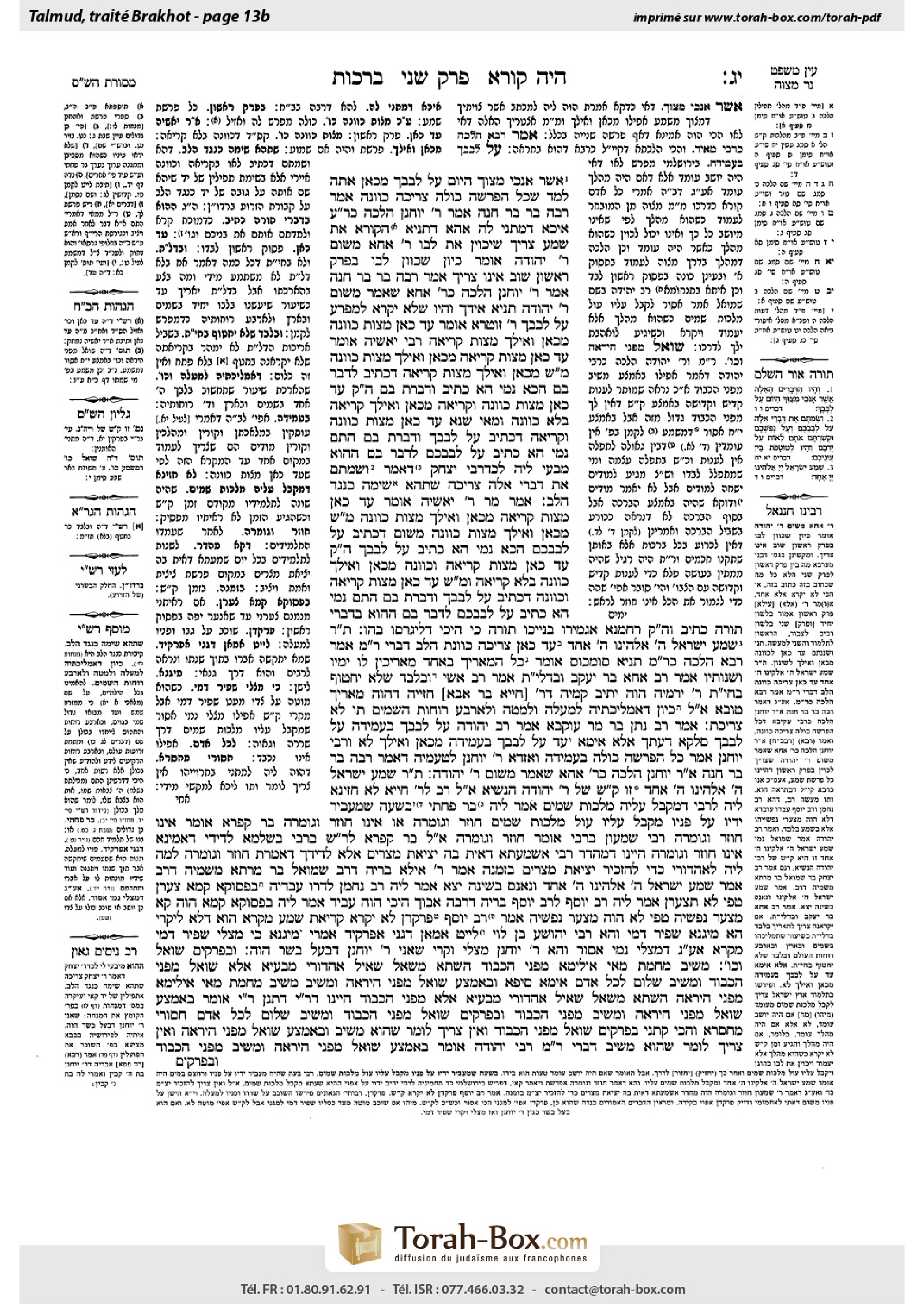
Berakhot 13b: Talmud study for Daf Yomi
Study the Talmud for Daf Yomi with scanned pages, Hebrew text, English translations from Sefaria and AI-generated French translations.
Passage selection and English or AI-generated French translation are available where the scan has annotations. Daf Study is independent of Torah-Box and Sefaria.
Browse Berakhot · ברכות · All tractatesBerakhot 13b text and translations
This page of Berakhot includes the Aramaic text, an English translation and an AI-generated French translation, alongside the scan above.
ברכות י״ג ב · Aramaic and Hebrew text
״אֲשֶׁר אָנֹכִי מְצַוְּךָ הַיּוֹם עַל לְבָבֶךָ״. מִכָּאן אַתָּה לָמֵד שֶׁכָּל הַפָּרָשָׁה כּוּלָּהּ צְרִיכָה כַּוָּונָה.
אָמַר רַבָּה בַּר בַּר חָנָה אָמַר רַבִּי יוֹחָנָן: הֲלָכָה כְּרַבִּי עֲקִיבָא.
אִיכָּא דְּמַתְנֵי לַהּ אַהָא דְתַנְיָא. הַקּוֹרֵא אֶת שְׁמַע צָרִיךְ שֶׁיְּכַוֵּין אֶת לִבּוֹ, רַבִּי אַחָא מִשּׁוּם רַבִּי יְהוּדָה אוֹמֵר: כֵּיוָן שֶׁכִּוֵּון לִבּוֹ בְּפֶרֶק רִאשׁוֹן שׁוּב אֵינוֹ צָרִיךְ. אָמַר רַבָּה בַּר בַּר חָנָה אָמַר רַבִּי יוֹחָנָן: הֲלָכָה כְּרַבִּי אַחָא שֶׁאָמַר מִשּׁוּם רַבִּי יְהוּדָה.
תַּנְיָא אִידָךְ. ״וְהָיוּ״ — שֶׁלֹּא יִקְרָא לְמַפְרֵעַ. ״עַל לְבָבֶךָ״ — רַב זוּטְרָא אוֹמֵר עַד כָּאן מִצְוַת כַּוָּונָה, מִכָּאן וְאֵילָךְ מִצְוַת קְרִיאָה. רַבִּי יֹאשִׁיָּה אוֹמֵר: עַד כָּאן מִצְוַת קְרִיאָה, מִכָּאן וְאֵילָךְ מִצְוַת כַּוָּונָה.
מַאי שְׁנָא מִכָּאן וְאֵילָךְ מִצְוַת קְרִיאָה — דִּכְתִיב: ״לְדַבֵּר בָּם״? הָכָא נָמֵי הָא כְתִיב ״וְדִבַּרְתָּ בָּם״!
הָכִי קָאָמַר: עַד כָּאן מִצְוַת כַּוָּונָה וּקְרִיאָה, מִכָּאן וְאֵילָךְ — קְרִיאָה בְּלֹא כַּוָּונָה.
וּמַאי שְׁנָא עַד כָּאן מִצְוַת כַּוָּונָה וּקְרִיאָה דִּכְתִיב ״עַל לְבָבֶךָ … וְדִבַּרְתָּ בָּם״. הָתָם נָמֵי הָא כְּתִיב ״עַל לְבַבְכֶם … לְדַבֵּר בָּם״.
הַהוּא מִבְּעֵי לֵיהּ לְכִדְרַבִּי יִצְחָק דְּאָמַר: ״וְשַׂמְתֶּם אֶת דְּבָרַי אֵלֶּה״ — צְרִיכָה שֶׁתְּהֵא שִׂימָה כְּנֶגֶד הַלֵּב.
אָמַר מָר, רַבִּי יֹאשִׁיָּה אוֹמֵר: עַד כָּאן מִצְוַת קְרִיאָה, מִכָּאן וְאֵילָךְ — מִצְוַת כַּוָּונָה. מַאי שְׁנָא מִכָּאן וְאֵילָךְ מִצְוַת כַּוָּונָה — מִשּׁוּם דִּכְתִיב ״עַל לְבַבְכֶם״, הָכָא נָמֵי הָא כְּתִיב ״עַל לְבָבֶךָ״!
הָכִי קָאָמַר: עַד כָּאן, מִצְוַת קְרִיאָה וְכַוָּונָה, מִכָּאן וְאֵילָךְ — כַּוָּונָה בְּלֹא קְרִיאָה.
וּמַאי שְׁנָא עַד כָּאן מִצְוַת קְרִיאָה וְכַוָּונָה — דִּכְתִיב ״עַל לְבָבֶךָ״ ״וְדִבַּרְתָּ בָּם״, הָתָם נָמֵי הָא כְּתִיב ״עַל לְבַבְכֶם … לְדַבֵּר בָּם״!
הַהוּא בְּדִבְרֵי תוֹרָה כְּתִיב. וְהָכִי קָאָמַר רַחֲמָנָא: אַגְמִירוּ בְּנַיְיכוּ תּוֹרָה, כִּי הֵיכִי דְּלִיגְרְסוּ בְּהוּ.
תָּנוּ רַבָּנַן: ״שְׁמַע יִשְׂרָאֵל ה׳ אֱלֹהֵינוּ ה׳ אֶחָד״ — עַד כָּאן צְרִיכָה כַּוָּונַת הַלֵּב, דִּבְרֵי רַבִּי מֵאִיר. אָמַר רָבָא: הֲלָכָה כְּרַבִּי מֵאִיר.
תַּנְיָא סוֹמְכוֹס אוֹמֵר: כָּל הַמַּאֲרִיךְ בְּ״אֶחָד״, מַאֲרִיכִין לוֹ יָמָיו וּשְׁנוֹתָיו. אָמַר רַב אַחָא בַּר יַעֲקֹב: וּבַדָּלֵית. אָמַר רַב אָשֵׁי: וּבִלְבַד שֶׁלֹּא יַחֲטוֹף בַּחֵית.
רַבִּי יִרְמְיָה הֲוָה יָתֵיב קַמֵּיהּ דְּרַבִּי [חִיָּיא בַּר אַבָּא], חַזְיֵיהּ דַּהֲוָה מַאֲרֵיךְ טוּבָא, אֲמַר לֵיהּ: כֵּיוָן דְּאַמְלֵיכְתֵּיהּ לְמַעְלָה וּלְמַטָּה וּלְאַרְבַּע רוּחוֹת הַשָּׁמַיִם — תּוּ לָא צְרִיכַתְּ.
אָמַר רַב נָתָן בַּר מָר עוּקְבָא אָמַר רַב יְהוּדָה: ״עַל לְבָבֶךָ״ בַּעֲמִידָה. ״עַל לְבָבֶךָ״ סָלְקָא דַּעְתָּךְ?! אֶלָּא אֵימָא עַד ״עַל לְבָבֶךָ״ בַּעֲמִידָה. מִכָּאן וְאֵילָךְ — לֹא. וְרַבִּי יוֹחָנָן אָמַר כָּל הַפָּרָשָׁה כּוּלָּהּ בַּעֲמִידָה.
וְאַזְדָּא רַבִּי יוֹחָנָן לְטַעְמֵיהּ, דְּאָמַר רַבָּה בַּר בַּר חָנָה אָמַר רַבִּי יוֹחָנָן: הֲלָכָה כְּרַבִּי אַחָא שֶׁאָמַר מִשּׁוּם רַבִּי יְהוּדָה.
תָּנוּ רַבָּנַן: ״שְׁמַע יִשְׂרָאֵל ה׳ אֱלֹהֵינוּ ה׳ אֶחָד״ זוֹ קְרִיאַת שְׁמַע שֶׁל רַבִּי יְהוּדָה הַנָּשִׂיא. אֲמַר לֵיהּ רַב לְרַבִּי חִיָּיא: לָא חֲזֵינָא לֵיהּ לְרַבִּי דִּמְקַבֵּל עֲלֵיהּ מַלְכוּת שָׁמַיִם. אֲמַר לֵיהּ: בַּר פַּחֲתֵי, בְּשָׁעָה שֶׁמַּעֲבִיר יָדָיו עַל פָּנָיו, מְקַבֵּל עָלָיו עוֹל מַלְכוּת שָׁמַיִם.
חוֹזֵר וְגוֹמְרָהּ, אוֹ אֵינוֹ חוֹזֵר וְגוֹמְרָהּ? בַּר קַפָּרָא אוֹמֵר: אֵינוֹ חוֹזֵר וְגוֹמְרָהּ. רַבִּי שִׁמְעוֹן בְּרַבִּי אוֹמֵר: חוֹזֵר וְגוֹמְרָהּ. אֲמַר לֵיהּ בַּר קַפָּרָא לְרַבִּי שִׁמְעוֹן בְּרַבִּי: בִּשְׁלָמָא לְדִידִי דְּאָמֵינָא ״אֵינוֹ חוֹזֵר וְגוֹמְרָהּ״, הַיְינוּ דִּמְהַדַּר רַבִּי אַשְּׁמַעְתָּא דְּאִית בַּהּ יְצִיאַת מִצְרַיִם. אֶלָּא לְדִידָךְ דְּאָמְרַתְּ חוֹזֵר וְגוֹמְרָהּ, לְמָה לֵיהּ לְאַהְדּוֹרֵי?
כְּדֵי לְהַזְכִּיר יְצִיאַת מִצְרַיִם בִּזְמַנָּהּ.
אָמַר רַבִּי אִילָא בְּרֵיהּ דְרַב שְׁמוּאֵל בַּר מָרְתָּא מִשְּׁמֵיהּ דְרַב: אָמַר ״שְׁמַע יִשְׂרָאֵל ה׳ אֱלֹהֵינוּ ה׳ אֶחָד״ וְנֶאֱנַס בְּשֵׁינָה — יָצָא. אֲמַר לֵיהּ רַב נַחְמָן לְדָרוּ עַבְדֵּיהּ: בִּפְסוּקָא קַמָּא — צַעֲרַן, טְפֵי — לָא תְּצַעֲרַן. אֲמַר לֵיהּ רַב יוֹסֵף לְרַב יוֹסֵף בְּרֵיהּ דְּרַבָּה: אֲבוּךְ הֵיכִי הֲוָה עָבֵיד? אֲמַר לֵיהּ: בִּפְסוּקָא קַמָּא הֲוָה קָא מְצַעַר נַפְשֵׁיהּ, טְפֵי — לָא הֲוָה מְצַעַר נַפְשֵׁיהּ.
אָמַר רַב יוֹסֵף: פְּרַקְדָּן, לֹא יִקְרָא קְרִיאַת שְׁמַע. מִקְרָא הוּא דְּלָא לִיקְרֵי, הָא מִיגְנָא שַׁפִּיר דָּמֵי? וְהָא רַבִּי יְהוֹשֻׁעַ בֶּן לֵוִי לָיֵיט אַמַּאן דְּגָנֵי אַפַּרְקִיד!
אָמְרִי, מִיגְנָא כִּי מַצְלֵי — שַׁפִּיר דָּמֵי, מִקְרָא אַף עַל גַּב דְּמַצְלֵי נָמֵי — אָסוּר.
וְהָא רַבִּי יוֹחָנָן מַצְלֵי וְקָרֵי!
שָׁאנֵי רַבִּי יוֹחָנָן דְּבַעַל בָּשָׂר הֲוָה.
בַּפְּרָקִים שׁוֹאֵל וְכוּ׳.
מֵשִׁיב מֵחֲמַת מַאי? אִילֵּימָא מִפְּנֵי הַכָּבוֹד, הַשְׁתָּא מִשְׁאָל שָׁאֵיל, אַהְדּוֹרֵי מִבַּעְיָא?! אֶלָּא: שׁוֹאֵל — מִפְּנֵי הַכָּבוֹד, וּמֵשִׁיב שָׁלוֹם — לְכָל אָדָם. אֵימָא סֵיפָא: ״וּבָאֶמְצַע שׁוֹאֵל מִפְּנֵי הַיִּרְאָה, וּמֵשִׁיב״.
מֵשִׁיב מֵחֲמַת מַאי? אִילֵּימָא מִפְּנֵי הַיִּרְאָה — הַשְׁתָּא מִשְׁאַל שָׁאֵיל, אַהְדּוֹרֵי מִבַּעְיָא? אֶלָּא — מִפְּנֵי הַכָּבוֹד. הַיְינוּ דְּרַבִּי יְהוּדָה! — דִּתְנַן, רַבִּי יְהוּדָה אוֹמֵר: בָּאֶמְצַע — שׁוֹאֵל מִפְּנֵי הַיִּרְאָה וּמֵשִׁיב מִפְּנֵי הַכָּבוֹד, וּבַפְּרָקִים — שׁוֹאֵל מִפְּנֵי הַכָּבוֹד וּמֵשִׁיב שָׁלוֹם לְכָל אָדָם?
חַסּוֹרֵי מְחַסְּרָא, וְהָכִי קָתָנֵי: בַּפְּרָקִים — שׁוֹאֵל מִפְּנֵי הַכָּבוֹד, וְאֵין צָרִיךְ לוֹמַר שֶׁהוּא מֵשִׁיב. וּבָאֶמְצַע — שׁוֹאֵל מִפְּנֵי הַיִּרְאָה, וְאֵין צָרִיךְ לוֹמַר שֶׁהוּא מֵשִׁיב, דִּבְרֵי רַבִּי מֵאִיר. רַבִּי יְהוּדָה אוֹמֵר: בָּאֶמְצַע — שׁוֹאֵל מִפְּנֵי הַיִּרְאָה וּמֵשִׁיב מִפְּנֵי הַכָּבוֹד,
Berakhot 13b · English translation
“Which I command you this day, will be upon your heart.” Surely the word these, does not come to limit the mitzva of intent. On the contrary, from here you derive that the entire portion requires intent.
Rabba bar bar Ḥana said that Rabbi Yoḥanan said: The halakha is in accordance with the opinion of Rabbi Akiva; the entire portion requires intent.
Some teach this halakha stated by Rabbi Yoḥanan with regard to that which was taught in a Tosefta, where there is a tannaitic dispute. The first tanna holds: One who recites Shema must focus his heart for the entire Shema. Rabbi Aḥa says in the name of Rabbi Yehuda: Once he focused his heart for the first paragraph alone, he no longer requires intent. With regard to this Tosefta, Rabba bar bar Ḥana said that Rabbi Yoḥanan said: The halakha is in accordance with Rabbi Aḥa who said in the name of Rabbi Yehuda. While this differs from the previous version in form, it arrives at the same conclusion.
It was taught in another baraita on this subject, which cited different opinions. From: And they will be, recited in Shema, it is derived that it may not be recited out of order. From: Upon your heart, Rav Zutra says: To this point, there is the mitzva of intent; from here on, beginning with the second paragraph, there is only the mitzva of recitation. Rabbi Yoshiya says that it means the opposite: To this point, there is the mitzva of recitation; from here on there is only the mitzva of intent.
At first the Gemara understands that Rav Zutra required recitation only in the second paragraph, while in the first paragraph only intent was required. Therefore, the Gemara asks: What is different, that from here on, beginning with the second paragraph, there is the mitzva of recitation? Is it because it is written: “And you shall teach them to your children, to speak of them” (Deuteronomy 11:19)? This is no proof, as here too, in the first paragraph it is written: “And you shall speak of them.” The mitzva of recitation applies to the first paragraph as well.
Rather, he is saying as follows: To this point there is the mitzva of both intent and recitation, but from here on, there is only the mitzva of recitation without intent.
Again the Gemara asks: According to Rav Zutra, what is different, that to this point, in the first paragraph, there is the mitzva of both intent and recitation because there are two requirements in the first paragraph, as it is written: “Upon your heart…and you shall speak of them”? There, too, in the second paragraph it is also written: “And you shall place these words upon your heart…to speak of them,” indicating that intent is also required in that paragraph.
The Gemara responds: That verse is necessary to derive that which was taught by Rabbi Yitzḥak, who said: “And you shall place these words” refers literally to the paragraphs of Shema found in the phylacteries. The verse teaches that the placement of the phylacteries of the arm must be opposite the heart.
The Gemara now attempts to clarify the second opinion in the baraita. The Master said, Rabbi Yoshiya says: To this point at the end of the first paragraph, there is the mitzva of recitation; from here on there is the mitzva of intent. The Gemara asks: What is different, that from here on, beginning with the second paragraph, there is the mitzva of intent? Is it because it is written in the second paragraph: “And you shall place these words upon your heart”? That is no proof, as here too, in the first paragraph it is written: “Upon your heart.”
The Gemara responds that he is saying as follows: To this point, there is the mitzva of both recitation and intent, but from here on, there is only the mitzva of intent without recitation.
The Gemara continues: And what is different, that to this point, in the first paragraph, there is the mitzva of recitation and intent because there are two requirements, as it is written: Upon your heart as well as: And you shall speak of them? There, too, with regard to the second paragraph isn’t it written: And you shall place these words upon your heart…and you shall teach them to your children, to speak of them?
Rabbi Yoshiya responded: That verse refers to Torah study in general, not to the recitation of Shema in particular. And the Torah says the following: Teach your children Torah, that they will be well-versed in them.
The Sages taught in another baraita with regard to one who recites Shema and utters the verse, “Hear, Israel, the Lord is our God, the Lord is One.” Intent of the heart is only required to this point. This is the statement of Rabbi Meir. Rava said: In this matter, the halakha is in accordance with the opinion of Rabbi Meir.
It was taught in a baraita, Sumakhos says: One who extends his intonation of the word One [eḥad] while reciting Shema, is rewarded that his days and years are extended. Rav Aḥa bar Ya’akov said: This is only true if he extends the letter dalet, so the word eḥad is sounded in its entirety. Rav Ashi said: This is only so long as one does not pronounce the letter ḥet hurriedly.
The Gemara relates that Rabbi Yirmeya was seated before Rabbi Ḥiyya bar Abba. He saw that he was greatly extending his pronunciation of eḥad. He said to him: Once you have crowned Him in your thoughts over everything above, in Heaven, below, on earth, and in the four corners of the heavens, you need not extend any further.
Rav Natan bar Mar Ukva said that Rav Yehuda said: One must recite upon your heart, while standing in one place. The Gemara is perplexed: Does it enter your mind that upon your heart alone must be recited while standing in one place? What distinguishes that phrase from the rest of Shema? Rather, say: One must recite until upon your heart while standing in one place. From here on, one need not stand in one place. Rabbi Yoḥanan said: One must recite the entire first portion while standing in one place.
The Gemara notes: Rabbi Yoḥanan is consistent and follows his reasoning expressed elsewhere, as Rabba bar bar Ḥana said that Rabbi Yoḥanan said: The halakha is in accordance with the opinion of Rabbi Aḥa who said in the name of Rabbi Yehuda; one is required to recite the entire first paragraph of Shema with intent.
The Sages taught in a baraita: The single verse, “Hear, Israel, the Lord is our God, the Lord is One”; this is Rabbi Yehuda HaNasi’s recitation of Shema. The Gemara relates: Rav said to his uncle, Rabbi Ḥiyya: I did not see Rabbi Yehuda HaNasi accept the kingship of Heaven upon himself, meaning that he did not see him recite Shema. Rabbi Ḥiyya said to him: Son of noblemen [bar paḥtei], when Rabbi Yehuda HaNasi passed his hands over his face in the study hall in the middle of his lesson, he accepted the yoke of the kingdom of Heaven upon himself, as his Shema was comprised of a single verse.
Rabbi Yehuda HaNasi’s students and members of his household disputed: Does he complete Shema later or does he not complete it later? Bar Kappara says: He does not complete it later. Rabbi Shimon, son of Rabbi Yehuda HaNasi, says: He completes it later. Bar Kappara said to Rabbi Shimon, son of Rabbi Yehuda HaNasi: Granted, according to my position, that I say that Rabbi Yehuda HaNasi does not complete Shema later, that is why when he taught, Rabbi Yehuda HaNasi would specifically seek a topic that included the exodus from Egypt, as by so doing he fulfills the mitzva to remember the Exodus; a mitzva that others fulfill in their recitation of the last paragraph of Shema. But according to you, who says that he completes his recitation of Shema later, why, when he teaches, would he specifically seek a topic that included the exodus from Egypt?
Rabbi Shimon responded: Rabbi Yehuda HaNasi did so in order to mention the exodus from Egypt at its appointed time, during the time of the recitation of Shema.
Based on this halakha, Rabbi Ila, son of Rav Shmuel bar Marta, said in the name of Rav: One who recited the verse, “Hear, Israel, the Lord is our God, the Lord is One,” and was immediately overcome by sleep, fulfilled his obligation to recite Shema. Similarly, Rav Naḥman said to his slave, Daru: If you see that I have fallen asleep, bother me to recite the first verse, do not bother me to recite any more than that. Similarly, Rav Yosef said to Rav Yosef, son of Rabba: What would your father do? Rav Yosef, son of Rabba, said to him: He would exert himself not to fall asleep in order to recite the first verse, he would not exert himself to recite any more than that.
Rav Yosef said: One who is lying [perakdan] on his back may not recite Shema, for lying that way is unbecoming. The Gemara asks: Is that to say that one may not recite Shema in this position, but to sleep lying in that position is permissible? Didn’t Rabbi Yehoshua ben Levi curse one who sleeps lying on his back?
The Gemara answers: If one lies on his back while leaning slightly to the side, it is permissible. Nonetheless, to recite Shema in this position, even though he is leaning, is prohibited.
The Gemara asks: Wouldn’t Rabbi Yoḥanan lie on his back, lean slightly and recite Shema?
The Gemara responds: The case of Rabbi Yoḥanan is different, because he was corpulent and it was difficult for him to read any other way.
The mishna cited Rabbi Meir’s statement: At the breaks between paragraphs, one may greet an individual due to the respect that he is obligated to show him, and may respond. And in the middle of each paragraph, one may greet an individual due to the fear that the individual may harm him if he fails do so, and may respond.
About this, the Gemara asks: He may respond due to what circumstance? If you say that one may respond due to respect; now that we learned that one may greet another due to respect, is it necessary to say that one may respond due to respect? Rather, it must be explained as follows: One may greet due to respect and respond with a greeting to any person. But if that is the case, say the latter clause of the mishna: In the middle of each paragraph one may greet due to fear and return another’s greeting due to fear.
Here too, it must be clarified: He may respond due to what circumstance? If you say that one may respond due to fear; now that we have learned that one may greet another due to fear, is it necessary to say that one may respond due to fear? Rather, it must mean that one may respond to another’s greeting even due to honor. If so, that is identical to the opinion of Rabbi Yehuda, as we learned in the mishna: In the middle of each paragraph, one may greet another due to fear and respond due to respect. At the breaks between paragraphs, one may greet another due to respect and respond with a greeting to any person. If so, what is the dispute between them?
The Gemara says: The mishna is incomplete; it is missing an important element, and it teaches the following: At the breaks between the paragraphs, one may greet due to respect, and, needless to say, he may respond due to respect. In the middle of each paragraph one may greet due to fear, and, needless to say, he may respond due to fear. This is the statement of Rabbi Meir. Rabbi Yehuda says: In the middle of each paragraph one may greet due to fear and respond due to respect.
Berakhot 13b · Traduction française (IA)
«Ce que je t'ordonne aujourd'hui, sera sur ton cœur.» Sans doute cette parole ne vient pas limiter la mitsva de l'intention. Au contraire, on en déduit ici que toute la portion exige l'intention.
Rabba bar bar Ḥana dit que Rabbi Yoḥanan a dit : La halakha suit l'opinion de Rabbi Akiva ; toute la portion exige l'intention.
Certains enseignent cette halakha rapportée par Rabbi Yoḥanan en rapport avec celle qui est enseignée dans une Tosefta, où il y a un débat tannaitique. Le premier tanna affirme : Celui qui récite le Chéma doit concentrer son cœur tout au long du Chéma. Rabbi Aḥa, dans le nom de Rabbi Yehuda, dit : Une fois qu'il a concentré son cœur pour le premier paragraphe seul, il n'a plus besoin d'intention. En ce qui concerne cette Tosefta, Rabba bar bar Ḥana dit que Rabbi Yoḥanan a dit : La halakha suit Rabbi Aḥa, qui a dit dans le nom de Rabbi Yehuda. Bien que cela diffère de la version précédente en forme, il arrive au même conclusion.
Il a été enseigné dans une autre baraïta sur ce sujet, qui cite des opinions différentes. De : « Et ils seront, récités dans le Chéma », on déduit qu'ils ne peuvent pas être récités dans un ordre différent. De : « Sur ton cœur », Rav Zutra dit : Jusqu'à ce point, il y a la mitsva d'intention ; à partir de là, à partir du deuxième paragraphe, il n'y a que la mitsva de récitation. Rabbi Yoshiya dit qu'il signifie l'inverse : Jusqu'à ce point, il y a la mitsva de récitation ; à partir de là, il n'y a que la mitsva d'intention.
Au début, la Guemara comprend que Rav Zutra exigeait la récitation uniquement dans le deuxième paragraphe, tandis que dans le premier paragraphe, seule l'intention était requise. Ainsi, la Guemara pose la question : Qu'est-ce qui diffère, que à partir de là, à partir du deuxième paragraphe, il y a la mitsva de récitation ? Est-ce parce qu'il est écrit : « Et tu enseignerás à tes enfants, afin qu'ils en parlent » (Lévitique 11:19) ? Cela n'est pas une preuve, car ici aussi, dans le premier paragraphe, il est écrit : « Et tu en parleras. » La mitsva de récitation s'applique également au premier paragraphe.
Plutôt, il dit comme suit : Jusqu'à ce point, il y a la mitsva des deux, intention et récitation, mais à partir de là, il n'y a que la mitsva de récitation sans intention.
Le Guemara pose à nouveau la question : Selon Rav Zutra, qu'est-ce qui diffère, que jusqu'à ce point, dans le premier paragraphe, il y a la mitsva de l'intention et de la récitation, car il y a deux exigences dans le premier paragraphe, comme il est écrit : « Sur ton cœur » et « et tu en parleras » ? Là aussi, dans le deuxième paragraphe, il est écrit : « Et tu placeras ces paroles sur ton cœur... afin qu'ils en parlent », indiquant que l'intention est également requise dans ce paragraphe.
Le Guemara répond : Ce verset est nécessaire pour déduire ce que Rabbi Yitzḥak a dit : « Et tu placeras ces paroles » fait référence littéralement aux paragraphes du Chéma trouvés dans les phylactères. Ce verset enseigne que la placement des phylactères de l'avant-bras doit être opposé au cœur.
Le Guemara tente maintenant de clarifier l'opinion secondaire dans la baraïta. Le Maître dit, Rabbi Yoshiya dit : Jusqu'à la fin du premier paragraphe, il y a la mitsva de la récitation ; à partir de là, il y a la mitsva de l'intention. Le Guemara pose la question : Qu'est-ce qui diffère, que à partir de là, à partir du deuxième paragraphe, il y a la mitsva de l'intention ? Est-ce parce qu'il est écrit dans le deuxième paragraphe : « Et tu placeras ces paroles sur ton cœur » ? Ce n'est pas une preuve, car ici aussi, dans le premier paragraphe, il est écrit : « Sur ton cœur. »
Le Guemara répond que cela signifie comme suit : Jusqu'à ce point, il y a la mitsva de la récitation et de l'intention, mais à partir de là, il n'y a que la mitsva de l'intention sans récitation.
Le Guemara continue : Et qu'est-ce qui diffère, que jusqu'à ce point, dans le premier paragraphe, il y a la mitsva de la récitation et de l'intention car il y a deux exigences, comme il est écrit : « Sur ton cœur » ainsi que : « Et tu en parleras » ? Là aussi, concernant le deuxième paragraphe, n'est-il pas écrit : « Et tu placeras ces paroles sur ton cœur... et tu enseigneras à tes enfants, afin qu'ils en parlent » ?
Rabbi Yoshiya répondit : Ce verset fait référence à l'étude de la Torah en général, pas à la récitation du Chéma en particulier. Et la Torah dit ceci : Enseigne à tes enfants la Torah, afin qu'ils soient bien-accoutumés à elle.
Les Sages enseignèrent dans une autre baraïta concernant celui qui récite le Chéma et prononce la verset : « Écoute, Israël, le Seigneur est notre Dieu, le Seigneur est un. » L'intention du cœur est requise uniquement jusqu'à ce point. C'est l'opinion de Rabbi Meir. Rava dit : En ce domaine, la halakha suit l'opinion de Rabbi Meir.
Il a été enseigné dans une baraïta, Sumakhos dit : Celui qui étire la prononciation du mot « un » [eḥad] lorsqu'il récite le Chéma est récompensé par l'extension de ses jours et de ses années. Rav Aḥa bar Ya’akov dit : Cela est vrai uniquement s'il étire la lettre dalet, de sorte que le mot eḥad est prononcé entièrement. Rav Ashi dit : Cela est vrai uniquement tant qu'on ne prononce pas la lettre ḥet précipitamment.
Le Guemara rapporte que Rabbi Yirmeya était assis devant Rabbi Ḥiyya bar Abba. Il vit qu'il étirait beaucoup la prononciation du mot eḥad. Il lui dit : Une fois que tu as couronné Lui dans tes pensées au-dessus de tout, dans le ciel, sur la terre, et dans les quatre coins des cieux, tu n'as plus besoin d'étirer davantage.
Rav Natan bar Mar Ukva a dit que Rav Yehuda a dit : On doit réciter « Sur ton cœur » en se tenant à un seul endroit. La Guemara est perplexe : Est-ce que cela entre dans ton esprit que « Sur ton cœur » seul doit être récité en se tenant à un seul endroit ? Quelle est la particularité de cette phrase par rapport au reste du Chéma ? Plutôt, dis : On doit réciter jusqu'à « Sur ton cœur » en se tenant à un seul endroit. À partir de là, on n'a plus besoin de se tenir à un seul endroit. Rabbi Yoḥanan a dit : On doit réciter l'intégralité de la première partie en se tenant à un seul endroit.
La Guemara note : Rabbi Yoḥanan est cohérent et suit sa raison exprimée ailleurs, comme Rabba bar bar Ḥana a dit que Rabbi Yoḥanan a dit : La halakha suit l'opinion de Rabbi Aḥa qui a dit en nom de Rabbi Yehuda ; on est tenu de réciter l'intégralité de la première partie du Chéma avec l'intention.
Les Sages ont enseigné dans une baraïta : La seule versette « Écoute, Israël, le Seigneur est notre Dieu, le Seigneur est un » ; c'est la récitation du Chéma de Rabbi Yehuda HaNasi. La Guemara rapporte : Rav a dit à son oncle, Rabbi Ḥiyya : Je n'ai pas vu Rabbi Yehuda HaNasi accepter le royaume du Ciel sur lui, c'est-à-dire qu'il n'a pas vu qu'il récitait le Chéma. Rabbi Ḥiyya a dit à lui : Fils de nobles [bar paḥtei], quand Rabbi Yehuda HaNasi passait ses mains sur son visage dans la salle de étude au milieu de son cours, il acceptait le joug du Royaume des Cieux sur lui, car son Chéma était composé d'un seul verset.
Les élèves de Rabbi Yehuda HaNasi et les membres de sa famille ont disputé : Il termine-t-il le Chéma plus tard ou ne le termine-t-il pas plus tard ? Bar Kappara dit : Il ne le termine pas plus tard. Rabbi Shimon, fils de Rabbi Yehuda HaNasi, dit : Il le termine plus tard. Bar Kappara a dit à Rabbi Shimon, fils de Rabbi Yehuda HaNasi : Admettons, selon mon opinion, que je dis que Rabbi Yehuda HaNasi ne termine pas le Chéma plus tard, c'est pourquoi quand il enseignait, Rabbi Yehuda HaNasi cherchait spécifiquement un sujet qui incluait l'Exode d'Egypte, car ainsi il accomplissait la mitsva de se souvenir de l'Exode ; une mitsva que les autres accomplissent lors de leur récitation de la dernière partie du Chéma. Mais selon toi, qui dis que lui termine son récitation du Chéma plus tard, pourquoi, quand il enseignait, cherchait-il spécifiquement un sujet qui incluait l'Exode d'Egypte ?
Rabbi Shimon a répondu : Rabbi Yehuda HaNasi le faisait afin d'évoquer l'Exode d'Egypte à son heure, pendant la récitation du Chéma.
En se basant sur cette halakha, Rabbi Ila, fils de Rav Shmuel bar Marta, a dit en nom de Rav : Celui qui a récité le verset « Écoute, Israël, le Seigneur est notre Dieu, le Seigneur est un » et s'est aussitôt endormi, a accompli son obligation de réciter le Chéma. De même, Rav Naḥman a dit à son serviteur, Daru : Si tu vois que je me suis endormi, réveille-moi pour réciter le premier verset, ne me réveille pas pour réciter plus que cela. De même, Rav Yosef a dit à Rav Yosef, fils de Rabba : Que ferait ton père ? Rav Yosef, fils de Rabba, a dit à lui : Il se serait appliqué pour ne pas s'endormir afin de réciter le premier verset, il ne se serait pas appliqué pour réciter plus que cela.
Rav Yosef a dit : Celui qui est allongé sur le dos ne peut pas réciter le Chéma, car être allongé ainsi est inapproprié. La Guemara pose la question : Est-ce que cela signifie que l'on ne peut pas réciter le Chéma dans cette position, mais que dormir dans cette position est permis ? N'a-t-on pas entendu Rabbi Yehoshua ben Levi maudire celui qui dort allongé sur le dos ?
La Guemara répond : Si l'on est allongé sur le dos en se penchant légèrement vers le côté, cela est permis. Cependant, réciter le Chéma dans cette position, même en se penchant, est interdit.
La Guemara pose la question : Ne serait-ce pas Rabbi Yoḥanan qui serait allongé sur le dos, penché légèrement et réciterait le Chéma ?
La Guemara répond : Le cas de Rabbi Yoḥanan est différent, car il était corpulent et il était difficile pour lui de lire autrement.
La mishna cite l'opinion de Rabbi Meir : Aux points de rupture entre les paragraphes, on peut saluer une personne en raison du respect que l'on est tenu de lui montrer, et répondre. Et au milieu de chaque paragraphe, on peut saluer une personne en raison de la crainte que la personne puisse nuire si l'on échoue à le faire, et répondre.
À ce sujet, la Guemara pose la question : Il peut répondre en raison de quelle circonstance ? Si vous dites qu'on peut répondre en raison du respect ; maintenant que nous avons appris qu'on peut saluer une autre personne en raison du respect, est-ce nécessaire de dire qu'on peut répondre en raison du respect ? Plutôt, cela doit être expliqué ainsi : On peut saluer en raison du respect et répondre à un salut à toute personne. Mais si c'est le cas, dites la clause finale de la mishna : Au milieu de chaque paragraphe, on peut saluer en raison de la crainte et répondre à un salut en raison de la crainte.
Ici aussi, il doit être clarifié : Il peut répondre en raison de quelle circonstance ? Si vous dites qu'on peut répondre en raison de la crainte ; maintenant que nous avons appris qu'on peut saluer une autre personne en raison de la crainte, est-ce nécessaire de dire qu'on peut répondre en raison de la crainte ? Plutôt, cela doit signifier qu'on peut répondre à un salut d'une autre personne même en raison de l'honneur. Si c'est ainsi, cela est identique à l'opinion de Rabbi Yehuda, comme nous l'avons appris dans la mishna : Au milieu de chaque paragraphe, on peut saluer une autre personne en raison de la crainte et répondre en raison du respect. Aux points de rupture entre les paragraphes, on peut saluer une autre personne en raison du respect et répondre à un salut à toute personne. Si c'est ainsi, quelle est la dispute entre eux ?
La Guemara dit : La mishna est incomplète ; elle manque un élément important, et elle enseigne ce qui suit : Aux points de rupture entre les paragraphes, on peut saluer en raison du respect, et, sans doute, on peut répondre en raison du respect. Au milieu de chaque paragraphe, on peut saluer en raison de la crainte, et, sans doute, on peut répondre en raison de la crainte. C'est l'opinion de Rabbi Meir. Rabbi Yehuda dit : Au milieu de chaque paragraphe, on peut saluer en raison de la crainte et répondre en raison du respect.
Traduction française générée par IA à partir de l’édition anglaise de Sefaria. Vérifie toujours un passage avec le texte source.
Text from Sefaria: William Davidson Edition - Vocalized Aramaic (CC BY NC); William Davidson Edition - English (CC BY NC).