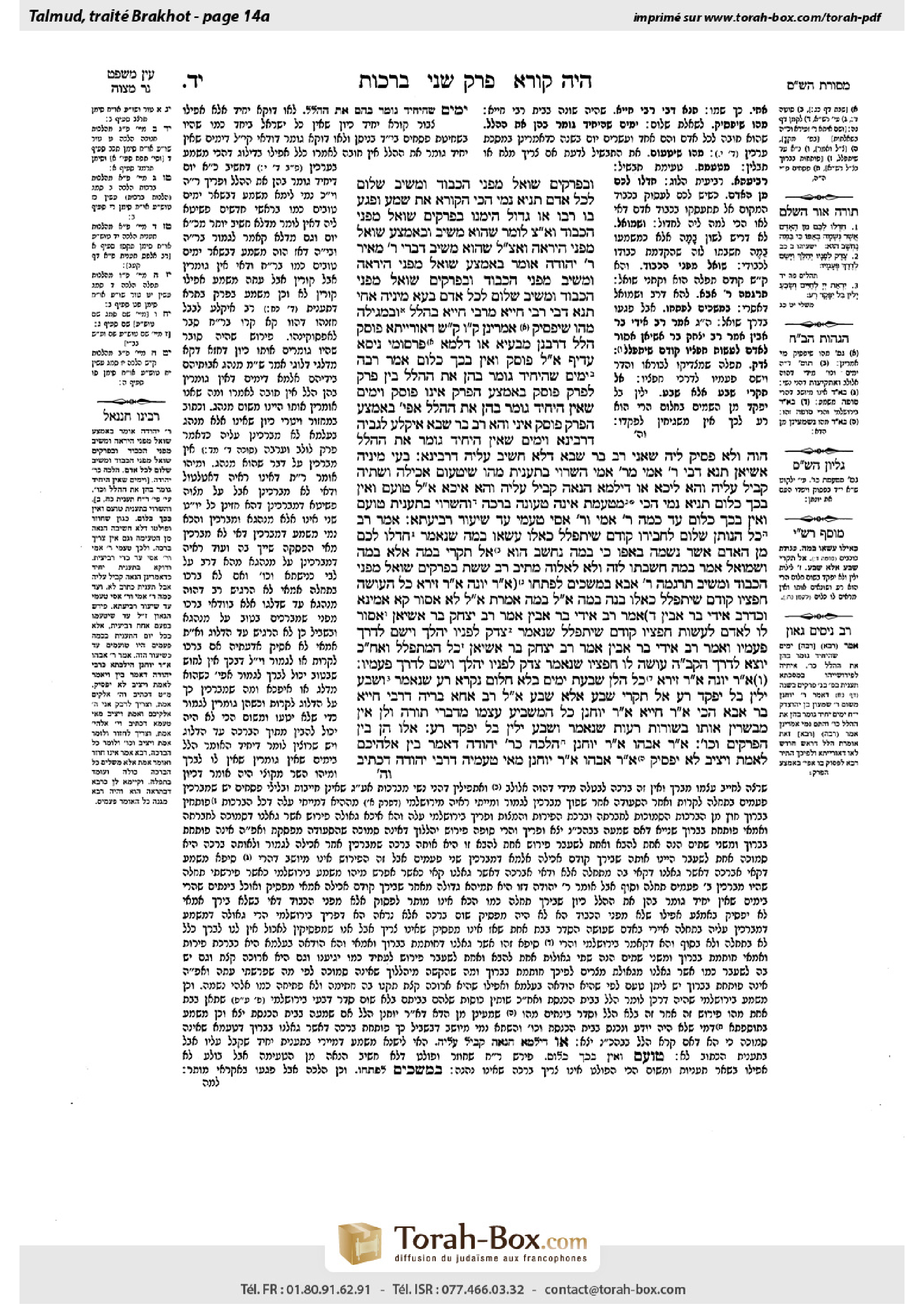
Berakhot 14a: Talmud study for Daf Yomi
Study the Talmud for Daf Yomi with scanned pages, Hebrew text, English translations from Sefaria and AI-generated French translations.
Passage selection and English or AI-generated French translation are available where the scan has annotations. Daf Study is independent of Torah-Box and Sefaria.
Browse Berakhot · ברכות · All tractatesBerakhot 14a text and translations
This page of Berakhot includes the Aramaic text, an English translation and an AI-generated French translation, alongside the scan above.
ברכות י״ד א · Aramaic and Hebrew text
וּבַפְּרָקִים — שׁוֹאֵל מִפְּנֵי הַכָּבוֹד וּמֵשִׁיב שָׁלוֹם לְכׇל אָדָם.
תַּנְיָא נָמֵי הָכִי: הַקּוֹרֵא אֶת שְׁמַע וּפָגַע בּוֹ רַבּוֹ אוֹ גָּדוֹל הֵימֶנּוּ, בַּפְּרָקִים — שׁוֹאֵל מִפְּנֵי הַכָּבוֹד וְאֵין צָרִיךְ לוֹמַר שֶׁהוּא מֵשִׁיב, וּבָאֶמְצַע — שׁוֹאֵל מִפְּנֵי הַיִּרְאָה וְאֵין צָרִיךְ לוֹמַר שֶׁהוּא מֵשִׁיב. דִּבְרֵי רַבִּי מֵאִיר. רַבִּי יְהוּדָה אוֹמֵר: בָּאֶמְצַע — שׁוֹאֵל מִפְּנֵי הַיִּרְאָה וּמֵשִׁיב מִפְּנֵי הַכָּבוֹד, וּבַפְּרָקִים — שׁוֹאֵל מִפְּנֵי הַכָּבוֹד וּמֵשִׁיב שָׁלוֹם לְכׇל אָדָם.
בְּעָא מִינֵּיהּ אַחַי תַּנָּא דְבֵי רַבִּי חִיָּיא מֵרַבִּי חִיָּיא: בְּהַלֵּל וּבַמְגִילָּה מַהוּ שֶׁיַּפְסִיק? אָמְרִינַן קַל וָחוֹמֶר: קְרִיאַת שְׁמַע דְּאוֹרָיְיתָא — פּוֹסֵק, הַלֵּל דְּרַבָּנַן מִבַּעְיָא?! אוֹ דִלְמָא פַּרְסוֹמֵי נִיסָּא עֲדִיף.
אֲמַר לֵיהּ: פּוֹסֵק, וְאֵין בְּכָךְ כְּלוּם. אָמַר רַבָּה: יָמִים שֶׁהַיָּחִיד גּוֹמֵר בָּהֶן אֶת הַהַלֵּל, בֵּין פֶּרֶק לְפֶרֶק פּוֹסֵק, בְּאֶמְצַע הַפֶּרֶק — אֵינוֹ פּוֹסֵק, וְיָמִים שֶׁאֵין הַיָּחִיד גּוֹמֵר בָּהֶן אֶת הַהַלֵּל — אֲפִילּוּ בְּאֶמְצַע הַפֶּרֶק פּוֹסֵק.
אִינִי?! וְהָא רַב בַּר שְׁבָא אִיקְּלַע לְגַבֵּיהּ דְּרָבִינָא, וְיָמִים שֶׁאֵין הַיָּחִיד גּוֹמֵר אֶת הַהַלֵּל הֲוָה, וְלָא פְּסֵיק לֵיהּ!
שָׁאנֵי רַב בַּר שְׁבָא דְּלָא חֲשִׁיב עֲלֵיהּ דְּרָבִינָא.
בְּעָא מִינֵּיהּ אַשְׁיָאן תַּנָּא דְבֵי רַבִּי אַמֵּי מֵרַבִּי אַמֵּי: הַשָּׁרוּי בְּתַעֲנִית מַהוּ שֶׁיִּטְעוֹם? אֲכִילָה וּשְׁתִיָּה קַבֵּיל עֲלֵיהּ — וְהָא לֵיכָּא. אוֹ דִילְמָא: הֲנָאָה קַבֵּיל עֲלֵיהּ — וְהָא אִיכָּא.
אָמַר לֵיהּ: טוֹעֵם וְאֵין בְּכָךְ כְּלוּם. תַּנְיָא נָמֵי הָכִי: מַטְעֶמֶת אֵינָהּ טְעוּנָה בְּרָכָה, וְהַשָּׁרוּי בְּתַעֲנִית טוֹעֵם וְאֵין בְּכָךְ כְּלוּם.
עַד כַּמָּה?
רַבִּי אַמֵּי וְרַבִּי אַסִּי טָעֲמִי עַד שִׁיעוּר רְבִיעֲתָא.
אָמַר רַב: כָּל הַנּוֹתֵן שָׁלוֹם לַחֲבֵירוֹ קוֹדֶם שֶׁיִּתְפַּלֵּל כְּאִילּוּ עֲשָׂאוֹ בָּמָה. שֶׁנֶּאֱמַר: ״חִדְלוּ לָכֶם מִן הָאָדָם אֲשֶׁר נְשָׁמָה בְּאַפּוֹ כִּי בַמֶּה נֶחְשָׁב הוּא״. אַל תִּקְרֵי, ״בַּמֶּה״ אֶלָּא ״בָּמָה״.
וּשְׁמוּאֵל אָמַר: בַּמֶּה חֲשַׁבְתּוֹ לָזֶה וְלֹא לָאֱלוֹהַּ?
מֵתִיב רַב שֵׁשֶׁת: בַּפְּרָקִים שׁוֹאֵל מִפְּנֵי הַכָּבוֹד וּמֵשִׁיב!
תַּרְגְּמַהּ רַבִּי אַבָּא: בְּמַשְׁכִּים לְפִתְחוֹ.
אָמַר רַבִּי יוֹנָה אָמַר רַבִּי זֵירָא: כָּל הָעוֹשֶׂה חֲפָצָיו קוֹדֶם שֶׁיִּתְפַּלֵּל — כְּאִלּוּ בָּנָה בָּמָה. אָמְרוּ לוֹ ״בָּמָה״ אָמְרַתְּ? אָמַר לְהוּ: לָא, ״אָסוּר״ קָא אָמֵינָא.
(וְכִדְרַב אִידִי בַּר אָבִין דְּאָמַר) רַב אִידִי בַּר אָבִין אָמַר רַב יִצְחָק בַּר אַשְׁיָאן: אָסוּר לוֹ לָאָדָם לַעֲשׂוֹת חֲפָצָיו קוֹדֶם שֶׁיִּתְפַּלֵּל, שֶׁנֶּאֱמַר: ״צֶדֶק לְפָנָיו יְהַלֵּךְ וְיָשֵׂם לְדֶרֶךְ פְּעָמָיו״.
וְאָמַר רַב אִידִי בַּר אָבִין אָמַר רַב יִצְחָק בַּר אַשְׁיָאן: כָּל הַמִּתְפַּלֵּל וְאַחַר כָּךְ יוֹצֵא לַדֶּרֶךְ, הַקָּדוֹשׁ בָּרוּךְ הוּא עוֹשֶׂה לוֹ חֲפָצָיו, שֶׁנֶּאֱמַר: ״צֶדֶק לְפָנָיו יְהַלֵּךְ וְיָשֵׂם לְדֶרֶךְ פְּעָמָיו״.
וְאָמַר רַבִּי יוֹנָה אָמַר רַבִּי זֵירָא: כָּל הַלָּן שִׁבְעַת יָמִים בְּלֹא חֲלוֹם נִקְרָא ״רַע״, שֶׁנֶּאֱמַר: ״וְשָׂבֵעַ יָלִין בַּל יִפָּקֶד רָע״, אַל תִּקְרֵי ״שָׂבֵעַ״ אֶלָּא ״שֶׁבַע״.
אֲמַר לֵיהּ רַב אַחָא בְּרֵיהּ דְּרַבִּי חִיָּיא בַּר אַבָּא: הָכִי אָמַר רַבִּי חִיָּיא אָמַר רַבִּי יוֹחָנָן: כָּל הַמַּשְׂבִּיעַ עַצְמוֹ מִדִּבְרֵי תּוֹרָה וְלָן — אֵין מְבַשְּׂרִין אוֹתוֹ בְּשׂוֹרוֹת רָעוֹת, שֶׁנֶּאֱמַר: ״וְשָׂבֵעַ יָלִין בַּל יִפָּקֶד רָע״.
אֵלּוּ הֵן בֵּין הַפְּרָקִים וְכוּ׳.
אָמַר רַבִּי אֲבָהוּ אָמַר רַבִּי יוֹחָנָן: הֲלָכָה כְּרַבִּי יְהוּדָה דְּאָמַר בֵּין ״אֱלֹהֵיכֶם״ לֶ״אֱמֶת וְיַצִּיב״ לֹא יַפְסִיק. אָמַר רַבִּי אֲבָהוּ אָמַר רַבִּי יוֹחָנָן: מַאי טַעְמֵיהּ דְּרַבִּי יְהוּדָה — דִּכְתִיב:
Berakhot 14a · English translation
And at the breaks between the paragraphs one may greet due to respect and respond with a greeting to any person. And if that is the case, the mishna is no longer difficult.
The Gemara remarks: This version of the dispute was also taught in a baraita: One who is reciting Shema and happens upon his teacher or one who is greater than he, at the breaks between the paragraphs he may greet him due to respect and, needless to say, he may respond. And in the middle of each paragraph, he may greet another due to fear and, needless to say, he may respond. This is the statement of Rabbi Meir. Rabbi Yehuda says: In the middle of each paragraph one may greet due to fear and respond due to respect. And in the breaks between the paragraphs one may greet due to respect and respond with a greeting to any person. The proposed additions to the mishna appear in the version of the dispute cited in the baraita.
Aḥai, the tanna who recited mishnayot in the school of Rabbi Ḥiyya, raised a dilemma before Rabbi Ḥiyya: May one interrupt during the recitation of hallel and the reading of the Megilla, Esther, to greet someone? Do we say that it is an a fortiori inference; if in the middle of Shema, which is a biblical obligation, one may interrupt in order to greet someone, all the more so, in the middle of hallel, which is a rabbinic obligation, one may interrupt? Or, perhaps, publicizing the miracle is more significant, so one may not interrupt hallel or the Megilla at all.
Rabbi Ḥiyya said to him: One interrupts and it is of no concern. Rabba said: On days when the individual completes the entire hallel, i.e., the days on which there is a rabbinic obligation to recite hallel, an individual may interrupt between one paragraph and another; however, one may not interrupt in the middle of the paragraph. On days where the individual does not complete the entire hallel, i.e., days on which the recitation of hallel is merely a custom, not a rabbinic obligation, one may interrupt even in the middle of the paragraph.
The Gemara questions this: It that so? Didn’t Rav bar Shaba once happen to come before Ravina on one of the days when the individual does not complete the entire hallel, and Ravina did not interrupt his recitation of hallel to greet him?
The Gemara responds: The case of Rav bar Shaba is different, as Rav bar Shaba was not considered important to Ravina. That is the reason that he did not interrupt his recitation of hallel to greet him.
Having mentioned the dilemma raised by one of those who recite the mishnayot in the study hall, the Gemara cites that Ashyan, the tanna who recited mishnayot in the school of Rabbi Ami, raised a dilemma before Rabbi Ami: May one who is fasting taste the food that he is preparing to determine if it spiced properly? Did he accept upon himself to refrain from eating and drinking, and that is not eating and drinking; it is merely tasting? Or, perhaps, he accepted upon himself to refrain from deriving pleasure from food, and that is pleasure when he tastes.
Rabbi Ami said to him: He tastes and it is of no concern. This was also taught in a baraita: Tasting a cooked dish does not require a blessing beforehand, and one who is fasting may taste and it is of no concern.
The Gemara asks: How much may one who is fasting taste?
The Gemara responds: When Rabbi Ami and Rabbi Asi would fast, they would taste up to a quarter of a log.
Rav said: Anyone who greets another person in the morning before he prayed, it is as if he built an altar for idol worship, as it is stated: “Cease you from man, in whose nostrils there is breath, for how little is he to be accounted” (Isaiah 2:22). When one’s soul is breathed in through his nostrils in the morning (ge’onim) he should turn to no one other than God. And do not read it as it is written, bameh, how; but rather, read bama, altar.
And Shmuel said: The word bameh should not be taken in anything other than its literal connotation. The verse must therefore be understood: How did you consider him so significant, that you gave him priority and not God? Certainly you should have honored God first.
Rav Sheshet raises an objection: We learned in our mishna that in the breaks between the paragraphs one may greet an individual due to respect, and respond to another’s greeting due to respect, despite the fact that the recitation of Shema precedes the Amida prayer.
Rabbi Abba explained this: The prohibition against greeting another in the morning refers specifically to when one sets out early to greet him at his door. If one simply happens to encounter another person, he is permitted to greet him.
With regard to this same verse, Rabbi Yona said that Rabbi Zeira said: Anyone who tends to his own affairs before he prays, it is as though he built an altar. They said to Rabbi Yona: Did you say that it was as if one built an altar? Rabbi Yona responded to them: No; I said simply that it is prohibited.
And as Rav Idi bar Avin said that Rav Yitzḥak bar Ashyan said: A person is prohibited to attend to his own affairs before he prays, as it is stated: “Righteousness shall go before Him, and shall make His footsteps on a path” (Psalms 85:14). One should first pray and acknowledge the righteousness of his Creator, and only then should he set out on his way.
And, Rav Idi bar Avin said that Rav Yitzḥak bar Ashyan said: Anyone who first prays and only then sets out on his way, the Holy One, Blessed be He, tends to his affairs, as it is stated: “Righteousness shall go before Him, and shall make His footsteps on a path.” God will set righteousness before him and satisfy all his wishes, when he sets out on his way.
Having mentioned his name, the Gemara tangentially cites what Rabbi Yona said that Rabbi Zeira said: One who goes seven nights without a dream, is called evil, as it is stated: “He who has it will abide satisfied [save’a], he will not be visited by evil” (Proverbs 19:23). Rabbi Yona reinterprets the verse: Do not read save’a, satisfied, but sheva, seven. One who sleeps for seven nights without being visited by a dream, is called evil.
Rav Aḥa, son of Rabbi Ḥiyya bar Abba, said to him: Rabbi Ḥiyya said that Rabbi Yoḥanan said as follows: Anyone who fills himself with matters of Torah and goes to sleep, they do not deliver evil tidings to him, as it is stated: “He who lies satisfied, will not be visited by evil.”
We learned in the mishna: These are the breaks between the paragraphs at which one is permitted to interrupt under certain circumstances. According to the first tanna, one may interrupt between the last paragraph of Shema and the blessing that follows it, but Rabbi Yehuda prohibits this.
Rabbi Abbahu said that Rabbi Yoḥanan said: The halakha is in accordance with the opinion of Rabbi Yehuda who said that one may not interrupt between eloheikhem and emet veyatziv. Furthermore, Rabbi Abbahu said that Rabbi Yoḥanan said: What is the reason for Rabbi Yehuda’s opinion? This phrase evokes the verse as it is written:
Berakhot 14a · Traduction française (IA)
Et entre les paragraphes, on peut saluer par respect et répondre à la salutation de toute personne. Et si c'est le cas, la mitsva n'est plus difficile.
La Guemara remarque : Cette version du débat a également été enseignée dans une baraïta : Celui qui récite le Chéma et croise son maître ou une personne plus importante que lui, entre les paragraphes, peut saluer par respect et, sans doute, répondre. Et au milieu de chaque paragraphe, il peut saluer un autre par crainte et, sans doute, répondre. C'est la déclaration de Rabbi Meir. Rabbi Yéhuda dit : Au milieu de chaque paragraphe, on peut saluer par crainte et répondre par respect. Et entre les paragraphes, on peut saluer par respect et répondre à la salutation de toute personne. Les propositions d'ajout à la mitsva apparaissent dans la version du débat citée dans la baraïta.
Achai, le tanna qui récitait les mitsvot dans l'école de Rabbi Chiyah, a soulevé un dilemme devant Rabbi Chiyah : Peut-on interrompre pendant la récitation de hallel et la lecture de la Megilla, Esther, pour saluer quelqu'un ? Disons-nous que c'est une déduction a fortiori ; si, au milieu du Chéma, qui est une obligation biblique, on peut interrompre pour saluer quelqu'un, encore plus dans le cas de hallel, qui est une obligation rabbinique, on peut interrompre ? Ou, peut-être, la publicité de la merveille est plus importante, donc on ne peut pas interrompre hallel ou la Megilla du tout.
Rabbi Chiyah dit à lui : On interrompt et cela ne constitue pas un problème. Rabba dit : Sur les jours où l'individu termine l'ensemble du hallel, c'est-à-dire les jours où il y a une obligation rabbinique de réciter le hallel, l'individu peut interrompre entre un paragraphe et l'autre ; toutefois, on ne peut pas interrompre au milieu du paragraphe. Sur les jours où l'individu ne termine pas l'ensemble du hallel, c'est-à-dire les jours où la récitation du hallel est simplement une coutume, pas une obligation rabbinique, on peut interrompre même au milieu du paragraphe.
La Guemara questionne cela : C'est ainsi ? N'est-ce pas que Rav bar Shaba est arrivé un jour devant Ravina, un des jours où l'individu ne termine pas l'ensemble du hallel, et Ravina n'a pas interrompu sa récitation du hallel pour le saluer ?
La Guemara répond : Le cas de Rav bar Shaba est différent, car Rav bar Shaba n'était pas considéré comme important pour Ravina. C'est la raison pour laquelle il n'a pas interrompu sa récitation du hallel pour le saluer.
Ayant mentionné le dilemme soulevé par l'un de ceux qui récitent les mitsnayot dans la salle d'étude, la Guemara cite Ashyan, le tanna qui récitait les mitsnayot dans l'école de Rabbi Ami, qui a soulevé un dilemme devant Rabbi Ami : Peut-on à celui qui jeûne goûter la nourriture qu'il prépare pour déterminer si elle est bien épisée ? A-t-il accepté de se refréner de manger et de boire, et cela n'est pas manger et boire ; c'est simplement goûter ? Ou, peut-être, a-t-il accepté de se refréner de tirer du plaisir de la nourriture, et cela est le plaisir lorsqu'il goûte ?
Rabbi Ami répondit à lui : Il goûte et cela ne constitue pas un problème. Cela a également été enseigné dans une baraïta : Goûter un plat cuit ne nécessite pas une bénédiction précédente, et celui qui jeûne peut goûter et cela ne constitue pas un problème.
La Guemara demande : Jusqu'à quel point peut-on goûter lorsqu'on jeûne ?
La Guemara répond : Lorsque Rabbi Ami et Rabbi Asi jeûnaient, ils goûtaient jusqu'à un quart de log.
Rav dit : Celui qui salue une autre personne le matin avant d'avoir prié, c'est comme s'il construisait un autel pour l'idolâtrie, car il est dit : « Cessez de considérer l'homme, dont les narines respirent, car il est peu de chose à être compté » (Yachin 2:22). Lorsque l'âme de l'homme est respirée par ses narines le matin (géonim), il devrait se tourner vers personne d'autre que Dieu. Et ne lisez pas comme il est écrit, bameh, comment ; mais plutôt, lisez bama, autel.
Et Shmuel dit : Le mot bameh ne doit pas être compris autrement que dans son sens littéral. La Sainte Écriture doit donc être comprise ainsi : Comment avez-vous considéré lui si important, que vous lui avez donné la priorité et non Dieu ? Certainement, vous devriez avoir honoré Dieu en premier.
Rav Sheshet soulève un objection : Nous avons appris dans notre mitsna que, entre les paragraphes, on peut saluer une personne par respect et répondre à la salutation d'une autre par respect, malgré le fait que la récitation du Chéma précède la prière Amida.
Rabbi Abba explique cela : L'interdiction de saluer un autre le matin se réfère spécifiquement au cas où l'on part tôt pour le saluer à sa porte. Si l'on croise simplement une autre personne, on est autorisé à la saluer.
Concernant cette même mitsva, Rabbi Yona dit que Rabbi Zeira a dit : Celui qui s'occupe de ses affaires avant de prier, c'est comme s'il construisait un autel. Ils dirent à Rabbi Yona : Avez-vous dit que c'était comme s'il construisait un autel ? Rabbi Yona répondit à eux : Non ; j'ai simplement dit que c'est interdit.
Et comme Rav Idi bar Avin a dit que Rav Yitzḥak bar Ashyan a dit : Une personne est interdite de s'occuper de ses affaires avant de prier, car il est dit : « La justice marchera devant Lui, et fera marcher Ses pas sur un chemin » (Psaumes 85:14). On devrait d'abord prier et reconnaître la justice de son Créateur, et seulement ensuite s'occuper de ses affaires.
Et Rav Idi bar Avin a dit que Rav Yitzḥak bar Ashyan a dit : Celui qui prie d'abord et seulement ensuite s'occupe de ses affaires, le Saint, le Bienheureux, s'occupe de ses affaires, car il est dit : « La justice marchera devant Lui, et fera marcher Ses pas sur un chemin ». Dieu mettra la justice devant lui et satisfera toutes ses volontés lorsqu'il s'occupe de ses affaires.
Après avoir mentionné son nom, la Guemara cite tangiquement ce que Rabbi Yona a dit que Rabbi Zéria avait dit : Celui qui dort sept nuits sans rêver est appelé mauvais, comme il est dit : « Celui qui a la satisfaction [sheva], il restera satisfait, il ne sera pas visité par le mal » (Proverbes 19:23). Rabbi Yona interprète le verset : ne lisez pas save’a, satisfait, mais sheva, sept. Celui qui dort sept nuits sans être visité par un rêve est appelé mauvais.
Rav Acha, fils de Rabbi Chiya bar Abba, lui dit : Rabbi Chiya a dit que Rabbi Yochanan a dit ainsi : Quiconque se remplit de choses de Torah et va se coucher, ils ne lui apportent pas de mauvaises nouvelles, comme il est dit : « Celui qui dort satisfait, ne sera pas visité par le mal. »
Nous avons appris dans la mitsva : Ces sont les ruptures entre les paragraphes où l'on est autorisé à interrompre sous certaines circonstances. Selon le premier tanna, on peut interrompre entre le dernier paragraphe de Chéma et la bénédiction qui le suit, mais Rabbi Yéhuda interdit cela.
Rabbi Abbahu a dit que Rabbi Yoḥanan a dit : La halakha suit l'opinion de Rabbi Yéhuda qui a dit que l'on ne doit pas interrompre entre Eloheikhem et Émet veYatziv. De plus, Rabbi Abbahu a dit que Rabbi Yoḥanan a dit : Quelle est la raison de l'opinion de Rabbi Yéhuda ? Cette phrase évoque le verset tel qu'il est écrit :
Traduction française générée par IA à partir de l’édition anglaise de Sefaria. Vérifie toujours un passage avec le texte source.
Text from Sefaria: William Davidson Edition - Vocalized Aramaic (CC BY NC); William Davidson Edition - English (CC BY NC).