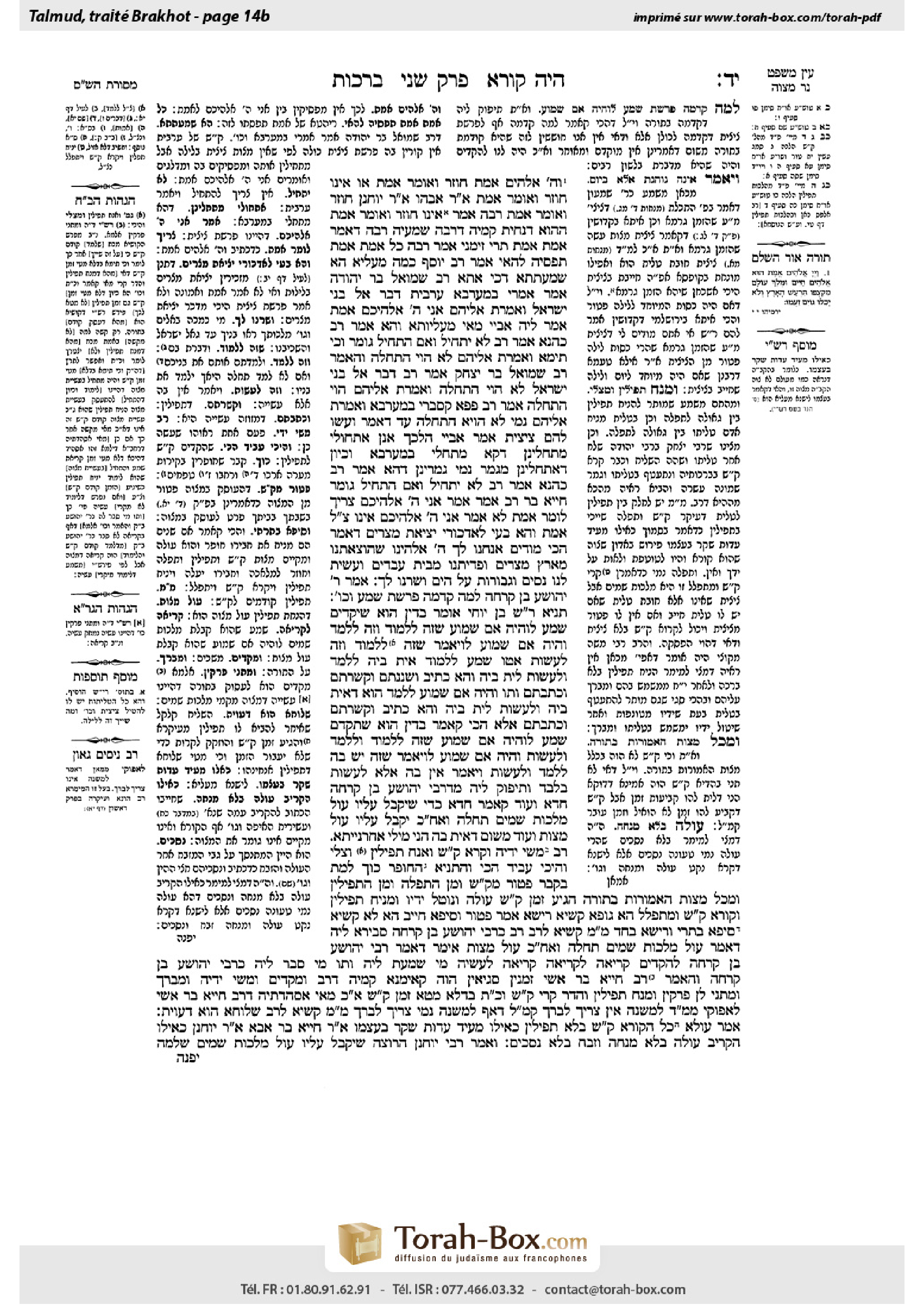
Berakhot 14b: Talmud study for Daf Yomi
Study the Talmud for Daf Yomi with scanned pages, Hebrew text, English translations from Sefaria and AI-generated French translations.
Passage selection and English or AI-generated French translation are available where the scan has annotations. Daf Study is independent of Torah-Box and Sefaria.
Browse Berakhot · ברכות · All tractatesBerakhot 14b text and translations
This page of Berakhot includes the Aramaic text, an English translation and an AI-generated French translation, alongside the scan above.
ברכות י״ד ב · Aramaic and Hebrew text
״וַה׳ אֱלֹהִים אֱמֶת״.
חוֹזֵר וְאוֹמֵר ״אֱמֶת״, אוֹ אֵינוֹ חוֹזֵר וְאוֹמֵר ״אֱמֶת״?
אָמַר רַבִּי אֲבָהוּ אָמַר רַבִּי יוֹחָנָן: חוֹזֵר וְאוֹמֵר ״אֱמֶת״. רַבָּה אָמַר: אֵינוֹ חוֹזֵר וְאוֹמֵר ״אֱמֶת״. הָהוּא דִּנְחֵית קַמֵּיהּ דְּרַבָּה. שַׁמְעֵיהּ רַבָּה דְּאָמַר ״אֱמֶת״ ״אֱמֶת״ תְּרֵי זִימְנֵי. אֲמַר רַבָּה: כֹּל ״אֱמֶת״ ״אֱמֶת״ תַּפְסֵיהּ לְהַאי.
אָמַר רַב יוֹסֵף: כַּמָּה מְעַלְּיָא הָא שְׁמַעְתְּתָא, דְּכִי אֲתָא רַב שְׁמוּאֵל בַּר יְהוּדָה אֲמַר: אָמְרִי בְּמַעְרְבָא עַרְבִית — ״דַּבֵּר אֶל בְּנֵי יִשְׂרָאֵל וְאָמַרְתָּ אֲלֵיהֶם אֲנִי ה׳ אֱלֹהֵיכֶם אֱמֶת״.
אֲמַר לֵיהּ אַבָּיֵי: מַאי מְעַלְּיוּתָא? וְהָא אָמַר רַב כָּהֲנָא אָמַר רַב: לֹא יַתְחִיל, וְאִם הִתְחִיל — גּוֹמֵר. וְכִי תֵּימָא ״וְאָמַרְתָּ אֲלֵיהֶם״ לָא הָוֵי הַתְחָלָה — וְהָאָמַר רַב שְׁמוּאֵל בַּר יִצְחָק אָמַר רַב: ״דַּבֵּר אֶל בְּנֵי יִשְׂרָאֵל״ לָא הָוֵי הַתְחָלָה, ״וְאָמַרְתָּ אֲלֵיהֶם״ הָוֵי הַתְחָלָה.
אָמַר רַב פָּפָּא: קָסָבְרִי בְּמַעְרְבָא ״וְאָמַרְתָּ אֲלֵיהֶם״ נָמֵי לָא הָוְיָא הַתְחָלָה עַד דְּאָמַר ״וְעָשׂוּ לָהֶם צִיצִית״.
אָמַר אַבָּיֵי: הִלְכָּךְ, אֲנַן אַתְחוֹלֵי מַתְחֲלִינַן, דְּקָא מַתְחֲלִי בְּמַעְרְבָא, וְכֵיוָן דְּאַתְחֲלִינַן — מִגְמָר נָמֵי גָּמְרִינַן. דְּהָא אָמַר רַב כָּהֲנָא אָמַר רַב לֹא יַתְחִיל, וְאִם הִתְחִיל גּוֹמֵר.
חִיָּיא בַּר רַב אָמַר: אָמַר ״אֲנִי ה׳ אֱלֹהֵיכֶם״, צָרִיךְ לוֹמַר ״אֱמֶת״. לֹא אָמַר ״אֲנִי ה׳ אֱלֹהֵיכֶם״ — אֵינוֹ צָרִיךְ לוֹמַר ״אֱמֶת״.
וְהָא בָּעֵי לְאַדְכּוֹרֵי יְצִיאַת מִצְרַיִם!
דְּאָמַר הָכִי: ״מוֹדִים אֲנַחְנוּ לָךְ ה׳ אֱלֹהֵינוּ שֶׁהוֹצֵאתָנוּ מֵאֶרֶץ מִצְרַיִם וּפְדִיתָנוּ מִבֵּית עֲבָדִים וְעָשִׂיתָ לָנוּ נִסִּים וּגְבוּרוֹת עַל הַיָּם וְשַׁרְנוּ לָךְ״.
אָמַר רַבִּי יְהוֹשֻׁעַ בֶּן קׇרְחָה: לָמָּה קָדְמָה פָּרָשַׁת ״שְׁמַע״ וְכוּ׳.
תַּנְיָא רַבִּי שִׁמְעוֹן בֶּן יוֹחַי אוֹמֵר: בַּדִּין הוּא שֶׁיַּקְדִּים ״שְׁמַע״, לִ״וְהָיָה אִם שָׁמוֹעַ״ — שֶׁזֶּה לִלְמוֹד, וְזֶה לְלַמֵּד. ״וְהָיָה אִם שָׁמוֹעַ״ לְ״וַיֹּאמֶר״ — שֶׁזֶּה לִלְמוֹד, וְזֶה לַעֲשׂוֹת.
אַטּוּ ״שְׁמַע״ — לִלְמוֹד אִית בֵּיהּ, לְלַמֵּד וְלַעֲשׂוֹת לֵית בֵּיהּ?! וְהָא כְּתִיב: ״וְשִׁנַּנְתָּם״, ״וּקְשַׁרְתָּם״, ״וּכְתַבְתָּם״! וְתוּ: ״וְהָיָה אִם שָׁמוֹעַ״ — לְלַמֵּד הוּא דְּאִית בֵּיהּ, וְלַעֲשׂוֹת לֵית בֵּיהּ? וְהָא כְּתִיב: ״וּקְשַׁרְתֶּם״, ״וּכְתַבְתָּם״!
אֶלָּא הָכִי קָאָמַר: בַּדִּין הוּא שֶׁתִּקְדַּם ״שְׁמַע״ לִ״וְהָיָה אִם שָׁמוֹעַ״, שֶׁזֶּה לִלְמוֹד וּלְלַמֵּד וְלַעֲשׂוֹת. ״וְהָיָה אִם שָׁמוֹעַ״ לְ״וַיֹּאמֶר״, שֶׁזֶּה יֵשׁ בָּהּ לְלַמֵּד וְלַעֲשׂוֹת, ״וַיֹּאמֶר״ אֵין בָּהּ אֶלָּא לַעֲשׂוֹת בִּלְבַד.
וְתִיפּוֹק לֵיהּ מִדְּרַבִּי יְהוֹשֻׁעַ בֶּן קׇרְחָה! חֲדָא וְעוֹד קָאָמַר, חֲדָא: כְּדֵי שֶׁיְּקַבֵּל עָלָיו עוֹל מַלְכוּת שָׁמַיִם תְּחִלָּה וְאַחַר כָּךְ יְקַבֵּל עָלָיו עוֹל מִצְוֹת, וְעוֹד — מִשּׁוּם דְּאִית בַּהּ הָנֵי מִילֵּי אַחְרָנְיָיתָא.
רַב מְשִׁי יְדֵיהּ, וּקְרָא קְרִיאַת שְׁמַע, וְאַנַּח תְּפִילִּין וְצַלִּי. וְהֵיכִי עָבֵיד הָכִי? וְהָתַנְיָא הַחוֹפֵר כּוּךְ לְמֵת בַּקֶּבֶר — פָּטוּר מִקְּרִיאַת שְׁמַע וּמִן הַתְּפִלָּה וּמִן הַתְּפִילִּין וּמִכׇּל מִצְוֹת הָאֲמוּרוֹת בַּתּוֹרָה. הִגִּיעַ זְמַן קְרִיאַת שְׁמַע — עוֹלֶה וְנוֹטֵל יָדָיו, וּמַנִּיחַ תְּפִילִּין, וְקוֹרֵא קְרִיאַת שְׁמַע, וּמִתְפַּלֵּל.
הָא גוּפָא קַשְׁיָא, רֵישָׁא אָמַר פָּטוּר, וְסֵיפָא חַיָּיב?!
הָא לָא קַשְׁיָא: סֵיפָא בִּתְרֵי, וְרֵישָׁא בְּחַד.
מִכׇּל מָקוֹם קַשְׁיָא לְרַב. רַב כְּרַבִּי יְהוֹשֻׁעַ בֶּן קָרְחָה סְבִירָא לֵיהּ, דְּאָמַר עוֹל מַלְכוּת שָׁמַיִם תְּחִלָּה וְאַחַר כָּךְ עוֹל מִצְוֹת.
אֵימַר דַּאֲמַר רַבִּי יְהוֹשֻׁעַ בֶּן קׇרְחָה — לְהַקְדִּים קְרִיאָה לִקְרִיאָה, קְרִיאָה לַעֲשִׂיָּה מִי שָׁמְעַתְּ לֵיהּ?!
וְתוּ, מִי סָבַר לֵיהּ כְּרַבִּי יְהוֹשֻׁעַ בֶּן קׇרְחָה? וְהָאָמַר רַב חִיָּיא בַּר אָשֵׁי: זִמְנִין סַגִּיאִין הֲוָה קָאֵימְנָא קַמֵּיהּ דְרַב, וּמַקְדֵּים וּמָשֵׁי יְדֵיהּ, וּמְבָרֵךְ, וּמַתְנֵי לַן פִּרְקִין, וּמַנַּח תְּפִילִּין, וַהֲדַר קָרֵי קְרִיאַת שְׁמַע. וְכִי תֵּימָא: בִּדְלָא מְטָא זְמַן קְרִיאַת שְׁמַע, אִם כֵּן מַאי אַסְהַדְתֵּיהּ דְרַב חִיָּיא בַּר אָשֵׁי?
לְאַפּוֹקֵי מִמַּאן דְּאָמַר לַמִּשְׁנָה אֵין צָרִיךְ לְבָרֵךְ, קָמַשְׁמַע לַן דְּאַף לְמִשְׁנָה נָמֵי צָרִיךְ לְבָרֵךְ.
מִכׇּל מָקוֹם קַשְׁיָא לְרַב! שְׁלוּחָא הוּא דְּעַוֵּית.
אָמַר עוּלָּא: כָּל הַקּוֹרֵא קְרִיאַת שְׁמַע בְּלֹא תְּפִילִּין, כְּאִילּוּ מֵעִיד עֵדוּת שֶׁקֶר בְּעַצְמוֹ. אָמַר רַבִּי חִיָּיא בַּר אַבָּא אָמַר רַבִּי יוֹחָנָן: כְּאִילּוּ הִקְרִיב עוֹלָה בְּלֹא מִנְחָה, וְזֶבַח בְּלֹא נְסָכִים.
וְאָמַר רַבִּי יוֹחָנָן: הָרוֹצֶה שֶׁיְּקַבֵּל עָלָיו עוֹל מַלְכוּת שָׁמַיִם שְׁלֵמָה
Berakhot 14b · English translation
“And the Lord, God, is True” (Jeremiah 10:10).
After the conclusion of the final paragraph of Shema along with the first word of the subsequent blessing, with the words: “The Lord, your God, is True [Hashem Eloheikhem emet],” the question is posed: Does one repeat emet when he begins the blessing of emet veyatziv, or does he not repeat emet?
Rabbi Abbahu said that Rabbi Yoḥanan said: He repeats emet. Rabba said: He does not repeat emet. The Gemara relates: This person who descended to lead the service before Rabba, Rabba heard that he said emet, emet twice. Rabba mocked him and said: Every emet, emet has caught this one; he must be passionate about the pursuit of truth.
Rav Yosef said: How excellent is this tradition that I heard, as when Rav Shmuel bar Yehuda came from Eretz Yisrael to Babylonia he said: In Eretz Yisrael, at the evening prayer they do not recite the entire third portion of Shema, which deals with ritual fringes, as there is no obligation to wear ritual fringes at night. Rather, they say a condensed version of that portion that includes an excerpt from the beginning and an excerpt from the end: “Speak to the children of Israel and say to them…I am the Lord, your God, True” (Numbers 15:38, Numbers 15:41).
Abaye said to him: What is excellent about this tradition? Didn’t Rav Kahana say that Rav said: One should not begin to recite the portion of ritual fringes at night, but if he does begin, he completes it? And if you say that: Speak to the children of Israel and say to them, is not considered the beginning of the portion of ritual fringes, didn’t Rav Shmuel bar Yitzḥak say that Rav said: Speak to the children of Israel, is not considered a beginning of the portion of ritual fringes, as many passages in the Torah begin this way; and say to them, is considered a beginning.
Rav Pappa said: In Eretz Yisrael, they hold that and say to them, is not considered a beginning, until he said: And make for them ritual fringes.
Abaye said: Therefore, we begin to recite the portion of ritual fringes, since they begin to recite it in Eretz Yisrael. And once we begin to recite it, we complete it as well, as Rav Kahana said that Rav said: One should not begin to recite the portion of ritual fringes at night, but if he does begin, he completes it.
Ḥiyya bar Rav said: If in the evening one recited the portion of ritual fringes concluding with: I am the Lord, your God, he must recite: True and Faithful [emet ve’emuna], and the entire blessing of redemption. However, if he did not recite: I am the Lord, your God, he need not recite emet ve’emuna.
The Gemara asks: Isn’t he required to mention the exodus from Egypt at night as well?
The Gemara responds: In place of reciting emet ve’emuna he said the following shorter passage: We give thanks to You, Lord, our God, Who took us out from Egypt and redeemed us from the house of bondage, and performed miracles and mighty deeds on our behalf on the sea, and we sang unto You, as this formula includes all of the content comprising emet ve’emuna.
We learned in the mishna: Rabbi Yehoshua ben Korḥa said: Why did the portion of Shema precede that of VeHaya im Shamoa? So that one will first accept upon himself the yoke of the kingdom of Heaven and only then accept upon himself the yoke of the mitzvot.
It was taught in a baraita that Rabbi Shimon ben Yoḥai offers a different explanation for the order of the portions of Shema. He says: By right, Shema should precede VeHaya im Shamoa because the Shema includes the directive to learn, while VeHaya im Shamoa includes the directive to teach. Similarly, VeHaya im Shamoa should precede VaYomer, the final paragraph of Shema, because VeHaya im Shamoa includes the directive to teach, while the portion of ritual fringes includes the directive to perform.
The Gemara asks: Is that to say that the portion of Shema contains the directive to learn but it does not contain the directive to teach and perform? Isn’t it written: “And you shall teach them to your children” (Deuteronomy 6:7), a directive to teach, as well as: “And you shall bind them as a sign upon your arm” (Deuteronomy 6:8) and: “And write them on your door posts of your house” (Deuteronomy 6:9), directives to perform? Furthermore, does VeHaya im Shamoa contain the directive to teach but it does not contain the directive to perform? Isn’t it written: “And you shall bind them as a sign upon your arm” (Deuteronomy 11:18), a directive to perform?
Rather, Rabbi Shimon ben Yoḥai said as follows: By right, the portion of Shema should precede VeHaya im Shamoa because the portion of Shema includes the directives to learn, to teach, and to perform, while VeHaya im Shamoa includes the directives to teach and to perform. VeHaya im Shamoa should precede VaYomer because VeHaya im Shamoa includes the directives to teach and to perform, while VaYomer only includes the directive to perform.
The Gemara asks: Let him derive this, that the portion of Shema is recited first, from the statement of Rabbi Yehoshua ben Korḥa. The Gemara responds: He stated one reason and another. Rabbi Shimon ben Yoḥai does not disagree with Rabbi Yehoshua ben Korḥa; he simply suggested as additional explanation as follows: One reason the portion of Shema is recited first is so that one will first accept the yoke of the kingdom of Heaven upon himself and afterward the yoke of the mitzvot; and the second reason is because the portion of Shema contains these other elements as well.
The Gemara relates: Rav washed his hands, recited Shema, donned phylacteries, and prayed in that order. The Gemara asks: How could he do that? Wasn’t it taught in a baraita: One who digs a grave for the dead in the wall of the family burial cave is exempt from the recitation of Shema, from prayer, from phylacteries, and from all mitzvot mentioned in the Torah. When the appointed time for the recitation of Shema arrives, he emerges from the cave, washes his hands, dons phylacteries, recites Shema, and prays.
Before clarifying the problem, the Gemara comments: This baraita itself is difficult; it appears to be contradictory. The first clause of the baraita stated that one digging a grave is exempt from the recitation of Shema, and the latter clause stated that he is obligated to emerge and recite Shema
The Gemara responds: That is not difficult. The latter clause of the baraita refers to a case of two individuals digging the grave together; one pauses to recite Shema while the other continues digging. The first clause of the baraita refers to a case of one individual digging alone, who may not stop.
In any case, this baraita contradicts Rav in terms of the order in which the mitzvot are performed. The Gemara responds: Rav holds in accordance with the opinion of Rabbi Yehoshua ben Korḥa, who said that the acceptance of the yoke of the kingdom of Heaven takes precedence and should come first, followed by the acceptance of the yoke of the mitzvot. Therefore, Rav first recited Shema, and only then donned phylacteries.
The Gemara challenges: Say that Rabbi Yehoshua ben Korḥa said to give precedence to recitation of the portion concerning the acceptance of the yoke of the kingdom of Heaven over recitation of other portions. But did you hear him say the halakha gives precedence to recitation over performance?
And furthermore, does Rav really hold in accordance with the opinion of Rabbi Yehoshua ben Korḥa? But didn’t Rav Ḥiyya bar Ashi say: Many times I stood before Rav, and he first washed his hands, recited a blessing, taught us our lesson, donned phylacteries, and then recited Shema. And if you say: This was when the time for the recitation of Shema had not yet arrived and that is why he donned his phylacteries first, then what is the point of the testimony of Rav Ḥiyya bar Ashi?
The Gemara responds: Rav Ḥiyya bar Ashi’s story comes to exclude the opinion of the one who said that one need not recite the blessing on Torah study for the study of mishna. It teaches us that even for mishna, one must recite a blessing.
In any case this baraita is difficult for Rav. The Gemara responds: The messenger was at fault and brought Rav his phylacteries late, so Rav recited Shema at its appropriate time and later donned phylacteries.
With regard to the recitation of Shema without phylacteries, Ulla said: Anyone who recites Shema without phylacteries, it is as if he has borne false testimony against himself, as in Shema, he mentions his obligation to don phylacteries and in this case fails to don them himself (Talmidei Rabbeinu Yona). Rabbi Ḥiyya bar Abba said that Rabbi Yoḥanan said: One who recites Shema without phylacteries, it is as if he has offered a burnt-offering without a meal-offering or a peace-offering without libations. Despite the fact that he fulfilled his obligation, his offering is incomplete.
And Rabbi Yoḥanan said: One who seeks to accept upon himself the complete yoke of the kingdom of Heaven
Berakhot 14b · Traduction française (IA)
« Et l'Éternel, ton Dieu, est vrai » (Jérémie 10:10).
Après la conclusion du dernier paragraphe du Chéma, ainsi que la première parole de la bénédiction suivante, avec les mots : « L'Éternel, ton Dieu, est vrai [Hashem Eloheikhem emet], » la question est posée : doit-on répéter emet lorsqu'on commence la bénédiction d'emet veyatziv, ou ne doit-on pas le répéter ?
Rabbi Abbahu a dit que Rabbi Yoḥanan a dit : On répète emet. Rabba a dit : On ne répète pas emet. La Guemara rapporte : Ce personnage qui est descendu pour diriger le service avant Rabba, Rabba a entendu qu'il avait dit emet, emet deux fois. Rabba a moqué ce dernier et a dit : Chaque emet, emet a attrapé celui-ci ; il doit être passionné par la quête de la vérité.
Rav Yosef a dit : Quel est l'excellence de cette tradition que j'ai entendue, comme quand Rav Shmuel bar Yehuda est venu de la Terre d'Israël vers Babylone, il a dit : En Terre d'Israël, lors de la prière du soir, ils ne récitent pas l'intégralité de la troisième partie du Chéma, qui traite des franges rituelles, car il n'y a pas d'obligation de porter des franges la nuit. Ils disent plutôt une version condensée de cette partie qui inclut un extrait du début et un extrait de la fin : « Parle aux enfants d'Israël et dis-leur... Je suis l'Éternel, ton Dieu, vrai » (Nombres 15:38, Nombres 15:41).
Abaye a dit à lui : Quel est l'excellence de cette tradition ? N'a-t-il pas dit Rav Kahana que Rav a dit : On ne doit pas commencer à réciter la partie des franges rituelles la nuit, mais si l'on commence, on doit la terminer ? Et si vous dites que : Parle aux enfants d'Israël et dis-leur, n'est pas considéré comme le début de la partie des franges rituelles, n'a-t-il pas dit Rav Shmuel bar Yitzḥak que Rav a dit : Parle aux enfants d'Israël, n'est pas considéré comme le début de la partie des franges rituelles, car de nombreuses passages de la Torah commencent ainsi ; et dis-leur, est considéré comme le début.
Rav Pappa a dit : En Terre d'Israël, ils ne considèrent pas dis-leur comme le début, jusqu'à ce qu'il ait dit : Et faites-leur des franges rituelles.
Abaye a dit : Par conséquent, nous commençons à réciter la portion des franges rituelles, car ils commencent à la réciter en Terre d'Israël. Et une fois que nous commençons à la réciter, nous la terminons également, comme Rav Kahana a dit que Rav a dit : On ne doit pas commencer à réciter la portion des franges rituelles la nuit, mais si l'on commence, on doit la terminer.
Ḥiyya bar Rav a dit : Si la nuit on a récité la portion des franges rituelles en terminant par : Je suis l'Éternel, ton Dieu, il doit réciter : Vrai et Fidèle [émét ve’emuna], et la bénédiction entière de la délivrance. Cependant, s'il n'a pas récité : Je suis l'Éternel, ton Dieu, il n'a pas besoin de réciter émét ve’emuna.
La Guemara pose la question : N'est-il pas tenu de mentionner la sortie d'Égypte la nuit également ?
La Guemara répond : À la place de réciter emet ve’emuna, il a récité la formule suivante plus courte : Nous te bénissons, Éternel, notre Dieu, qui nous as tirés d'Égypte et nous as délivrés de la maison d'Esclave, et qui as accompli des miracles et des prodiges en notre faveur sur la mer, et nous avons chanté à Toi, car cette formule inclut tout le contenu de emet ve’emuna.
Nous avons appris dans la mishna : Rabbi Yehoshua ben Korḥa a dit : Pourquoi la partie du Chéma précède-t-elle celle de VeHaya im Shamoa ? Afin que l'on accepte d'abord le joug du Royaume des Cieux et seulement ensuite celui des mitsvot.
Il a été enseigné dans une baraïta que Rabbi Shimon ben Yoḥai offre une explication différente pour l'ordre des parties du Chéma. Il dit : D'après la loi, la partie du Chéma devrait précéder VeHaya im Shamoa, car la partie du Chéma contient l'ordre d'apprendre, tandis que VeHaya im Shamoa contient l'ordre d'enseigner. De même, VeHaya im Shamoa devrait précéder VaYomer, la dernière partie du Chéma, car VeHaya im Shamoa contient l'ordre d'enseigner, tandis que la partie des franges rituelles contient l'ordre d'accomplir.
La Guemara pose la question : Est-ce que cela signifie que la partie du Chéma contient l'ordre d'apprendre mais ne contient pas l'ordre d'enseigner et d'accomplir ? N'est-il pas écrit : « Et tu apprendras à tes enfants » (Deutéronome 6:7), un ordre d'enseigner, ainsi que : « Et tu les attacheras comme un signe sur ton bras » (Deutéronome 6:8) et : « Et tu les écriras sur les piliers de ta maison » (Deutéronome 6:9), des ordres d'accomplir ? De plus, VeHaya im Shamoa contient-il l'ordre d'enseigner mais pas celui d'accomplir ? N'est-il pas écrit : « Et tu les attacheras comme un signe sur ton bras » (Deutéronome 11:18), un ordre d'accomplir ?
Plutôt, Rabbi Shimon ben Yoḥai a dit comme suit : D'après la loi, la partie du Chéma devrait précéder VeHaya im Shamoa, car la partie du Chéma contient les ordres d'apprendre, d'enseigner et d'accomplir, tandis que VeHaya im Shamoa contient les ordres d'enseigner et d'accomplir. VeHaya im Shamoa devrait précéder VaYomer car VeHaya im Shamoa contient les ordres d'enseigner et d'accomplir, tandis que VaYomer ne contient que l'ordre d'accomplir.
La Guemara pose la question : Laissez-le déduire cela, que la partie du Chéma est récitée en premier, à partir de la déclaration de Rabbi Yehoshua ben Korḥa. La Guemara répond : Il a énoncé une raison et une autre. Rabbi Shimon ben Yoḥai ne conteste pas Rabbi Yehoshua ben Korḥa ; il propose simplement une explication supplémentaire comme suit : Une raison pour laquelle la partie du Chéma est récitée en premier est afin que l'on accepte d'abord le joug du Royaume des Cieux sur soi et ensuite celui des mitsvot ; et la deuxième raison est parce que la partie du Chéma contient également ces autres éléments.
La Guemara rapporte : Rav lava ses mains, récita le Chéma, s'habilla des phylactères et pria dans cet ordre. La Guemara pose la question : Comment pouvait-il faire cela ? N'avait-il pas été enseigné dans une baraïta : Celui qui creuse une tombe pour les morts dans le mur de la tombe familiale est exempt de la récitation du Chéma, de la prière, des phylactères et de toutes les mitsvot mentionnées dans la Torah. Lorsque vient l'heure de la récitation du Chéma, il sort de la cave, lave ses mains, s'habille des phylactères, récita le Chéma et pria.
Avant de clarifier le problème, la Guemara commente : cette baraïta elle-même est difficile ; elle semble être contradictoire. La première partie de la baraïta affirmait que celui qui creuse une tombe est exempt de la récitation du Chéma, et la seconde partie affirmait qu'il est tenu de sortir et de réciter le Chéma.
La Guemara répond : Ce n'est pas difficile. La seconde partie de la baraïta fait référence à un cas où deux personnes creusent la tombe ensemble ; l'une s'arrête pour réciter le Chéma tandis que l'autre continue à creuser. La première partie de la baraïta fait référence à un cas où une seule personne creuse seul, et ne peut pas s'arrêter.
En tout cas, cette baraïta contredit Rav en ce qui concerne l'ordre dans lequel les mitsvot sont accomplies. La Guemara répond : Rav suit l'opinion de Rabbi Yéhoshua ben Korkha, qui affirmait que l'acceptation du joug du Royaume des Cieux doit avoir la priorité et venir en premier, suivie de l'acceptation du joug des mitsvot. Ainsi, Rav a d'abord récité le Chéma, puis s'est habillé avec les phylactères.
La Guemara conteste : Dites que Rabbi Yéhoshua ben Korkha a dit de donner la priorité à la récitation de la portion concernant l'acceptation du joug du Royaume des Cieux par rapport à la récitation d'autres portions. Mais avez-vous entendu qu'il ait dit que la halakha donne la priorité à la récitation par rapport à la performance ?
Et de plus, Rav ne tient-il vraiment compte de l'opinion de Rabbi Yéhoshua ben Korkha ? Mais n'a-t-il pas dit Rav Chiya bar Ashi : Beaucoup de fois j'ai été devant Rav, et il a d'abord lavé ses mains, récité une berakha, nous a enseigné notre leçon, s'est habillé avec les phylactères, puis a récité le Chéma. Et si vous dites : C'était lorsque l'heure de la récitation du Chéma n'était pas encore arrivée et que c'est pourquoi il s'est habillé avec les phylactères d'abord, alors à quoi sert le témoignage de Rav Chiya bar Ashi ?
La Guemara répond : L'histoire de Rav Chiya bar Ashi sert à exclure l'opinion de celui qui a dit qu'il n'est pas nécessaire de réciter la berakha sur l'étude de la Torah pour l'étude de la Michna. Elle nous apprend que même pour la Michna, il faut réciter une berakha.
En tout cas, cette baraïta est difficile pour Rav. La Guemara répond : Le messager était fautif et a apporté tard les phylactères à Rav, donc Rav a récité le Chéma à l'heure appropriée et s'est ensuite habillé avec les phylactères.
En ce qui concerne la récitation du Chéma sans phylactères, Ulla a dit : Celui qui récite le Chéma sans phylactères, c'est comme s'il a porté témoignage faux contre lui-même, comme dans le Chéma, il mentionne son obligation de s'habiller avec les phylactères et dans ce cas il ne les porte pas lui-même (Talmidei Rabbeinu Yona). Rabbi Chiya bar Abba a dit que Rabbi Yochanan a dit : Celui qui récite le Chéma sans phylactères, c'est comme s'il a offert un holocauste sans un offrande de table ou un offrande de paix sans des libations. Bien qu'il ait accompli son obligation, son offrande est incomplète.
Et Rabbi Yochanan a dit : Celui qui cherche à s'engager pleinement dans le joug du Royaume des Cieux
Traduction française générée par IA à partir de l’édition anglaise de Sefaria. Vérifie toujours un passage avec le texte source.
Text from Sefaria: William Davidson Edition - Vocalized Aramaic (CC BY NC); William Davidson Edition - English (CC BY NC).