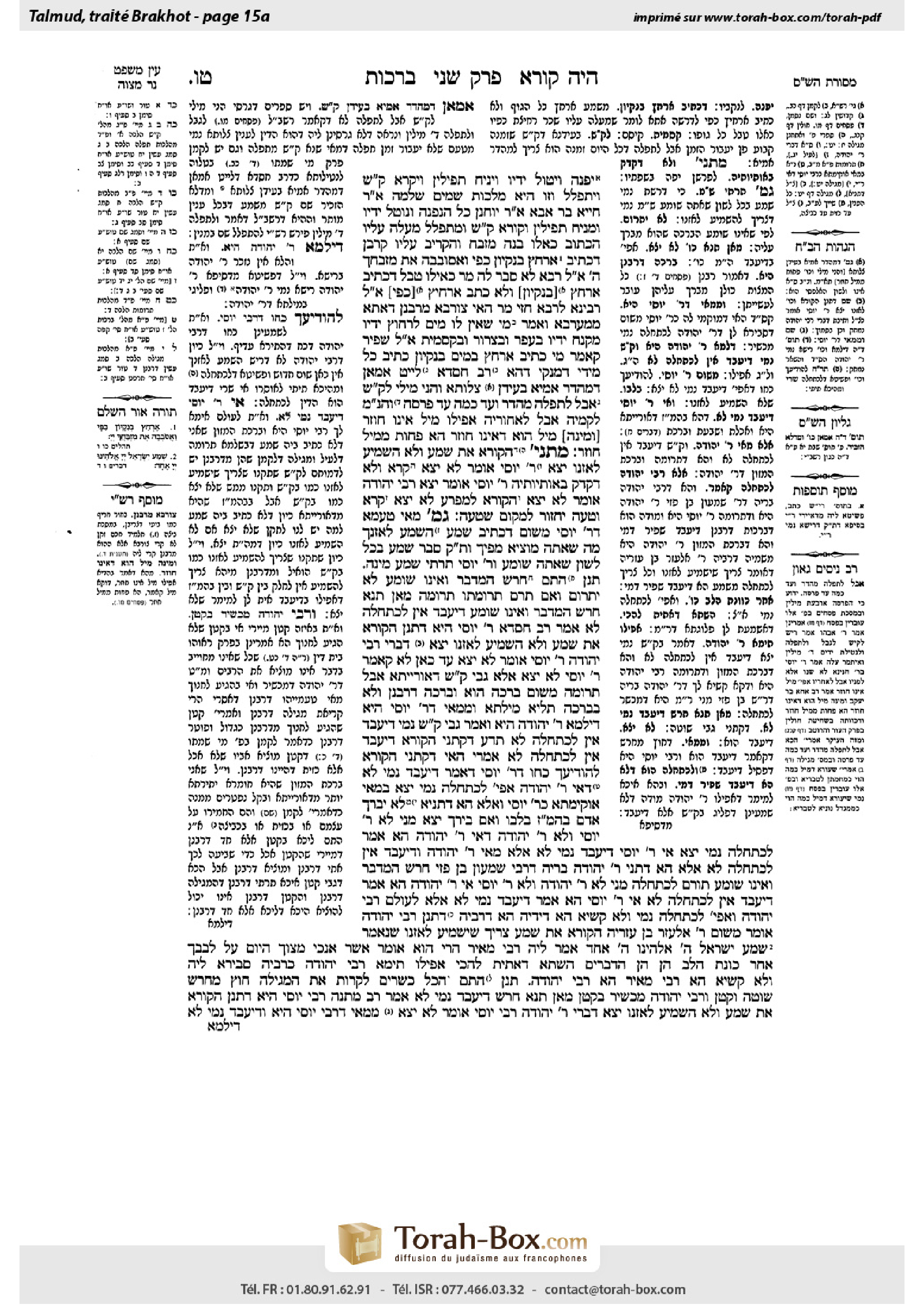
Berakhot 15a: Talmud study for Daf Yomi
Study the Talmud for Daf Yomi with scanned pages, Hebrew text, English translations from Sefaria and AI-generated French translations.
Passage selection and English or AI-generated French translation are available where the scan has annotations. Daf Study is independent of Torah-Box and Sefaria.
Browse Berakhot · ברכות · All tractatesBerakhot 15a text and translations
This page of Berakhot includes the Aramaic text, an English translation and an AI-generated French translation, alongside the scan above.
ברכות י״ה א · Aramaic and Hebrew text
יִפָּנֶה, וְיִטּוֹל יָדָיו, וְיַנִּיחַ תְּפִילִּין, וְיִקְרָא קְרִיאַת שְׁמַע, וְיִתְפַּלֵּל, וְזוֹ הִיא מַלְכוּת שָׁמַיִם שְׁלֵמָה.
אָמַר רַבִּי חִיָּיא בַּר אַבָּא אָמַר רַבִּי יוֹחָנָן: כָּל הַנִּפְנֶה, וְנוֹטֵל יָדָיו, וּמַנִּיחַ תְּפִילִּין, וְקוֹרֵא קְרִיאַת שְׁמַע, וּמִתְפַּלֵּל — מַעֲלֶה עָלָיו הַכָּתוּב כְּאִלּוּ בָּנָה מִזְבֵּחַ וְהִקְרִיב עָלָיו קׇרְבָּן, דִּכְתִיב: ״אֶרְחַץ בְּנִקָּיוֹן כַּפָּי וַאֲסוֹבְבָה אֶת מִזְבַּחֲךָ ה׳״. אֲמַר לֵיהּ רָבָא: לָא סָבַר לַהּ מָר כְּאִילּוּ טָבַל, דִּכְתִיב: ״אֶרְחַץ [בְּנִקָּיוֹן]״ — וְלָא כָּתַב ״אַרְחִיץ [כַּפָּי]״.
אֲמַר לֵיהּ רָבִינָא לְרָבָא: חֲזִי מָר הַאי צוּרְבָּא מֵרַבָּנָן דַּאֲתָא מִמַּעְרְבָא וְאָמַר: מִי שֶׁאֵין לוֹ מַיִם לִרְחוֹץ יָדָיו — מְקַנֵּחַ יָדָיו בְּעָפָר וּבִצְרוֹר וּבְקִסְמִית.
אֲמַר לֵיהּ: שַׁפִּיר קָאָמַר, מִי כְּתִיב ״אֶרְחַץ בְּמַיִם״? ״בְּנִקָּיוֹן״ כְּתִיב — כֹּל מִידֵּי דִּמְנַקֵּי, דְּהָא רַב חִסְדָּא לָיֵיט אַמַּאן דִּמְהַדַּר אַמַּיָּא בְּעִידָּן צְלוֹתָא.
וְהָנֵי מִילֵּי לִקְרִיאַת שְׁמַע, אֲבָל לִתְפִלָּה מְהַדַּר. וְעַד כַּמָּה? — עַד פַּרְסָה. וְהָנֵי מִילֵּי לְקַמֵּיהּ, אֲבָל לַאֲחוֹרֵיהּ — אֲפִילּוּ מִיל אֵינוֹ חוֹזֵר. [וּמִינַּהּ] מִיל הוּא דְּאֵינוֹ חוֹזֵר, הָא פָּחוֹת מִמִּיל — חוֹזֵר.
מַתְנִי׳ הַקּוֹרֵא אֶת שְׁמַע וְלֹא הִשְׁמִיעַ לְאׇזְנוֹ — יָצָא. רַבִּי יוֹסֵי אוֹמֵר: לֹא יָצָא.
קָרָא וְלֹא דִּקְדֵּק בְּאוֹתִיּוֹתֶיהָ, רַבִּי יוֹסֵי אוֹמֵר: יָצָא. רַבִּי יְהוּדָה אוֹמֵר: לֹא יָצָא.
הַקּוֹרֵא לְמַפְרֵעַ — לֹא יָצָא. קָרָא וְטָעָה — יַחְזוֹר לִמְקוֹם שֶׁטָּעָה.
גְּמָ׳ מַאי טַעְמָא דְּרַבִּי יוֹסֵי? מִשּׁוּם דִּכְתִיב ״שְׁמַע״ — הַשְׁמַע לְאׇזְנְךָ מָה שֶׁאַתָּה מוֹצִיא מִפִּיךָ. וְתַנָּא קַמָּא סָבַר, ״שְׁמַע״ — בְּכָל לָשׁוֹן שֶׁאַתָּה שׁוֹמֵעַ.
וְרַבִּי יוֹסֵי, תַּרְתֵּי שְׁמַע מִינַּהּ.
תְּנַן הָתָם: חֵרֵשׁ הַמְדַבֵּר וְאֵינוֹ שׁוֹמֵעַ — לֹא יִתְרוֹם. וְאִם תָּרַם — תְּרוּמָתוֹ תְּרוּמָה.
מַאן תְּנָא חֵרֵשׁ הַמְדַבֵּר וְאֵינוֹ שׁוֹמֵעַ דִּיעֲבַד — אִין, לְכַתְּחִלָּה — לָא?
אָמַר רַב חִסְדָּא: רַבִּי יוֹסֵי הִיא, דִּתְנַן: הַקּוֹרֵא אֶת ״שְׁמַע״ וְלֹא הִשְׁמִיעַ לְאׇזְנוֹ — יָצָא, דִּבְרֵי רַבִּי יְהוּדָה. רַבִּי יוֹסֵי אוֹמֵר: לֹא יָצָא.
עַד כָּאן לָא קָאָמַר רַבִּי יוֹסֵי לֹא יָצָא, אֶלָּא גַּבֵּי קְרִיאַת שְׁמַע דְּאוֹרָיְיתָא, אֲבָל תְּרוּמָה — מִשּׁוּם בְּרָכָה הוּא, וּבְרָכָה דְּרַבָּנַן וְלָא בִּבְרָכָה תַּלְיָא מִילְּתָא.
וּמִמַּאי דְּרַבִּי יוֹסֵי הִיא, דִּילְמָא רַבִּי יְהוּדָה הִיא? וְאָמַר גַּבֵּי קְרִיאַת שְׁמַע נָמֵי דִּיעֲבַד — אִין, לְכַתְּחִלָּה — לָא. תֵּדַע, דְּקָתָנֵי: ״הַקּוֹרֵא״, דִּיעֲבַד — אִין, לְכַתְּחִלָּה — לָא.
אָמְרִי: הַאי דְּקָתָנֵי ״הַקּוֹרֵא״, לְהוֹדִיעֲךָ כֹּחוֹ דְרַבִּי יוֹסֵי דְּאָמַר דִּיעֲבַד נָמֵי לָא. דְּאִי רַבִּי יְהוּדָה, אֲפִילּוּ לְכַתְּחִלָּה נָמֵי יָצָא.
בְּמַאי אוֹקִימְתָּא — כְּרַבִּי יוֹסֵי? וְאֶלָּא הָא דְתַנְיָא: לֹא יְבָרֵךְ אָדָם בִּרְכַּת הַמָּזוֹן בְּלִבּוֹ, וְאִם בֵּירַךְ — יָצָא.
מַנִּי? לָא רַבִּי יוֹסֵי וְלָא רַבִּי יְהוּדָה. דְּאִי רַבִּי יְהוּדָה — הָא אָמַר, לְכַתְּחִלָּה נָמֵי יָצָא? אִי רַבִּי יוֹסֵי, דִּיעֲבַד נָמֵי לָא!
אֶלָּא מַאי, רַבִּי יְהוּדָה. וְדִיעֲבַד — אִין, לְכַתְּחִלָּה — לָא.
אֶלָּא הָא דְתָנֵי רַבִּי יְהוּדָה בְּרֵיהּ דְּרַבִּי שִׁמְעוֹן בֶּן פַּזִּי: חֵרֵשׁ הַמְדַבֵּר וְאֵינוֹ שׁוֹמֵעַ — תּוֹרֵם לְכַתְּחִלָּה, מַנִּי?
לָא רַבִּי יְהוּדָה וְלָא רַבִּי יוֹסֵי. אִי רַבִּי יְהוּדָה — הָא אָמַר דִּיעֲבַד אִין, לְכַתְּחִלָּה לָא. אִי רַבִּי יוֹסֵי — הָא אָמַר דִּיעֲבַד נָמֵי לָא?
אֶלָּא, לְעוֹלָם רַבִּי יְהוּדָה, וַאֲפִילּוּ לְכַתְּחִלָּה נָמֵי. וְלָא קַשְׁיָא, הָא — דִידֵיהּ, הָא — דְרַבֵּיהּ. דִּתְנַן, רַבִּי יְהוּדָה אוֹמֵר מִשּׁוּם רַבִּי אֶלְעָזָר בֶּן עֲזַרְיָה: הַקּוֹרֵא אֶת שְׁמַע צָרִיךְ שֶׁיַּשְׁמִיעַ לְאׇזְנוֹ, שֶׁנֶּאֱמַר: ״שְׁמַע יִשְׂרָאֵל ה׳ אֱלֹהֵינוּ ה׳ אֶחָד״. אָמַר לוֹ רַבִּי מֵאִיר: הֲרֵי הוּא אוֹמֵר ״אֲשֶׁר אָנֹכִי מְצַוְּךָ הַיּוֹם עַל לְבָבֶךָ״ — אַחַר כַּוָּנַת הַלֵּב הֵן הֵן הַדְּבָרִים.
הַשְׁתָּא דְּאָתֵית לְהָכִי, אֲפִילּוּ תֵּימָא רַבִּי יְהוּדָה כְּרַבֵּיהּ סְבִירָא לֵיהּ. וְלָא קַשְׁיָא: הָא רַבִּי מֵאִיר, הָא רַבִּי יְהוּדָה.
תְּנַן הָתָם: הַכֹּל כְּשֵׁרִים לִקְרוֹת אֶת הַמְּגִילָּה, חוּץ מֵחֵרֵשׁ, שׁוֹטֶה וְקָטָן. וְרַבִּי יְהוּדָה מַכְשִׁיר בְּקָטָן.
מַאן תָּנָא חֵרֵשׁ דִּיעֲבַד נָמֵי לָא? אָמַר רַב מַתְנָה: רַבִּי יוֹסֵי הִיא. דִּתְנַן: הַקּוֹרֵא אֶת ״שְׁמַע״ וְלֹא הִשְׁמִיעַ לְאׇזְנוֹ — יָצָא, דִּבְרֵי רַבִּי יְהוּדָה. רַבִּי יוֹסֵי אוֹמֵר: לֹא יָצָא.
מִמַּאי דְּרַבִּי יוֹסֵי הִיא וְדִיעֲבַד נָמֵי לָא,
Berakhot 15a · English translation
should relieve himself, wash his hands, don phylacteries, recite Shema, and pray, and that is acceptance of the complete Kingdom of Heaven.
On a similar note, Rabbi Ḥiyya bar Abba said that Rabbi Yoḥanan said: Anyone who relieves himself, washes his hands, dons phylacteries, recites Shema, and prays, the verse ascribes credit to him as if he built an altar and offered a sacrifice upon it, as it is written: “I will wash in purity my hands, and I will encircle the altar of the Lord” (Psalms 26:6). Rava said to him: Do you not maintain, Master, that one who does so, it is as if he immersed his entire body, as it is written: “I will wash in purity,” and it is not written: “I will wash my hands”?
Ravina said to Rava: My Master, look at this Torah scholar [tzurva merabbanan] who came from Eretz Yisrael and said something astonishing: One who has no water with which to wash his hands, it is sufficient that he wipes his hands with earth, a rock, or a sliver of wood.
Rava replied to Ravina: He spoke well, as, is it written: I will wash with water? In purity, is written referring to anything that cleans, as Rav Ḥisda would curse one who went out of his way to seek water at the time of prayer.
With regard to seeking water, the Gemara comments: This applies only to the recitation of Shema, as the time for its recitation is limited, and if one goes seeking water he may run out of time. However, for prayer, which may be recited all day, one must go out of his way to seek water. And how far must one go out of his way to seek water? As far as a parasang [parsa]. And this, one parsa, applies only before him but behind him, he need not return even one mil. From this one may infer that he need not return one mil, but one must return less than one mil.
MISHNA: One who recites Shema and did not recite in a manner audible to his own ear, either because he read inaudibly or because he is deaf, fulfilled his obligation. Rabbi Yosei says: He did not fulfill his obligation.
One who recited Shema and was not sufficiently precise in his enunciation of its letters, Rabbi Yosei says: He fulfilled his obligation. Rabbi Yehuda says: He did not fulfill his obligation.
One who recited Shema out of order, meaning he did not read the verses sequentially, he did not fulfill his obligation. One who recited and erred, should return to the place in Shema that he erred.
GEMARA: The discussion in our mishna dealt with the question of whether or not one who recites Shema without hearing it fulfilled his obligation. The Gemara clarifies the opinions cited in the mishna: What is the reason for Rabbi Yosei’s opinion that one must recite Shema in a manner audible to his own ear? Because it is written: Shema, hear, and Rabbi Yosei holds that this is to be understood literally, meaning: Make your ears hear what your mouth utters. The first tanna, who holds that one fulfills his obligation even if he does not hear his recitation of Shema, holds that Shema, hear, comes to teach something else; one may recite Shema in any language that one can hear and understand, and there is no requirement to recite Shema specifically in Hebrew.
And Rabbi Yosei agrees with the principle derived by the first tanna from the word Shema; however Rabbi Yosei holds: Derive two halakhot from the word Shema; first, one may recite Shema in any language, and second, one must recite it in a manner audible to his own ears.
We learned there in a mishna regarding the laws of separating tithes: A deaf person who can speak but cannot hear may not separate teruma ab initio, because he must recite a blessing over the separation of teruma and he is unable to hear the blessing. But after the fact, if he did separate it, his teruma is valid teruma.
The Gemara asks: Who is this tanna who holds that if a deaf person who can speak but cannot hear separates teruma, it is considered teruma after the fact, but ab initio he may not do so?
Rav Ḥisda said: It is Rabbi Yosei, as we learned in our mishna: One who recites Shema and did not recite it so it was audible to his own ear, he fulfilled his obligation. This is the statement of Rabbi Yehuda. Rabbi Yosei says: He did not fulfill his obligation.
Rav Ḥisda elaborates: Rabbi Yosei only stated that a deaf person did not fulfill his obligation even after the fact with regard to the recitation of Shema, which is a biblical obligation. But with regard to teruma, the concern is due to the blessing recited over its separation. And the blessing is by rabbinic law, and the separation of teruma itself is not contingent upon the blessing. The separation of teruma takes effect regardless of whether or not a blessing is recited, so in the case of a deaf person, he fulfilled his obligation after the fact.
The Gemara challenges the assertion that this mishna is in accordance with the opinion of Rabbi Yosei: And from where do you infer that this is the opinion of Rabbi Yosei? Perhaps it is in accordance with the opinion of Rabbi Yehuda, and he said that with regard to the recitation of Shema as well, if one did not recite it in a manner audible to his own ears, he has fulfilled his obligation after the fact, but ab initio he may not do so. This opinion is identical to that of the tanna in the case of teruma. Know that this is true because it was taught in the mishna: One who recites Shema without it being audible to his own ear. The tanna formulated the dispute in a case which was after the fact. If one already recited Shema in this manner, yes, he fulfilled his obligation. The tanna did not formulate the case in the mishna using ab initio language, i.e., one may recite Shema in a manner inaudible to his own ears because, ab initio, he may not do so according to Rabbi Yehuda.
The Gemara rejects this proof. In explanation, they say: The fact that the mishna taught the halakha utilizing the after the fact language: One who recited, does not prove that Rabbi Yehuda also holds that one may not ab initio recite Shema in a manner inaudible to his own ears. Rather, the mishna formulated the halakha in that manner is to convey the far-reaching nature of the opinion of Rabbi Yosei, who said that if one does so, even after the fact, he did not fulfill his obligation to recite Shema. As, if it sought to convey the opinion of Rabbi Yehuda, then even ab initio he may fulfill his obligation without hearing the recitation.
The Gemara challenges this conclusion: How did you establish the reasoning of the mishna dealing with the laws of terumot? In accordance with the opinion of Rabbi Yosei, who holds that one who does not hear his recitation does not fulfill his obligation even after the fact. But what about that which was taught in a baraita: One may not recite the Grace after Meals, which like Shema and unlike the blessing on separating teruma is a Torah commandment, in his heart, inaudibly, and if he recited the blessing in that manner, he fulfilled his obligation?
In accordance with whose opinion is this baraita? It is in accordance neither with the opinion of Rabbi Yosei nor with the opinion of Rabbi Yehuda. As if you say that it is in accordance with the opinion of Rabbi Yehuda, didn’t he say according to the way the Gemara explained his position that even ab initio he may fulfill his obligation in that manner, and he need not recite it audibly. In that case, why should one refrain from reciting the blessing in his heart? And if you say that it is in accordance with the opinion of Rabbi Yosei; he holds that even after the fact, he did not fulfill his obligation.
Rather, what must we say? We must revert to the explanation that it is in accordance with the opinion of Rabbi Yehuda who holds that after the fact, yes, he fulfilled his obligation, but ab initio, no, one may not recite it in a manner inaudible to his own ears. Therefore the baraita concerning Grace after Meals is in accordance with the opinion of Rabbi Yehuda.
The Gemara questions this: But what about that baraita which was taught by Rabbi Yehuda, son of Rabbi Shimon ben Pazi: A deaf person who speaks but does not hear may, ab initio, separate teruma. In accordance with whose opinion is that baraita?
According to what we have said, it is in accordance neither with the opinion of Rabbi Yehuda nor with the opinion of Rabbi Yosei. As if you say that it is in accordance with the opinion of Rabbi Yehuda, didn’t he say that after the fact, yes, he fulfilled his obligation, although it was inaudible to his own ears, but ab initio, no, he may not fulfill his obligation in that manner? And if you say that it is in accordance with the opinion of Rabbi Yosei, didn’t he say that if he does not hear himself, even after the fact he did not fulfill his obligation? If so, whose opinion is reflected in this baraita?
Rather, we must revert to the previous explanation but with a slight revision, and say that actually it is in accordance with the opinion of Rabbi Yehuda, and even ab initio, a deaf person may also separate teruma. And this is not difficult and there is no contradiction between the mishna and the baraita, as this is his own opinion and that is his teacher’s opinion. As it was taught in a baraita: Rabbi Yehuda said in the name of Rabbi Elazar ben Azarya: One who recites Shema must make it audible to his ears, as it is stated: “Hear, Israel, the Lord is our God, the Lord is One.” This means that he must do so, but after the fact, if he failed to do so, he nevertheless fulfilled his obligation. The baraita continues: Rabbi Meir said to him: It says: “Which I command you this day, upon your heart;” which Rabbi Meir explains to mean that the significance of the words follows the intention of the heart and even ab initio one need not recite Shema audibly.
The Gemara notes: Now that you have arrived at this point and the entire baraita has been cited, even if you say that Rabbi Yehuda holds in accordance with the opinion of his teacher, that only after the fact, does a deaf person fulfill his obligation, it is, nevertheless, not difficult and the different baraitot are not contradictory. As this baraita permitting a deaf person to separate teruma ab initio is in accordance with the opinion of Rabbi Meir, while this baraita that holds that he may not recite Grace after Meals ab initio but after the fact he fulfilled his obligation is in accordance with the opinion of Rabbi Yehuda.
The Gemara cites a similar discussion with regard to the reading of the Megilla: We learned in a mishna there in tractate Megilla: All are fit to read the Megilla except a deaf person, an imbecile, and a minor. And Rabbi Yehuda deems a minor fit.
The Gemara clarifies: Who is the tanna who holds that even after the fact, the reading of a deaf person is not valid? Rav Mattana said: It is Rabbi Yosei, as we learned in our mishna: One who recites Shema and did not recite it so it was audible to his own ear, fulfilled his obligation. This is the statement of Rabbi Yehuda. Rabbi Yosei says: He did not fulfill his obligation.
The Gemara asks: From where do you conclude that the mishna cited from tractate Megilla is in accordance with the opinion of Rabbi Yosei, and that after the fact his reading is also not valid?
Berakhot 15a · Traduction française (IA)
doit se soulager, se laver les mains, porter les phylactères, réciter le Chéma et prier, et cela constitue l'acceptation du Royaume des Cieux complet.
Sur un point similaire, Rabbi Ḥiyya bar Abba a dit que Rabbi Yoḥanan a dit : Celui qui se soulage, se lave les mains, porte les phylactères, récite le Chéma et prie, la Bible attribue à lui un mérite comme s'il avait construit un autel et offert un sacrifice sur lui, comme il est écrit : « Je laverai mes mains en pureté, et je tournerai autour de l'autel du Seigneur » (Psaumes 26:6). Rava a dit à lui : N'êtes-vous pas, Maître, de l'avis que celui qui fait cela est comme s'il s'était purifié tout son corps, comme il est écrit : « Je laverai en pureté », et il n'est pas écrit : « Je laverai mes mains » ?
Ravina a dit à Rava : Mon Maître, regardez ce savant [tzurva merabbanan] qui est venu d'Eretz Yisrael et a dit quelque chose étonnant : Celui qui n'a pas d'eau pour se laver les mains, il suffit qu'il frotte ses mains avec de la terre, une pierre ou un morceau de bois.
Rava répondit à Ravina : Il a parlé bien, car il est écrit : « Je laverai avec de l'eau ? » En pureté, il est dit en référence à quelque chose qui nettoie, comme Rav Ḥisda aurait maudit celui qui s'est donné la peine de chercher de l'eau à l'heure de la prière.
En ce qui concerne la recherche d'eau, la Guemara commente : Cela s'applique uniquement à la récitation du Chéma, car le temps de sa récitation est limité, et si l'on cherche de l'eau, on peut manquer le moment. Cependant, pour la prière, qui peut être récitée toute la journée, il faut s'efforcer de trouver de l'eau. Et jusqu'où doit-on s'efforcer de trouver de l'eau ? Jusqu'à un parasang [parsa]. Et cela, un parasang, s'applique uniquement devant lui, mais derrière lui, il n'a pas besoin de revenir même d'un mil. De cela on peut déduire qu'il n'a pas besoin de revenir d'un mil, mais il faut qu'il revienne moins d'un mil.
MICHNA : Celui qui récite le Chéma et n'a pas récité de manière audible à ses propres oreilles, soit parce qu'il a lu inaudiblement, soit parce qu'il est sourd, a accompli son obligation. Rabbi Yosei dit : Il n'a pas accompli son obligation.
Celui qui a récité le Chéma et n'a pas été suffisamment précis dans l'articulation de ses lettres, Rabbi Yosei dit : Il a accompli son obligation. Rabbi Yehuda dit : Il n'a pas accompli son obligation.
Celui qui a récité le Chéma dans un ordre incorrect, c'est-à-dire qu'il n'a pas lu les versets de manière séquentielle, n'a pas accompli son obligation. Celui qui a récité et s'est trompé doit retourner au point du Chéma où il s'est trompé.
GUEMARA : La discussion dans notre mishna concernait la question de savoir si celui qui récite le Chéma sans l'entendre a accompli son obligation. La Guemara clarifie les opinions citées dans la mishna : Quelle est la raison de l'opinion de Rabbi Yosei selon laquelle l'on doit réciter le Chéma de manière audible à ses propres oreilles ? Parce qu'il est écrit : « Chéma, écoute », et Rabbi Yosei considère que cela doit être compris littéralement, c'est-à-dire : Fais entendre à tes oreilles ce que ta bouche prononce. Le premier tanna, qui considère que l'on accomplit son obligation même si l'on ne perçoit pas sa récitation du Chéma, considère que « Chéma, écoute » vient enseigner quelque chose d'autre ; on peut réciter le Chéma dans toute langue que l'on peut entendre et comprendre, et il n'y a pas de nécessité de réciter le Chéma spécifiquement en hébreu.
Et Rabbi Yosei est d'accord avec le principe dérivé par le premier tanna du mot « Chéma » ; cependant Rabbi Yosei considère : Dériver deux halakhot du mot « Chéma » ; premièrement, on peut réciter le Chéma dans toute langue, et deuxièmement, on doit le réciter de manière audible à ses propres oreilles.
Nous avons appris là-bas dans une mishna concernant les lois de la séparation des dixièmes : Un sourd qui peut parler mais ne peut pas entendre ne peut pas séparer la terouma ab initio, car il doit réciter une berakha sur la séparation de la terouma et il ne peut pas entendre la berakha. Cependant, après coup, si il a séparé la terouma, sa terouma est valide terouma.
La Guemara pose la question : Qui est ce tanna qui considère que si un sourd qui peut parler mais ne peut pas entendre sépare la terouma, il est considéré comme terouma après coup, mais ab initio il ne peut pas le faire ?
Rav Ḥisda a dit : C'est Rabbi Yosei, comme nous avons appris dans notre michna : Celui qui récite le Chéma et n'a pas récité de manière audible à ses propres oreilles, il a accompli son obligation. C'est la déclaration de Rabbi Yehuda. Rabbi Yosei dit : Il n'a pas accompli son obligation.
Rav Ḥisda développe : Rabbi Yosei a seulement dit que le sourd n'a pas accompli son obligation même après coup concernant la récitation du Chéma, qui est une obligation biblique. Cependant, concernant la terouma, la préoccupation est due à la berakha récitée sur sa séparation. Et la berakha est d'ordre rabbinique, et la séparation de la terouma elle-même n'est pas dépendante de la berakha. La séparation de la terouma prend effet indépendamment de la récitation d'une berakha, donc dans le cas du sourd, il a accompli son obligation après coup.
La Guemara conteste l'affirmation que cette michna est en conformité avec l'opinion de Rabbi Yosei : Et d'où inférez-vous que c'est l'opinion de Rabbi Yosei ? Peut-être que c'est en conformité avec l'opinion de Rabbi Yehuda, et il a dit que concernant la récitation du Chéma également, si l'on n'a pas récité de manière audible à ses propres oreilles, il a accompli son obligation après coup, mais ab initio il ne peut pas le faire. Cette opinion est identique à celle du tanna dans le cas de la terouma. Sachez que cela est vrai car cela a été enseigné dans la michna : Celui qui récite le Chéma sans qu'il soit audible à ses propres oreilles. Le tanna a formulé le débat dans un cas qui était après coup. Si l'on a déjà récité le Chéma ainsi, oui, il a accompli son obligation. Le tanna n'a pas formulé le cas dans la michna en utilisant un langage ab initio, c'est-à-dire qu'on peut réciter le Chéma de manière inaudible à ses propres oreilles parce que, ab initio, il ne peut pas le faire selon Rabbi Yehuda.
La Guemara rejette cette preuve. Elle explique en disant : Le fait que la mitsva ait enseigné la halakha en utilisant une formulation postérieure : celui qui a récité, ne prouve pas que Rabbi Yéhuda considère également que l'on ne peut pas réciter le Chéma de manière inaudible à ses propres oreilles dès le début. En réalité, la mitsva a formulé la halakha ainsi pour faire comprendre la portée de l'opinion de Rabbi Yosei, qui affirmait que si l'on fait ainsi, même après coup, on n'a pas accompli son obligation de réciter le Chéma. En effet, si elle avait voulu faire comprendre l'opinion de Rabbi Yéhuda, alors même dès le début, on pourrait accomplir son obligation sans entendre la récitation.
La Guemara remet en question cette conclusion : Comment avez-vous établi la raison de la mitsva concernant les lois de la terouma ? Selon l'opinion de Rabbi Yosei, qui considère que celui qui n'entend pas sa propre récitation ne remplissait pas son obligation même après coup. Mais que dire de la baraïta qui dit : On ne peut pas réciter la bénédiction de la prière après le repas, qui est un commandement de la Torah, comme le Chéma, mais pas comme la bénédiction sur la séparation de la terouma, en pensée, de manière inaudible, et si l'on récite la bénédiction ainsi, on a accompli son obligation ?
Selon l'opinion de qui est cette baraïta ? Elle n'est ni selon l'opinion de Rabbi Yosei ni selon celle de Rabbi Yéhuda. En effet, si vous dites qu'elle est selon l'opinion de Rabbi Yéhuda, n'a-t-il pas dit, selon la manière dont la Guemara a expliqué sa position, que même dès le début, on peut accomplir son obligation ainsi, et qu'il n'est pas nécessaire de le réciter à haute voix ? Dans ce cas, pourquoi s'abstenir de réciter la bénédiction en pensée ? Et si vous dites qu'elle est selon l'opinion de Rabbi Yosei, il considère que même après coup, on n'a pas accompli son obligation.
Plutôt, que devons-nous dire ? Nous devons revenir à l'explication précédente, et dire que, en réalité, cette baraïta est selon l'opinion de Rabbi Yéhuda, qui considère que, après coup, oui, on a accompli son obligation, mais dès le début, non, on ne peut pas réciter ainsi de manière inaudible à ses propres oreilles. Ainsi, la baraïta concernant la bénédiction après le repas est selon l'opinion de Rabbi Yéhuda.
La Guemara pose une question : Mais que dire de cette baraïta qui a été enseignée par Rabbi Yéhuda, fils de Rabbi Shimon ben Pazi : Un sourd qui parle mais n'entend pas peut, dès le début, séparer la terouma. Selon l'opinion de qui est cette baraïta ?
Selon ce que nous avons dit, elle n'est ni selon l'opinion de Rabbi Yéhuda ni selon celle de Rabbi Yosei. En effet, si vous dites qu'elle est selon l'opinion de Rabbi Yéhuda, n'a-t-il pas dit que, après coup, oui, il a accompli son obligation, même s'il était inaudible à ses propres oreilles, mais dès le début, non, il ne peut pas accomplir son obligation ainsi ? Et si vous dites qu'elle est selon l'opinion de Rabbi Yosei, n'a-t-il pas dit que s'il n'entend pas lui-même, même après coup, il n'a pas accompli son obligation ? Si c'est ainsi, selon quelle opinion cette baraïta s'exprime-t-elle ?
Plutôt, nous devons revenir à l'explication précédente, mais avec une légère modification, et dire que, en réalité, cela correspond à l'opinion de Rabbi Yéhuda, et même dès le début, un sourd peut également séparer la terouma. Et cela n'est pas difficile, il n'y a pas de contradiction entre la mitsna et la baraïta, car ceci est son propre avis et cela est l'avis de son maître. En effet, il a été enseigné dans une baraïta : Rabbi Yéhuda a dit en nom de Rabbi Eléazar ben Azaria : Celui qui récite le Chéma doit le rendre audible à ses propres oreilles, car il est dit : « Écoute, Israël, le Seigneur est notre Dieu, le Seigneur est un. » Cela signifie qu'il doit le faire, mais après coup, s'il n'a pas réussi à le faire, il a tout de même accompli son obligation. La baraïta continue : Rabbi Méir a dit à lui : Il est dit : « Qui je commande aujourd'hui, sur ton cœur ; » que Rabbi Méir explique pour signifier que la signification des mots suit l'intention du cœur, et même dès le début, on n'a pas besoin de réciter le Chéma à haute voix.
La Guemara note : Maintenant que vous avez atteint ce point et que l'ensemble de la baraïta a été cité, même si vous dites que Rabbi Yéhuda suit l'opinion de son maître, selon laquelle seul après coup un sourd accompli son obligation, il n'en est pas moins facile et les différentes baraitot ne sont pas contradictoires. En effet, cette baraïta permettant à un sourd de séparer la terouma dès le début suit l'opinion de Rabbi Méir, tandis que cette baraïta considérant qu'il ne peut pas réciter la bénédiction après le repas dès le début mais qu'il a accompli son obligation après coup suit l'opinion de Rabbi Yéhuda.
La Guemara cite une discussion similaire concernant la lecture du Megilla : Nous avons appris dans une mitsva là, dans le traité Megilla : Tous sont dignes de lire le Megilla sauf un sourd, un imbécile et un mineur. Et Rabbi Yéhuda considère que le mineur est digne.
La Guemara précise : Qui est le tanna qui affirme que même après coup, la lecture d'un sourd n'est pas valide ? Rav Mattana a dit : C'est Rabbi Yosei, comme nous l'avons appris dans notre mitsva : Celui qui récite le Chéma et n'a pas récité de manière audible à ses propres oreilles, a accompli son obligation. C'est l'avis de Rabbi Yéhuda. Rabbi Yosei dit : Il n'a pas accompli son obligation.
La Guemara pose une question : D'où concluez-vous que la mitsva citée du traité Megilla est selon l'opinion de Rabbi Yosei, et que même après coup, sa lecture n'est pas valide ?
Traduction française générée par IA à partir de l’édition anglaise de Sefaria. Vérifie toujours un passage avec le texte source.
Text from Sefaria: William Davidson Edition - Vocalized Aramaic (CC BY NC); William Davidson Edition - English (CC BY NC).