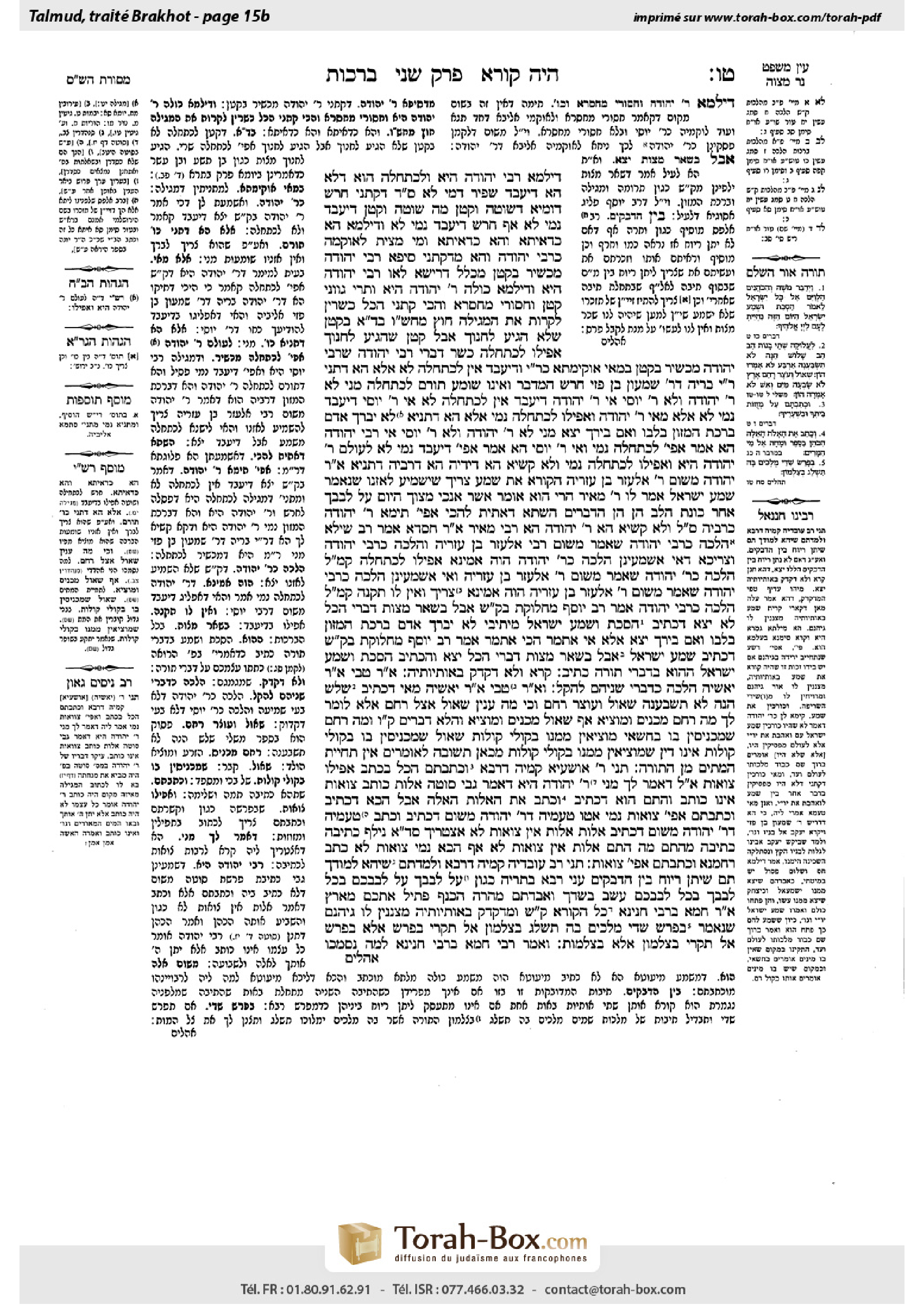
Berakhot 15b: Talmud study for Daf Yomi
Study the Talmud for Daf Yomi with scanned pages, Hebrew text, English translations from Sefaria and AI-generated French translations.
Passage selection and English or AI-generated French translation are available where the scan has annotations. Daf Study is independent of Torah-Box and Sefaria.
Browse Berakhot · ברכות · All tractatesBerakhot 15b text and translations
This page of Berakhot includes the Aramaic text, an English translation and an AI-generated French translation, alongside the scan above.
ברכות י״ה ב · Aramaic and Hebrew text
דִּילְמָא רַבִּי יְהוּדָה הִיא, וּלְכַתְּחִלָּה הוּא דְּלָא, הָא דִיעֲבַד — שַׁפִּיר דָּמֵי.
לָא סָלְקָא דַּעְתָּךְ, דְּקָתָנֵי, חֵרֵשׁ דּוּמְיָא דְּשׁוֹטֶה וְקָטָן. מָה שׁוֹטֶה וְקָטָן דִּיעֲבַד נָמֵי לָא — אַף חֵרֵשׁ דִּיעֲבַד נָמֵי לָא.
וְדִילְמָא הָא כִּדְאִיתָא וְהָא כִּדְאִיתָא.
וּמִי מָצֵית לְאוֹקְמַהּ כְּרַבִּי יְהוּדָה? וְהָא מִדְּקָתָנֵי סֵיפָא: רַבִּי יְהוּדָה מַכְשִׁיר בְּקָטָן, מִכְּלָל דְּרֵישָׁא לָאו רַבִּי יְהוּדָה הִיא?!
וְדִילְמָא כּוּלַּהּ רַבִּי יְהוּדָה הִיא וּתְרֵי גַוְונֵי קָטָן, וְחַסּוֹרֵי מְחַסְּרָא, וְהָכִי קָתָנֵי: הַכֹּל כְּשֵׁרִין לִקְרוֹת אֶת הַמְּגִילָּה, חוּץ מֵחֵרֵשׁ שׁוֹטֶה וְקָטָן. בַּמֶּה דְּבָרִים אֲמוּרִים — בְּקָטָן שֶׁלֹּא הִגִּיעַ לְחִנּוּךְ, אֲבָל קָטָן שֶׁהִגִּיעַ לְחִנּוּךְ — אֲפִילּוּ לְכַתְּחִלָּה כָּשֵׁר, דִּבְרֵי רַבִּי יְהוּדָה, שֶׁרַבִּי יְהוּדָה מַכְשִׁיר בְּקָטָן.
בְּמַאי אוֹקִימְתָּא, כְּרַבִּי יְהוּדָה — וְדִיעֲבַד אִין, לְכַתְּחִלָּה לָא? אֶלָּא הָא דְתָנֵי רַבִּי יְהוּדָה בְּרֵיהּ דְּרַבִּי שִׁמְעוֹן בֶּן פַּזִּי, חֵרֵשׁ הַמְדַבֵּר וְאֵינוֹ שׁוֹמֵעַ — תּוֹרֵם לְכַתְּחִלָּה,
מַנִּי? לָא רַבִּי יְהוּדָה וְלָא רַבִּי יוֹסֵי. אִי רַבִּי יְהוּדָה, דִּיעֲבַד אִין לְכַתְּחִילָּה לָא. אִי רַבִּי יוֹסֵי, דִּיעֲבַד נָמֵי לָא!
אֶלָּא מַאי, רַבִּי יְהוּדָה — וַאֲפִילּוּ לְכַתְּחִלָּה נָמֵי? אֶלָּא הָא דְּתַנְיָא: לֹא יְבָרֵךְ אָדָם בִּרְכַּת הַמָּזוֹן בְּלִבּוֹ, וְאִם בֵּירֵךְ — יָצָא, מַנִּי?
לָא רַבִּי יְהוּדָה וְלָא רַבִּי יוֹסֵי. אִי רַבִּי יְהוּדָה, הָא אָמַר אֲפִילּוּ לְכַתְּחִלָּה נָמֵי, וְאִי רַבִּי יוֹסֵי, הָא אָמַר אֲפִילּוּ דִּיעֲבַד נָמֵי לָא!
לְעוֹלָם רַבִּי יְהוּדָה הִיא, וַאֲפִילּוּ לְכַתְּחִלָּה נָמֵי. וְלָא קַשְׁיָא הָא — דִידֵיהּ, הָא — דְרַבֵּיהּ. דְּתַנְיָא, אָמַר רַבִּי יְהוּדָה מִשּׁוּם רַבִּי אֶלְעָזָר בֶּן עֲזַרְיָה: הַקּוֹרֵא אֶת שְׁמַע צָרִיךְ שֶׁיַּשְׁמִיעַ לְאׇזְנוֹ, שֶׁנֶּאֱמַר: ״שְׁמַע יִשְׂרָאֵל״. אָמַר לוֹ רַבִּי מֵאִיר: הֲרֵי הוּא אוֹמֵר: ״אֲשֶׁר אָנֹכִי מְצַוְּךָ הַיּוֹם עַל לְבָבֶךָ״, אַחַר כַּוָּנַת הַלֵּב הֵן הֵן הַדְּבָרִים.
הַשְׁתָּא דְּאָתֵית לְהָכִי, אֲפִילּוּ תֵּימָא רַבִּי יְהוּדָה כְּרַבֵּיהּ סְבִירָא לֵיהּ, וְלָא קַשְׁיָא, הָא — רַבִּי יְהוּדָה, הָא — רַבִּי מֵאִיר.
אָמַר רַב חִסְדָּא אָמַר רַב שֵׁילָא: הֲלָכָה כְּרַבִּי יְהוּדָה שֶׁאָמַר מִשּׁוּם רַבִּי אֶלְעָזָר בֶּן עֲזַרְיָה, וַהֲלָכָה כְּרַבִּי יְהוּדָה.
וּצְרִיכָא, דְּאִי אַשְׁמְעִינַן הֲלָכָה כְּרַבִּי יְהוּדָה, הֲוָה אָמֵינָא אֲפִילּוּ לְכַתְּחִלָּה, קָמַשְׁמַע לַן הֲלָכָה כְּרַבִּי יְהוּדָה שֶׁאָמַר מִשּׁוּם רַבִּי אֶלְעָזָר בֶּן עֲזַרְיָה.
וְאִי אַשְׁמְעִינַן הֲלָכָה כְּרַבִּי יְהוּדָה שֶׁאָמַר מִשּׁוּם רַבִּי אֶלְעָזָר בֶּן עֲזַרְיָה, הֲוָה אָמֵינָא צָרִיךְ וְאֵין לוֹ תַּקָּנָה. קָמַשְׁמַע לַן הֲלָכָה כְּרַבִּי יְהוּדָה.
אָמַר רַב יוֹסֵף: מַחֲלוֹקֶת בִּקְרִיאַת שְׁמַע, אֲבָל בִּשְׁאָר מִצְוֹת — דִּבְרֵי הַכֹּל לֹא יָצָא, דִּכְתִיב: ״הַסְכֵּת וּשְׁמַע יִשְׂרָאֵל״.
מֵיתִיבִי: לֹא יְבָרֵךְ אָדָם בִּרְכַּת הַמָּזוֹן בְּלִבּוֹ, וְאִם בֵּירֵךְ — יָצָא. אֶלָּא אִי אִתְּמַר — הָכִי אִתְּמַר: אָמַר רַב יוֹסֵף מַחֲלוֹקֶת בִּקְרִיאַת שְׁמַע, דִּכְתִיב ״שְׁמַע יִשְׂרָאֵל״, אֲבָל בִּשְׁאָר מִצְוֹת — דִּבְרֵי הַכֹּל יָצָא.
וְהָכְתִיב ״הַסְכֵּת וּשְׁמַע יִשְׂרָאֵל״!
הַהוּא בְּדִבְרֵי תוֹרָה כְּתִיב.
״קָרָא וְלֹא דִּקְדֵּק בְּאוֹתִיּוֹתֶיהָ״.
אָמַר רַבִּי טָבִי אָמַר רַבִּי יֹאשִׁיָּה: הֲלָכָה כְּדִבְרֵי שְׁנֵיהֶם לְהָקֵל.
וְאָמַר רַבִּי טָבִי אָמַר רַבִּי יֹאשִׁיָּה: מַאי דִּכְתִיב ״שָׁלוֹשׁ הֵנָּה לֹא תִשְׂבַּעְנָה. שְׁאוֹל וְעֹצֶר רָחַם״. וְכִי מָה עִנְיַן שְׁאוֹל אֵצֶל רֶחֶם? אֶלָּא לוֹמַר לָךְ: מָה רֶחֶם מַכְנִיס וּמוֹצִיא, אַף שְׁאוֹל מַכְנִיס וּמוֹצִיא.
וַהֲלֹא דְבָרִים קַל וָחוֹמֶר: וּמָה רֶחֶם שֶׁמַּכְנִיסִין בּוֹ בַּחֲשַׁאי, מוֹצִיאִין מִמֶּנּוּ בְּקוֹלֵי קוֹלוֹת. שְׁאוֹל שֶׁמַּכְנִיסִין בּוֹ בְּקוֹלֵי קוֹלוֹת, אֵינוֹ דִין שֶׁמּוֹצִיאִין מִמֶּנּוּ בְּקוֹלֵי קוֹלוֹת? מִכָּאן תְּשׁוּבָה לָאוֹמְרִים אֵין תְּחִיַּית הַמֵּתִים מִן הַתּוֹרָה.
תָּנֵי רַבִּי אוֹשַׁעְיָא קַמֵּיהּ דְּרָבָא: ״וּכְתַבְתָּם״ — הַכֹּל בִּכְתָב, אֲפִילּוּ צַוָּאוֹת.
אָמַר לֵיהּ: דַּאֲמַר לָךְ מַנִּי — רַבִּי יְהוּדָה הִיא, דְּאָמַר גַּבֵּי סוֹטָה — אָלוֹת כּוֹתֵב, צַוָּאוֹת אֵינוֹ כּוֹתֵב. וְהָתָם הוּא דִכְתִיב: ״וְכָתַב אֶת הָאָלוֹת הָאֵלֶּה״, אֲבָל הָכָא דִּכְתִיב: ״וּכְתַבְתָּם״ — אֲפִילּוּ צַוָּאוֹת נָמֵי.
אַטּוּ טַעְמֵיהּ דְּרַבִּי יְהוּדָה מִשּׁוּם דִּכְתִיב ״וְכָתַב״? טַעְמֵיהּ דְּרַבִּי יְהוּדָה מִשּׁוּם דִּכְתִיב ״אָלוֹת״. אָלוֹת אִין, צַוָּאוֹת — לָא.
אִצְטְרִיךְ, סָלְקָא דַּעְתָּךְ אָמֵינָא נֵילַף ״כְּתִיבָה״ ״כְּתִיבָה״ מֵהָתָם: מָה הָתָם — אָלוֹת אִין, צַוָּאוֹת לָא. אַף הָכָא נָמֵי — צַוָּאוֹת לָא. כְּתַב רַחֲמָנָא ״וּכְתַבְתָּם״ — אֲפִילּוּ צַוָּאוֹת.
תָּנֵי רַב עוֹבַדְיָה קַמֵּיהּ דְּרָבָא: ״וְלִמַּדְתֶּם״ שֶׁיְּהֵא לִמּוּדְךָ תָּם — שֶׁיִּתֵּן רֶיוַח בֵּין הַדְּבָקִים.
עָנֵי רָבָא בָּתְרֵיהּ: כְּגוֹן ״עַל לְבָבֶךָ״, ״עַל לְבַבְכֶם״, ״בְּכָל לְבָבְךָ״, ״בְּכָל לְבַבְכֶם״, ״עֵשֶׂב בְּשָׂדְךָ״, ״וַאֲבַדְתֶּם מְהֵרָה״, ״הַכָּנָף פְּתִיל״, ״אֶתְכֶם מֵאֶרֶץ״.
אָמַר רַבִּי חָמָא בְּרַבִּי חֲנִינָא: כָּל הַקּוֹרֵא קְרִיאַת שְׁמַע וּמְדַקְדֵּק בְּאוֹתִיּוֹתֶיהָ מְצַנְּנִין לוֹ גֵּיהִנָּם, שֶׁנֶּאֱמַר: ״בְּפָרֵשׂ שַׁדַּי מְלָכִים בָּהּ תַּשְׁלֵג בְּצַלְמוֹן״ — אַל תִּקְרֵי ״בְּפָרֵשׂ״ אֶלָּא ״בְּפָרֵשׁ״, אַל תִּקְרֵי ״בְּצַלְמוֹן״ אֶלָּא ״בְּצַלְמָוֶת״.
וְאָמַר רַבִּי חָמָא בְּרַבִּי חֲנִינָא: לָמָּה נִסְמְכוּ
Berakhot 15b · English translation
Perhaps it is in accordance with the opinion of Rabbi Yehuda, and although ab initio a deaf-mute may not read, after the fact his reading is valid?
The Gemara responds: This could not enter your mind, as it was taught: A deaf-mute, an imbecile, and a minor, in one phrase in our mishna; to teach that a deaf-mute is similar to an imbecile and a minor. Just as in the case of an imbecile and a minor, even after the fact, their reading is not valid, so too the reading of a deaf-mute, even after the fact, is not valid.
The Gemara rejects this assertion based on their appearance in a common list: And perhaps this case is as it is and that case is as it is; although listed together, the circumstances of each case may be different, and no definite proof can be drawn from their juxtaposition.
The Gemara objects from a different perspective: And can you really establish that the first clause in the mishna is in accordance with the opinion of Rabbi Yehuda? But from what was taught in the latter clause of the mishna: And Rabbi Yehuda deems a minor fit to read the Megilla, this proves by inference that the beginning of the mishna is not in accordance with the opinion of Rabbi Yehuda?
The Gemara rejects this challenge as well: And perhaps the entire mishna is in accordance with the opinion of Rabbi Yehuda, and there are two types of minors, and the mishna is incomplete and it teaches as follows: All are fit to read the Megilla except a deaf-mute, an imbecile, and a minor. In what case is this said? With regard to a minor who has not yet reached the age of training to fulfill the mitzvot. However in the case of a minor who has reached the age of training, even ab initio he is fit to read the Megilla. This is the statement of Rabbi Yehuda, as Rabbi Yehuda deems a minor fit, and his statement here comes to elucidate and not to dispute.
The Gemara asks: In accordance with whose opinion did you establish the mishna? In accordance with the opinion of Rabbi Yehuda, who holds that after the fact, yes, his reading is valid, but ab initio, no, he may not read? However, that baraita which was taught by Rabbi Yehuda, son of Rabbi Shimon ben Pazi: A deaf person who speaks but does not hear may, ab initio, separate teruma.
In accordance with whose opinion is this baraita? Neither the opinion of Rabbi Yehuda nor with the opinion of Rabbi Yosei. As, if you say that it is Rabbi Yehuda’s opinion, didn’t he say that after the fact, yes, he fulfilled his obligation, but ab initio, no, he may not fulfill his obligation in that manner? And if you say that it is Rabbi Yosei’s opinion, didn’t he say that even after the fact he did not fulfill his obligation?
This Gemara rejects this objection: But rather, what, will you explain the baraita in accordance with the opinion of Rabbi Yehuda, and a deaf-mute is also fit to fulfill his obligation even ab initio? However, that which was taught in a baraita: One may not recite the Grace after Meals in his heart, inaudibly, and if he recited the blessing in that manner, he fulfilled his obligation, in accordance with whose opinion is that baraita?
It is in accordance neither with the opinion of Rabbi Yehuda nor with the opinion of Rabbi Yosei. As if you say that it is in accordance with the opinion of Rabbi Yehuda, didn’t he say that even ab initio he may fulfill his obligation in that manner? And if you say that it is in accordance with the opinion of Rabbi Yosei, didn’t he say that even after the fact he did not fulfill his obligation?
The Gemara responds: Actually, we can explain that the baraita: A deaf person may, ab initio, separate teruma, is in accordance with the opinion of Rabbi Yehuda, according to whom a deaf-mute is also permitted to do so even ab initio. With regard to the opinion expressed that he is prohibited to recite Shema and Grace after Meals ab initio, there is no difficulty, as this is his own opinion and that is his teacher’s opinion. As it was taught in a baraita: Rabbi Yehuda said in the name of Rabbi Elazar ben Azarya: One who recites Shema must make it audible to his ears, as it is stated: “Hear, Israel, the Lord is our God, the Lord is One.” The baraita continues: Rabbi Meir said to him: But it says: “Which I command you this day, upon your heart”; meaning that the significance of the words follows the intention of the heart and even ab initio one need not recite Shema audibly. The opinion that after the fact, a deaf person fulfilled his obligation to recite Shema is the opinion of Rabbi Elazar ben Azarya.
The Gemara notes: Now that you have arrived at this point and the entire baraita has been cited, even if you say that Rabbi Yehuda holds in accordance with the opinion of his teacher, it is, nevertheless, not difficult. As this baraita that holds that he may not recite Grace after Meals ab initio but after the fact he fulfilled his obligation is in accordance with the opinion of Rabbi Yehuda, while this baraita permitting a deaf person to separate teruma ab initio is in accordance with the opinion of Rabbi Meir.
Rav Ḥisda said that Rav Sheila said: The halakha is in accordance with the opinion of Rabbi Yehuda who said in the name of Rabbi Elazar ben Azarya, and the halakha is in accordance with the opinion of Rabbi Yehuda as cited in our mishna.
The Gemara explains: And although that may seem redundant, both statements are necessary, as had Rav Ḥisda only taught us that the halakha is in accordance with the opinion of Rabbi Yehuda, I would have said, as was suggested in the Gemara above, that Rabbi Yehuda permits to do so even ab initio. Therefore, he teaches us that the halakha is in accordance with the opinion of Rabbi Yehuda who said it in the name of his teacher, Rabbi Elazar ben Azarya; ab initio one must recite Shema in a manner audible to his own ears.
And had Rav Ḥisda only taught us that the halakha is in accordance with Rabbi Yehuda in the name of Rabbi Elazar ben Azarya, I would have said that the phrase: Must make it audible, means not only must he recite it that way ab initio, but also after the fact he has no remedy if he failed to do so. Therefore, he teaches us that the halakha is in accordance with the opinion of Rabbi Yehuda; ab initio one must recite Shema in a manner audible to his own ears, but if he failed to do so, after the fact his recitation is valid.
Rav Yosef said: The dispute as to whether or not a deaf person fulfills his obligation is only in the case of the recitation of Shema, but with regard to the rest of the mitzvot, everyone agrees that he does not fulfill his obligation if he does not hear his recitation, as it is written: “Pay attention, and hear, Israel” (Deuteronomy 27:9); meaning that one is required to listen and hear.
The Gemara objects based on what was taught in a baraita: One may not recite the Grace after Meals in his heart, inaudibly, and if he recited the blessing in that manner, he fulfilled his obligation. In this example of the rest of the mitzvot, the obligation to hear the recitation of the blessing is only ab initio. Rather, Rav Yosef’s statement must be emended. If this was said, it was said as follows; Rav Yosef said: The dispute as to whether or not a deaf person fulfills his obligation is only in the case of the recitation of Shema, as it is written: “Hear, Israel.” But regarding the rest of the mitzvot, all agree that a deaf-mute fulfills his obligation.
The Gemara asks: Isn’t it written: “Pay attention, and hear, Israel”?
The Gemara responds: That verse is written with regard to matters of Torah; one must pay close attention to what is written in the Torah.
We learned in the mishna: One who recited Shema and was not sufficiently precise in his enunciation of its letters, Rabbi Yosei says: He fulfilled his obligation. Rabbi Yehuda says: He did not fulfill his obligation. Similarly, there is a dispute whether or not one who recites Shema in a manner inaudible to his own ears fulfilled his obligation; the anonymous first tanna says: He fulfilled his obligation. Rabbi Yosei says: He did not fulfill his obligation.
Rabbi Tavi said that Rabbi Yoshiya said: The halakha is in accordance with the statements in both disputes that rule leniently.
Incidental to citing one statement by this combination of Sages, the Gemara cites another statement in their name: And Rabbi Tavi said that Rabbi Yoshiya said: What is meant by that which is written: “There are three that are never satisfied…the grave and the barren womb” (Proverbs 30:15–16)? We have to ask: What does a grave have to do with a womb? Rather, this juxtaposition comes to tell you: Just as a womb takes in and gives forth, so too a grave takes in and gives forth with the resurrection of the dead.
And is this not an a fortiori inference: Just as the fetus is placed into the womb in private, and the baby is removed from it with loud cries at childbirth; the grave into which the deceased is placed with loud cries of mourning at burial, is it not right that the body should be removed with loud cries? From this verse there is a refutation to those who say that there is no Torah source for the resurrection of the dead.
Rabbi Oshaya taught the following baraita before Rava: The verse, “And you shall write them [ukhtavtam] on the door posts of your house and your gates” (Deuteronomy 6:9), should be understood as though it were written: “And you shall write them completely [ukhtav tam],” i.e., in their entirety. Everything must be in writing in the mezuza or phylacteries, even the commands to write mezuzot and phylacteries.
Rava said to him: Who said this baraita to you? It was Rabbi Yehuda, who said with regard to the scroll of the sota that one writes curses, but one does not write commands and instructions how to administer the potion to the sota. According to Rabbi Yehuda, in the case of mezuzot and phylacteries the Torah taught that even the commands must be written in order to distinguish it from sota. There, in the case of the sota, it is written: “And the priest shall write [vekhatav] these curses in a scroll” (Numbers 5:23); only the curses are recorded in the scroll, and nothing more. But here in the case of mezuza, where it is written: “And you shall write them [ukhtavtam],” even the commands must also be written.
The Gemara questions this: Is that to say Rabbi Yehuda’s reason for writing only the curses in the sota scroll is because the verse in the portion of sota says: “And the priest shall write [vekhatav],” as opposed to: “And you shall write them [ukhtavtam]”? Rabbi Yehuda’s reason is because it is written in the portion of the sota: These curses, meaning curses, yes, they must be recorded; commands, no. If that is Rabbi Yehuda’s reasoning, there is no reason to derive the requirement to write the commands from the phrase: And you shall write them, in the case of the mitzva of mezuza. Derive it simply from the fact that the Torah did not distinguish between the various components of the portion.
The Gemara responds: “And you shall write them” was necessary, as otherwise it might have entered your mind to say: Let us derive it by means of a verbal analogy, writing mentioned here from writing mentioned there, that just as there curses, yes, commands, no; so too here, commands, no. Therefore, the Torah wrote: And you shall write them in their entirety, even the commands.
On a similar note: Rav Ovadya taught a baraita before Rava: That which was stated: “And you shall teach them [velimadtem] to your children” (Deuteronomy 11:19) teaches that your teaching must be complete [tam] that one should leave space between adjacent words, where the last letter of the first and the first letter of the second are identical. One must distinguish between the words and enunciate each one clearly.
Rava responded after him by way of explanation: For example, one must enunciate al levavekha and not read them as one word. So too, al levavkhem, bekhol levavekha, bekhol levavkhem, esev besadkha, va’avadtem mehera, hakanaf petil, and etkhem me’eretz. Because the last letter of the first word and the first letter of the second are identical, the words are liable to be enunciated together and the correct meaning is liable to be obscured.
On this same topic, Rabbi Ḥama, son of Rabbi Ḥanina, said: Anyone who recites Shema and is punctilious in enunciating its letters, Gehenna is cooled for him, as it is stated: “When the Almighty scatters [befares] kings over it, it will snow in Tzalmon” (Psalms 68:15). Do not read befares, When He scatters, but befaresh, When he enunciates. When one enunciates the name of God with precision, God will fulfill the verse: It will snow in Tzalmon, on his behalf. Do not read beTzalmon, in Tzalmon, but betzalmavet, in the shadow of death, a reference to Gehenna. As reward for enunciating God’s name precisely, God will cool Gehenna for him.
Rabbi Ḥama, son of Rabbi Ḥanina, also said: Why were
Berakhot 15b · Traduction française (IA)
Peut-être cela correspond-il à l'opinion du Rabbi Yéhuda, et bien qu'un sourd-muet ne puisse pas lire ab initio, sa lecture est-elle valable après coup ?
La Guemara répond : Cela ne pouvait pas entrer dans votre esprit, car il a été enseigné : Un sourd-muet, un imbécile et un mineur, dans une seule phrase de notre mitsna ; pour enseigner que le sourd-muet est semblable à l'imbécile et au mineur. Aussi bien que dans le cas de l'imbécile et du mineur, même après coup, leur lecture n'est pas valable, de même la lecture du sourd-muet, même après coup, n'est pas valable.
La Guemara rejette cette affirmation en raison de leur apparition dans une liste commune : Et peut-être ce cas est-il ainsi et celui-ci est ainsi ; bien que mentionnés ensemble, les circonstances de chaque cas peuvent être différentes, et aucun preuve définitive ne peut être tirée de leur juxtaposition.
La Guemara s'oppose à cela d'un autre point de vue : Et pouvez-vous vraiment établir que la première clause de la mitsna correspond à l'opinion du Rabbi Yéhuda ? Mais à partir de ce qui a été enseigné dans la seconde clause de la mitsna : Et le Rabbi Yéhuda considère un mineur comme digne de lire la Megilla, cela prouve par déduction que le début de la mitsna ne correspond pas à l'opinion du Rabbi Yéhuda ?
La Guemara rejette également ce défi ainsi : Et peut-être toute la mitsna correspond à l'opinion du Rabbi Yéhuda, et il y a deux types de mineurs, et la mitsna est incomplète et elle enseigne ainsi : Tous sont dûment qualifiés de lire la Megilla sauf le sourd-muet, l'imbécile et le mineur. Dans quel cas cela est-il dit ? Concernant un mineur qui n'a pas encore atteint l'âge de l'entraînement pour accomplir les mitsvot. Cependant, dans le cas d'un mineur qui a atteint l'âge de l'entraînement, même ab initio il est dûment qualifié de lire la Megilla. C'est l'opinion du Rabbi Yéhuda, car le Rabbi Yéhuda considère un mineur comme dûment qualifié, et son discours ici vise à éclairer et non à contester.
La Guemara pose la question : Selon l'opinion de qui avez-vous établi la mitsna ? Selon l'opinion du Rabbi Yéhuda, qui considère que après coup, oui, sa lecture est valable, mais ab initio, non, il ne peut pas lire ? Cependant, cette baraïta qui a été enseignée par le Rabbi Yéhuda, fils du Rabbi Shimon ben Pazi : Un sourd qui parle mais ne perçoit pas peut, ab initio, séparer la terouma.
Selon l'opinion de qui est cette baraïta ? Ni celle du Rabbi Yéhuda ni celle du Rabbi Yosei. Car, si vous dites que c'est l'opinion du Rabbi Yéhuda, n'a-t-il pas dit que, après coup, oui, il accomplissait son obligation, mais ab initio, non, il ne pouvait pas accomplir son obligation ainsi ? Et si vous dites que c'est l'opinion du Rabbi Yosei, n'a-t-il pas dit que même après coup, il n'accomplissait pas son obligation ?
Cette Guemara rejette cette objection ainsi : Mais plutôt, que voulez-vous expliquer cette baraïta selon l'opinion du Rabbi Yéhuda, et le sourd-muet est également dûment qualifié à accomplir son obligation même ab initio ? Cependant, ce qui a été enseigné dans une baraïta : On ne peut pas réciter la Bérit après les repas dans l'esprit, inaudiblement, et si l'on a récité la bénédiction ainsi, il a accompli son obligation. Selon l'opinion de qui est cette baraïta ?
Cela ne correspond ni à l'opinion du Rabbi Yéhuda ni à celle du Rabbi Yosei. Car, si vous dites que c'est selon l'opinion du Rabbi Yéhuda, n'a-t-il pas dit que même ab initio il pouvait accomplir son obligation ainsi ? Et si vous dites que c'est selon l'opinion du Rabbi Yosei, n'a-t-il pas dit que même après coup, il n'accomplissait pas son obligation ?
La Guemara répond : En réalité, nous pouvons expliquer que la baraïta : Un sourd peut, ab initio, séparer la terouma, correspond à l'opinion du Rabbi Yéhuda, selon lequel le sourd-muet est également autorisé à le faire même ab initio. Concernant l'opinion exprimée qu'il est interdit de réciter le Chéma et la Bérit après les repas ab initio, il n'y a pas de difficulté, car cela est son propre opinion et celle de son maître. Car il a été enseigné dans une baraïta : Le Rabbi Yéhuda a dit au nom du Rabbi Eléazar ben Azarya : Celui qui récite le Chéma doit le faire audible à ses oreilles, car il est dit : « Écoute, Israël, le Seigneur est notre Dieu, le Seigneur est un ». La baraïta continue : Le Rabbi Méïr a dit à lui : Mais il est dit : « Qui je commande aujourd'hui, sur votre cœur » ; cela signifie que la signification des mots suit l'intention du cœur et même ab initio, on n'a pas besoin de réciter le Chéma de manière audible. L'opinion selon laquelle après coup, un sourd a accompli son obligation de réciter le Chéma est celle du Rabbi Eléazar ben Azarya.
La Guemara note : Maintenant que vous avez atteint ce point et que toute la baraïta a été citée, même si vous dites que le Rabbi Yéhuda tient compte de l'opinion de son maître, cela n'est pas difficile. Car cette baraïta qui considère qu'il ne peut pas réciter la Bérit après les repas ab initio mais qu'après coup il a accompli son obligation correspond à l'opinion du Rabbi Yéhuda, tandis que cette baraïta permettant à un sourd de séparer la terouma ab initio correspond à l'opinion du Rabbi Méïr.
Rav Ḥisda a dit que Rav Sheila a dit : La halakha est selon l'opinion du Rabbi Yéhuda qui a dit au nom du Rabbi Eléazar ben Azarya, et la halakha est selon l'opinion du Rabbi Yéhuda comme cité dans notre mitsna.
La Guemara explique : Et bien que cela puisse sembler redondant, les deux déclarations sont nécessaires, car si Rav Ḥisda n'avait que dit que la halakha est selon l'opinion du Rabbi Yéhuda, je dirais, comme suggéré dans la Guemara ci-dessus, que le Rabbi Yéhuda permet cela même ab initio. Ainsi, il nous enseigne que la halakha est selon l'opinion du Rabbi Yéhuda qui l'a dit au nom de son maître, Rabbi Eléazar ben Azarya ; ab initio, on doit réciter le Chéma de manière audible à ses propres oreilles.
Et si Rav Ḥisda n'avait enseigné que la halakha suit l'opinion de Rabbi Yehuda en nom de Rabbi Elazar ben Azarya, je dirais que la phrase : « Il faut le rendre audible », signifie non seulement qu'il doit le réciter ainsi dès le début, mais aussi qu'après coup, s'il a échoué à le faire, il n'a plus de remède. Ainsi, il nous apprend que la halakha suit l'opinion de Rabbi Yehuda ; dès le début, il faut réciter le Chéma de manière audible à ses propres oreilles, mais si l'on a échoué à le faire, sa récitation est valide après coup.
Rav Yosef a dit : Le débat sur le fait que si une personne sourde accomplît sa Mitsva est uniquement concernant la récitation du Chéma, mais concernant les autres Mitsvot, tout le monde convient qu'il ne l'accomplit pas s'il n'entend pas sa récitation, car il est écrit : « Écoute, et écoute, Israël » (Lévitique 27:9) ; cela signifie qu'on est tenu d'écouter et d'entendre.
Le Guemara s'oppose à cela en se basant sur ce qui a été enseigné dans une baraïta : On ne peut pas réciter la Bérit après les repas dans l'esprit, de manière inaudible, et si l'on a récité la bénédiction ainsi, il a accompli son obligation. Dans cet exemple des autres Mitsvot, l'obligation d'entendre la récitation de la bénédiction est uniquement dès le début. En revanche, la déclaration de Rav Yosef doit être corrigée. Si cela a été dit, cela a été dit ainsi : Rav Yosef a dit : Le débat sur le fait que si une personne sourde accomplît son obligation est uniquement concernant la récitation du Chéma, car il est écrit : « Écoute, Israël ». Mais concernant les autres Mitsvot, tout le monde convient qu'une personne sourde-mute accomplît son obligation.
Le Guemara demande : N'est-il pas écrit : « Écoute, et écoute, Israël » ?
Le Guemara répond : Cette versette est écrite concernant les affaires de la Torah ; on doit porter une attention particulière à ce qui est écrit dans la Torah.
Nous avons appris dans la mishna : Celui qui a récité le Chéma et n'a pas été suffisamment précis dans l'articulation de ses lettres, Rabbi Yosei dit : Il a accompli son obligation. Rabbi Yehuda dit : Il n'a pas accompli son obligation. De même, il y a un débat sur le fait que celui qui récite le Chéma de manière inaudible à ses propres oreilles accomplisse-t-il son obligation ; le tanna anonyme dit : Il a accompli son obligation. Rabbi Yosei dit : Il n'a pas accompli son obligation.
Rabbi Tavi a dit que Rabbi Yoshiya a dit : La halakha suit les déclarations des deux débats qui règlent avec indulgence.
Incidental à la citation d'une déclaration par cette combinaison de Sages, le Guemara cite une autre déclaration en leur nom : Et Rabbi Tavi a dit que Rabbi Yoshiya a dit : Qu'entend-on par ce qui est écrit : « Il y a trois qui ne sont jamais rassasiés… la tombe et le ventre stérile » (Proverbes 30:15–16) ? Nous devons demander : Qu'as-tu à voir une tombe avec un ventre ? En revanche, cette juxtaposition vient te dire : Comme un ventre absorbe et donne, ainsi une tombe absorbe et donne avec la résurrection des morts.
Et n'est-ce pas une déduction a fortiori : Comme le fœtus est placé dans le ventre en privé, et l'enfant est retiré de lui avec des cris à l'accouchement ; la tombe dans laquelle le défunt est placé avec des cris de deuil à l'enterrement, n'est-ce pas juste que le corps soit retiré avec des cris ? De cette versette, il y a une réfutation à ceux qui disent qu'il n'y a pas de source talmudique pour la résurrection des morts.
Rabbi Oshaya a enseigné la suivante baraïta avant Rava : La versette, « Et vous écrirez [ukhtavtam] sur les piliers de votre maison et vos portes » (Deutéronome 6:9), doit être comprise comme si elle était écrite : « Et vous écrirez [ukhtav tam], » c'est-à-dire en entier. Tout doit être écrit dans la mezuza ou les phylactères, même les commandements de rédiger des meuzot et des phylactères.
Rava a dit à lui : Qui a dit cette baraïta à toi ? C'était Rabbi Yehuda, qui a dit concernant le rouleau de la sota que l'on écrit des malédictions, mais l'on n'écrit pas les commandements et les instructions sur la préparation du philtre pour la sota. Selon Rabbi Yehuda, dans le cas des meuzot et des phylactères, la Torah a enseigné que même les commandements doivent être écrits afin de les distinguer du rouleau de la sota. Là, dans le cas de la sota, il est écrit : « Et le prêtre écrira [vekhatav] ces malédictions dans un rouleau » (Nombres 5:23) ; seulement les malédictions sont inscrites dans le rouleau, et rien de plus. Mais ici, dans le cas des meuzot, où il est écrit : « Et vous écrirez [ukhtavtam], » même les commandements doivent être écrits.
Le Guemara questionne cela : Est-ce que cela signifie que la raison de Rabbi Yehuda pour écrire seulement les malédictions dans le rouleau de la sota est parce que la versette dans la portion de la sota dit : « Et le prêtre écrira [vekhatav], » contrairement à : « Et vous écrirez [ukhtavtam] » ? La raison de Rabbi Yehuda est parce qu'il est écrit dans la portion de la sota : Ces malédictions, c'est-à-dire les malédictions, oui, elles doivent être enregistrées ; les commandements, non. Si c'est ainsi que raisonne Rabbi Yehuda, il n'y a pas de raison de déduire la nécessité d'écrire les commandements de la phrase : Et vous écrirez, dans le cas de la Mitsva des meuzot. Déduisez-le simplement du fait que la Torah n'a pas distingué entre les différents composants de la portion.
Le Guemara répond : « Et vous écrirez » était nécessaire, car autrement, il aurait pu entrer en vous l'idée de dire : Faisons-y une déduction par analogie verbale, l'écriture mentionnée ici de l'écriture mentionnée là, que comme là, les malédictions, oui, les commandements, non ; ainsi ici, les commandements, non. Ainsi, la Torah a écrit : Et vous écrirez en entier, même les commandements.
Sur un sujet similaire : Rav Ovadia enseigna une baraïta devant Rava : Ce qui a été dit : « Et vous apprendrez [velimadtem] à vos enfants » (Deutéronome 11:19) enseigne que votre enseignement doit être complet [tam], c'est-à-dire qu'on doit laisser un espace entre les mots adjacents, lorsque la dernière lettre du premier et la première lettre du second sont identiques. On doit distinguer les mots et prononcer chacun clairement.
Rava répondit après lui par explication : Par exemple, on doit prononcer « al levavekha » et non les lire comme un seul mot. De même, « al levavkhem », « bekhol levavekha », « bekhol levavkhem », « esev besadkha », « va’avadtem mehera », « hakanaf petil », et « etkhem me’eretz ». Puisque la dernière lettre du premier mot et la première lettre du second sont identiques, les mots peuvent être prononcés ensemble et le sens correct peut être obscurci.
Sur ce même sujet, Rabbi Ḥama, fils de Rabbi Ḥanina, dit : Celui qui récite le Chéma et est minutieux dans la prononciation de ses lettres, Gehenna est refroidie pour lui, car il est dit : « Quand l'Éternel prononce [befares] les rois sur elle, il neige à Tzalmon » (Psaumes 68:15). Ne lis pas « befares », Quand Il prononce, mais « befaresh », Quand il prononce. Lorsqu'on prononce le nom d'Éternel avec précision, l'Éternel accomplira la parole : Il neige à Tzalmon, en son nom. Ne lis pas « betzalmon », à Tzalmon, mais « betzalmavet », dans l'ombre de la mort, une allusion à Gehenna. En récompense de la prononciation précise du nom d'Éternel, l'Éternel refroidira Gehenna pour lui.
Rabbi Ḥama, fils de Rabbi Ḥanina, dit aussi : Pourquoi les mitsvot ont-elles été données
Traduction française générée par IA à partir de l’édition anglaise de Sefaria. Vérifie toujours un passage avec le texte source.
Text from Sefaria: William Davidson Edition - Vocalized Aramaic (CC BY NC); William Davidson Edition - English (CC BY NC).