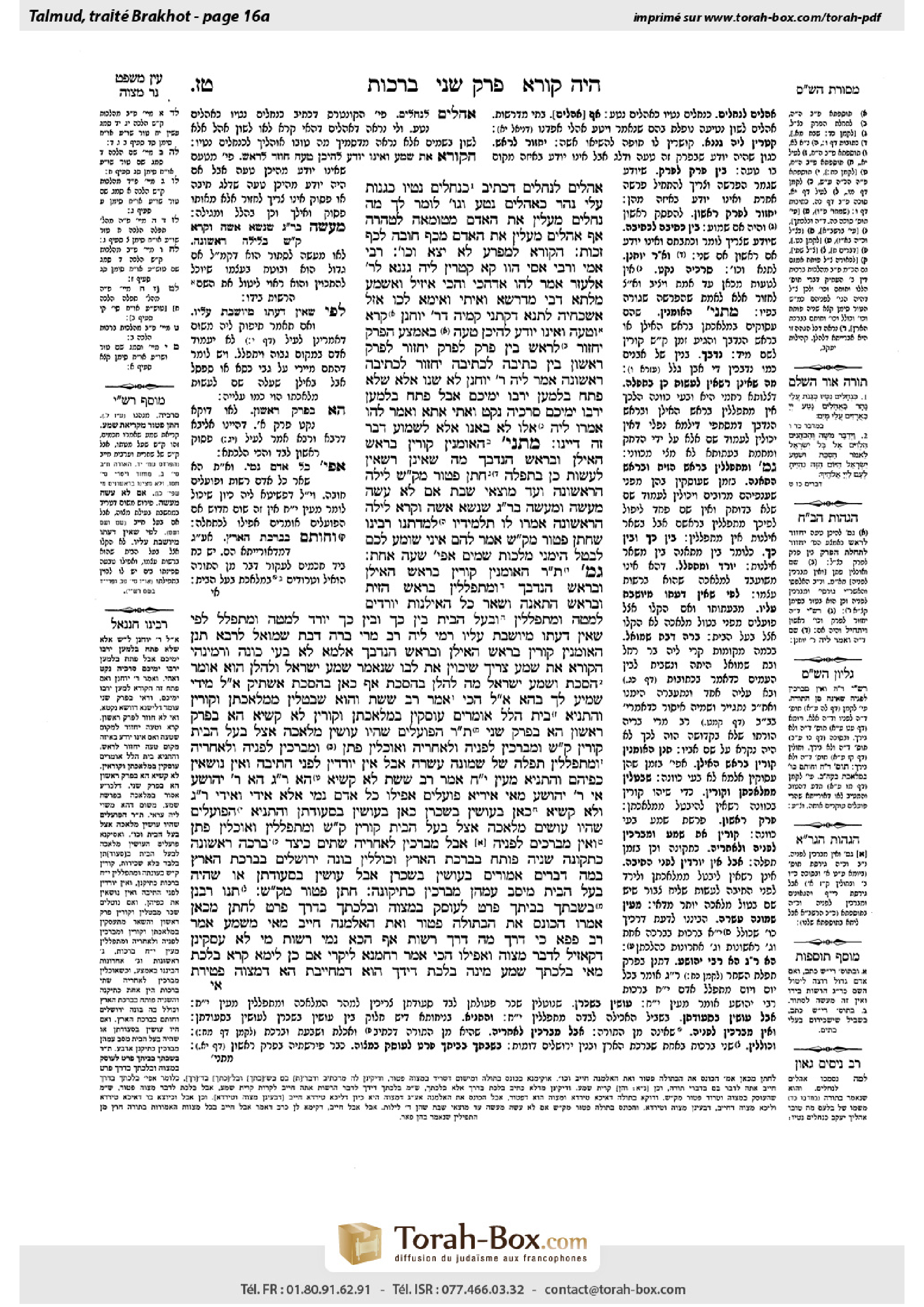
Berakhot 16a: Talmud study for Daf Yomi
Study the Talmud for Daf Yomi with scanned pages, Hebrew text, English translations from Sefaria and AI-generated French translations.
Passage selection and English or AI-generated French translation are available where the scan has annotations. Daf Study is independent of Torah-Box and Sefaria.
Browse Berakhot · ברכות · All tractatesBerakhot 16a text and translations
This page of Berakhot includes the Aramaic text, an English translation and an AI-generated French translation, alongside the scan above.
ברכות י״ו א · Aramaic and Hebrew text
אֹהָלִים לִנְחָלִים, דִּכְתִיב: ״כִּנְחָלִים נִטָּיוּ כְּגַנּוֹת עֲלֵי נָהָר כַּאֲהָלִים נָטַע וְגוֹ׳״ — לוֹמַר לְךָ: מָה נְחָלִים מַעֲלִין אֶת הָאָדָם מִטּוּמְאָה לְטׇהֳרָה — אַף אֹהָלִים מַעֲלִין אֶת הָאָדָם מִכַּף חוֹבָה לְכַף זְכוּת.
״הַקּוֹרֵא לְמַפְרֵעַ לֹא יָצָא וְכוּ׳״.
רַבִּי אַמֵּי וְרַבִּי אַסִּי הֲווֹ קָא קָטְרִין לֵיהּ גְּנָנָא לְרַבִּי אֶלְעָזָר. אֲמַר לְהוּ: אַדְּהָכִי וְהָכִי אֵיזִיל וְאֶשְׁמַע מִלְּתָא דְבֵי מִדְרְשָׁא, וְאֵיתֵי וְאֵימָא לְכוּ. אֲזַל אַשְׁכְּחֵיהּ לְתַנָּא דְּקָתָנֵי קַמֵּיהּ דְּרַבִּי יוֹחָנָן:
קָרָא וְטָעָה וְאֵינוֹ יוֹדֵעַ לְהֵיכָן טָעָה, בְּאֶמְצַע הַפֶּרֶק — יַחְזוֹר לָרֹאשׁ. בֵּין פֶּרֶק לְפֶרֶק — יַחְזוֹר לְפֶרֶק רִאשׁוֹן. בֵּין כְּתִיבָה לִכְתִיבָה — יַחְזוֹר לִכְתִיבָה רִאשׁוֹנָה.
אֲמַר לֵיהּ רַבִּי יוֹחָנָן: לֹא שָׁנוּ אֶלָּא שֶׁלֹּא פָּתַח בִּ״לְמַעַן יִרְבּוּ יְמֵיכֶם״, אֲבָל פָּתַח בִּ״לְמַעַן יִרְבּוּ יְמֵיכֶם״ — סִרְכֵיהּ נָקֵט וְאָתֵי.
אֲתָא וַאֲמַר לְהוּ. אֲמַרוּ לֵיהּ: אִלּוּ לֹא בָּאנוּ אֶלָּא לִשְׁמוֹעַ דָּבָר זֶה — דַּיֵּינוּ.
מַתְנִי׳ הָאוּמָּנִין — קוֹרִין בְּרֹאשׁ הָאִילָן וּבְרֹאשׁ הַנִּדְבָּךְ. מַה שֶּׁאֵינָן רַשָּׁאִין לַעֲשׂוֹת כֵּן בַּתְּפִלָּה.
חָתָן פָּטוּר מִקְּרִיאַת שְׁמַע לַיְלָה הָרִאשׁוֹנָה וְעַד מוֹצָאֵי שַׁבָּת אִם לֹא עָשָׂה מַעֲשֶׂה. וּמַעֲשֶׂה בְּרַבָּן גַּמְלִיאֵל שֶׁנָּשָׂא אִשָּׁה וְקָרָא לַיְלָה הָרִאשׁוֹנָה. אָמְרוּ לוֹ תַּלְמִידָיו: לִמַּדְתָּנוּ רַבֵּינוּ שֶׁחָתָן פָּטוּר מִקְּרִיאַת שְׁמַע? אָמַר לָהֶם אֵינִי שׁוֹמֵעַ לָכֶם לְבַטֵּל הֵימֶנִי מַלְכוּת שָׁמַיִם אֲפִילּוּ שָׁעָה אַחַת.
גְּמָ׳ תָּנוּ רַבָּנַן: הָאוּמָּנִין — קוֹרִין בְּרֹאשׁ הָאִילָן וּבְרֹאשׁ הַנִּדְבָּךְ. וּמִתְפַּלְּלִין בְּרֹאשׁ הַזַּיִת וּבְרֹאשׁ הַתְּאֵנָה. וּשְׁאָר כָּל הָאִילָנוֹת — יוֹרְדִים לְמַטָּה וּמִתְפַּלְּלִין. וּבַעַל הַבַּיִת, בֵּין כָּךְ וּבֵין כָּךְ יוֹרֵד לְמַטָּה וּמִתְפַּלֵּל, לְפִי שֶׁאֵין דַּעְתּוֹ מְיוּשֶּׁבֶת עָלָיו.
רָמֵי לֵיהּ רַב מָרִי בְּרַהּ דְּבַת שְׁמוּאֵל לְרָבָא, תְּנַן: הָאוּמָּנִין קוֹרִין בְּרֹאשׁ הָאִילָן וּבְרֹאשׁ הַנִּדְבָּךְ, אַלְמָא לָא בָּעֵי כַּוָּנָה. וּרְמִינְהִי: הַקּוֹרֵא אֶת שְׁמַע צָרִיךְ שֶׁיְּכַוֵּין אֶת לִבּוֹ, שֶׁנֶּאֱמַר: ״שְׁמַע יִשְׂרָאֵל״, וּלְהַלָּן הוּא אוֹמֵר: ״הַסְכֵּת וּשְׁמַע יִשְׂרָאֵל״. מַה לְּהַלָּן בְּ״הַסְכֵּת״ אַף כָּאן בְּ״הַסְכֵּת״.
אִשְׁתִּיק. אֲמַר לֵיהּ: מִידֵּי שְׁמִיעַ לָךְ בְּהָא? אֲמַר לֵיהּ: הָכִי אָמַר רַב שֵׁשֶׁת — וְהוּא שֶׁבְּטֵלִין מִמְּלַאכְתָּן וְקוֹרִין.
וְהָתַנְיָא: בֵּית הִלֵּל אוֹמְרִים עוֹסְקִים בִּמְלַאכְתָּן וְקוֹרִין!
לָא קַשְׁיָא: הָא בְּפֶרֶק רִאשׁוֹן, הָא בְּפֶרֶק שֵׁנִי.
תָּנוּ רַבָּנַן: הַפּוֹעֲלִים שֶׁהָיוּ עוֹשִׂין מְלָאכָה אֵצֶל בַּעַל הַבַּיִת, קוֹרִין קְרִיאַת שְׁמַע וּמְבָרְכִין לְפָנֶיהָ וּלְאַחֲרֶיהָ. וְאוֹכְלִין פִּתָּן וּמְבָרְכִין לְפָנֶיהָ וּלְאַחֲרֶיהָ, וּמִתְפַּלְּלִין תְּפִלָּה שֶׁל שְׁמוֹנֶה עֶשְׂרֵה. אֲבָל אֵין יוֹרְדִין לִפְנֵי הַתֵּיבָה, וְאֵין נוֹשְׂאִין כַּפֵּיהֶם.
וְהָתַנְיָא מֵעֵין שְׁמוֹנֶה עֶשְׂרֵה! אָמַר רַב שֵׁשֶׁת: לָא קַשְׁיָא, הָא — רַבָּן גַּמְלִיאֵל, הָא — רַבִּי יְהוֹשֻׁעַ.
אִי רַבִּי יְהוֹשֻׁעַ, מַאי אִירְיָא פּוֹעֲלִים? אֲפִילּוּ כָּל אָדָם נָמֵי!
אֶלָּא אִידֵּי וְאִידֵּי רַבָּן גַּמְלִיאֵל, וְלָא קַשְׁיָא: כָּאן, בְּעוֹשִׂין בִּשְׂכָרָן. כָּאן, בְּעוֹשִׂין בִּסְעוּדָתָן.
וְהָתַנְיָא: הַפּוֹעֲלִים שֶׁהָיוּ עוֹשִׂים מְלָאכָה אֵצֶל בַּעַל הַבַּיִת — קוֹרִין קְרִיאַת שְׁמַע וּמִתְפַּלְּלִין. וְאוֹכְלִין פִּתָּן — וְאֵין מְבָרְכִים לְפָנֶיהָ, אֲבָל מְבָרְכִין לְאַחֲרֶיהָ שְׁתַּיִם. כֵּיצַד? בְּרָכָה רִאשׁוֹנָה כְּתִקּוּנָהּ, שְׁנִיָּה פּוֹתֵחַ בְּבִרְכַּת הָאָרֶץ וְכוֹלְלִין ״בּוֹנֵה יְרוּשָׁלָיִם״ בְּבִרְכַּת הָאָרֶץ.
בַּמֶּה דְּבָרִים אֲמוּרִים — בְּעוֹשִׂין בִּשְׂכָרָן, אֲבָל עוֹשִׂין בִּסְעוּדָתָן אוֹ שֶׁהָיָה בַּעַל הַבַּיִת מֵיסֵב עִמָּהֶן — מְבָרְכִין כְּתִיקּוּנָהּ.
חָתָן פָּטוּר מִקְּרִיאַת שְׁמַע. תָּנוּ רַבָּנַן: ״בְּשִׁבְתְּךָ בְּבֵיתֶךָ״ — פְּרָט לְעוֹסֵק בְּמִצְוָה. ״וּבְלֶכְתְּךָ בַּדֶּרֶךְ״ — פְּרָט לְחָתָן. מִכָּאן אָמְרוּ: הַכּוֹנֵס אֶת הַבְּתוּלָה — פָּטוּר, וְאֶת הָאַלְמָנָה — חַיָּיב.
מַאי מַשְׁמַע? אָמַר רַב פָּפָּא: כִּי דֶרֶךְ. מָה דֶּרֶךְ רְשׁוּת, אַף הָכָא נָמֵי רְשׁוּת.
מִי לָא עָסְקִינַן דְּקָאָזֵיל לִדְבַר מִצְוָה, וַאֲפִילּוּ הָכִי אָמַר רַחֲמָנָא: לִיקְרֵי.
אִם כֵּן, לֵימָא קְרָא ״בְּלֶכֶת״, מַאי ״בְּלֶכְתְּךָ״ — שְׁמַע מִינַּהּ: בְּלֶכֶת דִּידָךְ הוּא דִּמְחַיְּיבַתְּ, הָא דְמִצְוָה — פְּטִירַתְּ.
Berakhot 16a · English translation
tents juxtaposed to streams, as it is written: “As streams stretched forth, as gardens by the riverside; as aloes [ahalim] planted by the Lord, as cedars by the water” (Numbers 24:6)? The Gemara vocalizes the word ohalim, tents, rather than ahalim. They are juxtaposed in order to tell you: Just as streams elevate a person from ritual impurity to purity after he immerses himself in their water, so too tents of Torah elevate a person from the scale of guilt to the scale of merit.
We learned in our mishna: One who recited Shema out of order did not fulfill his obligation. One who recited and erred, should return to the place in Shema that he erred.
With regard to an error in the recitation of Shema, the Gemara recounts: Rabbi Ami and Rabbi Asi were once tying a wedding canopy in preparation for the wedding of Rabbi Elazar. He said to them: In the meantime, until you finish, I will go and hear something in the study hall, and I will come and say it to you. He went and found the tanna who recited mishnayot in the study hall, who was reciting this Tosefta before Rabbi Yoḥanan:
One who recited Shema and erred, and does not know where exactly he erred; if he was in the middle of a paragraph when he realized his error, he must return to the beginning of the paragraph; if he was between one paragraph and another when he realized his error but does not remember between which paragraphs, he must return to the first break between paragraphs. Similarly, if one erred between writing and writing, i.e., between the verse: “And you shall write them on the door posts of your house and on your gates” (Deuteronomy 6:9) in the first paragraph and the identical verse (Deuteronomy 11:20) in the second paragraph, he must return to the first writing.
Rabbi Yoḥanan said to him: They only taught this halakha in a case where one did not yet begin: “In order to lengthen your days” (Deuteronomy 11:21) which follows that verse at the end of the second paragraph. However, if he already began to recite: In order to lengthen your days, he can assume that he assumed his routine and continued and completed the second paragraph.
Rabbi Elazar came and told Rabbi Ami and Rabbi Asi what he heard. They said to him: Had we come only to hear this, it would have been sufficient.
MISHNA: The primary issue in this mishna is the requisite degree of concentration when reciting Shema. Laborers engaged in their work may recite Shema while standing atop the tree or atop the course of stones in a wall under construction, which they are not permitted to do for the Amida prayer, which requires intent of the heart.
The mishna continues: A groom is exempt from the recitation of Shema on the first night of his marriage, which was generally Wednesday night, until Saturday night, if he has not taken action and consummated the marriage, as he is preoccupied by concerns related to consummation of the marriage. The mishna relates that there was an incident where Rabban Gamliel married a woman and recited Shema even the first night. His students said to him: Didn’t our teacher teach us that a groom is exempt from the recitation of Shema? He answered them: Nevertheless, I am not listening to you to refrain from reciting Shema, and in so doing preclude myself from the acceptance of the yoke of the Kingdom of Heaven, for even one moment.
GEMARA: With regard to laborers, the Sages taught in a Tosefta: Laborers, while engaged in their labor, may recite Shema while standing atop the tree or atop the course of stones in a wall under construction. And they may pray atop the olive tree or the fig tree, as those trees have many branches close together, so one could stand on them and focus properly while praying. In the case of all the rest of the trees, however, they must climb down and pray. However, the homeowner, who is self-employed, in all cases, regardless of the type of tree, must climb down and pray, as he will be unable to focus appropriately. Since, in contrast to the laborers, it is his prerogative to climb down and pray, the Sages did not permit him to pray atop the tree.
Rav Mari, son of the daughter of Shmuel, raised a contradiction before Rava: We learned in our mishna: Laborers may recite Shema atop the tree or atop the course of stones in a wall under construction. We see that he does not require intent, simple recitation is sufficient. And he raised a contradiction from the verbal analogy taught in a baraita: One who recites Shema must focus his heart, as it is stated: “Hear [Shema], Israel.” And below, later in Deuteronomy, it says: “Pay attention, and hear [shema], Israel” (Deuteronomy 27:9). Just as there one must pay attention, so too here one must pay attention.
Rava was silent as he had no response. But he said to him: Have you heard anything on this matter? He replied: Rav Sheshet said as follows: And this halakha, that laborers may recite Shema atop the tree only applies when they are idle from their work and recite it so they can focus their hearts.
The Gemara challenges this: But wasn’t it taught in a baraita that Beit Hillel say: Laborers engage in their labor and recite Shema?
The Gemara responds: This is not difficult. This, which says that laborers must be idle from their labor, is referring to a case when they are reciting the first paragraph of Shema, while that, which says that they may continue to work, is in a case when they are reciting the second paragraph.
The Sages taught in a Tosefta: Laborers who were working for a homeowner are obligated to recite Shema and recite the blessings before it and after it; and when they eat their bread they are obligated to recite the blessing before and after it; and they are obligated to recite the Amida prayer. However, they do not descend before the ark as communal prayer leaders and the priests among them do not lift their hands to recite the Priestly Blessing, so as not to be derelict in the duties they were hired to perform.
The Gemara challenges this: Didn’t we learn in a different baraita that laborers recite an abridged prayer consisting of a microcosm of the Amida prayer in place of the full Amida prayer? Rav Sheshet said: This is not difficult. This baraita obligating laborers to recite the full Amida prayer is in accordance with the opinion of Rabban Gamliel, as he holds that one must always recite the full eighteen blessings. This baraita which allows laborers to abridge their prayers is in accordance with the opinion of Rabbi Yehoshua, who permits one to abridge the Amida prayer.
The Gemara objects: But if this baraita is in accordance with the opinion of Rabbi Yehoshua, why did the baraita discuss a case involving laborers in particular? Rabbi Yehoshua holds that every person may also recite an abridged version of the Amida prayer.
Rather, we must say that this baraita and that baraita are both in accordance with the opinion of Rabban Gamliel, and this is not difficult: Here, in the baraita where laborers pray the abridged version of the Amida prayer, refers to a case where laborers work for their wage beyond the meal provided by their employer; while here, in the baraita where laborers must pray the full Amida prayer, refers to a case where laborers work only for their meal.
And indeed it was taught in a baraita: Laborers who were performing labor for the homeowner recite Shema and pray; and when they eat their bread they do not recite a blessing beforehand because the blessing recited before food is only an obligation by rabbinic law, but they recite two of the three blessings normally recited in the blessing thereafter, the Grace after Meals, which is an obligation by Torah law. How so? The first blessing is recited in its standard formula; the second blessing, he begins to recite the blessing of the land and they include the blessing: Who builds Jerusalem within the blessing of the land, at which point they conclude the Grace after Meals.
In what case is this said? This is said with regard to laborers who work for their wage, but if they work for their meal or if the homeowner reclined and ate the meal with them, they recite the blessings in their standard formula.
We learned in the mishna that a groom is exempt from the recitation of Shema on the first night of his marriage. The Sages taught the source of this halakha in a baraita based on the verse: “When you sit in your home, and when you walk along the way.” When you sit in your home, to the exclusion of one who is engaged in performance of a mitzva, who is exempt from the recitation of Shema; and when you walk along the way, to the exclusion of a groom, who is also exempt from the recitation of Shema. The baraita adds that from here, from this interpretation of the verses, they said: One who marries a virgin is exempt from the recitation of Shema on his wedding night, but one who marries a widow is obligated.
The Gemara clarifies the meaning of this baraita, and asks: From where is it inferred that the verse: “When you walk along the way,” enables us to derive that a groom is exempt from the obligation to recite Shema? Rav Pappa said that it is derived: Like the way; just as the journey along a specific way described in the verse is voluntary and involves no mitzva, so too all of those who are obligated to recite Shema are engaged in voluntary activities. However, one engaged in performance of a mitzva is exempt from the obligation to recite Shema.
The Gemara asks: Are we not dealing with a case where one is walking along on his way to perform a mitzva; nevertheless, the Torah said to recite Shema, indicating that he is obligated even if he set out to perform a mitzva.
The Gemara explains: If so, that the intention was to obligate in all cases, let the Torah say: When walking along the way. What is the meaning of: When you walk along the way? Conclude from this: It is in a case of your walking, meaning that when you do this for your own purposes and of your own volition, you are obligated to recite Shema, but when you go with the objective of performing a mitzva, you are exempt.
Berakhot 16a · Traduction française (IA)
Des tentes placées à côté des rivières, comme il est écrit : « Comme des rivières s'étendent, comme des jardins aux bords des rivières ; comme des ahalim plantés par l'Éternel, comme des cèdres près de l'eau » (Nombres 24:6). La Guemara prononce le mot ohalim, tentes, plutôt que ahalim. Elles sont placées afin de vous dire : Comme les rivières élèvent une personne de l'impureté rituelle à la pureté après qu'elle ait immergé dans leur eau, de même les tentes de la Torah élèvent une personne de l'échelle de la culpabilité à l'échelle de la mérite.
Nous avons appris dans notre mishna : Celui qui a récité le Chéma dans un ordre incorrect n'a pas accompli son obligation. Celui qui a récité et s'est trompé doit retourner au point du Chéma où il s'est trompé.
Concernant une erreur dans la récitation du Chéma, la Guemara rapporte : Rabbi Ami et Rabbi Asi étaient une fois en train de préparer un toit de mariage pour le mariage de Rabbi Elazar. Il leur dit : En attendant que vous finissiez, je vais aller écouter quelque chose dans la salle de étude, et je reviendrai vous le dire. Il alla et trouva le tanna qui récitait les mishnayot dans la salle de étude, qui récitait cette Tosefta devant Rabbi Yoḥanan :
Celui qui a récité le Chéma et s'est trompé, et ne sait pas exactement où il s'est trompé ; s'il était au milieu d'un paragraphe lorsqu'il a réalisé son erreur, il doit retourner au début du paragraphe ; s'il était entre un paragraphe et un autre lorsqu'il a réalisé son erreur mais ne se souvient pas entre quels paragraphes, il doit retourner au premier point d'arrêt entre les paragraphes. De même, si l'on s'est trompé entre l'écriture et l'écriture, c'est-à-dire entre la verset : « Et tu écriras ces paroles sur les piliers de ta maison et sur tes portes » (Deutéronome 6:9) dans le premier paragraphe et le même verset (Deutéronome 11:20) dans le deuxième paragraphe, il doit retourner à la première écriture.
Rabbi Yoḥanan dit à lui : Ils n'ont enseigné cette halakha que dans un cas où l'on n'avait pas encore commencé : « Afin de prolonger vos jours » (Deutéronome 11:21), qui suit ce verset à la fin du deuxième paragraphe. Cependant, s'il avait déjà commencé à réciter : Afin de prolonger vos jours, il peut supposer qu'il a suivi sa routine et a continué et a terminé le deuxième paragraphe.
Rabbi Elazar vint et raconta à Rabbi Ami et Rabbi Asi ce qu'il avait entendu. Ils dirent à lui : Si nous avions seulement venu pour entendre cela, cela aurait suffi.
MICHNA : Le principal problème de cette mishna est le degré requis de concentration lors de la récitation du Chéma. Les ouvriers engagés dans leur travail peuvent réciter le Chéma tout en se tenant sur un arbre ou sur la ligne des pierres d'un mur en construction, ce qu'ils ne peuvent pas faire pour la prière Amida, qui exige l'intention du cœur.
La mishna continue : Le mari est dispensé de la récitation du Chéma la première nuit de son mariage, qui était généralement la nuit du mercredi, jusqu'à la nuit du samedi, s'il n'a pas pris d'initiative et accompli le mariage, car il est occupé par des préoccupations liées à l'accomplissement du mariage. La mishna rapporte qu'il y avait un incident où Rabban Gamliel épousa une femme et récita le Chéma même la première nuit. Ses élèves lui dirent : N'avons-nous pas appris de notre maître que le mari est dispensé de la récitation du Chéma ? Il répondit à eux : Cependant, je ne vous écoute pas pour m'abstenir de réciter le Chéma, et ainsi exclure moi-même du joug du Royaume des Cieux, même pour une seconde.
GUEMARA : Concernant les ouvriers, les Sages ont enseigné dans une Tosefta : Les ouvriers, pendant qu'ils sont engagés dans leur travail, peuvent réciter le Chéma tout en se tenant sur un arbre ou sur la ligne des pierres d'un mur en construction. Et ils peuvent prier sur un olivier ou un figuier, car ces arbres ont de nombreuses branches proches les unes des autres, de sorte qu'on peut se tenir dessus et prier avec concentration. Cependant, pour tous les autres arbres, ils doivent descendre et prier. Cependant, le propriétaire, qui est auto-entrepreneur, dans tous les cas, indépendamment du type d'arbre, doit descendre et prier, car il ne pourra pas prier avec concentration. Puisque, contrairement aux ouvriers, c'est son droit de descendre et de prier, les Sages n'ont pas permis qu'il prie sur l'arbre.
Rav Mari, fils de la fille de Shmuel, a soulevé une contradiction devant Rava : Nous avons appris dans notre mishna : Les ouvriers peuvent réciter le Chéma sur un arbre ou sur la ligne des pierres d'un mur en construction. Nous voyons qu'il ne nécessite pas l'intention, une simple récitation suffit. Et il a soulevé une contradiction à partir de l'analogie verbale enseignée dans une baraïta : Celui qui récite le Chéma doit concentrer son cœur, comme il est dit : « Écoute [Chéma], Israël. » Et plus tard, dans Deutéronome, il dit : « Attention, et écoute [shema], Israël » (Deutéronome 27:9). Comme il faut y prêter attention là-bas, ainsi il faut y prêter attention ici.
Rava restait silencieux car il n'avait pas de réponse. Mais il dit à lui : Avez-vous entendu quelque chose à ce sujet ? Il répondit : Rav Sheshet a dit comme suit : Et cette halakha, que les ouvriers peuvent réciter le Chéma sur un arbre, s'applique uniquement lorsqu'ils sont libres de leur travail et récitent ainsi qu'ils puissent concentrer leur cœur.
La Guemara remet en question cela : N'était-ce pas enseigné dans une baraïta que Beit Hillel disent : Les ouvriers travaillent et récitent le Chéma ?
La Guemara répond : Ce n'est pas difficile. Ce qui dit que les ouvriers doivent être libres de leur travail fait référence à un cas où ils récitent le premier paragraphe du Chéma, tandis que celui qui dit qu'ils peuvent continuer à travailler est dans un cas où ils récitent le deuxième paragraphe.
Les Sages ont enseigné dans une Tosefta : Les ouvriers travaillant pour un propriétaire sont tenus de réciter le Chéma, les bénédictions avant et après, et lorsqu'ils mangent leur pain, ils sont tenus de réciter les bénédictions avant et après. Ils doivent également réciter la prière d'Amida. Cependant, ils ne descendent pas devant l'arche comme les leaders de prière communautaires, et les prêtres parmi eux ne lèvent pas leurs mains pour réciter la Bénédiction des Prêtres, afin de ne pas négliger les tâches pour lesquelles ils ont été engagés.
La Guemara soulève un défi : N'avons-nous pas appris dans une autre baraïta que les ouvriers récitent une prière abrégée, un microcosme de la prière d'Amida, à la place de la prière d'Amida complète ? Rav Sheshet a dit : Ce n'est pas difficile. Cette baraïta qui oblige les ouvriers à réciter la prière d'Amida complète est selon l'opinion de Rabban Gamliel, car il considère que l'on doit toujours réciter les dix-huit bénédictions complètes. Cette baraïta qui permet aux ouvriers d'abréger leurs prières est selon l'opinion de Rabbi Yéhoshua, qui permet à l'individu d'abréger la prière d'Amida.
La Guemara s'oppose à cela : Mais si cette baraïta est selon l'opinion de Rabbi Yéhoshua, pourquoi a-t-elle abordé un cas particulier des ouvriers ? Rabbi Yéhoshua considère que chaque personne peut également réciter une version abrégée de la prière d'Amida.
Plutôt, nous devons dire que cette baraïta et celle-ci sont toutes deux selon l'opinion de Rabban Gamliel, et cela n'est pas difficile : ici, dans la baraïta où les ouvriers récitent une version abrégée de la prière d'Amida, il s'agit d'un cas où les ouvriers travaillent pour leur salaire au-delà du repas fourni par leur employeur ; tandis que là, dans la baraïta où les ouvriers doivent réciter la prière d'Amida complète, il s'agit d'un cas où les ouvriers travaillent uniquement pour leur repas.
Et effectivement, il a été enseigné dans une baraïta : les ouvriers qui exécutaient des travaux pour le propriétaire récitent le Chéma et prient ; et lorsqu'ils mangent leur pain, ils ne récitent pas la bénédiction avant, car la bénédiction avant le repas est seulement une obligation selon la Loi rabbinique, mais ils récitent deux des trois bénédictions normalement récitées après le repas, la Bénédiction de la Table, qui est une obligation selon la Loi divine. Comment cela se passe-t-il ? La première bénédiction est récitée selon sa formule standard ; la deuxième bénédiction, il commence à réciter la bénédiction du pays et ils incluent la bénédiction : Celui qui reconstruit Jérusalem dans la bénédiction du pays, à ce moment-là ils concluent la Bénédiction de la Table.
Dans quel cas cela est-il dit ? Cela est dit concernant les ouvriers qui travaillent pour leur salaire, mais si ils travaillent pour leur repas ou si le propriétaire s'est allongé et a mangé le repas avec eux, ils récitent les bénédictions selon leur formule standard.
Nous avons appris dans la Michna que le mari est exempt de la récitation du Chéma la première nuit de son mariage. Les Sages ont enseigné la source de cette halakha dans une baraïta basée sur la verset : « Quand tu t'assieds à la maison, et quand tu marches sur la route. » Quand tu t'assieds à la maison, à l'exclusion de celui qui est engagé dans la performance d'une mitsva, qui est exempt de la récitation du Chéma ; et quand tu marches sur la route, à l'exclusion du mari, qui est également exempt de la récitation du Chéma. La baraïta ajoute que d'ici, à partir de cette interprétation des versets, ils ont dit : Celui qui épouse une vierge est exempt de la récitation du Chéma la nuit de son mariage, mais celui qui épouse une veuve est tenu.
La Guemara clarifie le sens de cette baraïta et pose la question : D'où infère-t-on que le verset : « Quand tu marches sur la route », permet de déduire que le mari est exempt de l'obligation de réciter le Chéma ? Rav Pappa a dit que cela est déduit : Comme la route ; tout comme le trajet le long d'une route spécifique décrit dans le verset est volontaire et ne comporte pas de mitsva, ainsi également tous ceux qui sont tenus de réciter le Chéma sont engagés dans des activités volontaires. Cependant, celui qui est engagé dans la performance d'une mitsva est exempt de l'obligation de réciter le Chéma.
La Guemara pose la question : Ne sommes-nous pas en présence d'un cas où l'on marche sur la route pour accomplir une mitsva ; néanmoins, la Torah dit de réciter le Chéma, indiquant qu'il est tenu même s'il est parti accomplir une mitsva.
La Guemara explique : Si tel est le cas, c'est-à-dire que l'intention était d'obliger dans tous les cas, la Torah aurait dit : Quand tu marches sur la route. Quel est le sens de : Quand tu marches sur la route ? Concluez-en ainsi : C'est dans le cas de votre marche, c'est-à-dire que lorsque vous faites cela à vos propres fins et de votre propre volonté, vous êtes tenu de réciter le Chéma, mais lorsque vous allez avec l'objectif d'accomplir une mitsva, vous êtes exempt.
Traduction française générée par IA à partir de l’édition anglaise de Sefaria. Vérifie toujours un passage avec le texte source.
Text from Sefaria: William Davidson Edition - Vocalized Aramaic (CC BY NC); William Davidson Edition - English (CC BY NC).