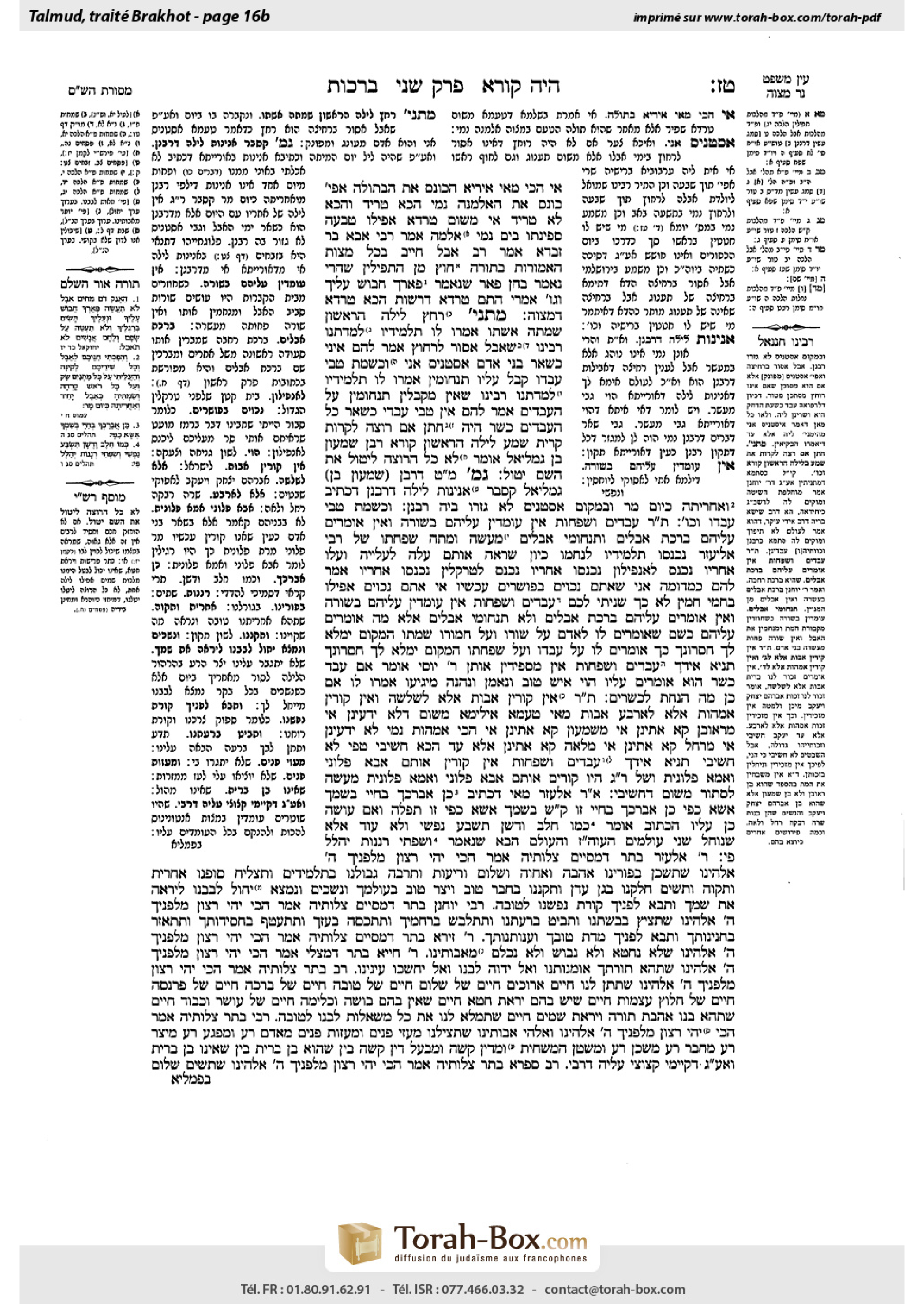
Berakhot 16b: Talmud study for Daf Yomi
Study the Talmud for Daf Yomi with scanned pages, Hebrew text, English translations from Sefaria and AI-generated French translations.
Passage selection and English or AI-generated French translation are available where the scan has annotations. Daf Study is independent of Torah-Box and Sefaria.
Browse Berakhot · ברכות · All tractatesBerakhot 16b text and translations
This page of Berakhot includes the Aramaic text, an English translation and an AI-generated French translation, alongside the scan above.
ברכות י״ו ב · Aramaic and Hebrew text
אִי הָכִי מַאי אִירְיָא הַכּוֹנֵס אֶת הַבְּתוּלָה? אֲפִילּוּ כּוֹנֵס אֶת הָאַלְמָנָה נָמֵי.
הָכָא — טְרִיד, וְהָכָא — לָא טְרִיד.
אִי מִשּׁוּם טִרְדָּא, אֲפִילּוּ טָבְעָה סְפִינָתוֹ בַּיָּם נָמֵי, אַלְּמָה אָמַר רַבִּי אַבָּא בַּר זַבְדָּא אָמַר רַב: אָבֵל חַיָּיב בְּכָל מִצְוֹת הָאֲמוּרוֹת בַּתּוֹרָה, חוּץ מִן הַתְּפִילִּין שֶׁהֲרֵי נֶאֱמַר בָּהֶן ״פְּאֵר״, שֶׁנֶּאֱמַר ״פְּאֵרְךָ חֲבוֹשׁ עָלֶיךָ וְגוֹ׳״!
אָמְרִי הָתָם טִרְדָּא דִרְשׁוּת הָכָא טִרְדָּא דְמִצְוָה.
מַתְנִי׳ רָחַץ לַיְלָה הָרִאשׁוֹן שֶׁמֵּתָה אִשְׁתּוֹ. אָמְרוּ לוֹ תַּלְמִידָיו: לִמַּדְתָּנוּ רַבֵּינוּ שֶׁאָבֵל אָסוּר לִרְחוֹץ? אָמַר לָהֶם אֵינִי כִּשְׁאָר בְּנֵי אָדָם, אִסְטְנִיס אֲנִי.
וּכְשֶׁמֵּת טָבִי עַבְדּוֹ קִבֵּל עָלָיו תַּנְחוּמִין. אָמְרוּ לוֹ תַּלְמִידָיו: לִמַּדְתָּנוּ רַבֵּינוּ שֶׁאֵין מְקַבְּלִין תַּנְחוּמִין עַל הָעֲבָדִים? אָמַר לָהֶם: אֵין טָבִי עַבְדִּי כִּשְׁאָר כָּל הָעֲבָדִים, כָּשֵׁר הָיָה.
חָתָן אִם רוֹצֶה לִקְרוֹת קְרִיאַת שְׁמַע לַיְלָה הָרִאשׁוֹן — קוֹרֵא, רַבָּן שִׁמְעוֹן בֶּן גַּמְלִיאֵל אוֹמֵר: לֹא כָּל הָרוֹצֶה לִיטּוֹל אֶת הַשֵּׁם, יִטּוֹל.
גְּמָ׳ מַאי טַעְמָא דְּרַבָּן (שִׁמְעוֹן בֶּן) גַּמְלִיאֵל? קָסָבַר: אֲנִינוּת לַיְלָה — דְּרַבָּנַן, דִּכְתִיב: ״וְאַחֲרִיתָהּ כְּיוֹם מָר״. וּבִמְקוֹם אִיסְטְנִיס לָא גְזַרוּ בֵּיהּ רַבָּנַן.
וּכְשֶׁמֵּת טָבִי עַבְדּוֹ וְכוּ׳.
תָּנוּ רַבָּנַן: עֲבָדִים וּשְׁפָחוֹת אֵין עוֹמְדִין עֲלֵיהֶם בְּשׁוּרָה, וְאֵין אוֹמְרִים עֲלֵיהֶם בִּרְכַּת אֲבֵלִים וְתַנְחוּמֵי אֲבֵלִים.
מַעֲשֶׂה וּמֵתָה שִׁפְחָתוֹ שֶׁל רַבִּי אֱלִיעֶזֶר. נִכְנְסוּ תַּלְמִידָיו לְנַחֲמוֹ. כֵּיוָן שֶׁרָאָה אוֹתָם עָלָה לַעֲלִיָּיה, וְעָלוּ אַחֲרָיו. נִכְנַס לָאַנְפִּילוֹן, נִכְנְסוּ אַחֲרָיו. נִכְנַס לַטְּרַקְלִין, נִכְנְסוּ אַחֲרָיו. אָמַר לָהֶם: כִּמְדוּמֶּה אֲנִי שֶׁאַתֶּם נִכְוִים בְּפוֹשְׁרִים, עַכְשָׁיו אִי אַתֶּם נִכְוִים אֲפִילּוּ בְּחַמֵּי חַמִּין, לֹא כָּךְ שָׁנִיתִי לָכֶם: עֲבָדִים וּשְׁפָחוֹת אֵין עוֹמְדִים עֲלֵיהֶם בְּשׁוּרָה, וְאֵין אוֹמְרִים עֲלֵיהֶם בִּרְכַּת אֲבֵלִים וְלֹא תַּנְחוּמֵי אֲבֵלִים? אֶלָּא מָה אוֹמְרִים עֲלֵיהֶם? — כְּשֵׁם שֶׁאוֹמְרִים לוֹ לְאָדָם עַל שׁוֹרוֹ וְעַל חֲמוֹרוֹ שֶׁמֵּתוּ — ״הַמָּקוֹם יְמַלֵּא לְךָ חֶסְרוֹנְךָ״, כָּךְ אוֹמְרִים לוֹ עַל עַבְדּוֹ וְעַל שִׁפְחָתוֹ ״הַמָּקוֹם יְמַלֵּא לְךָ חֶסְרוֹנְךָ״.
תַּנְיָא אִידַּךְ: עֲבָדִים וּשְׁפָחוֹת אֵין מַסְפִּידִין אוֹתָן. רַבִּי יוֹסֵי אוֹמֵר: אִם עֶבֶד כָּשֵׁר הוּא — אוֹמְרִים עָלָיו: ״הוֹי אִישׁ טוֹב וְנֶאֱמָן וְנֶהֱנֶה מִיגִיעוֹ״. אָמְרוּ לוֹ: אִם כֵּן, מָה הִנַּחְתָּ לַכְּשֵׁרִים?
תָּנוּ רַבָּנַן: אֵין קוֹרִין ״אָבוֹת״ אֶלָּא לִשְׁלֹשָׁה, וְאֵין קוֹרִין ״אִמָּהוֹת״ אֶלָּא לְאַרְבַּע.
אָבוֹת מַאי טַעְמָא? אִילֵּימָא מִשּׁוּם דְּלָא יָדְעִינַן אִי מֵרְאוּבֵן קָא אָתֵינַן אִי מִשִּׁמְעוֹן קָא אָתֵינַן, אִי הָכִי אִמָּהוֹת נָמֵי לָא יָדְעִינַן אִי מֵרָחֵל קָא אָתֵינַן אִי מִלֵּאָה קָא אָתֵינַן! אֶלָּא, עַד הָכָא חֲשִׁיבִי, טְפִי לָא חֲשִׁיבִי.
תַּנְיָא אִידָךְ: עֲבָדִים וּשְׁפָחוֹת אֵין קוֹרִין אוֹתָם ״אַבָּא פְּלוֹנִי״ וְ״אִמָּא פְּלוֹנִית״. וְשֶׁל רַבָּן גַּמְלִיאֵל הָיוּ קוֹרִים אוֹתָם ״אַבָּא פְּלוֹנִי״ וְ״אִמָּא פְּלוֹנִית״.
מַעֲשֶׂה לִסְתּוֹר?! מִשּׁוּם דַּחֲשִׁיבִי.
אָמַר רַבִּי אֶלְעָזָר: מַאי דִּכְתִיב, ״כֵּן אֲבָרֶכְךָ בְחַיָּי בְּשִׁמְךָ אֶשָּׂא כַפָּי״? ״כֵּן אֲבָרֶכְךָ בְחַיָּי״ — זוֹ קְרִיאַת שְׁמַע. ״בְּשִׁמְךָ אֶשָּׂא כַפָּי״ — זוֹ תְּפִלָּה. וְאִם עוֹשֶׂה כֵּן — עָלָיו הַכָּתוּב אוֹמֵר: ״כְּמוֹ חֵלֶב וָדֶשֶׁן תִּשְׂבַּע נַפְשִׁי״. וְלֹא עוֹד אֶלָּא שֶׁנּוֹחֵל שְׁנֵי עוֹלָמִים — הָעוֹלָם הַזֶּה וְהָעוֹלָם הַבָּא, שֶׁנֶּאֱמַר: ״וְשִׂפְתֵי רְנָנוֹת יְהַלֶּל פִּי״.
רַבִּי אֶלְעָזָר בָּתַר דִּמְסַיֵּים צְלוֹתֵיהּ אָמַר הָכִי: ״יְהִי רָצוֹן מִלְּפָנֶיךָ ה׳ אֱלֹהֵינוּ, שֶׁתְּשַׁכֵּן בְּפוּרֵינוּ אַהֲבָה וְאַחְוָה וְשָׁלוֹם וְרֵיעוּת. וְתַרְבֶּה גְּבוּלֵנוּ בְּתַלְמִידִים וְתַצְלִיחַ סוֹפֵנוּ אַחֲרִית וְתִקְוָה. וְתָשִׂים חֶלְקֵנוּ בְּגַן עֵדֶן, וְתַקְּנֵנוּ בְּחָבֵר טוֹב וְיֵצֶר טוֹב בְּעוֹלָמֶךָ. וְנַשְׁכִּים וְנִמְצָא יִחוּל לְבָבֵנוּ לְיִרְאָה אֶת שְׁמֶךָ, וְתָבֹא לְפָנֶיךָ קוֹרַת נַפְשֵׁנוּ לְטוֹבָה״.
רַבִּי יוֹחָנָן בָּתַר דִּמְסַיֵּים צְלוֹתֵיהּ אָמַר הָכִי: ״יְהִי רָצוֹן מִלְּפָנֶיךָ ה׳ אֱלֹהֵינוּ, שֶׁתָּצִיץ בְּבׇשְׁתֵּנוּ, וְתַבִּיט בְּרָעָתֵנוּ, וְתִתְלַבֵּשׁ בְּרַחֲמֶיךָ, וְתִתְכַּסֶּה בְּעֻזֶּךָ, וְתִתְעַטֵּף בַּחֲסִידוּתֶךָ, וְתִתְאַזֵּר בַּחֲנִינוּתֶךָ, וְתָבֹא לְפָנֶיךָ מִדַּת טוּבְךָ וְעִנְוְתָנוּתֶךְ״.
רַבִּי זֵירָא בָּתַר דִּמְסַיֵּים צְלוֹתֵיהּ אָמַר הָכִי: ״יְהִי רָצוֹן מִלְּפָנֶיךָ ה׳ אֱלֹהֵינוּ, שֶׁלֹּא נֶחֱטָא וְלֹא נֵבוֹשׁ וְלֹא נִכָּלֵם מֵאֲבוֹתֵינוּ״.
רַבִּי חִיָּיא בָּתַר דִּמְצַלֵּי אָמַר הָכִי: ״יְהִי רָצוֹן מִלְּפָנֶיךָ ה׳ אֱלֹהֵינוּ, שֶׁתְּהֵא תּוֹרָתְךָ אוּמָּנוּתֵנוּ, וְאַל יִדְוֶה לִבֵּנוּ, וְאַל יֶחְשְׁכוּ עֵינֵינוּ״.
רַב בָּתַר צְלוֹתֵיהּ אָמַר הָכִי: ״יְהִי רָצוֹן מִלְּפָנֶיךָ ה׳ אֱלֹהֵינוּ שֶׁתִּתֵּן לָנוּ חַיִּים אֲרוּכִּים, חַיִּים שֶׁל שָׁלוֹם, חַיִּים שֶׁל טוֹבָה, חַיִּים שֶׁל בְּרָכָה, חַיִּים שֶׁל פַּרְנָסָה, חַיִּים שֶׁל חִלּוּץ עֲצָמוֹת, חַיִּים שֶׁיֵּשׁ בָּהֶם יִרְאַת חֵטְא, חַיִּים שֶׁאֵין בָּהֶם בּוּשָׁה וּכְלִימָּה, חַיִּים שֶׁל עוֹשֶׁר וְכָבוֹד, חַיִּים שֶׁתְּהֵא בָּנוּ אַהֲבַת תּוֹרָה וְיִרְאַת שָׁמַיִם, חַיִּים שֶׁתְּמַלֵּא לָנוּ אֶת כָּל מִשְׁאֲלוֹת לִבֵּנוּ לְטוֹבָה״.
רַבִּי בָּתַר צְלוֹתֵיהּ אָמַר הָכִי: ״יְהִי רָצוֹן מִלְּפָנֶיךָ ה׳ אֱלֹהֵינוּ וֵאלֹהֵי אֲבוֹתֵינוּ, שֶׁתַּצִּילֵנוּ מֵעַזֵּי פָּנִים וּמֵעַזּוּת פָּנִים, מֵאָדָם רָע, וּמִפֶּגַע רָע, מִיֵּצֶר רָע, מֵחָבֵר רָע, מִשָּׁכֵן רָע, וּמִשָּׂטָן הַמַּשְׁחִית, וּמִדִּין קָשֶׁה וּמִבַּעַל דִּין קָשֶׁה, בֵּין שֶׁהוּא בֶּן בְּרִית בֵּין שֶׁאֵינוֹ בֶּן בְּרִית״.
וְאַף עַל גַּב דְּקָיְימִי קָצוֹצֵי עֲלֵיהּ דְּרַבִּי.
רַב סָפְרָא בָּתַר צְלוֹתֵיהּ אָמַר הָכִי: ״יְהִי רָצוֹן מִלְּפָנֶיךָ ה׳ אֱלֹהֵינוּ, שֶׁתָּשִׂים שָׁלוֹם
Berakhot 16b · English translation
The Gemara questions this: If so, why discuss a case of one who is marrying a virgin in particular? Even one who is marrying a widow is performing a mitzva and should also be exempt.
The Gemara responds that nevertheless, there is a distinction between one marrying a virgin and one marrying a widow. Here, in the case of one who marries a virgin, the groom is preoccupied by his thoughts, while here, in the case of one who marries a widow, he is not preoccupied.
The Gemara challenges: If a groom is exempt from the recitation of Shema simply due to preoccupation, then even one who is preoccupied because his ship sank at sea should be exempt. If so, why then did Rabbi Abba bar Zavda say that Rav said: A mourner is obligated in all the mitzvot mentioned in the Torah except for the mitzva to don phylacteries, as the term splendor is stated with regard to phylacteries, as it is stated that the prophet Ezekiel was prohibited to mourn and was told: “Bind your splendor upon yourself” (Ezekiel 24:17). If even a mourner, who is pained and preoccupied, is obligated to recite Shema, clearly preoccupation has no bearing upon one’s obligation.
The Gemara responds: Nevertheless, there is a distinction between the cases. There, it is a case of preoccupation with a voluntary act, as there is no mitzva to be preoccupied with his mourning, but here, in the case of a groom, the cause of the preoccupation is the mitzva itself.
MISHNA: The mishna relates another episode portraying unusual conduct by Rabban Gamliel. He bathed on the first night after his wife died. His students said to him: Have you not taught us, our teacher, that a mourner is prohibited to bathe? He answered them: I am not like other people, I am delicate [istenis]. For me, not bathing causes actual physical distress, and even a mourner need not suffer physical distress as part of his mourning.
Another exceptional incident is related: And when his slave, Tavi, died, Rabban Gamliel accepted condolences for his death as one would for a close family member. His students said to him: Have you not taught us, our teacher, that one does not accept condolences for the death of slaves? Rabban Gamliel said to his students: My slave, Tavi, is not like all the rest of the slaves, he was virtuous and it is appropriate to accord him the same respect accorded to a family member.
With regard to the recitation of Shema on one’s wedding night, the Sages said that if, despite his exemption, a groom wishes to recite Shema on the first night, he may do so. Rabban Shimon ben Gamliel says: Not everyone who wishes to assume the reputation of a God-fearing person may assume it, and consequently, not everyone who wishes to recite Shema on his wedding night may do so.
GEMARA: With regard to Rabban Gamliel’s bathing on the first night after the death of his wife, the Gemara asks: What is the reason that Rabban Gamliel did not practice the customs of mourning after his wife died? The Gemara answers: He holds that acute mourning [aninut] is in effect only on the day of the death itself, but acute mourning at night is only by rabbinic law, as it is written: “And I will turn your feasts into mourning, and all your songs into lamentations; I will bring sackcloth upon your loins and baldness upon every head; and I will make you like a mourner for an only child, and the end will be like a bitter day” (Amos 8:10). Therefore, by Torah law one’s acute mourning is only during the day, like a bitter day, while the acute mourning at night that follows is only rabbinic. And in the case of a delicate person, the Sages did not issue a decree that one should afflict himself during the period of acute mourning.
We learned in our mishna that: When his servant, Tavi, died, Rabban Gamliel accepted condolences for him.
The Sages taught in a baraita: For slaves and maidservants who die, one does not stand in a row of comforters to console the mourners, and one recites neither the blessing of the mourners nor the consolation of the mourners.
An incident is related that when Rabbi Eliezer’s maidservant died, his students entered to console him. When he saw them approaching he went up to the second floor, and they went up after him. He entered the gatehouse [anpilon], and they entered after him. He entered the banquet hall [teraklin], and they entered after him. Having seen them follow him everywhere, he said to them: It seems to me that you would be burned by lukewarm water, meaning that you could take a hint and when I went up to the second floor, you would understand that I did not wish to receive your consolations. Now I see that you are not even burned by boiling hot water. Did I not teach you the following: For slaves and maidservants who die, one does not stand in a row of comforters to console the mourners, and one neither recites the blessing of the mourners nor does he recite the consolation of the mourners, as the relationship between master and slave is not like a familial relationship? Rather, what does one say about them when they die? Just as we say to a person about his ox or donkey which died: May the Omnipresent replenish your loss, so too do we say for one’s slave or maidservant who died: May the Omnipresent replenish your loss, as the connection between a master and his slave is only financial in nature.
It was taught in another baraita: One does not eulogize slaves and maidservants. Rabbi Yosei says: If he was a virtuous servant, one recites over him a eulogy of sorts: Alas, a good and loyal man who enjoyed the fruits of his hard labor. They said to him: If so, what praise have you left for virtuous Jews? A Jewish person would be proud to be eulogized in that manner.
The Sages taught in a baraita: One may only call three people patriarchs, Abraham, Isaac, and Jacob, but not Jacob’s children. And one may only call four people matriarchs, Sarah, Rebecca, Rachel, and Leah.
The Gemara asks: What is the reason for this exclusivity with regard to the Patriarchs? If you say that it is because we do not know whether we descend from Reuben or from Simon, so we cannot accurately say our father Reuben, for example, if so, with regard to the Matriarchs as well, we do not know whether we descend from Rachel or from Leah, and we should not call Rachel and Leah matriarchs either. Instead, the reason the sons of Jacob are not called patriarchs is not for that reason, but because until Jacob they are significant enough to be referred to as patriarchs, but beyond Jacob, they are not significant enough to be referred to as patriarchs.
This serves as an introduction; although older people are often referred to with the honorific: Father so-and-so, it was taught in another baraita: One may not refer to slaves and maidservants as father [abba] so-and-so or mother [imma] so-and-so. But they would call the slaves and maidservants of Rabban Gamliel “father so-and-so” and “mother so-and-so.”
The Gemara asks: Is a story cited in order to contradict the previously stated halakha? The Gemara answers: There is no contradiction; rather, because Rabban Gamliel’s servants were significant, they were addressed with these honorifics.
The Gemara cites an aggadic statement concerning prayer and the recitation of Shema. Rabbi Elazar said: What is the meaning of that which is written: “So I will bless You as I live, to Your name I will raise my hands” (Psalms 63:5)? So I will bless You as I live, refers to the recitation of Shema, and to Your name I will raise my hands, refers to the Amida prayer, which is characterized as lifting one’s hands to God. And if one does so, recites Shema and prays, the verse says about him: “As with fat and marrow, my soul will be satisfied” (Psalms 63:6). And not only does he receive this reward, but he inherits two worlds, this world and the World-to-Come, as it is stated: “With lips of joys [renanot], my mouth praises You” (Psalms 63:6). The plural, joys, refers to two joys, that of this world and that of the World-to-Come.
The Gemara describes how after Rabbi Elazar concluded his prayer, he said the following additional prayer:
May it be Your will, Lord our God,
to cause to dwell in our lot love and brotherhood, peace and friendship.
And may You make our borders rich in disciples
and cause us to ultimately succeed, that we will have a good end and hope.
And may You set our portion in the Garden of Eden,
and may You establish for us a good companion and a good inclination in Your world.
And may we rise early and find the aspiration of our hearts to fear Your name,
and may the satisfaction of our souls come before You, i.e., may You hear our prayers that we may have spiritual contentment in this world for the best.
Similarly, the Gemara recounts that after Rabbi Yoḥanan concluded his prayer, he said the following additional prayer:
May it be Your will, Lord our God,
that You look upon our shame and behold our plight,
that You clothe Yourself in Your mercy,
and cover Yourself with Your might,
that You wrap Yourself in Your loving-kindness,
and gird Yourself with Your grace,
and may Your attributes of goodness and humility come before You.
Similarly, after Rabbi Zeira concluded his prayers he said the following additional prayer:
May it be Your will, Lord our God,
that we not sin or shame ourselves,
and that we not disgrace ourselves before our forefathers,
in the sense that our actions should not disgrace the actions of our forefathers.
After Rabbi Ḥiyya prayed he said the following:
May it be Your will, Lord our God,
that Your Torah should be our vocation,
and may our heart not become faint nor our eyes dim.
After his prayer, Rav said the following:
May it be Your will, Lord our God,
that You grant us long life, a life of peace,
a life of goodness, a life of blessing,
a life of sustenance, a life of freedom of movement from place to place, where we are not tied to one place,
a life of dread of sin, a life without shame and disgrace,
a life of wealth and honor,
a life in which we have love of Torah and reverence for Heaven,
a life in which You fulfill all the desires of our heart for good.
After his prayer, Rabbi Yehuda HaNasi said the following:
May it be Your will, Lord our God, and God of our forefathers,
that You save us from the arrogant and from arrogance in general,
from a bad man, from a bad mishap,
from an evil instinct, from a bad companion,
from a bad neighbor, from the destructive Satan,
from a harsh trial and from a harsh opponent,
whether he is a member of the covenant, a Jew,
or whether he is not a member of the covenant.
And the Gemara notes that Rabbi Yehuda HaNasi would recite this prayer every day despite the fact that royal officers stood watch over Rabbi Yehuda HaNasi for his protection; nevertheless, he prayed to avoid conflict or hindrance resulting from arrogance.
After his prayer, Rav Safra said the following:
May it be Your will, Lord our God, that You establish peace
Berakhot 16b · Traduction française (IA)
La Guemara pose une question : Si c’est ainsi, pourquoi discuter spécifiquement d’un cas où l’on épouse une vierge ? Même celui qui épouse une veuve accompli une Mitsva et devrait être exempt.
La Guemara répond que néanmoins, il y a une distinction entre celui qui épouse une vierge et celui qui épouse une veuve. Ici, dans le cas d’un mariant une vierge, le mari est préoccupé par ses pensées, tandis que dans le cas d’un mariant une veuve, il ne l’est pas.
La Guemara conteste : Si un mari est exempt de la récitation du Chéma simplement en raison de la préoccupation, alors même celui qui est préoccupé à cause de la perte de son navire en mer devrait être exempt. Si c’est ainsi, pourquoi Rabbi Abba bar Zavda a-t-il dit que Rav a dit : Le veuf est tenu de toutes les Mitsvot mentionnées dans la Torah, sauf la Mitsva de porter les phylactères, car le terme « splendeur » est mentionné en référence aux phylactères, comme il est dit que le prophète Ézéchiel était interdit de pleurer et lui a été dit : « Attache ta splendeur à toi-même » (Ézéchiel 24:17). Si même un veuf, qui est souffrant et préoccupé, est tenu de réciter le Chéma, évidemment la préoccupation n’a pas d’effet sur son obligation.
La Guemara répond : Néanmoins, il y a une distinction entre les cas. Là, il s’agit d’une préoccupation liée à une action volontaire, car il n’y a pas de mitsva de se préoccuper de son deuil, mais ici, dans le cas du mari, la cause de la préoccupation est la mitsva elle-même.
MICHNA : La Michna relate un autre épisode montrant un comportement inhabituel de Rabban Gamliel. Il s’est lavé la première nuit après la mort de sa femme. Ses élèves lui dirent : N’avez-vous pas enseigné, notre maître, que le veuf est interdit de se laver ? Il répondit : Je ne suis pas comme les autres, je suis délicat [istenis]. Pour moi, ne pas me laver cause un malaise physique réel, et même le veuf ne doit pas souffrir de malaise physique en raison de son deuil.
Un autre incident inhabituel est rapporté : Et lorsqu’est mort son serviteur Tavi, Rabban Gamliel a accepté les condoléances pour sa mort comme on le ferait pour un membre de sa famille. Ses élèves lui dirent : N’avez-vous pas enseigné, notre maître, que l’on ne reçoit pas de condoléances pour la mort des serviteurs ? Rabban Gamliel répondit à ses élèves : Mon serviteur Tavi n’est pas comme les autres serviteurs, il était vertueux et il est approprié de lui accorder le même respect que à un membre de la famille.
Concernant la récitation du Chéma la nuit de mariage, les Sages dirent que si, malgré son exemption, un mari souhaite réciter le Chéma la première nuit, il peut le faire. Rabban Shimon ben Gamliel dit : Ce n’est pas tout le monde qui peut s’attribuer le statut de personne craignant Dieu, et par conséquent, ce n’est pas tout le monde qui peut réciter le Chéma la nuit de son mariage.
GUEMARA : Concernant le fait que Rabban Gamliel s’est lavé la première nuit après la mort de sa femme, la Guemara pose une question : Quelle est la raison pour laquelle Rabban Gamliel n’a pas pratiqué les coutumes du deuil après la mort de sa femme ? La Guemara répond : Il considère que le deuil aigu [aninut] est en vigueur uniquement le jour de la mort, mais le deuil aigu la nuit est seulement de droit rabbinique, comme il est écrit : « Et je ferai de vos fêtes des jours de deuil, et de vos chants des laments ; je mettrai la toile de sac sur vos reins et la perte de cheveux sur toute la tête ; et je vous ferai semblant d’un veuf pour un seul enfant, et la fin sera comme un jour amer » (Amos 8:10). Ainsi, selon la Loi divine, le deuil aigu est seulement pendant la journée, comme un jour amer, tandis que le deuil aigu la nuit qui suit est seulement rabbinique. Et dans le cas d’une personne délicate, les Sages n’ont pas émis un décret selon lequel on devrait s’affliger pendant la période du deuil aigu.
Nous avons appris dans notre Michna que : Lorsque son serviteur Tavi est mort, Rabban Gamliel a accepté les condoléances pour lui.
Les Sages enseignèrent dans une baraïta : Pour les serviteurs et les servantes qui meurent, on ne se tient pas en rang pour consoler les veufs, et on ne récite ni la bénédiction des veufs ni la consolation des veufs.
Un incident est rapporté : lorsqu’est morte la servante de Rabbi Eliezer, ses élèves entrèrent pour la consoler. Lorsqu’il les vit approcher, il monta au deuxième étage, et ils le suivirent. Il entra dans la porte d’entrée [anpilon], et ils entrèrent après lui. Il entra dans la salle de banquet [teraklin], et ils entrèrent après lui. Ayant vu qu’ils le suivaient partout, il dit à eux : Il me semble que vous seriez brûlés par de l’eau tiède, c’est-à-dire que vous pourriez prendre un indice et, quand je suis monté au deuxième étage, vous comprendriez que je ne voulais pas recevoir vos condoléances. Maintenant, je vois que vous n’êtes même pas brûlés par de l’eau bouillante. N’ai-je pas enseigné que : Pour les serviteurs et les servantes qui meurent, on ne se tient pas en rang pour consoler les veufs, et on ne récite ni la bénédiction des veufs ni la consolation des veufs, car la relation entre le maître et son serviteur n’est pas comme une relation familiale ? Et qu’on dit alors à propos d’eux lorsqu’ils meurent ? Comme nous disons à propos d’un homme de son bœuf ou de son âne qui est mort : Que l’Éternel répare votre perte, ainsi aussi disons pour un serviteur ou une servante qui est mort : Que l’Éternel répare votre perte, car la relation entre un maître et son serviteur est seulement financière.
Il fut enseigné dans une autre baraïta : On ne célèbre pas de funérailles pour les serviteurs et les servantes. Rabbi Yosei dit : Si c’était un serviteur vertueux, on récite une sorte de panégyrique sur lui : Hélas, un homme bon et fidèle qui a savouré les fruits de son labeur ardu. Ils lui dirent : Si c’est ainsi, quels éloges avez-vous laissé pour les Juifs vertueux ? Un Juif serait fier d’être élogié ainsi.
Les Sages enseignèrent dans une baraïta : On peut seulement appeler trois personnes des patriarches, Abraham, Isaac et Jacob, mais pas les enfants de Jacob. Et on peut seulement appeler quatre personnes des matriarches, Sarah, Rebecca, Rachel et Léa.
La Guemara pose la question : Quel est le motif de cette exclusivité concernant les Patriarches ? Si l'on dit que c'est parce que nous ne savons pas si nous descendons de Rouben ou de Simôn, nous ne pouvons pas dire avec exactitude « notre père Rouben », par exemple. Si c'est ainsi, concernant les Matriarches également, nous ne savons pas si nous descendons de Rachel ou de Léa, et nous ne devrions pas appeler Rachel et Léa matriarches non plus. En réalité, la raison pour laquelle les fils de Jacob ne sont pas appelés patriarches n'est pas pour cette raison, mais parce que jusqu'à Jacob, ils sont suffisamment importants pour être désignés comme patriarches, mais au-delà de Jacob, ils ne sont pas suffisamment importants pour être appelés patriarches.
Cela sert d'introduction ; bien que les personnes âgées soient souvent désignées avec l'honorifique : « Père tel et tel », il a été enseigné dans une autre baraïta : On ne doit pas appeler les serviteurs et les servantes « père tel et tel » ou « mère tel et tel ». Cependant, on appelait les serviteurs et les servantes de Rabban Gamliel « père tel et tel » et « mère tel et tel ».
La Guemara pose la question : Une histoire est-elle citée afin de contredire la halakha précédemment énoncée ? La Guemara répond : Il n'y a pas de contradiction ; plutôt, c'est parce que les serviteurs de Rabban Gamliel étaient importants qu'ils étaient désignés avec ces honorifiques.
La Guemara cite une déclaration aggadique concernant la prière et la récitation du Chéma. Rabbi Eléazar dit : Quelle est la signification de ce qui est écrit : « Ainsi je bénirai Dieu, tant que je vis, à ton nom je leverai mes mains » (Psaumes 63:5) ? « Ainsi je bénirai Dieu, tant que je vis », fait référence à la récitation du Chéma, et « à ton nom je leverai mes mains », fait référence à la prière Amida, qui est caractérisée par le lever des mains vers Dieu. Et si l'on fait cela, récite le Chéma et prie, la Sainte Écriture dit à son sujet : « Comme avec des graisses et des matières grasses, mon âme sera rassasiée » (Psaumes 63:6). Et non seulement reçoit-il cette récompense, mais il hérite de deux mondes, ce monde et le Monde à Venir, comme il est dit : « Avec des lèvres de joies [renanot], ma bouche te loue » (Psaumes 63:6). Le pluriel, joies, fait référence à deux joies, celle de ce monde et celle du Monde à Venir.
La Guemara décrit comment, après que Rabbi Eléazar ait terminé sa prière, il a dit la prière suivante : Que cela soit ton vœu, Seigneur notre Dieu, que tu fasses résider dans notre lot l'amour et la fraternité, la paix et l'amitié. Et que tu fasses de nos frontières des disciples riches et que tu nous fasses réussir, afin que nous ayons une fin bonne et un espoir. Et que tu nous donnes une portion dans le Jardin d'Éden, et que tu établisses pour nous un compagnon bon et une inclination bonne dans ton monde. Et que nous levions tôt et trouvions l'aspiration de nos cœurs pour craindre ton nom, et que la satisfaction de nos âmes vienne devant toi, c'est-à-dire que tu entends nos prières afin que nous ayons une satisfaction spirituelle dans ce monde pour le meilleur.
De même, la Guemara rapporte que, après que Rabbi Yoḥanan ait terminé sa prière, il a dit la prière suivante : Que cela soit ton vœu, Seigneur notre Dieu, que tu regardes notre honte et vois notre détresse, que tu t'habilles de ta miséricorde, et que tu te couvres de ta puissance, que tu t'enveloppes de ta bonté, et que tu t'arme de ta grâce, que tes attributs de bonté et de modestie viennent devant toi.
De même, après que Rabbi Zéira ait terminé ses prières, il a dit la prière suivante : Que cela soit ton vœu, Seigneur notre Dieu, que nous ne péchions pas ou ne nous honteions pas, que nous ne nous déshonorions pas devant nos pères, au sens où nos actions ne devraient pas honteux les actions de nos pères.
Après sa prière, Rabbi Ḥiyya a dit la suivante : Que cela soit ton vœu, Seigneur notre Dieu, que ta Torah soit notre vocation, que notre cœur ne devienne pas faible ni nos yeux assombris.
Après sa prière, Rav a dit ceci : Que cela soit votre vœu, Seigneur notre Dieu, que vous nous donniez une longue vie, une vie de paix, une vie de bien, une vie de bénédiction, une vie de subsistance, une vie de liberté de mouvement d'un lieu à un autre, où nous ne sommes pas attachés à un seul lieu, une vie de crainte du péché, une vie sans honte et déshonneur, une vie de richesse et d'honneur, une vie où nous avons l'amour de la Torah et le respect du Ciel, une vie où vous accomplissez toutes les désirs de notre cœur pour le bien.
Après sa prière, Rabbi Yéhouda HaNasi a dit ceci : Que cela soit votre vœu, Seigneur notre Dieu, et Dieu de nos pères, que vous nous sauvez des orgueilleux et de l'orgueil en général, de l'homme mauvais, d'un mauvais événement, de l'instinct mauvais, d'un mauvais compagnon, de l'homme mauvais, de l'ennemi destructeur, de l'épreuve sévère et de l'adversaire sévère, que ce soit un membre du pacte, un Juif, ou que ce ne soit pas un membre du pacte.
Et la Guemara note que Rabbi Yéhouda HaNasi récitait cette prière chaque jour, malgré le fait que des officiers royaux veillaient à sa protection ; néanmoins, il priait afin d'éviter les conflits ou les obstacles résultant de l'orgueil.
Après sa prière, Rav Safra a dit ceci : Que cela soit votre volonté, Seigneur notre Dieu, que vous établissiez la paix
Traduction française générée par IA à partir de l’édition anglaise de Sefaria. Vérifie toujours un passage avec le texte source.
Text from Sefaria: William Davidson Edition - Vocalized Aramaic (CC BY NC); William Davidson Edition - English (CC BY NC).