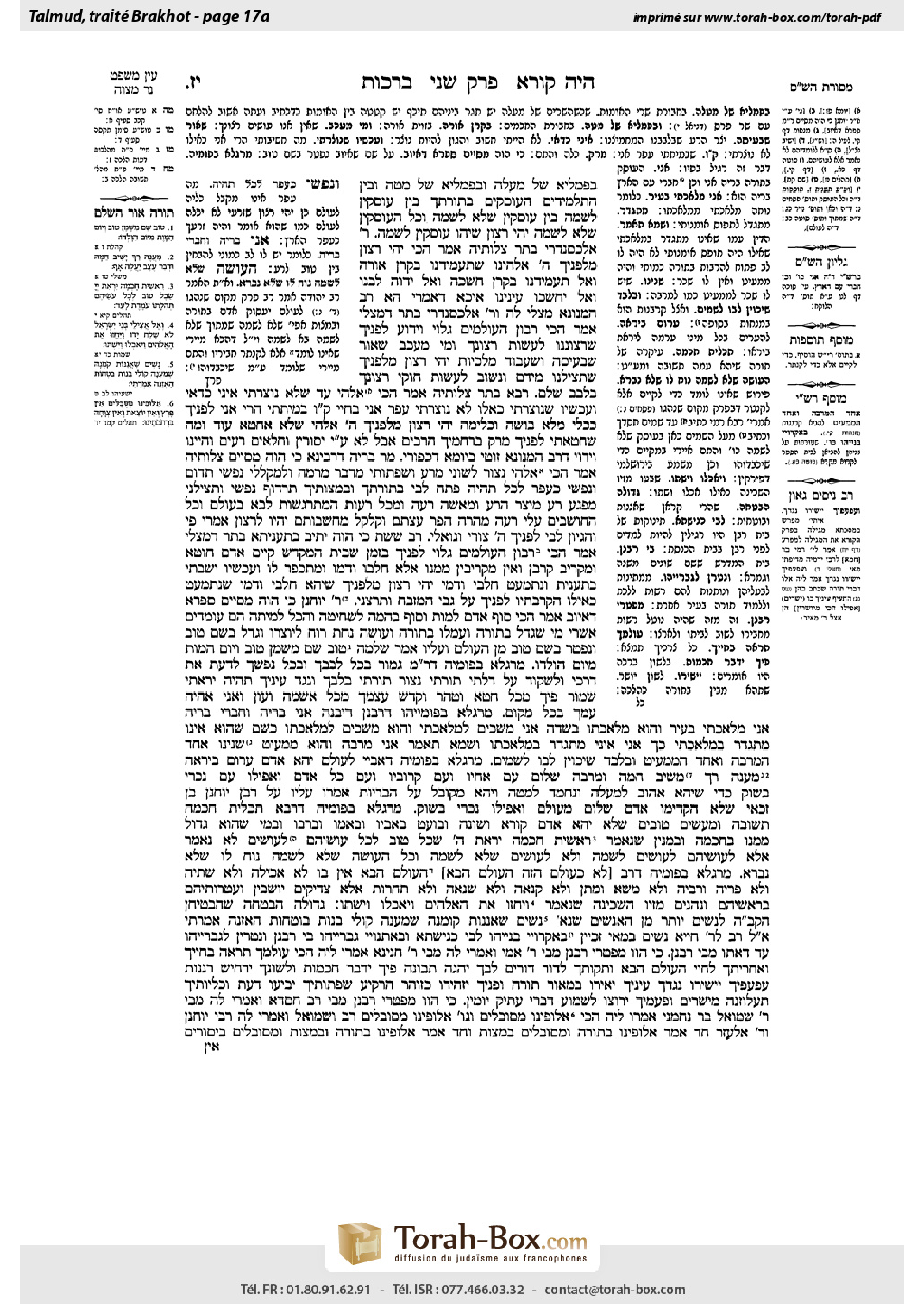
Berakhot 17a: Talmud study for Daf Yomi
Study the Talmud for Daf Yomi with scanned pages, Hebrew text, English translations from Sefaria and AI-generated French translations.
Passage selection and English or AI-generated French translation are available where the scan has annotations. Daf Study is independent of Torah-Box and Sefaria.
Browse Berakhot · ברכות · All tractatesBerakhot 17a text and translations
This page of Berakhot includes the Aramaic text, an English translation and an AI-generated French translation, alongside the scan above.
ברכות י״ז א · Aramaic and Hebrew text
בְּפָמַלְיָא שֶׁל מַעְלָה. וּבְפָמַלְיָא שֶׁל מַטָּה, וּבֵין הַתַּלְמִידִים הָעוֹסְקִים בְּתוֹרָתֶךָ בֵּין עוֹסְקִין לִשְׁמָהּ בֵּין עוֹסְקִין שֶׁלֹּא לִשְׁמָהּ. וְכָל הָעוֹסְקִין שֶׁלֹּא לִשְׁמָהּ יְהִי רָצוֹן שֶׁיְּהוּ עוֹסְקִין לִשְׁמָהּ״.
רַבִּי אָלֶכְּסַנְדְרִי בָּתַר צְלוֹתֵיהּ אָמַר הָכִי: ״יְהִי רָצוֹן מִלְּפָנֶיךָ ה׳ אֱלֹהֵינוּ, שֶׁתַּעֲמִידֵנוּ בְּקֶרֶן אוֹרָה, וְאַל תַּעֲמִידֵנוּ בְּקֶרֶן חֲשֵׁכָה, וְאַל יִדְוֶה לִבֵּנוּ, וְאַל יֶחְשְׁכוּ עֵינֵינוּ״. אִיכָּא דְאָמְרִי, הָא רַב הַמְנוּנָא מְצַלֵּי לַהּ. וְרַבִּי אָלֶכְּסַנְדְרִי בָּתַר דִּמְצַלֵּי אָמַר הָכִי: ״רִבּוֹן הָעוֹלָמִים, גָּלוּי וְיָדוּעַ לְפָנֶיךָ שֶׁרְצוֹנֵנוּ לַעֲשׂוֹת רְצוֹנֶךָ, וּמִי מְעַכֵּב? — שְׂאוֹר שֶׁבָּעִיסָּה וְשִׁעְבּוּד מַלְכֻיוֹת. יְהִי רָצוֹן מִלְּפָנֶיךָ שֶׁתַּצִּילֵנוּ מִיָּדָם, וְנָשׁוּב לַעֲשׂוֹת חוּקֵּי רְצוֹנְךָ בְּלֵבָב שָׁלֵם״.
רָבָא בָּתַר צְלוֹתֵיהּ אָמַר הָכִי: ״אֱלֹהַי, עַד שֶׁלֹּא נוֹצַרְתִּי אֵינִי כְּדַאי, וְעַכְשָׁיו שֶׁנּוֹצַרְתִּי כְּאִלּוּ לֹא נוֹצַרְתִּי. עָפָר אֲנִי בְּחַיַּי, קַל וָחוֹמֶר בְּמִיתָתִי, הֲרֵי אֲנִי לְפָנֶיךָ כִּכְלִי מָלֵא בּוּשָׁה וּכְלִימָּה. יְהִי רָצוֹן מִלְּפָנֶיךָ ה׳ אֱלֹהַי, שֶׁלֹּא אֶחֱטָא עוֹד, וּמַה שֶּׁחָטָאתִי לְפָנֶיךָ מָרֵק בְּרַחֲמֶיךָ הָרַבִּים, אֲבָל לֹא עַל יְדֵי יִסּוּרִין וָחֳלָאִים רָעִים״. וְהַיְינוּ וִידּוּי דְרַב הַמְנוּנָא זוּטֵי בְּיוֹמָא דְכִפּוּרֵי.
מָר בְּרֵיהּ דְּרָבִינָא כִּי הֲוָה מְסַיֵּים צְלוֹתֵיהּ אָמַר הָכִי: ״אֱלֹהַי, נְצוֹר לְשׁוֹנִי מֵרָע וְשִׂפְתוֹתַי מִדַּבֵּר מִרְמָה, וְלִמְקַלְּלַי נַפְשִׁי תִדּוֹם, וְנַפְשִׁי כֶּעָפָר לַכֹּל תִּהְיֶה. פְּתַח לִבִּי בְּתוֹרָתֶךָ, וּבְמִצְוֹתֶיךָ תִּרְדּוֹף נַפְשִׁי. וְתַצִּילֵנִי מִפֶּגַע רָע, מִיֵּצֶר הָרָע, וּמֵאִשָּׁה רָעָה, וּמִכָּל רָעוֹת הַמִּתְרַגְּשׁוֹת לָבֹא בָּעוֹלָם. וְכָל הַחוֹשְׁבִים עָלַי רָעָה מְהֵרָה הָפֵר עֲצָתָם וְקַלְקֵל מַחְשְׁבוֹתָם. יִהְיוּ לְרָצוֹן אִמְרֵי פִי וְהֶגְיוֹן לִבִּי לְפָנֶיךָ ה׳ צוּרִי וְגוֹאֲלִי״.
רַב שֵׁשֶׁת כִּי הֲוָה יָתֵיב בְּתַעֲנִיתָא, בָּתַר דִּמְצַלֵּי אָמַר הָכִי: ״רִבּוֹן הָעוֹלָמִים, גָּלוּי לְפָנֶיךָ בִּזְמַן שֶׁבֵּית הַמִּקְדָּשׁ קַיָּים, אָדָם חוֹטֵא — וּמַקְרִיב קָרְבָּן. וְאֵין מַקְרִיבִין מִמֶּנּוּ, אֶלָּא חֶלְבּוֹ וְדָמוֹ, וּמִתְכַּפֵּר לוֹ. וְעַכְשָׁיו יָשַׁבְתִּי בְּתַעֲנִית וְנִתְמַעֵט חֶלְבִּי וְדָמִי, יְהִי רָצוֹן מִלְּפָנֶיךָ שֶׁיְּהֵא חֶלְבִּי וְדָמִי שֶׁנִּתְמַעֵט כְּאִילּוּ הִקְרַבְתִּיו לְפָנֶיךָ עַל גַּבֵּי הַמִּזְבֵּחַ, וְתִרְצֵנִי״.
רַבִּי יוֹחָנָן כִּי הֲוָה מְסַיֵּים סִפְרָא דְאִיּוֹב, אָמַר הָכִי: ״סוֹף אָדָם לָמוּת וְסוֹף בְּהֵמָה לִשְׁחִיטָה, וְהַכֹּל לְמִיתָה הֵם עוֹמְדִים. אַשְׁרֵי מִי שֶׁגָּדֵל בַּתּוֹרָה וַעֲמָלוֹ בַּתּוֹרָה, וְעוֹשֶׂה נַחַת רוּחַ לְיוֹצְרוֹ, וְגָדֵל בְּשֵׁם טוֹב וְנִפְטָר בְּשֵׁם טוֹב מִן הָעוֹלָם, וְעָלָיו אָמַר שְׁלֹמֹה: 'טוֹב שֵׁם מִשֶּׁמֶן טוֹב וְיוֹם הַמָּוֶת מִיּוֹם הִוָּלְדוֹ'״.
מַרְגְּלָא בְּפוּמֵּיהּ דְּרַבִּי מֵאִיר: ״גְּמוֹר בְּכָל לְבָבְךָ וּבְכָל נַפְשְׁךָ לָדַעַת אֶת דְּרָכַי, וְלִשְׁקוֹד עַל דַּלְתֵי תוֹרָתִי. נְצוֹר תּוֹרָתִי בְּלִבְּךָ, וְנֶגֶד עֵינֶיךָ תִּהְיֶה יִרְאָתִי. שְׁמוֹר פִּיךְ מִכָּל חֵטְא, וְטַהֵר וְקַדֵּשׁ עַצְמְךָ מִכָּל אַשְׁמָה וְעָוֹן. וַאֲנִי אֶהְיֶה עִמְּךָ בְּכָל מָקוֹם״.
מַרְגְּלָא בְּפוּמַּיְיהוּ דְּרַבָּנַן דְּיַבְנֶה: ״אֲנִי בְּרִיָּה, וַחֲבֵרִי בְּרִיָּה. אֲנִי מְלַאכְתִּי בָּעִיר וְהוּא מְלַאכְתּוֹ בַּשָּׂדֶה. אֲנִי מַשְׁכִּים לִמְלַאכְתִּי, וְהוּא מַשְׁכִּים לִמְלַאכְתּוֹ. כְּשֵׁם שֶׁהוּא אֵינוֹ מִתְגַּדֵּר בִּמְלַאכְתִּי, כָּךְ אֲנִי אֵינִי מִתְגַּדֵּר בִּמְלַאכְתּוֹ. וְשֶׁמָּא תֹּאמַר: אֲנִי מַרְבֶּה, וְהוּא מַמְעִיט — שָׁנִינוּ: אֶחָד הַמַּרְבֶּה וְאֶחָד הַמַּמְעִיט וּבִלְבַד שֶׁיְּכַוֵּין לִבּוֹ לַשָּׁמַיִם״.
מַרְגְּלָא בְּפוּמֵּיהּ דְּאַבָּיֵּי: לְעוֹלָם יְהֵא אָדָם עָרוּם בְּיִרְאָה. ״מַעֲנֶה רַךְ מֵשִׁיב חֵמָה״. וּמַרְבֶּה שָׁלוֹם עִם אֶחָיו וְעִם קְרוֹבָיו וְעִם כָּל אָדָם וַאֲפִילּוּ עִם גּוֹי בַּשּׁוּק, כְּדֵי שֶׁיְּהֵא אָהוּב לְמַעְלָה וְנֶחְמָד לְמַטָּה, וִיהֵא מְקוּבָּל עַל הַבְּרִיּוֹת.
אָמְרוּ עָלָיו עַל רַבָּן יוֹחָנָן בֶּן זַכַּאי שֶׁלֹּא הִקְדִּימוֹ אָדָם שָׁלוֹם מֵעוֹלָם, וַאֲפִילּוּ גּוֹי בַּשּׁוּק.
מַרְגְּלָא בְּפוּמֵּיהּ דְּרָבָא: תַּכְלִית חָכְמָה — תְּשׁוּבָה וּמַעֲשִׂים טוֹבִים, שֶׁלֹּא יְהֵא אָדָם קוֹרֵא וְשׁוֹנֶה וּבוֹעֵט בְּאָבִיו וּבְאִמּוֹ וּבְרַבּוֹ וּבְמִי שֶׁהוּא גָּדוֹל מִמֶּנּוּ בְּחָכְמָה וּבְמִנְיָן, שֶׁנֶּאֱמַר: ״רֵאשִׁית חָכְמָה יִרְאַת ה׳ שֵׂכֶל טוֹב לְכָל עוֹשֵׂיהֶם״. ״לָעוֹשִׂים״ לֹא נֶאֱמַר, אֶלָּא ״לְעוֹשֵׂיהֶם״ — לָעוֹשִׂים לִשְׁמָהּ וְלֹא לָעוֹשִׂים שֶׁלֹּא לִשְׁמָהּ. וְכָל הָעוֹשֶׂה שֶׁלֹּא לִשְׁמָהּ, נוֹחַ לוֹ שֶׁלֹּא נִבְרָא.
מַרְגְּלָא בְּפוּמֵּיהּ דְּרַב: לֹא כָּעוֹלָם הַזֶּה הָעוֹלָם הַבָּא. הָעוֹלָם הַבָּא אֵין בּוֹ לֹא אֲכִילָה וְלֹא שְׁתִיָּהּ וְלֹא פְּרִיָּה וּרְבִיָּה וְלֹא מַשָּׂא וּמַתָּן וְלֹא קִנְאָה וְלֹא שִׂנְאָה וְלֹא תַּחֲרוּת, אֶלָּא צַדִּיקִים יוֹשְׁבִין וְעַטְרוֹתֵיהֶם בְּרָאשֵׁיהֶם וְנֶהֱנִים מִזִּיו הַשְּׁכִינָה, שֶׁנֶּאֱמַר: ״וַיֶּחֱזוּ אֶת הָאֱלֹהִים וַיֹּאכְלוּ וַיִּשְׁתּוּ״.
גְּדוֹלָה הַבְטָחָה שֶׁהִבְטִיחָן הַקָּדוֹשׁ בָּרוּךְ הוּא לְנָשִׁים יוֹתֵר מִן הָאֲנָשִׁים, שֶׁנֶּאֱמַר: ״נָשִׁים שַׁאֲנַנּוֹת קֹמְנָה שְׁמַעְנָה קוֹלִי בָּנוֹת בֹּטְחוֹת הַאְזֵנָּה אִמְרָתִי״.
אֲמַר לֵיהּ רַב לְרַבִּי חִיָּיא: נָשִׁים בְּמַאי זָכְיָין? בְּאַקְרוֹיֵי בְּנַיְיהוּ לְבֵי כְנִישְׁתָּא, וּבְאַתְנוֹיֵי גַּבְרַיְיהוּ בֵּי רַבָּנַן, וְנָטְרִין לְגַבְרַיְיהוּ עַד דְּאָתוּ מִבֵּי רַבָּנַן.
כִּי הֲווֹ מִפַּטְרִי רַבָּנַן מִבֵּי רַבִּי אַמֵּי, וְאָמְרִי לַהּ מִבֵּי רַבִּי חֲנִינָא, אָמְרִי לֵיהּ הָכִי: ״עוֹלָמְךָ תִּרְאֶה בְּחַיֶּיךָ, וְאַחֲרִיתְךָ לְחַיֵּי הָעוֹלָם הַבָּא, וְתִקְוָתְךָ לְדוֹר דּוֹרִים. לִבְּךָ יֶהְגֶּה תְּבוּנָה, פִּיךָ יְדַבֵּר חָכְמוֹת וּלְשׁוֹנְךָ יַרְחִישׁ רְנָנוֹת, עַפְעַפֶּיךָ יַיְשִׁירוּ נֶגְדְּךָ, עֵינֶיךָ יָאִירוּ בִּמְאוֹר תּוֹרָה, וּפָנֶיךָ יַזְהִירוּ כְּזוֹהַר הָרָקִיעַ, שִׂפְתוֹתֶיךָ יַבִּיעוּ דַּעַת, וְכִלְיוֹתֶיךָ תַּעֲלוֹזְנָה מֵישָׁרִים, וּפְעָמֶיךָ יָרוּצוּ לִשְׁמוֹעַ דִּבְרֵי עַתִּיק יוֹמִין״.
כִּי הֲווֹ מִפַּטְרִי רַבָּנַן מִבֵּי רַב חִסְדָּא, וְאָמְרִי לַהּ מִבֵּי רַבִּי שְׁמוּאֵל בַּר נַחְמָנִי, אָמְרוּ לֵיהּ הָכִי: ״אַלּוּפֵינוּ מְסֻבָּלִים וְגוֹ׳״.
״אַלּוּפֵינוּ מְסֻבָּלִים״ — רַב וּשְׁמוּאֵל, וְאָמְרִי לַהּ רַבִּי יוֹחָנָן וְרַבִּי אֶלְעָזָר, חַד אָמַר: ״אַלּוּפֵינוּ״ — בַּתּוֹרָה, וּ״מְסֻבָּלִים״ — בְּמִצְוֹת. וְחַד אָמַר: ״אַלּוּפֵינוּ״ — בַּתּוֹרָה וּבְמִצְוֹת, וּ״מְסֻבָּלִים״ — בְּיִסּוּרִים.
Berakhot 17a · English translation
in the heavenly entourage [pamalia] of angels each of whom ministers to a specific nation (see Daniel 10), and whose infighting causes war on earth;
and in the earthly entourage, the Sages,
and among the disciples engaged in the study of Your Torah,
whether they engage in its study for its own sake or not for its own sake.
And all those engaged in Torah study not for its own sake,
may it be Your will that they will come to engage in its study for its own sake.
After his prayer, Rabbi Alexandri said the following:
May it be Your will, Lord our God,
that You station us in a lighted corner and not in a darkened corner,
and do not let our hearts become faint nor our eyes dim.
Some say that this was the prayer that Rav Hamnuna would recite, and that after Rabbi Alexandri prayed, he would say the following:
Master of the Universe, it is revealed and known before You
that our will is to perform Your will, and what prevents us?
On the one hand, the yeast in the dough, the evil inclination that is within every person;
and the subjugation to the kingdoms on the other.
May it be Your will
that You will deliver us from their hands, of both the evil inclination and the foreign kingdoms,
so that we may return to perform the edicts of Your will with a perfect heart.
After his prayer, Rava said the following:
My God, before I was created I was worthless,
and now that I have been created it is as if I had not been created, I am no more significant.
I am dust in life, all the more so in my death.
I am before You as a vessel filled with shame and humiliation.
Therefore, may it be Your will, Lord my God, that I will sin no more,
and that those transgressions that I have committed,
cleanse in Your abundant mercy;
but may this cleansing not be by means of suffering and serious illness, but rather in a manner I will be able to easily endure.
And this is the confession of Rav Hamnuna Zuti on Yom Kippur.
When Mar, son of Ravina, would conclude his prayer, he said the following:
My God, guard my tongue from evil and my lips from speaking deceit.
To those who curse me let my soul be silent
and may my soul be like dust to all.
Open my heart to Your Torah,
and may my soul pursue your mitzvot.
And save me from a bad mishap, from the evil inclination,
from a bad woman, and from all evils that suddenly come upon the world.
And all who plan evil against me,
swiftly thwart their counsel, and frustrate their plans.
May the words of my mouth and the meditation of my heart find favor before You,
Lord, my Rock and my Redeemer.
The Gemara recounts that when Rav Sheshet would sit in observance of a fast, after he prayed he said as follows:
Master of the Universe, it is revealed before You
that when the Temple is standing, one sins and offers a sacrifice.
And although only its fat and blood were offered from that sacrifice on the altar, his transgression is atoned for him.
And now, I sat in observance of a fast and my fat and blood diminished.
May it be Your will that my fat and blood that diminished be considered as if I offered a sacrifice before You on the altar,
and may I find favor in Your eyes.
Having cited statements that various Sages would recite after their prayers, the Gemara cites additional passages recited by the Sages on different occasions.
When Rabbi Yoḥanan would conclude study of the book of Job, he said the following:
A person will ultimately die and an animal will ultimately be slaughtered, and all are destined for death. Therefore, death itself is not a cause for great anguish.
Rather, happy is he who grew up in Torah, whose labor is in Torah,
who gives pleasure to his Creator,
who grew up with a good name and who took leave of the world with a good name.
Such a person lived his life fully, and about him, Solomon said:
“A good name is better than fine oil, and the day of death than the day of one’s birth” (Ecclesiastes 7:1); one who was faultless in life reaches the day of his death on a higher level than he was at the outset.
Rabbi Meir was wont to say the following idiom:
Study with all your heart and with all your soul to know My ways
and to be diligent at the doors of My Torah.
Keep My Torah in your heart,
and fear of Me should be before your eyes.
Guard your mouth from all transgression,
and purify and sanctify yourself from all fault and iniquity.
And if you do so, I, God, will be with you everywhere.
The Sages in Yavne were wont to say:
I who learn Torah am God’s creature and my counterpart who engages in other labor is God’s creature.
My work is in the city and his work is in the field.
I rise early for my work and he rises early for his work.
And just as he does not presume to perform my work, so I do not presume to perform his work.
Lest you say: I engage in Torah study a lot, while he only engages in Torah study a little, so I am better than he,
it has already been taught:
One who brings a substantial sacrifice and one who brings a meager sacrifice have equal merit,
as long as he directs his heart towards Heaven (Rav Hai Gaon, Arukh).
Abaye was wont to say: One must always be shrewd and utilize every strategy in order to achieve fear of Heaven and performance of mitzvot. One must fulfill the verse: “A soft answer turns away wrath” (Proverbs 15:1) and take steps to increase peace with one’s brethren and with one’s relatives, and with all people, even with a non-Jew in the marketplace, despite the fact that he is of no importance to him and does not know him at all (Me’iri), so that he will be loved above in God’s eyes, pleasant below in the eyes of the people, and acceptable to all of God’s creatures.
Tangentially, the Gemara mentions that they said about Rabban Yoḥanan ben Zakkai that no one ever preceded him in issuing a greeting, not even a non-Jew in the marketplace, as Rabban Yoḥanan would always greet him first.
Rava was wont to say:
The objective of Torah wisdom is to achieve repentance and good deeds;
that one should not read the Torah and study mishna and become arrogant
and spurn his father and his mother and his teacher
and one who is greater than he in wisdom or in the number of students who study before him,
as it is stated: “The beginning of wisdom is fear of the Lord, a good understanding have all who fulfill them” (Psalms 111:10).
It is not stated simply: All who fulfill, but rather: All who fulfill them, those who perform these actions as they ought to be performed, meaning those who do such deeds for their own sake, for the sake of the deeds themselves, not those who do them not for their own sake.
Rava continued: One who does them not for their own sake, it would have been preferable for him had he not been created.
Rav was wont to say:
The World-to-Come is not like this world.
In the World-to-Come there is no eating, no drinking,
no procreation, no business negotiations,
no jealousy, no hatred, and no competition.
Rather, the righteous sit with their crowns upon their heads, enjoying the splendor of the Divine Presence, as it is stated:
“And they beheld God, and they ate and drank” (Exodus 24:11), meaning that beholding God’s countenance is tantamount to eating and drinking.
The Gemara states: Greater is the promise for the future made by the Holy One, Blessed be He, to women than to men, as it is stated: “Rise up, women at ease; hear My voice, confident daughters, listen to what I say” (Isaiah 32:9). This promise of ease and confidence is not given to men.
Rav said to Rabbi Ḥiyya: By what virtue do women merit to receive this reward? Rabbi Ḥiyya answered: They merit this reward for bringing their children to read the Torah in the synagogue, and for sending their husbands to study mishna in the study hall, and for waiting for their husbands until they return from the study hall.
When the Sages who had been studying there took leave of the study hall of Rabbi Ami, and some say it was the study hall of Rabbi Ḥanina, they would say to him the following blessing:
May you see your world, may you benefit from all of the good in the world, in your lifetime,
and may your end be to life in the World-to-Come,
and may your hope be sustained for many generations.
May your heart meditate understanding,
your mouth speak wisdom, and your tongue whisper with praise.
May your eyelids look directly before you,
your eyes shine in the light of Torah,
and your face radiate like the brightness of the firmament.
May your lips express knowledge,
your kidneys rejoice in the upright,
and your feet run to hear the words of the Ancient of Days, God (see Daniel 7).
When the Sages took leave of the study hall of Rav Ḥisda, and some say it was the study hall of Rabbi Shmuel bar Naḥmani, they would say to him the following, in accordance with the verse: “Our leaders are laden, there is no breach and no going forth and no outcry in our open places” (Psalms 144:14).
Our leaders are laden. Rav and Shmuel, and some say Rabbi Yoḥanan and Rabbi Elazar, disputed the proper understanding of this verse. One said: Our leaders in Torah are laden with mitzvot. And one said: Our leaders in Torah and mitzvot are laden with suffering.
Berakhot 17a · Traduction française (IA)
dans l'entourage céleste [pamalia] des anges, chacun desquels sert une nation spécifique (voir Daniel 10), et dont les conflits internes provoquent des guerres sur terre ; ainsi que dans l'entourage terrestre, les Sages, ainsi que parmi les disciples engagés dans l'étude de Votre Torah, qu'ils l'étudient pour elle-même ou non pour elle-même. Et tous ceux qui étudient la Torah non pour elle-même, que Votre volonté soit ainsi qu'ils viennent à l'étudier pour elle-même.
Après sa prière, Rabbi Alexandri dit ceci : Que Votre volonté soit ainsi, Seigneur notre Dieu, que Vous nous stationniez dans un coin éclairé et non dans un coin sombre, et ne laissez pas nos cœurs s'assombrir ni nos yeux s'assombrir. Certains disent que c'était la prière que Rav Hamnuna récitait, et que après Rabbi Alexandri avait prié, il disait ceci : Maître du Monde, il est révélé et connu devant Vous que notre volonté est de faire votre volonté, et ce qui nous empêche ? D'une part, la levain dans la pâte, l'inclination mauvaise qui est en chaque personne ; et l'asservissement aux royaumes d'autre part. Que Votre volonté soit que Vous nous délivriez de leurs mains, des deux l'inclination mauvaise et les royaumes étrangers, tel que nous puissions retourner à faire les ordonnances de Votre volonté avec un cœur parfait.
Après sa prière, Rava dit ceci : Mon Dieu, avant que je ne sois créé, je n'étais pas digne, et maintenant que je suis créé, c'est comme si je n'avais pas été créé, je ne suis plus important. Je suis de la poussière dans la vie, encore plus dans ma mort. Je suis devant Vous comme un vase rempli de honte et de humiliation. Donc, que Votre volonté soit ainsi, Seigneur mon Dieu, que je ne péche plus, et que les transgressions que j'ai commises, soient purifiées par Votre miséricorde abondante ; mais que cette purification ne soit pas par le biais de souffrance et de maladie grave, mais plutôt d'une manière que je puisse facilement endurer. Et c'est la confession de Rav Hamnuna Zuti le jour de la Fête des Tabernacles.
Quand Mar, fils de Ravina, concluait sa prière, il disait ceci : Mon Dieu, garde ma langue du mal et mes lèvres de parler de mensonge. À ceux qui me maudissent, que mon âme soit muette et que mon âme soit comme de la poussière pour tous. Ouvre mon cœur à Votre Torah, et que mon âme poursuive vos mitsvot. Et sauve-moi d'un mauvais hasard, de l'inclination mauvaise, de la mauvaise femme, et de toutes les mauvaises choses qui soudainement arrivent au monde. Et tous ceux qui planifient du mal contre moi, empêche rapidement leur conseil et frustrer leurs plans. Que les paroles de ma bouche et la méditation de mon cœur trouvent la faveur devant Vous, Seigneur, mon Roch et mon Rédempteur.
La Guemara raconte que quand Rav Sheshet était assis en observance de jeûne, après avoir prié, il disait ceci : Maître du Monde, il est révélé devant Vous que quand le Temple était debout, on péchait et on offrait un sacrifice. Et bien que seulement sa graisse et son sang aient été offerts de ce sacrifice sur l'autel, sa transgression était expiée. Et maintenant, j'étais en observance de jeûne et ma graisse et mon sang diminuaient. Que Votre volonté soit ainsi que ma graisse et mon sang qui diminuaient soient considérés comme si j'avais offert un sacrifice devant Vous sur l'autel, et que je trouve la faveur devant Vos yeux. Ayant cité des déclarations que divers Sages récitaient après leurs prières, la Guemara cite également des passages récités par les Sages à différentes occasions.
Quand Rabbi Yoḥanan concluait l'étude du livre de Job, il disait ceci : Une personne mourra finalement et un animal sera finalement sacrifié, et tous sont destinés à la mort. Donc, la mort elle-même n'est pas une cause de grande affliction. Plutôt, heureux celui qui s'est élevé dans la Torah, dont le travail est dans la Torah, qui donne du plaisir à son Créateur, qui s'est élevé avec un bon nom et qui a quitté le monde avec un bon nom. Une telle personne a vécu sa vie pleinement, et à son sujet, Salomon a dit : "Un bon nom est meilleur que l'huile parfumée, et le jour de la mort que le jour de la naissance" (Ecclésiaste 7:1) ; celui qui a été sans faute dans la vie atteint le jour de sa mort sur un niveau plus élevé qu'il n'était au début.
Rabbi Meir avait l'habitude de dire ceci : Apprends avec tout ton cœur et toute ton âme pour connaître Mes voies et être diligent aux portes de Ma Torah. Conserve Ma Torah dans ton cœur, et la crainte de Moi devrait être devant tes yeux. Garde ta bouche de toute transgression, et purifie et sanctifie-toi de toute faute et iniquité. Et si tu le fais, Je, Dieu, serai avec toi partout.
Les Sages de Yavne avaient l'habitude de dire : Je qui apprends la Torah suis la créature de Dieu et mon homologue qui s'occupe d'autres travaux est la créature de Dieu. Mon travail est en ville et son travail est en champ. Je me lève tôt pour mon travail et il se lève tôt pour son travail. Et tout comme il ne prétend pas à faire mon travail, ainsi je ne prétend pas à faire son travail. De peur que tu dises : J'étudie beaucoup la Torah, tandis qu'il n'étudie que peu, donc je suis meilleur que lui, il a déjà été enseigné : Celui qui apporte un sacrifice substantiel et celui qui apporte un sacrifice modeste ont la même mérite, à condition qu'il dirige son cœur vers le Ciel (Rav Hai Gaon, Arukh).
Abaye avait l'habitude de dire : On doit toujours être rusé et utiliser toute stratégie afin d'atteindre la crainte de Dieu et la performance des mitsvot. On doit accomplir la parole : "Une réponse douce éloigne la colère" (Proverbes 15:1) et prendre des mesures pour augmenter la paix avec ses frères et ses parents, et avec toutes les personnes, même avec un non-Juif au marché, malgré le fait qu'il n'ait aucune importance pour lui et qu'il ne le connaisse pas du tout (Me’iri), afin qu'il soit aimé au-dessus dans les yeux de Dieu, agréable en bas dans les yeux des gens, et acceptable pour toutes les créatures de Dieu.
Par ailleurs, la Guemara mentionne que l'on disait à propos de Rabban Yoḥanan ben Zakkai que personne ne le précédait en lui adressant la salutation, pas même un non-Juif au marché, car Rabban Yoḥanan saluait toujours le premier.
Rava disait : L'objectif de la sagesse de la Torah est d'atteindre la repentance et les bonnes œuvres ; on ne doit pas lire la Torah et étudier la Michna et se vanter, et mépriser son père et sa mère et son maître, et celui qui est supérieur à lui en sagesse ou en nombre d'élèves qui l'ont précédé dans l'étude, car il est dit : « Le commencement de la sagesse est la crainte du Seigneur, une bonne compréhension ont tous ceux qui les accomplissent » (Psaumes 111:10). Il n'est pas dit simplement : tous ceux qui les accomplissent, mais plutôt : tous ceux qui les accomplissent, ceux qui accomplissent ces actions comme elles doivent être accomplies, c'est-à-dire ceux qui font de telles œuvres pour leur propre compte, pour le compte des œuvres elles-mêmes, pas ceux qui les font pas pour leur propre compte. Rava continua : Celui qui les accomplit pas pour son propre compte, il aurait été préférable qu'il n'ait pas été créé.
Rav disait : Le Monde à Venir n'est pas comme ce monde. Dans le Monde à Venir, il n'y a pas de manger, pas de boire, pas de procréation, pas de négociations commerciales, pas de jalousie, pas de haine et pas de compétition. Plutôt, les justes siègent avec leurs couronnes sur la tête, en jouissant de la splendeur de la Présence divine, comme il est dit : « Et ils virent Dieu, et ils mangèrent et burent » (Exode 24:11), c'est-à-dire que voir la face de Dieu est équivalent à manger et boire.
La Guemara dit : La promesse promise à l'avenir par le Saint, le Bienheureux, aux femmes est plus grande que celle promise aux hommes, comme il est dit : « Levez-vous, femmes à l'aise ; écoutez la voix de mon Seigneur, filles confiantes, écoutez ce que je dis » (Yachout 32:9). Cette promesse de sérénité et de confiance n'est pas donnée aux hommes.
Rav dit à Rabbi Ḥiyya : Par quel mérite les femmes méritent-elles de recevoir cette récompense ? Rabbi Ḥiyya répondit : Elles méritent cette récompense pour avoir amené leurs enfants à lire la Torah dans la synagogue, et pour avoir envoyé leurs maris étudier la Michna dans la salle de étude, et pour avoir attendu leurs maris jusqu'à leur retour de la salle de étude.
Lorsque les Sages qui avaient étudié là ont quitté la salle de étude de Rabbi Ami, et certains disent que c'était la salle de étude de Rabbi Ḥanina, ils disaient à lui la bénédiction suivante : Que tu voies ton monde, que tu profits de tout le bien du monde, dans ta vie, et que ta fin soit la vie dans le Monde à Venir, et que ton espoir soit soutenu pour de nombreuses générations. Que ton cœur médite la compréhension, que ta bouche parle la sagesse, et que ta langue murmure des louanges. Que tes paupières regardent directement devant toi, que tes yeux brillent dans la lumière de la Torah, et que ton visage rayonne comme la clarté du firmament. Que tes lèvres expriment la connaissance, que tes reins se réjouissent dans la droiture, et que tes pieds courront pour entendre les paroles du Très Haut, Dieu (voir Daniel 7).
Lorsque les Sages ont quitté la salle de étude de Rav Ḥisda, et certains disent que c'était la salle de étude de Rabbi Shmuel bar Naḥmani, ils disaient à lui la bénédiction suivante, conformément au verset : « Nos chefs sont chargés, il n'y a pas de brèche et pas de sortie et pas de cri dans nos lieux ouverts » (Psaumes 144:14).
Nos chefs sont chargés. Rav et Shmuel, et certains disent Rabbi Yoḥanan et Rabbi Elazar, ont disputé sur la bonne compréhension de ce verset. L'un disait : Nos chefs en Torah sont chargés de mitsvot. Et l'autre disait : Nos chefs en Torah et mitsvot sont chargés de souffrance.
Traduction française générée par IA à partir de l’édition anglaise de Sefaria. Vérifie toujours un passage avec le texte source.
Text from Sefaria: William Davidson Edition - Vocalized Aramaic (CC BY NC); William Davidson Edition - English (CC BY NC).