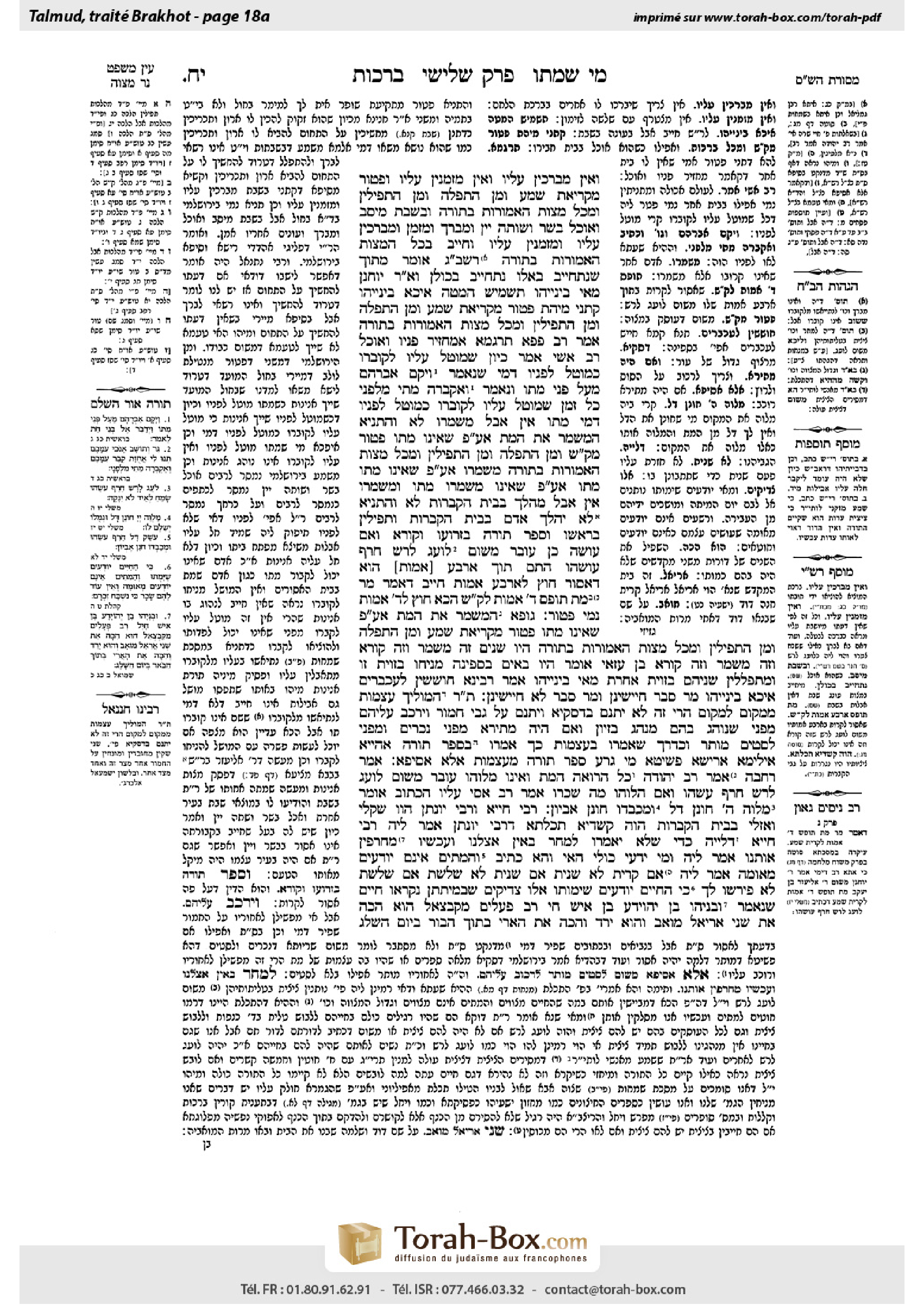
Berakhot 18a: Talmud study for Daf Yomi
Study the Talmud for Daf Yomi with scanned pages, Hebrew text, English translations from Sefaria and AI-generated French translations.
Passage selection and English or AI-generated French translation are available where the scan has annotations. Daf Study is independent of Torah-Box and Sefaria.
Browse Berakhot · ברכות · All tractatesBerakhot 18a text and translations
This page of Berakhot includes the Aramaic text, an English translation and an AI-generated French translation, alongside the scan above.
ברכות י״ח א · Aramaic and Hebrew text
וְאֵין מְבָרְכִין עָלָיו, וְאֵין מְזַמְּנִין עָלָיו, וּפָטוּר מִקְּרִיאַת שְׁמַע וּמִן הַתְּפִלָּה וּמִן הַתְּפִילִּין וּמִכׇּל מִצְוֹת הָאֲמוּרוֹת בַּתּוֹרָה. וּבְשַׁבָּת מֵיסֵב וְאוֹכֵל בָּשָׂר וְשׁוֹתֶה יַיִן, וּמְבָרֵךְ וּמְזַמֵּן, וּמְבָרְכִין עָלָיו וּמְזַמְּנִין עָלָיו, וְחַיָּיב בְּכָל הַמִּצְוֹת הָאֲמוּרוֹת בַּתּוֹרָה. רַבָּן שִׁמְעוֹן בֶּן גַּמְלִיאֵל אוֹמֵר: מִתּוֹךְ שֶׁנִּתְחַיֵּיב בְּאֵלּוּ — נִתְחַיֵּיב בְּכוּלָּן.
וְאָמַר רַבִּי יוֹחָנָן: מַאי בֵּינַיְיהוּ — תַּשְׁמִישׁ הַמִּטָּה אִיכָּא בֵּינַיְיהוּ.
קָתָנֵי מִיהַת פָּטוּר מִקְּרִיאַת שְׁמַע וּמִן הַתְּפִלָּה וּמִן הַתְּפִילִּין וּמִכׇּל מִצְוֹת הָאֲמוּרוֹת בַּתּוֹרָה! אָמַר רַב פָּפָּא: תַּרְגְּמָא אַמַּחֲזִיר פָּנָיו וְאוֹכֵל. רַב אָשֵׁי אָמַר: כֵּיוָן שֶׁמּוּטָּל עָלָיו לְקוֹבְרוֹ, כְּמוּטָל לְפָנָיו דָּמֵי. שֶׁנֶּאֱמַר: ״וַיָּקׇם אַבְרָהָם מֵעַל פְּנֵי מֵתוֹ״, וְנֶאֱמַר: ״וְאֶקְבְּרָה מֵתִי מִלְּפָנָי״, כָּל זְמַן שֶׁמּוּטָּל עָלָיו לְקוֹבְרוֹ כְּמוּטָל לְפָנָיו דָּמֵי.
מֵתוֹ — אִין, אֲבָל מְשַׁמְּרוֹ — לָא.
וְהָתַנְיָא: הַמְשַׁמֵּר אֶת הַמֵּת, אַף עַל פִּי שֶׁאֵינוֹ מֵתוֹ — פָּטוּר מִקְּרִיאַת שְׁמַע וּמִן הַתְּפִלָּה וּמִן הַתְּפִילִּין וּמִכׇּל מִצְוֹת הָאֲמוּרוֹת בַּתּוֹרָה! מְשַׁמְּרוֹ, אַף עַל פִּי שֶׁאֵינוֹ מֵתוֹ, מֵתוֹ אַף עַל פִּי שֶׁאֵינוֹ מְשַׁמְּרוֹ.
מֵתוֹ וּמְשַׁמְּרוֹ — אִין, אֲבָל מְהַלֵּךְ בְּבֵית הַקְּבָרוֹת — לָא. וְהָתַנְיָא: לֹא יְהַלֵּךְ אָדָם בְּבֵית הַקְּבָרוֹת וּתְפִילִּין בְּרֹאשׁוֹ וְסֵפֶר תּוֹרָה בִּזְרוֹעוֹ וְקוֹרֵא. וְאִם עוֹשֶׂה כֵּן — עוֹבֵר מִשּׁוּם ״לוֹעֵג לָרָשׁ חֵרֵף עוֹשֵׂהוּ״.
הָתָם, תּוֹךְ אַרְבַּע אַמּוֹת הוּא דְאָסוּר, חוּץ לְאַרְבַּע אַמּוֹת — חַיָּיב. דְּאָמַר מָר מֵת תּוֹפֵס אַרְבַּע אַמּוֹת לִקְרִיאַת שְׁמַע. הָכָא, חוּץ לְאַרְבַּע אַמּוֹת נָמֵי פָּטוּר.
גּוּפָא. הַמְשַׁמֵּר אֶת הַמֵּת אַף עַל פִּי שֶׁאֵינוֹ מֵתוֹ — פָּטוּר מִקְּרִיאַת שְׁמַע וּמִן הַתְּפִלָּה וּמִן הַתְּפִילִּין וּמִכׇּל מִצְוֹת הָאֲמוּרוֹת בַּתּוֹרָה. הָיוּ שְׁנַיִם — זֶה מְשַׁמֵּר וְזֶה קוֹרֵא, וְזֶה מְשַׁמֵּר וְזֶה קוֹרֵא. בֶּן עַזַּאי אוֹמֵר: הָיוּ בָּאִים בִּסְפִינָה — מַנִּיחוֹ בְּזָוִית זוֹ, וּמִתְפַּלְּלִין שְׁנֵיהֶם בְּזָוִית אַחֶרֶת.
מַאי בֵּינַיְיהוּ? אָמַר רָבִינָא: חוֹשְׁשִׁין לְעַכְבָּרִים אִיכָּא בֵּינַיְיהוּ. מָר סָבַר: חָיְישִׁינַן. וּמַר סָבַר: לָא חָיְישִׁינַן.
תָּנוּ רַבָּנַן: הַמּוֹלִיךְ עֲצָמוֹת מִמָּקוֹם לְמָקוֹם, הֲרֵי זֶה לֹא יִתְּנֵם בְּדִסַקַּיָּא וְיִתְּנֵם עַל גַּבֵּי חֲמוֹר וְיִרְכַּב עֲלֵיהֶם, מִפְּנֵי שֶׁנּוֹהֵג בָּהֶם מִנְהַג בִּזָּיוֹן. וְאִם הָיָה מִתְיָרֵא מִפְּנֵי גּוֹיִם וּמִפְּנֵי לִסְטִים — מוּתָּר. וּכְדֶרֶךְ שֶׁאָמְרוּ בַּעֲצָמוֹת כָּךְ אָמְרוּ בְּסֵפֶר תּוֹרָה.
אַהֵיָיא? אִילֵּימָא אַרֵישָׁא — פְּשִׁיטָא! מִי גָּרַע סֵפֶר תּוֹרָה מֵעֲצָמוֹת? אֶלָּא אַסֵּיפָא.
אָמַר רַחֲבָה אָמַר רַב יְהוּדָה: כָּל הָרוֹאֶה הַמֵּת וְאֵינוֹ מְלַוֵּהוּ עוֹבֵר מִשּׁוּם ״לֹעֵג לָרָשׁ חֵרֵף עֹשֵׂהוּ״. וְאִם הִלְוָהוּ מַה שְּׂכָרוֹ? אָמַר רַב אַסִּי, עָלָיו הַכָּתוּב אוֹמֵר: ״מַלְוֵה ה׳ חוֹנֵן דָּל״ ״וּמְכַבְּדוֹ חֹנֵן אֶבְיוֹן״.
רַבִּי חִיָּיא וְרַבִּי יוֹנָתָן הֲווֹ שָׁקְלִי וְאָזְלִי בְּבֵית הַקְּבָרוֹת. הֲוָה קָשַׁדְיָא תְּכֵלְתָּא דְרַבִּי יוֹנָתָן. אֲמַר לֵיהּ רַבִּי חִיָּיא: דַּלְיַיהּ, כְּדַי שֶׁלֹּא יֹאמְרוּ: לְמָחָר בָּאִין אֶצְלֵנוּ, וְעַכְשָׁיו מְחָרְפִין אוֹתָנוּ.
אֲמַר לֵיהּ: וּמִי יָדְעִי כּוּלֵּי הַאי? וְהָא כְּתִיב: ״וְהַמֵּתִים אֵינָם יוֹדְעִים מְאוּמָה״! אֲמַר לֵיהּ: אִם קָרִיתָ — לֹא שָׁנִיתָ. אִם שָׁנִיתָ — לֹא שִׁלַּשְׁתָּ. אִם שִׁלַּשְׁתָּ — לֹא פֵּירְשׁוּ לְךָ. ״כִּי הַחַיִּים יוֹדְעִים שֶׁיָּמוּתוּ״ — אֵלּוּ צַדִּיקִים שֶׁבְּמִיתָתָן נִקְרְאוּ חַיִּים, שֶׁנֶּאֱמַר: ״וּבְנָיָהוּ בֶן יְהוֹיָדָע בֶּן אִישׁ חַי רַב פְּעָלִים מִקַּבְצְאֵל הוּא הִכָּה אֵת שְׁנֵי אֲרִאֵל מוֹאָב וְהוּא יָרַד וְהִכָּה אֶת הָאֲרִי בְּתוֹךְ הַבּוֹר בְּיוֹם הַשָּׁלֶג״.
Berakhot 18a · English translation
And there is no need for others to recite a blessing beforehand on his behalf, nor do others invite him to join in Grace after Meals, as he cannot be a member of the quorum of three required to recite the formula. He is exempt from the recitation of Shema, from the Amida prayer and from phylacteries, and from all mitzvot mentioned in the Torah. On Shabbat, however, he reclines at the meal as per his custom, and eats meat and drinks wine, and recites blessings and recites the formula to invite the participants in the meal to join together in the Grace after Meals, and others may recite blessings on his behalf and invite him to join in Grace after Meals, and he is obligated in all mitzvot mentioned in the Torah. Rabban Shimon ben Gamliel says: Just as he is obligated on Shabbat to fulfill these mitzvot associated with Shabbat meals, he is obligated to fulfill all mitzvot.
Rabbi Yoḥanan said: What is the practical difference between the apparently identical statements of Rabban Shimon ben Gamliel and the first tanna? The practical difference between them is with regard to conjugal relations. The first tanna holds that although there is no mourning on Shabbat, since refraining from addressing his wife’s conjugal rights would not be a public display of mourning, conjugal relations are prohibited. Rabban Shimon ben Gamliel holds that since there is no mourning on Shabbat, he must fulfill the mitzva of addressing his wife’s conjugal rights.
In any event, the baraita teaches that one is exempt from the recitation of Shema, from the Amida prayer and from phylacteries, and from all mitzvot mentioned in the Torah. This is an apparent contradiction of our mishna which states that one is exempt only when the deceased is laid before him. To resolve this contradiction, Rav Pappa said: Explain the baraita as applicable only to the particular case when one turns his face away and eats, with the deceased laid out before him. In the other cases, when he is in a different room, he is obligated in all mitzvot. Rav Ashi says: The phrase: The deceased is laid out before him, is not to be taken literally, but rather, since it is incumbent upon him to bury the deceased, and he is not yet buried, it is as if he is laid out before him, as it is stated: “And Abraham rose up from before his dead” (Genesis 23:3), and when Abraham speaks with the Hittites, it is stated: “So that I may bury my dead from before me” (Genesis 23:4). As long as it is incumbent upon him to bury him, it is as he is laid out before him.
From the mishna one can infer that when his deceased relative is laid out before him, yes, he is exempt from mitzvot. But, if it is not his relative and he is only watching over the deceased, no, he is not exempt.
The Gemara challenges: Wasn’t it taught in a baraita: One who watches over the deceased, even if it is not his deceased relative, is exempt from the recitation of Shema, from prayer and from phylacteries, and from all mitzvot mentioned in the Torah? The Gemara responds that these two sources should not be understood as contradictory, but as complementary. In both the cases, he is exempt; where one watches over the deceased, but it is not his deceased relative, as well as the case where it is his deceased relative, but he is not watching over the deceased.
The Gemara further challenges: We concluded that, in both cases, if it is his deceased relative or if he was watching over the unrelated deceased, he is exempt from mitzvot. However, one walking in a cemetery is not exempt. Wasn’t it taught explicitly in a baraita: One may not walk in a cemetery with phylacteries on his head and a Torah scroll in his arm and read from it? If one does so he commits a transgression due to the verse: “He who mocks the poor blasphemes his Creator” (Proverbs 17:5). As the deceased is incapable of fulfilling mitzvot, fulfilling a mitzva in his presence is seen as mocking him.
The Gemara answers: There, when one walks in a cemetery, within four cubits of a grave, that is prohibited. However, beyond four cubits from a grave, one is obligated in prayer and phylacteries. As the Master said: The deceased occupies four cubits with regard to the exemption from the recitation of Shema. One who walks within four cubits of the deceased is exempt. Here, however, in the case where it is either his deceased relative or he is watching over an unrelated deceased, beyond four cubits he is also exempt.
The Gemara discusses the matter of the baraita itself. It was taught in the baraita: One who watches over the deceased, even though it is not his dead relative, is exempt from the recitation of Shema, from the Amida prayer and from phylacteries, and from all mitzvot mentioned in the Torah. The baraita continues: If two individuals were watching over the deceased, this one watches and that one recites Shema, and then that one watches and this one recites Shema. Ben Azzai says: If they were traveling with the deceased on a boat, they are permitted to set the deceased down in this corner of the boat and both pray in another corner of the boat.
The Gemara asks: What is the practical difference between these two opinions? Ravina said: The practical difference between them is whether or not one need be concerned about mice even inside the boat. The first Sage holds that we are concerned about mice everywhere, and it is therefore inappropriate to leave the deceased unguarded, even on a boat, lest he be eaten by mice. The other Sage, ben Azzai, maintains that we are not concerned about mice on a boat.
The Gemara discusses other issues concerning the dignity of the deceased. The Sages taught: One who transports bones from place to place may not place them in a saddlebag [disakaya] and place them on the donkey’s back and ride on them, as in doing so he treats the remains disgracefully. However, if he is afraid of gentiles or highwaymen and therefore must move quickly, he is permitted to do so. And just as they said with regard to bones, so they said with regard to a Torah scroll.
With regard to this last statement, the Gemara asks: To what section of the baraita does the parallel to a Torah scroll refer? If you say that this refers to the first clause of the baraita, this is obvious. Is a Torah scroll less important than bones of the dead? Certainly one may not treat a Torah disgracefully. Rather, this statement must refer to the latter clause of the baraita, that in a dangerous situation, one is permitted to ride on a Torah scroll as well.
Raḥava said that Rav Yehuda said: One who sees the deceased taken to burial and does not escort him has committed a transgression due to the verse: “He who mocks the poor blasphemes his Creator.” (Proverbs 17:5) And if he does escort him, what is his reward? Rav Asi said: The verse says about him: “He who gives to the poor gives a loan to the Lord, and the Lord will repay him” (Proverbs 19:17), and: “He who oppresses the poor blasphemes his Creator, but he who is gracious to the poor honors Him” (Proverbs 14:31).
The Gemara relates that Rabbi Ḥiyya and Rabbi Yonatan were walking in a cemetery and the sky-blue string of Rabbi Yonatan’s ritual fringes was cast to the ground and dragging across the graves. Rabbi Ḥiyya said to him: Lift it, so the dead will not say: Tomorrow, when their day comes, they will come to be buried with us, and now they are insulting us.
Rabbi Yonatan said to him: Do the dead know so much? Isn’t it stated: “And the dead know nothing” (Ecclesiastes 9:5)? Rabbi Ḥiyya said to him: If you read the verse, you did not read it a second time, and if you read it a second time, you did not read it a third time, and if you read it a third time, they did not explain it to you properly. The meaning of the verse: “For the living know that they will die, and the dead know nothing and have no more reward, for their memory has been forgotten” (Ecclesiastes 9:5): For the living know that they will die, these are the righteous, who even in their death are called living. An allusion to this is as it is stated: “And Benayahu, son of Yehoyada, son of a valiant man of Kabze’el, who had done mighty deeds, he smote the two altar-hearths of Moab; he went down also and slew a lion in the midst of a pit in time of snow” (II Samuel 23:20).
Berakhot 18a · Traduction française (IA)
Il n'est pas nécessaire que d'autres récitent une berakha à sa place avant, ni que d'autres l'invitent à participer à la bénédiction après le repas, car il ne peut être membre du minyan de trois requis pour réciter la formule. Il est exempt de la récitation du Chéma, de la prière de l'Amida et des phylactères, ainsi que de toutes les mitsvot mentionnées dans la Torah. Cependant, le sabbat, il s'allonge pour le repas selon sa coutume, mange de la viande et boit du vin, et récite des bénédictions et la formule pour inviter les participants à participer à la bénédiction après le repas, et d'autres peuvent réciter des bénédictions à sa place et l'inviter à participer à la bénédiction après le repas, et il est tenu de toutes les mitsvot mentionnées dans la Torah. Rabban Shimon ben Gamliel dit : Comme il est tenu de remplir ces mitsvot liées aux repas du sabbat, il est tenu de remplir toutes les mitsvot.
Rabbi Yoḥanan dit : Quelle est la différence pratique entre les déclarations apparemment identiques de Rabban Shimon ben Gamliel et du premier tanna ? La différence pratique entre eux concerne les relations conjugales. Le premier tanna considère que bien qu'il n'y ait pas de deuil le sabbat, puisque l'abstention de relations conjugales ne serait pas une démonstration publique de deuil, les relations conjugales sont interdites. Rabban Shimon ben Gamliel considère que puisque le deuil n'existe pas le sabbat, il doit accomplir la mitsva de s'adresser aux droits conjugaux de sa femme.
En tout cas, la baraïta enseigne que l'on est exempt de la récitation du Chéma, de la prière de l'Amida et des phylactères, ainsi que de toutes les mitsvot mentionnées dans la Torah. C'est une contradiction apparente avec notre mitsna qui stipule que l'on est exempt uniquement lorsque le défunt est placé devant soi. Pour résoudre cette contradiction, Rav Pappa dit : Expliquez la baraïta comme s'appliquant uniquement au cas où l'on tourne le visage et mange, avec le défunt placé devant soi. Dans les autres cas, lorsque l'on est dans une autre pièce, l'on est tenu de toutes les mitsvot. Rav Ashi dit : La phrase : Le défunt est placé devant soi, ne doit pas être prise littéralement, mais plutôt, puisque c'est à lui de l'enterrer et qu'il n'est pas encore enterré, cela est comme s'il était placé devant soi, comme il est dit : « Et Abraham se leva de devant ses morts » (Genèse 23:3), et lorsque Abraham parle aux Hittites, il est dit : « Afin que je puisse enterrer mes morts devant moi » (Genèse 23:4). Tant qu'il est à lui d'enterrer le défunt, cela est comme s'il était placé devant soi.
D'après la mitsna, on peut déduire que lorsque son proche disparu est placé devant lui, oui, il est exempt des mitsvot. Mais, si ce n'est pas son proche et qu'il surveille simplement le défunt, non, il n'est pas exempt.
La Guemara pose la question : N'était-il pas enseigné dans une baraïta : Celui qui surveille le défunt, même s'il ne s'agit pas de son proche disparu, est exempt de la récitation du Chéma, de la prière et des phylactères, ainsi que de toutes les mitsvot mentionnées dans la Torah ? La Guemara répond que ces deux sources ne doivent pas être comprises comme contradictoires, mais comme complémentaires. Dans les deux cas, il est exempt ; que ce soit lorsqu'il surveille le défunt mais qu'il ne s'agit pas de son proche disparu, ainsi que dans le cas où il s'agit de son proche disparu mais qu'il ne surveille pas le défunt.
La Guemara soulève une autre question : Nous avons conclu que, dans les deux cas, si c'est son proche disparu ou s'il surveille un défunt non lié, il est exempt des mitsvot. Cependant, celui qui marche dans un cimetière n'est pas exempt. N'était-il pas enseigné explicitement dans une baraïta : On ne doit pas marcher dans un cimetière avec des phylactères sur la tête et un livre de la Torah dans les bras et lire à partir de celui-ci ? Si l'on fait cela, on commet un péché en raison de la parole : « Celui qui moque le pauvre blasphème son Créateur » (Proverbes 17:5). Comme le défunt n'est pas capable d'accomplir des mitsvot, accomplir une mitsva en sa présence est considéré comme le moquer.
La Guemara répond : Là, lorsque l'on marche dans un cimetière, à quatre cubits d'une tombe, cela est interdit. Cependant, au-delà de quatre cubits d'une tombe, l'on est tenu de la prière et des phylactères. Comme le Maître a dit : Le défunt occupe quatre cubits en ce qui concerne l'exemption de la récitation du Chéma. Celui qui marche à quatre cubits du défunt est exempt. Ici cependant, dans le cas où c'est son proche disparu ou s'il surveille un défunt non lié, au-delà de quatre cubits il est également exempt.
La Guemara discute de la question de la baraïta elle-même. Elle a été enseignée dans la baraïta : Celui qui surveille le défunt, même s'il ne s'agit pas de son proche disparu, est exempt de la récitation du Chéma, de la prière de l'Amida et des phylactères, ainsi que de toutes les mitsvot mentionnées dans la Torah. La baraïta continue : Si deux personnes surveillaient le défunt, l'une surveille et l'autre récite le Chéma, et ensuite l'une surveille et l'autre récite le Chéma. Ben Azzai dit : Si ils voyageaient avec le défunt sur un bateau, ils sont autorisés à poser le défunt dans cette partie du bateau et à prier dans une autre partie du bateau.
La Guemara pose la question : Quelle est la différence pratique entre ces deux opinions ? Ravina dit : La différence pratique entre eux réside dans le fait de savoir si l'on doit craindre les rats même à l'intérieur du bateau. Le premier Sage considère que nous craignons les rats partout, et il est donc inapproprié de laisser le défunt sans surveillance, même sur un bateau, de peur qu'il soit mangé par des rats. L'autre Sage, Ben Azzai, maintient que nous ne craignons pas les rats sur un bateau.
La Guemara discute d'autres questions concernant le respect du défunt. Les Sages ont enseigné : Celui qui transporte des os d'un lieu à un autre ne doit pas les placer dans un sac de selle [disakaya] et les poser sur le dos de l'âne et monter dessus, car cela traiterait les restes avec dédain. Cependant, s'il craint les gens païens ou les voleurs et doit donc se déplacer rapidement, il est autorisé à le faire. Et comme ils l'ont dit concernant les os, ils l'ont dit concernant un livre de la Torah.
Concernant cette dernière déclaration, la Guemara pose la question : à quelle partie de la baraïta la comparaison avec un rouleau de Torah fait-elle référence ? Si vous dites que cela fait référence à la première clause de la baraïta, cela est évident. La Torah est-elle moins importante que les os des morts ? Bien sûr, on ne peut pas traiter la Torah avec dédain. Plutôt, cette déclaration doit faire référence à la seconde clause de la baraïta, celle qui stipule qu'en cas de danger, on est autorisé à monter sur un rouleau de Torah également.
Raḥava a dit que Rav Yehuda a dit : celui qui voit un mort emmené au sépulcre et ne l'accompagne pas a commis un péché en vertu de la parole : « Celui qui moque le pauvre blasphème son Créateur » (Proverbes 17:5). Et si l'on accompagne le mort, quelle est sa récompense ? Rav Asi a dit : la parole dit à son sujet : « Celui qui donne au pauvre prête à l'Éternel, et l'Éternel le récompensera » (Proverbes 19:17), et : « Celui qui opprime le pauvre blasphème son Créateur, mais celui qui est généreux envers le pauvre honore Lui » (Proverbes 14:31).
La Guemara rapporte que Rabbi Ḥiyya et Rabbi Yonatan marchaient dans un cimetière et la corde bleue de la frange rituelle de Rabbi Yonatan était tombée au sol et traînait sur les tombes. Rabbi Ḥiyya a dit à lui : Lève-la, afin que les morts ne disent pas : Demain, lorsqu'ils viendront à leur tour, ils viendront être enterrés avec nous, et maintenant ils nous insultent.
Rabbi Yonatan a dit à lui : Les morts savent donc autant que cela ? N'est-il pas dit : « Et les morts ne savent rien » (Ecclésiaste 9:5) ? Rabbi Ḥiyya a dit à lui : Si vous lisez la parole, vous ne l'avez pas relue une seconde fois, et si vous lisez une seconde fois, vous ne l'avez pas relue une troisième fois, et si vous lisez une troisième fois, ils ne vous l'ont pas expliquée correctement. La signification de la parole : « Car les vivants savent qu'ils mourront, et les morts ne savent rien et n'ont plus de récompense, car leur souvenir a été oublié » (Ecclésiaste 9:5) : Car les vivants savent qu'ils mourront, ce sont les justes, qui même en leur mort sont appelés vivants. Une allusion à cela est trouvée dans la parole : « Et Benayahu, fils de Yehoyada, fils d'un homme vaillant de Kabze’el, qui avait accompli des œuvres puissantes, il tua les deux autels de Moab ; il descendit aussi et tua un lion au milieu d'un puits en temps de neige » (II Samuel 23:20).
Traduction française générée par IA à partir de l’édition anglaise de Sefaria. Vérifie toujours un passage avec le texte source.
Text from Sefaria: William Davidson Edition - Vocalized Aramaic (CC BY NC); William Davidson Edition - English (CC BY NC).