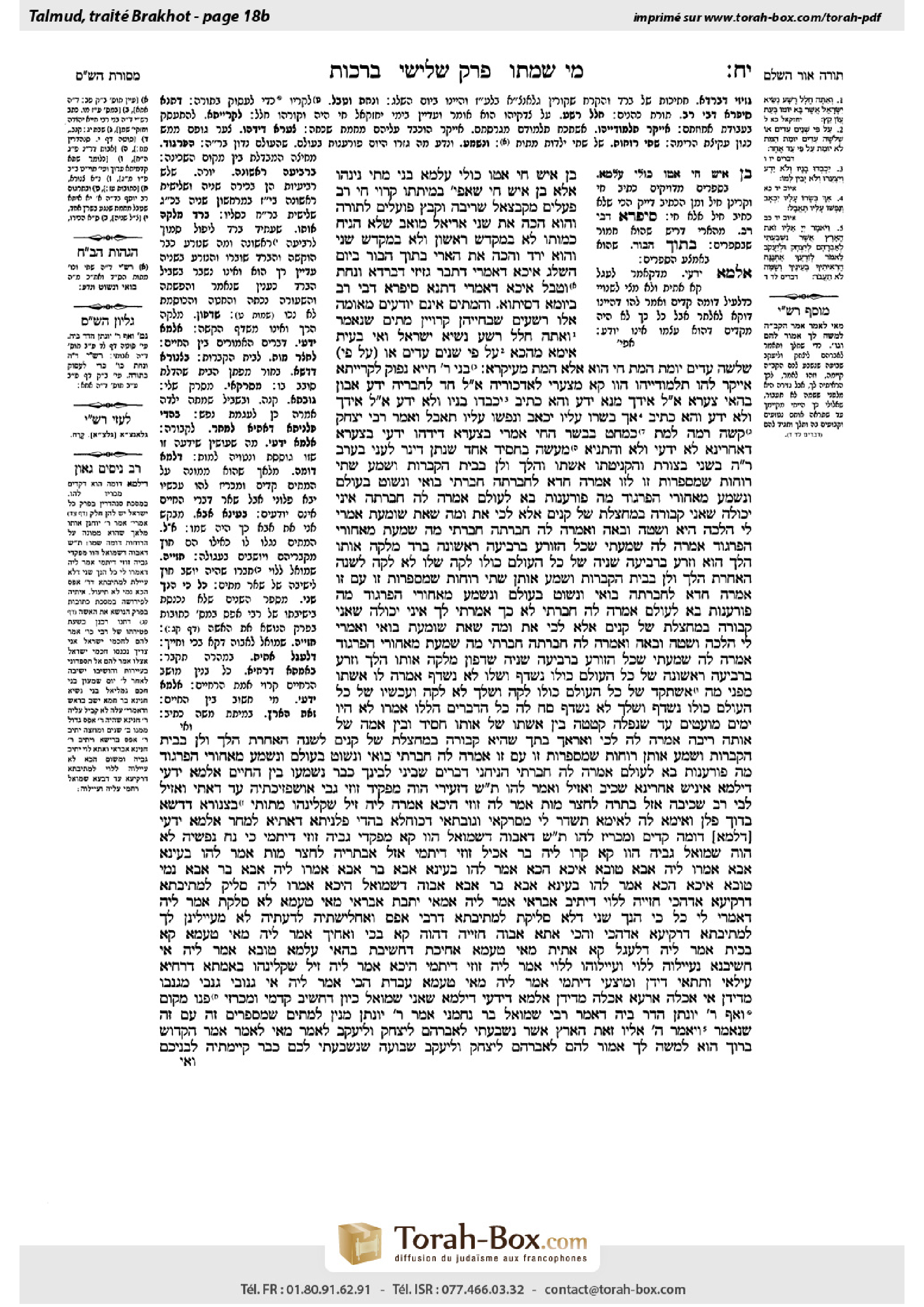
Berakhot 18b: Talmud study for Daf Yomi
Study the Talmud for Daf Yomi with scanned pages, Hebrew text, English translations from Sefaria and AI-generated French translations.
Passage selection and English or AI-generated French translation are available where the scan has annotations. Daf Study is independent of Torah-Box and Sefaria.
Browse Berakhot · ברכות · All tractatesBerakhot 18b text and translations
This page of Berakhot includes the Aramaic text, an English translation and an AI-generated French translation, alongside the scan above.
ברכות י״ח ב · Aramaic and Hebrew text
״בֶּן אִישׁ חַי״: אַטּוּ כּוּלֵּי עָלְמָא בְּנֵי מֵתֵי נִינְהוּ? אֶלָּא: ״בֶּן אִישׁ חַי״ — שֶׁאֲפִילּוּ בְּמִיתָתוֹ קָרוּי חַי. ״רַב פְּעָלִים מִקַּבְצְאֵל״ — שֶׁרִיבָּה וְקִבֵּץ פּוֹעֲלִים לַתּוֹרָה. ״וְהוּא הִכָּה אֵת שְׁנֵי אֲרִאֵל מוֹאָב״ — שֶׁלֹּא הִנִּיחַ כְּמוֹתוֹ לֹא בְּמִקְדָּשׁ רִאשׁוֹן וְלֹא בְּמִקְדָּשׁ שֵׁנִי.
״וְהוּא יָרַד וְהִכָּה אֶת הָאֲרִי בְּתוֹךְ הַבּוֹר בְּיוֹם הַשָּׁלֶג״, אִיכָּא דְאָמְרִי: דְּתַבַּר גְּזִיזֵי דְבַרְדָּא, וּנְחַת וּטְבַל. אִיכָּא דְאָמְרִי: דִּתְנָא סִיפְרָא דְבֵי רַב בְּיוֹמָא דְסִיתְוָא.
״וְהַמֵּתִים אֵינָם יוֹדְעִים מְאוּמָה״ — אֵלּוּ רְשָׁעִים, שֶׁבְּחַיֵּיהֶן קְרוּיִין ״מֵתִים״, שֶׁנֶּאֱמַר: ״וְאַתָּה חָלָל רָשָׁע נְשִׂיא יִשְׂרָאֵל״. וְאִי בָּעֵית אֵימָא, מֵהָכָא: ״עַל פִּי שְׁנַיִם עֵדִים אוֹ עַל פִּי שְׁלֹשָׁה עֵדִים יוּמַת הַמֵּת״, חַי הוּא! אֶלָּא, הַמֵּת מֵעִיקָּרָא.
בְּנֵי רַבִּי חִיָּיא נְפוּק לְקִרְיָיתָא. אִייַּקַּר לְהוּ תַּלְמוּדַיְיהוּ. הֲווֹ קָא מִצַּעֲרִי לְאִדְּכוֹרֵיהּ. אֲמַר לֵיהּ חַד לְחַבְרֵיהּ: יָדַע אֲבוּן בְּהַאי צַעֲרָא? אֲמַר לֵיהּ אִידַּךְ: מְנָא יָדַע? וְהָא כְּתִיב: ״יִכְבְּדוּ בָנָיו וְלֹא יֵדָע״.
אֲמַר לֵיהּ אִידַּךְ: וְלָא יָדַע? וְהָא כְּתִיב: ״אַךְ בְּשָׂרוֹ עָלָיו יִכְאָב וְנַפְשׁוֹ עָלָיו תֶּאֱבָל״. וְאָמַר רַבִּי יִצְחָק: קָשָׁה רִמָּה לַמֵּת כְּמַחַט בַּבָּשָׂר הַחַי!
אָמְרִי: בְּצַעֲרָא דִידְהוּ — יָדְעִי, בְּצַעֲרָא דְאַחֲרִינָא — לָא יָדְעִי.
וְלָא? וְהָתַנְיָא: מַעֲשֶׂה בְּחָסִיד אֶחָד שֶׁנָּתַן דִּינָר לְעָנִי בְּעֶרֶב רֹאשׁ הַשָּׁנָה בִּשְׁנֵי בַצּוֹרֶת, וְהִקְנִיטַתּוּ אִשְׁתּוֹ, וְהָלַךְ וְלָן בְּבֵית הַקְּבָרוֹת. וְשָׁמַע שְׁתֵּי רוּחוֹת שֶׁמְסַפְּרוֹת זוֹ לָזוֹ. אָמְרָה חֲדָא לַחֲבֶרְתָּהּ: חֲבֶרְתִּי, בּוֹאִי וְנָשׁוּט בָּעוֹלָם, וְנִשְׁמַע מֵאֲחוֹרֵי הַפַּרְגּוֹד מַה פּוּרְעָנוּת בָּא לָעוֹלָם? אָמְרָה לָהּ חֲבֶרְתָּהּ: אֵינִי יְכוֹלָה, שֶׁאֲנִי קְבוּרָה בְּמַחְצֶלֶת שֶׁל קָנִים. אֶלָּא לְכִי אַתְּ, וּמַה שֶּׁאַתְּ שׁוֹמַעַת אִמְרִי לִי. הָלְכָה הִיא וְשָׁטָה וּבָאָה. וְאָמְרָה לָהּ חֲבֶרְתָּהּ: חֲבֶרְתִּי, מַה שָּׁמַעְתְּ מֵאֲחוֹרֵי הַפַּרְגּוֹד? אָמְרָה לָהּ: שָׁמַעְתִּי שֶׁכָּל הַזּוֹרֵעַ בִּרְבִיעָה רִאשׁוֹנָה בָּרָד מַלְקֶה אוֹתוֹ. הָלַךְ הוּא וְזָרַע בִּרְבִיעָה שְׁנִיָּה. שֶׁל כָּל הָעוֹלָם כּוּלּוֹ לָקָה, שֶׁלּוֹ — לֹא לָקָה.
לַשָּׁנָה הָאַחֶרֶת הָלַךְ וְלָן בְּבֵית הַקְּבָרוֹת, וְשָׁמַע אוֹתָן שְׁתֵּי רוּחוֹת שֶׁמְסַפְּרוֹת זוֹ עִם זוֹ. אָמְרָה חֲדָא לַחֲבֶרְתָּהּ: בּוֹאִי וְנָשׁוּט בָּעוֹלָם וְנִשְׁמַע מֵאֲחוֹרֵי הַפַּרְגּוֹד מַה פּוּרְעָנוּת בָּא לָעוֹלָם. אָמְרָה לָהּ: חֲבֶרְתִּי, לֹא כָּךְ אָמַרְתִּי לָךְ, אֵינִי יְכוֹלָה שֶׁאֲנִי קְבוּרָה בְּמַחְצֶלֶת שֶׁל קָנִים?! אֶלָּא לְכִי אַתְּ, וּמַה שֶּׁאַתְּ שׁוֹמַעַת בּוֹאִי וְאִמְרִי לִי. הָלְכָה וְשָׁטָה וּבָאָה. וְאָמְרָה לָהּ חֲבֶרְתָּהּ: חֲבֶרְתִּי, מַה שָּׁמַעְתְּ מֵאֲחוֹרֵי הַפַּרְגּוֹד? אָמְרָה לָהּ: שָׁמַעְתִּי שֶׁכָּל הַזּוֹרֵעַ בִּרְבִיעָה שְׁנִיָּה שִׁדָּפוֹן מַלְקֶה אוֹתוֹ. הָלַךְ וְזָרַע בִּרְבִיעָה רִאשׁוֹנָה, שֶׁל כָּל הָעוֹלָם כּוּלּוֹ נִשְׁדַּף וְשֶׁלּוֹ לֹא נִשְׁדַּף.
אָמְרָה לוֹ אִשְׁתּוֹ: מִפְּנֵי מָה אֶשְׁתָּקַד שֶׁל כָּל הָעוֹלָם כּוּלּוֹ לָקָה וְשֶׁלְּךָ לֹא לָקָה, וְעַכְשָׁיו שֶׁל כָּל הָעוֹלָם כּוּלּוֹ נִשְׁדַּף וְשֶׁלְּךָ לֹא נִשְׁדַּף? סָח לָהּ כָּל הַדְּבָרִים הַלָּלוּ. אָמְרוּ: לֹא הָיוּ יָמִים מוּעָטִים עַד שֶׁנָּפְלָה קְטָטָה בֵּין אִשְׁתּוֹ שֶׁל אוֹתוֹ חָסִיד וּבֵין אִמָּהּ שֶׁל אוֹתָהּ רִיבָה. אָמְרָה לָהּ: לְכִי וְאַרְאֵךְ בִּתֵּךְ שֶׁהִיא קְבוּרָה בְּמַחְצֶלֶת שֶׁל קָנִים.
לַשָּׁנָה הָאַחֶרֶת הָלַךְ וְלָן בְּבֵית הַקְּבָרוֹת וְשָׁמַע אוֹתָן רוּחוֹת שֶׁמְסַפְּרוֹת זוֹ עִם זוֹ. אָמְרָה לָהּ: חֲבֶרְתִּי, בּוֹאִי וְנָשׁוּט בָּעוֹלָם וְנִשְׁמַע מֵאֲחוֹרֵי הַפַּרְגּוֹד מַה פּוּרְעָנוּת בָּא לָעוֹלָם. אָמְרָה לָהּ: חֲבֶרְתִּי, הֲנִיחִינִי, דְּבָרִים שֶׁבֵּינִי לְבֵינֵךְ כְּבָר נִשְׁמְעוּ בֵּין הַחַיִּים. אַלְמָא יָדְעִי.
דִּילְמָא אִינִישׁ אַחֲרִינָא שָׁכֵיב, וְאָזֵיל וְאָמַר לְהוּ.
תָּא שְׁמַע: דִּזְעֵירִי הֲוָה מַפְקֵיד זוּזֵי גַּבֵּי אוּשְׁפִּיזְכָתֵיהּ. עַד דְּאָתֵי וְאָזֵיל לְבֵי רַב, שְׁכִיבָה. אֲזַל בָּתְרַהּ לַחֲצַר מָוֶת, אֲמַר לַהּ: זוּזֵי הֵיכָא? אֲמַרָה לֵיהּ: זִיל שַׁקְלִינְהוּ מִתּוּתֵי צִנּוֹרָא דְּדָשָׁא בְּדוּךְ פְּלָן, וְאֵימָא לַהּ לְאִימָּא, תְּשַׁדַּר לִי מַסְרְקַאי וְגוּבְתַּאי דְּכוּחְלָא בַּהֲדֵי פְּלָנִיתָא דְּאָתְיָא לִמְחַר. אַלְמָא יָדְעִי!
דִּלְמָא דּוּמָה קָדֵים וּמַכְרֵיז לְהוּ.
תָּא שְׁמַע: דַּאֲבוּהּ דִּשְׁמוּאֵל הֲווֹ קָא מַפְקְדִי גַּבֵּיהּ זוּזֵי דְיַתְמֵי. כִּי נָח נַפְשֵׁיהּ לָא הֲוָה שְׁמוּאֵל גַּבֵּיהּ. הֲווֹ קָא קָרוּ לֵיהּ: ״בַּר אָכֵיל זוּזֵי דְיַתְמֵי״. אֲזַל אַבָּתְרֵיהּ לַחֲצַר מָוֶת. אֲמַר לְהוּ: בָּעֵינָא אַבָּא! אֲמַרוּ לֵיהּ: אַבָּא טוּבָא אִיכָּא הָכָא. אֲמַר לְהוּ: בָּעֵינָא אַבָּא בַּר אַבָּא. אֲמַרוּ לֵיהּ: אַבָּא בַּר אַבָּא נָמֵי טוּבָא אִיכָּא הָכָא. אֲמַר לְהוּ: בָּעֵינָא אַבָּא בַּר אַבָּא אֲבוּהּ דִּשְׁמוּאֵל הֵיכָא? אֲמַרוּ לֵיהּ סְלֵיק לִמְתִיבְתָּא דִּרְקִיעָא. אַדְּהָכִי חַזְיֵיהּ לְלֵוִי דְּיָתֵיב אַבָּרַאי. אֲמַר לֵיהּ: אַמַּאי יָתְבַתְּ אַבָּרַאי? מַאי טַעְמָא לָא סָלְקַתְּ? אֲמַר לֵיהּ, דְאָמְרִי לִי: כָּל כִּי הָנָךְ שְׁנֵי דְּלָא סְלֵיקְתְּ לִמְתִיבְתָּא דְּרַבִּי אַפָּס וְאַחְלֵישְׁתֵּיהּ לְדַעְתֵּיהּ, לָא מְעַיְּילִינַן לָךְ לִמְתִיבְתָּא דִרְקִיעָא.
אַדְּהָכִי וְהָכִי אֲתָא אֲבוּהּ, חַזְיֵיהּ דַּהֲוָה קָא בָכֵי וְאַחֵיךְ. אֲמַר לֵיהּ: מַאי טַעְמָא קָא בָכֵית? אֲמַר לֵיהּ: דְּלַעֲגָל קָא אָתֵית. מַאי טַעְמָא אַחֵיכְתְּ? דַּחֲשִׁיבַתְּ בְּהַאי עָלְמָא טוּבָא. אֲמַר לֵיהּ: אִי חֲשִׁיבְנָא — נְעַיְּילוּהּ לְלֵוִי. וְעַיְּילוּהוּ לְלֵוִי.
אֲמַר לֵיהּ: זוּזֵי דְיַתְמֵי הֵיכָא? אֲמַר לֵיהּ: זִיל שַׁקְלִינְהוּ בְּאַמְתָא דְרִחְיָא. עִילָּאֵי וְתַתָּאֵי — דִּידַן, וּמִיצְעֵי דְּיַתְמֵי. אֲמַר לֵיהּ: מַאי טַעְמָא עֲבַדְתְּ הָכִי? אֲמַר לֵיהּ: אִי גָּנְבִי גַּנָּבֵי — מִגַּנְבוּ מִדִּידַן. אִי אָכְלָה אַרְעָא — אָכְלָה מִדִּידַן. אַלְמָא דְּיָדְעִי! — דִּילְמָא שָׁאנֵי שְׁמוּאֵל, כֵּיוָן דַּחֲשִׁיב קָדְמִי וּמַכְרְזִי: פַּנּוּ מָקוֹם.
וְאַף רַבִּי יוֹנָתָן הֲדַר בֵּיהּ, דְּאָמַר רַבִּי שְׁמוּאֵל בַּר נַחְמָנִי אָמַר רַבִּי יוֹנָתָן: מִנַּיִן לַמֵּתִים שֶׁמְסַפְּרִים זֶה עִם זֶה — שֶׁנֶּאֱמַר: ״וַיֹּאמֶר ה׳ אֵלָיו זֹאת הָאָרֶץ אֲשֶׁר נִשְׁבַּעְתִּי לְאַבְרָהָם לְיִצְחָק וּלְיַעֲקֹב לֵאמֹר״. מַאי ״לֵאמֹר״? — אָמַר הַקָּדוֹשׁ בָּרוּךְ הוּא לְמֹשֶׁה: לֵךְ אֱמוֹר לָהֶם לְאַבְרָהָם לְיִצְחָק וּלְיַעֲקֹב: שְׁבוּעָה שֶׁנִּשְׁבַּעְתִּי לָכֶם כְּבָר קִייַּמְתִּיהָ לִבְנֵיכֶם.
Berakhot 18b · English translation
He was referred to in the verse as son of a living man. The Gemara wonders: Is that to say, the fact that the Bible referred to him with that appellation, that all others are children of the dead? Rather, the verse should be explained as follows: The son of a living man who lives forever, who even in death is referred to as living. Man of Kabze’el who had done mighty deeds, as he accumulated and gathered many workers for the sake of the Torah. Who killed the two lion-hearted men [Ariel] of Moab, as after his death he left no one his equal, in either the First Temple or the Second Temple periods, as the Temple is called Ariel (see Isaiah 29:1), and the two Ariel refers to the two Temples.
The Sages disagreed over the interpretation of the rest of the verse: “And who descended and slew the lion in the pit on the snowy day.” Some say that this means that he broke blocks of hail and descended and immersed himself in the water to purify himself. Others say that he learned all of the Sifra, the halakhic midrash on the book of Leviticus of the school of Rav, on a winter’s day.
In contrast to the righteous, who are referred to as living even after their death, the verse states explicitly: “The dead know nothing.” These are the wicked, who even during their lives are called dead, as the prophet Ezekiel said in reference to a king of Israel who was alive: “And you are a slain, wicked prince of Israel” (Ezekiel 21:30). And if you wish, say instead that the proof is from here: “At the mouth of two witnesses or three witnesses the dead shall be put to death” (Deuteronomy 17:6). This is puzzling. As long as the accused has not been sentenced to death, he is alive. Rather, this person who is wicked is considered dead from the outset.
The Gemara relates a story on this topic: The sons of Rabbi Ḥiyya went out to the villages to oversee the laborers. They forgot what they had learned and were struggling to recall it. One of them said to the other: Does our deceased father know of our anguish? The other said to him: From where would he know? Isn’t it written: “His sons are honored yet he shall not know it, they come to sorrow and he shall not understand them” (Job 14:21)? The dead do not know.
The other said back to him: And do the dead truly not know? Isn’t it written: “Only in his flesh does he feel pain, in his soul does he mourn” (Job 14:22)? Based on this verse Rabbi Yitzḥak said: Gnawing maggots are as excruciating to the dead as the stab of a needle to the flesh of the living. The dead must have the capacity to feel and know.
In order to reconcile this contradiction they said: They know of their own pain but do not know of the pain of others.
The Gemara challenges this: And is it so that the dead do not know of the pain of others? Wasn’t it taught in a baraita: There was an incident involving a pious man who gave a poor man a dinar on the eve of Rosh HaShana during drought years, and his wife mocked him for giving so large a sum at so difficult a time? And in order to escape her incessant mockery, he went and slept in the cemetery. That night in his dream (Ritva, HaKotev, Maharsha), he heard two spirits conversing with each other. One said to the other: My friend, let us roam the world and hear from behind the heavenly curtain [pargod], which separates the Divine Presence from the world, what calamity will befall the world. The other spirit said to her: I cannot go with you, as I am buried in a mat of reeds, but you go, and tell me what you hear. She went, and roamed, and came back. The other spirit said: My friend, what did you hear from behind the heavenly curtain? She replied: I heard that anyone who sows during the first rainy season of this year, hail will fall and strike his crops. Hearing this, the pious man went and sowed his seeds during the second rainy season. Ultimately, the crops of the entire world were stricken by hail and his crops were not stricken.
The following year, on the eve of Rosh HaShana, the same pious man went and slept in the cemetery at his own initiative, and again he heard the two spirits conversing with each other. One said to the other: Let us roam the world and hear from behind the heavenly curtain what calamity will befall the world. She said to her: My friend, have I not already told you that I cannot, as I am buried in a mat of reeds? Rather, you go, and tell me what you hear. She went, and roamed, and returned. The other spirit said to her: My friend, what did you hear from behind the curtain? She said to her: I heard that those who sow during the second rainy season blight will strike his crops. That pious man went and sowed during the first rainy season. Since everyone else sowed during the second rainy season, ultimately, the crops of the entire world were blighted and his crops were not blighted.
The pious man’s wife said to him: Why is it that last year, the crops of the entire world were stricken and yours were not stricken, and now this year, the crops of the entire world were blighted and yours were not blighted? He related to her the entire story. They said: It was not even a few days later that a quarrel fell between the pious man’s wife and the mother of the young woman who was buried there. The pious man’s wife said to her scornfully: Go and I will show you your daughter, and you will see that she is buried in a mat of reeds.
The following year, he again went and slept in the cemetery, and heard the same spirits conversing with each other. One said to the other: My friend, let us roam the world and hear from behind the heavenly curtain what calamity will befall the world. She said to her: My friend, leave me alone, as words that we have privately exchanged between us have already been heard among the living. Apparently, the dead know what transpires in this world.
The Gemara responds: This is no proof; perhaps another person, who heard about the conversation of the spirits secondhand, died and he went and told them that they had been overheard.
With regard to the deceased’s knowledge of what transpires, come and hear a proof, as it is told: Ze’iri would deposit his dinars with his innkeeper. While he was going and coming to and from the school of Rav, she died, and he did not know where she had put the money. So he went after her to her grave in the cemetery and said to her: Where are the dinars? She replied: Go and get them from beneath the hinge of the door in such and such a place, and tell my mother that she should send me my comb and a tube of eyeshadow with such and such a woman who will die and come here tomorrow. Apparently, the dead know what transpires in this world.
The Gemara rejects this proof: Perhaps the angel Duma, who oversees the dead, comes beforehand and announces to them that a particular individual will arrive the next day, but they themselves do not know.
The Gemara cites another proof: Come and hear, as it is told: They would deposit the money of orphans with Shmuel’s father for safekeeping. When Shmuel’s father died, Shmuel was not with him, and did not learn from him the location of the money. Since he did not return it, Shmuel was called: Son of him who consumes the money of orphans. Shmuel went after his father to the cemetery and said to the dead: I want Abba. The dead said to him: There are many Abbas here. He told them: I want Abba bar Abba. They said to him: There are also many people named Abba bar Abba here. He told them: I want Abba bar Abba, the father of Shmuel. Where is he? They replied: Ascend to the yeshiva on high. Meanwhile, he saw his friend Levi sitting outside the yeshiva, away from the rest of the deceased. He asked him: Why do you sit outside? Why did you not ascend to the yeshiva? He replied: Because they tell me that for all those years that you didn’t enter the yeshiva of Rabbi Afes, and thereby upset him, we will not grant you entry to the yeshiva on high.
Meanwhile, Shmuel’s father came and Shmuel saw that he was crying and laughing. Shmuel said to his father: Why are you crying? His father replied: Because you will come here soon. Shmuel continued and asked: Why are you laughing? His father replied: Because you are extremely important in this world. Shmuel said to him: If I am important, then let them grant Levi entry to the yeshiva. And so it was that they granted Levi entry to the yeshiva.
Shmuel said to his father: Where is the orphans’ money? He said to him: Go and retrieve it from the millhouse, where you will find the uppermost and the lowermost money is ours, and the money in the middle belongs to the orphans. Shmuel said to him: Why did you do that? He replied: If thieves stole, they would steal from our money on top, which the thief would see first. If the earth swallowed up any of it, it would swallow from our money, on the bottom. Apparently, the dead, in this case Shmuel’s father, know when others will die. Since Shmuel did not die the next day, clearly the angel Duma could not have informed them (Tosafot). The Gemara responds: Perhaps Shmuel is different, and because he is so important they announce beforehand: Clear place for his arrival.
In any case, with regard to the crux of the issue, Rabbi Yonatan also reconsidered his opinion, as Rabbi Shmuel bar Naḥmani said that Rabbi Yonatan said: From where is it derived that the dead converse with each other? As it is stated: “And the Lord said to him, this is the land that I swore to Abraham, Isaac and Jacob, saying: I will give it to your offspring” (Deuteronomy 34:4). What is the meaning of “saying”? It means that God told Moses: Go and tell Abraham, Isaac, and Jacob, that the oath that I swore to you I have already fulfilled for your descendants.
Berakhot 18b · Traduction française (IA)
Il est désigné dans la Bible comme fils d'un homme vivant. La Guemara se demande : cela signifie-t-il que, puisque la Bible l'appelle ainsi, tous les autres sont des enfants des morts ? Plutôt, la Bible doit être interprétée ainsi : le fils d'un homme vivant, qui vit éternellement, dont on parle même après sa mort comme vivant. L'homme de Kabze’el qui a accompli des œuvres merveilleuses, car il a accumulé et rassemblé beaucoup de travailleurs pour la Torah. Celui qui a tué les deux hommes lions de Moab, car après sa mort, il n'a laissé personne comparable à lui, ni durant la première maison de Dieu, ni durant la deuxième maison de Dieu, car la Maison de Dieu est appelée Ariel (voir Michna 29:1), et les deux Ariel désignent les deux Maisons.
Les Sages s'entendaient sur l'interprétation du reste de la versette : « Et qui descendit et tua le lion dans le puits le jour de la neige. » Certains disent que cela signifie qu'il brisa des blocs de grêle et descendit et s'immergea dans l'eau pour se purifier. D'autres disent qu'il apprit toute la Sifra, le midrash halakhique sur le livre de Lévitique de la école de Rava, un jour d'hiver.
Contrairement aux justes, qui sont désignés comme vivants même après leur mort, la versette dit explicitement : « Les morts ne savent rien. » Ce sont les méchants, qui même durant leur vie sont appelés morts, comme le prophète Ézéchiel l'a dit à propos d'un roi d'Israël qui était vivant : « Et tu es un mort, un prince méchant d'Israël » (Ézéchiel 21:30). Et si tu veux, dis plutôt que la preuve vient d'ici : « À la bouche de deux témoins ou de trois témoins, le mort sera mis à mort » (Deutéronome 17:6). Cela est troublant. Tant que l'accusé n'a pas été condamné à mort, il est vivant. Plutôt, cette personne méchante est considérée comme morte dès le départ.
La Guemara raconte une histoire à ce sujet : les fils de Rabbi Ḥiyya sont allés aux villages pour surveiller les travailleurs. Ils avaient oublié ce qu'ils avaient appris et luttaient pour le retrouver. L'un d'eux dit à l'autre : Notre père décédé sait-il de notre détresse ? L'autre dit à lui : D'où saura-t-il ? N'est-il pas écrit : « Ses fils sont honorés, et il ne le sait pas, ils viennent à la tristesse et il ne les comprend pas » (Job 14:21) ? Les morts ne savent pas.
L'autre dit à lui : Et les morts ne savent-ils vraiment pas ? N'est-il pas écrit : « Seulement dans sa chair ressent-il la douleur, dans son âme il pleure » (Job 14:22) ? Sur cette versette, Rabbi Yitzḥak a dit : Les mouches rongeuses sont aussi douloureuses pour les morts que la pointe d'une aiguille pour la chair des vivants. Les morts doivent avoir la capacité de sentir et de connaître.
Pour résoudre ce conflit, ils dirent : Ils connaissent leur propre douleur mais ne connaissent pas la douleur des autres.
La Guemara remet en question cela : Et est-ce que les morts ne connaissent pas la douleur des autres ? N’a-t-il pas été enseigné dans une baraïta : Il y avait un homme pieux qui donna un dinar à un pauvre le soir de Rosh HaShana pendant les années de sécheresse, et sa femme le moqua pour avoir donné une somme si grande à un moment si difficile ? Et afin d’échapper à son moquerie incessante, il alla dormir dans le cimetière. La nuit, dans son rêve (Ritva, HaKotev, Maharsha), il entendit deux esprits converser entre eux. L’un dit à l’autre : Mon ami, allons parcourir le monde et écoutons derrière le rideau céleste [pargod], qui sépare la Présence divine du monde, quelle calamité frappera le monde. L’autre esprit dit à lui : Je ne peux pas t’accompagner, car je suis enterré dans un mat de roseaux, mais tu vas, et dis-moi ce que tu entends. Il alla, parcourut, et revint. L’autre esprit dit à lui : Mon ami, qu’as-tu entendu derrière le rideau céleste ? Il répondit : J’ai entendu que celui qui sème durant la première saison pluvieuse de cette année, la grêle tombera et frappera ses récoltes. En entendant cela, l’homme pieux alla et sème ses graines durant la deuxième saison pluvieuse. Finalement, les récoltes du monde entier furent frappées par la grêle et ses récoltes ne furent pas frappées.
L'année suivante, le même homme pieux alla dormir dans le cimetière de son propre initiative, et à nouveau il entendit les deux esprits converser entre eux. L'un dit à l'autre : Allons parcourir le monde et écoutons derrière le rideau céleste quelle calamité frappera le monde. Elle dit à l'autre : Mon ami, n'ai-je pas déjà dit que je ne peux pas, car je suis enterré dans un mat de roseaux ? Plutôt, tu vas, et dis-moi ce que tu entends. Elle alla, parcourut, et revint. L'autre esprit dit à elle : Mon amie, qu'as-tu entendu derrière le rideau ? Elle dit à l'autre : J'ai entendu que ceux qui sèment durant la deuxième saison pluvieuse, la pourriture frappera leurs récoltes. Cet homme pieux alla et sèma durant la première saison pluvieuse. Puisque tout le monde sème durant la deuxième saison pluvieuse, finalement, les récoltes du monde entier furent pourries et ses récoltes ne furent pas pourries.
La femme de l'homme pieux dit à lui : Pourquoi est-ce que l'année dernière, les récoltes du monde entier furent frappées et les tiennes ne furent pas frappées, et maintenant cette année, les récoltes du monde entier furent pourries et les tiennes ne furent pas pourries ? Il raconta à elle l'ensemble de l'histoire. Ils dirent : Il n'était même pas quelques jours plus tard qu'une querelle tomba entre la femme de l'homme pieux et la mère de la jeune femme qui était enterrée là. La femme de l'homme pieux dit à elle avec dédain : Va et je te montrerai ta fille, et tu verras qu'elle est enterrée dans un mat de roseaux.
L'année suivante, il alla à nouveau dormir dans le cimetière, et entendit les mêmes esprits converser entre eux. L'un dit à l'autre : Mon ami, allons parcourir le monde et écoutons derrière le rideau céleste quelle calamité frappera le monde. Elle dit à l'autre : Mon ami, laisse-moi tranquille, car les paroles que nous avons échangées en privé entre nous ont déjà été entendues par les vivants. Apparemment, les morts savent ce qui se passe dans ce monde.
La Guemara répond : Cela n'est pas une preuve ; peut-être un autre homme, qui a entendu la conversation des esprits par l'intermédiaire d'un tiers, est mort et est allé leur dire qu'ils avaient été entendus.
En ce qui concerne la connaissance du défunt sur ce qui se passe, viens écouter une preuve, comme il est raconté : Ze’iri déposait ses dinars chez son aubergiste. Tandis qu’il allait et venait de la maison de Rav, elle mourut et il ne savait pas où elle avait caché l’argent. Il alla donc la suivre dans son tombeau au cimetière et lui demanda : Où sont les dinars ? Elle répondit : Va les chercher sous le gond de la porte, dans telle et telle place, et dis à ma mère qu’elle doive m’envoyer mon peigne et un tube de khôl avec telle et telle femme qui mourra et viendra ici demain. Apparemment, les morts savent ce qui se passe dans ce monde.
La Guemara rejette cette preuve : Peut-être l'ange Duma, qui surveille les morts, vient d'abord et annonce à ceux-ci qu'un individu particulier arrivera le lendemain, mais ils eux-mêmes ne savent pas.
La Guemara cite une autre preuve : Viens écouter, car il est dit : Ils déposaient l'argent des orphelins chez le père de Shmuel pour l'entreposer en sécurité. Lorsque le père de Shmuel mourut, Shmuel n'était pas avec lui et n'avait pas appris de lui la localisation de l'argent. Puisqu'il ne le rendit pas, Shmuel fut appelé : Fils de celui qui consomme l'argent des orphelins. Shmuel alla chercher son père au cimetière et dit aux morts : Je veux Abba. Les morts lui dirent : Il y a beaucoup d'Abbas ici. Il leur dit : Je veux Abba bar Abba. Ils lui dirent : Il y a aussi beaucoup de personnes nommées Abba bar Abba ici. Il leur dit : Je veux Abba bar Abba, le père de Shmuel. Où est-il ? Ils répondirent : Monte à l'yeshiva du haut. En même temps, il vit son ami Levi assis en dehors de l'yeshiva, éloigné du reste des défunts. Il lui demanda : Pourquoi tu t'assieds en dehors ? Pourquoi n'as-tu pas monté à l'yeshiva ? Il répondit : Parce qu'ils me disent que pour tous ces années où tu n'as pas entré dans l'yeshiva de Rabbi Afes et as ainsi déplu à lui, nous ne te permettrons pas d'entrer à l'yeshiva du haut.
En même temps, le père de Shmuel est arrivé et Shmuel a vu qu'il pleurait et riait. Shmuel a dit à son père : Pourquoi pleures-tu ? Son père a répondu : Parce que tu viendras ici bientôt. Shmuel a continué et a demandé : Pourquoi rires-tu ? Son père a répondu : Parce que tu es très important dans ce monde. Shmuel a dit à son père : Si je suis important, alors faites entrer Levi dans la yeshiva. Et ainsi, ils firent entrer Levi dans la yeshiva.
Shmuel a dit à son père : Où est l'argent des orphelins ? Il a répondu : Va le récupérer dans la maison de meunier, où tu trouveras l'argent du haut et de la bas qui est le nôtre, et l'argent du milieu appartient aux orphelins. Shmuel a dit à son père : Pourquoi as-tu fait cela ? Il a répondu : Si des voleurs volaient, ils voleraient de notre argent du haut, qui est le premier que le voleur verrait. Si la terre avalait quelque chose de cela, elle l'avalait du bas. Apparemment, les morts, dans ce cas le père de Shmuel, savent quand les autres mourront. Puisque Shmuel n'est pas mort le lendemain, évidemment l'ange Duma ne pouvait pas avoir informé les autres (Tosafot). La Guemara répond : Peut-être Shmuel est différent, et parce qu'il est si important, ils annoncent d'avance : Place claire pour son arrivée.
En tout cas, concernant la question principale, le Rabbi Yonatan a également réexaminé son opinion, comme le Rabbi Shmuel bar Naḥmani a dit que le Rabbi Yonatan a dit : D'où tire-t-on que les morts s'entretenaient entre eux ? Comme il est dit : « Et l'Éternel dit à lui, c'est la terre que j'ai juré à Abraham, Isaac et Jacob, disant : Je la donnerai à votre descendance » (Deutéronome 34:4). Quelle est la signification de « disant » ? Cela signifie que Dieu a dit à Moïse : Va et dis à Abraham, Isaac et Jacob que le serment que j'ai juré à vous, je l'ai déjà accompli pour votre descendance.
Traduction française générée par IA à partir de l’édition anglaise de Sefaria. Vérifie toujours un passage avec le texte source.
Text from Sefaria: William Davidson Edition - Vocalized Aramaic (CC BY NC); William Davidson Edition - English (CC BY NC).