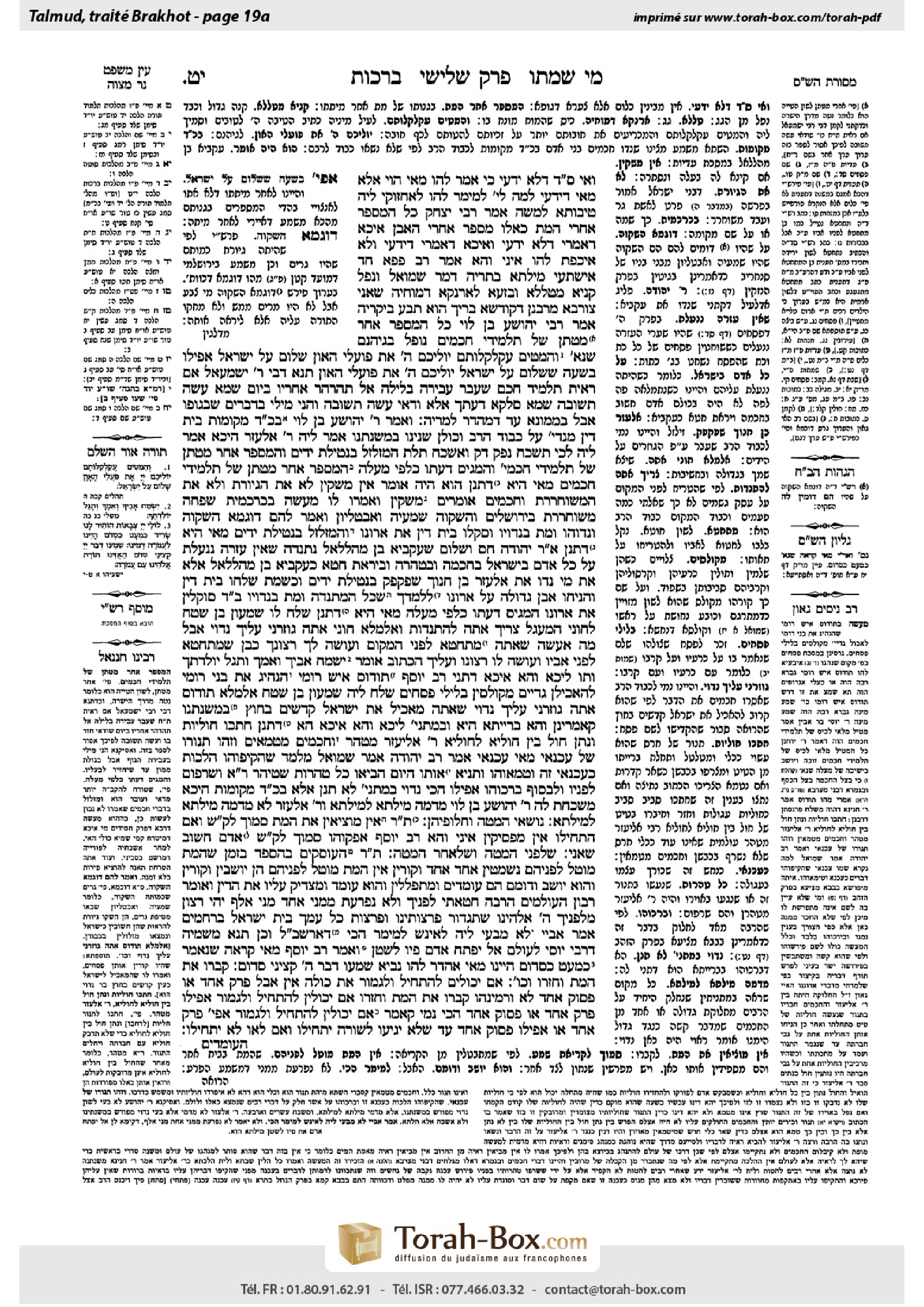
Berakhot 19a: Talmud study for Daf Yomi
Study the Talmud for Daf Yomi with scanned pages, Hebrew text, English translations from Sefaria and AI-generated French translations.
Passage selection and English or AI-generated French translation are available where the scan has annotations. Daf Study is independent of Torah-Box and Sefaria.
Browse Berakhot · ברכות · All tractatesBerakhot 19a text and translations
This page of Berakhot includes the Aramaic text, an English translation and an AI-generated French translation, alongside the scan above.
ברכות י״ט א · Aramaic and Hebrew text
וְאִי סָלְקָא דַעְתָּךְ דְּלָא יָדְעִי, כִּי אָמַר לְהוּ מַאי הָוֵי? אֶלָּא מַאי — דְּיָדְעִי? לְמָה לֵיהּ לְמֵימַר לְהוּ?! לְאַחְזוֹקֵי לֵיהּ טֵיבוּתָא לְמֹשֶׁה.
אָמַר רַבִּי יִצְחָק: כׇּל הַמְסַפֵּר אַחֲרֵי הַמֵּת, כְּאִלּוּ מְסַפֵּר אַחֲרֵי הָאֶבֶן. אִיכָּא דְאָמְרִי דְּלָא יָדְעִי, וְאִיכָּא דְאָמְרִי דְּיָדְעִי וְלָא אִיכְפַּת לְהוּ.
אִינִי?! וְהָא אָמַר רַב פָּפָּא: חַד אִישְׁתַּעִי מִילְּתָא בָּתְרֵיהּ דְּמָר שְׁמוּאֵל וּנְפַל קַנְיָא מִטְּלָלָא וּבְזַעָא לְאַרְנְקָא דְמוֹחֵיהּ!
שָׁאנֵי צוֹרְבָא מֵרַבָּנָן, דְּקוּדְשָׁא בְּרִיךְ הוּא תָּבַע בִּיקָרֵיהּ.
אָמַר רַבִּי יְהוֹשֻׁעַ בֶּן לֵוִי: כׇּל הַמְסַפֵּר אַחַר מִטָּתָן שֶׁל תַּלְמִידֵי חֲכָמִים נוֹפֵל בְּגֵיהִנָּם, שֶׁנֶּאֱמַר: ״וְהַמַּטִּים עֲקַלְקַלּוֹתָם יוֹלִיכֵם ה׳ אֶת פּוֹעֲלֵי הָאָוֶן שָׁלוֹם עַל יִשְׂרָאֵל״. אֲפִילּוּ בְּשָׁעָה שֶׁשָּׁלוֹם עַל יִשְׂרָאֵל, ״יוֹלִיכֵם ה׳ אֶת פּוֹעֲלֵי הָאָוֶן״.
תָּנָא דְּבֵי רַבִּי יִשְׁמָעֵאל: אִם רָאִיתָ תַּלְמִיד חָכָם שֶׁעָבַר עֲבֵירָה בַּלַּיְלָה — אַל תְּהַרְהֵר אַחֲרָיו בַּיּוֹם, שֶׁמָּא עָשָׂה תְּשׁוּבָה. ״שֶׁמָּא״ סָלְקָא דַעְתָּךְ? אֶלָּא וַדַּאי עָשָׂה תְּשׁוּבָה. וְהָנֵי מִילֵּי — בִּדְבָרִים שֶׁבְּגוּפוֹ. אֲבָל בְּמָמוֹנָא — עַד דְּמַהְדַּר לְמָרֵיהּ.
וְאָמַר רַבִּי יְהוֹשֻׁעַ בֶּן לֵוִי: בְּעֶשְׂרִים וְאַרְבָּעָה מְקוֹמוֹת בֵּית דִּין מְנַדִּין עַל כְּבוֹד הָרַב, וְכוּלָּן שָׁנִינוּ בְּמִשְׁנָתֵנוּ. אֲמַר לֵיהּ רַבִּי אֶלְעָזָר: הֵיכָא? אֲמַר לֵיהּ: לְכִי תַּשְׁכַּח.
נְפַק דָּק, וְאַשְׁכַּח תְּלָת: הַמְזַלְזֵל בִּנְטִילַת יָדַיִם, וְהַמְסַפֵּר אַחַר מִטָּתָן שֶׁל תַּלְמִידֵי חֲכָמִים, וְהַמֵּגִיס דַּעְתּוֹ כְּלַפֵּי מַעְלָה.
״הַמְסַפֵּר אַחַר מִטָּתָן שֶׁל תַּלְמִידֵי חֲכָמִים״ מַאי הִיא? — דִּתְנַן: הוּא הָיָה אוֹמֵר: אֵין מַשְׁקִין לֹא אֶת הַגִּיּוֹרֶת, וְלֹא אֶת הַמְשׁוּחְרֶרֶת. וַחֲכָמִים אוֹמְרִים: מַשְׁקִין. וְאָמְרוּ לוֹ: מַעֲשֶׂה בְּכַרְכְּמִית, שִׁפְחָה מְשׁוּחְרֶרֶת בִּירוּשָׁלַיִם וְהִשְׁקוּהָ שְׁמַעְיָה וְאַבְטַלְיוֹן! וְאָמַר לָהֶם: דּוּגְמָא הִשְׁקוּהָ — וְנִדּוּהוּ וּמֵת בְּנִדּוּיוֹ, וְסָקְלוּ בֵּית דִּין אֶת אֲרוֹנוֹ.
״וְהַמְזַלְזֵל בִּנְטִילַת יָדַיִם״ מַאי הִיא? — דִּתְנַן, אָמַר רַבִּי יְהוּדָה: חַס וְשָׁלוֹם שֶׁעֲקַבְיָא בֶּן מַהֲלַלְאֵל נִתְנַדָּה, שֶׁאֵין עֲזָרָה נִנְעֶלֶת עַל כׇּל אָדָם בְּיִשְׂרָאֵל בְּחׇכְמָה וּבְטׇהֳרָה וּבְיִרְאַת חֵטְא כַּעֲקַבְיָא בֶּן מַהֲלַלְאֵל. אֶלָּא אֶת מִי נִדּוּ? — אֶת אֶלְעָזָר בֶּן חֲנוֹךְ שֶׁפִּקְפֵּק בִּנְטִילַת יָדַיִם. וּכְשֶׁמֵּת, שָׁלְחוּ בֵּית דִּין וְהִנִּיחוּ אֶבֶן גְּדוֹלָה עַל אֲרוֹנוֹ, לְלַמֶּדְךָ שֶׁכָּל הַמִּתְנַדֶּה וּמֵת בְּנִדּוּיוֹ — בֵּית דִּין סוֹקְלִין אֶת אֲרוֹנוֹ.
״הַמֵּגִיס דַּעְתּוֹ כְּלַפֵּי מַעְלָה״ מַאי הִיא? — דִּתְנַן, שָׁלַח לוֹ שִׁמְעוֹן בֶּן שֶׁטַח לְחוֹנִי הַמְעַגֵּל: צָרִיךְ אַתָּה לְהִתְנַדּוֹת, וְאִלְמָלֵא חוֹנִי אַתָּה גּוֹזְרַנִי עָלֶיךָ נִדּוּי, אֲבָל מָה אֶעֱשֶׂה שֶׁאַתָּה מִתְחַטֵּא לִפְנֵי הַמָּקוֹם וְעוֹשֶׂה לְךָ רְצוֹנְךָ, כְּבֵן שֶׁמִּתְחַטֵּא לִפְנֵי אָבִיו וְעוֹשֶׂה לוֹ רְצוֹנוֹ. וְעָלֶיךָ הַכָּתוּב אוֹמֵר: ״יִשְׂמַח אָבִיךָ וְאִמֶּךָ וְתָגֵל יוֹלַדְתֶּךָ״.
וְתוּ לֵיכָּא? וְהָא אִיכָּא דְּתָנֵי רַב יוֹסֵף: תּוֹדוֹס אִישׁ רוֹמִי הִנְהִיג אֶת בְּנֵי רוֹמִי לְהַאֲכִילָן גְּדָיִים מְקוּלָּסִין בְּלֵילֵי פְּסָחִים. שְׁלַח לֵיהּ שִׁמְעוֹן בֶּן שָׁטַח: אִלְמָלֵא תּוֹדוֹס אַתָּה, גּוֹזְרַנִי עָלֶיךָ נִדּוּי, שֶׁאַתָּה מַאֲכִיל אֶת יִשְׂרָאֵל קׇדָשִׁים בַּחוּץ.
״בְּמִשְׁנָתֵנוּ״ קָאָמְרִינַן. וְהָא, בָּרַיְיתָא הִיא.
וּבְמַתְנִיתִין לֵיכָּא? וְהָא אִיכָּא הָא דִתְנַן: חֲתָכוֹ חוּלְיוֹת וְנָתַן חוֹל בֵּין חוּלְיָא לְחוּלְיָא — רַבִּי אֱלִיעֶזֶר מְטַהֵר, וַחֲכָמִים מְטַמְּאִים. וְזֶהוּ תַּנּוּרוֹ שֶׁל עַכְנַאי.
מַאי ״עַכְנַאי״? אָמַר רַב יְהוּדָה אָמַר שְׁמוּאֵל: מְלַמֵּד שֶׁהִקִּיפוּהוּ הֲלָכוֹת כְּעַכְנַאי זֶה, וְטִמְּאוּהוּ.
וְתַנְיָא: אוֹתוֹ הַיּוֹם הֵבִיאוּ כׇּל טְהָרוֹת שֶׁטִּיהֵר רַבִּי אֱלִיעֶזֶר וּשְׂרָפוּם לְפָנָיו, וּלְבַסּוֹף בֵּרְכוּהוּ.
אֲפִילּוּ הָכִי, נִדּוּי בְּמַתְנִיתִין לָא תְּנַן. אֶלָּא ״בְּעֶשְׂרִים וְאַרְבָּעָה מְקוֹמוֹת״ הֵיכָא מַשְׁכַּחַתְּ לַהּ? רַבִּי יְהוֹשֻׁעַ בֶּן לֵוִי מְדַמֵּה מִילְּתָא לְמִילְּתָא, וְרַבִּי אֶלְעָזָר לָא מְדַמֵּה מִילְּתָא לְמִילְּתָא.
נוֹשְׂאֵי הַמִּטָּה וְחִלּוּפֵיהֶן. תָּנוּ רַבָּנַן אֵין מוֹצִיאִין אֶת הַמֵּת סָמוּךְ לִקְרִיאַת שְׁמַע. וְאִם הִתְחִילוּ — אֵין מַפְסִיקִין. אִינִי?! וְהָא רַב יוֹסֵף אַפְּקוּהוּ סָמוּךְ לִקְרִיאַת שְׁמַע! אָדָם חָשׁוּב שָׁאנֵי.
שֶׁלִּפְנֵי הַמִּטָּה וְשֶׁלְּאַחַר הַמִּטָּה. תָּנוּ רַבָּנַן: הָעוֹסְקִים בְּהֶסְפֵּד, בִּזְמַן שֶׁהַמֵּת מוּטָל לִפְנֵיהֶם נִשְׁמָטִין אֶחָד אֶחָד וְקוֹרִין. אֵין הַמֵּת מוּטָל לִפְנֵיהֶם, הֵן יוֹשְׁבִין וְקוֹרִין, וְהוּא יוֹשֵׁב וְדוֹמֵם. הֵם עוֹמְדִים וּמִתְפַּלְּלִין, וְהוּא עוֹמֵד וּמַצְדִּיק עָלָיו אֶת הַדִּין, וְאוֹמֵר: ״רִבּוֹן הָעוֹלָמִים, הַרְבֵּה חָטָאתִי לְפָנֶיךָ, וְלֹא נִפְרַעְתָּ מִמֶּנִּי אֶחָד מִנִּי אֶלֶף, יְהִי רָצוֹן מִלְּפָנֶיךָ ה׳ אֱלֹהֵינוּ, שֶׁתִּגְדּוֹר פִּרְצוֹתֵינוּ וּפִרְצוֹת כׇּל עַמְּךָ בֵּית יִשְׂרָאֵל בְּרַחֲמִים״.
אָמַר אַבָּיֵי: לָא מִבְּעֵי לֵיהּ לְאִינָשׁ לְמֵימַר הָכִי, דְּאָמַר רַבִּי שִׁמְעוֹן בֶּן לָקִישׁ, וְכֵן תָּנָא מִשְּׁמֵיהּ דְּרַבִּי יוֹסֵי: לְעוֹלָם אַל יִפְתַּח אָדָם פִּיו לַשָּׂטָן.
וְאָמַר רַב יוֹסֵף: מַאי קְרָאָה — שֶׁנֶּאֱמַר: ״כִּמְעַט כִּסְדוֹם הָיִינוּ״, מַאי אַהֲדַר לְהוּ נָבִיא — ״שִׁמְעוּ דְבַר ה׳ קְצִינֵי סְדוֹם״.
קָבְרוּ אֶת הַמֵּת וְחָזְרוּ וְכוּ׳. אִם יְכוֹלִים לְהַתְחִיל וְלִגְמוֹר אֶת כּוּלָּהּ אִין, אֲבָל פֶּרֶק אֶחָד אוֹ פָּסוּק אֶחָד — לָא. וּרְמִינְהוּ: קָבְרוּ אֶת הַמֵּת וְחָזְרוּ, אִם יְכוֹלִין לְהַתְחִיל וְלִגְמוֹר אֲפִילּוּ פֶּרֶק אֶחָד אוֹ פָּסוּק אֶחָד!
הָכִי נָמֵי קָאָמַר: אִם יְכוֹלִין לְהַתְחִיל וְלִגְמוֹר אֲפִילּוּ פֶּרֶק אֶחָד אוֹ אֲפִילּוּ פָּסוּק אֶחָד עַד שֶׁלֹּא יַגִּיעוּ לַשּׁוּרָה — יַתְחִילוּ, וְאִם לָאו — לֹא יַתְחִילוּ.
Berakhot 19a · English translation
And if it should enter your mind that the dead do not know, then what of it if he tells them? The Gemara rejects this: Rather what will you say, that they know? Then why does he need to tell them? The Gemara replies: This is not difficult, as he is telling them so that they will give credit to Moses.
On this subject, Rabbi Yitzḥak said: Anyone who speaks negatively after the deceased it is as if he speaks after the stone. The Gemara offers two interpretations of this: Some say this is because the dead do not know, and some say that they know, but they do not care that they are spoken of in such a manner.
The Gemara asks: Is that so? Didn’t Rav Pappa say: There was once someone who spoke disparagingly after the death of Mar Shmuel and a reed fell from the ceiling, fracturing his skull? Obviously, the dead care when people speak ill of them.
The Gemara rejects this: This is no proof that the dead care. Rather, a Torah scholar is different, as God Himself demands that his honor be upheld.
Rabbi Yehoshua ben Levi said similarly: One who speaks disparagingly after the biers of Torah scholars and maligns them after their death will fall in Gehenna, as it is stated: “But those who turn aside unto their crooked ways, the Lord will lead them away with the workers of iniquity; peace be upon Israel” (Psalms 125:5). Even if he speaks ill of them when there is peace upon Israel, after death, when they are no longer able to fight those denouncing them (Tosafot); nevertheless the Lord will lead them away with the workers of iniquity, to Gehenna.
On a similar note, it was taught in the school of Rabbi Yishmael: If you saw a Torah scholar transgress a prohibition at night, do not think badly of him during the day; perhaps he has repented in the meantime. The Gemara challenges this: Does it enter your mind that only perhaps he has repented? Shouldn’t he be given the benefit of the doubt? Rather, he has certainly repented. The Gemara notes: The idea that one must always give a Torah scholar the benefit of the doubt and assume that he has repented refers specifically to matters affecting himself, but, if one witnesses a Torah scholar committing a transgression involving the property of another, one is not required to give him the benefit of the doubt. Rather, he should not assume that he has repented until he sees him return the money to its owner.
Since matters relating to the respect due Torah scholars were raised, the Gemara continues, citing Rabbi Yehoshua ben Levi, who said: There are twenty-four places in which the court ostracizes over matters of respect due the rabbi, and we learned them all in our Mishna. Rabbi Elazar said to him: Where are those cases to be found? Rabbi Yehoshua ben Levi said to him: When you look, you will find them.
He went out, analyzed, and found three examples: One who demeans the ritual of washing of the hands, one who speaks disparagingly after the bier of Torah scholars, and one who is arrogant vis-à-vis Heaven. The Gemara cites sources for each of these cases.
What is the source for one who speaks disparagingly after the biers of Torah scholars? As we learned in the mishna: Akavya ben Mahalalel would say: In the case of a woman whose husband suspects her of adultery, who was warned by her husband not to seclude herself with another man and she did not listen (see Numbers 5), the court does not administer the bitter water potion of a sota to a convert or an emancipated maidservant. And the Rabbis say: The court administers the bitter water potion to them. And the Rabbis said to him as proof: There is the story of Kharkemit, an emancipated maidservant in Jerusalem, and Shemaya and Avtalyon administered her the bitter waters. Akavya ben Mahalalel said to the Sages: That is no proof. Shemaya and Avtalyon, who were also from families of converts, required the maidservant to drink the potion because she was like them [dugma]. And since Akavya ben Mahalalel cast aspersion on the deceased Torah scholars, he was ostracized and died while he was still under the ban of ostracism. And in accordance with the halakha with regard to one who dies while under a ban of ostracism, the court stoned his coffin. Apparently, one who deprecates a deceased Torah scholar is sentenced to ostracism.
And what is the source for one who demeans the ritual of washing of the hands? We learned later in the same mishna: Rabbi Yehuda said: That story related with regard to the ostracism of Akavya ben Mahalalel is completely untrue; God forbid that Akavya ben Mahalalel was ostracized, as the Temple courtyard is not closed on any Jew, meaning that even when all of Israel made the pilgrimage to Jerusalem, when each of the three groups that gathered to offer the Paschal lamb filled the courtyard, leading the Temple administration to close the courtyard, there was no one there as perfect in wisdom, purity and fear of sin as Akavya ben Mahalalel. Rather, whom did they excommunicate? Elazar ben Ḥanokh, because he doubted and demeaned the rabbinic ordinance of washing of the hands. And when he died, the court sent instructions and they placed a large rock upon his coffin in order to teach you that one who is ostracized and dies in a state of ostracism, the court stones his coffin, as if symbolically stoning him. Apparently, one who makes light of the ritual of washing of the hands is sentenced to ostracism.
What is the source for the third case, one who is arrogant vis-à-vis Heaven? The mishna relates that Ḥoni HaMe’aggel, the circle-drawer, drew a circle and stood inside it, and said that he would not leave the circle until it rained, and he went so far as to make demands in terms of the manner in which he wanted the rain to fall. After it rained, Shimon ben Shataḥ, the Nasi of the Sanhedrin, relayed to Ḥoni HaMe’aggel: Actually, you should be ostracized for what you said, and if you were not Ḥoni, I would have decreed ostracism upon you, but what can I do? You nag God and He does your bidding, like a son who nags his father and his father does his bidding without reprimand. After all, the rain fell as you requested. About you, the verse states: “Your father and mother will be glad and she who bore you will rejoice” (Proverbs 23:25). Apparently, one who is arrogant vis-à-vis Heaven would ordinarily merit excommunication.
The Gemara challenges this: And are there no more cases of excommunication or threats of excommunication? Surely there are additional cases like the one in the baraita taught by Rav Yosef: It is told that Theodosius of Rome, leader of the Jewish community there, instituted the custom for the Roman Jews to eat whole kids, young goats roasted with their entrails over their heads, as was the custom when roasting the Paschal lamb, on the eve of Passover, as they did in the Temple. Shimon ben Shataḥ sent a message to him: If you were not Theodosius, an important person, I would have decreed ostracism upon you, as it appears as if you are feeding Israel consecrated food, which may only be eaten in and around the Temple itself, outside the Temple.
The Gemara responds: This case should not be included, as Rabbi Yehoshua ben Levi said that there were twenty-four cases in our Mishna, and this is merely a baraita.
The Gemara asks: And are there none in the Mishna? Isn’t there that which we learned in the mishna: One who cut an earthenware oven horizontally into ring-shaped pieces and put sand between the pieces, Rabbi Eliezer deems the oven ritually pure, i.e., it is no longer susceptible to ritual impurity. He holds that, although the fragments of the oven were pieced together, it is not considered an intact vessel but, rather, as a collection of fragments, and a broken earthenware vessel cannot become ritually impure. And the Rabbis deem it ritually impure. Since the oven continues to serve its original function, it is still considered a single entity and a whole vessel despite the sand put between the pieces. And this is called the oven of akhnai, snake.
The Gemara asks: What is the meaning of oven of the snake? Rav Yehuda said that Shmuel said: It is called snake to teach that the Rabbis surrounded Rabbi Eliezer with halakhot and proofs like a snake surrounds its prey, and declared the oven and its contents ritually impure.
And it was taught in a baraita: On that day, they gathered all of the ritually pure food items that had come into contact with the oven that Rabbi Eliezer had declared ritually pure, and burned them before him, and because he did not accept the decision of the majority, in the end they “blessed,” a euphemism for ostracized, him. This is another case that ended in ostracism.
The Gemara answers: Even so, we did not learn the ruling with regard to his ostracism in the mishna. The Gemara asks: Then where do you find the twenty-four places mentioned in Rabbi Yehoshua ben Levi’s statement? The Gemara responds: Rabbi Yehoshua ben Levi likens one matter to another similar matter. Whenever he would encounter a case in a mishna where one of the Sages expressed himself inappropriately in reference to other Sages, he concluded that they should have been excommunicated. Rabbi Elazar does not liken one matter to another similar matter, and therefore located only three explicit cases of ostracism.
We learned in the mishna that the pallbearers and their replacements are exempt from the recitation of Shema. On this subject, the Gemara cites that which the Sages taught in a baraita: The deceased may not be taken out to be buried adjacent to the time for the recitation of Shema, but should be buried later. And if they already started to take him out, they need not stop in order to recite Shema. The Gemara challenges: Is that so? Didn’t they take Rav Yosef out to be buried adjacent to the time for the recitation of Shema? The Gemara resolves this contradiction: The case of an important person is different, and they are more lenient in order to honor him at his burial.
In the mishna, we learned the halakha with regard to the pallbearers and their obligation to recite Shema, and a distinction was made between those who are before the bier and those after the bier. Our Rabbis taught in a baraita: Those involved in eulogy must slip away from the eulogy one by one while the deceased is laid out before them and recite Shema elsewhere. And if the deceased is not laid out before them, the eulogizers must sit and recite Shema while the bereaved sits silently. They stand and pray and he stands and justifies God’s judgment, saying: Master of the Universe, I have sinned greatly against You, and You have not collected even one one-thousandth of my debt. May it be Your will, Lord our God, to mercifully repair the breaches in our fence and the breaches of Your nation, the House of Israel.
Abaye said: A person should not say that, as Rabbi Shimon ben Lakish said, and it was also taught in the name of Rabbi Yosei: One must never open his mouth to the Satan, i.e., one must not leave room for or raise the possibility of disaster or evil. This formula, which states that the entire debt owed due to his transgressions has not been collected, raises the possibility that further payment will be exacted from him.
And Rav Yosef said: What is the verse from which it is derived? As it is stated: “We should have almost been as Sodom, we should have been like unto Gomorrah” (Isaiah 1:9), after which what did the prophet reply to them? “Hear the word of the Lord, rulers of Sodom; give ear unto the law of our God, people of Gomorrah” (Isaiah 1:10).
We learned in the mishna that, in a case when they buried the deceased and returned, if they have sufficient time to begin to recite Shema and conclude before they arrive at the row formed by those who came to console the bereaved, they should begin. Here, the Gemara clarifies: This is the case only if they can begin and complete recitation of Shema in its entirety. However, if they can only complete one chapter or one verse, they should not stop to do so. The Gemara raises a contradiction from that which we learned in the baraita: After they buried the deceased and returned, if they can begin the recitation of Shema and finish even a single chapter or verse, they should begin.
The Gemara responds: That is also what the tanna of the mishna said and this is the conclusion drawn from his statement: If one can begin and conclude even one chapter or one verse before they arrive at the row of consolers, they should begin. And if not, they should not begin.
Berakhot 19a · Traduction française (IA)
Et si cela entre dans votre pensée que les morts ne savent pas, alors que faire si l'on leur dit cela ? La Guemara rejette cela : plutôt, que diriez-vous qu'ils sachent ? Alors pourquoi a-t-il besoin de leur parler ? La Guemara répond : cela n'est pas difficile, car il leur parle afin qu'ils reconnaissent Moïse.
Sur ce sujet, le Rabbi Yitzhak a dit : celui qui parle mal après la mort d'une personne est comme s'il parlait après la pierre. La Guemara offre deux interprétations de cela : certains disent cela parce que les morts ne savent pas, et d'autres disent qu'ils savent, mais qu'ils n'ont pas à s'intéresser à ce qu'on dit d'eux ainsi.
La Guemara demande : est-ce ainsi ? N'a-t-il pas dit Rav Pappa : il y avait une fois quelqu'un qui a parlé mal de Mar Shmuel après sa mort et une canne est tombée du plafond, fracturant sa tête ? Évidemment, les morts s'occupent quand les gens parlent mal d'eux.
La Guemara rejette cela : cela n'est pas une preuve que les morts s'occupent. Plutôt, un savant de la Torah est différent, car Dieu lui-même exige que son honneur soit préservé.
Le Rabbi Yéhoshua ben Levi a dit de même : celui qui parle mal après les cercueils des savants de la Torah et qui les calomnie après leur mort tombera en Géhenna, car il est dit : « Mais ceux qui s'écartent de leurs voies tortueuses, l'Éternel les conduira avec les ouvriers des méfaits ; la paix soit sur Israël » (Psaumes 125:5). Même s'il parle mal d'eux lorsqu'il y a la paix sur Israël, après leur mort, lorsqu'ils ne peuvent plus combattre ceux qui les dénigrent (Tosafot) ; néanmoins l'Éternel les conduira avec les ouvriers des méfaits, vers Géhenna.
Sur un point similaire, il a été enseigné dans l'école du Rabbi Yishmael : si vous avez vu un savant de la Torah transgresser une interdiction la nuit, ne pensez pas mal de lui le jour ; peut-être a-t-il déjà repenti en attendant. La Guemara conteste cela : entre dans votre pensée que peut-être il a repenti ? Ne devrait-il pas être donné le bénéfice du doute ? Plutôt, il a certainement repenti. La Guemara note : l'idée que l'on doit toujours donner le bénéfice du doute à un savant de la Torah et supposer qu'il a repenti concerne spécifiquement les choses qui concernent lui-même, mais, si l'on témoin d'un savant de la Torah commettre une transgression concernant la propriété d'autrui, on n'est pas tenu de lui donner le bénéfice du doute. Plutôt, on ne devrait pas supposer qu'il a repenti jusqu'à ce qu'on le voie rendre l'argent à son propriétaire.
Puisque les questions relatives au respect dû aux savants de la Torah ont été soulevées, la Guemara continue, citant le Rabbi Yéhoshua ben Levi, qui a dit : il y a vingt-quatre cas dans lesquels le tribunal excommunie en raison du respect dû au rabbin, et nous avons appris tous ceux-ci dans notre Michna. Le Rabbi Eléazar lui a demandé : où sont ces cas à trouver ? Le Rabbi Yéhoshua ben Levi lui a répondu : quand tu regardes, tu les trouveras.
Il est sorti, a analysé et a trouvé trois exemples : celui qui dénigre la cérémonie du lavement des mains, celui qui parle mal après les cercueils des savants de la Torah, et celui qui est arrogant vis-à-vis du Royaume des Cieux. La Guemara cite des sources pour chacun de ces cas.
Quelle est la source pour celui qui parle mal après les cercueils des savants de la Torah ? Comme nous l'avons appris dans la mishna : Akavya ben Mahalalel disait : dans le cas d'une femme dont l'époux soupçonne son adultère, qui a été avertie par son époux de ne pas se retirer avec un autre homme et qui n'a pas écouté (voir Nombres 5), la cour ne donne pas la potion amère à un converti ou à une servante émancipée. Et les Rabbins disent : la cour donne la potion amère à eux. Et les Rabbins lui ont répondu comme preuve : il y a l'histoire de Kharkemit, une servante émancipée à Jérusalem, et Shemaya et Avtalyon lui ont administré la potion amère. Akavya ben Mahalalel a dit aux Sages : cela n'est pas une preuve. Shemaya et Avtalyon, qui étaient également issus de familles de convertis, ont exigé que la servante boive la potion car elle était comme eux [dugma]. Et puisque Akavya ben Mahalalel a diffamé les savants de la Torah décédés, il a été excommunié et est mort alors qu'il était encore sous le ban d'excommunication. Et selon la halakha concernant celui qui meurt sous un ban d'excommunication, la cour jette un caillou sur son cercueil. Apparemment, celui qui dénigre un savant de la Torah décédé est condamné à l'excommunication.
Et quelle est la source pour celui qui dénigre la cérémonie du lavement des mains ? Nous avons appris plus tard dans la même mishna : Rabbi Yéhuda a dit : cette histoire concernant l'excommunication d'Akavya ben Mahalalel est totalement fausse ; il est interdit que Akavya ben Mahalalel ait été excommunié, car le cour d'honneur du Temple n'est pas fermé pour aucun Juif, ce qui signifie que même quand tout Israël est venu à Jérusalem pour le pèlerinage, quand chaque groupe des trois qui se sont réunis pour offrir l'Agneau Pascal a rempli le cour, entraînant la fermeture du cour par la direction du Temple, il n'y avait personne là qui était aussi parfait en sagesse, pureté et crainte du péché que Akavya ben Mahalalel. Plutôt, à qui ont-ils excommunié ? Elazar ben Hanokh, parce qu'il doute et dénigre l'ordonnance rabbinique du lavement des mains. Et quand il est mort, la cour a envoyé des instructions et ils ont placé une grande pierre sur son cercueil afin de vous enseigner que celui qui est excommunié et meurt sous l'excommunication, la cour jette un caillou sur son cercueil, comme si on le pierre symboliquement. Apparemment, celui qui fait moindre de la cérémonie du lavement des mains est condamné à l'excommunication.
Quelle est la source du troisième cas, celui qui est arrogant vis-à-vis du Ciel ? La Michna rapporte que Choni HaMe'aggel, le dessinateur de cercle, a tracé un cercle et s'est placé à l'intérieur, et a dit qu'il ne quitterait pas le cercle jusqu'à ce qu'il pleuve, et il a même fait des exigences en ce qui concerne la manière dont il voulait que la pluie tombe. Après que la pluie soit tombée, Shim'on ben Shataḥ, le Nasi du Sanhédrin, a transmis à Choni HaMe'aggel : En réalité, tu devrais être mis à l'isolement pour ce que tu as dit, et si tu n'étais pas Choni, je l'aurais décrété moi-même, mais que puis-je faire ? Tu importunes Dieu et Il fait ce que tu demandes, comme un fils qui importune son père et ce dernier fait ce que le fils demande sans réprimande. En effet, la pluie est tombée comme tu l'avais demandé. À ton sujet, la Parashia dit : « Votre père et votre mère seront heureux et celle qui t'a porté sera joyeuse » (Proverbes 23:25). Apparemment, celui qui est arrogant vis-à-vis du Ciel mériterait normalement l'excommunication.
La Guemara remet en question cela : Et n'y a-t-il pas d'autres cas d'excommunication ou de menaces d'excommunication ? Il y a certainement d'autres cas comme celui du baraïta rapporté par R. Yosef : On raconte que Théodose de Rome, chef de la communauté juive là-bas, a institué la coutume pour les Juifs romains de manger des agnels entiers, des jeunes boucs cuits avec leurs entrailles sur leur tête, comme c'était la coutume lors de la cuisson de l'agneau pascal, la veille de Pâque, comme ils le faisaient dans le Temple. Shim'on ben Shataḥ a envoyé un message à lui : Si tu n'étais pas Théodose, une personne importante, je l'aurais décrété moi-même, car cela semble comme si tu nourrissais Israël avec des aliments consacrés, qui ne peuvent être mangés qu'à l'intérieur et autour du Temple lui-même.
La Guemara répond : Ce cas ne devrait pas être inclus, car R. Yehoshua ben Levi a dit qu'il y avait vingt-quatre cas dans notre Michna, et cela est simplement un baraïta.
La Guemara demande : Et n'y a-t-il pas de cas dans la Michna ? N'est-ce pas ce que nous avons appris dans la Michna : Celui qui a coupé une fournaise en terre horizontalement en morceaux annelés et a mis du sable entre les morceaux, R. Eliezer considère la fournaise comme pure, c'est-à-dire qu'elle n'est plus susceptible de devenir impure rituellement. Il considère que, bien que les fragments de la fournaise aient été réunis, elle n'est pas considérée comme un vase intact mais plutôt comme une collection de fragments, et un vase en terre brisé ne peut pas devenir impur rituellement. Et les Rabbins considèrent qu'elle est impure. Puisque la fournaise continue à servir sa fonction originale, elle est encore considérée comme un seul entité et un vase entier malgré le sable mis entre les morceaux. Et cela s'appelle la fournaise d'Akhnai, serpent.
La Guemara demande : Quelle est la signification de la fournaise du serpent ? R. Yehuda a dit que Shmuel a dit : On l'appelle serpent pour enseigner que les Rabbins ont entouré R. Eliezer avec des halakhot et des preuves comme un serpent entoure sa proie, et ont déclaré la fournaise et ses contenants impurs rituellement.
Et il a été enseigné dans une baraïta : Ce jour-là, ils ont rassemblé tous les aliments rituellement purs qui avaient été en contact avec la fournaise que R. Eliezer avait déclaré pure, et ils l'ont brûlé devant lui, et parce qu'il n'acceptait pas la décision de la majorité, à la fin ils l'ont « béni », un euphémisme pour l'isolement. C'est un autre cas qui a pris fin par l'isolement.
La Guemara répond : Même ainsi, nous n'avons pas appris la décision concernant son isolement dans la Michna. La Guemara demande : Alors où trouves-tu les vingt-quatre endroits mentionnés dans l'affirmation de R. Yehoshua ben Levi ? La Guemara répond : R. Yehoshua ben Levi compare une affaire à une autre similaire. Quand il rencontrait un cas dans une Michna où l'un des Sages s'exprimait inappropriément en référence à d'autres Sages, il concluait qu'ils devraient être excommuniés. R. Elazar ne compare pas une affaire à une autre similaire, et par conséquent a trouvé seulement trois cas explicites d'isolement.
Nous avons appris dans la Michna que les porteurs de cercueil et leurs remplaçants sont exemptés de la récitation du Chéma. Sur ce sujet, la Guemara cite ce que les Sages ont enseigné dans un baraïta : Le défunt ne doit pas être emporté pour être enterré à proximité du moment de la récitation du Chéma, mais doit être enterré plus tard. Et si ils ont déjà commencé à l'emporter, ils n'ont pas besoin de s'arrêter pour réciter le Chéma. La Guemara remet en question : Est-ce ainsi ? N'ont-ils pas emporté R. Yosef pour être enterré à proximité du moment de la récitation du Chéma ? La Guemara résout ce paradoxe : Le cas d'une personne importante est différent, et ils sont plus tolérants pour honorer sa sépulture.
Dans la Michna, nous avons appris la halakha concernant les porteurs de cercueil et leur obligation de réciter le Chéma, et une distinction a été faite entre ceux qui sont devant le cercueil et ceux qui sont derrière. Nos Rabbins ont enseigné dans un baraïta : Ceux qui participent à l'office funéraire doivent s'éloigner un par un pendant que le défunt est allongé devant eux et réciter le Chéma ailleurs. Et si le défunt n'est pas allongé devant eux, les orateurs doivent s'asseoir et réciter le Chéma pendant que les veufs restent silencieux. Ils se lèvent et prieront et il se lève et justifie le jugement de Dieu, disant : Seigneur notre Dieu, mon Maître, j'ai péché grandement contre Toi, et Tu n'as pas recueilli même un dixième de ma dette. Que Ta volonté soit ainsi, Seigneur notre Dieu, pour mercifier les brèches de notre mur et les brèches de Ta nation, la Maison d'Israël.
Abaye a dit : Une personne ne devrait pas dire cela, comme Rabbi Shimon ben Lakish l'a dit, et cela a également été enseigné au nom de Rabbi Yosei : On ne doit jamais ouvrir sa bouche au Diable, c'est-à-dire qu'on ne doit pas laisser place ou évoquer la possibilité de malheur ou de mal. Cette formule, qui affirme que la dette entière due à ses transgressions n'a pas été recueillie, évoque la possibilité que d'autres paiements soient exigeés.
Et Rav Yosef a dit : De quel verset cela est-il dérivé ? Comme il est dit : « Nous aurions presque été comme Sodome, nous aurions été comme Gomorrah » (Michna 1:9), après quoi le prophète a-t-il répondu à eux ? « Écoutez la parole du Seigneur, chefs de Sodome ; écoutez la loi de notre Dieu, peuple de Gomorrah » (Michna 1:10).
Nous avons appris dans la Michna que, dans un cas où ils ont enterré le défunt et sont revenus, s'ils ont suffisamment de temps pour commencer à réciter le Chéma et le terminer avant d'arriver à la rangée formée par ceux qui sont venus consoler les veuves, ils devraient commencer. Ici, la Guemara clarifie : cela est valable uniquement s'ils peuvent commencer et terminer la récitation du Chéma dans son entier. Cependant, s'ils peuvent seulement terminer un chapitre ou une verset, ils ne devraient pas s'arrêter pour le faire. La Guemara soulève une contradiction avec ce que nous avons appris dans la baraïta : après avoir enterré le défunt et être revenus, s'ils peuvent commencer la récitation du Chéma et terminer même un seul chapitre ou verset, ils devraient commencer.
La Guemara répond : c'est aussi ce que disait le tanna de la Michna et c'est la conclusion tirée de son discours : si l'on peut commencer et terminer même un chapitre ou un verset avant d'arriver à la rangée des consolateurs, on devrait commencer. Et si ce n'est pas possible, on ne devrait pas commencer.
Traduction française générée par IA à partir de l’édition anglaise de Sefaria. Vérifie toujours un passage avec le texte source.
Text from Sefaria: William Davidson Edition - Vocalized Aramaic (CC BY NC); William Davidson Edition - English (CC BY NC).