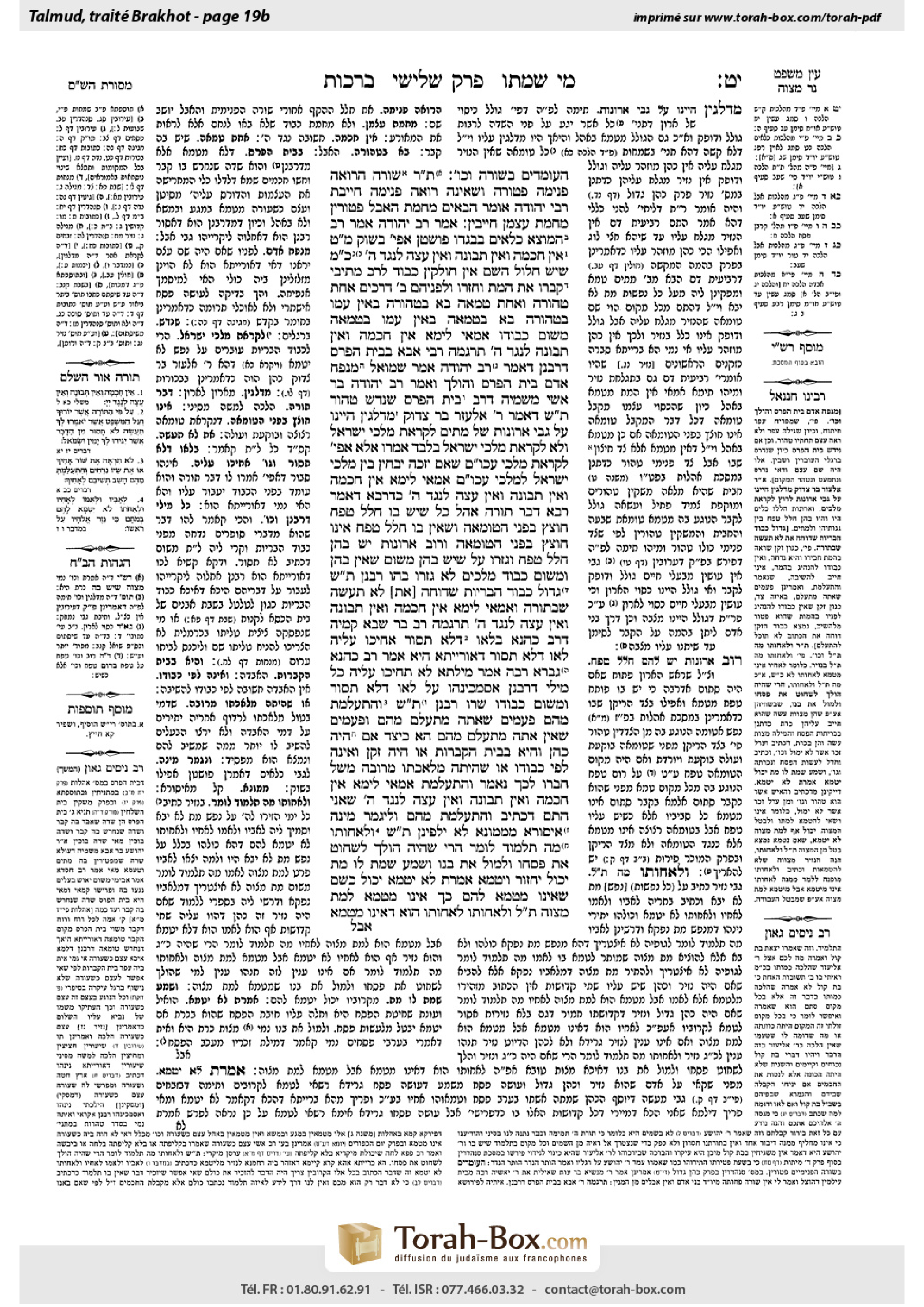
Berakhot 19b: Talmud study for Daf Yomi
Study the Talmud for Daf Yomi with scanned pages, Hebrew text, English translations from Sefaria and AI-generated French translations.
Passage selection and English or AI-generated French translation are available where the scan has annotations. Daf Study is independent of Torah-Box and Sefaria.
Browse Berakhot · ברכות · All tractatesBerakhot 19b text and translations
This page of Berakhot includes the Aramaic text, an English translation and an AI-generated French translation, alongside the scan above.
ברכות י״ט ב · Aramaic and Hebrew text
הָעוֹמְדִים בַּשּׁוּרָה וְכוּ׳. תָּנוּ רַבָּנַן: שׁוּרָה הָרוֹאָה פְּנִימָה — פְּטוּרָה, וְשֶׁאֵינָהּ רוֹאָה פְּנִימָה — חַיֶּיבֶת. רַבִּי יְהוּדָה אוֹמֵר: הַבָּאִים מֵחֲמַת הָאָבֵל — פְּטוּרִין, מֵחֲמַת עַצְמָן — חַיָּיבִין.
אָמַר רַב יְהוּדָה אָמַר רַב: הַמּוֹצֵא כִּלְאַיִם בְּבִגְדוֹ — פּוֹשְׁטָן אֲפִילּוּ בַּשּׁוּק. מַאי טַעְמָא: ״אֵין חׇכְמָה וְאֵין תְּבוּנָה וְאֵין עֵצָה לְנֶגֶד ה׳״, כׇּל מָקוֹם שֶׁיֵּשׁ חִלּוּל הַשֵּׁם אֵין חוֹלְקִין כָּבוֹד לָרַב.
מֵתִיבִי: קָבְרוּ אֶת הַמֵּת וְחָזְרוּ, וְלִפְנֵיהֶם שְׁתֵּי דְרָכִים, אַחַת טְהוֹרָה וְאַחַת טְמֵאָה, בָּא בַּטְּהוֹרָה — בָּאִין עִמּוֹ בַּטְּהוֹרָה, בָּא בַּטְּמֵאָה — בָּאִין עִמּוֹ בַּטְּמֵאָה מִשּׁוּם כְּבוֹדוֹ. אַמַּאי? לֵימָא ״אֵין חׇכְמָה וְאֵין תְּבוּנָה לְנֶגֶד ה׳״!
תַּרְגְּמַהּ רַבִּי אַבָּא בְּבֵית הַפְּרָס דְּרַבָּנַן.
דְּאָמַר רַב יְהוּדָה אָמַר שְׁמוּאֵל: מְנַפֵּחַ אָדָם בֵּית הַפְּרָס וְהוֹלֵךְ. וְאָמַר רַב יְהוּדָה בַּר אָשֵׁי מִשְּׁמֵיהּ דְּרַב: בֵּית הַפְּרָס שֶׁנִּדַּשׁ — טָהוֹר.
תָּא שְׁמַע דְּאָמַר רַבִּי אֶלְעָזָר בַּר צָדוֹק: מְדַלְּגִין הָיִינוּ עַל גַּבֵּי אֲרוֹנוֹת שֶׁל מֵתִים, לִקְרַאת מַלְכֵי יִשְׂרָאֵל. וְלֹא לִקְרַאת מַלְכֵי יִשְׂרָאֵל בִּלְבַד אָמְרוּ אֶלָּא אֲפִילּוּ לִקְרַאת מַלְכֵי אוּמּוֹת הָעוֹלָם, שֶׁאִם יִזְכֶּה, יַבְחִין בֵּין מַלְכֵי יִשְׂרָאֵל לְמַלְכֵי אוּמּוֹת הָעוֹלָם. אַמַּאי? לֵימָא ״אֵין חׇכְמָה וְאֵין תְּבוּנָה וְאֵין עֵצָה לְנֶגֶד ה׳״!
כִּדְרָבָא. דְּאָמַר רָבָא: דְּבַר תּוֹרָה, אֹהֶל, כֹּל שֶׁיֵּשׁ בּוֹ חָלָל טֶפַח — חוֹצֵץ בִּפְנֵי הַטּוּמְאָה. וְשֶׁאֵין בּוֹ חָלָל טֶפַח — אֵינוֹ חוֹצֵץ בִּפְנֵי הַטּוּמְאָה.
וְרוֹב אֲרוֹנוֹת יֵשׁ בָּהֶן חָלָל טֶפַח. וְגָזְרוּ עַל שֶׁיֵּשׁ בָּהֶן מִשּׁוּם שֶׁאֵין בָּהֶן. וּמִשּׁוּם כְּבוֹד מְלָכִים לָא גְזַרוּ בְּהוּ רַבָּנַן.
תָּא שְׁמַע: גָּדוֹל כְּבוֹד הַבְּרִיּוֹת שֶׁדּוֹחֶה [אֶת] לֹא תַעֲשֶׂה שֶׁבַּתּוֹרָה.
וְאַמַּאי? לֵימָא ״אֵין חׇכְמָה וְאֵין תְּבוּנָה וְאֵין עֵצָה לְנֶגֶד ה׳״! תַּרְגְּמַהּ רַב בַּר שְׁבָא קַמֵּיהּ דְּרַב כָּהֲנָא בְּלָאו דְּ״לֹא תָסוּר״. אֲחִיכוּ עֲלֵיהּ, לָאו דְּ״לֹא תָסוּר״ דְאוֹרָיְיתָא הִיא?!
אָמַר רַב כָּהֲנָא: גַּבְרָא רַבָּה אָמַר מִילְּתָא, לָא תְּחִיכוּ עֲלֵיהּ. כׇּל מִילֵּי דְרַבָּנַן אַסְמְכִינְהוּ עַל לָאו דְּ״לֹא תָסוּר״, וּמִשּׁוּם כְּבוֹדוֹ שְׁרוֹ רַבָּנַן.
תָּא שְׁמַע: ״וְהִתְעַלַּמְתָּ מֵהֶם״ — פְּעָמִים שֶׁאַתָּה מִתְעַלֵּם מֵהֶם, וּפְעָמִים שֶׁאֵין אַתָּה מִתְעַלֵּם מֵהֶם.
הָא כֵּיצַד? אִם הָיָה כֹּהֵן, וְהִיא בְּבֵית הַקְּבָרוֹת, אוֹ הָיָה זָקֵן וְאֵינָהּ לְפִי כְבוֹדוֹ, אוֹ שֶׁהָיְתָה מְלַאכְתּוֹ מְרוּבָּה מִשֶּׁל חֲבֵרוֹ, לְכָךְ נֶאֱמַר ״וְהִתְעַלַּמְתָּ״. אַמַּאי, לֵימָא ״אֵין חׇכְמָה וְאֵין תְּבוּנָה וְאֵין עֵצָה לְנֶגֶד ה׳״!
שָׁאנֵי הָתָם, דִּכְתִיב ״וְהִתְעַלַּמְתָּ מֵהֶם״. וְלִיגְמַר מִינַּהּ? אִיסּוּרָא מִמָּמוֹנָא לָא יָלְפִינַן.
תָּא שְׁמַע.
״וּלְאַחֹתוֹ״ מַה תַּלְמוּד לוֹמַר? הֲרֵי שֶׁהָיָה הוֹלֵךְ לִשְׁחוֹט אֶת פִּסְחוֹ, וְלָמוּל אֶת בְּנוֹ, וְשָׁמַע שֶׁמֵּת לוֹ מֵת, יָכוֹל יַחְזוֹר וְיִטַּמָּא? — אָמַרְתָּ: לֹא יִטַּמָּא.
יָכוֹל: כְּשֵׁם שֶׁאֵינוֹ מִטַּמֵּא לָהֶם כָּךְ אֵינוֹ מִטַּמֵּא לְמֵת מִצְוָה — תַּלְמוּד לוֹמַר ״וּלְאַחוֹתוֹ״ — לַאֲחוֹתוֹ הוּא דְּאֵינוֹ מִטַּמֵּא,
Berakhot 19b · English translation
We learned in the mishna that those standing in the row, those in the interior row, are exempt from reciting Shema and the others are obligated. The Sages taught this more expansively in the Tosefta: The consolers standing in a row from which one sees inside the area where the mourners are passing are exempt, and those standing in a row from which one does not see inside are obligated. And Rabbi Yehuda elaborates and says: The consolers standing in the row who come on account of the bereaved are exempt, while those who come on account of their own curiosity are obligated to recite Shema.
We learned that some who come to console the bereaved are exempt from Shema as a means of honoring the deceased. The Gemara expands the discussion to raise the general question: To what degree does preserving human dignity take precedence over mitzvot enumerated in the Torah? Rav Yehuda said that Rav said: One who discovers diverse kinds [kilayim], i.e., a prohibited mixture of wool and linen, in his garment, must remove them even in the public marketplace. He may not wait until he reaches home. What is the reason for this? As it is stated: “There is neither wisdom, nor understanding, nor counsel against the Lord” (Proverbs 21:30). From here, the general principle: Anywhere that there is desecration of the Lord’s name, one does not show respect to the teacher, is derived.
The Gemara cites several sources to challenge this principle. The Gemara raised an objection from a baraita: After they buried the deceased and returned, and on their way there are two paths before them, one ritually pure and one ritually impure, e.g., it passes through a cemetery, if the mourner comes on the pure path, they come with him on the pure path; if he comes on the impure path, all of the funeral participants accompany him on the impure path in order to show him respect. Why would they do this? Let us say here too that, “There is neither wisdom, nor understanding…against the Lord!”
Rabbi Abba explained that the baraita is referring to a path that passes through an area where there is uncertainty with regard to the location of a grave or a corpse [beit haperas]. For example, with regard to a field in which there is a grave that was plowed and no longer intact, the entire field is deemed impure due to concern that the plow scattered bones throughout the field. The field is impure only by rabbinic law but not according to Torah law. Since it is only prohibited by rabbinic law, one is permitted to walk through the field to show the mourner respect.
The Gemara cites proof that the legal status of a beit haperas is unlike the legal status of impurity by Torah law: Rav Yehuda said that Shmuel said: One who passes through a beit haperas may blow on the dust before taking each step, so that if there is a bone beneath the dust, he will expose it, avoid it, and walk. One may not rely on that method of examination with regard to impurity by Torah law. And Rav Yehuda bar Ashi said in the name of Rav: A beit haperas that has been trodden underfoot, creating a path, is pure, and one no longer need be concerned about bones. Clearly, the entire prohibition is a stringency decreed by the Sages.
The Gemara cites additional proof with regard to the extent to which human dignity overrides mitzvot in the Torah. Come and hear, as Rabbi Elazar bar Tzadok the priest said: I and my fellow priests would jump over coffins of the deceased in order to hurry towards kings of Israel to greet them. And they did not say this only towards kings of Israel, but they said this even towards kings of the nations of the world, so that if one will be privileged to witness the redemption of Israel, he will distinguish between kings of Israel and kings of the nations of the world. The priest violated the Torah prohibition to become ritually impure through contact with the dead, in order to show respect for a king. And why is this? Let us say here too: “There is neither wisdom, nor understanding, nor counsel against the Lord.”
The Gemara responds to this challenge by saying that it must be understood in accordance with the opinion of Rava, as Rava said: By Torah law, a tent over a corpse, as long as there is a handbreadth of space between the corpse and the tent over it, constitutes a barrier before the spread of impurity and nothing above the tent can become ritually impure due to impurity imparted by the corpse. And when there is not a handbreadth of space between the corpse and the tent over it, the tent does not constitute a barrier before the spread of impurity and the “pressed” ritual impurity, can reach the heavens.
Most coffins have a handbreadth of space. Consequently, their impurity does not spread above the coffin. However, the Sages issued a decree regarding coffins in which there is a handbreadth of space because of those coffins in which there is not. Nevertheless, due to respect for kings, the Sages did not issue a decree in a case involving them and the priests were permitted to jump over the coffins, as it is permitted by Torah law. Therefore, there is no proof from here regarding the question of whether or not human dignity overrides Torah law.
The Gemara cites an additional proof from a baraita: Come and hear: Great is human dignity, as it overrides a prohibition in the Torah.
The Gemara asks: Why? Let us also say here: “There is neither wisdom, nor understanding, nor counsel against the Lord.” Rav bar Shaba interpreted this prohibition, which is overridden by human dignity, before Rav Kahana as referring to the prohibition of: “According to the Torah taught to you and the ruling handed down to you, you shall do, you shall not deviate to the left or the right from that which they tell you” (Deuteronomy 17:11). The Yeshiva students laughed at him, as the prohibition of “you shall not deviate” is by Torah law, like all other Torah prohibitions. Why should human dignity override it any more than any other Torah prohibition?
Rav Kahana replied to them: A great man has spoken, do not laugh at him. The Sages based all rabbinic law on the prohibition of “you shall not deviate”; however, due to concern for human dignity, the Sages permitted suspension of rabbinic law in cases where the two collide. All rabbinic decrees are predicated on the mitzva in the Torah to heed the judges in each generation and to never stray from their words. Therefore, when the Sages suspend a decree in the interest of preserving human dignity, human dignity is overriding a Torah prohibition. In any case, it only overrides rabbinic decrees.
The Gemara cites an additional proof from a baraita: Come and hear: With regard to the laws of returning a lost object, it is stated: “You shall not see the ox of your brother or his sheep go astray and ignore them; return them to your brother” (Deuteronomy 22:1). The baraita explains that the seemingly extraneous expression and disregard them must be understood to give license that at times you disregard lost objects and at times you do not disregard them.
How so? If he was a priest and the lost object was in the cemetery, or if he was an elder and it is beneath his dignity to tend to a lost object of that kind, or if he had more work to do than another person and he does not want to set it all aside when another person is available to tend to the lost object. Therefore, with regard to those cases it is stated: And disregard them to permit one to refrain from returning the object. Why? Let us say here, too: Although handling the lost object would be beneath his dignity, “there is neither wisdom, nor understanding, nor counsel against the Lord.”
The Gemara answers: There it is different, as it is written: “And disregard them,” indicating that under certain circumstances one is permitted to disregard a lost object. In that case, there is a biblical directive that creates an exception to the prohibition: “You may not disregard” (Deuteronomy 22:3). We found a case in which human dignity overrides a Torah prohibition. The Gemara suggests: Let us derive a general principle that human dignity takes precedence over all mitzvot in the Torah from this case. This possibility is rejected: We do not derive halakhot pertaining to prohibitions from monetary laws, and the case of the lost object merely entails a monetary loss, unlike other prohibitions.
The Gemara cites an additional proof from a baraita. Come and hear what was said in the Torah with regard to the Nazirite: “He shall not become impure for his father or his mother or his brother or his sister in their death, for the crown of his God is on his head” (Numbers 6:7). Since it was already written with regard to the Nazirite: “He shall not come upon a dead body” (Numbers 6:6), why is it necessary to elaborate and specify his parents and siblings?
The Sages derived through halakhic midrash that each of these relationships come to teach a specific nuance of the law. They learned: To what purpose did the verse state: And his sister? To teach that one who was going to slaughter his Paschal lamb and to circumcise his son, both of which are positive mitzvot that if he fails to fulfill them, he is punished with karet, and he heard that a relative of his died, I might have thought that he should return and become ritually impure with the impurity imparted by a corpse. You said: “He shall not become impure”; the death of his relative will not override so significant a mitzva from the Torah.
I might have thought: Just as he does not become impure for his relatives, so he does not become impure for a corpse with no one to bury it [met mitzva]. The verse states: “And his sister”; he may not become impure for his sister, as someone else can attend to her burial,
Berakhot 19b · Traduction française (IA)
Nous avons appris dans la Michna que ceux qui se tiennent en rang, ceux qui se tiennent en rang intérieur, sont dispensés de réciter le Chéma et les autres sont obligés. Les Sages ont développé cela davantage dans la Tosefta : Les consolateurs qui se tiennent en rang depuis lequel on peut voir à l'intérieur de la zone où les veuves passent sont dispensés, et ceux qui se tiennent en rang depuis lequel on ne peut pas voir à l'intérieur sont obligés. Et Rabbi Yéhuda développe et dit : Les consolateurs qui se tiennent en rang qui viennent en raison du deuil sont dispensés, tandis que ceux qui viennent en raison de leur propre curiosité sont obligés de réciter le Chéma.
Nous avons appris que ceux qui viennent consoler les veuves sont dispensés du Chéma comme moyen d'honorer le défunt. La Guemara développe la discussion pour poser la question générale : Dans quelle mesure la préservation de la dignité humaine prévaut-elle sur les mitsvot énumérées dans la Torah ? Rav Yéhuda a dit que Rav a dit : Celui qui découvre divers genres [kilayim], c'est-à-dire un mélange interdit de laine et de lin, dans sa robe, doit les enlever même dans le marché public. Il ne peut pas attendre jusqu'à ce qu'il arrive chez lui. Quelle est la raison de cela ? Comme il est dit : « Il n'y a ni sagesse, ni compréhension, ni conseil contre l'Éternel » (Proverbes 21:30). D'où l'on dérive le principe général : Partout où il y a une profanation du nom de l'Éternel, on ne montre pas de respect au maître.
La Guemara cite plusieurs sources pour contester ce principe. La Guemara soulève un objet d'une baraïta : Après avoir enterré le défunt et être revenu, et sur le chemin il y a deux chemins devant eux, l'un rituellement pur et l'autre rituellement impur, par exemple, il passe par un cimetière, si le veuf vient sur le chemin pur, ils viennent avec lui sur le chemin pur ; si il vient sur le chemin impur, tous les participants au funérailles l'accompagnent sur le chemin impur afin de lui montrer du respect. Pourquoi font-ils cela ? Disons ici aussi que « Il n'y a ni sagesse, ni compréhension… contre l'Éternel ! »
Rabbi Abba explique que la baraïta fait référence à un chemin qui passe par une zone où il y a une incertitude concernant la localisation d'un tombeau ou d'un cadavre [beit haperas]. Par exemple, concernant un champ dans lequel il y a un tombeau qui a été labouré et n'est plus intact, l'ensemble du champ est considéré comme impur en raison de la crainte que le labour ait dispersé les os dans tout le champ. Le champ est impur uniquement selon la loi rabbinique mais pas selon la loi de la Torah. Puisque c'est seulement interdit par la loi rabbinique, on est autorisé à marcher dans le champ pour montrer du respect au veuf.
La Guemara cite une preuve que le statut juridique d'un beit haperas est différent du statut juridique de l'impureté selon la loi de la Torah : Rav Yéhuda a dit que Shmuel a dit : Celui qui passe par un beit haperas peut souffler sur la poussière avant de prendre chaque pas, de sorte qu'il expose un os s'il y en a sous la poussière, évite celui-ci et marche. On ne peut pas compter sur cette méthode d'examen concernant l'impureté selon la loi de la Torah. Et Rav Yéhuda bar Ashi a dit en nom de Rav : Un beit haperas qui a été foulé par les pieds, créant un chemin, est pur, et on n'a plus besoin de s'inquiéter des os. Évidemment, l'interdiction totale est une stricte déclaration des Sages.
La Guemara cite une preuve supplémentaire concernant la mesure dans laquelle la dignité humaine prévaut sur les mitsvot de la Torah. Viens écouter, comme Rabbi Eléazar bar Tzadok le prêtre a dit : Moi et mes frères prêtres sautions sur les cercueils des défunts afin de nous hâter vers les rois d'Israël pour les saluer. Et ils ne disaient cela que vis-à-vis des rois d'Israël, mais ils disaient cela même vis-à-vis des rois des nations du monde, afin que si l'on est privilégié à voir la rédemption d'Israël, on distinguera entre les rois d'Israël et les rois des nations du monde. Le prêtre a violé l'interdiction de la Torah de devenir rituellement impur par contact avec le mort, afin de montrer du respect envers un roi. Et pourquoi est-ce ainsi ? Disons ici aussi : « Il n'y a ni sagesse, ni compréhension, ni conseil contre l'Éternel. »
La Guemara répond à ce défi en disant qu'il faut le comprendre selon l'opinion de Rava, car Rava a dit : Selon la loi de la Torah, un abri sur un cadavre, tant qu'il y a un tefach d'espace entre le cadavre et l'abri, constitue une barrière avant la propagation de l'impureté et rien au-dessus de l'abri ne peut devenir rituellement impur en raison de l'impureté transmise par le cadavre. Et quand il n'y a pas un tefach d'espace entre le cadavre et l'abri, l'abri ne constitue pas une barrière avant la propagation de l'impureté et l'impureté pressée peut atteindre les cieux.
La plupart des cercueils ont un tefach d'espace. Par conséquent, leur impureté ne se propage pas au-dessus du cercueil. Cependant, les Sages ont émis un décret concernant les cercueils dans lesquels il y a un tefach d'espace en raison de ceux dans lesquels il n'y en a pas. Cependant, en raison du respect envers les rois, les Sages n'ont pas émis un décret dans un cas impliquant eux et les prêtres étaient autorisés à sauter sur les cercueils, car cela est permis selon la loi de la Torah. Par conséquent, il n'y a pas de preuve ici concernant la question de savoir si la dignité humaine prévaut sur la loi de la Torah.
La Guemara cite une preuve supplémentaire tirée d'une baraïta : Viens écouter : La dignité humaine est grande, car elle surpasse une interdiction de la Torah.
La Guemara pose la question : Pourquoi ? Disons ici aussi : « Il n'y a ni sagesse, ni compréhension, ni conseil contre l'Éternel. » Rav bar Shaba a interprété cette interdiction, qui est surpasse par la dignité humaine, devant Rav Kahana comme faisant référence à l'interdiction de : « Selon la Torah que tu as reçue et la décision donnée à toi, tu feras, tu ne dévieras pas à gauche ou à droite de ce qu'ils t'ont dit » (Deutéronome 17:11). Les étudiants de la Yeshiva ont ri de lui, car l'interdiction de « ne dévier pas » est selon la loi de la Torah, comme toutes les autres interdictions de la Torah. Pourquoi la dignité humaine devrait-elle surpasser cela plus que toute autre interdiction de la Torah ?
Rav Kahana répondit à ceux-ci : Un homme d'importance a parlé, ne le moquez pas. Les Sages ont fondé toute la loi rabbinique sur l'interdiction de « ne pas dévier » ; cependant, par souci de la dignité humaine, les Sages ont permis la suspension de la loi rabbinique dans les cas où les deux s'opposent. Tous les décrets rabbiniques sont fondés sur la mitsva de la Torah de respecter les juges de chaque génération et de ne jamais s'éloigner de leurs paroles. Ainsi, lorsque les Sages suspendent un décret en faveur de la dignité humaine, la dignité humaine l'emporte sur un interdit de la Torah. En tout cas, elle ne l'emporte que sur les décrets rabbiniques.
Le Guemara cite une preuve supplémentaire tirée d'une baraïta : Approchez-vous et écoutez : concernant les lois de la restitution d'un objet perdu, il est dit : « Tu ne regarderas pas l'âne de ton frère ou son mouton s'égarer et l'ignoreras ; rends-les à ton frère » (Deutéronome 22:1). La baraïta explique que l'expression apparemment superflue « et l'ignorez » doit être comprise comme un privilège permettant parfois d'ignorer les objets perdus et parfois de ne pas les ignorer.
Comment cela ? Si c'était un prêtre et l'objet perdu était dans le cimetière, ou s'il était un vieillard et il est humiliant pour lui de s'occuper d'un objet perdu de ce genre, ou s'il avait plus de travail à faire qu'une autre personne et il ne veut pas le laisser de côté quand une autre personne est disponible pour s'occuper de l'objet perdu. Ainsi, concernant ces cas, il est dit : « Et ignorez-les » pour permettre de ne pas rendre l'objet. Pourquoi ? Disons ici aussi : Bien que manipuler l'objet perdu soit humiliant, « il n'y a ni sagesse, ni compréhension, ni conseil contre l'Éternel ».
Le Guemara répond : C'est différent là-bas, car il est écrit : « Et ignorez-les », indiquant que sous certaines circonstances on est autorisé à ignorer un objet perdu. Dans ce cas, il y a une directive biblique qui crée une exception à l'interdiction : « Tu ne dois pas ignorer » (Deutéronome 22:3). Nous avons trouvé un cas où la dignité humaine l'emporte sur un interdit de la Torah. Le Guemara suggère : Exigeons-en une règle générale selon laquelle la dignité humaine l'emporte sur toutes les mitsvot de la Torah à partir de ce cas. Cette possibilité est rejetée : Nous ne dérivons pas les halakhot concernant les interdits à partir des lois monétaires, et le cas de l'objet perdu ne concerne qu'une perte monétaire, contrairement à d'autres interdits.
Le Guemara cite une preuve supplémentaire tirée d'une baraïta. Approchez-vous et écoutez ce qui a été dit dans la Torah concernant le Nazirite : « Il ne deviendra pas impur pour son père ou sa mère ou son frère ou sa sœur en leur mort, car la couronne de son Dieu est sur sa tête » (Nombres 6:7). Puisque cela a déjà été dit concernant le Nazirite : « Il ne devra pas entrer en contact avec un cadavre » (Nombres 6:6), pourquoi est-il nécessaire d'élaborer et de spécifier ses parents et ses frères et sœurs ?
Les Sages ont dérivé par midrash halakhique que chaque relation mentionnée vient enseigner une nuance spécifique de la loi. Ils ont appris : À quel but la parole « et sa sœur » a-t-elle été insérée ? Pour enseigner que celui qui allait sacrifier son Agneau Pascal et circoncire son fils, deux commandements positifs dont l'omission entraîne la karet, et qui a appris qu'un parent de lui était mort, je pourrais penser qu'il devrait revenir et devenir impur par contact avec un cadavre. Vous dites : « Il ne deviendra pas impur » ; la mort de son parent ne l'emporte pas sur un commandement si important de la Torah.
Je pouvais penser : Comme il ne devient pas impur pour ses parents, il ne devient pas non plus impur pour un cadavre sans personne pour le faire enterrer [met mitsva]. La parole « et sa sœur » indique qu'il ne devient pas impur pour sa sœur, car quelqu'un d'autre peut s'occuper de son inhumation,
Traduction française générée par IA à partir de l’édition anglaise de Sefaria. Vérifie toujours un passage avec le texte source.
Text from Sefaria: William Davidson Edition - Vocalized Aramaic (CC BY NC); William Davidson Edition - English (CC BY NC).