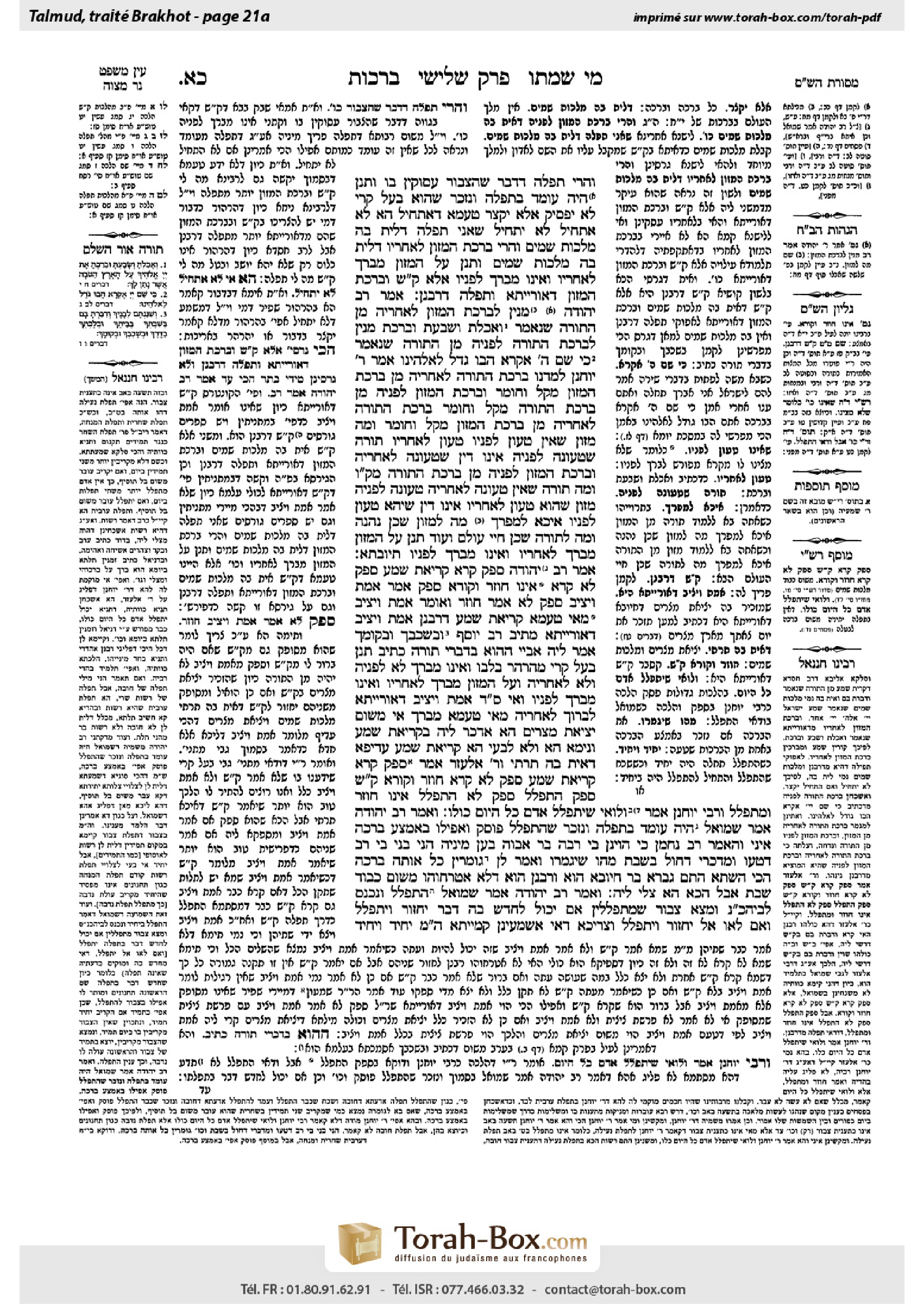
Berakhot 21a: Talmud study for Daf Yomi
Study the Talmud for Daf Yomi with scanned pages, Hebrew text, English translations from Sefaria and AI-generated French translations.
Passage selection and English or AI-generated French translation are available where the scan has annotations. Daf Study is independent of Torah-Box and Sefaria.
Browse Berakhot · ברכות · All tractatesBerakhot 21a text and translations
This page of Berakhot includes the Aramaic text, an English translation and an AI-generated French translation, alongside the scan above.
ברכות כ״א א · Aramaic and Hebrew text
וַהֲרֵי תְּפִלָּה, דְּדָבָר שֶׁהַצִּבּוּר עֲסוּקִין בּוֹ, וּתְנַן: הָיָה עוֹמֵד בִּתְפִלָּה וְנִזְכַּר שֶׁהוּא בַּעַל קֶרִי — לֹא יַפְסִיק, אֶלָּא יְקַצֵּר. טַעְמָא דְּאַתְחֵיל, הָא לָא אַתְחֵיל — לֹא יַתְחִיל!
שָׁאנֵי תְּפִלָּה דְּלֵית בַּהּ מַלְכוּת שָׁמַיִם. וַהֲרֵי בִּרְכַּת הַמָּזוֹן לְאַחֲרָיו דְּלֵית בַּהּ מַלְכוּת שָׁמַיִם, וּתְנַן עַל הַמָּזוֹן מְבָרֵךְ לְאַחֲרָיו וְאֵינוֹ מְבָרֵךְ לְפָנָיו! אֶלָּא: קְרִיאַת שְׁמַע וּבִרְכַּת הַמָּזוֹן דְּאוֹרָיְיתָא, וּתְפִלָּה דְּרַבָּנַן.
אָמַר רַב יְהוּדָה: מִנַּיִן לְבִרְכַּת הַמָּזוֹן לְאַחֲרֶיהָ מִן הַתּוֹרָה — שֶׁנֶּאֱמַר: ״וְאָכַלְתָּ וְשָׂבָעְתָּ וּבֵרַכְתָּ״.
מִנַּיִן לְבִרְכַּת הַתּוֹרָה לְפָנֶיהָ מִן הַתּוֹרָה — שֶׁנֶּאֱמַר: ״כִּי שֵׁם ה׳ אֶקְרָא הָבוּ גֹדֶל לֵאלֹהֵינוּ״.
אָמַר רַבִּי יוֹחָנָן: לָמַדְנוּ בִּרְכַּת הַתּוֹרָה לְאַחֲרֶיהָ מִן בִּרְכַּת הַמָּזוֹן מִקַּל וָחוֹמֶר, וּבִרְכַּת הַמָּזוֹן לְפָנֶיהָ מִן בִּרְכַּת הַתּוֹרָה מִקַּל וָחוֹמֶר. בִּרְכַּת הַתּוֹרָה לְאַחֲרֶיהָ מִן בִּרְכַּת הַמָּזוֹן מִקַּל וָחוֹמֶר: וּמָה מָזוֹן שֶׁאֵין טָעוּן לְפָנָיו, טָעוּן לְאַחֲרָיו, תּוֹרָה שֶׁטְּעוּנָה לְפָנֶיהָ, אֵינוֹ דִּין שֶׁטְּעוּנָה לְאַחֲרֶיהָ. וּבִרְכַּת הַמָּזוֹן לְפָנֶיהָ מִן בִּרְכַּת הַתּוֹרָה מִקַּל וָחוֹמֶר: וּמָה תּוֹרָה שֶׁאֵין טְעוּנָה לְאַחֲרֶיהָ, טְעוּנָה לְפָנֶיהָ, מָזוֹן שֶׁהוּא טָעוּן לְאַחֲרָיו, אֵינוֹ דִּין שֶׁיְּהֵא טָעוּן לְפָנָיו.
אִיכָּא לְמִפְרַךְ: מָה לְמָזוֹן שֶׁכֵּן נֶהֱנֶה. וּמָה לְתוֹרָה שֶׁכֵּן חַיֵּי עוֹלָם. וְעוֹד, תְּנַן עַל הַמָּזוֹן מְבָרֵךְ לְאַחֲרָיו וְאֵינוֹ מְבָרֵךְ לְפָנָיו. תְּיוּבְתָּא.
אָמַר רַב יְהוּדָה: סָפֵק קָרָא קְרִיאַת שְׁמַע, סָפֵק לֹא קָרָא — אֵינוֹ חוֹזֵר וְקוֹרֵא. סָפֵק אָמַר ״אֱמֶת וְיַצִּיב״, סָפֵק לֹא אָמַר — חוֹזֵר וְאוֹמֵר ״אֱמֶת וְיַצִּיב״. מַאי טַעְמָא? — קְרִיאַת שְׁמַע דְּרַבָּנַן. ״אֱמֶת וְיַצִּיב״, דְּאוֹרָיְיתָא.
מֵתִיב רַב יוֹסֵף: ״וּבְשָׁכְבְּךָ וּבְקוּמֶךָ״. אֲמַר לֵיהּ אַבָּיֵי: הָהוּא בְּדִבְרֵי תוֹרָה כְּתִיב.
תְּנַן: בַּעַל קֶרִי מְהַרְהֵר בְּלִבּוֹ וְאֵינוֹ מְבָרֵךְ לֹא לְפָנֶיהָ וְלֹא לְאַחֲרֶיהָ. וְעַל הַמָּזוֹן מְבָרֵךְ לְאַחֲרָיו וְאֵינוֹ מְבָרֵךְ לְפָנָיו.
וְאִי סָלְקָא דַעְתָּךְ ״אֱמֶת וְיַצִּיב״ דְּאוֹרָיְיתָא — לִבְרוֹךְ לְאַחֲרֶיהָ!
מַאי טַעְמָא מְבָרֵךְ, אִי מִשּׁוּם יְצִיאַת מִצְרַיִם — הָא אַדְכַּר לֵיהּ בִּקְרִיאַת שְׁמַע.
וְנֵימָא הָא וְלָא לִבְעֵי הָא! קְרִיאַת שְׁמַע עֲדִיפָא, דְּאִית בַּהּ תַּרְתֵּי.
וְרַבִּי אֶלְעָזָר אָמַר: סָפֵק קָרָא קְרִיאַת שְׁמַע סָפֵק לֹא קָרָא — חוֹזֵר וְקוֹרֵא קְרִיאַת שְׁמַע. סָפֵק הִתְפַּלֵּל סָפֵק לֹא הִתְפַּלֵּל — אֵינוֹ חוֹזֵר וּמִתְפַּלֵּל. וְרַבִּי יוֹחָנָן אָמַר: וּלְוַאי שֶׁיִּתְפַּלֵּל אָדָם כׇּל הַיּוֹם כּוּלּוֹ.
וְאָמַר רַב יְהוּדָה אָמַר שְׁמוּאֵל: הָיָה עוֹמֵד בִּתְפִלָּה וְנִזְכַּר שֶׁהִתְפַּלֵּל פּוֹסֵק — וַאֲפִילּוּ בְּאֶמְצַע בְּרָכָה. אִינִי?! וְהָאָמַר רַב נַחְמָן: כִּי הֲוֵינַן בֵּי רַבָּה בַּר אֲבוּהּ, בְּעַן מִינֵּיהּ: הָנֵי בְּנֵי בֵי רַב דְּטָעוּ וּמַדְכְּרִי דְּחוֹל בְּשַׁבָּת, מַהוּ שֶׁיִּגְמְרוּ? וַאֲמַר לַן: גּוֹמְרִין כׇּל אוֹתָהּ בְּרָכָה?!
הָכִי הַשְׁתָּא! הָתָם גַּבְרָא בַּר חִיּוּבָא הוּא, וְרַבָּנַן הוּא דְּלָא אַטְרְחוּהוּ מִשּׁוּם כְּבוֹד שַׁבָּת, אֲבָל הָכָא — הָא צַלִּי לֵיהּ.
וְאָמַר רַב יְהוּדָה אָמַר שְׁמוּאֵל: הִתְפַּלֵּל וְנִכְנַס לְבֵית הַכְּנֶסֶת וּמָצָא צִבּוּר שֶׁמִּתְפַּלְּלִין, אִם יָכוֹל לְחַדֵּשׁ בָּהּ דָּבָר — יַחְזוֹר וְיִתְפַּלֵּל, וְאִם לָאו — אַל יַחְזוֹר וְיִתְפַּלֵּל.
וּצְרִיכָא, דְּאִי אַשְׁמְעִינַן קַמַּיְיתָא, הָנֵי מִילֵּי יָחִיד וְיָחִיד
Berakhot 21a · English translation
The Gemara challenges: And prayer, which is also a matter in which the community is engaged, and we learned in the mishna: One who was standing in prayer and remembered that he is one who experienced a seminal emission and did not yet immerse himself should not interrupt his prayer, rather he should abridge it. The Gemara infers: The reason is because he already began to pray; however, if he did not yet begin, then he should not begin, even by means of contemplation.
The Gemara responds: Prayer is different in that it does not contain the acceptance of the yoke of the kingdom of Heaven. The Gemara rejects this: And Grace after Meals does not contain the acceptance of the yoke of the kingdom of Heaven, and yet we learned in the mishna: Over food, one recites a blessing afterward, but does not recite a blessing beforehand. Rather, the differences must be explained otherwise: The recitation of Shema and Grace after Meals are both mitzvot by Torah law, while prayer is only by rabbinic law. Therefore, one who is impure need not pray.
Rav Yehuda said: From where is the mitzva by Torah law to recite Grace after Meals, derived? As it is stated: “And you shall eat and be satisfied and bless the Lord your God” (Deuteronomy 8:10).
And from where is the mitzva by Torah law to recite the blessing over the Torah before it is read, derived? As it is stated: “When I proclaim the Lord’s name, give glory to our God” (Deuteronomy 32:3), meaning that before one proclaims the Lord’s name by reading the Torah, he must give glory to God.
Rabbi Yoḥanan said: We derived that one must recite the blessing over the Torah after it is read from Grace after Meals by means of an a fortiori inference. And we derive the obligation to recite a blessing before partaking of food from the blessing over the Torah by means of an a fortiori inference. The blessing over the Torah after it is read from Grace after Meals by means of an a fortiori inference: Food, which does not require a blessing beforehand by Torah law, requires a blessing afterward; Torah, which requires a blessing beforehand, is it not right that it requires a blessing afterward? And similarly: The blessing before partaking of food from the blessing over the Torah by means of an a fortiori inference: Torah, which requires no blessing afterward by Torah law, requires a blessing beforehand; food, which requires a blessing afterward, is it not right that it requires a blessing beforehand?
The Gemara notes: The logic of this a fortiori inference can be refuted: What is true with regard to food, where one derives pleasure from eating, is not true with regard to matters which offer no bodily pleasure. Therefore, the blessing over the Torah cannot be derived from the blessing over food. And similarly: What is true with regard to Torah, that provides eternal life to those who engage in its study, is not true with regard to matters that do not provide eternal life. Therefore, the blessing before partaking of food cannot be derived from the blessing over the Torah. Furthermore, we learned in the mishna: Over food, one who is impure due to a seminal emission recites a blessing afterward, but does not recite a blessing beforehand. The mishna does not derive the blessing recited before a meal from the blessing recited over Torah. Consequently, this is a conclusive refutation of Rabbi Yoḥanan’s statement.
Rav Yehuda said: One who is uncertain whether he recited Shema or whether he did not recite it does not recite it again. However, one who is uncertain whether he recited: True and Firm [emet veyatziv], the blessing that follows Shema in the morning, must recite emet veyatziv again. What is the reason for this? In his opinion, the obligation to recite Shema is only by rabbinic law. His ruling follows the principle that in cases of uncertainty involving rabbinic law, the ruling is lenient and he need not repeat it. However, since emet veyatziv is primarily a commemoration of the exodus from Egypt, it is a mitzva by Torah law, and, in cases of uncertainty involving Torah law, the ruling is stringent and he must repeat it.
Rav Yosef raises an objection: How can you say that the obligation to recite Shema is only by rabbinic law when it is explicitly written: “And you shall recite them to your children and speak of them when you sit in your home and when you walk by the way, when you lie down and when you rise” (Deuteronomy 6:7)? Abaye said to him: That verse was written with regard to matters of Torah. One need not interpret the verse in the conventional manner, as obligating the recitation of Shema, but rather as referring to the general obligation to study Torah.
From here, the Gemara attempts to resolve this issue by citing proof from the mishna. We learned in the mishna: One who experienced a seminal emission may contemplate Shema in his heart, but neither recites the blessings preceding Shema, nor the blessings thereafter. Over food which, after partaking, one is obligated by Torah law to recite a blessing, one recites a blessing thereafter, but not beforehand.
And if it would enter your mind that the obligation to recite emet veyatziv is by Torah law, let him recite the blessing after Shema. Since he does not recite the blessing, apparently, he is exempt.
The Gemara refutes this: What is the reason that he recites emet veyatziv? If it is because it deals primarily with the exodus from Egypt, wasn’t it already mentioned in the recitation of Shema, in the portion of the ritual fringes?
The Gemara challenges: And let him say this, emet veyatziv, and he will not need to recite that, Shema. The Gemara responds: While one may commemorate the exodus from Egypt in either Shema or emet veyatziv, Shema is preferable as it contains two elements, both a commemoration of the exodus and an acceptance of the yoke of the kingdom of Heaven.
And Rabbi Elazar said a different opinion: One who is uncertain whether he recited Shema or whether he did not recite Shema, must recite Shema again. According to his opinion, there is a mitzva by Torah law to recite Shema. However, if one is uncertain whether he prayed or whether he did not pray, he does not pray again, as the obligation to pray is by rabbinic law. And Rabbi Yoḥanan said: He must pray again; if only a person would pray throughout the entire day.
And Rav Yehuda said that Shmuel said: One who was standing in prayer and remembered that he already prayed must interrupt his prayer, even in the middle of a blessing. The Gemara challenges this: Is that so? Didn’t Rav Naḥman say: When we were in the school of Rabba bar Avuh we raised a dilemma before him: Those students in the school of Rav who mistakenly recited a blessing from the weekday Amida on Shabbat, what is the ruling with regards to completing the weekday prayer? And Rabba bar Avuh said to us: The ruling is that one must complete that entire blessing. How then did Rav Yehuda say that one must interrupt his prayer even in the middle of a blessing?
The Gemara rejects this: How can you compare the two cases? There, on Shabbat, the individual is one who is obligated and should actually recite all eighteen blessings, and it is the Sages who did not impose upon him in deference to Shabbat and instituted an abridged formula. But here, didn’t he already pray? Therefore he can stop, even in the middle of a blessing.
And Rav Yehuda said that Shmuel said: One who already prayed, and then enters a synagogue to find a congregation standing and praying, if he is able to introduce a new element, an expression or request, into his prayer, he may pray again, and if not, he may not pray again.
The Gemara notes: This concept is identical to Shmuel’s previous statement regarding one who already prayed that he need not pray again. Nevertheless, both statements are necessary. If he had taught us the first halakha, we would have said that applies only to a case involving an individual who prayed and an individual who began to repeat the prayer,
Berakhot 21a · Traduction française (IA)
La Guemara questionne : La prière, qui est aussi une affaire dans laquelle la communauté est engagée, et nous avons appris dans la michna : Celui qui était debout en prière et se souvient qu'il a connu une émission séminal et n'a pas encore purifié lui-même ne doit pas interrompre sa prière, plutôt il doit la raccourcir. La Guemara déduit : La raison est qu'il a déjà commencé à prier ; cependant, s'il n'a pas encore commencé, alors il ne devrait pas commencer, même par la méditation.
La Guemara répond : La prière est différente dans le sens où elle ne contient pas l'acceptation du joug du Royaume des Cieux. La Guemara rejette cela : Et la bénédiction après le repas ne contient pas l'acceptation du joug du Royaume des Cieux, et pourtant nous avons appris dans la michna : Sur la nourriture, on récite une bénédiction après, mais pas avant. Par conséquent, les différences doivent être expliquées autrement : La récitation du Chéma et la bénédiction après le repas sont des mitsvot par la loi de la Torah, tandis que la prière est seulement par la loi rabbinique. Ainsi, celui qui est impur n'a pas besoin de prier.
Rav Yéhouda a dit : D'où est tiré la mitsva par la loi de la Torah de réciter la bénédiction après le repas ? Comme il est dit : « Et vous mangerez et vous serez rassasiés et vous bénirez l'Éternel votre Dieu » (Deutéronome 8:10).
Et d'où est tirée la mitsva selon la loi de la Torah de réciter la bénédiction sur la Torah avant de la lire ? Comme il est dit : « Quand je proclame le nom de l'Éternel, glorifiez notre Dieu » (Deutéronome 32:3), c'est-à-dire que avant de proclamer le nom de l'Éternel en lisant la Torah, il faut glorifier Dieu.
Rabbi Yoḥanan a dit : Nous avons tiré que l'on doit réciter la bénédiction sur la Torah après qu'elle a été lue après la bénédiction du repas par une inférence a fortiori. Et nous tirons l'obligation de réciter une bénédiction avant de manger de la bénédiction sur la Torah par une inférence a fortiori. La bénédiction sur la Torah après qu'elle a été lue après la bénédiction du repas par une inférence a fortiori : La nourriture, qui ne nécessite pas une bénédiction avant par la loi de la Torah, nécessite une bénédiction après ; la Torah, qui nécessite une bénédiction avant, n'est-ce pas justifié qu'elle nécessite une bénédiction après ? Et de même : La bénédiction avant de manger d'après la bénédiction sur la Torah par une inférence a fortiori : La Torah, qui ne nécessite pas une bénédiction après par la loi de la Torah, nécessite une bénédiction avant ; la nourriture, qui nécessite une bénédiction après, n'est-ce pas justifié qu'elle nécessite une bénédiction avant ?
La Guemara note : La logique de cette inférence a fortiori peut être réfutée : Ce qui est vrai concernant la nourriture, où l'on trouve du plaisir à manger, n'est pas vrai concernant les choses qui ne donnent pas de plaisir corporel. Ainsi, la bénédiction sur la Torah ne peut pas être tirée de la bénédiction sur la nourriture. Et de même : Ce qui est vrai concernant la Torah, qui donne la vie éternelle à ceux qui étudient, n'est pas vrai concernant les choses qui ne donnent pas la vie éternelle. Ainsi, la bénédiction avant de manger ne peut pas être tirée de la bénédiction sur la Torah. De plus, nous avons appris dans la michna : Sur la nourriture, celui qui est impur à cause d'une émission séminal récite une bénédiction après, mais ne récite pas une bénédiction avant. La michna ne tire pas la bénédiction récitée avant le repas de la bénédiction récitée sur la Torah. Ainsi, cela constitue une réfutation définitive de l'affirmation de Rabbi Yoḥanan.
Rav Yéhouda a dit : Celui qui est incertain s'il a récité le Chéma ou s'il ne l'a pas récité ne doit pas le réciter à nouveau. Cependant, celui qui est incertain s'il a récité : Vrai et Solide [émét véyatziv], la bénédiction qui suit le Chéma le matin, doit réciter émét véyatziv à nouveau. Quelle est la raison de cela ? Selon son avis, l'obligation de réciter le Chéma est seulement par la loi rabbinique. Son arrêt suit le principe que dans les cas d'incertitude concernant la loi rabbinique, l'arrêt est leniant et il n'a pas besoin de le répéter. Cependant, puisque émét véyatziv est principalement une commémoration de l'Exode d'Égypte, c'est une mitsva par la loi de la Torah, et, dans les cas d'incertitude concernant la loi de la Torah, l'arrêt est strict et il doit le répéter.
Rav Yosef soulève une objection : Comment pouvez-vous dire que l'obligation de réciter le Chéma est seulement par la loi rabbinique lorsque cela est explicitement écrit : « Et vous lirez ces paroles à vos enfants et en parlerez quand vous serez assis à la maison, quand vous marcherez sur la route, quand vous vous coucherez et quand vous vous lèverez » (Deutéronome 6:7) ? Abaye lui répond : Cette versette a été écrite en référence aux choses de la Torah. On n'a pas besoin d'interpréter le verset dans le sens conventionnel, comme obligeant la récitation du Chéma, mais plutôt comme faisant référence à l'obligation générale d'étudier la Torah.
D'ici, la Guemara tente de résoudre ce problème en citant une preuve tirée de la michna. Nous avons appris dans la michna : Celui qui a connu une émission séminal peut méditer le Chéma dans son cœur, mais ne récite pas les bénédictions précédant le Chéma ni les bénédictions suivantes. Sur la nourriture, dont on est tenu par la loi de la Torah à réciter une bénédiction après, on récite une bénédiction après, mais pas avant.
Et si cela vous venait à l'esprit que l'obligation de réciter émét véyatziv est par la loi de la Torah, faites-le réciter la bénédiction après le Chéma. Puisqu'il ne récite pas la bénédiction, apparemment, il est exempt.
La Guemara réfute cela : Quelle est la raison qu'il récite émét véyatziv ? Si c'est parce qu'il s'agit principalement de l'Exode d'Égypte, n'était-ce pas déjà mentionné dans la récitation du Chéma, dans la portion des franges rituels ?
La Guemara pose un défi : Et qu'il dise cela, émét véyatziv, et il n'aura pas besoin de réciter cela, Chéma. La Guemara répond : Bien que l'on puisse commémorer l'Exode d'Égypte soit dans le Chéma soit dans émét véyatziv, le Chéma est préférable car il contient deux éléments, à la fois une commémoration de l'Exode et une acceptation du joug du Royaume des Cieux.
Et Rabbi Elazar a dit une opinion différente : Celui qui est incertain s'il a récité le Chéma ou s'il ne l'a pas récité, doit réciter le Chéma à nouveau. Selon son opinion, il y a une mitsva selon la Torah, par halakha, de réciter le Chéma. Cependant, si l'on est incertain s'il a prié ou s'il n'a pas prié, il ne prie pas à nouveau, car l'obligation de prier est selon la loi rabbinique. Et Rabbi Yoḥanan a dit : Il doit prier à nouveau ; si seulement une personne priait tout au long de la journée.
Et Rav Yehuda a dit que Shmuel a dit : Celui qui était en prière et se souvient qu'il a déjà prié doit interrompre sa prière, même au milieu d'une berakha. La Guemara remet en question cela : Est-ce ainsi ? N'a-t-il pas dit Rav Naḥman : Quand nous étions dans l'école de Rabba bar Avuh, nous avons soulevé un doute devant lui : Ces étudiants dans l'école de Rav qui ont récité par erreur une berakha du Amidah du jour ordinaire le sabbat, quelle est la décision concernant la fin de la prière du jour ordinaire ? Et Rabba bar Avuh a dit à nous : La décision est que l'on doit achever cette berakha entière. Comment alors Rav Yehuda a-t-il dit que l'on doit interrompre sa prière même au milieu d'une berakha ?
La Guemara rejette cela : Comment pouvez-vous comparer les deux cas ? Là, le sabbat, l'individu est celui qui est obligé et devrait réciter toutes les dix-huit berakhot, et c'est les Sages qui n'ont pas imposé sur lui par respect du sabbat et ont institué une formule abrégée. Mais ici, n'a-t-il pas déjà prié ? Donc il peut s'arrêter, même au milieu d'une berakha.
Et Rav Yehuda a dit que Shmuel a dit : Celui qui a déjà prié, et ensuite entre dans une synagogue et trouve une congrégation debout et en prière, s'il peut introduire un nouvel élément, une expression ou une prière, dans sa prière, il peut prier à nouveau, et s'il ne peut pas, il ne peut pas prier à nouveau.
La Guemara note : Ce concept est identique à l'affirmation précédente de Shmuel concernant celui qui a déjà prié et qui n'a pas besoin de prier à nouveau. Cependant, les deux affirmations sont nécessaires. Si on nous avait appris la première halakha, nous aurions dit qu'elle s'applique uniquement à un cas impliquant une personne qui a prié et une personne qui a commencé à répéter la prière,
Traduction française générée par IA à partir de l’édition anglaise de Sefaria. Vérifie toujours un passage avec le texte source.
Text from Sefaria: William Davidson Edition - Vocalized Aramaic (CC BY NC); William Davidson Edition - English (CC BY NC).