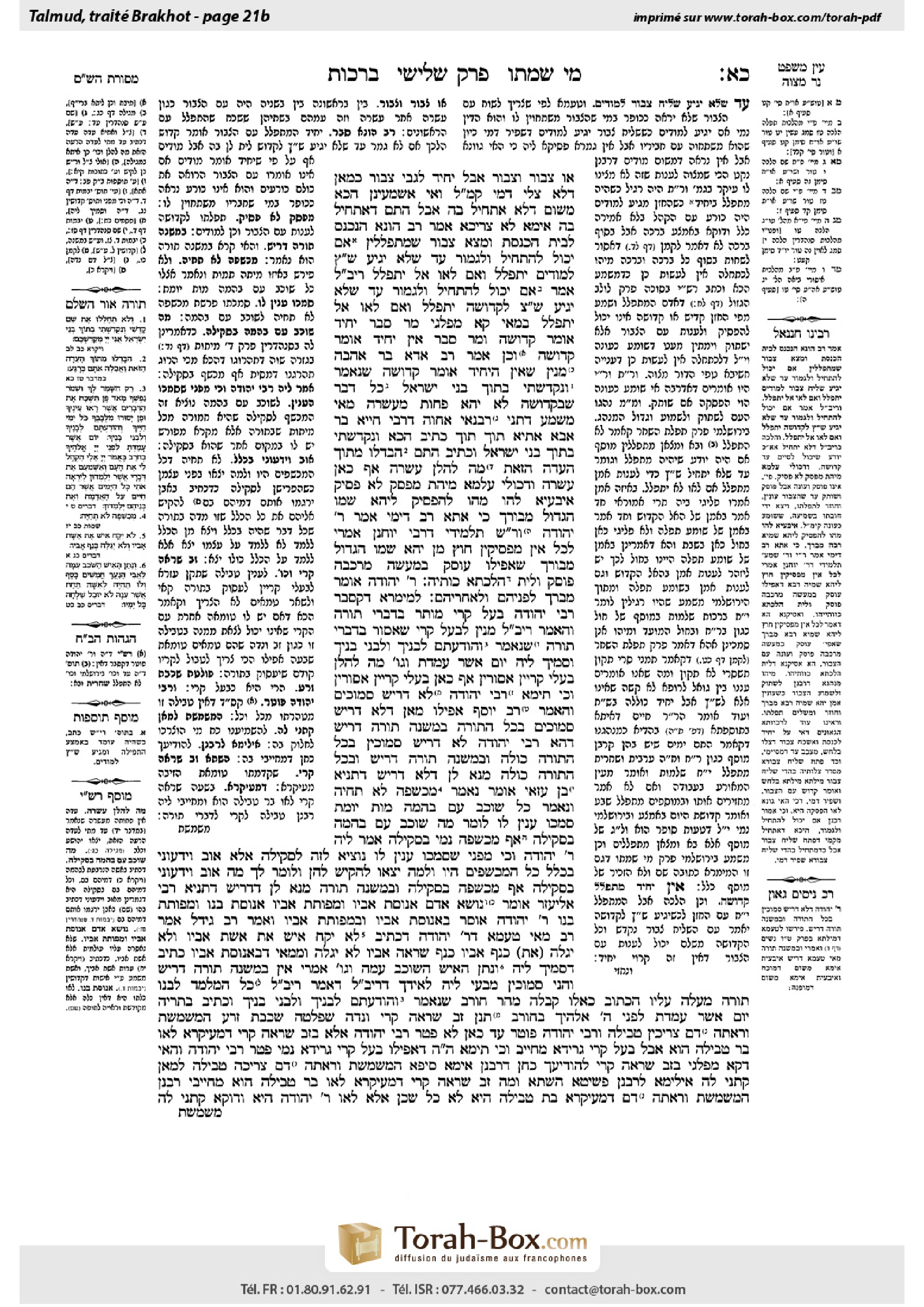
Berakhot 21b: Talmud study for Daf Yomi
Study the Talmud for Daf Yomi with scanned pages, Hebrew text, English translations from Sefaria and AI-generated French translations.
Passage selection and English or AI-generated French translation are available where the scan has annotations. Daf Study is independent of Torah-Box and Sefaria.
Browse Berakhot · ברכות · All tractatesBerakhot 21b text and translations
This page of Berakhot includes the Aramaic text, an English translation and an AI-generated French translation, alongside the scan above.
ברכות כ״א ב · Aramaic and Hebrew text
אוֹ צִבּוּר וְצִבּוּר, אֲבָל יָחִיד לְגַבֵּי צִבּוּר כְּמַאן דְּלָא צַלִּי דָּמֵי, קָמַשְׁמַע לַן. וְאִי אַשְׁמְעִינַן הָכָא, מִשּׁוּם דְּלָא אַתְחֵיל בַּהּ, אֲבָל הָתָם דְּאַתְחֵיל בַּהּ — אֵימָא לָא. צְרִיכָא.
אָמַר רַב הוּנָא: הַנִּכְנָס לְבֵית הַכְּנֶסֶת וּמָצָא צִבּוּר שֶׁמִּתְפַּלְּלִין, אִם יָכוֹל לְהַתְחִיל וְלִגְמוֹר עַד שֶׁלֹּא יַגִּיעַ שְׁלִיחַ צִבּוּר לְ״מוֹדִים״ — יִתְפַּלֵּל. וְאִם לָאו — אַל יִתְפַּלֵּל. רַבִּי יְהוֹשֻׁעַ בֶּן לֵוִי אָמַר: אִם יָכוֹל לְהַתְחִיל וְלִגְמוֹר עַד שֶׁלֹּא יַגִּיעַ שְׁלִיחַ צִבּוּר לִ״קְדוּשָּׁה״ — יִתְפַּלֵּל, וְאִם לָאו — אַל יִתְפַּלֵּל.
בְּמַאי קָא מִפַּלְגִי — מָר סָבַר יָחִיד אוֹמֵר ״קְדוּשָּׁה״, וּמַר סָבַר אֵין יָחִיד אוֹמֵר ״קְדוּשָּׁה״.
וְכֵן אָמַר רַב אַדָּא בַּר אַהֲבָה: מִנַּיִן שֶׁאֵין הַיָּחִיד אוֹמֵר ״קְדוּשָּׁה״ — שֶׁנֶּאֱמַר: ״וְנִקְדַּשְׁתִּי בְּתוֹךְ בְּנֵי יִשְׂרָאֵל״, כׇּל דָּבָר שֶׁבִּקְדוּשָּׁה לֹא יְהֵא פָּחוֹת מֵעֲשָׂרָה.
מַאי מַשְׁמַע? דְּתָנֵי רַבְנַאי אֲחוּהּ דְּרַבִּי חִיָּיא בַּר אַבָּא: אָתְיָא ״תּוֹךְ״ ״תּוֹךְ״. כְּתִיב הָכָא: ״וְנִקְדַּשְׁתִּי בְּתוֹךְ בְּנֵי יִשְׂרָאֵל״, וּכְתִיב הָתָם: ״הִבָּדְלוּ מִתּוֹךְ הָעֵדָה הַזֹּאת״, מָה לְהַלָּן עֲשָׂרָה. אַף כָּאן עֲשָׂרָה.
וּדְכוּלֵּי עָלְמָא מִיהַת מִפְסָק לָא פָּסֵיק.
אִיבַּעְיָא לְהוּ: מַהוּ לְהַפְסִיק לִ״יהֵא שְׁמוֹ הַגָּדוֹל מְבוֹרָךְ״? כִּי אֲתָא רַב דִּימִי, אָמַר: רַבִּי יְהוּדָה וְרַבִּי שִׁמְעוֹן תַּלְמִידֵי דְּרַבִּי יוֹחָנָן אָמְרִי: לַכֹּל אֵין מַפְסִיקִין חוּץ מִן ״יְהֵא שְׁמוֹ הַגָּדוֹל מְבוֹרָךְ״. שֶׁאֲפִילּוּ עוֹסֵק בְּמַעֲשֵׂה מֶרְכָּבָה — פּוֹסֵק. וְלֵית הִלְכְתָא כְּוָתֵיהּ.
רַבִּי יְהוּדָה אוֹמֵר מְבָרֵךְ לִפְנֵיהֶם וּלְאַחֲרֵיהֶם. לְמֵימְרָא דְקָסָבַר רַבִּי יְהוּדָה בַּעַל קֶרִי מוּתָּר בְּדִבְרֵי תוֹרָה? וְהָאָמַר רַבִּי יְהוֹשֻׁעַ בֶּן לֵוִי, מִנַּיִן לְבַעַל קֶרִי שֶׁאָסוּר בְּדִבְרֵי תוֹרָה — שֶׁנֶּאֱמַר: ״וְהוֹדַעְתָּם לְבָנֶיךָ וְלִבְנֵי בָנֶיךָ״, וּסְמִיךְ לֵיהּ: ״יוֹם אֲשֶׁר עָמַדְתָּ וְגוֹ׳״. מָה לְהַלָּן בַּעֲלֵי קְרָיִין אֲסוּרִין, אַף כָּאן בַּעֲלֵי קְרָיִין אֲסוּרִין!
וְכִי תֵּימָא רַבִּי יְהוּדָה לָא דָּרֵישׁ ״סְמוּכִים״, וְהָאָמַר רַב יוֹסֵף: אֲפִילּוּ מַאן דְּלָא דָּרֵישׁ סְמוּכִים בְּכָל הַתּוֹרָה, בְּמִשְׁנֵה תוֹרָה — דָּרֵישׁ. דְּהָא רַבִּי יְהוּדָה לָא דָּרֵישׁ ״סְמוּכִין״ בְּכָל הַתּוֹרָה כּוּלָּהּ וּבְמִשְׁנֵה תוֹרָה — דָּרֵישׁ.
וּבְכׇל הַתּוֹרָה כּוּלָּהּ מְנָא לַן דְּלָא דָּרֵישׁ — דְּתַנְיָא, בֶּן עַזַּאי אוֹמֵר: נֶאֱמַר ״מְכַשֵּׁפָה לֹא תְחַיֶּה״, וְנֶאֱמַר ״כׇּל שׁוֹכֵב עִם בְּהֵמָה מוֹת יוּמָת״ — סְמָכוֹ עִנְיָן לוֹ, לוֹמַר: מָה שׁוֹכֵב עִם בְּהֵמָה בִּסְקִילָה, אַף מְכַשֵּׁפָה נָמֵי בִּסְקִילָה.
אָמַר לוֹ רַבִּי יְהוּדָה: וְכִי מִפְּנֵי שֶׁסְּמָכוֹ עִנְיָן לוֹ, נוֹצִיא לָזֶה לִסְקִילָה? אֶלָּא: אוֹב וְיִדְּעוֹנִי בִּכְלַל כׇּל הַמְכַשְּׁפִים הָיוּ, וְלָמָּה יָצְאוּ — לְהַקִּישׁ לָהֶן וְלוֹמַר לָךְ: מָה אוֹב וְיִדְּעוֹנִי בִּסְקִילָה — אַף מְכַשֵּׁפָה בִּסְקִילָה.
וּבְמִשְׁנֵה תוֹרָה מְנָא לַן דְּדָרֵישׁ — דְּתַנְיָא: רַבִּי אֱלִיעֶזֶר אוֹמֵר נוֹשֵׂא אָדָם אֲנוּסַת אָבִיו וּמְפוּתַּת אָבִיו אֲנוּסַת בְּנוֹ וּמְפוּתַּת בְּנוֹ.
רַבִּי יְהוּדָה אוֹסֵר בַּאֲנוּסַת אָבִיו וּבִמְפוּתַּת אָבִיו. וְאָמַר רַב גִּידֵּל אָמַר רַב: מַאי טַעְמָא דְּרַבִּי יְהוּדָה? — דִּכְתִיב: ״לֹא יִקַּח אִישׁ אֶת אֵשֶׁת אָבִיו וְלֹא יְגַלֶּה אֶת כְּנַף אָבִיו״. כָּנָף שֶׁרָאָה אָבִיו — לֹא יְגַלֶּה.
וּמִמַּאי דְּבַאֲנוּסַת אָבִיו כְּתִיב — דִּסְמִיךְ לֵיהּ: ״וְנָתַן הָאִישׁ הַשּׁוֹכֵב עִמָּהּ וְגוֹ׳״.
אָמְרִי: אִין בְּמִשְׁנֵה תוֹרָה דָּרֵישׁ, וְהָנֵי סְמוּכִין מִבְּעֵי לֵיהּ לְאִידָךְ דְּרַבִּי יְהוֹשֻׁעַ בֶּן לֵוִי. דְּאָמַר רַבִּי יְהוֹשֻׁעַ בֶּן לֵוִי: כׇּל הַמְלַמֵּד לִבְנוֹ תּוֹרָה מַעֲלֶה עָלָיו הַכָּתוּב כְּאִלּוּ קִבְּלָהּ מֵהַר חוֹרֵב. שֶׁנֶּאֱמַר: ״וְהוֹדַעְתָּם לְבָנֶיךָ וְלִבְנֵי בָנֶיךָ״, וּכְתִיב בָּתְרֵיהּ ״יוֹם אֲשֶׁר עָמַדְתָּ לִפְנֵי ה׳ אֱלֹהֶיךָ בְּחוֹרֵב״.
תְּנַן זָב שֶׁרָאָה קֶרִי, וְנִדָּה שֶׁפָּלְטָה שִׁכְבַת זֶרַע, הַמְשַׁמֶּשֶׁת וְרָאֲתָה דָּם, צְרִיכִין טְבִילָה. וְרַבִּי יְהוּדָה פּוֹטֵר.
עַד כָּאן לֹא פָּטַר רַבִּי יְהוּדָה אֶלָּא בְּזָב שֶׁרָאָה קֶרִי, דְּמֵעִיקָּרָא לָאו בַּר טְבִילָה הוּא, אֲבָל בַּעַל קֶרִי גְּרֵידָא מְחַיַּיב.
וְכִי תֵּימָא: הוּא הַדִּין דַּאֲפִילּוּ בַּעַל קֶרִי גְּרֵידָא נָמֵי פָּטַר רַבִּי יְהוּדָה, וְהַאי דְּקָא מִפַּלְּגִי בְּזָב שֶׁרָאָה קֶרִי — לְהוֹדִיעֲךָ כֹּחָן דְּרַבָּנַן. אֵימָא סֵיפָא: הַמְשַׁמֶּשֶׁת וְרָאֲתָה דָּם — צְרִיכָה טְבִילָה.
לְמַאן קָתָנֵי לַהּ? אִילֵּימָא לְרַבָּנַן — פְּשִׁיטָא! הַשְׁתָּא וּמָה זָב שֶׁרָאָה קֶרִי — דְּמֵעִיקָּרָא לָאו בַּר טְבִילָה הוּא, מְחַיְּיבִי רַבָּנַן; הַמְשַׁמֶּשֶׁת וְרָאֲתָה דָּם — דְּמֵעִיקָּרָא בַּת טְבִילָה הִיא, לֹא כׇּל שֶׁכֵּן?! אֶלָּא לָאו רַבִּי יְהוּדָה הִיא, וְדַוְקָא קָתָנֵי לַהּ,
Berakhot 21b · English translation
or a case where he prayed as part of a congregation and began to repeat it as part of a congregation; however, in a case where he initially prayed by himself and subsequently joined the congregation at the venue where it was praying, we might have said that an individual vis-à-vis the congregation is considered as one who has not prayed. Therefore, he taught us that in this case, too, one may not repeat the prayer. And, on the other hand, if he had taught us here only with regard to one who entered a synagogue, we would have thought that the reason he may not pray again is because he did not yet begin to recite the prayer, but there, in the case where he already began to recite the prayer, say that this is not the case and he may continue to repeat the prayer. Therefore, both statements are necessary.
Rav Huna said: One who did not yet pray and enters a synagogue and found that the congregation is in the midst of reciting the Amida prayer, if he is able to begin and complete his own prayer before the prayer leader reaches the blessing of thanksgiving [modim], he should begin to pray, and, if not, he should not begin to pray. Rabbi Yehoshua ben Levi said: If he is able to begin and complete his prayer before the prayer leader reaches sanctification [kedusha], then he should begin to pray. If not, then he should not begin to pray.
The Gemara clarifies: With regard to what do they disagree? The basis for their dispute is that one Sage, Rav Huna, holds: An individual is permitted to recite kedusha on his own, so he need not insist on reciting it along with the prayer leader; and the other Sage, Rabbi Yehoshua ben Levi, holds that an individual may not recite kedusha alone, and, therefore he is required to complete his prayer before the communal prayer leader reaches kedusha.
Similarly, Rav Adda bar Ahava stated, in accordance with the second opinion: From where is it derived that an individual may not recite kedusha alone? As it is stated: “And I shall be hallowed among the children of Israel” (Leviticus 22:32), any expression of sanctity may not be recited in a quorum of fewer than ten men.
The Gemara asks: How is this inferred from that verse? The Gemara responds: This must be understood in light of a baraita, which was taught by Rabbenai, the brother of Rabbi Ḥiyya bar Abba: It is inferred by means of a verbal analogy [gezera shava] between the words among, among. Here it is written: “And I shall be hallowed among the children of Israel,” and there, regarding Korah’s congregation, it is written “Separate yourselves from among this congregation” (Numbers 16:21). Just as there among connotes ten, so too here, among connotes ten. The connotation of ten associated with the word among written in the portion of Korah is, in turn, derived by means of another verbal analogy between the word congregation written there and the word congregation written in reference to the ten spies who slandered Eretz Yisrael: “How long shall I bear with this evil congregation?” (Numbers 14:27). Consequently, among the congregation there must be at least ten.
And, in any case, everyone agrees that one may not interrupt his prayer in order to respond to kedusha.
However, a dilemma was raised before the Sages of the yeshiva: What is the ruling? Is one permitted to interrupt his prayer in order to recite: “May His great name be blessed” in kaddish? When Rav Dimi came from Eretz Yisrael to Babylonia, he said: Rabbi Yehuda and Rabbi Shimon, disciples of Rabbi Yoḥanan, said: One may not interrupt his prayer for anything, except for: “May His great name be blessed,” as even if one was engaged in the exalted study of the Act of the Divine Chariot [Ma’aseh Merkava] (see Ezekiel 1) he stops to recite it. However, the Gemara concludes: The halakha is not in accordance with his opinion.
We learned in the mishna that Rabbi Yehuda says with regard to one who experiences a seminal emission; he recites a blessing beforehand and afterward in both the case of Shema and in the case of food. The Gemara asks: Is that to say that Rabbi Yehuda holds that one who experienced a seminal emission is permitted to engage in matters of Torah? Didn’t Rabbi Yehoshua ben Levi say: From where in the Torah is it derived that one who experiences a seminal emission is prohibited from engaging in matters of Torah? As it is stated: “Just take heed and guard your soul diligently lest you forget the things your eyes have seen, and lest they depart from your heart, for all the days of your life, and you shall impart them to your children and your children’s children” (Deuteronomy 4:9), from which we derive, among other things, the obligation to study Torah. And, juxtaposed to it, is the verse: “The day that you stood before the Lord your God at Horeb” (Deuteronomy 4:10). This juxtaposition teaches us that just as below, at the revelation at Mount Sinai, those who experienced a seminal emission were prohibited and were commanded to refrain from relations with their wives and immerse themselves, so too here, throughout the generations, those who experience a seminal emission are prohibited from engaging in Torah study.
And if you say that Rabbi Yehuda does not derive homiletic interpretations from juxtaposed verses, didn’t Rav Yosef already say: Even one who does not derive homiletic interpretations from juxtaposed verses throughout the entire Torah, nevertheless, derives them in Deuteronomy [Mishne Torah], as Rabbi Yehuda does not derive homiletic interpretations from juxtaposed verses throughout the entire Torah and he does derive them in Mishne Torah.
And from where do we derive that Rabbi Yehuda does not derive homiletic interpretations from juxtaposed verses throughout the entire Torah? As it was taught in a baraita with regard to the punishment of a sorceress, ben Azzai says: It is stated: “You shall not allow a sorceress to live” (Exodus 22:17), although the manner of her execution is not specified, and it is stated: “Whoever lies with a beast shall surely be put to death” (Exodus 22:18). The fact that the Torah juxtaposed this matter to that was to say: Just as one who lies with a beast is executed by stoning (see Leviticus 20), so too a sorceress is executed by stoning.
With regard to this proof Rabbi Yehuda said to him: And does the fact that the Torah juxtaposed this matter to that warrant taking this person out to be stoned? Should he be sentenced to the most severe of the death penalties on that basis Rather, the source is: Mediums and wizards were included among all sorcerers. And why were they singled out from the rest, in the verse: “And a man or a woman who is a medium or a wizard shall surely be put to death; they shall stone them with stones, their blood is upon them” (Leviticus 20:27)? In order to draw an analogy to them and say to you: Just as a medium and a wizard are executed by stoning, so too is a sorceress executed by stoning.
And from where do we derive that Rabbi Yehuda derives homiletic interpretations from juxtaposed verses in Mishne Torah? As it was taught in another baraita: Rabbi Eliezer said that a man may wed a woman raped by his father and one seduced by his father; a woman raped by his son and one seduced by his son. Though one is prohibited by Torah law from marrying the wife of his father or the wife of his son, this prohibition does not apply to a woman raped or seduced by them.
And Rabbi Yehuda prohibits him from marrying a woman raped by his father and a woman seduced by his father. And Rav Giddel said that Rav said: What is the reason for Rabbi Yehuda’s opinion? As it is written: “A man shall not take his father’s wife, and shall not uncover his father’s skirt” (Deuteronomy 23:1). The last expression, “and shall not uncover his father’s skirt,” implies that: A skirt that has been seen by his father, i.e., any woman who has had sexual relations with his father, may not be uncovered by his son, i.e., his son may not marry her.
And from where do we know that the verse is written with regard to a woman raped by his father? As the previous section, juxtaposed to it, deals with the laws of rape: “And the man who lay with her must give her father fifty shekels…because he has violated her” (Deuteronomy 22:29).
At any rate, we see that in Deuteronomy, Rabbi Yehuda derives homiletic interpretations from juxtaposed verses. Why does he fail to derive that one who experiences a seminal emission is prohibited from engaging in matters of Torah from the juxtaposition of the verses? They replied: Indeed, in Mishne Torah Rabbi Yehuda does derive homiletic interpretations from the juxtaposition of verses, but he requires these juxtaposed verses in order to derive another statement of Rabbi Yehoshua ben Levi, as Rabbi Yehoshua ben Levi said: One who teaches his son Torah, the verse ascribes to him credit as if he received the Torah from Mount Horeb. As it is stated: “And you shall impart them to your children and your children’s children” (Deuteronomy 4:9) after which it is written: “The day that you stood before the Lord your God at Horeb.” Therefore, Rabbi Yehuda cannot derive from that same juxtaposition a prohibition banning one who experienced a seminal emission from engaging in matters of Torah.
We learned in a mishna that a zav who experienced a seminal emission, and a menstruating woman who discharged semen, and a woman who engaged in intercourse with her husband and she saw menstrual blood, all of whom are ritually impure for at least seven days due to the severity of their impurity, nevertheless require ritual immersion in order to purify themselves from the impurity of the seminal emission before they may engage in matters of Torah. And Rabbi Yehuda exempts them from immersion.
However, Rabbi Yehuda only exempted from immersion in the case of a zav who experienced a seminal emission, who was unfit to immerse himself from the outset, as even after immersion he would remain impure with the seven-day impurity of the zav. But, in the case of one who experienced a seminal emission alone, with no concurrent impurity, even Rabbi Yehuda requires immersion before he may engage in Torah matters.
And if you say: The same is true even in the case of one who experienced a seminal emission alone, that Rabbi Yehuda also exempts him from immersion, and the fact that they disagree in the case of a zav who experienced a seminal emission and not in the case of a person who experienced a seminal emission alone is in order to convey the far-reaching nature of the opinion of the Rabbis, who require immersion even in this case. If so, say the last case of that same mishna: A woman who was engaged in intercourse and she saw menstrual blood requires immersion.
The Gemara seeks to clarify: In accordance with whose opinion was this case in the mishna taught? If you say that it is in accordance with the opinion of the Rabbis, that is obvious; if in the case of a zav who experienced a seminal emission who was unfit to immerse himself from the outset, when he experienced the seminal emission, the Rabbis nevertheless require immersion, all the more so wouldn’t they require immersion for a woman who engaged in intercourse and only then saw blood, who was fit to immerse herself from the outset, when she came into contact with the seminal emission of her husband? Rather, isn’t this Rabbi Yehuda’s opinion, and this case was taught specifically in order to teach
Berakhot 21b · Traduction française (IA)
ou un cas où il a prié en tant que membre d'une congrégation et a commencé à le répéter en tant que membre d'une congrégation ; cependant, dans un cas où il a prié initialement seul et s'est ensuite joint à la congrégation dans l'endroit où la prière était en cours, nous aurions pu dire qu'un individu face à la congrégation est considéré comme celui qui n'a pas prié. Ainsi, il nous a appris que dans ce cas également, on ne peut pas répéter la prière. D'un autre côté, si on nous avait enseigné ici uniquement concernant celui qui entre dans une synagogue, nous aurions pu penser que la raison pour laquelle il ne peut pas prier à nouveau est qu'il n'a pas encore commencé à réciter la prière, mais là, dans le cas où il a déjà commencé à réciter la prière, on dit que ce n'est pas le cas et qu'il peut continuer à répéter la prière. Ainsi, les deux déclarations sont nécessaires.
Rav Huna a dit : Celui qui n'a pas encore prié et entre dans une synagogue et découvre que la congrégation est en plein milieu de la récitation de la prière d'Amida, s'il peut commencer et terminer sa propre prière avant que le chef de prière n'atteigne la bénédiction de remerciement [modim], il devrait commencer à prier, et s'il ne peut pas le faire, il ne devrait pas commencer à prier. Rabbi Yéhoshua ben Levi a dit : S'il peut commencer et terminer sa prière avant que le chef de prière n'atteigne la sanctification [kedousha], il devrait commencer à prier. S'il ne peut pas le faire, il ne devrait pas commencer à prier.
La Guemara clarifie : À propos de quoi ces deux opinions s'opposent-elles ? La base de leur débat est que l'un des sages, Rav Huna, considère que l'individu peut réciter la kedousha seul, donc il n'a pas besoin de l'accomplir avec le chef de prière ; et l'autre sage, Rabbi Yéhoshua ben Levi, considère que l'individu ne peut pas réciter la kedousha seul, et par conséquent, il est tenu de terminer sa prière avant que le chef de prière n'atteigne la kedousha.
De même, Rav Adda bar Ahava a déclaré, conformément à l'opinion secondaire : D'où dérive-t-il que l'individu ne peut pas réciter la kedousha seul ? Comme il est dit : « Et je serai sanctifié parmi les enfants d'Israël » (Lévitique 22:32), toute expression de sanctité ne peut être récitée devant un groupe de moins de dix hommes.
La Guemara demande : Comment cette déduction est-elle tirée de cette verset ? La Guemara répond : Cela doit être compris à la lumière d'une baraïta, enseignée par les Rabbanim, frère de Rabbi Ḥiyya bar Abba : Il est déduit par analogie verbale [gezera shava] entre les mots « parmi », « parmi ». Ici, il est écrit : « Et je serai sanctifié parmi les enfants d'Israël », et là, concernant la congrégation de Korah, il est écrit : « Séparez-vous de parmi cette congrégation » (Nb 16:21). Tout comme là, « parmi » implique dix, de même ici, « parmi » implique dix. La connotation de dix associée au mot « parmi » dans la portion de Korah est, à son tour, déduite par une autre analogie verbale entre le mot « congrégation » écrit là et le mot « congrégation » mentionné concernant les dix espions qui ont calomnié la Terre d'Israël : « Combien de temps dois-je supporter cette mauvaise congrégation ? » (Nb 14:27). Ainsi, dans la congrégation, il doit y avoir au moins dix personnes.
Et, en tout cas, tout le monde convient que l'on ne doit pas interrompre sa prière pour répondre à la kedousha.
Cependant, un dilemme a été soulevé devant les Sages de la yeshiva : Quel est le jugement ? Est-on autorisé à interrompre sa prière pour réciter : « Que Son grand nom soit béni » dans le kaddish ? Quand Rav Dimi est venu de la Terre d'Israël en Babylone, il a dit : Rabbi Yéhuda et Rabbi Shimon, disciples de Rabbi Yoḥanan, ont dit : On ne doit pas interrompre sa prière pour rien, sauf pour : « Que Son grand nom soit béni », car même si l'on était engagé dans l'étude exaltée de l'Acte du Chariot divin [Ma'aseh Merkava] (voir Ezéchiel 1), on s'arrête pour le réciter. Cependant, la Guemara conclut : La halakha ne suit pas son opinion.
Nous avons appris dans la Michna que Rabbi Yéhuda dit concernant celui qui a eu une émission sémencière ; il récite une bénédiction avant et après, tant dans le cas du Chéma que dans le cas des aliments. La Guemara demande : Est-ce que cela signifie que Rabbi Yéhuda considère que celui qui a eu une émission sémencière est autorisé à s'engager dans les affaires de la Torah ? N'a-t-il pas dit Rabbi Yéhoshua ben Levi : D'où dérive-t-il dans la Torah que celui qui a eu une émission sémencière est interdit d'engager dans les affaires de la Torah ? Comme il est dit : « Veille et garde ton âme avec soin, afin de ne pas oublier les choses que tes yeux ont vues, et afin qu'elles ne s'éloignent pas de ton cœur, pour tous les jours de ta vie, et tu les transmettras à tes enfants et à leurs enfants » (Dn 4:9), d'où nous déduisons, entre autres, l'obligation d'étudier la Torah. Et, juxtaposé à cela, est le verset : « Le jour où tu as été devant l'Éternel ton Dieu à Horeb » (Dn 4:10). Cette juxtaposition nous apprend que tout comme en bas, à la révélation du Sinaï, ceux qui avaient eu une émission sémencière étaient interdits et commandés de se retirer de leurs épouses et de se purifier, de même ici, à travers les générations, ceux qui ont une émission sémencière sont interdits d'étudier la Torah.
Et si vous dites que Rabbi Yéhuda ne dérive pas des interprétations homilétiques à partir de versets juxtaposés, n’a-t-il pas dit Rav Yosef déjà : Même celui qui ne dérive pas d’interprétations homilétiques à partir de versets juxtaposés à travers toute la Torah, néanmoins, il en dérive dans la Mishne Torah, comme Rabbi Yéhuda le fait. Et Rabbi Yéhuda ne dérive pas d’interprétations homilétiques à partir de versets juxtaposés à travers toute la Torah et il en dérive dans la Mishne Torah.
Et d’où dérive-t-on que Rabbi Yéhuda ne dérive pas d’interprétations homilétiques à partir de versets juxtaposés à travers toute la Torah ? Comme il a été enseigné dans une baraïta concernant la punition de la sorcière, ben Azzai dit : Il est dit : « Tu ne laisseras pas vivre une sorcière » (Exode 22:17), bien que la manière d’exécution ne soit pas spécifiée, et il est dit : « Celui qui couchera avec un animal sera certainement mis à mort » (Exode 22:18). Le fait que la Torah ait juxtaposé cette affaire à celle-ci signifie : Tout comme celui qui couchera avec un animal est exécuté par lapidation (voir Lévitique 20), de même la sorcière est exécutée par lapidation.
Concernant cette preuve, le maître Yéhuda dit à lui : Et est-ce que le fait que la Torah a juxtaposé cette affaire à celle-ci justifie de sortir cette personne pour la lapider ? Doit-on la condamner à la peine de mort la plus sévère sur cette base ? Non, la source est : les devins et les sorciers étaient inclus parmi tous les sorciers. Et pourquoi les a-t-on spécifiquement mentionnés dans la parabole : « Et un homme ou une femme qui est un devin ou un sorcier sera certainement mis à mort ; on le lapidera, son sang est sur lui » (Lévitique 20:27) ? Afin de faire une analogie avec eux et de dire à vous : Tout comme un devin et un sorcier sont lapidés, de même aussi une sorcière est lapidée.
Et d'où tirons-nous que le maître Yéhuda tire des interprétations hérétiques des versets juxtaposés dans la Michna Torah ? Comme il a été enseigné dans une autre baraïta : le maître Éliezer dit qu'un homme peut épouser une femme violée par son père et une femme séduite par son père ; une femme violée par son fils et une femme séduite par son fils. Bien que l'un soit interdit par la Loi divine de se marier avec la femme de son père ou la femme de son fils, cette interdiction ne s'applique pas à une femme violée ou séduite par eux.
Et le maître Yéhuda interdit de se marier avec une femme violée par son père et une femme séduite par son père. Et Rav Giddel dit que Rav dit : Quelle est la raison de l'opinion du maître Yéhuda ? Comme il est écrit : « Un homme ne prendra pas la femme de son père, et ne dévoilera pas la robe de son père » (Dt 23:1). L'expression finale, « et ne dévoilera pas la robe de son père », implique que : une robe qui a été vue par son père, c'est-à-dire toute femme qui a eu des relations sexuelles avec son père, ne doit pas être dévoilée par son fils, c'est-à-dire son fils ne doit pas l'épouser.
Et d'où savons-nous que le verset est écrit concernant une femme violée par son père ? Comme la section précédente, juxtaposée à celle-ci, traite des lois de la violence : « Et l'homme qui a couché avec elle doit donner à son père cinquante sicles… parce qu'il a violé elle » (Dt 22:29).
En tout cas, nous voyons que dans le Deutéronome, le maître Yéhuda tire des interprétations hérétiques des versets juxtaposés. Pourquoi ne tire-t-il pas de cette juxtaposition l'interdiction d'un homme qui a eu une émission sémencière de participer aux affaires de la Torah ? Ils répondirent : En effet, dans la Michna Torah, le maître Yéhuda tire des interprétations hérétiques des versets juxtaposés, mais il exige ces versets juxtaposés afin de déduire une autre déclaration du maître Yéhoshua ben Levi, comme le maître Yéhoshua ben Levi dit : Celui qui enseigne à son fils la Torah, le verset attribue à lui un mérite comme s'il avait reçu la Torah du mont Horeb. Comme il est dit : « Et vous transmettrez-les à vos enfants et à leurs enfants » (Dt 4:9), après quoi il est écrit : « Le jour où vous êtes restés devant l'Éternel votre Dieu à Horeb. » Ainsi, le maître Yéhuda ne peut déduire de cette même juxtaposition une interdiction interdisant à celui qui a eu une émission sémencière de participer aux affaires de la Torah.
Nous avons appris dans une mishna que le zav qui a eu une émission sémencière, et la femme menstruelle qui a émis du sperme, et la femme qui a eu des relations conjugales et qui a vu du sang menstruel, tous ceux-ci sont impurs au moins sept jours en raison de la gravité de leur impureté, néanmoins ils nécessitent une immersion rituelle afin de se purifier de l'impureté de l'émission sémencière avant de pouvoir participer aux affaires de la Torah. Et le maître Yéhuda les exemptait de l'immersion.
Cependant, le maître Yéhuda a exempté de l'immersion uniquement dans le cas du zav qui a eu une émission sémencière, qui était inapte à s'immerger dès le départ, car même après l'immersion, il restait impur avec l'impureté sept jours du zav. Mais, dans le cas d'une personne qui a eu une émission sémencière seule, sans impureté concomitante, même le maître Yéhuda exige l'immersion avant de pouvoir participer aux affaires de la Torah.
Et si vous dites : La même chose est vraie même dans le cas d'une personne qui a eu une émission sémencière seule, que le maître Yéhuda l'exempte également de l'immersion, et le fait qu'ils divergent dans le cas du zav qui a eu une émission sémencière et non dans le cas d'une personne qui a eu une émission sémencière seule est afin de faire comprendre la portée de l'opinion des Rabbins, qui exigent l'immersion même dans ce cas. Si c'est ainsi, disent les derniers cas de cette même mishna : la femme qui a eu des relations conjugales et qui a vu du sang menstruel exige l'immersion.
La Guemara cherche à clarifier : selon quel avis était ce cas dans la mishna enseignée ? Si vous dites qu'il est selon l'avis des Rabbins, c'est évident ; si dans le cas du zav qui a eu une émission sémencière qui était inapte à s'immerger dès le départ, quand il a eu l'émission sémencière, les Rabbins exigent tout de même l'immersion, à plus forte raison ne demanderaient-ils pas l'immersion pour une femme qui a eu des relations conjugales et qui a seulement vu du sang, qui était apte à s'immerger dès le départ, quand elle a été en contact avec l'émission sémencière de son mari ? Plutôt, n'est-ce pas l'avis du maître Yéhuda, et ce cas a été enseigné spécifiquement afin de faire comprendre
Traduction française générée par IA à partir de l’édition anglaise de Sefaria. Vérifie toujours un passage avec le texte source.
Text from Sefaria: William Davidson Edition - Vocalized Aramaic (CC BY NC); William Davidson Edition - English (CC BY NC).