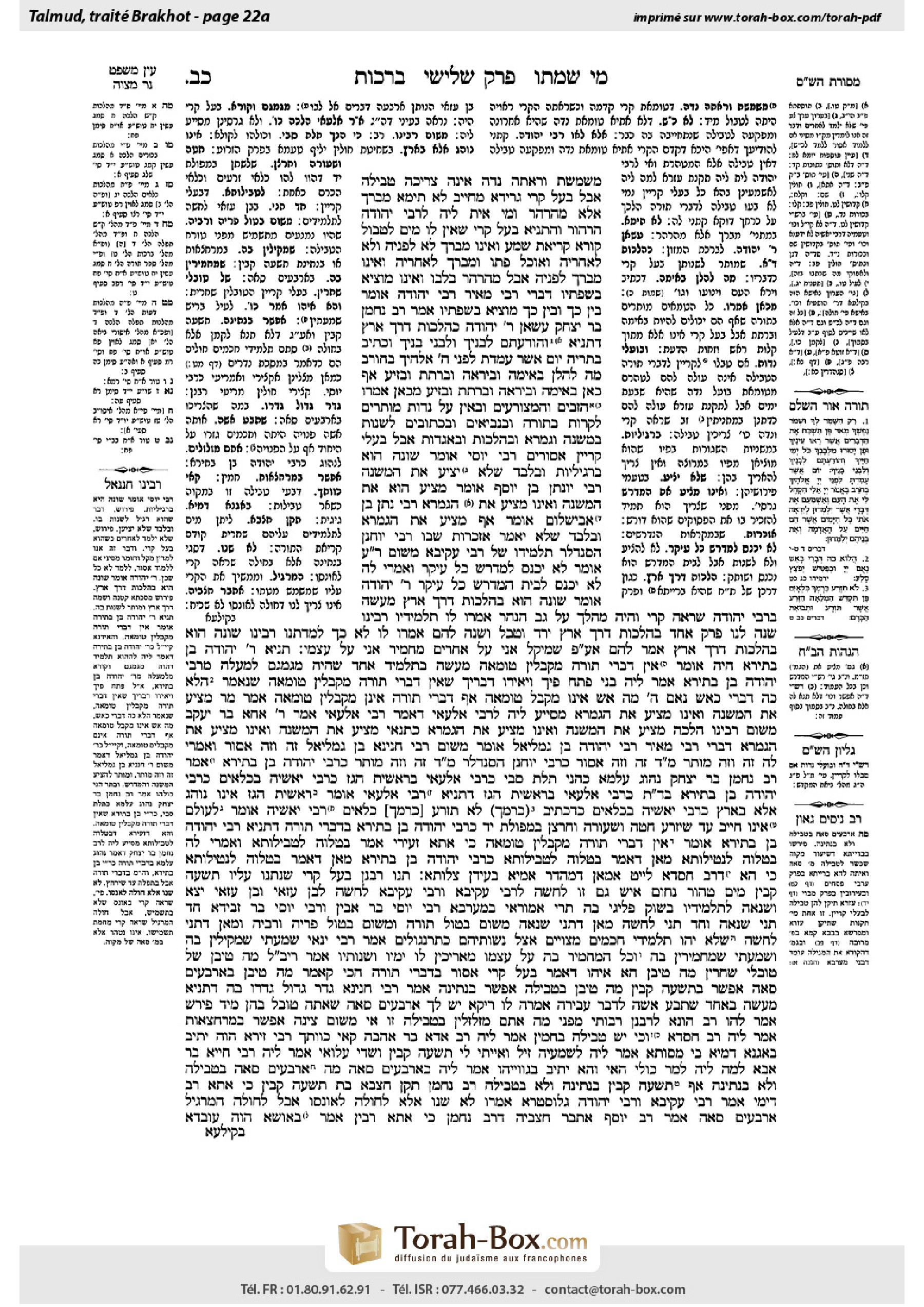
Berakhot 22a: Talmud study for Daf Yomi
Study the Talmud for Daf Yomi with scanned pages, Hebrew text, English translations from Sefaria and AI-generated French translations.
Passage selection and English or AI-generated French translation are available where the scan has annotations. Daf Study is independent of Torah-Box and Sefaria.
Browse Berakhot · ברכות · All tractatesBerakhot 22a text and translations
This page of Berakhot includes the Aramaic text, an English translation and an AI-generated French translation, alongside the scan above.
ברכות כ״ב א · Aramaic and Hebrew text
מְשַׁמֶּשֶׁת וְרָאֲתָה נִדָּה — אֵינָהּ צְרִיכָה טְבִילָה, אֲבָל בַּעַל קֶרִי גְּרֵידָא — מְחַיַּיב. לָא תֵּימָא ״מְבָרֵךְ״, אֶלָּא מְהַרְהֵר.
וּמִי אִית לֵיהּ לְרַבִּי יְהוּדָה הִרְהוּר? וְהָתַנְיָא: בַּעַל קֶרִי שֶׁאֵין לוֹ מַיִם לִטְבּוֹל — קוֹרֵא קְרִיאַת שְׁמַע, וְאֵינוֹ מְבָרֵךְ, לֹא לְפָנֶיהָ וְלֹא לְאַחֲרֶיהָ. וְאוֹכֵל פִּתּוֹ וּמְבָרֵךְ לְאַחֲרֶיהָ, וְאֵינוֹ מְבָרֵךְ לְפָנֶיהָ. אֲבָל מְהַרְהֵר בְּלִבּוֹ וְאֵינוֹ מוֹצִיא בִּשְׂפָתָיו, דִּבְרֵי רַבִּי מֵאִיר. רַבִּי יְהוּדָה אוֹמֵר: בֵּין כָּךְ וּבֵין כָּךְ מוֹצִיא בִּשְׂפָתָיו.
אָמַר רַב נַחְמָן בַּר יִצְחָק: עֲשָׂאָן רַבִּי יְהוּדָה כְּהִלְכוֹת דֶּרֶךְ אֶרֶץ.
דְּתַנְיָא: ״וְהוֹדַעְתָּם לְבָנֶיךָ וְלִבְנֵי בָנֶיךָ״, וּכְתִיב בָּתְרֵיהּ ״יוֹם אֲשֶׁר עָמַדְתָּ לִפְנֵי ה׳ אֱלֹהֶיךָ בְּחוֹרֵב״, מָה לְהַלָּן בְּאֵימָה וּבְיִרְאָה וּבִרְתֵת וּבְזִיעַ, אַף כָּאן בְּאֵימָה וּבְיִרְאָה וּבִרְתֵת וּבְזִיעַ.
מִכָּאן אָמְרוּ: הַזָּבִים וְהַמְצֹרָעִים וּבָאִין עַל נִדּוֹת — מוּתָּרִים לִקְרוֹת בַּתּוֹרָה וּבַנְּבִיאִים וּבַכְּתוּבִים, לִשְׁנוֹת בַּמִּשְׁנָה וּגְמָרָא וּבָהֲלָכוֹת וּבָאַגָּדוֹת. אֲבָל בַּעֲלֵי קְרָיִין אֲסוּרִים.
רַבִּי יוֹסֵי אוֹמֵר: שׁוֹנֶה הוּא בָּרְגִילִיּוֹת, וּבִלְבַד שֶׁלֹּא יַצִּיעַ אֶת הַמִּשְׁנָה. רַבִּי יוֹנָתָן בֶּן יוֹסֵף אוֹמֵר: מַצִּיעַ הוּא אֶת הַמִּשְׁנָה, וְאֵינוֹ מַצִּיעַ אֶת הַגְּמָרָא. רַבִּי נָתָן בֶּן אֲבִישָׁלוֹם אוֹמֵר: אַף מַצִּיעַ אֶת הַגְּמָרָא, וּבִלְבַד שֶׁלֹּא יֹאמַר אַזְכָּרוֹת שֶׁבּוֹ. רַבִּי יוֹחָנָן הַסַּנְדְּלָר תַּלְמִידוֹ שֶׁל רַבִּי עֲקִיבָא מִשּׁוּם רַבִּי עֲקִיבָא אוֹמֵר: לֹא יִכָּנֵס לַמִּדְרָשׁ כׇּל עִיקָּר. וְאָמְרִי לַהּ: לֹא יִכָּנֵס לְבֵית הַמִּדְרָשׁ כׇּל עִיקָּר. רַבִּי יְהוּדָה אוֹמֵר: שׁוֹנֶה הוּא בְּהִלְכוֹת דֶּרֶךְ אֶרֶץ.
מַעֲשֶׂה בְּרַבִּי יְהוּדָה שֶׁרָאָה קֶרִי, וְהָיָה מְהַלֵּךְ עַל גַּב הַנָּהָר. אָמְרוּ לוֹ תַּלְמִידָיו: רַבֵּינוּ, שְׁנֵה לָנוּ פֶּרֶק אֶחָד בְּהִלְכוֹת דֶּרֶךְ אֶרֶץ. יָרַד וְטָבַל וְשָׁנָה לָהֶם. אָמְרוּ לוֹ: לֹא כָּךְ לִמַּדְתָּנוּ רַבֵּינוּ, שׁוֹנֶה הוּא בְּהִלְכוֹת דֶּרֶךְ אֶרֶץ?! אָמַר לָהֶם: אַף עַל פִּי שֶׁמֵּיקֵל אֲנִי עַל אֲחֵרִים, מַחְמִיר אֲנִי עַל עַצְמִי.
תַּנְיָא, רַבִּי יְהוּדָה בֶּן בְּתֵירָא הָיָה אוֹמֵר: אֵין דִּבְרֵי תוֹרָה מְקַבְּלִין טוּמְאָה. מַעֲשֶׂה בְּתַלְמִיד אֶחָד שֶׁהָיָה מְגַמְגֵּם לְמַעְלָה מֵרַבִּי יְהוּדָה בֶּן בְּתֵירָא. אָמַר לֵיהּ: בְּנִי, פְּתַח פִּיךָ וְיָאִירוּ דְבָרֶיךָ, שֶׁאֵין דִּבְרֵי תוֹרָה מְקַבְּלִין טוּמְאָה, שֶׁנֶּאֱמַר: ״הֲלֹא כֹה דְבָרִי כָּאֵשׁ נְאֻם ה׳״, מָה אֵשׁ אֵינוֹ מְקַבֵּל טוּמְאָה אַף דִּבְרֵי תוֹרָה אֵינָן מְקַבְּלִין טוּמְאָה.
אָמַר מָר. מַצִּיעַ אֶת הַמִּשְׁנָה וְאֵינוֹ מַצִּיעַ אֶת הַגְּמָרָא. מְסַיַּיע לֵיהּ לְרַבִּי אִלְעַאי, דְּאָמַר רַבִּי אִלְעַאי אָמַר רַבִּי אַחָא בַּר יַעֲקֹב מִשּׁוּם רַבֵּינוּ: הֲלָכָה, מַצִּיעַ אֶת הַמִּשְׁנָה וְאֵינוֹ מַצִּיעַ אֶת הַגְּמָרָא. כְּתַנָּאֵי: מַצִּיעַ אֶת הַמִּשְׁנָה וְאֵינוֹ מַצִּיעַ אֶת הַגְּמָרָא, דִּבְרֵי רַבִּי מֵאִיר. רַבִּי יְהוּדָה בֶּן גַּמְלִיאֵל אוֹמֵר מִשּׁוּם רַבִּי חֲנִינָא בֶּן גַּמְלִיאֵל: זֶה וָזֶה אָסוּר. וְאָמְרִי לַהּ: זֶה וָזֶה מוּתָּר.
מַאן דְּאָמַר זֶה וָזֶה אָסוּר — כְּרַבִּי יוֹחָנָן הַסַּנְדְּלָר, מַאן דְּאָמַר זֶה וָזֶה מוּתָּר — כְּרַבִּי יְהוּדָה בֶּן בְּתֵירָא.
אָמַר רַב נַחְמָן בַּר יִצְחָק: נְהוּג עָלְמָא כְּהָנֵי תְּלָת סָבֵי — כְּרַבִּי אִלְעַאי בְּרֵאשִׁית הַגֵּז, כְּרַבִּי יֹאשִׁיָּה בְּכִלְאַיִם, כְּרַבִּי יְהוּדָה בֶּן בְּתֵירָא בְּדִבְרֵי תוֹרָה.
כְּרַבִּי אִלְעַאי בְּרֵאשִׁית הַגֵּז — דְּתַנְיָא, רַבִּי אִלְעַאי אוֹמֵר: רֵאשִׁית הַגֵּז אֵינוֹ נוֹהֵג אֶלָּא בָּאָרֶץ.
כְּרַבִּי יֹאשִׁיָּה בְּכִלְאַיִם, כְּדִכְתִיב: ״לֹא תִזְרַע כַּרְמְךָ כִּלְאָיִם״, רַבִּי יֹאשִׁיָּה אוֹמֵר: לְעוֹלָם אֵינוֹ חַיָּיב עַד שֶׁיִּזְרַע חִטָּה וּשְׂעוֹרָה וְחַרְצָן בְּמַפּוֹלֶת יָד.
כְּרַבִּי יְהוּדָה בֶּן בְּתֵירָא בְּדִבְרֵי תוֹרָה, דְּתַנְיָא, רַבִּי יְהוּדָה בֶּן בְּתֵירָא אוֹמֵר: אֵין דִּבְרֵי תוֹרָה מְקַבְּלִין טוּמְאָה.
כִּי אֲתָא זְעֵירִי, אֲמַר: בַּטְּלוּהָ לִטְבִילוּתָא. וְאָמְרִי לַהּ: בַּטְּלוּהָ לִנְטִילוּתָא. מַאן דְּאָמַר בַּטְּלוּהָ לִטְבִילוּתָא — כְּרַבִּי יְהוּדָה בֶּן בְּתֵירָא. מַאן דְּאָמַר בַּטְּלוּהָ לִנְטִילוּתָא — כִּי הָא דְּרַב חִסְדָּא לָיֵיט אַמַּאן דִּמְהַדַּר אַמַּיָּא בְּעִידָּן צְלוֹתָא.
תָּנוּ רַבָּנַן: בַּעַל קֶרִי שֶׁנָּתְנוּ עָלָיו תִּשְׁעָה קַבִּין מַיִם — טָהוֹר. נַחוּם אִישׁ גַּם זוֹ לְחָשָׁהּ לְרַבִּי עֲקִיבָא, וְרַבִּי עֲקִיבָא לְחָשָׁהּ לְבֶן עַזַּאי, וּבֶן עַזַּאי יָצָא וּשְׁנָאָהּ לְתַלְמִידָיו בְּשׁוּק. פְּלִיגִי בַּהּ תְּרֵי אָמוֹרָאֵי בְּמַעְרְבָא, רַבִּי יוֹסֵי בַּר אָבִין וְרַבִּי יוֹסֵי בַּר זְבִידָא. חַד תָּנֵי: שְׁנָאָהּ, וְחַד תָּנֵי: לְחָשָׁהּ.
מַאן דְּתָנֵי שְׁנָאָהּ, מִשּׁוּם בִּטּוּל תּוֹרָה וּמִשּׁוּם בִּטּוּל פְּרִיָּה וּרְבִיָּה. וּמַאן דְּתָנֵי לְחָשָׁהּ — שֶׁלֹּא יְהוּ תַּלְמִידֵי חֲכָמִים מְצוּיִים אֵצֶל נְשׁוֹתֵיהֶם כְּתַרְנְגוֹלִים.
אָמַר רַבִּי יַנַּאי: שָׁמַעְתִּי שֶׁמְּקִילִּין בָּהּ וְשָׁמַעְתִּי שֶׁמַּחֲמִירִין בָּהּ, וְכׇל הַמַּחֲמִיר בָּהּ עַל עַצְמוֹ מַאֲרִיכִין לוֹ יָמָיו וּשְׁנוֹתָיו.
אָמַר רַבִּי יְהוֹשֻׁעַ בֶּן לֵוִי: מַה טִּיבָן שֶׁל טוֹבְלֵי שְׁחָרִין? מַה טִּיבָן?! הָא אִיהוּ דְּאָמַר בַּעַל קֶרִי אָסוּר בְּדִבְרֵי תּוֹרָה. הָכִי קָאָמַר: מַה טִּיבָן בְּאַרְבָּעִים סְאָה, אֶפְשָׁר בְּתִשְׁעָה קַבִּין. מַה טִּיבָן בִּטְבִילָה, אֶפְשָׁר בִּנְתִינָה.
אָמַר רַבִּי חֲנִינָא: גָּדֵר גָּדוֹל גָּדְרוּ בָּהּ. דְּתַנְיָא: מַעֲשֶׂה בְּאֶחָד שֶׁתָּבַע אִשָּׁה לִדְבַר עֲבֵירָה. אָמְרָה לוֹ: רֵיקָא! יֵשׁ לְךָ אַרְבָּעִים סְאָה שֶׁאַתָּה טוֹבֵל בָּהֶן? מִיָּד פֵּירַשׁ.
אֲמַר לְהוּ רַב הוּנָא לְרַבָּנָן: רַבּוֹתַי, מִפְּנֵי מָה אַתֶּם מְזַלְזְלִין בִּטְבִילָה זוֹ: אִי מִשּׁוּם צִינָּה, אֶפְשָׁר בְּמֶרְחֲצָאוֹת.
אֲמַר לֵיהּ רַב חִסְדָּא: וְכִי יֵשׁ טְבִילָה בְּחַמִּין? אֲמַר לֵיהּ: רַב אַדָּא בַּר אַהֲבָה קָאֵי כְּווֹתָךְ.
רַבִּי זֵירָא הֲוָה יָתֵיב בְּאַגָּנָא דְמַיָּא בֵּי מַסּוּתָא, אֲמַר לֵיהּ לְשַׁמָּעֵיהּ: זִיל וְאַיְיתִי לִי תִּשְׁעָה קַבִּין וּשְׁדִי עִלָּוַאי. אֲמַר לֵיהּ רַבִּי חִיָּיא בַּר אַבָּא: לְמָה לֵיהּ לְמָר כּוּלֵּי הַאי? וְהָא יָתֵיב בְּגַוַּויְיהוּ! אֲמַר לֵיהּ: כְּאַרְבָּעִים סְאָה, מָה אַרְבָּעִים סְאָה, בִּטְבִילָה וְלֹא בִּנְתִינָה — אַף תִּשְׁעָה קַבִּין בִּנְתִינָה וְלֹא בִּטְבִילָה.
רַב נַחְמָן תַּקֵּן חַצְבָּא בַּת תִּשְׁעָה קַבִּין. כִּי אֲתָא רַב דִּימִי, אֲמַר רַבִּי עֲקִיבָא וְרַבִּי יְהוּדָה גְּלוֹסְטְרָא אָמְרוּ: לֹא שָׁנוּ אֶלָּא לְחוֹלֶה לְאוֹנְסוֹ. אֲבָל לְחוֹלֶה הַמַּרְגִּיל, אַרְבָּעִים סְאָה.
אֲמַר רַב יוֹסֵף: אִתְּבַר חַצְבֵּיהּ דְּרַב נַחְמָן. כִּי אֲתָא רָבִין אֲמַר בְּאוּשָׁא הֲוָה עוֹבָדָא
Berakhot 22a · English translation
that a woman who engaged in intercourse and saw menstrual blood is not required to immerse herself, but one who experienced a seminal emission alone, with no concurrent impurity, is required to do so? If so, we must interpret Rabbi Yehuda’s statement in the mishna that one recites a blessing both beforehand and thereafter as follows: Do not say that one recites a blessing orally, but rather he means that one contemplates those blessings in his heart.
The Gemara challenges this explanation: And does Rabbi Yehuda maintain that there is validity to contemplating in his heart? Wasn’t it taught in a baraita: One who experienced a seminal emission and who has no water to immerse and purify himself recites Shema and neither recites the blessings of Shema beforehand nor thereafter? And when he eats his bread, he recites the blessing thereafter, Grace after Meals, but does not recite the blessing: Who brings forth bread from the earth, beforehand. However, in the instances where he may not recite the blessing, he contemplates it in his heart rather than utter it with his lips, this is the statement of Rabbi Meir. However Rabbi Yehuda says: In either case, he utters all of the blessings with his lips. Rabbi Yehuda does not consider contemplating the blessings in his heart a solution and permits them to be recited.
Rav Naḥman bar Yitzḥak said: Rabbi Yehuda’s statement in the mishna should be interpreted in another way. Rabbi Yehuda rendered the blessings like Hilkhot Derekh Eretz, which according to some Sages were not considered to be in the same category as all other matters of Torah and therefore, one is permitted to engage in their study even after having experienced a seminal emission.
As it was taught in a baraita: It is written: “And you shall impart them to your children and your children’s children” (Deuteronomy 4:9), and it is written thereafter: “The day that you stood before the Lord your God at Horeb” (Deuteronomy 4:10). Just as below, the Revelation at Sinai was in reverence, fear, quaking, and trembling, so too here, in every generation, Torah must be studied with a sense of reverence, fear, quaking, and trembling.
From here the Sages stated: Zavim, lepers, and those who engaged in intercourse with menstruating women, despite their severe impurity, are permitted to read the Torah, Prophets, and Writings, and to study Mishna and Gemara and halakhot and aggada. However, those who experienced a seminal emission are prohibited from doing so. The reason for this distinction is that the cases of severe impurity are caused by ailment or other circumstances beyond his control and, as a result, they do not necessarily preclude a sense of reverence and awe as he studies Torah. This, however, is not the case with regard to impurity resulting from a seminal emission, which usually comes about due to frivolity and a lack of reverence and awe. Therefore, it is inappropriate for one who experiences a seminal emission to engage in matters of in Torah.
However, there are many opinions concerning the precise parameters of the Torah matters prohibited by this decree. Rabbi Yosei says: One who experiences a seminal emission studies mishnayot that he is accustomed to study, as long as he does not expound upon a new mishna to study it in depth. Rabbi Yonatan ben Yosef says: He expounds upon the mishna but he does not expound upon the Gemara, which is the in-depth analysis of the Torah. Rabbi Natan ben Avishalom says: He may even expound upon the Gemara, as long as he does not utter the mentions of God’s name therein. Rabbi Yoḥanan the Cobbler, Rabbi Akiva’s student, says in the name of Rabbi Akiva: One who experiences a seminal emission may not enter into homiletic interpretation [midrash] of verses at all. Some say that he says: He may not enter the study hall [beit hamidrash] at all. Rabbi Yehuda says: He may study only Hilkhot Derekh Eretz. In terms of the problem raised above, apparently Rabbi Yehuda considers the legal status of the blessings to be parallel to the legal status of Hilkhot Derekh Eretz, and therefore one may utter them orally.
The Gemara relates an incident involving Rabbi Yehuda himself, who experienced a seminal emission and was walking along the riverbank with his disciples. His disciples said to him: Rabbi, teach us a chapter from Hilkhot Derekh Eretz, as he maintained that even in a state of impurity, it is permitted. He descended and immersed himself in the river and taught them Hilkhot Derekh Eretz. They said to him: Did you not teach us, our teacher, that he may study Hilkhot Derekh Eretz? He said to them: Although I am lenient with others, and allow them to study it without immersion, I am stringent with myself.
Further elaborating on the issue of Torah study while in a state of impurity, it was taught in a baraita that Rabbi Yehuda ben Beteira would say: Matters of Torah do not become ritually impure and therefore one who is impure is permitted to engage in Torah study. He implemented this halakha in practice. The Gemara relates an incident involving a student who was reciting mishnayot and baraitot hesitantly before the study hall of Rabbi Yehuda ben Beteira. The student experienced a seminal emission, and when he was asked to recite he did so in a rushed, uneven manner, as he did not want to utter the words of Torah explicitly. Rabbi Yehuda said to him: My son, open your mouth and let your words illuminate, as matters of Torah do not become ritually impure, as it is stated: “Is not my word like fire, says the Lord” (Jeremiah 23:29). Just as fire does not become ritually impure, so too matters of Torah do not become ritually impure.
In this baraita the Master said that one who is impure because of a seminal emission expounds upon the mishna but does not expound upon the Gemara. The Gemara notes: This statement supports the opinion of Rabbi El’ai, as Rabbi El’ai said that Rabbi Aḥa bar Ya’akov said in the name of Rabbeinu, Rav: The halakha is that one who experienced a seminal emission may expound upon the mishna but may not expound upon the Gemara. This dispute is parallel a tannaitic dispute, as it was taught: One who experienced a seminal emission expounds upon the mishna but does not expound upon the Gemara; that is the statement of Rabbi Meir. Rabbi Yehuda ben Gamliel says in the name of Rabbi Ḥanina ben Gamliel: Both this and that are prohibited. And some say that he said: Both this and that are permitted.
Comparing these opinions: The one who said that both this and that are prohibited holds in accordance with the opinion of Rabbi Yoḥanan the Cobbler; the one who said that both this and that are permitted holds in accordance with the opinion of Rabbi Yehuda ben Beteira.
Summarizing the halakha, Rav Naḥman bar Yitzḥak said: The universally accepted practice is in accordance with the opinions of these three elders: In accordance with the opinion of Rabbi El’ai with regard to the halakhot of the first shearing, in accordance with the opinion of Rabbi Yoshiya with regard to the laws of prohibited diverse kinds, and in accordance with the opinion of Rabbi Yehuda ben Beteira with regard to matters of Torah.
The Gemara elaborates: In accordance with the opinion of Rabbi El’ai with regard to the first shearing, as it was taught in a baraita that Rabbi El’ai says: The obligation to set aside the first shearing from the sheep for the priest is only practiced in Eretz Yisrael and not in the Diaspora, and that is the accepted practice.
In accordance with the opinion of Rabbi Yoshiya with regard to diverse kinds, as it is written: “You shall not sow your vineyard with diverse kinds” (Deuteronomy 22:9). Rabbi Yoshiya says: This means that one who sows diverse kinds is not liable by Torah law until he sows wheat and barley and a grape pit with a single hand motion, meaning that while sowing in the vineyard he violates the prohibition of diverse kinds that applies to seeds and to the vineyard simultaneously.
In accordance with Rabbi Yehuda ben Beteira with regard to one who experiences a seminal emission is permitted to engage in matters of Torah, as it was taught in a baraita that Rabbi Yehuda ben Beteira says: Matters of Torah do not become ritually impure.
And the Gemara relates: When Ze’iri came from Eretz Yisrael to Babylonia, he succinctly capsulated this halakha and said: They abolished ritual immersion, and some say that he said: They abolished ritual washing of the hands. The Gemara explains: The one who says that they abolished immersion holds in accordance with the opinion of Rabbi Yehuda ben Beteira that one who experienced a seminal emission is not required to immerse. And the one who says that they abolished washing of the hands holds in accordance with that which Rav Ḥisda cursed one who goes out of his way to seek water at the time of prayer.
The Sages taught in a baraita: One who experienced a seminal emission who had nine kav of drawn water poured over him, that is sufficient to render him ritually pure and he need not immerse himself in a ritual bath. The Gemara relates: Naḥum of Gam Zo whispered this halakha to Rabbi Akiva, and Rabbi Akiva whispered it to his student ben Azzai, and ben Azzai went out and taught it to his students publicly in the marketplace. Two amora’im in Eretz Yisrael, Rabbi Yosei bar Avin and Rabbi Yosei bar Zevida, disagreed as to the correct version of the conclusion of the incident. One taught: Ben Azzai taught it to his students in the market. And the other taught: Ben Azzai also whispered it to his students.
The Gemara explains the rationale behind the two versions of this incident. The Sage who taught that ben Azzai taught the law openly in the market held that the leniency was due to concern that the halakhot requiring ritual immersion would promote dereliction in the study of Torah. The ruling of Rabbi Yehuda ben Beteira eases the way for an individual who experienced a seminal emission to study Torah. This was also due to concern that the halakhot requiring ritual immersion would promote the suspension of procreation, as one might abstain from marital relations to avoid the immersion required thereafter. And the Sage, who taught that ben Azzai only whispered this halakha to his students, held that he did so in order that Torah scholars would not be with their wives like roosters. If the purification process was that simple, Torah scholars would engage in sexual activity constantly, which would distract them from their studies.
With regard to this ritual immersion, Rabbi Yannai said: I heard that there are those who are lenient with regard to it and I have heard that there are those who are stringent with regard to it. The halakha in this matter was never conclusively established and anyone who accepts upon himself to be stringent with regard to it, they prolong for him his days and years.
The Gemara relates that Rabbi Yehoshua ben Levi said: What is the essence of those who immerse themselves in the morning? The Gemara retorts: How can one ask what is their essence? Isn’t he the one who said that one who experiences a seminal emission is prohibited from engaging in matters of Torah and is required to immerse himself in the morning? Rather, this is what he meant to say: What is the essence of immersion in a ritual bath of forty se’a of water when it is possible to purify oneself with nine kav? Furthermore, what is the essence of immersion when it is also possible to purify oneself by pouring water?
Regarding this, Rabbi Ḥanina said: They established a massive fence protecting one from sinning with their decree that one must immerse himself in forty se’a of water. As it was taught in a baraita: There was an incident involving one who solicited a woman to commit a sinful act. She said to him: Good-for-nothing. Do you have forty se’a in which to immerse and purify yourself afterwards? He immediately desisted. The obligation to immerse oneself caused individuals to refrain from transgression.
Rav Huna said to the Sages: Gentlemen, why do you disdain this immersion? If it is because it is difficult for you to immerse in the cold waters of the ritual bath, it is possible to purify oneself by immersing oneself in the heated bathhouses, which are unfit for immersion for other forms of ritual impurity but are fit for immersion in this case.
Rabbi Ḥisda said to him: Is there ritual immersion in hot water? Rav Huna said to him: Indeed, doubts with regard to the fitness of baths have been raised, and Rav Adda bar Ahava holds in accordance with your opinion. Nevertheless, I remain convinced that it is permitted.
The Gemara relates: Rabbi Zeira was sitting in a tub of water in the bathhouse. He said to his attendant: Go and get nine kav of water and pour it over me so that I may purify myself from the impurity caused by a seminal emission. Rabbi Ḥiyya bar Abba said to him: Why does my master require all of this? Aren’t you seated in at least nine kav of water in the tub. He said to him: The law of nine kav parallels the law of forty se’a, in that their halakhot are exclusive. Just as forty se’a can only purify an individual through immersion and not through pouring, so too nine kav can only purify one who experienced a seminal emission through pouring and not through immersion.
The Gemara relates that Rav Naḥman prepared a jug with a capacity of nine kav so that his students could pour water over themselves and become pure. When Rav Dimi came from Eretz Yisrael to Babylonia, he said: Rabbi Akiva and Rabbi Yehuda Gelostera said: The halakha that one who experienced a seminal emission can be purified by pouring nine kav was only taught for a sick person who experienced the emission involuntarily. However, a sick person who experienced a normal seminal emission in the course of marital relations, is required to immerse himself in forty se’a.
Rav Yosef said: In that case, Rav Naḥman’s jug is broken, meaning it is no longer of any use, as few people fall into the category of sick people who experienced seminal emissions. Nevertheless, when Ravin came from Eretz Yisrael to Babylonia he said: In Usha there was an incident
Berakhot 22a · Traduction française (IA)
celle qui a eu des relations sexuelles et a vu du sang menstruel n'est pas tenue de se purifier, mais celle qui a eu une émission sémencière seule, sans impureté simultanée, l'est. Si c'est ainsi, nous devons interpréter la déclaration du Rabbi Yehuda dans la Michna que l'on récite une bénédiction avant et après comme suit : Ne dis pas qu'on récite la bénédiction oralement, mais plutôt qu'on y pense dans son cœur.
La Guemara conteste cette interprétation : Et le Rabbi Yehuda maintient-il que la contemplation dans le cœur est valable ? N'était-ce pas enseigné dans une baraïta : Celui qui a eu une émission sémencière et qui n'a pas d'eau pour se purifier récite le Chéma et ne récite ni la bénédiction avant ni après ? Et lorsqu'il mange son pain, il récite la bénédiction après, la Bénédiction de la Table, mais ne récite pas la bénédiction : Celui qui fait sortir le pain de la terre, avant. Cependant, dans les cas où il ne peut pas réciter la bénédiction, il la contemple dans son cœur plutôt que de la prononcer avec ses lèvres, c'est la déclaration du Rabbi Meir. Le Rabbi Yehuda dit : Dans tous les cas, il doit prononcer toutes les bénédictions avec ses lèvres. Le Rabbi Yehuda ne considère pas la contemplation des bénédictions dans le cœur comme une solution et permet leur récitation.
Rav Naḥman bar Yitzḥak dit : La déclaration du Rabbi Yehuda dans la Michna doit être interprétée d'une autre manière. Le Rabbi Yehuda considère les bénédictions comme les Hilkhot Derekh Eretz, qui selon certains Sages ne sont pas considérées comme faisant partie de la même catégorie que toutes les autres matières de Torah et donc, on est autorisé à étudier leur étude même après avoir eu une émission sémencière.
Il a été enseigné dans une baraïta : Il est écrit : « Et tu transmettras cela à tes enfants et à leurs enfants » (Deutéronome 4:9), et ensuite : « Le jour où tu as été devant l'Éternel ton Dieu à Horeb » (Deutéronome 4:10). Aussi bien en dessous, la Révélation à Sinaï fut dans le respect, la crainte, la frayeur et la tremblante, ainsi que ici, dans chaque génération, la Torah doit être étudiée avec un sentiment de respect, de crainte, de frayeur et de tremblante.
D'ici, les Sages ont déclaré : Les Zavim, les lépreux et ceux qui ont eu des relations avec des femmes menstruantes, malgré leur impureté sévère, sont autorisés à lire la Torah, les Prophètes et les Ecritures, et à étudier la Michna et la Guemara et les halakhot et l'aggada. Cependant, ceux qui ont eu une émission sémencière sont interdits de le faire. La raison de cette distinction est que les cas d'impureté sévère sont causés par une maladie ou d'autres circonstances hors de leur contrôle et, en conséquence, ils ne bloquent pas nécessairement un sentiment de respect et d'effroi lorsqu'ils étudient la Torah. Cela n'est pas le cas de l'impureté résultant d'une émission sémencière, qui vient généralement de la légèreté et de l'absence de respect et d'effroi. Par conséquent, il est inapproprié pour celui qui a eu une émission sémencière d'étudier des matières de Torah.
Cependant, il existe de nombreuses opinions concernant les paramètres précis des matières de Torah interdites par cette déclaration. Le Rabbi Yosei dit : Celui qui a eu une émission sémencière étudie les mitsvot qu'il est habitué à étudier, à condition qu'il ne développe pas une nouvelle mitsva pour l'étudier en profondeur. Le Rabbi Yonatan ben Yosef dit : Il développe la mitsva mais il ne développe pas la Guemara, qui est l'analyse approfondie de la Torah. Le Rabbi Natan ben Avishalom dit : Il peut même développer la Guemara, à condition qu'il ne prononce pas les mentions du Nom de Dieu dedans. Le Rabbi Yoḥanan le Cordonnier, élève du Rabbi Akiva, dit en nom du Rabbi Akiva : Celui qui a eu une émission sémencière ne doit pas entrer dans l'interprétation homiletique [midrash] des versets du tout. Certains disent qu'il dit : Il ne doit pas entrer dans la salle d'étude [beit hamidrash] du tout. Le Rabbi Yehuda dit : Il peut étudier seulement les Hilkhot Derekh Eretz. En termes du problème soulevé ci-dessus, apparemment le Rabbi Yehuda considère le statut juridique des bénédictions comme parallèle au statut juridique des Hilkhot Derekh Eretz, et donc on peut les prononcer oralement.
La Guemara rapporte un incident concernant le Rabbi Yehuda lui-même, qui a eu une émission sémencière et marchait le long de la rive avec ses disciples. Ses disciples lui dirent : Rabbi, enseigne-nous un chapitre des Hilkhot Derekh Eretz, car il maintenait que même dans un état d'impureté, cela est permis. Il descendit et se purifia dans le fleuve et enseigna à ses disciples les Hilkhot Derekh Eretz. Ils lui dirent : N'as-tu pas enseigné à nous, notre maître, qu'il peut étudier les Hilkhot Derekh Eretz ? Il leur dit : Bien que je sois tolérant avec les autres et leur permette d'étudier cela sans immersion, je suis strict avec moi-même.
En développant davantage sur la question de l'étude de la Torah dans un état d'impureté, il a été enseigné dans une baraïta que le Rabbi Yehuda ben Beteira disait : Les matières de Torah ne deviennent pas impures et donc celui qui est impur est autorisé à étudier la Torah. Il a appliqué cette halakha en pratique. La Guemara rapporte un incident concernant un étudiant qui récitait des mitsnayot et des baraitot avec hésitation devant la salle d'étude du Rabbi Yehuda ben Beteira. L'étudiant a eu une émission sémencière, et lorsqu'on lui demanda de réciter, il le fit de manière hâtive et irrégulière, car il ne voulait pas prononcer explicitement les mots de la Torah. Le Rabbi Yehuda lui dit : Mon fils, ouvre ta bouche et laisse tes paroles illuminer, car les matières de Torah ne deviennent pas impures, comme il est dit : « N'est-ce pas mon mot comme le feu, dit l'Éternel » (Jérémie 23:29). Aussi bien que le feu ne devient pas impur, ainsi les matières de Torah ne deviennent pas impures.
Dans ce baraïta, le Maître a dit que celui qui est impur à cause d'une émission sémencière commente la Michna mais ne commente pas la Guemara. La Guemara note : Cette déclaration soutient l'opinion de Rabbi El’aï, car Rabbi El’aï a dit que Rabbi Aḥa bar Ya’akov a dit au nom de Rabbeinu, Rav : La halakha est que celui qui a eu une émission sémencière peut commenter la Michna mais ne peut pas commenter la Guemara. Ce débat est parallèle à un débat tannaitique, car il a été enseigné : Celui qui a eu une émission sémencière commente la Michna mais ne commente pas la Guemara ; c’est l’opinion de Rabbi Meir. Rabbi Yehuda ben Gamliel dit au nom de Rabbi Ḥanina ben Gamliel : Les deux sont interdits. Et certains disent qu’il a dit : Les deux sont permis.
En comparant ces opinions : celui qui dit que les deux sont interdits suit l’opinion de Rabbi Yoḥanan le Cordonnier ; celui qui dit que les deux sont permis suit l’opinion de Rabbi Yehuda ben Beteira.
En résumant la halakha, Rav Naḥman bar Yitzḥak a dit : La pratique universellement acceptée suit l’opinion de ces trois anciens : suivant l’opinion de Rabbi El’aï concernant les halakhot du premier laine, suivant l’opinion de Rabbi Yoshiya concernant les lois des espèces diverses, et suivant l’opinion de Rabbi Yehuda ben Beteira concernant les affaires de Torah.
La Guemara développe : suivant l'opinion de Rabbi El’aï concernant le premier laine, car il a été enseigné dans un baraïta que Rabbi El’aï dit : L'obligation de séparer le premier laine des brebis pour le prêtre est pratiquée uniquement en Eretz Yisrael et non en Diaspora, et c'est la pratique acceptée.
Suivant l'opinion de Rabbi Yoshiya concernant les espèces diverses, car il est écrit : « Tu ne semeras pas ton vigne avec des espèces diverses » (Lévitique 22:9). Rabbi Yoshiya dit : Cela signifie que celui qui sème des espèces diverses n'est pas puni par la loi divine jusqu'à ce qu'il sème du blé et du froment et un pépin de raisin avec un seul geste, c'est-à-dire que pendant qu'il sème dans la vigne, il enfreint la prohibition des espèces diverses qui s'applique aux semences et à la vigne simultanément.
Suivant l'opinion de Rabbi Yehuda ben Beteira concernant celui qui a eu une émission sémencière, il est permis d'engager des affaires de Torah, car il a été enseigné dans un baraïta que Rabbi Yehuda ben Beteira dit : Les affaires de Torah ne deviennent pas impures rituellement.
Et la Guemara rapporte : Quand Ze'iri est venu d'Eretz Yisrael vers Babylone, il a succinctement résumé cette halakha et a dit : Ils ont aboli le bain rituel, et certains disent qu'il a dit : Ils ont aboli le lavage rituel des mains. La Guemara explique : Celui qui dit qu'ils ont aboli le bain rituel suit l'opinion de Rabbi Yehuda ben Beteira qui dit que celui qui a eu une émission sémencière n'est pas tenu de se baigner. Et celui qui dit qu'ils ont aboli le lavage des mains suit ce que Rav Ḥisda a maudit celui qui sort de son chemin pour chercher de l'eau lors de la prière.
Les Sages ont enseigné dans un baraïta : Celui qui a eu une émission sémencière qui a eu neuf kav d'eau tiré vers lui, cela suffit à le rendre rituellement pur et il n'a pas besoin de se baigner dans un bain rituel. La Guemara rapporte : Naḥum de Gam Zo a murmuré cette halakha à Rabbi Akiva, et Rabbi Akiva l'a murmuré à son élève ben Azzai, et ben Azzai est sorti et l'a enseigné à ses élèves publiquement dans le marché. Deux amoraïm en Eretz Yisrael, Rabbi Yosei bar Avin et Rabbi Yosei bar Zevida, ont disputé sur la version correcte de la conclusion de l'incident. L'un a dit : ben Azzai a enseigné la halakha ouvertement dans le marché. Et l'autre a dit : ben Azzai a aussi murmuré cette halakha à ses élèves.
La Guemara explique la raison des deux versions de cet incident. Le Sage qui a enseigné que ben Azzai enseignait la loi ouvertement dans le marché pensait que la leniencé était due à la crainte que les halakhot exigeant le bain rituel encourageraient la négligence dans l'étude de la Torah. La décision de Rabbi Yehuda ben Beteira facilite la voie pour une personne ayant eu une émission sémencière d'étudier la Torah. Cela était aussi dû à la crainte que les halakhot exigeant le bain rituel encourageraient l'abandon de la procréation, car on pourrait s'abstenir des relations conjugales pour éviter le bain requis après. Et le Sage qui a enseigné que ben Azzai n'avait que murmuré cette halakha à ses élèves pensait qu'il l'avait fait afin que les savants de la Torah ne soient pas avec leurs épouses comme des poules. Si le processus de purification était aussi simple, les savants de la Torah engageraient constamment des relations sexuelles, ce qui distrairait leurs études.
Concernant ce bain rituel, Rabbi Yannai a dit : J'ai entendu dire que certains sont leniants à son égard et j'ai entendu dire que d'autres sont stricts à son égard. La halakha concernant cette affaire n'a jamais été établie de manière concluante et celui qui s'engage à être strict à son égard, on prolonge pour lui ses jours et ses années.
La Guemara rapporte que Rabbi Yehoshua ben Levi a dit : Quel est l'essence de ceux qui se baignent le matin ? La Guemara rétorque : Comment peut-on demander ce que leur essence est ? N'est-ce pas celui qui a dit que celui qui a eu une émission sémencière est interdit d'étudier des affaires de Torah et est tenu de se baigner le matin ? Plutôt, c'est ce que ce dernier voulait dire : Quel est l'essence du bain rituel de quarante se'a d'eau quand il est possible de se purifier avec neuf kav ? De plus, quel est l'essence du bain rituel quand il est aussi possible de se purifier en versant de l'eau ?
Concerning this, Rabbi Ḥanina said: They established a massive fence to protect one from sinning through their decree that one must immerse himself in forty se’a of water. As it was taught in a baraïta: There was an incident involving a man who enticed a woman to commit a sinful act. She said to him: Good-for-nothing. Do you have forty se’a in which to immerse and purify yourself afterwards? He immediately desisted. The obligation to immerse oneself caused individuals to refrain from transgression.
Rav Huna said to the Sages: Gentlemen, why do you despise this immersion? If it is because it is difficult for you to immerse in the cold waters of the ritual bath, it is possible to purify oneself by immersing oneself in the heated bathhouses, which are unfit for immersion for other forms of ritual impurity but are fit for immersion in this case.
Rabbi Ḥisda said to him: Is there ritual immersion in hot water? Rav Huna said to him: Indeed, doubts with regard to the fitness of baths have been raised, and Rav Adda bar Ahava holds in accordance with your opinion. Nevertheless, I remain convinced that it is permitted.
La Guemara rapporte : Rabbi Zeira était assis dans un bac d'eau dans la maison de bain. Il dit à son serviteur : Va chercher neuf kav d'eau et verse-le sur moi afin que je puisse me purifier de l'impureté causée par une émission sémencière. Rabbi Ḥiyya bar Abba lui dit : Pourquoi ton maître exige-t-il tout cela ? Ne t'assieds-tu pas déjà dans au moins neuf kav d'eau dans le bac ? Il lui répondit : La loi des neuf kav est parallèle à la loi des quarante se'a, en ce que leurs halakhot sont exclusives. Tout comme les quarante se'a peuvent seulement purifier une personne par immersion et non par versement, de même les neuf kav peuvent seulement purifier celui qui a eu une émission sémencière par versement et non par immersion.
Le Guemara rapporte que Rav Naḥman a préparé un récipient de neuf kav afin que ses élèves puissent verser de l'eau sur eux-mêmes et se purifier. Lorsque Rav Dimi est venu de la Terre d'Israël en Babylonie, il a dit : Rabbi Akiva et Rabbi Yehuda Gelostera ont dit : La halakha selon laquelle une personne ayant eu un émission sémencière peut se purifier en versant neuf kav est uniquement enseignée pour une personne malade ayant eu cette émission involontairement. Cependant, une personne malade ayant eu une émission sémencière normale lors de relations conjugales est tenue de se purifier dans quarante se'a.
Rav Yosef a dit : Dans ce cas, le récipient de Rav Naḥman est cassé, c'est-à-dire qu'il n'est plus d'aucune utilité, car peu de personnes tombent dans la catégorie des personnes malades ayant eu des émissions sémencières. Cependant, lorsque Ravin est venu de la Terre d'Israël en Babylonie, il a dit : Il y avait un incident à Usha
Traduction française générée par IA à partir de l’édition anglaise de Sefaria. Vérifie toujours un passage avec le texte source.
Text from Sefaria: William Davidson Edition - Vocalized Aramaic (CC BY NC); William Davidson Edition - English (CC BY NC).