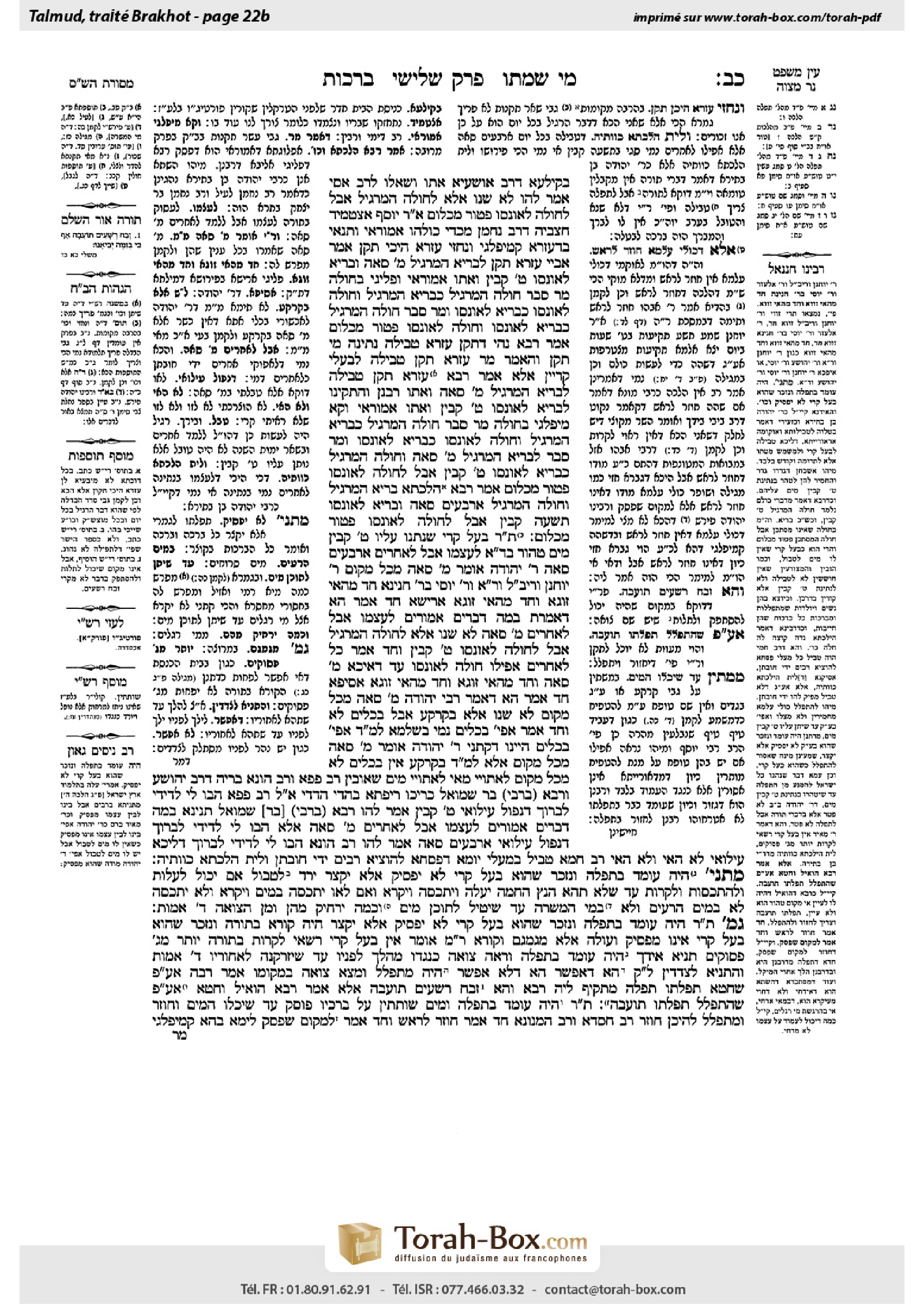
Berakhot 22b: Talmud study for Daf Yomi
Study the Talmud for Daf Yomi with scanned pages, Hebrew text, English translations from Sefaria and AI-generated French translations.
Passage selection and English or AI-generated French translation are available where the scan has annotations. Daf Study is independent of Torah-Box and Sefaria.
Browse Berakhot · ברכות · All tractatesBerakhot 22b text and translations
This page of Berakhot includes the Aramaic text, an English translation and an AI-generated French translation, alongside the scan above.
ברכות כ״ב ב · Aramaic and Hebrew text
בְּקִילְעָא דְּרַב אוֹשַׁעְיָא, אֲתוֹ וּשְׁאִלוּ לְרַב אַסִּי. אֲמַר לְהוּ: לֹא שָׁנוּ אֶלָּא לְחוֹלֶה הַמַּרְגִּיל, אֲבָל לְחוֹלֶה לְאוֹנְסוֹ פָּטוּר מִכְּלוּם. אָמַר רַב יוֹסֵף: אִצְטְמִיד חַצְבֵּיהּ דְּרַב נַחְמָן.
מִכְּדֵי כּוּלְּהוּ אָמוֹרָאֵי וְתַנָּאֵי בִּדְעֶזְרָא קָמִיפַּלְגִי, וְנֶחְזֵי עֶזְרָא הֵיכִי תַּקֵּן.
אָמַר אַבָּיֵי: עֶזְרָא תַּקֵּן לְבָרִיא הַמַּרְגִּיל אַרְבָּעִים סְאָה, וּבָרִיא לְאוֹנְסוֹ תִּשְׁעָה קַבִּין. וַאֲתוֹ אָמוֹרָאֵי וּפְלִיגִי בְּחוֹלֶה. מָר סָבַר חוֹלֶה הַמַּרְגִּיל כְּבָרִיא הַמַּרְגִּיל וְחוֹלֶה לְאוֹנְסוֹ כְּבָרִיא לְאוֹנְסוֹ. וּמַר סָבַר חוֹלֶה הַמַּרְגִּיל כְּבָרִיא לְאוֹנְסוֹ, וְחוֹלֶה לְאוֹנְסוֹ פָּטוּר מִכְּלוּם.
אָמַר רָבָא: נְהִי דְּתַקֵּן עֶזְרָא טְבִילָה, נְתִינָה מִי תַּקֵּן?! וְהָאָמַר מָר עֶזְרָא תִּקֵּן טְבִילָה לְבַעֲלֵי קְרָיִין. אֶלָּא אָמַר רָבָא: עֶזְרָא תַּקֵּן טְבִילָה לְבָרִיא הַמַּרְגִּיל אַרְבָּעִים סְאָה. וַאֲתוֹ רַבָּנַן וְהַתְקִינוּ לְבָרִיא לְאוֹנְסוֹ תִּשְׁעָה קַבִּין. וַאֲתוֹ אָמוֹרָאֵי וְקָא מִיפַּלְגִי בְּחוֹלֶה, מָר סָבַר חוֹלֶה הַמַּרְגִּיל כְּבָרִיא הַמַּרְגִּיל, וְחוֹלֶה לְאוֹנְסוֹ — כְּבָרִיא לְאוֹנְסוֹ, וּמַר סָבַר לְבָרִיא הַמַּרְגִּיל אַרְבָּעִים סְאָה, וְחוֹלֶה הַמַּרְגִּיל כְּבָרִיא לְאוֹנְסוֹ — תִּשְׁעָה קַבִּין. אֲבָל לְחוֹלֶה לְאוֹנְסוֹ פָּטוּר מִכְּלוּם.
אָמַר רָבָא הִלְכְתָא: בָּרִיא הַמַּרְגִּיל וְחוֹלֶה הַמַּרְגִּיל — אַרְבָּעִים סְאָה. וּבָרִיא לְאוֹנְסוֹ — תִּשְׁעָה קַבִּין. אֲבָל לְחוֹלֶה לְאוֹנְסוֹ — פָּטוּר מִכְּלוּם.
תָּנוּ רַבָּנַן: בַּעַל קֶרִי שֶׁנָּתְנוּ עָלָיו תִּשְׁעָה קַבִּין מַיִם — טָהוֹר. בַּמֶּה דְּבָרִים אֲמוּרִים — לְעַצְמוֹ, אֲבָל לַאֲחֵרִים אַרְבָּעִים סְאָה. רַבִּי יְהוּדָה אוֹמֵר: אַרְבָּעִים סְאָה מִכׇּל מָקוֹם.
רַבִּי יוֹחָנָן וְרַבִּי יְהוֹשֻׁעַ בֶּן לֵוִי וְרַבִּי אֶלְעָזָר וְרַבִּי יוֹסֵי בְּרַבִּי חֲנִינָא. חַד מֵהַאי זוּגָא וְחַד מֵהַאי זוּגָא אַרֵישָׁא, חַד אָמַר: הָא דְּאָמְרַתְּ בַּמֶּה דְּבָרִים אֲמוּרִים לְעַצְמוֹ, אֲבָל לַאֲחֵרִים אַרְבָּעִים סְאָה, לֹא שָׁנוּ אֶלָּא לְחוֹלֶה הַמַּרְגִּיל, אֲבָל לְחוֹלֶה לְאוֹנְסוֹ תִּשְׁעָה קַבִּין. וְחַד אָמַר: כׇּל לַאֲחֵרִים, אֲפִילּוּ חוֹלֶה לְאוֹנְסוֹ עַד דְּאִיכָּא אַרְבָּעִים סְאָה.
וְחַד מֵהַאי זוּגָא וְחַד מֵהַאי זוּגָא אַסֵּיפָא. חַד אָמַר: הָא דְאָמַר רַבִּי יְהוּדָה אַרְבָּעִים סְאָה מִכׇּל מָקוֹם — לֹא שָׁנוּ אֶלָּא בְּקַרְקַע, אֲבָל בְּכֵלִים — לֹא. וְחַד אָמַר: אֲפִילּוּ בְּכֵלִים נָמֵי.
בִּשְׁלָמָא לְמַאן דְּאָמַר אֲפִילּוּ בְּכֵלִים — הַיְינוּ דְּקָתָנֵי רַבִּי יְהוּדָה אוֹמֵר: ״אַרְבָּעִים סְאָה מִכׇּל מָקוֹם״. אֶלָּא לְמַאן דְּאָמַר בְּקַרְקַע — אִין, בְּכֵלִים — לָא, ״מִכׇּל מָקוֹם״ לְאֵתוּיֵי מַאי?
לְאֵתוּיֵי מַיִם שְׁאוּבִין.
רַב פָּפָּא וְרַב הוּנָא בְּרֵיהּ דְּרַב יְהוֹשֻׁעַ וְרָבָא בְּרַבִּי בַּר שְׁמוּאֵל כְּרִיכוּ רִיפְתָּא בַּהֲדֵי הֲדָדֵי. אֲמַר לְהוּ רַב פָּפָּא: הַבוּ לִי לְדִידִי לִבְרוֹךְ, דִּנְפוּל עִילָּוַאי תִּשְׁעָה קַבִּין. אֲמַר לְהוּ רָבָא בְּרַבִּי בַּר שְׁמוּאֵל: תְּנֵינָא, בַּמֶּה דְּבָרִים אֲמוּרִים — לְעַצְמוֹ, אֲבָל לַאֲחֵרִים — אַרְבָּעִים סְאָה. אֶלָּא, הַבוּ לִי לְדִידִי לִבְרוֹךְ, דִּנְפוּל עִילָּוַאי אַרְבָּעִים סְאָה. אֲמַר לְהוּ רַב הוּנָא: הַבוּ לִי לְדִידִי לִבְרוֹךְ, דְּלֵיכָּא עִילָּוַאי לָא הַאי וְלָא הַאי.
רַב חָמָא טָבֵיל בְּמַעֲלֵי יוֹמָא דְפִסְחָא לְהוֹצִיא רַבִּים יְדֵי חוֹבָתָן. וְלֵית הִלְכְתָא כְּווֹתֵיהּ.
מַתְנִי׳ הָיָה עוֹמֵד בִּתְפִלָּה וְנִזְכַּר שֶׁהוּא בַּעַל קֶרִי, לֹא יַפְסִיק, אֶלָּא יְקַצֵּר.
יָרַד לִטְבּוֹל, אִם יָכוֹל לַעֲלוֹת וּלְהִתְכַּסּוֹת וְלִקְרוֹת עַד שֶׁלֹּא תְּהֵא הָנֵץ הַחַמָּה — יַעֲלֶה וְיִתְכַּסֶּה וְיִקְרָא, וְאִם לָאו — יִתְכַּסֶּה בְּמַיִם וְיִקְרָא. וְלֹא יִתְכַּסֶּה לֹא בַּמַּיִם הָרָעִים וְלֹא בְּמֵי הַמִּשְׁרָה, עַד שֶׁיָּטִיל לְתוֹכָן מַיִם. וְכַמָּה יַרְחִיק מֵהֶן וּמִן הַצּוֹאָה — אַרְבַּע אַמּוֹת.
גְּמָ׳ תָּנוּ רַבָּנַן: הָיָה עוֹמֵד בִּתְפִלָּה וְנִזְכַּר שֶׁהוּא בַּעַל קֶרִי — לֹא יַפְסִיק, אֶלָּא יְקַצֵּר. הָיָה קוֹרֵא בַּתּוֹרָה וְנִזְכַּר שֶׁהוּא בַּעַל קֶרִי — אֵינוֹ מַפְסִיק וְעוֹלֶה, אֶלָּא מְגַמְגֵּם וְקוֹרֵא. רַבִּי מֵאִיר אוֹמֵר: אֵין בַּעַל קֶרִי רַשַּׁאי לִקְרוֹת בַּתּוֹרָה יוֹתֵר מִשְּׁלֹשָׁה פְּסוּקִים.
תַּנְיָא אִידַּךְ: הָיָה עוֹמֵד בִּתְפִלָּה וְרָאָה צוֹאָה כְּנֶגְדּוֹ — מְהַלֵּךְ לְפָנָיו עַד שֶׁיִּזְרְקֶנָּה לַאֲחוֹרָיו אַרְבַּע אַמּוֹת. וְהָתַנְיָא לִצְדָדִין. לָא קַשְׁיָא, הָא, דְּאֶפְשָׁר, הָא, דְּלָא אֶפְשָׁר.
הָיָה מִתְפַּלֵּל וּמָצָא צוֹאָה בִּמְקוֹמוֹ, אָמַר רַבָּה: אַף עַל פִּי שֶׁחָטָא — תְּפִלָּתוֹ תְּפִלָּה. מַתְקִיף לֵיהּ רָבָא: וְהָא: ״זֶבַח רְשָׁעִים תּוֹעֵבָה״! אֶלָּא אָמַר רָבָא: הוֹאִיל וְחָטָא, אַף עַל פִּי שֶׁהִתְפַּלֵּל — תְּפִלָּתוֹ תּוֹעֵבָה.
תָּנוּ רַבָּנַן: הָיָה עוֹמֵד בִּתְפִלָּה וּמַיִם שׁוֹתְתִין עַל בִּרְכָּיו — פּוֹסֵק עַד שֶׁיִּכְלוּ הַמַּיִם וְחוֹזֵר וּמִתְפַּלֵּל. לְהֵיכָן חוֹזֵר? רַב חִסְדָּא וְרַב הַמְנוּנָא, חַד אָמַר חוֹזֵר לָרֹאשׁ, וְחַד אָמַר: לְמָקוֹם שֶׁפָּסַק.
לֵימָא בְּהָא קָמִיפַּלְגִי:
Berakhot 22b · English translation
that this problem was raised in Rav Oshaya’s chamber, and they came and asked Rav Asi. He said to them: They only stated the obligation to pour water over one who is impure because of a seminal emission with regard to a sick person who experienced a normal seminal emission, but a sick person who experienced an involuntary seminal emission is clearly exempt from anything and requires no immersion whatsoever. Rav Yosef said: In that case, Rav Naḥman’s jug is rejoined, meaning that it is effective with regard to purification.
Up to now, discussion has focused on various problems pertaining to the laws of immersion as they concern one whose impurity is due to seminal emission. The Gemara asks: Since all of the amora’im and tanna’im disagree with regard to the decree of Ezra, let us examine how Ezra instituted this ordinance, as this is not an uncommon circumstance and we can see how they conducted themselves.
Abaye said: Ezra did not institute a sweeping ordinance concerning every case of one who experienced a seminal emission; rather, he instituted only that a healthy person who experienced a normal seminal emission is required to immerse himself in forty se’a, while for a healthy person who experienced an involuntary seminal emission, nine kav are sufficient. And the amora’im came and disagreed with regard to a sick person. One Sage held that a sick person who experienced a normal seminal emission is considered like a healthy person who experienced a normal seminal emission, while a sick person who experienced an involuntary seminal emission is considered like a healthy person who experienced an involuntary seminal emission. However, another Sage maintained that a sick person who experienced a normal seminal emission is considered like a healthy person who experienced an involuntary seminal emission, and consequently requires only that nine kav be poured over him, while a sick person who experienced an involuntary seminal emission is exempt from any form of immersion or purification.
Rava said: Although Ezra instituted immersion for one who experienced a seminal emission, did he institute the pouring of nine kav? Didn’t the Master say that we have a tradition that Ezra only instituted immersion for those who experienced a seminal emission? Rather, Rava said: We must explain that the diverse opinions developed after Ezra’s decree. Ezra himself instituted immersion in forty se’a only for a healthy person who experienced a normal seminal emission. And the Sages came and instituted that a healthy person who experienced an involuntary seminal emission should have nine kav poured over him. And then the amora’im came and disagreed with regard to a sick person; one Sage held that a sick person who experienced a normal seminal emission is considered like a healthy person who experienced a normal seminal emission, while a sick person who experienced an involuntary seminal emission is considered like a healthy person who experienced an involuntary seminal emission, another Sage maintained that only a healthy person who experienced a normal seminal emission is required to immerse himself in forty se’a while a sick person who experienced a normal seminal emission is considered like a healthy person who experienced an involuntary seminal emission, requiring only nine kav. But a sick person who experienced an involuntary seminal emission is exempt from any form of immersion or purification.
Rava stated that the halakhic ruling is in accordance with the first opinion: A healthy person who experienced a normal seminal emission and a sick person who experienced a normal seminal emission require forty se’a, while a healthy person who experienced an involuntary seminal emission suffices with nine kav. But a sick person who experienced an involuntary seminal emission is exempt from undergoing any rite of purification.
The Sages taught in a Tosefta: One who experienced a seminal emission and had nine kav of drawn water poured over him is ritually pure. In what case is this statement said? In a case involving Torah study for himself, but in order to purify himself that he may teach Torah to others, he must immerse himself in forty se’a. Rabbi Yehuda says: Forty se’a is required for purification in any case.
With regard to this issue, a dispute arose between Rabbi Yoḥanan and Rabbi Yehoshua ben Levi, and Rabbi Elazar and Rabbi Yosei, son of Rabbi Ḥanina. One member of this pair and one member of that pair disagreed with regard to the first clause of the Tosefta. One said: That which you said: In what case is this statement said? In a case involving Torah study for himself, but in order to purify himself that he may teach Torah to others, he must immerse himself in forty se’a, was only taught regarding a sick person who experienced a normal seminal emission, but for a sick person who experienced an involuntary seminal emission, nine kav is sufficient even for teaching others. And one said that anyone who teaches others, even if he was sick and experienced an involuntary seminal emission, is not considered pure until there are forty se’a.
And one member of this pair and one member of that pair disagreed with regard to the latter clause of the Tosefta. One said: That which Rabbi Yehuda said: Forty se’a in any case, was only taught when the water is in the ground, in accordance with the Torah law of ritual bath, but not if it was collected in vessels. And one said: Even forty se’a collected in vessels are sufficient for purification.
The Gemara clarifies this problem: Granted, according to the one who said that forty se’a purifies even in vessels. That is why the Tosefta taught: Rabbi Yehuda says: Forty se’a in any case. However, according to the one who said that Rabbi Yehuda’s opinion is that forty se’a in the ground, yes, it purifies, but in vessels, no, it does not purify, what does the expression in any case come to include?
The Gemara explains: In any case comes to include drawn water, as Rabbi Yehuda permits immersion in forty se’a of water collected in the ground even if the water was drawn by human hand.
The Gemara relates that Rav Pappa and Rav Huna, son of Rav Yehoshua, and Rava bar Shmuel ate bread together. Rav Pappa said to them: Allow me to recite Grace after Meals for the group, as I am ritually pure because nine kav of water fell upon me; in other words, he poured it over himself. Rava bar Shmuel said to them: We learned, in what case is this statement that nine kav purify, said? In a case involving Torah study for himself. But, in order to purify himself that he may teach Torah to others, and by extension to fulfill the obligation of others, he must immerse himself in forty se’a. Rather, allow me to recite Grace after Meals for the group, as forty se’a of water fell upon me; in other words, I immersed myself in a ritual bath. Rav Huna said to them: Allow me to recite Grace after Meals for the group, as I have had neither this nor that upon me because I remained ritually pure.
It is also said that Rav Ḥama would immerse himself on Passover eve in order to fulfill the obligations of the masses. However the Gemara concludes: The halakha is not in accordance with his opinion that distinguishes between the purification for oneself and purification for the sake of others.
MISHNA: This mishna contains various statements with regard to individuals with different types of ritual impurity as well as the need to distance oneself from filth and impurity. One who was standing in prayer and he recalled that he experienced a seminal emission, and according to this opinion he is prohibited from praying, should not interrupt his prayer, rather he should abridge each individual blessing.
They stated a general principle: One who descended to immerse himself, if he is able to ascend, cover himself with a garment, and recite the morning Shema before sunrise, he should ascend, cover himself, and recite Shema, and if not, he should cover himself in the water and recite Shema there. He may not, however, cover himself in either foul water, or water in which flax was soaked, until he pours other water into it. And in general, how far must one distance himself from urine and feces in order to recite Shema? At least four cubits.
GEMARA: A baraita further elaborates on the first halakha in the mishna. The Sages taught: One who was standing in prayer and he recalled that he had experienced a seminal emission, should not interrupt his prayer. Rather, he should abridge. One who was reading the Torah and recalled that he experienced a seminal emission, does not interrupt his reading, but rather reads quickly with less than perfect diction. Rabbi Meir disagrees and says: One who experienced a seminal emission is not permitted to read more than three verses in the Torah, as one may read no fewer than three verses in the Torah. After he completes three verses, he must stop and let someone else continue.
It was taught in another baraita: One who was standing in prayer and he saw feces before him must walk forward until he has placed it four cubits behind him. The Gemara challenges this: Wasn’t it taught in another baraita that it is sufficient if he distances himself four cubits to the side? The Gemara resolves this contradiction: This is not difficult, as that baraita which taught that it must be four cubits behind him, is referring to a case where it is possible for him to advance that distance, while that baraita which taught that he may distance himself four cubits to the side, is referring to a case where it is not possible to advance four cubits, in which case he must at least step to the side.
The Gemara cites another halakha: One who was praying and later found feces in the place where he prayed, Rabba said: Although he committed a transgression in his failure to examine that venue to determine if it was worthy of prayer (Tosafot), his prayer is a valid prayer and he fulfilled his obligation. Rava strongly objects to his statement: Isn’t it stated: “The sacrifice of the wicked is an abomination, the more so as he offers it in depravity” (Proverbs 21:27), from which we derive that a mitzva performed inappropriately is no mitzva at all? Consequently, the fact that he did not pay proper attention invalidates his prayer. Rather, Rava said: Because this person committed a transgression, although he prayed, his prayer is an abomination and he must pray again.
The Sages taught in a baraita: One who was standing in prayer when, for some reason, urine is flowing on his knees, he must interrupt his prayer until the urine ceases, and then resume praying. The Gemara, asks: To where in the prayer does he return when he resumes his prayer? Rav Ḥisda and Rav Hamnuna disagreed; one said: He must return to the beginning of the prayer, and the other said: He must return to the point where he stopped.
The Gemara notes: Let us say that they disagree about this:
Berakhot 22b · Traduction française (IA)
que ce problème a été soulevé dans la chambre de Rav Oshaya, et ils sont venus demander à Rav Asi. Il leur a répondu : Ils ont seulement évoqué l'obligation de verser de l'eau sur celui qui est impur en raison d'une émission sémencière, concernant une personne malade qui a eu une émission sémencière normale, mais une personne malade qui a eu une émission sémencière involontaire est clairement exemptée de toute chose et n'a besoin d'aucune immersion. Rav Yosef a dit : Dans ce cas, le tonneau de Rav Naḥman est rejoint, ce qui signifie qu'il est efficace en ce qui concerne la purification.
Jusqu'à présent, la discussion s'est concentrée sur divers problèmes relatifs aux lois de l'immersion, concernant celui dont l'impureté provient d'une émission sémencière. La Guemara pose la question : Puisque tous les amoraïm et tannaïm s'opposent au décret d'Ezra, examinons comment Ezra a institué cette ordonnance, car cela n'est pas une situation inhabituelle et nous pouvons voir comment ils se sont comportés.
Abaye a dit : Ezra n'a pas institué une ordonnance générale concernant chaque cas de personne ayant eu une émission sémencière ; plutôt, il a institué que la personne saine ayant eu une émission sémencière normale doit s'immerger dans quarante se'a, tandis que pour une personne saine ayant eu une émission sémencière involontaire, neuf kav suffisent. Et les amoraïm se sont divisés sur la question d'une personne malade. Un sage a affirmé qu'une personne malade ayant eu une émission sémencière normale est considérée comme une personne saine ayant eu une émission sémencière normale, tandis qu'une personne malade ayant eu une émission sémencière involontaire est considérée comme une personne saine ayant eu une émission sémencière involontaire. Cependant, un autre sage a maintenu qu'une personne malade ayant eu une émission sémencière normale est considérée comme une personne saine ayant eu une émission sémencière involontaire, et par conséquent, il suffit de verser neuf kav sur elle, tandis qu'une personne malade ayant eu une émission sémencière involontaire est exemptée de toute forme d'immersion ou de purification.
Rava a dit : Bien que Ezra ait institué l'immersion pour celui qui a eu une émission sémencière, a-t-il institué le versement de neuf kav ? N'a-t-il pas dit le Maître que nous avons une tradition selon laquelle Ezra a institué l'immersion uniquement pour ceux qui ont eu une émission sémencière ? Plutôt, Rava a dit : Nous devons expliquer que les divergences d'opinions se sont développées après le décret d'Ezra. Ezra lui-même a institué l'immersion dans quarante se'a uniquement pour une personne saine ayant eu une émission sémencière normale. Et les Sages sont venus instituer que pour une personne saine ayant eu une émission sémencière involontaire, il suffit de verser neuf kav sur elle. Et ensuite, les amoraïm sont venus s'opposer concernant une personne malade ; un sage a affirmé qu'une personne malade ayant eu une émission sémencière normale est considérée comme une personne saine ayant eu une émission sémencière normale, tandis qu'une personne malade ayant eu une émission sémencière involontaire est considérée comme une personne saine ayant eu une émission sémencière involontaire, un autre sage a maintenu que seule une personne saine ayant eu une émission sémencière normale doit s'immerger dans quarante se'a, tandis qu'une personne malade ayant eu une émission sémencière normale est considérée comme une personne saine ayant eu une émission sémencière involontaire, nécessitant seulement neuf kav. Mais une personne malade ayant eu une émission sémencière involontaire est exemptée de toute forme d'immersion ou de purification.
Rava a affirmé que le règlement halakhique suit l'opinion première : une personne saine ayant eu une émission sémencière normale et une personne malade ayant eu une émission sémencière normale nécessitent quarante se'a, tandis qu'une personne saine ayant eu une émission sémencière involontaire suffit à neuf kav. Mais une personne malade ayant eu une émission sémencière involontaire est exemptée de toute cérémonie de purification.
Les Sages ont enseigné dans une Tosefta : celui qui a eu une émission sémencière et qui a eu neuf kav d'eau tirée versé sur lui est rituellement pur. Dans quel cas cette déclaration est-elle faite ? Dans un cas concernant l'étude de la Torah pour soi-même, mais afin de se purifier afin de pouvoir enseigner la Torah aux autres, il doit s'immerger dans quarante se'a. Rabbi Yehuda dit : quarante se'a sont nécessaires pour la purification dans tous les cas.
Concernant ce problème, un désaccord s'est produit entre Rabbi Yoḥanan et Rabbi Yehoshua ben Levi, et entre Rabbi Elazar et Rabbi Yosei, fils de Rabbi Ḥanina. Un membre de ce dernier et un membre de celui-ci ont divergé concernant la première clause de la Tosefta. Un a dit : Ce que vous avez dit : Dans quel cas cette déclaration est-elle faite ? Dans un cas concernant l'étude de la Torah pour soi-même, mais afin de se purifier afin de pouvoir enseigner la Torah aux autres, il doit s'immerger dans quarante se'a, a été enseigné uniquement concernant une personne malade ayant eu une émission sémencière normale, mais pour une personne malade ayant eu une émission sémencière involontaire, neuf kav suffisent même pour enseigner aux autres. Et un a dit que celui qui enseigne aux autres, même s'il était malade et avait eu une émission sémencière involontaire, n'est considéré comme pur que lorsqu'il y a quarante se'a.
Un membre de ce couple et un membre de l'autre couple ont divergé concernant la seconde clause de la Tosefta. Un a dit : Ce que Rabbi Yehuda a dit : quarante se'a dans tous les cas, a été enseigné uniquement lorsque l'eau est dans le sol, conformément à la loi du bain rituel, mais pas si elle a été collectée dans des récipients. Et un a dit : même quarante se'a collectés dans des récipients sont suffisants pour la purification.
La Guemara clarifie ce problème : Évidemment, selon celui qui a dit que quarante se'a purifient même dans les récipients. C'est pourquoi la Tosefta a enseigné : Rabbi Yehuda dit : quarante se'a dans tous les cas. Cependant, selon celui qui a dit que l'opinion de Rabbi Yehuda est que quarante se'a dans le sol, oui, il purifie, mais dans les récipients, non, il ne purifie pas, à quoi la formulation « dans tous les cas » vient-elle inclure ?
La Guemara explique : « Dans tous les cas » vient inclure l'eau tirée, car Rabbi Yehuda permet l'immersion dans quarante se'a d'eau collectée dans le sol même si l'eau a été tirée par la main humaine.
La Guemara rapporte que Rav Pappa et Rav Huna, fils de Rav Yéhoshua, et Rava bar Shmuel ont mangé du pain ensemble. Rav Pappa dit à eux : Permettez-moi de réciter la Bérit après le repas pour le groupe, car je suis rituellement pur car neuf kav d'eau sont tombés sur moi ; autrement dit, il les a versés sur lui. Rava bar Shmuel dit à eux : Nous avons appris, dans quel cas cette déclaration que neuf kav purifient, est-elle dite ? Dans un cas impliquant l'étude de la Torah pour soi-même. Mais, afin de se purifier afin de pouvoir enseigner la Torah aux autres, et par extension pour remplir l'obligation des autres, il doit se purifier dans quarante se'a. Plutôt, permettez-moi de réciter la Bérit après le repas pour le groupe, car quarante se'a d'eau sont tombés sur moi ; autrement dit, j'ai fait une ablution rituelle. Rav Huna dit à eux : Permettez-moi de réciter la Bérit après le repas pour le groupe, car je n'ai eu ni cela ni cela sur moi car je suis resté rituellement pur.
Il est aussi dit que Rav Ḥama se purifiait le soir de Pessah afin de remplir les obligations du peuple. Cependant la Guemara conclut : La halakha ne suit pas son opinion qui distingue entre la purification pour soi-même et la purification pour le bénéfice des autres.
MICHNA : Cette mishna contient diverses déclarations concernant des personnes avec différents types d'impureté rituelle ainsi que la nécessité de s'éloigner de la saleté et de l'impureté. Celui qui priait et se rappelait qu'il avait eu une émission sémencière, et selon cette opinion il est interdit de prier, ne doit pas interrompre sa prière, plutôt il doit abréger chaque bénédiction individuelle.
Ils ont énoncé un principe général : Celui qui descend pour se purifier, s'il peut monter, se couvrir d'un vêtement et réciter le Chéma matinal avant l'aube, il doit monter, se couvrir et réciter le Chéma, et s'il ne peut pas, il doit se couvrir dans l'eau et réciter le Chéma là. Il ne doit pas cependant se couvrir dans un eau impure, ou dans de l'eau où du lin avait été trempé, jusqu'à ce qu'il verse d'autres eaux dedans. Et en général, à quelle distance doit-on s'éloigner des urines et des excréments afin de réciter le Chéma ? Au moins quatre coudées.
GUEMARA : Une baraïta développe davantage la première halakha de la mishna. Les Sages enseignèrent : Celui qui priait et se rappelait qu'il avait eu une émission sémencière, ne doit pas interrompre sa prière. Plutôt, il doit abréger. Celui qui lisait la Torah et se rappelait qu'il avait eu une émission sémencière, ne doit pas interrompre sa lecture, mais plutôt lire rapidement avec une prononciation moins parfaite. Rabbi Meïr désaccorde et dit : Celui qui a eu une émission sémencière n'est pas autorisé à lire plus de trois versets dans la Torah, car on peut lire au moins trois versets dans la Torah. Après qu'il ait terminé trois versets, il doit s'arrêter et laisser quelqu'un d'autre continuer.
Il a été enseigné dans une autre baraïta : Celui qui priait et voyait des excréments devant lui doit marcher jusqu'à ce qu'il ait mis celui-ci quatre coudées derrière lui. La Guemara conteste cela : N'était-ce pas enseigné dans une autre baraïta que quatre coudées suffisent en se déplaçant à côté ? La Guemara résout ce conflit : Ce n'est pas difficile, car cette baraïta qui enseignait qu'il faut quatre coudées derrière lui, fait référence à un cas où il est possible de s'avancer cette distance, tandis que celle qui enseignait qu'on peut s'éloigner quatre coudées à côté, fait référence à un cas où il n'est pas possible de s'avancer quatre coudées, dans ce cas il faut au moins marcher à côté.
La Guemara cite une autre halakha : Celui qui priait et trouva plus tard des excréments là où il avait prié, Rabba dit : Bien qu'il ait commis un péché en n'ayant pas examiné ce lieu pour déterminer s'il était digne de prière (Tosafot), sa prière est une prière valide et il a rempli son obligation. Rava s'oppose fermement à son affirmation : N'est-il pas dit : « Le sacrifice des méchants est une abomination, d'autant plus qu'il l'offre dans la dépravation » (Proverbes 21:27), d'où nous dérivons que une mitsva accomplie de manière inappropriée n'est pas une mitsva du tout ? Ainsi, le fait qu'il n'ait pas pris soin de vérifier invalide sa prière. Plutôt, Rava dit : Parce que cette personne a commis un péché, bien qu'il ait prié, sa prière est une abomination et il doit prier à nouveau.
Les Sages enseignèrent dans une baraïta : Celui qui priait et, pour une raison quelconque, de l'urine coulait sur ses genoux, il doit interrompre sa prière jusqu'à ce que l'urine cesse, puis reprendre la prière. La Guemara demande : Où dans la prière doit-il reprendre lorsqu'il reprend sa prière ? Rav Ḥisda et Rav Hamnuna s'opinèrent ; l'un dit : Il doit revenir au début de la prière, et l'autre dit : Il doit revenir au point où il avait arrêté.
La Guemara note : Disons qu'ils s'opinent sur cela :
Traduction française générée par IA à partir de l’édition anglaise de Sefaria. Vérifie toujours un passage avec le texte source.
Text from Sefaria: William Davidson Edition - Vocalized Aramaic (CC BY NC); William Davidson Edition - English (CC BY NC).