Berakhot 23a: Talmud study for Daf Yomi
Study the Talmud for Daf Yomi with scanned pages, Hebrew text, English translations from Sefaria and AI-generated French translations.
Passage selection and English or AI-generated French translation are available where the scan has annotations. Daf Study is independent of Torah-Box and Sefaria.
Browse Berakhot · ברכות · All tractatesBerakhot 23a text and translations
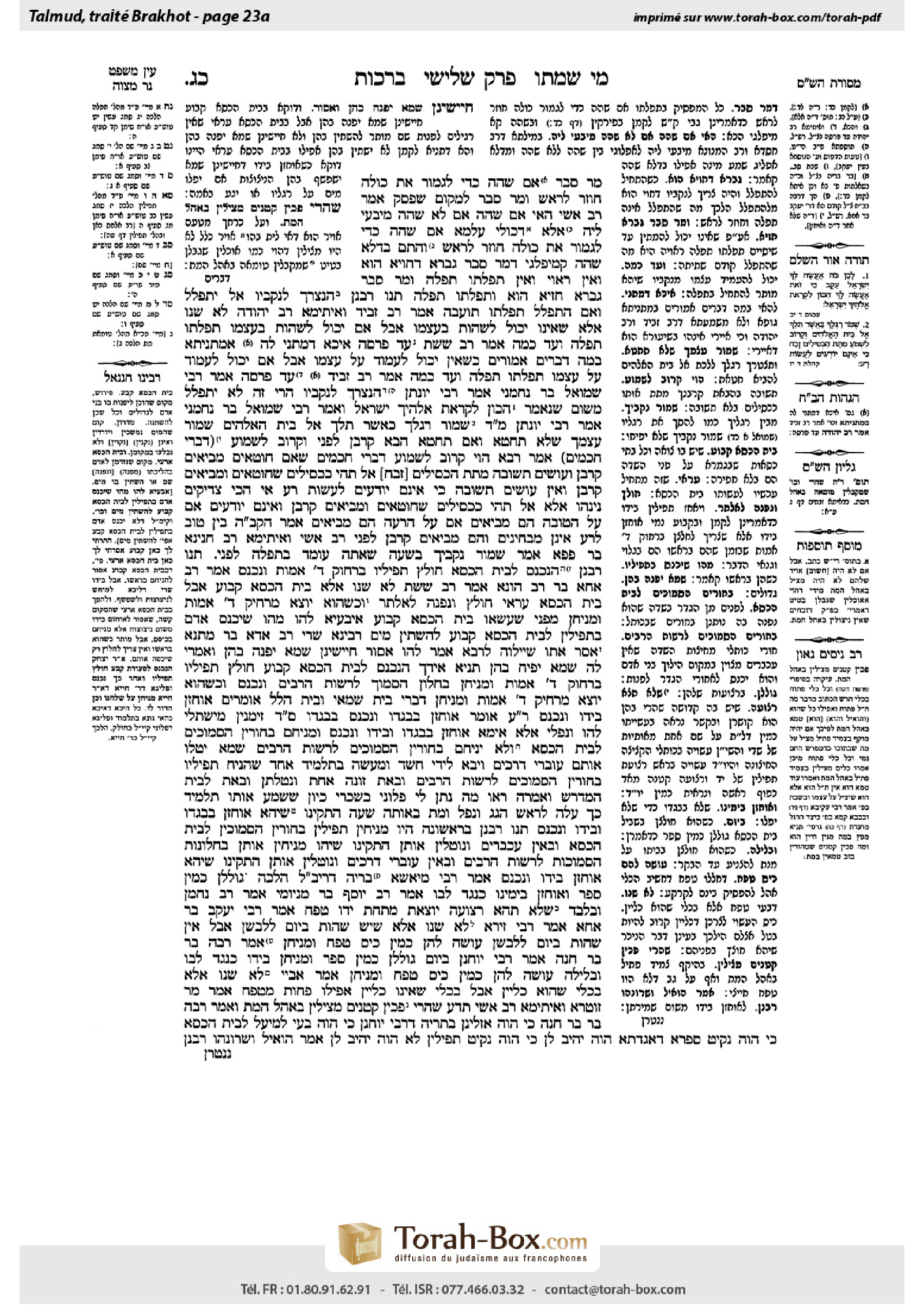
This page of Berakhot includes the Aramaic text, an English translation and an AI-generated French translation, alongside the scan above.
ברכות כ״ג א · Aramaic and Hebrew text
מָר סָבַר: אִם שָׁהָה כְּדֵי לִגְמוֹר אֶת כּוּלָּהּ — חוֹזֵר לָרֹאשׁ. וּמַר סָבַר: לְמָקוֹם שֶׁפָּסַק.
אָמַר רַב אָשֵׁי: הַאי ״אִם שָׁהָה״, אִם לֹא שָׁהָה מִיבְּעֵי לֵיהּ! אֶלָּא, דְּכוּלֵּי עָלְמָא אִם שָׁהָה כְּדֵי לִגְמוֹר אֶת כּוּלָּהּ — חוֹזֵר לָרֹאשׁ, וְהָתָם בִּדְלֹא שָׁהָה קָמִיפַּלְגִי, דְּמָר סָבַר גַּבְרָא דְחוּיָא הוּא, וְאֵין רָאוּי, וְאֵין תְּפִלָּתוֹ תְּפִלָּה. וּמַר סָבַר גַּבְרָא חַזְיָא הוּא, וּתְפִלָּתוֹ תְּפִלָּה.
תָּנוּ רַבָּנַן: הַנִּצְרָךְ לִנְקָבָיו — אַל יִתְפַּלֵּל, וְאִם הִתְפַּלֵּל — תְּפִלָּתוֹ תּוֹעֵבָה. אָמַר רַב זְבִיד וְאִיתֵּימָא רַב יְהוּדָה: לֹא שָׁנוּ אֶלָּא שֶׁאֵינוֹ יָכוֹל לִשְׁהוֹת בְּעַצְמוֹ, אֲבָל אִם יָכוֹל לִשְׁהוֹת בְּעַצְמוֹ — תְּפִלָּתוֹ תְּפִלָּה.
וְעַד כַּמָּה? אָמַר רַב שֵׁשֶׁת: עַד פַּרְסָה. אִיכָּא דְּמַתְנֵי לַהּ אַמַּתְנִיתָא: בַּמֶּה דְּבָרִים אֲמוּרִים — כְּשֶׁאֵין יָכוֹל לַעֲמוֹד עַל עַצְמוֹ. אֲבָל אִם יָכוֹל לַעֲמוֹד עַל עַצְמוֹ — תְּפִלָּתוֹ תְּפִלָּה. וְעַד כַּמָּה? אָמַר רַב זְבִיד: עַד פַּרְסָה.
אָמַר רַבִּי שְׁמוּאֵל בַּר נַחְמָנִי אָמַר רַבִּי יוֹנָתָן: הַנִּצְרָךְ לִנְקָבָיו — הֲרֵי זֶה לֹא יִתְפַּלֵּל, מִשּׁוּם שֶׁנֶּאֱמַר: ״הִכּוֹן לִקְרַאת אֱלֹהֶיךָ יִשְׂרָאֵל״.
וְאָמַר רַבִּי שְׁמוּאֵל בַּר נַחְמָנִי אָמַר רַבִּי יוֹנָתָן: מַאי דִּכְתִיב: ״שְׁמוֹר רַגְלְךָ כַּאֲשֶׁר תֵּלֵךְ אֶל בֵּית הָאֱלֹהִים״? שְׁמוֹר עַצְמְךָ שֶׁלֹּא תֶּחְטָא, וְאִם תֶּחְטָא — הָבֵא קׇרְבָּן לְפָנַי. ״וְקָרוֹב לִשְׁמֹעַ דִּבְרֵי חֲכָמִים״, אָמַר רָבָא: הֱוֵי קָרוֹב לִשְׁמוֹעַ דִּבְרֵי חֲכָמִים, שֶׁאִם חוֹטְאִים מְבִיאִים קׇרְבָּן וְעוֹשִׂים תְּשׁוּבָה. ״מִתֵּת הַכְּסִילִים זָבַח״ — אַל תְּהִי כַּכְּסִילִים שֶׁחוֹטְאִים וּמְבִיאִים קׇרְבָּן, וְאֵין עוֹשִׂים תְּשׁוּבָה.
״כִּי אֵינָם יוֹדְעִים לַעֲשׂוֹת רָע״ אִי הָכִי צַדִּיקִים נִינְהוּ! אֶלָּא, אַל תְּהִי כַּכְּסִילִים שֶׁחוֹטְאִים וּמְבִיאִים קׇרְבָּן, וְאֵינָם יוֹדְעִים אִם עַל הַטּוֹבָה הֵם מְבִיאִים, אִם עַל הָרָעָה הֵם מְבִיאִים. אָמַר הַקָּדוֹשׁ בָּרוּךְ הוּא: בֵּין טוֹב לְרַע אֵינָן מַבְחִינִים, וְהֵם מְבִיאִים קׇרְבָּן לְפָנַי?!
רַב אָשֵׁי וְאִיתֵּימָא רַבִּי חֲנִינָא בַּר פָּפָּא אָמַר: שְׁמוֹר נְקָבֶיךָ בְּשָׁעָה שֶׁאַתָּה עוֹמֵד בִּתְפִלָּה לְפָנַי.
תָּנוּ רַבָּנַן: הַנִּכְנָס לְבֵית הַכִּסֵּא, חוֹלֵץ תְּפִילָּיו בְּרִחוּק אַרְבַּע אַמּוֹת, וְנִכְנָס. אָמַר רַב אַחָא בַּר רַב הוּנָא אָמַר רַב שֵׁשֶׁת: לֹא שָׁנוּ אֶלָּא בֵּית הַכִּסֵּא קָבוּעַ, אֲבָל בֵּית הַכִּסֵּא עֲרַאי — חוֹלֵץ, וְנִפְנֶה לְאַלְתַּר. וּכְשֶׁהוּא יוֹצֵא — מַרְחִיק אַרְבַּע אַמּוֹת, וּמַנִּיחָן, מִפְּנֵי שֶׁעֲשָׂאוֹ בֵּית הַכִּסֵּא קָבוּעַ.
אִיבַּעְיָא לְהוּ: מַהוּ שֶׁיִּכָּנֵס אָדָם בִּתְפִילִּין לְבֵית הַכִּסֵּא קָבוּעַ לְהַשְׁתִּין מַיִם? רָבִינָא שָׁרֵי, רַב אַדָּא בַּר מַתְנָא אָסַר. אֲתוֹ שַׁיְילוּהּ לְרָבָא, אָמַר לְהוּ: אָסוּר — חָיְישִׁינַן שֶׁמָּא יִפָּנֶה בָּהֶן. וְאָמְרִי לַהּ, שֶׁמָּא יָפִיחַ בָּהֶן.
תַּנְיָא אִידַּךְ: הַנִּכְנָס לְבֵית הַכִּסֵּא קָבוּעַ חוֹלֵץ תְּפִילָּיו בְּרִחוּק אַרְבַּע אַמּוֹת, וּמַנִּיחָן בַּחַלּוֹן הַסָּמוּךְ לִרְשׁוּת הָרַבִּים, וְנִכְנָס. וּכְשֶׁהוּא יוֹצֵא — מַרְחִיק אַרְבַּע אַמּוֹת, וּמַנִּיחָן, דִּבְרֵי בֵּית שַׁמַּאי. וּבֵית הִלֵּל אוֹמְרִים: אוֹחֲזָן בְּיָדוֹ, וְנִכְנָס. רַבִּי עֲקִיבָא אוֹמֵר: אוֹחֲזָן בְּבִגְדוֹ, וְנִכְנָס.
בְּבִגְדוֹ סָלְקָא דַעְתָּךְ?! זִימְנִין מִישְׁתְּלֵי לְהוּ וְנָפְלִי! אֶלָּא אֵימָא: אוֹחֲזָן בְּבִגְדוֹ וּבְיָדוֹ, וְנִכְנָס.
וּמַנִּיחָם בַּחוֹרִין הַסְּמוּכִים לְבֵית הַכִּסֵּא, וְלֹא יַנִּיחֵם בַּחוֹרִין הַסְּמוּכִים לִרְשׁוּת הָרַבִּים, שֶׁמָּא יִטְּלוּ אוֹתָם עוֹבְרֵי דְרָכִים, וְיָבֹא לִידֵי חֲשָׁד.
וּמַעֲשֶׂה בְּתַלְמִיד אֶחָד שֶׁהִנִּיחַ תְּפִילָּיו בַּחוֹרִין הַסְּמוּכִים לִרְשׁוּת הָרַבִּים, וּבָאת זוֹנָה אַחַת, וּנְטָלָתַן, וּבָאת לְבֵית הַמִּדְרָשׁ וְאָמְרָה: רְאוּ מַה נָּתַן לִי פְּלוֹנִי בִּשְׂכָרִי! כֵּיוָן שֶׁשָּׁמַע אוֹתוֹ תַּלְמִיד כָּךְ, עָלָה לְרֹאשׁ הַגָּג וְנָפַל וָמֵת. בְּאוֹתָהּ שָׁעָה הִתְקִינוּ שֶׁיְּהֵא אוֹחֲזָן בְּבִגְדוֹ וּבְיָדוֹ, וְנִכְנָס.
תָּנוּ רַבָּנַן: בָּרִאשׁוֹנָה הָיוּ מַנִּיחִין תְּפִילִּין בַּחוֹרִין הַסְּמוּכִים לְבֵית הַכִּסֵּא, וּבָאִין עַכְבָּרִים וְנוֹטְלִין אוֹתָן. הִתְקִינוּ שֶׁיְּהוּ מַנִּיחִין אוֹתָן בַּחַלּוֹנוֹת הַסְּמוּכוֹת לִרְשׁוּת הָרַבִּים; וּבָאִין עוֹבְרֵי דְרָכִים וְנוֹטְלִין אוֹתָן. הִתְקִינוּ שֶׁיְּהֵא אוֹחֲזָן בְּיָדוֹ וְנִכְנָס.
אָמַר רַבִּי מְיָאשָׁא בְּרֵיהּ דְּרַבִּי יְהוֹשֻׁעַ בֶּן לֵוִי: הֲלָכָה, גּוֹלְלָן כְּמִין סֵפֶר, וְאוֹחֲזָן בִּימִינוֹ כְּנֶגֶד לִבּוֹ. אָמַר רַב יוֹסֵף בַּר מִנְיוֹמֵי אָמַר רַב נַחְמָן: וּבִלְבַד שֶׁלֹּא תְּהֵא רְצוּעָה יוֹצֵאת מִתַּחַת יָדוֹ טֶפַח.
אָמַר רַבִּי יַעֲקֹב בַּר אַחָא אָמַר רַבִּי זֵירָא: לֹא שָׁנוּ אֶלָּא שֶׁיֵּשׁ שְׁהוּת בְּיוֹם לְלׇבְשָׁן, אֲבָל אֵין שְׁהוּת בְּיוֹם לְלׇבְשָׁן — עוֹשֶׂה לָהֶן כְּמִין כִּיס טֶפַח, וּמַנִּיחָן.
אָמַר רַבָּה בַּר בַּר חָנָה אָמַר רַבִּי יוֹחָנָן: בַּיּוֹם גּוֹלְלָן כְּמִין סֵפֶר וּמַנִּיחָן בְּיָדוֹ כְּנֶגֶד לִבּוֹ, וּבַלַּיְלָה עוֹשֶׂה לָהֶן כְּמִין כִּיס טֶפַח, וּמַנִּיחָן.
אָמַר אַבָּיֵי: לֹא שָׁנוּ אֶלָּא בִּכְלִי שֶׁהוּא כִּלְיָין, אֲבָל בִּכְלִי שֶׁאֵינוֹ כִּלְיָין, אֲפִילּוּ פָּחוֹת מִטֶּפַח.
אָמַר מָר זוּטְרָא, וְאִיתֵּימָא רַב אָשֵׁי: תֵּדַע שֶׁהֲרֵי פַּכִּין קְטַנִּים מַצִּילִין בְּאֹהֶל הַמֵּת.
אָמַר רַבָּה בַּר בַּר חָנָה: כִּי הֲוָה אָזְלִינַן בָּתְרֵיהּ דְּרַבִּי יוֹחָנָן, כִּי הֲוָה בָּעֵי לְמֵיעַל לְבֵית הַכִּסֵּא כִּי הֲוָה נָקֵיט סִפְרָא דְאַגָּדְתָּא — הֲוָה יָהֵיב לַן, כִּי הֲוָה נָקֵיט תְּפִילִּין — לָא הֲוָה יָהֵיב לַן, אָמַר: הוֹאִיל וּשְׁרוֹנְהוּ רַבָּנַן —
Berakhot 23a · English translation
One Sage held that, as a rule, if one interrupted his prayer and delayed continuing his prayer for an interval sufficient to complete the entire prayer, he returns to the beginning of the prayer. And one Sage held: He returns to the place in the prayer where he stopped.
Rejecting this possibility, Rav Ashi said: If that was the crux of their dispute, they should have discussed the element of: If he delayed, and: If he did not delay. Nowhere in their dispute do they mention the matter of how long the delay was for. Rather, everyone, both Rav Ḥisda and Rav Hamnuna, agrees that if one delayed continuing his prayer for an interval sufficient to complete the entire prayer, he returns to the beginning of the prayer. And there, in the dispute under discussion, they disagree with regard to one who did not delay that long. The dispute centers on the status of the one praying in this particular case. As one Sage holds that since he evidently needed to urinate before starting his prayer, he is a man who was disqualified, and unfit for prayer, and his prayer is not a valid prayer; therefore he must repeat it in its entirety. And one Sage holds he is a man who was fit for prayer and his prayer is a valid prayer.
The Sages taught in a baraita: One who needs to relieve himself may not pray, and if he prayed, his prayer is an abomination. Rav Zevid and some say Rav Yehuda said in qualifying this statement: They only taught this halakha in a case where one cannot restrain himself. But, if he can restrain himself, his prayer is a valid prayer as he is not tarnished by his need to relieve himself.
The Gemara asks: And for how long must he be able to restrain himself? Rav Sheshet said: For as long as it takes to walk one parasang. Some teach this halakha directly on what was taught in the baraita: In what case is this statement said? Where he is unable to restrain himself, but if he is able to restrain himself, his prayer is a valid prayer. And for how long? Rav Zevid said: For as long as it takes to walk one parasang.
Rabbi Shmuel bar Naḥmani said that Rabbi Yonatan said: One who needs to relieve himself may not pray, because it is stated: “Prepare to greet your God, O Israel” (Amos 4:12), and one must clear his mind of all distractions to prepare to receive the Lord during prayer.
In this context, the Gemara cites an additional statement, which Rabbi Shmuel bar Naḥmani said that Rabbi Yonatan said: What is the meaning of that which is written: “Guard your foot when you go to the house of God, and prepare to listen; it is better than when fools offer sacrifices, as they know not to do evil” (Ecclesiastes 4:17)? It means: When you enter the house of the Lord, guard yourself from transgression, and if you commit a transgression, bring a sacrifice before Me in atonement. The verse continues: “And draw near and listen to the words of the wise.” Rava said: Be prepared to hearken to the words of the wise, who, if they commit a transgression, they bring a sacrifice and repent. He interprets the next part of the verse: “It is better than when fools give sacrifices,” that one should not act like the fools who commit a transgression and bring a sacrifice but do not repent.
Regarding the end of the verse: “As they know not to do evil,” the Gemara asks: If so, they are righteous. Rather it must be understood: Do not be like the fools who commit a transgression and bring a sacrifice, but are unaware whether they are bringing it as a thanks-offering for the good, or as an offering of atonement for the evil. This is the meaning of the verse: “As they know not to do evil”; they know not if and when their actions are evil. With regard to those individuals, the Holy One, Blessed be He, said: They cannot distinguish between good and evil and yet they bring a sacrifice before me?
Rav Ashi and some say Rabbi Ḥanina bar Pappa said: Mind your orifices when you stand before me in prayer.
The Sages taught: One who enters a bathroom must remove his phylacteries at a distance of four cubits and enter. Rav Aḥa bar Rav Huna said that Rav Sheshet said: This was only taught with regard to one entering a regular bathroom, but one who enters a makeshift bathroom may remove his phylacteries and defecate immediately. But when one exits from a makeshift bathroom, he must distance himself four cubits before donning his phylacteries because he has now rendered that place a regular bathroom.
A dilemma was raised before the Sages in the yeshiva: What is the halakha; may one enter a regular bathroom wearing his phylacteries in order to urinate? The Sages disagreed: Ravina permitted to do so while Rav Adda bar Mattana prohibited it. They came and asked this of Rava. He said to them: It is forbidden because we are concerned lest he will come to defecate with them still on. Others say that this halakha is because we are concerned that, since he is already in the bathroom, he might forget that his phylacteries are on his head and will break wind with them still on him.
It was taught in another baraita: One who enters a regular bathroom must remove his phylacteries at a distance of four cubits, place them in the window in the wall of the bathroom adjacent to the public domain, and then enter. And when he exits, he must distance himself four cubits before donning them. This is the statement of Beit Shammai. Beit Hillel say: He must remove his phylacteries but he holds them in his hand and enters. Rabbi Akiva says: He holds them in his garment and enters.
The Gemara wonders: Does it enter your mind to say in his garment? There is room for concern because sometimes he forgets them and they fall. Rather, say: He holds them with his garment and in his hand and enters the bathroom. He holds the phylacteries in his hand and covers it with the garment.
It was established in the baraita: And if there is room to place them, he places them in the holes adjacent to the bathroom, but he does not place them in the holes adjacent to the public domain, lest the phylacteries will be taken by passersby and he will come to be suspect.
And an incident occurred involving a student who placed his phylacteries in the holes adjacent to the public domain, and a prostitute passed by and took the phylacteries. She came to the study hall and said: See what so-and-so gave me as my payment. When that student heard this, he ascended to the rooftop and fell and died. At that moment they instituted that one should hold them with his garment and in his hand and enter to avoid situations of that kind.
The Sages taught in a baraita on this topic: At first, they would place the phylacteries in the holes adjacent to the bathroom, and mice would come and take them or gnaw upon them. Therefore, they instituted that they should place them in the holes adjacent to the public domain, where there were no mice. However, passersby would come and take the phylacteries. Ultimately, they instituted that one should hold the phylacteries in his hand and enter.
On this topic, Rabbi Meyasha, son of Rabbi Yehoshua ben Levi, said: The halakha in this case is that one rolls up the phylacteries in their straps like a scroll, and holds them in his hand opposite his heart. Rav Yosef bar Manyumi said that Rav Naḥman said: This is provided that the strap of the phylacteries does not emerge more than a handbreadth below his hand.
Rabbi Ya’akov bar Aḥa said that Rabbi Zeira said: It was only taught that one rolls up his phylacteries when there is still time left in the day to don them. If there is not time left in the day to don them before nightfall, when phylacteries are not donned, he makes a one-handbreadth pouch of sorts for them and he places them in it.
Similarly, Rabba bar bar Ḥana said that Rabbi Yoḥanan said: During the day one rolls up the phylacteries like a scroll and places them in his hand opposite his heart, and at night he makes a one-handbreadth pouch of sorts for them and he places them in it.
Abaye said: They only taught that it must be a one-handbreadth pouch with regard to a vessel that is the phylacteries’ regular vessel, but in a vessel that is not their regular vessel, he may place the phylacteries in it, even if it is less than a handbreadth.
Mar Zutra and, some say, Rav Ashi, said as proof for that distinction: The laws of impurity state that only a space of at least a handbreadth can serve as a barrier to prevent the spread of impurity imparted by a corpse. Nevertheless, small sealed vessels less than a handbreadth in size protect their contents from ritual impurity even if they are inside a tent over a corpse. This proves that even a space smaller than a handbreadth can serve as a barrier before impurity.
Rabba bar bar Ḥana said: When we would walk after Rabbi Yoḥanan, we would see that when he sought to enter the bathroom while holding a book of aggada, he would give it to us. When he was holding phylacteries, he would not give them to us, as he said: Since the Sages permitted to hold them,
Berakhot 23a · Traduction française (IA)
Un sage affirmait que, en règle générale, si l'on interrompait sa prière et retardait de la reprendre pendant un intervalle suffisant pour accomplir toute la prière, il devait reprendre la prière au début. Un autre sage affirmait : Il devait reprendre la prière au point où il avait cessé.
Rejetant cette possibilité, Rav Ashi dit : Si c'était le point principal de leur débat, ils auraient dû discuter de l'élément suivant : Si l'on retarde, et : Si l'on ne retarde pas. Nulle part dans leur débat ne mentionnent-ils la durée du retard. En effet, tout le monde, à la fois Rav Ḥisda et Rav Hamnuna, s'accordent sur le fait que si l'on retarde de reprendre sa prière pendant un intervalle suffisant pour accomplir toute la prière, il doit reprendre la prière au début. Et dans ce débat, ils s'opposent sur le cas d'une personne qui n'a pas retardé autant. Le débat porte sur le statut de la personne priant dans ce cas précis. Un sage affirme que puisqu'il fallait nécessairement uriner avant de commencer sa prière, il est un homme disqualifié, inadapté à la prière, et sa prière n'est pas valable ; il doit donc la répéter entièrement. Un autre sage affirme qu'il est un homme adapté à la prière et sa prière est valable.
Les Sages enseignèrent dans une baraïta : Celui qui a besoin d'uriner ne doit pas prier, et si il prie, sa prière est une abomination. Rav Zevid et certains disent Rav Yehuda dirent en précision cette déclaration : Ils ont enseigné cette halakha uniquement dans le cas où l'on ne peut se retenir. Cependant, si l'on peut se retenir, sa prière est valable, car il n'est pas souillé par son besoin d'uriner.
Le Guemara pose la question : Et pendant combien de temps doit-il être capable de se retenir ? Rav Sheshet dit : Aussi longtemps qu'il faut pour marcher un parasang. Certains enseignent cette halakha directement sur ce qui a été enseigné dans la baraïta : Dans quel cas cette déclaration est-elle dite ? Lorsqu'on ne peut se retenir, mais si l'on peut se retenir, sa prière est valable. Et pendant combien de temps ? Rav Zevid dit : Aussi longtemps qu'il faut pour marcher un parasang.
Rabbi Shmuel bar Naḥmani dit que Rabbi Yonatan dit : Celui qui a besoin de se soulager ne doit pas prier, car il est dit : « Préparez-vous à saluer votre Dieu, ô Israël » (Amos 4:12), et l'on doit éliminer toutes les distractions pour se préparer à recevoir le Seigneur lors de la prière.
Dans ce contexte, le Guemara cite une autre déclaration, que Rabbi Shmuel bar Naḥmani dit que Rabbi Yonatan dit : Quelle est la signification de ce qui est écrit : « Gardez vos pieds lorsque vous entrez dans la maison de Dieu, et préparez-vous à écouter ; c'est mieux que lorsque les fous offrent des sacrifices, car ils ne savent pas faire le mal » (Ecclésiaste 4:17) ? Cela signifie : Lorsque vous entrez dans la maison du Seigneur, gardez-vous de la transgression, et si vous commettez une transgression, offrez un sacrifice devant Moi pour l'expiation. La Sainte Écriture continue : « Et approchez-vous et écoutez les paroles des sages. » Rava dit : Soyez prêt à écouter les paroles des sages, qui, s'ils commettent une transgression, offrent un sacrifice et se repentent. Il interprète la suite de la Sainte Écriture : « C'est mieux que lorsque les fous offrent des sacrifices », que l'on ne doive pas agir comme les fous qui commettent une transgression et offrent un sacrifice mais ne se repentent pas.
Concernant la fin de la Sainte Écriture : « Car ils ne savent pas faire le mal », le Guemara pose la question : Si c'est ainsi, ils sont justes. Cependant, il faut le comprendre ainsi : Ne soyez pas comme les fols qui commettent une transgression et offrent un sacrifice, mais ne savent pas si leur action est un sacrifice de remerciement pour le bien ou un sacrifice d'expiation pour le mal. C'est la signification de la Sainte Écriture : « Car ils ne savent pas faire le mal » ; ils ne savent pas si et quand leurs actions sont mauvaises. En ce qui concerne ces individus, le Saint, le Très Haut, a dit : Ils ne peuvent pas distinguer entre le bien et le mal et pourtant ils offrent un sacrifice devant Moi ?
Rav Ashi et certains disent Rabbi Ḥanina bar Pappa dirent : Gardez vos orifices lorsque vous vous trouvez devant Moi en prière.
Les Sages enseignèrent : Celui qui entre dans une salle de toilette doit ôter ses phylactères à une distance de quatre coudées et entrer. Rav Aḥa bar Rav Huna dit que Rav Sheshet dit : Cela a été enseigné uniquement concernant celui qui entre dans une salle de toilette normale, mais celui qui entre dans une salle de toilette improvisée peut ôter ses phylactères et déféquer immédiatement. Cependant, lorsqu'il sort d'une salle de toilette improvisée, il doit s'éloigner de quatre coudées avant de les remettre, car il a maintenant rendu cette salle une salle de toilette normale.
Un dilemme a été soulevé devant les Sages dans l'yeshiva : Quelle est la halakha ? Peut-on entrer dans une salle de toilette normale avec ses phylactères pour uriner ? Les Sages s'opinèrent : Ravina permit cela tandis que Rav Adda bar Mattana l'interdisit. Ils vinrent demander cela à Rava. Il leur dit : C'est interdit car nous craignons qu'il vienne à déféquer avec eux encore sur lui. D'autres disent que cette halakha est car nous craignons qu'étant déjà dans la salle de toilette, il oublie que ses phylactères sont sur sa tête et fasse un bruit de ventre avec eux encore sur lui.
Il a été enseigné dans une autre baraïta : Celui qui entre dans une salle de toilette normale doit ôter ses phylactères à une distance de quatre coudées, les placer à la fenêtre du mur de la salle de toilette adjacent au domaine public, puis entrer. Et lorsqu'il sort, il doit s'éloigner de quatre coudées avant de les remettre. C'est l'opinion de Beit Shammai. Beit Hillel disent : Il doit ôter ses phylactères mais les tient en main et entre. Rabbi Akiva dit : Il les tient dans sa vêture et entre.
Le Guemara se demande : Est-ce que cela entre dans votre esprit de dire dans sa vêture ? Il y a lieu de crainte car parfois il oublie et ils tombent. Cependant, dites : Il les tient avec sa vêture et en main et entre dans la salle de toilette. Il tient les phylactères en main et les couvre avec la vêture.
Il a été établi dans la baraïta : Et s'il y a de la place pour les placer, il les place dans les trous adjacents à la salle de bain, mais il ne les place pas dans les trous adjacents au domaine public, de peur que les phylactères soient pris par les passants et qu'il vienne à être soupçonné.
Et un incident est survenu concernant un étudiant qui avait placé ses phylactères dans les trous adjacents au domaine public, et une prostituée passa et prit les phylactères. Elle vint dans la salle de étude et dit : Voyez ce que tel et tel m'a donné comme paiement. Lorsque cet étudiant entendit cela, il monta sur le toit et tomba et mourut. À ce moment-là, ils instituèrent que l'on doive les tenir avec sa robe et dans sa main et entrer afin d'éviter des situations de ce genre.
Les Sages enseignèrent dans une baraïta sur ce sujet : D'abord, ils plaçaient les phylactères dans les trous adjacents à la salle de bain, et des rats venaient les prendre ou les mordaient. Par conséquent, ils instituèrent qu'ils devaient les placer dans les trous adjacents au domaine public, où il n'y avait pas de rats. Cependant, des passants venaient les prendre. Finalement, ils instituèrent que l'on doive tenir les phylactères dans sa main et entrer.
Sur ce sujet, Rabbi Meyasha, fils de Rabbi Yéhoshua ben Levi, dit : La halakha dans ce cas est que l'on roule les phylactères dans leurs attaches comme un rouleau, et l'on les tient dans sa main opposée au cœur. Rav Yosef bar Manyumi dit que Rav Naḥman dit : Cela est conditionnel au fait que l'attache des phylactères ne dépasse pas un tefach sous sa main.
Rabbi Ya'akov bar Aḥa dit que Rabbi Zéria dit : Il a été enseigné que l'on roule ses phylactères lorsque l'on a encore le temps dans la journée pour les mettre. Si l'on n'a plus le temps dans la journée pour les mettre avant la nuit, lorsque les phylactères ne sont pas portés, il fait un petit sac d'un tefach environ et il les place dedans.
De même, Rabba bar bar Ḥana dit que Rabbi Yoḥanan dit : Durant la journée, l'on roule les phylactères comme un rouleau et l'on les place dans sa main opposée au cœur, et la nuit, l'on fait un petit sac d'un tefach environ et l'on les place dedans.
Abaye dit : Ils n'ont enseigné que cela doit être un sac d'un tefach concernant un récipient qui est le récipient habituel des phylactères, mais dans un récipient qui n'est pas leur récipient habituel, il peut placer les phylactères dedans, même s'il est inférieur à un tefach.
Mar Zutra et, dit-on, Rav Ashi, dirent comme preuve de cette distinction : Les lois de l'impureté disent que seul un espace d'au moins un tefach peut servir de barrière pour empêcher la propagation de l'impureté transmise par un cadavre. Cependant, des petits récipients fermés inférieurs à un tefach protègent leur contenu de l'impureté rituelle même s'ils sont à l'intérieur d'une tente sur un cadavre. Cela prouve que même un espace inférieur à un tefach peut servir de barrière avant l'impureté.
Rabba bar bar Ḥana dit : Quand nous marchions après Rabbi Yoḥanan, nous voyions qu'il donnait à nous le livre d'aggada qu'il tenait lorsqu'il voulait entrer dans la salle de bain, mais il ne nous donnait pas les phylactères, car il disait : Puisque les Sages ont permis de les tenir,
Traduction française générée par IA à partir de l’édition anglaise de Sefaria. Vérifie toujours un passage avec le texte source.
Text from Sefaria: William Davidson Edition - Vocalized Aramaic (CC BY NC); William Davidson Edition - English (CC BY NC).