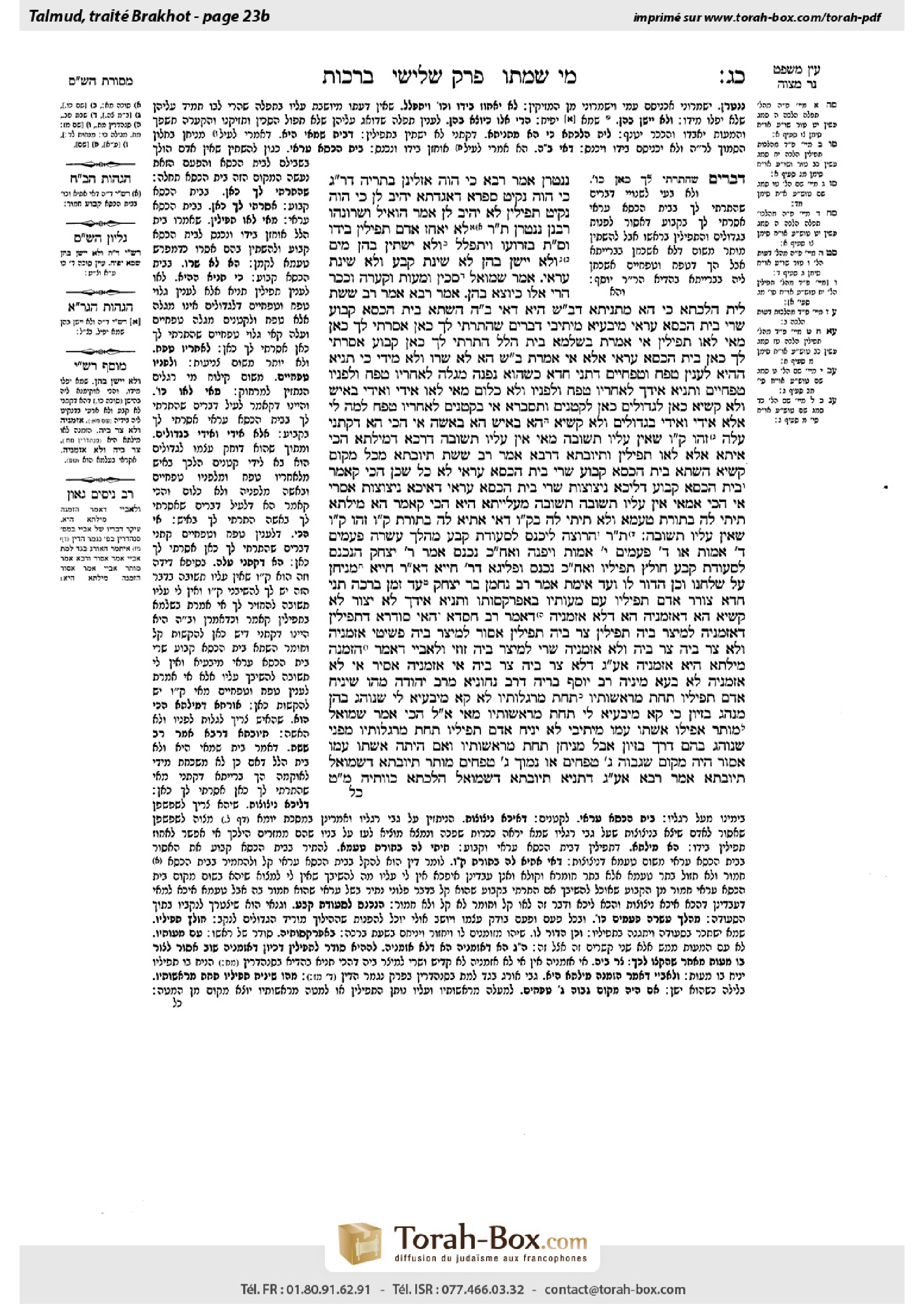
Berakhot 23b: Talmud study for Daf Yomi
Study the Talmud for Daf Yomi with scanned pages, Hebrew text, English translations from Sefaria and AI-generated French translations.
Passage selection and English or AI-generated French translation are available where the scan has annotations. Daf Study is independent of Torah-Box and Sefaria.
Browse Berakhot · ברכות · All tractatesBerakhot 23b text and translations
This page of Berakhot includes the Aramaic text, an English translation and an AI-generated French translation, alongside the scan above.
ברכות כ״ג ב · Aramaic and Hebrew text
נִינְטְרַן. אָמַר רָבָא: כִּי הֲוָה אָזְלִינַן בָּתְרֵיהּ דְּרַב נַחְמָן, כִּי הֲוָה נָקֵיט סִפְרָא דְאַגַּדְתָּא — יָהֵיב לַן, כִּי הֲוָה נָקֵיט תְּפִילִּין — לָא יָהֵיב לַן, אָמַר: הוֹאִיל וּשְׁרוֹנְהוּ רַבָּנַן, נִינְטְרַן.
תָּנוּ רַבָּנַן: לֹא יֹאחַז אָדָם תְּפִילִּין בְּיָדוֹ וְסֵפֶר תּוֹרָה בִּזְרוֹעוֹ וְיִתְפַּלֵּל. וְלֹא יַשְׁתִּין בָּהֶן מַיִם, וְלֹא יִישַׁן בָּהֶן לֹא שֵׁינַת קֶבַע וְלֹא שֵׁינַת עֲרַאי. אָמַר שְׁמוּאֵל: סַכִּין וּמָעוֹת וּקְעָרָה וְכִכָּר, הֲרֵי אֵלּוּ כַּיּוֹצֵא בָּהֶן.
אָמַר רָבָא אָמַר רַב שֵׁשֶׁת: לֵית הִלְכְתָא כִּי הָא מַתְנִיתָא, דְּבֵית שַׁמַּאי הִיא. דְּאִי בֵּית הִלֵּל — הַשְׁתָּא בֵּית הַכִּסֵּא קָבוּעַ שְׁרֵי, בֵּית הַכִּסֵּא עֲרַאי מִיבַּעְיָא?!
מֵיתִיבִי: דְּבָרִים שֶׁהִתַּרְתִּי לְךָ כָּאן, אָסַרְתִּי לְךָ כָּאן. מַאי לָאו תְּפִילִּין? אִי אָמְרַתְּ בִּשְׁלָמָא בֵּית הִלֵּל: הִתַּרְתִּי לְךָ כָּאן קָבוּעַ, אָסַרְתִּי לְךָ כָּאן בֵּית הַכִּסֵּא עֲרַאי. אֶלָּא אִי אָמְרַתְּ בֵּית שַׁמַּאי הָא לָא שָׁרוּ וְלָא מִידֵּי?
כִּי תַּנְיָא הַהִיא, לְעִנְיַן טֶפַח וְטִפְחַיִים. דְּתָנֵי חֲדָא: כְּשֶׁהוּא נִפְנֶה — מְגַלֶּה לְאַחֲרָיו טֶפַח וּלְפָנָיו טִפְחַיִים. וְתַנְיָא אִידַּךְ: לְאַחֲרָיו טֶפַח וּלְפָנָיו וְלֹא כְלוּם.
מַאי לָאו אִידֵּי וְאִידֵּי בְּאִישׁ, וְלָא קַשְׁיָא, כָּאן לִגְדוֹלִים, כָּאן לִקְטַנִּים?
וְתִסְבְּרָא?! אִי בִּקְטַנִּים, לְאַחֲרָיו טֶפַח לְמָה לִי? אֶלָּא אִידֵּי וְאִידֵּי בִּגְדוֹלִים, וְלָא קַשְׁיָא, הָא בְּאִישׁ, הָא בָּאִשָּׁה.
אִי הָכִי הָא דְּקָתָנֵי עֲלַהּ, ״זֶהוּ קַל וָחוֹמֶר שֶׁאֵין עָלָיו תְּשׁוּבָה״ — מַאי ״אֵין עָלָיו תְּשׁוּבָה״? דַּרְכָּא דְמִלְּתָא הָכִי אִיתָא.
אֶלָּא לָאו, תְּפִילִּין, וּתְיוּבְתָּא דְרָבָא אָמַר רַב שֵׁשֶׁת. תְּיוּבְתָּא.
מִכׇּל מָקוֹם, קַשְׁיָא, הַשְׁתָּא בֵּית הַכִּסֵּא קָבוּעַ שְׁרֵי, בֵּית הַכִּסֵּא עֲרַאי לֹא כׇּל שֶׁכֵּן!
הָכִי קָאָמַר: בֵּית הַכִּסֵּא קָבוּעַ דְּלֵיכָּא נִיצוֹצוֹת, שָׁרוּ. בֵּית הַכִּסֵּא עֲרַאי דְּאִיכָּא נִיצוֹצוֹת, אָסְרִי.
אִי הָכִי, אַמַּאי ״אֵין עָלָיו תְּשׁוּבָה״? תְּשׁוּבָה מְעַלַּיְתָא הִיא!
הָכִי קָאָמַר: הָא מִילְּתָא תֵּיתֵי לַהּ בְּתוֹרַת טַעְמָא, וְלָא תֵּיתֵי לַהּ בְּקַל וָחוֹמֶר, דְּאִי אָתְיָא לַהּ בְּתוֹרַת קַל וָחוֹמֶר, זֶהוּ קַל וָחוֹמֶר שֶׁאֵין עָלָיו תְּשׁוּבָה.
תָּנוּ רַבָּנַן: הָרוֹצֶה לִיכָּנֵס לִסְעוּדַת קֶבַע, מְהַלֵּךְ עֲשָׂרָה פְּעָמִים אַרְבַּע אַמּוֹת, אוֹ אַרְבָּעָה פְּעָמִים עֶשֶׂר אַמּוֹת, וְיִפָּנֶה, וְאַחַר כָּךְ נִכְנָס.
אָמַר רַבִּי יִצְחָק: הַנִּכְנָס לִסְעוּדַת קֶבַע, חוֹלֵץ תְּפִילָּיו וְאַחַר כָּךְ נִכְנָס. וּפְלִיגָא דְּרַבִּי חִיָּיא, דְּאָמַר רַבִּי חִיָּיא: מַנִּיחָן עַל שֻׁלְחָנוֹ, וְכֵן הָדוּר לוֹ.
וְעַד אֵימַת? אָמַר רַב נַחְמָן בַּר יִצְחָק: עַד זְמַן בְּרָכָה.
תָּנֵי חֲדָא: צוֹרֵר אָדָם תְּפִילָּיו עִם מְעוֹתָיו בַּאֲפַרְקְסוּתוֹ. וְתַנְיָא אִידַּךְ: לֹא יָצוֹר.
לָא קַשְׁיָא, הָא דְּאַזְמְנֵיהּ. הָא דְּלָא אַזְמְנֵיהּ. דְּאָמַר רַב חִסְדָּא: הַאי סוּדָרָא דִתְפִילִּין דְּאַזְמְנֵיהּ לְמֵיצַר בֵּיהּ תְּפִילִּין, צָר בֵּיהּ תְּפִילִּין — אָסוּר לְמֵיצַר בֵּיהּ פְּשִׁיטֵי, אַזְמְנֵיהּ וְלָא צָר בֵּיהּ, צָר בֵּיהּ וְלָא אַזְמְנֵיהּ — שְׁרֵי לְמֵיצַר בֵּיהּ זוּזִי.
וּלְאַבָּיֵי דְּאָמַר הַזְמָנָה מִילְּתָא הִיא: אַזְמְנֵיהּ אַף עַל גַּב דְּלָא צָר בֵּיהּ. צָר בֵּיהּ, אִי אַזְמְנֵיהּ — אֲסִיר, אִי לָא אַזְמְנֵיהּ — לָא.
בְּעָא מִינֵּיהּ רַב יוֹסֵף בְּרֵיהּ דְּרַב נְחוּנְיָא מֵרַב יְהוּדָה: מַהוּ שֶׁיַּנִּיחַ אָדָם תְּפִילָּיו תַּחַת מְרַאֲשׁוֹתָיו? תַּחַת מַרְגְּלוֹתָיו לָא קָא מִיבַּעְיָא לִי, שֶׁנּוֹהֵג בָּהֶן מִנְהַג בִּזָּיוֹן. כִּי קָא מִיבַּעְיָא לִי, תַּחַת מְרַאֲשׁוֹתָיו מַאי? אֲמַר לֵיהּ הָכִי אָמַר שְׁמוּאֵל: מוּתָּר, אֲפִילּוּ אִשְׁתּוֹ עִמּוֹ.
מֵיתִיבִי: לָא יַנִּיחַ אָדָם תְּפִילָּיו תַּחַת מַרְגְּלוֹתָיו מִפְּנֵי שֶׁנּוֹהֵג בָּהֶם דֶּרֶךְ בִּזָּיוֹן, אֲבָל מַנִּיחָם תַּחַת מְרַאֲשׁוֹתָיו. וְאִם הָיְתָה אִשְׁתּוֹ עִמּוֹ — אָסוּר. הָיָה מָקוֹם שֶׁגָּבוֹהַּ שְׁלֹשָׁה טְפָחִים אוֹ נָמוּךְ שְׁלֹשָׁה טְפָחִים — מוּתָּר.
תְּיוּבְתָּא דִשְׁמוּאֵל, תְּיוּבְתָּא.
אָמַר רָבָא: אַף עַל גַּב דְּתַנְיָא תְּיוּבְתָּא דִשְׁמוּאֵל, הִלְכְתָא כְּווֹתֵיהּ. מַאי טַעְמָא?
Berakhot 23b · English translation
they will protect me. Although there were people on hand to whom he could have handed the phylacteries, he kept them to protect himself from danger. Rava said: When we would walk after Rabbi Naḥman, we would see that when he was holding a book of aggada, he would give it to us. When he was holding phylacteries, he would not give them to us, as he said: Since the Sages permitted to hold them, they will protect me.
The Sages taught: One may not hold phylacteries in his hand or a Torah scroll in his arm and pray, because his concern that the phylacteries or Torah scroll might fall will distract him from his prayer. And so too, with regard to sacred objects, one may not urinate with them in his hands and may not sleep with them in his hands, neither a deep sleep nor even a brief nap. Shmuel said: Not only should one holding phylacteries refrain from prayer, but one holding a knife, money, a bowl, or a loaf of bread have a similar status in that his concern that they might fall will distract him from his prayer.
Rava said that Rav Sheshet said: The halakha is not in accordance with this baraita, because it is in accordance with the opinion of Beit Shammai. As if it was in accordance with the opinion of Beit Hillel, now Beit Hillel permitted to hold phylacteries in his hand when he defecates in a regular bathroom, is it necessary to say that it is permitted when he urinates in a makeshift bathroom?
The Gemara raised an objection based on the second part of the baraita, where it was taught: Matters which I permitted you to do here, I prohibited you from doing there. In other words, there are matters that were permitted in a regular bathroom and not in a makeshift bathroom. What, is it not referring to phylacteries? Granted, if you say that the prohibition against urinating while wearing phylacteries is in accordance with the opinion of Beit Hillel, then we would understand the baraita as follows: Matters which I permitted you to do here, to hold phylacteries in a regular bathroom, I have prohibited you from doing there, in the makeshift bathroom. But if you hold that this baraita is in accordance with the opinion of Beit Shammai, they did not permit anything in a regular bathroom. What, then, is the meaning of matters which I permitted you to do here?
This challenge is rejected by the Gemara, which explains: When that baraita was taught it was not in reference to phylacteries, but with regard to the matter of one handbreadth and two handbreadths. As is it was taught in one baraita: When one relieves himself, he must maintain modesty and bare a single handbreadth of his flesh behind him and two handbreadths before him. And it was taught in another baraita: One may only bare a single handbreadth behind him and nothing before him.
What, are not both this baraita and that one referring to a male, and the apparent contradiction between the two baraitot is not difficult, as here the baraita that states that one may bare a handbreadth behind him and nothing before him is referring to defecation, while here, the other baraita that states that one may bare a handbreadth behind him and two handbreadths before him is referring to urination. Accordingly, despite the fact that one may bare two handbreadths before him when urinating in a makeshift bathroom, matters that I have permitted you to do here, one may bare nothing before him when defecating in an established bathroom, I have prohibited you from doing there.
The Gemara rejects this explanation: And how can you understand it that way? If that baraita is referring to urination, why do I need to bare one handbreadth behind him? Rather, both this baraita and that baraita are referring to defecation, and the apparent contradiction between the two baraitot is not difficult. This baraita that states that one may bare two handbreadths before him is referring to a man, who must bare himself in case he inadvertently urinates. That baraita that states that one may not bare anything in front is referring to a woman, who does not need to uncover herself to account for inadvertent urination.
The Gemara challenges this: If so, then that which is taught with regard to this halakha in the baraita: This is an a fortiori inference for which there is no refutation, meaning that even though logically it would seem correct to be stricter in the case of defecating in a regular bathroom than in the case of urinating in a makeshift bathroom, that is not the ruling, is difficult. According to the distinction suggested above, what is the meaning of: for which there is no refutation? That is the nature of the matter; men and women need to uncover themselves differently.
Rather, is it not so that the baraita that states: Matters which I permitted you to do here, I prohibited you from doing there, is referring to phylacteries, and the a fortiori inference that cannot be refuted is similarly referring to phylacteries. And the refutation of that which Rava says that Rav Sheshet says, that the baraita is in accordance with the opinion of Beit Shammai, is indeed a conclusive refutation.
The Gemara asks: Nevertheless, it remains difficult: Now, holding phylacteries in his hand when he defecates in a regular bathroom is permitted, all the more so that it is permitted when he urinates in a makeshift bathroom.
The Gemara explains: It says as follows: When defecating in a regular bathroom, where one sits there are no drops of urine on one’s clothes or shoes, he need not dirty his hands to clean his garment, and therefore one is permitted to hold phylacteries in his hand. However, in a makeshift bathroom, where one stands, and there are ricocheting drops which he may touch with his hand, it is prohibited.
The Gemara challenges: If so, then why was it referred to as an a fortiori inference that “cannot be refuted”? This seems an excellent refutation that explains the distinction.
The Gemara explains that it says as follows: Derive this matter based on the reason mentioned above that due to different circumstances the ruling is different. Do not derive it by means of an a fortiori inference, as if you were to derive it by means of an a fortiori inference, it would certainly be an a fortiori inference that cannot be rebutted.
The Sages taught: One who wishes to enter and partake of a regular meal that will last for some time, paces a distance of four cubits ten times, or ten cubits four times, in order to expedite the movement of the bowels, and defecates. Only then may he enter and partake of the meal. That way he spares himself the unpleasantness of being forced to leave in the middle of the meal.
On this same subject, Rabbi Yitzḥak said: One who partakes of a regular meal removes his phylacteries and then enters, as it is inappropriate to partake in a meal where there is frivolity while wearing phylacteries. And this statement disputes the statement of Rabbi Ḥiyya, as Rabbi Ḥiyya said: During a formal meal one places his phylacteries on his table, and it is admirable for him to do so in order that they will be available to don immediately if he so desires.
The Gemara asks: And until when in the meal must he refrain from wearing phylacteries? Rav Naḥman bar Yitzḥak said: Until the time of the recitation of the blessing of Grace after Meals.
It was taught in one baraita: One may bundle his phylacteries with his money in his head covering [apraksuto], and it was taught in another baraita: One may not bundle phylacteries and money together.
The Gemara explains: This is not difficult, as one must distinguish and say that this baraita, which prohibits bundling phylacteries and money together, refers to a case where the vessel was designated for use with phylacteries, while this baraita, which permits one to do so, refers to a case where the vessel was not designated for that purpose. As Rav Ḥisda said: With regard to this cloth used with phylacteries that one designated to bundle phylacteries in it, if one already bundled phylacteries in it then it is prohibited to bundle coins in it, but if he only designated it for that purpose, but did not yet bundle phylacteries in it, or if he bundled phylacteries in it but did not originally designate it for that purpose, then it is permitted to bundle money in it.
And according to Abaye, who said that designation is significant, as Abaye holds that all relevant halakhot apply to an object designated for a specific purpose, whether or not it has been already used for that purpose, the halakha is: If he designated the cloth, even if he did not bundle phylacteries in it, he is prohibited from bundling money in it. However, if he bundled phylacteries in it, if he designated the cloth for that particular use, it is prohibited to bundle money in it, but if he did not designate it, no, it is not prohibited.
Rav Yosef, son of Rav Neḥunya, raised a dilemma before Rav Yehuda: What is the halakha; may a man place his phylacteries in his bed, under his head while he sleeps? He himself explains: With regard to whether or not one may place them under his feet, I have no dilemma, as that would be treating them in a deprecating manner and is certainly prohibited. My dilemma is whether or not one may place them under his head; what is the halakha in that case? Rav Yehuda said to him, Shmuel said as follows: It is permitted, even if his wife is with him in his bed.
The Gemara raises an objection based on what was taught in a baraita: A man may not place his phylacteries under his feet, as in doing so, he treats them in a deprecating manner, but he may place them under his head. And if his wife was with him, it is prohibited even to place it under his head. If there was a place where he could place the phylacteries three handbreadths above or three handbreadths below his head it is permissible, as that space is sufficient for the phylacteries to be considered in a separate place.
This is a conclusive refutation of Shmuel’s statement. The Gemara concludes: Indeed, it is a conclusive refutation.
Rava said: Although a baraita was taught that constitutes a conclusive refutation of Shmuel, the halakha is in accordance with his opinion in this matter. What is the reason for this?
Berakhot 23b · Traduction française (IA)
ils le protégeront. Bien qu'il y ait des personnes présentes à qui il aurait pu donner les phylactères, il les garda pour se protéger contre les dangers. Rava dit : Quand nous marchions après Rabbi Naḥman, nous voyions qu'il donnait les livres d'aggada quand il les tenait, mais pas les phylactères, car il disait : Puisque les Sages ont permis de les tenir, ils me protégeront.
Les Sages enseignèrent : On ne doit pas tenir les phylactères dans la main ou un rouleau de Torah dans l'armée et prier, car l'inquiétude que les phylactères ou le rouleau de Torah puissent tomber distrairait de la prière. De même, concernant les objets sacrés, on ne doit pas uriner en les tenant ou dormir en les tenant, ni un sommeil profond ni même un bref repos. Shmuel dit : Non seulement celui qui tient les phylactères doit éviter la prière, mais celui qui tient un couteau, de l'argent, une coupelle ou un pain doit avoir un statut similaire, car l'inquiétude qu'ils puissent tomber distrairait de la prière.
Rava dit que Rav Sheshet dit : La halakha ne suit pas cette baraïta, car elle suit l'opinion de Beit Shammai. Si elle suivait l'opinion de Beit Hillel, maintenant que Beit Hillel permet de tenir les phylactères dans la main quand on défèque dans une salle de bain normale, est-ce nécessaire de dire qu'il est permis quand on urine dans une salle de bain improvisée ?
Le Guemara souleva une objection basée sur la deuxième partie de la baraïta, où il était enseigné : Ce que je vous ai permis de faire ici, je vous interdis de faire là. Autrement dit, il y a des choses qui étaient permises dans une salle de bain normale et non dans une salle de bain improvisée. Qu'est-ce que cela signifie ? N'est-ce pas en référence aux phylactères ? Si vous dites que l'interdiction d'uriner avec les phylactères est selon l'opinion de Beit Hillel, alors nous comprendrions la baraïta ainsi : Ce que je vous ai permis de faire ici, de tenir les phylactères dans une salle de bain normale, je vous interdis de faire là, dans une salle de bain improvisée. Mais si vous considérez que cette baraïta suit l'opinion de Beit Shammai, ils n'ont permis rien dans une salle de bain normale. Qu'est-ce que cela signifie alors ?
Ce défi est rejeté par le Guemara, qui explique : Quand cette baraïta a été enseignée, elle ne faisait pas référence aux phylactères, mais à la question d'un tefach et de deux tefachim. Comme il était enseigné dans une baraïta : Quand on s'excuse, on doit maintenir la pudeur et dévoiler un tefach de sa chair derrière soi et deux tefachim devant soi. Et il était enseigné dans une autre baraïta : On peut seulement dévoiler un tefach derrière soi et rien devant soi.
Qu'est-ce que cela signifie que ces deux baraitot ne font pas référence à un homme, et que la contradiction entre les deux baraitot n'est pas difficile, car celle qui dit qu'on peut dévoiler un tefach derrière soi et rien devant soi fait référence à la défécation, tandis que celle qui dit qu'on peut dévoiler un tefach derrière soi et deux tefachim devant soi fait référence à l'urine. Ainsi, malgré le fait qu'on peut dévoiler deux tefachim devant soi quand on urine dans une salle de bain improvisée, les choses que je vous ai permis de faire ici, on ne peut dévoiler rien devant soi quand on défèque dans une salle de bain établie, je vous interdis de faire là.
Le Guemara rejette cette explication : Et comment pouvez-vous comprendre cela ainsi ? Si cette baraïta fait référence à l'urine, pourquoi dois-je dévoiler un tefach derrière soi ? Plutôt, ces deux baraitot font référence à la défécation, et la contradiction entre les deux baraitot n'est pas difficile. Cette baraïta qui dit qu'on peut dévoiler deux tefachim devant soi fait référence à un homme, qui doit se dévoiler en cas d'urine accidentelle. Cette baraïta qui dit qu'on ne peut dévoiler rien devant soi fait référence à une femme, qui n'a pas besoin de se dévoiler pour l'urine accidentnelle.
Le Guemara challenge cela : Si c'est ainsi, alors ce qui est enseigné avec référence à cette halakha dans la baraïta : C'est une déduction a fortiori pour laquelle il n'y a pas de réfutation, c'est-à-dire que même si logiquement il semble correct d'être plus strict dans le cas de la défécation dans une salle de bain normale que dans le cas de l'urine dans une salle de bain improvisée, cela n'est pas la décision, est difficile. Selon la distinction suggérée ci-dessus, que signifie : pour laquelle il n'y a pas de réfutation ? C'est la nature de la chose ; les hommes et les femmes doivent se dévoiler différemment.
Plutôt, n'est-ce pas ainsi que la baraïta qui dit : Ce que je vous ai permis de faire ici, je vous interdis de faire là, fait référence aux phylactères, et la déduction a fortiori qui ne peut pas être réfutée est également en référence aux phylactères. Et la réfutation de ce que Rava dit que Rav Sheshet dit, que la baraïta suit l'opinion de Beit Shammai, est effectivement une réfutation concluante.
Le Guemara demande : Toutefois, il reste difficile : Maintenant, tenir les phylactères dans la main quand on défèque dans une salle de bain normale est permis, encore plus que quand on urine dans une salle de bain improvisée.
Le Guemara explique : Il dit comme suit : Quand on défèque dans une salle de bain normale, où l'on s'assoit et où il n'y a pas de gouttelettes d'urine sur ses vêtements ou ses chaussures, on n'a pas besoin de salir ses mains pour nettoyer son vêtement, et donc on est autorisé à tenir les phylactères dans la main. Cependant, dans une salle de bain improvisée, où l'on se tient et où il y a des gouttelettes qui peuvent être touchées par la main, cela est interdit.
Le Guemara questionne : Si c'est ainsi, alors pourquoi est-ce appelé une déduction a fortiori qui 'ne peut pas être réfutée' ? Cela semble être une excellente réfutation qui explique la distinction.
La Guemara explique que cela est dit comme suit : Déduisez cette question à partir de la raison mentionnée ci-dessus, car en raison des circonstances différentes, le jugement est différent. Ne déduisez pas cela par une inférence a fortiori, car si vous le faisiez par une inférence a fortiori, cela serait certainement une inférence a fortiori qui ne peut être contredite.
Les Sages enseignent : Celui qui veut entrer et participer à un repas ordinaire qui durera quelque temps, marche une distance de quatre coudées dix fois, ou dix coudées quatre fois, afin d'accélérer le mouvement des intestins, et défèque. Ce n'est qu'alors qu'il peut entrer et participer au repas. Ainsi, il se dispense de l'embarras de devoir quitter le repas au milieu.
Sur ce même sujet, Rabbi Yitzhak a dit : Celui qui partage un repas ordinaire retire ses phylactères et entre alors, car il n'est pas approprié de participer à un repas où il y a de la frivolité en portant les phylactères. Et cette déclaration contredit celle de Rabbi Hiyaa, car Rabbi Hiyaa a dit : Lors d'un repas formel, on place ses phylactères sur sa table, et il est admirable de le faire afin qu'ils soient disponibles pour être portés immédiatement si l'on en a envie.
La Guemara pose la question : Jusqu'à quel moment du repas doit-il éviter de porter les phylactères ? Rav Naḥman bar Yitzḥak a dit : Jusqu'au moment de la prière de béatitude après le repas.
Il a été enseigné dans une baraïta : On peut ranger ses phylactères avec ses deniers dans son couvre-chef [apraksuto], et il a été enseigné dans une autre baraïta : On ne doit pas ranger les phylactères et les deniers ensemble.
La Guemara explique : Cela n'est pas difficile, car on doit distinguer et dire que cette baraïta, qui interdit de ranger les phylactères et les deniers ensemble, fait référence à un cas où le récipient était destiné à être utilisé avec les phylactères, tandis que cette baraïta, qui permet cela, fait référence à un cas où le récipient n'était pas destiné à cela. Comme Rav Ḥisda a dit : Concernant ce tissu utilisé avec les phylactères que l'on a désigné pour y ranger les phylactères, si l'on a déjà rangé les phylactères dedans, il est interdit de ranger des deniers dedans, mais si l'on n'a pas encore rangé les phylactères dedans, ou si l'on a rangé les phylactères dedans mais que l'on n'avait pas initialement désigné ce tissu à cet usage, alors il est permis de ranger des deniers dedans.
Et selon Abaye, qui a dit que la désignation est importante, car Abaye considère que toutes les halakhot pertinentes s'appliquent à un objet désigné pour un usage spécifique, qu'il ait été utilisé ou non pour cet usage, la halakha est : S'il a désigné le tissu, même s'il n'a pas encore lié les phylactères dedans, il est interdit de lier de l'argent dedans. Cependant, s'il a lié les phylactères dedans, si l'on a désigné le tissu à cet usage, il est interdit de lier de l'argent dedans, mais si l'on n'a pas désigné le tissu, non, il n'est pas interdit.
Rav Yosef, fils de Rav Néhunya, a soulevé un dilemme devant Rav Yéhuda : Quelle est la halakha ; peut-on placer ses phylactères dans son lit, sous sa tête pendant qu'il dort ? Il lui-même explique : Concernant la question de savoir si l'on peut les placer sous ses pieds, je n'ai pas de dilemme, car cela serait traiter les phylactères de manière dégradante et est certainement interdit. Mon dilemme est de savoir si l'on peut les placer sous sa tête ; quelle est la halakha dans ce cas ? Rav Yéhuda a dit à lui, Shmuel a dit comme suit : C'est permis, même si sa femme est avec lui dans son lit.
La Guemara soulève une objection basée sur ce qui a été enseigné dans une baraïta : Un homme ne doit pas placer ses phylactères sous ses pieds, car cela le traite de manière dégradante, mais il peut les placer sous sa tête. Et si sa femme était avec lui, il est interdit même de les placer sous sa tête. Si il y avait un endroit où il pouvait placer les phylactères à trois coudées au-dessus ou à trois coudées en dessous de sa tête, cela serait permis, car cet espace est suffisant pour que les phylactères soient considérés comme étant dans un lieu séparé.
C'est une réfutation concluante de l'affirmation de Shmuel. La Guemara conclut : En effet, c'est une réfutation concluante.
Rava a dit : Bien qu'une baraïta ait été enseignée qui constitue une réfutation concluante de Shmuel, la halakha suit son avis sur cette question. Quelle est la raison de cela ?
Traduction française générée par IA à partir de l’édition anglaise de Sefaria. Vérifie toujours un passage avec le texte source.
Text from Sefaria: William Davidson Edition - Vocalized Aramaic (CC BY NC); William Davidson Edition - English (CC BY NC).