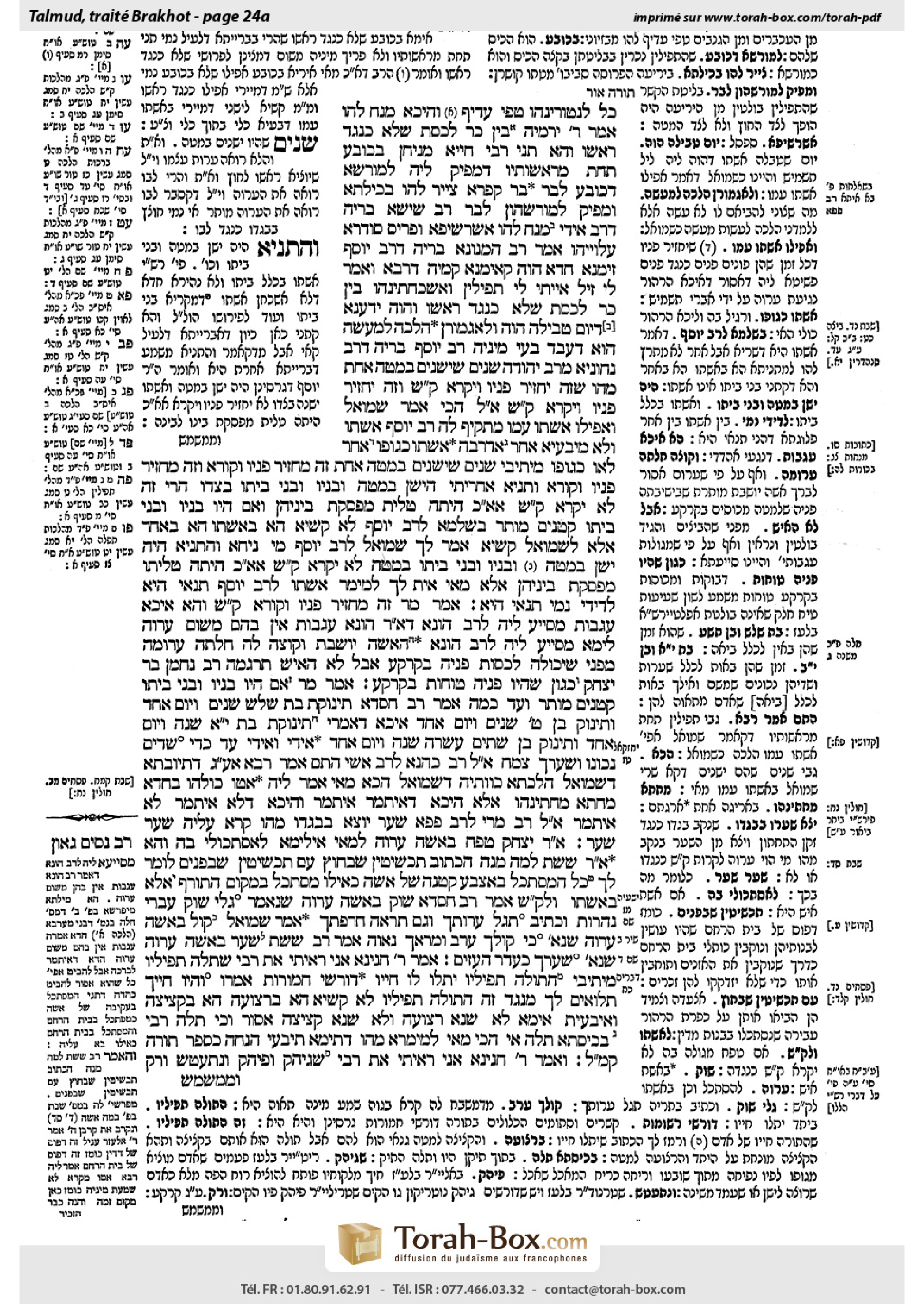
Berakhot 24a: Talmud study for Daf Yomi
Study the Talmud for Daf Yomi with scanned pages, Hebrew text, English translations from Sefaria and AI-generated French translations.
Passage selection and English or AI-generated French translation are available where the scan has annotations. Daf Study is independent of Torah-Box and Sefaria.
Browse Berakhot · ברכות · All tractatesBerakhot 24a text and translations
This page of Berakhot includes the Aramaic text, an English translation and an AI-generated French translation, alongside the scan above.
ברכות כ״ד א · Aramaic and Hebrew text
כֹּל לְנַטּוֹרִינְהוּ טְפֵי עֲדִיף. וְהֵיכָא מַנַּח לְהוּ? אָמַר רַבִּי יִרְמְיָה: בֵּין כַּר לְכֶסֶת, שֶׁלֹּא כְּנֶגֶד רֹאשׁוֹ.
וְהָא תָּנֵי רַבִּי חִיָּיא: מַנִּיחָן בְּכוֹבַע, תַּחַת מְרַאֲשׁוֹתָיו! דְּמַפֵּיק לֵיהּ לְמוּרְשָׁא דְכוֹבַע לְבַר.
בַּר קַפָּרָא צָיַיר לְהוּ בְּכִילְּתָא, וּמַפִּיק לְמוּרְשְׁהוֹן לְבַר. רַב שִׁישָׁא בְּרֵיהּ דְּרַב אִידֵּי מַנַּח לְהוּ אַשַּׁרְשִׁיפָא, וּפָרֵיס סוּדָרָא עִילָּוַיְיהוּ.
אָמַר רַב הַמְנוּנָא בְּרֵיהּ דְּרַב יוֹסֵף: זִימְנָא חֲדָא הֲוָה קָאֵימְנָא קַמֵּיהּ דְּרָבָא, וַאֲמַר לִי: זִיל אַיְיתִי לִי תְּפִילִּין. וְאַשְׁכַּחְתִּינְהוּ בֵּין כַּר לְכֶסֶת, שֶׁלֹּא כְּנֶגֶד רֹאשׁוֹ. וַהֲוָה יָדַעְנָא דְּיוֹם טְבִילָה הֲוָה, וּלְאַגְמוֹרַן הֲלָכָה לְמַעֲשֶׂה הוּא דַּעֲבַד.
בְּעָא מִינֵּיהּ רַב יוֹסֵף בְּרֵיהּ דְּרַב נְחוּנְיָא מֵרַב יְהוּדָה: שְׁנַיִם שֶׁיְּשֵׁנִים בְּמִטָּה אַחַת, מַהוּ שֶׁזֶּה יַחֲזִיר פָּנָיו וְיִקְרָא קְרִיאַת שְׁמַע, וְזֶה יַחֲזִיר פָּנָיו וְיִקְרָא קְרִיאַת שְׁמַע? אֲמַר לֵיהּ: הָכִי אָמַר שְׁמוּאֵל: וַאֲפִילּוּ אִשְׁתּוֹ עִמּוֹ.
מַתְקִיף לַהּ רַב יוֹסֵף: אִשְׁתּוֹ וְלָא מִיבַּעְיָא אַחֵר?! אַדְּרַבָּה, אִשְׁתּוֹ כְּגוּפוֹ, אַחֵר לָאו כְּגוּפוֹ.
מֵיתִיבִי: שְׁנַיִם שֶׁיְּשֵׁנִים בְּמִטָּה אַחַת — זֶה מַחֲזִיר פָּנָיו וְקוֹרֵא, וְזֶה מַחֲזִיר פָּנָיו וְקוֹרֵא. וְתַנְיָא אַחֲרִיתִי: הַיָּשֵׁן בַּמִּטָּה, וּבָנָיו וּבְנֵי בֵיתוֹ בְּצִדּוֹ, הֲרֵי זֶה לֹא יִקְרָא קְרִיאַת שְׁמַע, אֶלָּא אִם כֵּן הָיְתָה טַלִּית מַפְסֶקֶת בֵּינֵיהֶן. וְאִם הָיוּ בָּנָיו וּבְנֵי בֵיתוֹ קְטַנִּים — מוּתָּר.
בִּשְׁלָמָא לְרַב יוֹסֵף לָא קַשְׁיָא, הָא אִשְׁתּוֹ, וְהָא בְּאַחֵר. אֶלָּא לִשְׁמוּאֵל קַשְׁיָא?
אָמַר לְךָ שְׁמוּאֵל: לְרַב יוֹסֵף מִי נִיחָא? וְהָתַנְיָא הָיָה יָשֵׁן בַּמִּטָּה, וּבָנָיו וּבְנֵי בֵיתוֹ בַּמִּטָּה — לֹא יִקְרָא קְרִיאַת שְׁמַע אֶלָּא אִם כֵּן הָיְתָה טַלִּיתוֹ מַפְסֶקֶת בֵּינֵיהֶן. אֶלָּא מַאי אִית לָךְ לְמֵימַר — אִשְׁתּוֹ לְרַב יוֹסֵף תַּנָּאֵי הִיא, לְדִידִי נָמֵי תַּנָּאֵי הִיא.
אָמַר מָר: זֶה מַחֲזִיר פָּנָיו וְקוֹרֵא קְרִיאַת שְׁמַע. וְהָא אִיכָּא עֲגָבוֹת! מְסַיַּיע לֵיהּ לְרַב הוּנָא, דְּאָמַר רַב הוּנָא: עֲגָבוֹת אֵין בָּהֶם מִשּׁוּם עֶרְוָה. לֵימָא מְסַיַּיע לֵיהּ לְרַב הוּנָא: הָאִשָּׁה יוֹשֶׁבֶת, וְקוֹצָה לָהּ חַלָּתָהּ עֲרוּמָּה, מִפְּנֵי שֶׁיְּכוֹלָה לְכַסּוֹת פָּנֶיהָ בְּקַרְקַע, אֲבָל לֹא הָאִישׁ.
תַּרְגְּמַהּ רַב נַחְמָן בַּר יִצְחָק: כְּגוֹן שֶׁהָיוּ פָּנֶיהָ טוּחוֹת בַּקַּרְקַע.
אָמַר מָר: אִם הָיוּ בָּנָיו וּבְנֵי בֵּיתוֹ קְטַנִּים, מוּתָּר: וְעַד כַּמָּה? אָמַר רַב חִסְדָּא: תִּינוֹקֶת בַּת שָׁלֹשׁ שָׁנִים וְיוֹם אֶחָד, וְתִינוֹק בֶּן תֵּשַׁע שָׁנִים וְיוֹם אֶחָד. אִיכָּא דְאָמְרִי: תִּינוֹקֶת בַּת אַחַת עֶשְׂרֵה שָׁנָה וְיוֹם אֶחָד, וְתִינוֹק בֶּן שְׁתֵּים עֶשְׂרֵה שָׁנָה וְיוֹם אֶחָד. אִידֵּי וְאִידֵּי עַד כְּדַי ״שָׁדַיִם נָכֹנוּ וּשְׂעָרֵךְ צִמֵּחַ״.
אֲמַר לֵיהּ רַב כָּהֲנָא לְרַב אָשֵׁי: הָתָם אָמַר רָבָא: אַף עַל גַּב דִּתְיוּבְתָּא דִּשְׁמוּאֵל, הִלְכְתָא כְּווֹתֵיהּ דִּשְׁמוּאֵל. הָכָא מַאי? אֲמַר לֵיהּ: אַטּוּ כּוּלְּהוּ בַּחֲדָא מְחִתָא מְחִתִינְהוּ? אֶלָּא הֵיכָא דְּאִיתְּמַר — אִיתְּמַר, וְהֵיכָא דְּלָא אִיתְּמַר — לָא אִיתְּמַר.
אֲמַר לֵיהּ רַב מָרִי לְרַב פָּפָּא: שֵׂעָר יוֹצֵא בְּבִגְדוֹ מַהוּ? קְרָא עֲלֵיהּ: שֵׂעָר, שֵׂעָר.
אָמַר ר׳ יִצְחָק: טֶפַח בָּאִשָּׁה עֶרְוָה. לְמַאי? אִילֵּימָא לְאִסְתַּכּוֹלֵי בַּהּ, וְהָא אָמַר רַב שֵׁשֶׁת: לָמָּה מָנָה הַכָּתוּב תַּכְשִׁיטִין שֶׁבַּחוּץ עִם תַּכְשִׁיטִין שֶׁבִּפְנִים — לוֹמַר לָךְ כׇּל הַמִּסְתַּכֵּל בְּאֶצְבַּע קְטַנָּה שֶׁל אִשָּׁה, כְּאִילּוּ מִסְתַּכֵּל בִּמְקוֹם הַתּוֹרֶף.
אֶלָּא בְּאִשְׁתּוֹ וְלִקְרִיאַת שְׁמַע.
אָמַר רַב חִסְדָּא: שׁוֹק בָּאִשָּׁה עֶרְוָה, שֶׁנֶּאֱמַר: ״גַּלִּי שׁוֹק עִבְרִי נְהָרוֹת״, וּכְתִיב: ״תִּגָּל עֶרְוָתֵךְ וְגַם תֵּרָאֶה חֶרְפָּתֵךְ״. אָמַר שְׁמוּאֵל: קוֹל בָּאִשָּׁה — עֶרְוָה, שֶׁנֶּאֱמַר: ״כִּי קוֹלֵךְ עָרֵב וּמַרְאֵךְ נָאוֶה״. אָמַר רַב שֵׁשֶׁת: שֵׂעָר בָּאִשָּׁה עֶרְוָה, שֶׁנֶּאֱמַר: ״שַׂעֲרֵךְ כְּעֵדֶר הָעִזִּים״.
אָמַר רַבִּי חֲנִינָא: אֲנִי רָאִיתִי אֶת רַבִּי שֶׁתָּלָה תְּפִילָּיו. מֵיתִיבִי: הַתּוֹלֶה תְּפִילָּיו יִתָּלוּ לוֹ חַיָּיו!
דּוֹרְשֵׁי חֲמוּרוֹת אָמְרוּ: ״וְהָיוּ חַיֶּיךָ תְּלֻאִים לְךָ מִנֶּגֶד״, זֶה הַתּוֹלֶה תְּפִילָּיו.
לָא קַשְׁיָא הָא בִּרְצוּעָה. הָא בִּקְצִיצָה.
וְאִיבָּעֵית אֵימָא: לָא שְׁנָא רְצוּעָה וְלָא שְׁנָא קְצִיצָה — אָסוּר. וְכִי תְּלָה רַבִּי — בְּכִיסְתָּא תְּלָה.
אִי הָכִי מַאי לְמֵימְרָא? מַהוּ דְתֵימָא תִּיבְעֵי הַנָּחָה כְּסֵפֶר תּוֹרָה — קָא מַשְׁמַע לַן.
וְאָמַר רַבִּי חֲנִינָא: אֲנִי רָאִיתִי אֶת רַבִּי שֶׁגִּיהֵק וּפִיהֵק וְנִתְעַטֵּשׁ וְרָק
Berakhot 24a · English translation
Because whatever offers more protection is preferable even at the cost of deprecation. And where under his head does he place them? Rabbi Yirmeya said: He places them between the pillow and the mattress, not directly aligned with his head but rather a bit to the side.
The Gemara asks: Didn’t Rabbi Ḥiyya teach a baraita that in that case he places them in a pouch used for phylacteries, directly under his head? The Gemara replies: He does so in a manner that the bulge in the pouch, where the phylacteries are, protrudes out and is not beneath his head.
On this note, the Gemara relates that Bar Kappara would tie them in his bed curtain and project their bulge outward. Rav Sheisha, son of Rav Idi, would place them on a bench and spread a cloth over them.
Rav Hamnuna, son of Rav Yosef, said: I was once standing before Rava and he told me: Go and bring me my phylacteries. And I found them in his bed, between the mattress and the pillow, not aligned with his head. And I knew that it was the day of his wife’s immersion in the ritual bath for purification from the ritual impurity of a menstruating woman, and he certainly engaged in marital relations in order to fulfill the mitzva, and he did so, he sent me to bring him his phylacteries, to teach us the practical halakha in that case.
Rav Yosef, son of Rav Neḥunya, who raised a dilemma above, raised a dilemma before Rav Yehuda: Two individuals sleeping in a single bed, given that it was standard practice to sleep without clothing, what is the halakha; is it permissible for this one to turn his head aside and recite Shema and for that one turns his head and recites Shema; or is it prohibited because they are unclothed and are considered unfit to recite Shema even though they are covered with a blanket? He said to him: Shmuel said as follows: This is permitted even if his wife is in bed with him.
Rav Yosef strongly objects to this response: You say that he is permitted to recite Shema in bed with his wife, and needless to say he is permitted to do so when in bed with another. On the contrary, since his wife is like his own flesh, and he will not have lustful thoughts of her, it is permitted; another is not like his own flesh and it is prohibited.
The Gemara raises an objection to this from the resolution of an apparent contradiction between two baraitot. It was taught in one baraita: Two unclothed individuals who are sleeping in a single bed, this one turns his head aside and recites Shema and that one turns his head aside and recites Shema. And it was taught in another baraita: One who is sleeping in bed and his unclothed children and members of his household are beside him, may not recite Shema unless a garment separates between them. If his children and the members of his household were minors, it is permitted to recite Shema even without a garment separating between them.
Granted, according to Rav Yosef, the apparent contradiction between the two baraitot is not difficult, as this baraita is referring to a case where his wife is in the bed with him, while this other baraita is referring to a case where another person is in bed with him and there is concern lest he will have lustful thoughts. However, according to Shmuel, who permits one to recite Shema regardless of who is in bed with him, it is indeed difficult. How would he interpret the baraita that prohibits?
The Gemara replies: Shmuel could have said to you: And according to Rav Yosef’s opinion, does it work out well? Wasn’t it taught in that same baraita that one who is sleeping in bed and his children and members of his household are beside him, may not recite Shema unless a garment separates between them? Doesn’t Rav Yosef hold that his wife is like his own flesh and no separation is necessary? Rather, what have you to say in response? Rav Yosef holds that there is a tannaitic dispute in the case of one’s wife; I, too, hold that it is a tannaitic dispute, and I accept the ruling of one of the baraitot.
The Gemara reverts to clarify something mentioned above. The Master said in a baraita: This one turns his head aside and recites Shema. The Gemara notes a difficulty: Aren’t there bare buttocks? This supports the opinion of Rav Huna, as Rav Huna said: Buttocks do not constitute nakedness. Let us say that the following mishna supports Rav Huna’s opinion: A woman sits and separates her ḥalla naked, despite the fact that she must recite a blessing over the separation of the ḥalla, because she can cover her face, a euphemism for her genitals, in the ground, but a male, whose genitals are not covered when he sits, may not do so. The mishna teaches that exposed buttocks do not constitute nakedness.
Rav Naḥman bar Yitzḥak interpreted the mishna as referring to a case where her face, genitals, was completely covered in the ground such that her posterior was covered by the ground. Therefore, proof for Rav Huna’s opinion cannot be brought from this mishna.
The Master said in a baraita: If his children and the members of his household were minors, even though they are unclothed, it is permitted to recite Shema even without a garment separating between them. The Gemara asks: Until what age is one still considered a minor? Rav Ḥisda said: A girl until she is three years and one day old, and a boy until he is nine years and one day old, for these are the ages from which a sexual act in which they participate is considered a sexual act. Some say: A girl eleven years and one day old and a boy of twelve years and one day old, as that is the age at which they are considered adults in this regard. This age is only approximate, as the age of majority for both this, the boy, and that, the girl, is at the onset of puberty in accordance with the verse: “Your breasts were formed and your hair was grown” (Ezekiel 16:7).
Rav Kahana said to Rav Ashi: There, with regard to the law of phylacteries, Rava said: Despite a conclusive refutation of the opinion of Shmuel, the halakha is in accordance with the opinion of Shmuel. Here, what is the ruling? He said to him: Were all of them woven in the same act of weaving? Are there no distinctions between different cases? Rather, where it is stated, it is stated, and where it is not stated, it is not stated, and there is no comparison.
Rav Mari said to Rav Pappa: Does it constitute nakedness if one’s pubic hair protruded from his garment? Rav Pappa said about him: A hair, a hair. You are splitting hairs and being pedantic over trivialities.
Rabbi Yitzḥak stated: An exposed handbreadth in a woman constitutes nakedness. The Gemara asks: Regarding which halakha was this said? If you say that it comes to prohibit looking at an exposed handbreadth in her, didn’t Rav Sheshet say: Why did the verse enumerate “anklets and bracelets, rings, earrings and girdles” (Numbers 31:50), jewelry that is worn externally, over her clothing, e.g., bracelets, together with jewelry worn internally, beneath her clothing, near her nakedness, e.g., girdles? This was to tell you: Anyone who gazes upon a woman’s little finger is considered as if he gazed upon her naked genitals, for if his intentions are impure, it makes no difference where he looks or how much is exposed; even less than a handbreadth.
Rather, it is referring even to his wife, with regard to the recitation of Shema. One may not recite Shema before an exposed handbreadth of his wife.
Along these lines, Rav Ḥisda said: Even a woman’s exposed leg is considered nakedness, as it is stated: “Uncover the leg and pass through the rivers” (Isaiah 47:2), and it is written in the following verse: “Your nakedness shall be revealed and your shame shall be seen” (Isaiah 47:3). Shmuel further stated: A woman’s singing voice is considered nakedness, which he derives from the praise accorded a woman’s voice, as it is stated: “Sweet is your voice and your countenance is alluring” (Song of Songs 2:14). Similarly, Rav Sheshet stated: Even a woman’s hair is considered nakedness, for it too is praised, as it is written: “Your hair is like a flock of goats, trailing down from Mount Gilead” (Song of Songs 4:1).
The Gemara resumes its discussion of phylacteries. Rabbi Ḥanina said: I saw Rabbi Yehuda HaNasi hang his phylacteries. The Gemara raises an objection: It was taught in a baraita that one who hangs his phylacteries will have his life hang in the balance.
Moreover, the Symbolic Interpreters of the Torah said that the verse: “And your life shall hang in doubt before you [minneged]” (Deuteronomy 28:66), that is the punishment of one who hangs his phylacteries.
The Gemara replies: This apparent contradiction is not difficult, as this baraita, which condemns one who hangs his phylacteries, refers to one who hangs them by the strap, allowing the leather boxes into which the parchment is placed to dangle in a deprecating way, which is certainly prohibited. That baraita, which relates that Rabbi Yehuda HaNasi would hang his phylacteries and that it is clearly permitted, refers to when one hangs them from the box with the straps dangling.
And if you wish, say another explanation instead: There is no difference whether he hangs the phylacteries from the strap and there is no difference whether he hangs the phylacteries from the box; both are prohibited. And when Rabbi Yehuda HaNasi hung his phylacteries, he hung them in their pouch.
The Gemara asks: If so, what is the purpose to relate that incident? The Gemara replies: Lest you say that phylacteries would require placement atop a surface, as is the custom with a Torah scroll. Therefore, it teaches us that this is unnecessary.
Since Rabbi Ḥanina related a story involving Rabbi Yehuda HaNasi, the Gemara cites another such story. Rabbi Ḥanina said: I saw Rabbi Yehuda HaNasi, while he was praying, belch, yawn, sneeze, spit,
Berakhot 24a · Traduction française (IA)
Car il est préférable de choisir ce qui offre le plus de protection, même au détriment de la dépréciation. Et où place-t-il ces objets sous sa tête ? Rabbi Yirmeya a dit : Il les place entre le coussin et le matelas, pas directement alignés avec sa tête, mais un peu à côté.
La Guemara pose la question : N’a-t-il pas enseigné Rabbi Ḥiyya une baraïta selon laquelle, dans ce cas, il les place dans un sac utilisé pour les phylactères, directement sous sa tête ? La Guemara répond : Il le fait de manière que le renflement du sac, où se trouvent les phylactères, sorte et ne soit pas sous sa tête.
Sur ce point, la Guemara rapporte que Bar Kappara les attachait dans la couverture de son lit et faisait sortir le renflement. Rav Sheisha, fils de Rav Idi, les plaçait sur un banc et recouvrait avec un tissu.
Rav Hamnuna, fils de Rav Yosef, a dit : J'étais une fois devant Rava et il m'a dit : Va me chercher mes phylactères. Et j'ai trouvé qu'ils étaient dans son lit, entre le matelas et le coussin, pas alignés avec sa tête. Et j'ai su que c'était le jour de la purification de sa femme dans le bain rituel, et qu'il avait certainement eu des relations conjugales pour accomplir la mitsva, et il l'a fait, il m'a envoyé chercher ses phylactères pour nous enseigner la halakha pratique dans ce cas.
Rav Yosef, fils de Rav Neḥunya, qui avait soulevé un dilemme ci-dessus, a soulevé un dilemme devant Rav Yehuda : Deux personnes dormant dans un lit, sachant que la pratique était de dormir sans vêtements, quelle est la halakha ; est-il permis à l'un de tourner la tête et de réciter le Chéma et à l'autre de tourner la tête et de réciter le Chéma ; ou est-il interdit car ils sont nus et considérés comme inaptes à réciter le Chéma, même s'ils sont couverts d'un drap ? Il a dit : Shmuel a dit comme suit : Cela est permis même si sa femme est dans le lit avec lui.
Rav Yosef s'oppose fermement à cette réponse : Tu dis qu'il est permis de réciter le Chéma dans le lit avec sa femme, et sans doute encore plus s'il est dans le lit avec un autre. Au contraire, puisque sa femme est comme sa propre chair, et qu'il n'aura pas de pensées louches envers elle, cela est permis ; un autre n'est pas comme sa propre chair et cela est interdit.
La Guemara soulève un objection à ce point concernant la résolution d'une contradiction apparente entre deux baraïtotes. Il a été enseigné dans une baraïta : Deux personnes nues dormant dans un lit, l'un tourne la tête et récite le Chéma et l'autre tourne la tête et récite le Chéma. Et il a été enseigné dans une autre baraïta : Celui qui dort dans un lit et ses enfants et membres de sa famille sont à côté de lui, ne peut pas réciter le Chéma à moins qu'un vêtement ne les sépare. Si ses enfants et les membres de sa famille sont des mineurs, il est permis de réciter le Chéma même sans que l'un ne sépare de l'autre.
Admettons, selon l'opinion de Rav Yosef, la contradiction apparente entre ces deux baraïtotes n'est pas difficile, car cette baraïta fait référence à un cas où sa femme est dans le lit avec lui, tandis que cette autre baraïta fait référence à un cas où une autre personne est dans le lit avec lui et il y a une crainte qu'il ait des pensées louches. Cependant, selon Shmuel, qui permet de réciter le Chéma indépendamment de qui est dans le lit avec lui, cela est effectivement difficile. Comment interpréterait-il la baraïta qui interdit ?
La Guemara répond : Shmuel aurait pu te dire : Et selon l'opinion de Rav Yosef, cela fonctionne-t-il bien ? N'a-t-il pas été enseigné dans cette même baraïta que celui qui dort dans un lit et ses enfants et membres de sa famille sont à côté de lui, ne peut pas réciter le Chéma à moins qu'un vêtement ne les sépare ? N'est-ce pas selon l'opinion de Rav Yosef que sa femme est comme sa propre chair et qu'il n'y a pas besoin de séparation ? Plutôt, que répondre ? Rav Yosef considère qu'il y a un débat tannaitique dans le cas de sa femme ; moi aussi, je considère qu'il y a un débat tannaitique, et je reconnais la décision d'une des baraïtotes.
La Guemara revient à clarifier quelque chose mentionné ci-dessus. Le Maître a dit dans une baraïta : Celui-ci tourne la tête et récite le Chéma. La Guemara note une difficulté : Ne sont-ce pas des fesses nues ? Cela soutient l'opinion de Rav Huna, car Rav Huna a dit : Les fesses ne constituent pas la nudité. Disons que la mishna suivante soutient l'opinion de Rav Huna : Une femme s'assied et sépare sa ḥalla nue, malgré le fait qu'elle doit réciter une bénédiction sur la séparation de la ḥalla, car elle peut couvrir son visage, un euphémisme pour ses organes génitaux, dans le sol, mais un homme, dont les organes génitaux ne sont pas couverts lorsqu'il s'assied, ne peut pas le faire. La mishna enseigne que les fesses exposées ne constituent pas la nudité.
Rav Naḥman bar Yitzḥak a interprété la mishna comme faisant référence à un cas où son visage et ses organes génitaux étaient complètement couverts dans le sol de sorte que son postérieur était couvert par le sol. Ainsi, la preuve pour l'opinion de Rav Huna ne peut pas être tirée de cette mishna.
Le Maître a dit dans une baraïta : Si ses enfants et les membres de sa famille étaient des mineurs, même s'ils sont nus, il est permis de réciter le Chéma même sans que l'un ne sépare de l'autre. La Guemara pose la question : Jusqu'à quel âge est-on encore considéré comme mineur ? Rav Ḥisda a dit : Une fille jusqu'à trois ans et un jour, et un garçon jusqu'à neuf ans et un jour, car ces sont les âges à partir desquels un acte sexuel dans lequel ils participent est considéré comme un acte sexuel. Certains disent : Une fille onze ans et un jour et un garçon douze ans et un jour, car c'est l'âge à partir duquel ils sont considérés comme adultes à cet égard. Cet âge est seulement approximatif, car l'âge de majorité pour les deux, le garçon et la fille, est au début de la puberté conformément au verset : « Vos seins étaient formés et vos cheveux étaient poussés » (Ezechiel 16:7).
Rav Kahana dit à Rav Ashi : Là, concernant la loi des phylactères, Rava a dit : Malgré une démonstration concluante de l'opinion de Shmuel, la halakha suit l'opinion de Shmuel. Ici, quelle est la décision ? Il lui dit : Tous ceux-ci ont-ils été tissés dans le même acte de tissage ? Y a-t-il des distinctions entre des cas différents ? Plutôt, là où il est dit, il est dit, et là où il n'est pas dit, il n'est pas dit, et il n'y a pas de comparaison.
Rabbi Mari dit à Rav Pappa : Constitue-t-il la nudité si les cheveux pubiens d'une personne sortent de ses vêtements ? Rav Pappa dit à son sujet : Un cheveu, un cheveu. Vous divisez des cheveux et vous êtes minutieux sur des détails triviaux.
Rabbi Yitzḥak a dit : Une mainbreadth exposée chez une femme constitue la nudité. La Guemara pose la question : Concernant quelle halakha a-t-on dit cela ? Si vous dites qu'il s'agit de prohiber de regarder une mainbreadth exposée chez elle, n'a-t-on pas dit Rav Sheshet : Pourquoi la parabole a-t-elle énuméré « des bracelets et des anneaux, des boucles et des ceintures » (Nombres 31:50), des bijoux portés en extérieur, sur ses vêtements, par exemple des bracelets, ensemble avec des bijoux portés en intérieur, sous ses vêtements, près de sa nudité, par exemple des ceintures ? Cela a été pour vous dire : Quiconque regarde le doigt d'une femme est considéré comme s'il regardait ses organes génitaux nus, car si ses intentions sont impures, cela n'a plus d'importance où il regarde ou combien est exposé ; encore moins qu'une mainbreadth.
Plutôt, cela s'applique même à sa femme, concernant la récitation du Chéma. On ne peut pas réciter le Chéma devant une mainbreadth exposée de sa femme.
Dans ce sens, Rav Ḥisda a dit : Même une jambe exposée d'une femme est considérée comme la nudité, car il est dit : « Dévoile la jambe et traverse les rivières » (Yachout 47:2), et il est écrit dans la verset suivant : « Ta nudité sera révélée et ta honte sera vue » (Yachout 47:3). Shmuel a dit de plus : La voix de chant d'une femme est considérée comme la nudité, qu'il dérive de l'éloge accordé à la voix d'une femme, car il est dit : « Doux est ton voix et ton visage est attirant » (Cantique des Cantiques 2:14). De même, Rav Sheshet a dit : Même les cheveux d'une femme sont considérés comme la nudité, car ils sont également élogés, car il est écrit : « Tes cheveux sont comme une troupe de chèvres, descendant du mont Gilead » (Cantique des Cantiques 4:1).
La Guemara reprend la discussion sur les phylactères. Rabbi Ḥanina a dit : J'ai vu Rabbi Yehuda HaNasi accrocher ses phylactères. La Guemara soulève une objection : Il a été enseigné dans une baraïta que celui qui accroche ses phylactères aura sa vie en danger.
De plus, les Interprètes Symboliques de la Torah ont dit que la verset : « Et ta vie pendra en doute devant toi [minneged] » (Deutéronome 28:66), c'est la punition de celui qui accroche ses phylactères.
La Guemara répond : Ce paradoxe apparent n'est pas difficile, car cette baraïta, qui condamne celui qui accroche ses phylactères, se réfère à celui qui les accroche par la ceinture, permettant aux boîtes en cuir dans lesquelles le parchemin est placé de pendre de manière dégradante, ce qui est certainement interdit. Cette baraïta, qui rapporte que Rabbi Yehuda HaNasi accrochait ses phylactères et que cela est clairement permis, se réfère à celui qui les accroche à partir de la boîte avec les ceintures pendantes.
Et si vous le souhaitez, dites une autre explication plutôt : Il n'y a pas de différence s'il accroche les phylactères par la ceinture et il n'y a pas de différence s'il accroche les phylactères à partir de la boîte ; les deux sont interdits. Et lorsque Rabbi Yehuda HaNasi accrochait ses phylactères, il les accrochait dans leur poche.
La Guemara pose la question : Si c'est ainsi, quel est le but de rapporter cet incident ? La Guemara répond : Pour ne pas dire que les phylactères nécessitent d'être placés sur une surface, comme c'est la coutume avec un rouleau de Torah. Ainsi, elle nous enseigne que cela n'est pas nécessaire.
Puisque Rabbi Ḥanina a rapporté une histoire concernant Rabbi Yehuda HaNasi, la Guemara cite une autre telle histoire. Rabbi Ḥanina a dit : J'ai vu Rabbi Yehuda HaNasi, pendant qu'il priait, éternuer, bâiller, tousser,
Traduction française générée par IA à partir de l’édition anglaise de Sefaria. Vérifie toujours un passage avec le texte source.
Text from Sefaria: William Davidson Edition - Vocalized Aramaic (CC BY NC); William Davidson Edition - English (CC BY NC).