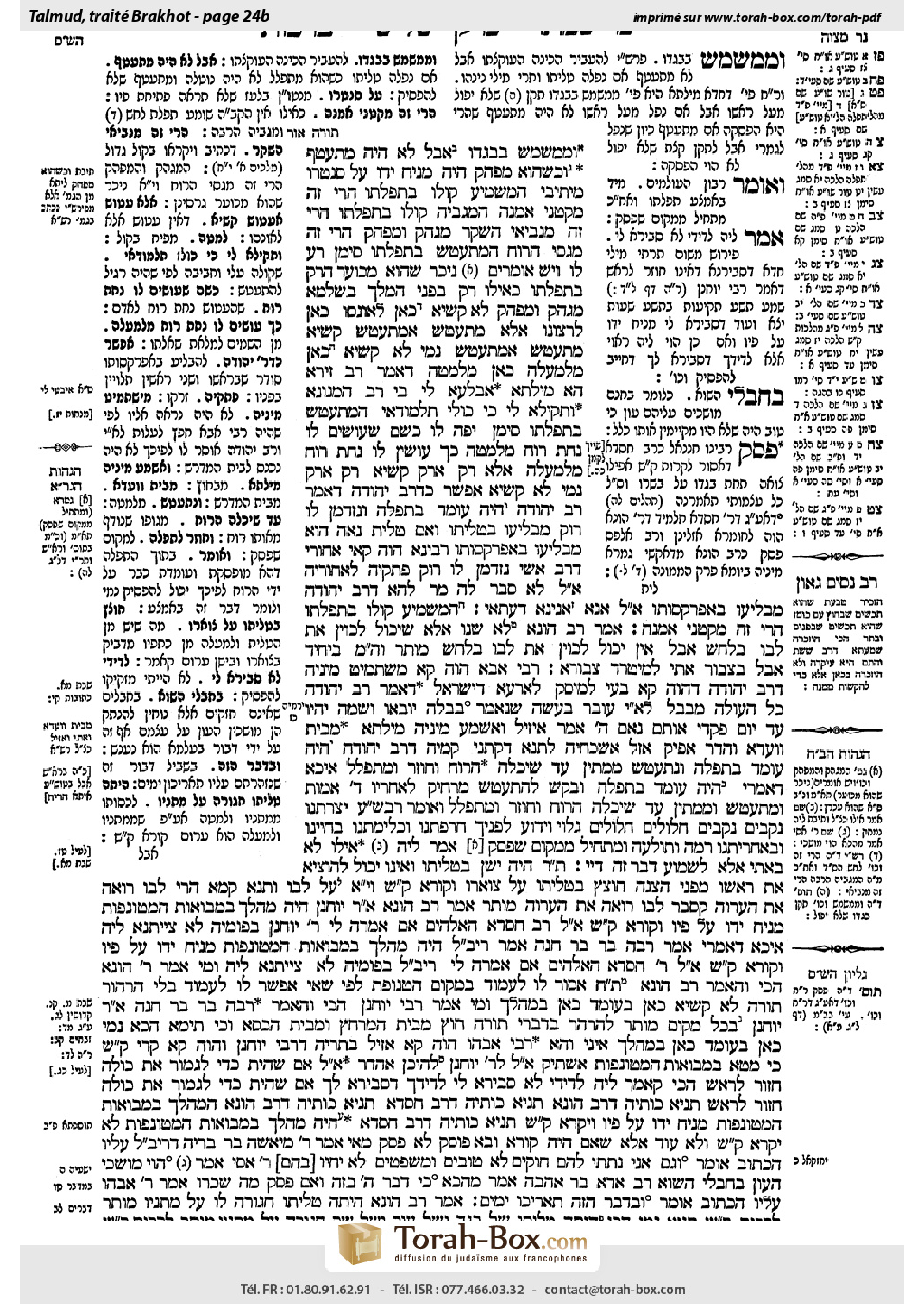
Berakhot 24b: Talmud study for Daf Yomi
Study the Talmud for Daf Yomi with scanned pages, Hebrew text, English translations from Sefaria and AI-generated French translations.
Passage selection and English or AI-generated French translation are available where the scan has annotations. Daf Study is independent of Torah-Box and Sefaria.
Browse Berakhot · ברכות · All tractatesBerakhot 24b text and translations
This page of Berakhot includes the Aramaic text, an English translation and an AI-generated French translation, alongside the scan above.
ברכות כ״ד ב · Aramaic and Hebrew text
וּמְמַשְׁמֵשׁ בְּבִגְדוֹ, אֲבָל לֹא הָיָה מִתְעַטֵּף. וּכְשֶׁהוּא מְפַהֵק הָיָה מַנִּיחַ יָדוֹ עַל סַנְטֵרוֹ.
מֵיתִיבִי: הַמַּשְׁמִיעַ קוֹלוֹ בִּתְפִלָּתוֹ — הֲרֵי זֶה מִקְּטַנֵּי אֲמָנָה. הַמַּגְבִּיהַּ קוֹלוֹ בִּתְפִלָּתוֹ הֲרֵי זֶה מִנְּבִיאֵי הַשֶּׁקֶר.
מְגַהֵק וּמְפַהֵק — הֲרֵי זֶה מִגַּסֵּי הָרוּחַ. הַמִּתְעַטֵּשׁ בִּתְפִלָּתוֹ — סִימָן רַע לוֹ. וְיֵשׁ אוֹמְרִים: נִיכָּר שֶׁהוּא מְכוֹעָר. הָרָק בִּתְפִלָּתוֹ — כְּאִילּוּ רָק בִּפְנֵי הַמֶּלֶךְ.
בִּשְׁלָמָא מְגַהֵק וּמְפַהֵק לָא קַשְׁיָא: כָּאן לְאוֹנְסוֹ, כָּאן לִרְצוֹנוֹ. אֶלָּא מִתְעַטֵּשׁ אַמִּתְעַטֵּשׁ קַשְׁיָא!
מִתְעַטֵּשׁ אַמִּתְעַטֵּשׁ נָמֵי לָא קַשְׁיָא, כָּאן מִלְּמַעְלָה, כָּאן מִלְּמַטָּה. דְּאָמַר רַב זֵירָא: הָא מִילְּתָא אִבַּלְעָא לִי בֵּי רַב הַמְנוּנָא וּתְקִילָא לִי כִּי כּוּלֵּי תַּלְמוּדַאי: הַמִּתְעַטֵּשׁ בִּתְפִלָּתוֹ סִימָן יָפֶה לוֹ, כְּשֵׁם שֶׁעוֹשִׂים לוֹ נַחַת רוּחַ מִלְּמַטָּה, כָּךְ עוֹשִׂים לוֹ נַחַת רוּחַ מִלְּמַעְלָה.
אֶלָּא רָק אַרָק קַשְׁיָא! רָק אַרָק נָמֵי לָא קַשְׁיָא, אֶפְשָׁר כִּדְרַב יְהוּדָה. דְּאָמַר רַב יְהוּדָה: הָיָה עוֹמֵד בִּתְפִילָּה וְנִזְדַּמֵּן לוֹ רוֹק — מַבְלִיעוֹ בְּטַלִּיתוֹ. וְאִם טַלִּית נָאֶה הוּא — מַבְלִיעוֹ בַּאֲפַרְקְסוּתוֹ. רָבִינָא הֲוָה קָאֵי אֲחוֹרֵי רַב אָשֵׁי, נִזְדַּמֵּן לוֹ רוֹק, פַּתְקֵיהּ לַאֲחוֹרֵיהּ. אֲמַר לֵיהּ: לָא סָבַר לַהּ מָר לְהָא דְּרַב יְהוּדָה מַבְלִיעוֹ בַּאֲפַרְקְסוּתוֹ? אֲמַר לֵיהּ: אֲנָא אֲנִינָא דַּעְתַּאי.
הַמַּשְׁמִיעַ קוֹלוֹ בִּתְפִלָּתוֹ הֲרֵי זֶה מִקְּטַנֵּי אֲמָנָה. אָמַר רַב הוּנָא: לֹא שָׁנוּ, אֶלָּא שֶׁיָּכוֹל לְכַוֵּון אֶת לִבּוֹ בְּלַחַשׁ, אֲבָל אֵין יָכוֹל לְכַוֵּון אֶת לִבּוֹ בְּלַחַשׁ — מוּתָּר. וְהָנֵי מִילֵּי, בְּיָחִיד, אֲבָל בְּצִיבּוּר — אָתֵי לְמִיטְרַד צִיבּוּרָא.
רַבִּי אַבָּא הֲוָה קָא מִשְׁתְּמִיט מִינֵּיהּ דְּרַב יְהוּדָה דַּהֲוָה קָא בָּעֵי לְמִיסַּק לְאַרְעָא דְיִשְׂרָאֵל, דְּאָמַר רַב יְהוּדָה: כׇּל הָעוֹלֶה מִבָּבֶל לְאֶרֶץ יִשְׂרָאֵל — עוֹבֵר בַּעֲשֵׂה, שֶׁנֶּאֱמַר: ״בָּבֶלָה יוּבָאוּ וְשָׁמָּה יִהְיוּ עַד יוֹם פׇּקְדִי אוֹתָם נְאֻם ה׳״. אָמַר: אֵיזִיל וְאֶשְׁמַע מִינֵּיהּ מִילְּתָא מִבֵּית וַועֲדָא, וַהֲדַר אֶפֹּיק.
אֲזַל, אַשְׁכְּחֵיהּ לְתַנָּא דְּקָתָנֵי קַמֵּיהּ דְּרַב יְהוּדָה: הָיָה עוֹמֵד בִּתְפִלָּה וְנִתְעַטֵּשׁ — מַמְתִּין עַד שֶׁיִּכְלֶה הָרוּחַ וְחוֹזֵר וּמִתְפַּלֵּל. אִיכָּא דְאָמְרִי: הָיָה עוֹמֵד בִּתְפִלָּה וּבִיקֵּשׁ לְהִתְעַטֵּשׁ — מַרְחִיק לְאַחֲרָיו אַרְבַּע אַמּוֹת, וּמִתְעַטֵּשׁ, וּמַמְתִּין עַד שֶׁיִּכְלֶה הָרוּחַ, וְחוֹזֵר וּמִתְפַּלֵּל, וְאוֹמֵר: ״רִבּוֹנוֹ שֶׁל עוֹלָם, יְצַרְתָּנוּ נְקָבִים נְקָבִים חֲלוּלִים חֲלוּלִים, גָּלוּי וְיָדוּעַ לְפָנֶיךָ חֶרְפָּתֵנוּ וּכְלִימָּתֵנוּ בְּחַיֵּינוּ וּבְאַחֲרִיתֵנוּ רִמָּה וְתוֹלֵעָה״, וּמַתְחִיל מִמָּקוֹם שֶׁפָּסַק.
אֲמַר לֵיהּ: אִילּוּ לֹא בָּאתִי אֶלָּא לִשְׁמוֹעַ דָּבָר זֶה — דַּיִּי.
תָּנוּ רַבָּנַן: הָיָה יָשֵׁן בְּטַלִּיתוֹ, וְאֵינוֹ יָכוֹל לְהוֹצִיא אֶת רֹאשׁוֹ מִפְּנֵי הַצִּנָּה — חוֹצֵץ בְּטַלִּיתוֹ עַל צַוָּארוֹ, וְקוֹרֵא קְרִיאַת שְׁמַע. וְיֵשׁ אוֹמְרִים: עַל לִבּוֹ.
וְתַנָּא קַמָּא הֲרֵי לִבּוֹ רוֹאֶה אֶת הָעֶרְוָה! קָסָבַר לִבּוֹ רוֹאֶה אֶת הָעֶרְוָה — מוּתָּר.
אָמַר רַב הוּנָא אָמַר רַבִּי יוֹחָנָן: הָיָה מְהַלֵּךְ בִּמְבוֹאוֹת הַמְטוּנָּפוֹת — מַנִּיחַ יָדוֹ עַל פִּיו וְקוֹרֵא קְרִיאַת שְׁמַע. אֲמַר לֵיהּ רַב חִסְדָּא: הָאֱלֹהִים! אִם אַמְרָהּ לִי רַבִּי יוֹחָנָן בְּפוּמֵּיהּ — לָא צָיֵיתְנָא לֵיהּ.
אִיכָּא דְאָמְרִי: אָמַר רַבָּה בַּר בַּר חָנָה אָמַר רַבִּי יְהוֹשֻׁעַ בֶּן לֵוִי: הָיָה מְהַלֵּךְ בִּמְבוֹאוֹת הַמְטוּנָּפוֹת — מַנִּיחַ יָדוֹ עַל פִּיו וְקוֹרֵא קְרִיאַת שְׁמַע. אֲמַר לֵיהּ רַב חִסְדָּא: הָאֱלֹהִים! אִם אַמְרָהּ לִי רַבִּי יְהוֹשֻׁעַ בֶּן לֵוִי בְּפוּמֵּיהּ — לָא צָיֵיתְנָא לֵיהּ.
וּמִי אָמַר רַב הוּנָא הָכִי? וְהָאָמַר רַב הוּנָא: תַּלְמִיד חָכָם אָסוּר לוֹ לַעֲמוֹד בִּמְקוֹם הַטִּנּוֹפֶת לְפִי שֶׁאִי אֶפְשָׁר לוֹ לַעֲמוֹד בְּלִי הִרְהוּר תּוֹרָה! לָא קַשְׁיָא, כָּאן — בְּעוֹמֵד, כָּאן — בִּמְהַלֵּךְ.
וּמִי אָמַר רַבִּי יוֹחָנָן הָכִי? וְהָאָמַר רַבָּה בַּר בַּר חָנָה אָמַר רַבִּי יוֹחָנָן: בְּכָל מָקוֹם מוּתָּר לְהַרְהֵר בְּדִבְרֵי תוֹרָה, חוּץ מִבֵּית הַמֶּרְחָץ וּמִבֵּית הַכִּסֵּא. וְכִי תֵּימָא: הָכָא נָמֵי כָּאן בְּעוֹמֵד כָּאן בִּמְהַלֵּךְ — אִינִי, וְהָא רַבִּי אֲבָהוּ הֲוָה קָא אָזֵיל בָּתְרֵיהּ דְּרַבִּי יוֹחָנָן וַהֲוָה קָא קָרֵי קְרִיאַת שְׁמַע. כִּי מְטָא בִּמְבוֹאוֹת הַמְטוּנָּפוֹת אִשְׁתִּיק. אֲמַר לֵיהּ לְרַבִּי יוֹחָנָן: לְהֵיכָן אֶהְדַּר? אֲמַר לֵיהּ: אִם שָׁהִיתָ כְּדֵי לִגְמוֹר אֶת כּוּלָּהּ — חֲזוֹר לָרֹאשׁ!
הָכִי קָאָמַר לֵיהּ: לְדִידִי לָא סְבִירָא לִי, לְדִידָךְ דִּסְבִירָא לָךְ, אִם שָׁהִיתָ כְּדֵי לִגְמוֹר אֶת כּוּלָּהּ חֲזוֹר לָרֹאשׁ.
תַּנְיָא כְּוָתֵיהּ דְּרַב הוּנָא, תַּנְיָא כְּוָתֵיהּ דְּרַב חִסְדָּא. תַּנְיָא כְּוָתֵיהּ דְּרַב הוּנָא: הַמְהַלֵּךְ בִּמְבוֹאוֹת הַמְטוּנָּפוֹת — מַנִּיחַ יָדוֹ עַל פִּיו וְיִקְרָא קְרִיאַת שְׁמַע. תַּנְיָא כְּוָתֵיהּ דְּרַב חִסְדָּא: הָיָה מְהַלֵּךְ בִּמְבוֹאוֹת הַמְטוּנָּפוֹת — לֹא יִקְרָא קְרִיאַת שְׁמַע, וְלֹא עוֹד אֶלָּא שֶׁאִם הָיָה קוֹרֵא וּבָא — פּוֹסֵק.
לֹא פָּסַק — מַאי? אָמַר רַבִּי מְיָאשָׁה בַּר בְּרֵיהּ דְּרַבִּי יְהוֹשֻׁעַ בֶּן לֵוִי: עָלָיו הַכָּתוּב אוֹמֵר: ״וְגַם אֲנִי נָתַתִּי לָהֶם חֻקִּים לֹא טוֹבִים וּמִשְׁפָּטִים לֹא יִחְיוּ בָּהֶם״.
רַב אַסִּי אָמַר: ״הוֹי מוֹשְׁכֵי הֶעָוֹן בְּחַבְלֵי הַשָּׁוְא״. רַב אַדָּא בַּר אַהֲבָה אָמַר מֵהָכָא: ״כִּי דְבַר ה׳ בָּזָה״.
וְאִם פָּסַק מַה שְּׂכָרוֹ? אָמַר רַבִּי אֲבָהוּ: עָלָיו הַכָּתוּב אוֹמֵר: ״וּבַדָּבָר הַזֶּה תַּאֲרִיכוּ יָמִים״.
אָמַר רַב הוּנָא: הָיְתָה טַלִּיתוֹ חֲגוּרָה לוֹ עַל מׇתְנָיו — מוּתָּר לִקְרוֹת קְרִיאַת שְׁמַע. תַּנְיָא נָמֵי הָכִי: הָיְתָה טַלִּיתוֹ שֶׁל בֶּגֶד וְשֶׁל עוֹר וְשֶׁל שַׂק חֲגוּרָה עַל מׇתְנָיו — מוּתָּר לִקְרוֹת קְרִיאַת שְׁמַע.
Berakhot 24b · English translation
and if he was stung by a louse, he may feel for it and remove it with his garment, but he would not wrap himself in his prayer shawl if it fell during prayer. And when he would yawn he would place his hand on his chin so that his open mouth would not be visible.
The Gemara raises an objection based on a baraita: One who sounds his voice during his Amida prayer is among those of little faith, as he seems to believe that the Lord cannot hear his prayer when it is uttered silently. One who raises his voice during prayer is considered to be among the false prophets, as they too were wont to cry out and shout to their gods.
Furthermore, one who belches and yawns while praying is surely among the uncouth. One who sneezes during his prayer, for him it is a bad omen. And some say: It is clear that he is repulsive. Also, one who spits during prayer, it is tantamount to spitting in the face of the king. In light of all this, how could Rabbi Yehuda HaNasi have done all that while praying?
The Gemara explains: Granted, with regard to one who belches and yawns, it is not difficult: Here, in the case where Rabbi Yehuda HaNasi did so, it was involuntary and therefore permissible; here, where it is considered uncouth, is in a case where it is deliberate. However, the contradiction between sneezing in the case where Rabbi Yehuda HaNasi did so and sneezing where it is considered a bad omen is difficult.
The Gemara responds: The contradiction between sneezing in one case and sneezing in the other case is also not difficult: Here, in the case of Rabbi Yehuda HaNasi, it is referring to sneezing from above, his nose; here, where it is a bad omen, is referring to sneezing from below, flatulence. As Rav Zeira said: In the school of Rav Hamnuna I absorbed this matter in passing, and it is equal in significance to all the rest of my learning: One who sneezes in the midst of prayer, it is a good omen for him. Just as the sneeze soothes his irritation, giving him pleasure below, it is a sign that they are similarly giving him pleasure above. Since Rav Zeira sneezed often, he was extremely pleased to hear this.
However, The contradiction between spitting in the case where Rabbi Yehuda HaNasi did so and spitting where it is deemed tantamount to spitting in the face of the king is difficult. The Gemara replies: The contradiction between spitting in one case and spitting in the other case is also not difficult, as it is possible to resolve it in accordance with the opinion of Rav Yehuda, as Rav Yehuda said: One who was standing in prayer, and saliva happened to accumulate in his mouth, he absorbs it in his garment. And if it was a fine garment and he does not want it to become sullied, he may cover it up in his head covering. That way, one is permitted to spit. The Gemara relates: Ravina was standing behind Rav Ashi during prayer when saliva happened to accumulate in his mouth, so he discharged it behind him. Rav Ashi said to him: And does the Master not hold in accordance with that statement of Rav Yehuda, who said that one absorbs it in his head covering? He said to him: I am delicate, and the mere knowledge that there is spittle in my head covering disturbs my prayer.
It was taught in a baraita: One who sounds his voice during his Amida prayer is among those of little faith. Rav Huna said: This was only taught in a case where one is able to focus his heart while praying silently, but if he is unable to focus his heart while praying silently, he is permitted to sound his voice. This applies only to one praying alone, but when he is praying in a congregation his voice will come to disturb the congregation and it is prohibited.
The Gemara relates that Rabbi Abba was avoiding being seen by his teacher Rav Yehuda, as Rabbi Abba sought to ascend to Eretz Yisrael and his teacher disapproved, as Rav Yehuda said: Anyone who ascends from Babylonia to Eretz Yisrael transgresses a positive commandment, as it is stated: “They shall be taken to Babylonia and there they shall remain until the day that I recall them, said the Lord” (Jeremiah 27:22). Rabbi Abba did not want to discuss his desire to emigrate with Rav Yehuda. Nevertheless he said: I will go and hear something from him at the hall where the Sages assemble, without being seen, and afterwards I will leave Babylonia.
He went and found the tanna, who recites the tannaitic sources before the study hall, reciting the following baraita before Rav Yehuda: One who was standing in prayer and sneezed from below waits until the odor dissipates and resumes praying. Some say: One who was standing in prayer when he felt the need to sneeze from below, retreats four cubits, sneezes, waits until the odor dissipates and resumes praying. And before resuming his prayer, he says: Master of the universe, You have formed us with many orifices and cavities; our disgrace and shame in life are clear and evident before You, as is our destiny with maggots and worms, and so we should not be judged harshly. And he resumes his prayer from where he stopped.
Rabbi Abba said to him: Had I only come to the assembly of the Sages to hear this teaching, it would have been sufficient for me.
The Sages taught: One who was sleeping unclothed, but was covered with his garment, and he is unable to stick his head out from under the garment because of the cold, may form a barrier with his garment at his neck and recite Shema in bed. And some say: He must form a barrier with his garment at his heart.
The Gemara asks: And according to the first tanna, shouldn’t he be prohibited from reciting Shema because his heart sees his nakedness, as there is no barrier between them? The Gemara responds: Indeed, the first tanna holds that when one’s heart sees his nakedness, it is permitted to recite Shema, and a barrier is only necessary to separate between his mouth and his nakedness.
Rav Huna said that Rabbi Yoḥanan said: One who was walking in alleyways filthy with human excrement and he must recite Shema, he places his hand over his mouth and recites Shema. Rav Ḥisda said to him: By God! Even if Rabbi Yoḥanan had said it to me directly, with his own mouth, I would not have obeyed him.
Some say this halakha: Rabba bar bar Ḥana said that Rabbi Yehoshua ben Levi said: One who was walking in alleyways filthy with human excrement and he must recite Shema, he places his hand over his mouth and recites Shema. Rav Ḥisda said to him: By God! Even if Rabbi Yehoshua ben Levi had said it to me directly, with his own mouth, I would not have obeyed him.
The Gemara challenges this: Did Rav Huna really say that? Didn’t Rav Huna say: A Torah scholar is prohibited from standing in a place of filth, as he is unable to stand without contemplating Torah, and uttering Shema orally is graver than mere contemplation. The Gemara responds: This is not difficult; here, Rav Huna prohibited contemplating Torah in a case where one is standing in a place of filth, while here he permitted to recite Shema in a case where one is walking through a place of filth.
The Gemara asks: Did Rabbi Yoḥanan really say that? Didn’t Rabba bar bar Ḥana say that Rabbi Yoḥanan said: One is permitted to contemplate matters of Torah everywhere, except the bathhouse and the bathroom? Consequently, it is prohibited to even contemplate Torah in a place of filth. And if you say: Here, too, there is a distinction between the two cases, here, Rabbi Yoḥanan prohibited contemplating Torah in a case where one is standing; here, Rabbi Yoḥanan permitted to recite Shema in a case where one is walking, is that so? Wasn’t Rabbi Abbahu walking after Rabbi Yoḥanan and reciting Shema, and when he reached a filthy alleyway he fell silent and stopped reciting Shema. When they emerged, Rabbi Abbahu said to Rabbi Yoḥanan: To where in Shema should I return and resume reciting it? Rabbi Yoḥanan said to him: If you delayed continuing Shema for an interval sufficient to complete the entire Shema, return to the beginning and recite it from there. From the fact that Rabbi Yoḥanan did not admonish him for interrupting his recitation, apparently he, too, prohibits reciting Shema while walking through a filthy alleyway.
The Gemara responds: This is not a proof, as he says to him as follows: I do not hold that one must interrupt the recitation of Shema in this case, but for you, who holds that one must, if you delayed Shema for an interval sufficient to complete the entire Shema, return to the beginning and recite it from there.
The Gemara cites tannaitic sources to corroborate both the lenient and the stringent opinions. It is taught in a baraita in accordance with the opinion of Rav Huna, and it is taught in a baraita in accordance with the opinion of Rav Ḥisda. It is taught in a baraita in accordance with the opinion of Rav Huna: One who was walking in filthy alleyways places his hand over his mouth and recites Shema. It is taught in a baraita in accordance with the opinion of Rav Ḥisda: One who was walking in filthy alleyways may not recite Shema. Furthermore, if he was in the course of reciting Shema when he reached a filthy alleyway, he stops his recitation at that point.
The Gemara asks: If one did not stop, what is his status? Rabbi Meyasha, son of the son of Rabbi Yehoshua ben Levi, said: Of him the verse says: “Moreover, I gave them statutes that were not good and laws by which they could not live” (Ezekiel 20:25), as in this case following these statutes and laws led to sin, not to mitzva.
Rav Asi said that this is derived from the verse: “Woe to those who draw iniquity with cords of vanity” (Isaiah 5:18), meaning that this man brings sin upon himself for naught. Rav Adda bar Ahava said it is derived from here: “For he has shown contempt for the word of the Lord” (Numbers 15:31), meaning that uttering God’s word in a place of filth shows contempt for the Lord.
The Gemara asks: And if he stopped his recitation, what is his reward? Rabbi Abbahu said: Of him the verse says: “And it is through this matter that you will prolong your days” (Deuteronomy 32:47), meaning that by being careful with one’s speech one merits longevity.
Rav Huna said: One whose garment was tied around his waist, even if he was bare above the waist, is permitted to recite Shema. Indeed, that opinion was also taught in a baraita: One whose garment made of cloth, of leather, of sack or of any other material was strapped around his waist, he is permitted to recite Shema.
Berakhot 24b · Traduction française (IA)
Et s'il était piqué par un moustique, il pouvait le chercher et le retirer avec sa robe, mais il ne s'envelopperait pas de son manteau de prière si celui-ci tombait pendant la prière. Et lorsqu'il bâillait, il posait sa main sur son menton afin que sa bouche ouverte ne soit pas visible.
La Guemara évoque un objet d'opposition tiré d'une baraïta : Celui qui fait entendre sa voix pendant sa prière d'Amida est considéré comme un homme de peu de foi, car il semble croire que l'Éternel ne peut pas entendre sa prière lorsqu'elle est murmurée. Celui qui élève sa voix pendant la prière est considéré comme un faux prophète, car ils aussi avaient l'habitude de crier et de hurler à leurs dieux.
De plus, celui qui éternue et bâille pendant la prière est certainement considéré comme grossier. Celui qui éternue pendant sa prière, pour lui c'est un mauvais présage. Et certains disent : C'est clair qu'il est repoussant. Aussi, celui qui éternue pendant la prière, c'est équivalent à éternuer devant le roi. En lumière de tout cela, comment Rabbi Yehuda HaNasi aurait-il pu faire tout cela pendant la prière ?
La Guemara explique : C'est évident, concernant celui qui éternue et bâille, il n'est pas difficile : ici, dans le cas où Rabbi Yehuda HaNasi l'a fait, c'était involontaire et donc permis ; ici, où il est considéré comme grossier, c'est dans un cas où c'est délibéré. Cependant, la contradiction entre l'éternuement dans le cas où Rabbi Yehuda HaNasi l'a fait et l'éternuement où c'est un mauvais présage est difficile.
La Guemara répond : La contradiction entre l'éternuement dans un cas et l'éternuement dans l'autre cas n'est pas difficile non plus : ici, dans le cas de Rabbi Yehuda HaNasi, il s'agit d'un éternuement du nez ; ici, où c'est un mauvais présage, c'est un éternuement du ventre. Comme Rav Zeira a dit : Dans l'école de Rav Hamnuna, j'ai absorbé cette matière en passant, et cela est aussi important que tout le reste de mon apprentissage : celui qui éternue au milieu de la prière, c'est un bon présage pour lui. Tout comme l'éternuement apaise son irritation, lui donnant du plaisir en bas, c'est un signe que cela lui donne aussi du plaisir en haut. Puisque Rav Zeira éternuait souvent, il était très content d'entendre cela.
Cependant, la contradiction entre l'éternuement dans le cas où Rabbi Yehuda HaNasi l'a fait et l'éternuement où il est considéré comme équivalent à éternuer devant le roi est difficile. La Guemara répond : La contradiction entre l'éternuement dans un cas et l'éternuement dans l'autre cas n'est pas difficile non plus, car il est possible de la résoudre selon l'opinion de Rav Yehuda, car Rav Yehuda a dit : Celui qui priait et avait de la salive dans la bouche, il l'absorbe dans sa robe. Et si c'était une robe fine et qu'il ne voulait pas qu'elle se salisse, il peut la couvrir avec son couvre-chef. Ainsi, on est autorisé à éternuer. La Guemara rapporte : Ravina était debout derrière Rav Ashi pendant la prière, et de la salive s'était accumulée dans sa bouche, donc il l'a expulsée derrière lui. Rav Ashi lui a dit : Et le Maître ne tient-il pas selon cette déclaration de Rav Yehuda, qui disait que l'on absorbe la salive dans son couvre-chef ? Il lui a répondu : Je suis sensible, et la simple connaissance qu'il y a de la salive dans mon couvre-chef perturbe ma prière.
Il a été enseigné dans une baraïta : Celui qui fait entendre sa voix pendant sa prière d'Amida est considéré comme un homme de peu de foi. Rav Huna a dit : Cela a été enseigné uniquement dans le cas où l'on peut se concentrer l'esprit pendant la prière muette, mais si l'on ne peut pas se concentrer l'esprit pendant la prière muette, on est autorisé à faire entendre sa voix. Cela s'applique uniquement à celui qui prie seul, mais lorsqu'il prie en communauté, sa voix viendra perturber la communauté et c'est interdit.
La Guemara rapporte que Rabbi Abba évitait d'être vu par son maître Rav Yehuda, car Rabbi Abba voulait monter en Eretz Yisrael et son maître n'aprouvait pas, car Rav Yehuda a dit : Quiconque monte de Babylone vers Eretz Yisrael transgresse une Mitsva positive, car il est dit : « Ils seront emmenés en Babylone et y resteront jusqu'au jour où je me souviendrai d'eux, dit l'Éternel » (Jérémie 27:22). Rabbi Abba ne voulait pas discuter de son désir de s'émigrer avec Rav Yehuda. Cependant, il a dit : Je vais aller écouter quelque chose de lui à la salle où les Sages se réunissent, sans être vu, et ensuite je quitterai Babylone.
Il est allé et a trouvé le tanna, qui récite les sources tannaitiques avant la salle de étude, récitant la suivante baraïta devant Rav Yehuda : Celui qui était debout en prière et éternua du ventre attend jusqu'à ce que l'odeur s'évapore et reprend la prière. Certains disent : Celui qui était debout en prière et sentit le besoin d'éternuer du ventre, recule de quatre coudées, éternue, attend jusqu'à ce que l'odeur s'évapore et reprend la prière. Et avant de reprendre sa prière, il dit : Maître de l'univers, Tu as formé nous avec beaucoup d'orifices et de cavités ; notre honte et notre humiliation dans la vie sont claires et évidentes devant Toi, comme est notre destin avec des mouches et des vers, et ainsi nous ne devons pas être jugés sévèrement. Et il reprend sa prière là où il avait arrêté.
Rabbi Abba lui a dit : Si j'avais seulement été à l'assemblée des Sages pour entendre cette enseignement, cela aurait suffi pour moi.
Les Sages ont enseigné : Celui qui dormait sans vêtements, mais était couvert avec sa robe, et il ne pouvait pas sortir sa tête de sous la robe à cause du froid, peut former une barrière avec sa robe à son cou et réciter Chéma dans son lit. Et certains disent : Il doit former une barrière avec sa robe à son cœur.
La Guemara pose la question : Et selon le premier tanna, ne devrait-il pas être interdit de réciter Chéma car son cœur voit son nudité, comme il n'y a pas de barrière entre eux ? La Guemara répond : En effet, le premier tanna considère que lorsque le cœur voit la nudité, il est permis de réciter Chéma, et une barrière est nécessaire uniquement pour séparer sa bouche de sa nudité.
Rav Huna a dit que Rabbi Yoḥanan avait dit : Celui qui marchait dans des ruelles sales de crottes d'humain et qui devait réciter le Chéma, posait sa main sur sa bouche et récitait le Chéma. Rav Ḥisda lui a dit : Par le Dieu ! Même si Rabbi Yoḥanan me l'avait dit directement, avec sa propre bouche, je ne l'aurais pas suivi.
Certains disent que cette halakha : Rabba bar bar Ḥana a dit que Rabbi Yehoshua ben Levi avait dit : Celui qui marchait dans des ruelles sales de crottes d'humain et qui devait réciter le Chéma, posait sa main sur sa bouche et récitait le Chéma. Rav Ḥisda lui a dit : Par le Dieu ! Même si Rabbi Yehoshua ben Levi me l'avait dit directement, avec sa propre bouche, je ne l'aurais pas suivi.
La Guemara questionne cela : Rav Huna avait vraiment dit cela ? N'avait-il pas dit : Un savant de la Torah est interdit de se tenir dans un lieu sale, car il ne peut se tenir sans méditer la Torah, et l'oralisation du Chéma est plus grave que la simple méditation. La Guemara répond : Ce n'est pas difficile ; ici, Rav Huna interdisait la méditation de la Torah dans un cas où l'on se tenait dans un lieu sale, tandis que ici il permettait de réciter le Chéma dans un cas où l'on marchait dans un lieu sale.
La Guemara demande : Rabbi Yoḥanan avait vraiment dit cela ? N'avait-il pas dit Rabba bar bar Ḥana que Rabbi Yoḥanan avait dit : On est autorisé à méditer les choses de la Torah partout, sauf dans la salle de bain et la toilette ? Ainsi, il est interdit même de méditer la Torah dans un lieu sale. Et si vous dites : Ici aussi, il y a une distinction entre les deux cas, ici, Rabbi Yoḥanan interdisait la méditation de la Torah dans un cas où l'on se tenait, ici, Rabbi Yoḥanan permettait de réciter le Chéma dans un cas où l'on marchait, est-ce ainsi ? N'était-ce pas Rabbi Abbahu qui marchait après Rabbi Yoḥanan et récitait le Chéma, et lorsqu'il est arrivé dans une ruelle sale, il s'est tu et a arrêté de réciter le Chéma. Lorsqu'ils sont sortis, Rabbi Abbahu a dit à Rabbi Yoḥanan : Où dans le Chéma dois-je reprendre et continuer à le réciter ? Rabbi Yoḥanan lui a dit : Si vous avez retardé la continuation du Chéma pendant un intervalle suffisant pour accomplir tout le Chéma, retournez au début et récitez-le à partir de là. Du fait que Rabbi Yoḥanan n'a pas réprimandé lui pour l'interruption, apparemment lui aussi interdisait de réciter le Chéma en marchant dans une ruelle sale.
La Guemara répond : Ce n'est pas une preuve, car il lui dit comme suit : Je ne considère pas qu'il soit nécessaire d'interrompre la récitation du Chéma dans ce cas, mais pour vous, qui considérez qu'il le faut, si vous avez retardé la récitation du Chéma pendant un intervalle suffisant pour accomplir tout le Chéma, retournez au début et récitez-le à partir de là.
La Guemara cite des sources tannaitiques pour corroborer à la fois l'opinion leniente et l'opinion stricte. Il est enseigné dans une baraïta selon l'opinion de Rav Huna : celui qui marchait dans des ruelles sales posait sa main sur sa bouche et récitait le Chéma. Il est enseigné dans une baraïta selon l'opinion de Rav Ḥisda : celui qui marchait dans des ruelles sales ne pouvait pas réciter le Chéma. De plus, si l'on récitait le Chéma et qu'on arrivait à une ruelle sale, on arrêtait la récitation à ce point.
La Guemara demande : Si l'on n'a pas arrêté, quelle est la situation ? Rabbi Meyasha, fils du fils de Rabbi Yehoshua ben Levi, a dit : De lui, la Parashia dit : « Et j'ai donné à mes fils des lois qui n'étaient pas bonnes et des commandements par lesquels ils ne pouvaient pas vivre » (Ezéchiel 20:25), car dans ce cas, suivre ces lois et commandements a conduit au péché, pas à la Mitsva.
Rav Asi a dit que cela est tiré de la parole : « Malheur à ceux qui tirent le mal avec des cordes de vanité » (Yachout 5:18), signifiant que cet homme apporte le péché sur lui pour rien. Rav Adda bar Ahava a dit qu'il est tiré d'ici : « Car il a méprisé la Parole du Seigneur » (Nombres 15:31), signifiant que réciter la Parole de Dieu dans un lieu sale montre un mépris pour le Seigneur.
La Guemara demande : Et si l'on a arrêté la récitation, quelle est la récompense ? Rabbi Abbahu a dit : De lui, la parole dit : « Et c'est par cela que vous prolongerez vos jours » (Deutéronome 32:47), signifiant que par la vigilance sur sa parole, l'on mérite la longévité.
Rav Huna a dit : Celui dont la robe était attachée autour de sa taille, même s'il était nu au-dessus de la taille, est autorisé à réciter le Chéma. En effet, cette opinion a aussi été enseignée dans une baraïta : Celui dont la robe, en tissu, en cuir, en sac ou en tout autre matériau, était attachée autour de sa taille, il est autorisé à réciter le Chéma.
Traduction française générée par IA à partir de l’édition anglaise de Sefaria. Vérifie toujours un passage avec le texte source.
Text from Sefaria: William Davidson Edition - Vocalized Aramaic (CC BY NC); William Davidson Edition - English (CC BY NC).