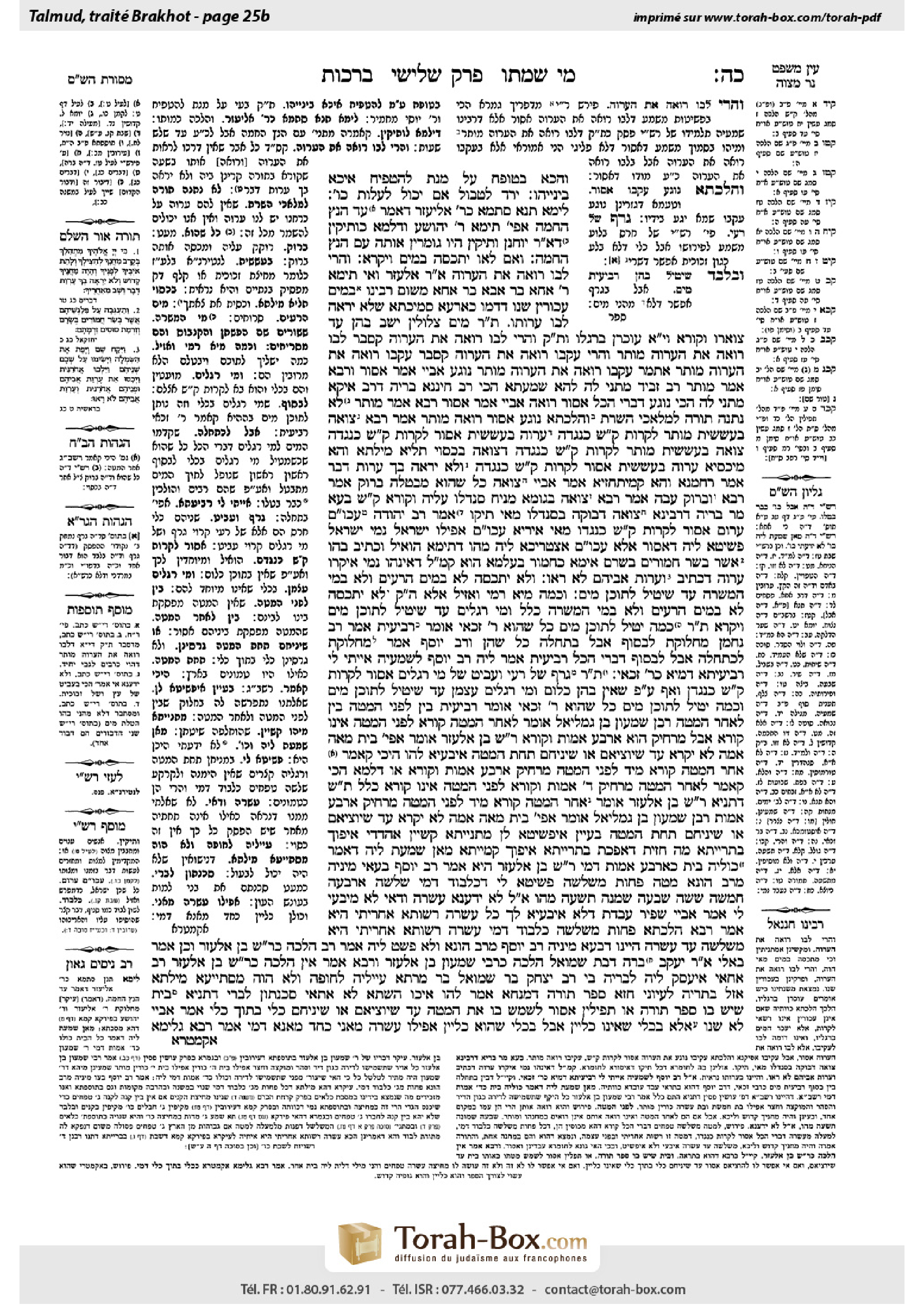
Berakhot 25b: Talmud study for Daf Yomi
Study the Talmud for Daf Yomi with scanned pages, Hebrew text, English translations from Sefaria and AI-generated French translations.
Passage selection and English or AI-generated French translation are available where the scan has annotations. Daf Study is independent of Torah-Box and Sefaria.
Browse Berakhot · ברכות · All tractatesBerakhot 25b text and translations
This page of Berakhot includes the Aramaic text, an English translation and an AI-generated French translation, alongside the scan above.
ברכות כ״ה ב · Aramaic and Hebrew text
וְהָכָא בְּטוֹפֵחַ עַל מְנָת לְהַטְפִּיחַ, אִיכָּא בֵּינַיְיהוּ.
יָרַד לִטְבּוֹל, אִם יָכוֹל לַעֲלוֹת כוּ׳: לֵימָא תַּנָּא סְתָמָא כְּרַבִּי אֱלִיעֶזֶר דְּאָמַר עַד הָנֵץ הַחַמָּה?
אֲפִילּוּ תֵּימָא רַבִּי יְהוֹשֻׁעַ, וְדִלְמָא כְּוָתִיקִין. דְּאָמַר רַבִּי יוֹחָנָן: וָתִיקִין הָיוּ גּוֹמְרִין אוֹתָהּ עִם הָנֵץ הַחַמָּה.
וְאִם לָאו — יִתְכַּסֶּה בְּמַיִם וְיִקְרָא. וַהֲרֵי לִבּוֹ רוֹאֶה אֶת הָעֶרְוָה?
אָמַר רַבִּי אֶלְעָזָר, וְאִי תֵּימָא רַבִּי אַחָא בַּר אַבָּא בַּר אַחָא מִשּׁוּם רַבֵּינוּ: בְּמַיִם עֲכוּרִין שָׁנוּ, דְּדָמוּ כְּאַרְעָא סְמִיכְתָּא, שֶׁלֹּא יִרְאֶה לִבּוֹ עֶרְוָתוֹ.
תָּנוּ רַבָּנַן: מַיִם צְלוּלִין — ישֵׁב בָּהֶן עַד צַוָּארוֹ וְקוֹרֵא. וְיֵשׁ אוֹמְרִים עוֹכְרָן בְּרַגְלוֹ.
וְתָנָא קַמָּא, וַהֲרֵי לִבּוֹ רוֹאֶה אֶת הָעֶרְוָה! קָסָבַר לִבּוֹ רוֹאֶה אֶת הָעֶרְוָה — מוּתָּר. וַהֲרֵי עֲקֵבוֹ רוֹאֶה אֶת הָעֶרְוָה! קָסָבַר עֲקֵבוֹ רוֹאֶה אֶת הָעֶרְוָה מוּתָּר.
אִתְּמַר: עֲקֵבוֹ רוֹאֶה אֶת הָעֶרְוָה מוּתָּר, נוֹגֵעַ — אַבָּיֵי אָמַר: אָסוּר, וְרָבָא אָמַר: מוּתָּר. רַב זְבִיד מַתְנִי לַהּ לְהָא שְׁמַעְתָּא הָכִי. רַב חִינָּנָא בְּרֵיהּ דְּרַב אִיקָא מַתְנִי לַהּ הָכִי: נוֹגֵעַ — דִּבְרֵי הַכֹּל אָסוּר, רוֹאֶה — אַבָּיֵי אָמַר: אָסוּר, רָבָא אָמַר: מוּתָּר: לֹא נִתְּנָה תּוֹרָה לְמַלְאֲכֵי הַשָּׁרֵת. וְהִלְכְתָא נוֹגֵעַ — אָסוּר, רוֹאֶה — מוּתָּר.
אָמַר רָבָא: צוֹאָה בַּעֲשָׁשִׁית, מוּתָּר לִקְרוֹת קְרִיאַת שְׁמַע כְּנֶגְדָּהּ. עֶרְוָה בַּעֲשָׁשִׁית, אָסוּר לִקְרוֹת קְרִיאַת שְׁמַע כְּנֶגְדָּהּ. צוֹאָה בַּעֲשָׁשִׁית מוּתָּר לִקְרוֹת קְרִיאַת שְׁמַע כְּנֶגְדָּהּ דְּצוֹאָה בְּכִיסּוּי תַּלְיָא מִילְּתָא, וְהָא מִיכַּסְּיָא. עֶרְוָה בַּעֲשָׁשִׁית אָסוּר לִקְרוֹת קְרִיאַת שְׁמַע כְּנֶגְדָּהּ, ״וְלֹא יִרְאֶה בְךָ עֶרְוַת דָּבָר״ אָמַר רַחֲמָנָא. וְהָא קָמִיתְחַזְיָא.
אָמַר אַבָּיֵי: צוֹאָה כׇּל שֶׁהוּ, מְבַטְּלָהּ בְּרוֹק. אָמַר רָבָא: וּבְרוֹק עָבֶה. אָמַר רָבָא: צוֹאָה בְּגוּמָּא — מַנִּיחַ סַנְדָּלוֹ עָלֶיהָ, וְקוֹרֵא קְרִיאַת שְׁמַע. בְּעָא מָר בְּרֵיהּ דְּרָבִינָא: צוֹאָה דְּבוּקָה בְּסַנְדָּלוֹ — מַאי? תֵּיקוּ.
אָמַר רַב יְהוּדָה: גּוֹי עָרוֹם אָסוּר לִקְרוֹת קְרִיאַת שְׁמַע כְּנֶגְדּוֹ. מַאי אִירְיָא גּוֹי? אֲפִילּוּ יִשְׂרָאֵל נָמֵי! יִשְׂרָאֵל פְּשִׁיטָא לֵיהּ דְּאָסוּר, אֶלָּא גּוֹי אִיצְטְרִיכָא לֵיהּ מַהוּ דְתֵימָא, הוֹאִיל וּכְתִיב בְּהוּ ״אֲשֶׁר בְּשַׂר חֲמוֹרִים בְּשָׂרָם״, אֵימָא כַּחֲמוֹר בְּעָלְמָא הוּא, קָא מַשְׁמַע לַן דְּאִינְהוּ נָמֵי אִיקְּרוּ עֶרְוָה, דִּכְתִיב: ״וְעֶרְוַת אֲבִיהֶם לֹא רָאוּ״.
וְלֹא יִתְכַּסֶּה לֹא בַּמַּיִם הָרָעִים וְלֹא בְּמֵי הַמִּשְׁרָה עַד שֶׁיָּטִיל לְתוֹכָן מַיִם. וְכַמָּה מַיָּא רָמֵי וְאָזֵיל? אֶלָּא הָכִי קָאָמַר לֹא יִתְכַּסֶּה לֹא בְּמַיִם הָרָעִים וְלֹא בְּמֵי הַמִּשְׁרָה כְּלָל. וּמֵי רַגְלַיִם עַד שֶׁיָּטִיל לְתוֹכָן מַיִם, וְיִקְרָא.
תָּנוּ רַבָּנַן: כַּמָּה יָטִיל לְתוֹכָן מַיִם — כׇּל שֶׁהוּא. רַבִּי זַכַּאי אוֹמֵר: רְבִיעִית.
אָמַר רַב נַחְמָן: מַחֲלוֹקֶת לְבַסּוֹף. אֲבָל בַּתְּחִילָּה, כׇּל שֶׁהֵן.
וְרַב יוֹסֵף אָמַר: מַחֲלוֹקֶת לְכַתְּחִילָּה. אֲבָל לְבַסּוֹף דִּבְרֵי הַכֹּל רְבִיעִית. אֲמַר לֵיהּ רַב יוֹסֵף לְשַׁמָּעֵיהּ: אַיְּיתִי לִי רְבִיעֵיתָא דְמַיָּא, כְּרַבִּי זַכַּאי.
תָּנוּ רַבָּנַן: גְּרָף שֶׁל רְעִי וְעָבִיט שֶׁל מֵי רַגְלַיִם — אָסוּר לִקְרוֹת קְרִיאַת שְׁמַע כְּנֶגְדָּן, וְאַף עַל פִּי שֶׁאֵין בָּהֶן כְּלוּם. וּמֵי רַגְלַיִם עַצְמָן — עַד שֶׁיָּטִיל לְתוֹכָן מַיִם. וְכַמָּה יָטִיל לְתוֹכָן מַיִם — כׇּל שֶׁהוּא. רַבִּי זַכַּאי אוֹמֵר: רְבִיעִית. בֵּין לִפְנֵי הַמִּטָּה בֵּין לְאַחַר הַמִּטָּה. רַבָּן שִׁמְעוֹן בֶּן גַּמְלִיאֵל אוֹמֵר: לְאַחַר הַמִּטָּה — קוֹרֵא, לִפְנֵי הַמִּטָּה — אֵינוֹ קוֹרֵא, אֲבָל מַרְחִיק הוּא אַרְבַּע אַמּוֹת וְקוֹרֵא. רַבִּי שִׁמְעוֹן בֶּן אֶלְעָזָר אוֹמֵר: אֲפִילּוּ בֵּית מֵאָה אַמָּה — לֹא יִקְרָא עַד שֶׁיּוֹצִיאֵם אוֹ שֶׁיַּנִּיחֵם תַּחַת הַמִּטָּה.
אִיבַּעְיָא לְהוּ: הֵיכִי קָאָמַר, אַחַר הַמִּטָּה — קוֹרֵא מִיָּד, לִפְנֵי הַמִּטָּה — מַרְחִיק אַרְבַּע אַמּוֹת וְקוֹרֵא, אוֹ דִילְמָא הָכִי קָאָמַר: לְאַחַר הַמִּטָּה — מַרְחִיק אַרְבַּע אַמּוֹת וְקוֹרֵא, לִפְנֵי הַמִּטָּה — אֵינוֹ קוֹרֵא כְּלָל.
תָּא שְׁמַע, דְּתַנְיָא רַבִּי שִׁמְעוֹן בֶּן אֶלְעָזָר אוֹמֵר: אַחַר הַמִּטָּה — קוֹרֵא מִיָּד, לִפְנֵי הַמִּטָּה — מַרְחִיק אַרְבַּע אַמּוֹת. רַבָּן שִׁמְעוֹן בֶּן גַּמְלִיאֵל אוֹמֵר: אֲפִילּוּ בֵּית מֵאָה אַמָּה — לֹא יִקְרָא עַד שֶׁיּוֹצִיאֵם אוֹ שֶׁיַּנִּיחֵם תַּחַת הַמִּטָּה.
בַּעְיָין אִיפְּשִׁיטָא לַן, מַתְנְיָיתָא קַשְׁיָין אַהֲדָדֵי: אֵיפוֹךְ בָּתְרָיְיתָא.
מָה חָזֵית דְּאָפְכַתְּ בָּתְרָיְיתָא? אֵיפוֹךְ קַמַּיְיתָא!
מַאן שָׁמְעַתְּ לֵיהּ דְּאָמַר כּוּלֵּיהּ בַּיִת כְּאַרְבַּע אַמּוֹת דָּמֵי — רַבִּי שִׁמְעוֹן בֶּן אֶלְעָזָר הִיא.
אָמַר רַב יוֹסֵף: בְּעַאי מִינֵּיהּ מֵרַב הוּנָא: מִטָּה פָּחוֹת מִשְּׁלֹשָׁה פְּשִׁיטָא לִי דִּכְלָבוּד דָּמֵי. שְׁלֹשָׁה, אַרְבָּעָה, חֲמִשָּׁה, שִׁשָּׁה, שִׁבְעָה, שְׁמֹנָה, תִּשְׁעָה, מַהוּ? אֲמַר לֵיהּ: לָא יָדַעְנָא. עֲשָׂרָה וַדַּאי לָא מִיבְּעֵי לִי. אָמַר אַבָּיֵי: שַׁפִּיר עֲבַדְתְּ דְּלָא אִיבַּעְיָא לְךָ, כׇּל עֲשָׂרָה רְשׁוּתָא אַחֲרִיתִי הִיא.
אָמַר רָבָא: הִלְכְתָא, פָּחוֹת מִשְּׁלֹשָׁה כְּלָבוּד דָּמֵי. עֲשָׂרָה — רְשׁוּתָא אַחֲרִיתִי הִיא. מִשְּׁלֹשָׁה עַד עֲשָׂרָה — הַיְינוּ דִּבְעָא מִינֵּיהּ רַב יוֹסֵף מֵרַב הוּנָא וְלָא פְּשַׁט לֵיהּ. אָמַר רַב: הֲלָכָה כְּרַבִּי שִׁמְעוֹן בֶּן אֶלְעָזָר. וְכֵן אָמַר בָּאלִי אָמַר רַב יַעֲקֹב בְּרַהּ דְּבַת שְׁמוּאֵל: הֲלָכָה כְּרַבִּי שִׁמְעוֹן בֶּן אֶלְעָזָר. וְרָבָא אָמַר: אֵין הֲלָכָה כְּרַבִּי שִׁמְעוֹן בֶּן אֶלְעָזָר.
רַב אַחַאי אִיעַסַּק לֵיהּ לִבְרֵיהּ בֵּי רַב יִצְחָק בַּר שְׁמוּאֵל בַּר מָרְתָא, עַיְּילֵיהּ לְחוּפָּה, וְלָא הֲוָה מִסְתַּיְּיעָא מִילְּתָא. אֲזַל בָּתְרֵיהּ לְעַיּוֹנֵי, חֲזָא סֵפֶר תּוֹרָה דְּמַנְּחָא. אֲמַר לְהוּ: אֵיכוּ הַשְׁתָּא לָא אֲתַאי סַכֵּנְתּוּן לִבְרִי. דְּתַנְיָא: בַּיִת שֶׁיֵּשׁ בּוֹ סֵפֶר תּוֹרָה אוֹ תְּפִילִּין אָסוּר לְשַׁמֵּשׁ בּוֹ אֶת הַמִּטָּה עַד שֶׁיּוֹצִיאֵם אוֹ שֶׁיַּנִּיחֵם כְּלִי בְּתוֹךְ כְּלִי.
אָמַר אַבָּיֵי: לֹא שָׁנוּ אֶלָּא בִּכְלִי שֶׁאֵינוֹ כִּלְיָין, אֲבָל בִּכְלִי שֶׁהוּא כִּלְיָין — אֲפִילּוּ עֲשָׂרָה מָאנֵי כְּחַד מָאנָא דָּמֵי. אָמַר רָבָא: גְּלִימָא
Berakhot 25b · English translation
And here, the difference between them is in a case where it is moist enough to moisten other things. According to the first tanna the prohibition is only in effect when the urine is moist enough to moisten other objects, while according to Rabbi Yosei it applies as long as the urine itself is moist, even if it is not moist enough to moisten other objects.
We learned in a mishna that one who descended to immerse himself due to a seminal emission must calculate, whether or not he is able to ascend, cover himself with a garment and recite the morning Shema before sunrise. The Gemara asks: Let us say that Rabbi Yehuda HaNasi taught this in the unattributed mishna in accordance with the opinion of Rabbi Eliezer, who said: One may recite Shema until sunrise.
The Gemara immediately rejects this assumption: Even if you say that the mishna is in accordance with the opinion of Rabbi Yehoshua, who disagrees with Rabbi Eliezer and holds that one may recite the morning Shema until the third hour of the day, and perhaps the halakha in the mishna was directed toward those whose practice was in accordance with the custom of the vatikin, pious individuals who were scrupulous in their performance of mitzvot, with regard to whom Rabbi Yoḥanan said: The vatikin would conclude the recitation of Shema with sunrise.
We learned in the mishna: And if one calculates that he will not be able to ascend and cover himself with a garment in time to recite Shema, he should cover himself in the water and recite Shema there. The Gemara asks: How can one recite Shema with his head above water? His heart sees his nakedness as there is no barrier between them.
Regarding this Rabbi Elazar said, and some say it was Rabbi Aḥa bar Abba bar Aḥa in the name of Rabbeinu, Rav: This was taught with regard to murky water, which is considered to be like solid earth. Therefore, it constitutes a barrier so that his heart does not see his nakedness.
On this same topic, the Sages taught in a baraita: If one was in clear water, he should sit in it up to his neck and recite Shema. And some say: He sullies the water with his foot.
The Gemara asks: And according to the first tanna doesn’t his heart see his nakedness through the clear water? The Gemara replies: He holds that even if his heart sees his nakedness, it is permitted to recite Shema. The Gemara continues and asks: But in the clear water, doesn’t his heel see his nakedness? The Gemara replies: Here too, the first tanna holds that in a case where his heel sees his nakedness it is permitted.
The Gemara notes, it was stated: If one’s heel sees his nakedness it is permitted. However, what is the halakha in a case where his heel touches his nakedness? May one in that circumstance recite Shema or not? Abaye said: It is prohibited, and Rava said: It is permitted. The Gemara notes: Rav Zevid taught this halakha in that manner. Rav Ḥinnana, son of Rav Ika, taught it as follows: In a case where his heel touches his nakedness, everyone agrees that it is prohibited. Their dispute is with regard to a case where his heel sees his nakedness. Abaye said: It is prohibited, and Rava said: It is permitted; the Torah was not given to the ministering angels, and a person, who, as opposed to a ministering angel, has genitals, cannot avoid this. And the halakha is that if his heel touches his nakedness it is prohibited, but if it merely sees his nakedness, it is permitted.
Rava said: Opposite feces covered only by a lantern-like covering, which is transparent, it is permitted to recite Shema. But opposite nakedness covered only by a lantern-like covering, it is prohibited to recite Shema. Opposite feces in a lantern, it is permitted to recite Shema because with regard to feces, the ability to recite Shema is contingent upon covering, as it is said: “And cover your excrement” (Deuteronomy 23:14), and although it is visible, it is covered. On the other hand, opposite nakedness covered only by a lantern-like covering, it is prohibited to recite Shema; the Torah said: “And no indecent thing shall be seen in you” (Deuteronomy 23:15), and here it is seen.
Abaye said: A small amount of feces may be nullified with spittle, and as long as it is covered, it is permitted to recite Shema. Rava said: This applies specifically when it is thick spittle. Rava said: Feces in a hole in the ground, he places his sandal over the hole to cover it and recites Shema. Mar, son of Ravina, raised a dilemma: What is the halakha in a case where feces is stuck to his sandal? Perhaps he would be considered filthy in that case? Let this dilemma stand unresolved.
Rav Yehuda said: Opposite a naked gentile, it is forbidden to recite Shema. The Gemara asks: Why did Rav Yehuda discuss particularly the case of a gentile? Even with regard to a Jew it is also prohibited. The Gemara replies: Opposite the nakedness of a Jew, it is obvious that it is prohibited; however, opposite the nakedness of a gentile, it was necessary for him to say. Lest you say that since it is written about gentiles: “Their flesh is the flesh of donkeys” (Ezekiel 23:20), say that his nakedness is like that of a mere donkey and does not constitute nakedness. Rav Yehuda taught us that their nakedness is also considered nakedness, as it is written regarding the sons of Noah: “And their father’s nakedness they did not see” (Genesis 9:23). Although Noah predated Abraham and was consequently not Jewish, his nakedness is mentioned.
And we learned in the mishna: And one who needs to recite Shema may not cover himself with either foul water or water in which flax was soaked until he pours other water into it. The Gemara asks: How much water does he continue to pour in order to render them a permissible covering. If he is covering himself in water in which flax was soaked, it must be a considerable amount of water, requiring at least an equally considerable amount of water to neutralize it. Rather, this is what it says: One may neither cover himself with foul water nor water in which flax was soaked at all; and urine, which is considered repugnant, until he adds clean water to it, and only then he may recite Shema.
The Sages taught a related disagreement in a baraita: How much water must one add in order to nullify urine? Any quantity is sufficient. Rabbi Zakkai says: One must add a quarter of a log.
Rav Naḥman said: This dispute is with regard to a case where the urine is already in a vessel, and afterward one seeks to nullify it. However, if the clean water was in a vessel at the beginning, before the urine, each drop of urine is nullified as it enters the vessel and therefore any amount of clean water in the vessel is sufficient.
And Rav Yosef said: This dispute is with regard to the amount of water necessary to have in the vessel at the beginning, before the urine. However, afterward, everyone agrees that a quarter of a log is required. The Gemara relates: Rav Yosef said to his servant at the beginning: Bring me a quarter of a log of water, in accordance with the opinion of Rabbi Zakkai.
The Sages taught an elaboration of this point in the Tosefta: Opposite a chamber pot used for excrement or urine, it is prohibited to recite Shema, even if there is nothing in it, as it is always considered filthy. Opposite urine itself, one may not recite Shema until he pours water into it. And how much water must he pour into it? Any quantity. Rabbi Zakkai says: A quarter of a log. That is the ruling both when it is before the bed and when it is behind the bed. Rabban Shimon ben Gamliel says: When it is behind the bed, one may recite Shema, but when it is before the bed, one may not recite Shema, but he must distance himself four cubits and only then recite Shema. Rabbi Shimon ben Elazar is even more strict, saying: Even in a house one hundred cubits in size, one may not recite Shema until he removes it or places it beneath the bed.
A dilemma was raised before students at the yeshiva: How does Rabban Shimon ben Gamliel state this halakha? What did he mean? Did he mean that if the chamber pot is behind the bed, he recites Shema immediately; before the bed, he distances himself four cubits and recites? Or perhaps he states the following: If the chamber pot is behind the bed, he distances himself four cubits and then recites Shema, but if it is before the bed he may not recite Shema at all?
In order to resolve this dilemma, the Gemara cites proof. Come and hear that it was taught in a baraita: Rabbi Shimon ben Elazar says: If it is behind the bed he recites Shema immediately; before the bed, he distances himself four cubits. Rabban Shimon ben Gamliel says: Even in a large house of one hundred cubits one may not recite Shema until he removes it or places it beneath the bed. Thus we see from this baraita that if the vessel is obstructed by the bed he may recite Shema immediately.
The Gemara notes: Our dilemma has been resolved, but the baraitot contradict each other. The statements made in the name of Rabban Shimon ben Gamliel in one baraita were made in the name of Rabbi Shimon ben Elazar in the other. The Gemara resolves the contradiction: Reverse the latter baraita and say that the names of the tanna’im were attached to the wrong opinions.
This solution is difficult: What did you see that led you to reverse the latter baraita? Reverse the first one.
The Gemara proves that the latter baraita should be reversed in accordance with the opinions expressed by these Sages in general. Who did you hear that said that an entire house is considered like four cubits? It is Rabbi Shimon ben Elazar, who expressed that opinion in the halakhot of eiruv (Rav Nissim). Consequently, it is reasonable to posit that this would also be his opinion with regard to these halakhot, and the baraita was reversed accordingly.
Rav Yosef said: I raised a dilemma before Rav Huna: It is obvious to me that a bed under which there is a space of less than three handbreadths is considered connected [lavud] to the ground as if the void beneath it does not exist, as halakha considers a void of less than three handbreadths as sealed. What, then, is the dilemma? What is the halakha if that space is three, four, five, six, seven, eight or nine handbreadths? He said to him: I do not know. However, with regard to a space greater than ten handbreadths I certainly have no dilemma, as it is clear that this space is considered a separate domain. Abaye said to him: You did well that you did not have a dilemma, as the halakha is that any space ten handbreadths high is a separate domain.
Rava summarized and said: The halakha is that less than three handbreadths is considered connected and it is permitted to recite Shema. Ten handbreadths is a separate domain. Three to ten handbreadths is the case with regard to which Rav Yosef raised a dilemma before Rav Huna, and Rav Huna did not resolve it for him. Rav said: The halakha is in accordance with the opinion of Rabbi Shimon ben Elazar. And, so too, the Sage Bali said that Rav Ya’akov, son of Shmuel’s daughter, said: The halakha is in accordance with the opinion of Rabbi Shimon ben Elazar. And Rava said: The halakha is not in accordance with the opinion of Rabbi Shimon ben Elazar.
The Gemara relates: Rav Aḥai arranged for his son to marry into the family of Rav Yitzḥak bar Shmuel bar Marta. He led him to enter the wedding canopy for the wedding ceremony, but he was unsuccessful in his attempts to consummate the marriage. Rav Aḥai followed him to examine possible causes of the problem and he saw a Torah scroll placed there. He said to them: Had I not come now, you would have endangered the life of my son. As it was taught in a baraita: In a room in which there is a Torah scroll or phylacteries, it is forbidden to engage in conjugal relations until he takes them out of the room or places them in a vessel inside a second vessel.
Abaye said: They only taught that a vessel inside a second vessel is sufficient when the vessel is not their, the Torah scroll’s or the phylacteries’, regular vessel. But a vessel that is their regular vessel, even ten vessels are considered as one vessel, and the Torah or phylacteries must be covered in another vessel not typically used for that purpose. Rava said: A cloak
Berakhot 25b · Traduction française (IA)
Et ici, la différence entre eux est dans le cas où il est suffisamment humide pour humecter d'autres choses. Selon le premier tanna, la prohibition est en vigueur uniquement lorsque l'urine est suffisamment humide pour humecter d'autres objets, tandis que selon Rabbi Yosei, elle s'applique tant que l'urine elle-même est humide, même si elle n'est pas suffisamment humide pour humecter d'autres objets.
Nous avons appris dans une mitsva que celui qui est descendu pour se purifier en raison d'une émission sémencière doit calculer s'il est capable de monter, de se couvrir d'un vêtement et de réciter le Chéma du matin avant l'aube. La Guemara pose la question : Disons que Rabbi Yehuda HaNasi a enseigné cela dans la mitsva non attribuée selon l'opinion de Rabbi Eliezer, qui disait : On peut réciter le Chéma jusqu'à l'aube.
La Guemara rejette immédiatement cette hypothèse : Même si vous dites que la mitsva est selon l'opinion de Rabbi Yehoshua, qui s'oppose à Rabbi Eliezer et qui considère que l'on peut réciter le Chéma du matin jusqu'au troisième heure de la journée, et peut-être la halakha dans la mitsva était orientée vers ceux dont la pratique était conforme à la coutume des vatikin, des individus pieux qui étaient rigoureux dans l'accomplissement des mitsvot, à l'égard desquels Rabbi Yoḥanan a dit : Les vatikin concluaient la récitation du Chéma avec l'aube.
Nous avons appris dans la Michna : Et si l'on calcule qu'il ne sera pas capable de monter et de se couvrir d'un vêtement à temps pour réciter le Chéma, il devrait se couvrir dans l'eau et réciter le Chéma là. La Guemara pose la question : Comment peut-on réciter le Chéma avec la tête au-dessus de l'eau ? Son cœur voit sa nudité, car il n'y a pas de barrière entre eux.
Concernant cela, Rabbi Elazar a dit, et certains disent que c'était Rabbi Aḥa bar Abba bar Aḥa en nom de Rabbeinu, Rav : Cela a été enseigné concernant de l'eau trouble, qui est considérée comme étant comme la terre solide. Ainsi, cela constitue une barrière de sorte que son cœur ne voit pas sa nudité.
Sur ce même sujet, les Sages ont enseigné dans une baraïta : Si l'on est dans de l'eau claire, il devrait s'asseoir dedans jusqu'au niveau du cou et réciter le Chéma. Et certains disent : Il souille l'eau avec son pied.
La Guemara pose la question : Et selon le premier tanna, ne voit-il pas sa nudité à travers l'eau claire ? La Guemara répond : Il considère que même si son regard voit sa nudité, il est permis de réciter le Chéma. La Guemara continue et pose la question : Mais dans l'eau claire, ne voit-il pas son talon sa nudité ? La Guemara répond : Ici aussi, le premier tanna considère que dans le cas où son talon voit sa nudité, il est permis.
La Guemara note : Il a été dit : Si le talon de l'homme voit sa nudité, il est permis. Cependant, quelle est la halakha dans le cas où le talon touche sa nudité ? Est-il permis de réciter le Chéma dans ce cas ou non ? Abaye a dit : C'est interdit, et Rava a dit : C'est permis. La Guemara note : Rav Zevid a enseigné cette halakha ainsi. Rav Ḥinnana, fils de Rav Ika, l'a enseigné ainsi : Dans le cas où le talon touche sa nudité, tout le monde est d'accord pour dire qu'il est interdit. Le débat est concernant le cas où le talon voit sa nudité. Abaye a dit : C'est interdit, et Rava a dit : C'est permis ; la Torah n'a pas été donnée aux anges ministères, et un homme, contrairement à un ange ministère, possède des organes génitaux et ne peut éviter cela. Et la halakha est que si son talon touche sa nudité, il est interdit, mais si c'est seulement qu'il la voit, il est permis.
Rava a dit : Opposé aux excrements recouverts seulement d'une couverture semblant à une lanterne, qui est transparente, il est permis de réciter le Chéma. Mais opposé à la nudité recouverte seulement d'une couverture semblant à une lanterne, il est interdit de réciter le Chéma. Opposé aux excrements dans une lanterne, il est permis de réciter le Chéma, car concernant les excrements, la capacité à réciter le Chéma dépend du recouvrement, comme il est dit : « Et couvre tes excrements » (Lévitique 23:14), et bien qu'ils soient visibles, ils sont recouverts. En revanche, opposé à la nudité recouverte seulement d'une couverture semblant à une lanterne, il est interdit de réciter le Chéma ; la Torah dit : « Et aucun objet indecent ne devra être vu en vous » (Lévitique 23:15), et ici, il est vu.
Abaye a dit : Une petite quantité d'excrements peut être annulée avec la salive, et tant qu'ils sont recouverts, il est permis de réciter le Chéma. Rava a dit : Cela s'applique spécifiquement lorsque la salive est épaisse. Rava a dit : Les excrements dans un trou du sol, il place son sandal sur le trou pour le recouvrir et récite le Chéma. Mar, fils de Ravina, a soulevé un dilemme : Quelle est la halakha dans le cas où les excrements sont collés à son sandal ? Peut-être qu'il serait considéré comme sale dans ce cas ? Laissons ce dilemme sans réponse.
Rav Yehuda a dit : Opposé à un gentil nu, il est interdit de réciter le Chéma. La Guemara pose la question : Pourquoi Rav Yehuda a-t-il spécifiquement discuté du cas d'un gentil ? Même concernant un Juif, cela est également interdit. La Guemara répond : Opposé à la nudité d'un Juif, il est évident qu'il est interdit ; cependant, opposé à la nudité d'un gentil, il était nécessaire de le dire. De peur que l'on dise que puisque cela est écrit concernant les gentils : « Leur chair est la chair des ânes » (Ezéchiel 23:20), disons que leur nudité est comme celle d'un simple âne et ne constitue pas de nudité. Rav Yehuda nous a appris que leur nudité est également considérée comme de la nudité, comme il est écrit concernant les fils de Noé : « Et leur père nu ils ne l'ont pas vu » (Genèse 9:23). Bien que Noé précède Abraham et n'était donc pas juif, sa nudité est mentionnée.
Et nous avons appris dans la Michna : Celui qui a besoin de réciter le Chéma ne peut pas se couvrir avec de l'eau impure ou de l'eau dans laquelle on a trempé du lin jusqu'à ce qu'il verse d'autres eaux dedans. La Guemara pose la question : Combien d'eau doit-il continuer à verser afin de rendre ces couvertures permises ? Si l'on se couvre avec de l'eau dans laquelle on a trempé du lin, il doit s'agir d'une quantité considérable d'eau, nécessitant au moins une quantité égale d'eau pour la neutraliser. En réalité, ce que cela dit est : On ne peut pas se couvrir avec de l'eau impure ni avec de l'eau dans laquelle on a trempé du lin du tout ; et l'urine, considérée comme répugnante, jusqu'à ce qu'on y ajoute de l'eau propre, et seulement alors on peut réciter le Chéma.
Les Sages ont enseigné une divergence similaire dans une baraïta : Quelle quantité d'eau doit-on ajouter afin de neutraliser l'urine ? Toute quantité est suffisante. Rabbi Zakkai dit : On doit ajouter un quart de log.
Rav Naḥman a dit : Cette divergence concerne un cas où l'urine est déjà dans un récipient, et ensuite on cherche à la neutraliser. Cependant, si l'eau propre était dans un récipient au début, avant l'urine, chaque goutte d'urine est neutralisée à mesure qu'elle entre dans le récipient et donc toute quantité d'eau propre dans le récipient est suffisante.
Et Rav Yosef a dit : Cette divergence concerne la quantité d'eau nécessaire pour être dans le récipient au début, avant l'urine. Cependant, ensuite, tout le monde convient qu'un quart de log est requis. La Guemara rapporte : Rav Yosef a dit à son serviteur au début : Apporte-moi un quart de log d'eau, conformément à l'opinion de Rabbi Zakkai.
Les Sages ont enseigné une précision de ce point dans la Tosefta : En face d'une cuvette utilisée pour les excrements ou l'urine, il est interdit de réciter le Chéma, même s'il n'y a rien dedans, car on le considère toujours comme impur. En face de l'urine elle-même, on ne peut pas réciter le Chéma jusqu'à ce qu'on y verse de l'eau. Et combien d'eau doit-on y verser ? Toute quantité. Rabbi Zakkai dit : Un quart de log. C'est la décision tant que l'urine est devant le lit que derrière le lit. Rabban Shimon ben Gamliel dit : Quand l'urine est derrière le lit, on peut réciter le Chéma, mais quand elle est devant le lit, on ne peut pas réciter le Chéma, mais il faut s'éloigner de quatre cubits et seulement alors réciter le Chéma. Rabbi Shimon ben Elazar est encore plus strict, disant : Même dans une maison de cent cubits, on ne peut pas réciter le Chéma jusqu'à ce qu'on l'ôte ou qu'on le place sous le lit.
Un dilemme a été soulevé devant les étudiants de la yeshiva : Comment Rabban Shimon ben Gamliel énonce-t-il cette halakha ? De quoi voulait-il dire ? Voulait-il dire que si la cuvette est derrière le lit, on récite le Chéma immédiatement ; devant le lit, on s'éloigne de quatre cubits et on récite ? Ou peut-être voulait-il dire ceci : Si la cuvette est derrière le lit, on s'éloigne de quatre cubits et on récite le Chéma, mais si elle est devant le lit, on ne peut pas réciter le Chéma du tout ?
Pour résoudre ce dilemme, la Guemara cite un témoignage. Vient et écoute que cela a été enseigné dans une baraïta : Rabbi Shimon ben Elazar dit : Si elle est derrière le lit, on récite le Chéma immédiatement ; devant le lit, on s'éloigne de quatre cubits. Rabban Shimon ben Gamliel dit : Même dans une grande maison de cent cubits, on ne peut pas réciter le Chéma jusqu'à ce qu'on l'ôte ou qu'on le place sous le lit. Ainsi nous voyons à partir de cette baraïta que si le récipient est bloqué par le lit, on peut réciter le Chéma immédiatement.
La Guemara note : Notre dilemme a été résolu, mais les baraïtotes s'opposent entre elles. Les déclarations faites au nom de Rabban Shimon ben Gamliel dans une baraïta ont été faites au nom de Rabbi Shimon ben Elazar dans l'autre. La Guemara résout la contradiction : Inverse la dernière baraïta et dis que les noms des tannaïm étaient attachés aux mauvais opinions.
Cette solution est difficile : Qu'est-ce que tu as vu qui t'a conduit à inverser la dernière baraïta ? Inverse la première.
La Guemara démontre que cette dernière baraïta devrait être inversée conformément aux opinions exprimées par ces Sages en général. Qui as-tu entendu dire qu'une maison entière est considérée comme quatre cubits ? C'est Rabbi Shimon ben Elazar, qui a exprimé cette opinion dans les halakhot de l'eiruv (Rav Nissim). Par conséquent, il est raisonnable de penser que cela serait aussi son opinion concernant ces halakhot, et la baraïta a été inversée ainsi.
Rav Yosef a dit : J'ai soulevé un dilemme devant Rav Huna : Il me semble évident qu'un lit dont l'espace sous lui est inférieur à trois tefachim est considéré comme connecté au sol comme si l'espace vide sous lui n'existait pas, car la halakha considère un vide inférieur à trois tefachim comme scellé. Qu'est-ce alors le dilemme ? Quelle est la halakha si cet espace est de trois, quatre, cinq, six, sept, huit ou neuf tefachim ? Il a dit à lui : Je ne sais pas. Cependant, concernant un espace supérieur à dix tefachim, je suis certainement sans dilemme, car il est clair que cet espace est considéré comme un domaine séparé. Abaye a dit à lui : Tu as bien fait de ne pas avoir de dilemme, car la halakha est que tout espace de dix tefachim est un domaine séparé.
Rava a résumé et a dit : La halakha est que moins de trois tefachim est considéré comme connecté et il est permis de réciter le Chéma. Dix tefachim est un domaine séparé. Trois à dix tefachim est le cas concernant lequel Rav Yosef a soulevé un dilemme devant Rav Huna, et Rav Huna n'a pas résolu ce dilemme pour lui. Rav a dit : La halakha suit l'opinion de Rabbi Shimon ben Elazar. Et ainsi aussi a dit le Sage Bali que Rav Ya'akov, fils de la fille de Shmuel, a dit : La halakha suit l'opinion de Rabbi Shimon ben Elazar. Et Rava a dit : La halakha ne suit pas l'opinion de Rabbi Shimon ben Elazar.
La Guemara rapporte : Rav Aḥai a organisé le mariage de son fils avec la famille de Rav Yitzḥak bar Shmuel bar Marta. Il l’a conduit sous le dais pour la cérémonie de mariage, mais il n’a pas réussi à consommer le mariage. Rav Aḥai l’a suivi pour examiner les causes du problème et il a vu un rouleau de Torah placé là. Il a dit à ceux-ci : Si je n’étais pas venu maintenant, vous auriez mis en danger la vie de mon fils. Comme il a été enseigné dans une baraïta : Dans une pièce où il y a un rouleau de Torah ou des phylactères, il est interdit de faire l’amour jusqu’à ce qu’on enlève ces objets de la pièce ou qu’on les place dans un récipient à l’intérieur d’un autre récipient.
Abaye a dit : Ils n’ont enseigné cela que dans le cas où un récipient à l’intérieur d’un autre récipient est suffisant lorsque le récipient n’est pas le leur, celui du rouleau de Torah ou celui des phylactères. Mais un récipient qui est leur récipient habituel, même dix récipients sont considérés comme un seul récipient, et le rouleau de Torah ou les phylactères doivent être couverts avec un autre récipient qui n’est pas habituellement utilisé à cet effet. Rava a dit : Une couverture
Traduction française générée par IA à partir de l’édition anglaise de Sefaria. Vérifie toujours un passage avec le texte source.
Text from Sefaria: William Davidson Edition - Vocalized Aramaic (CC BY NC); William Davidson Edition - English (CC BY NC).