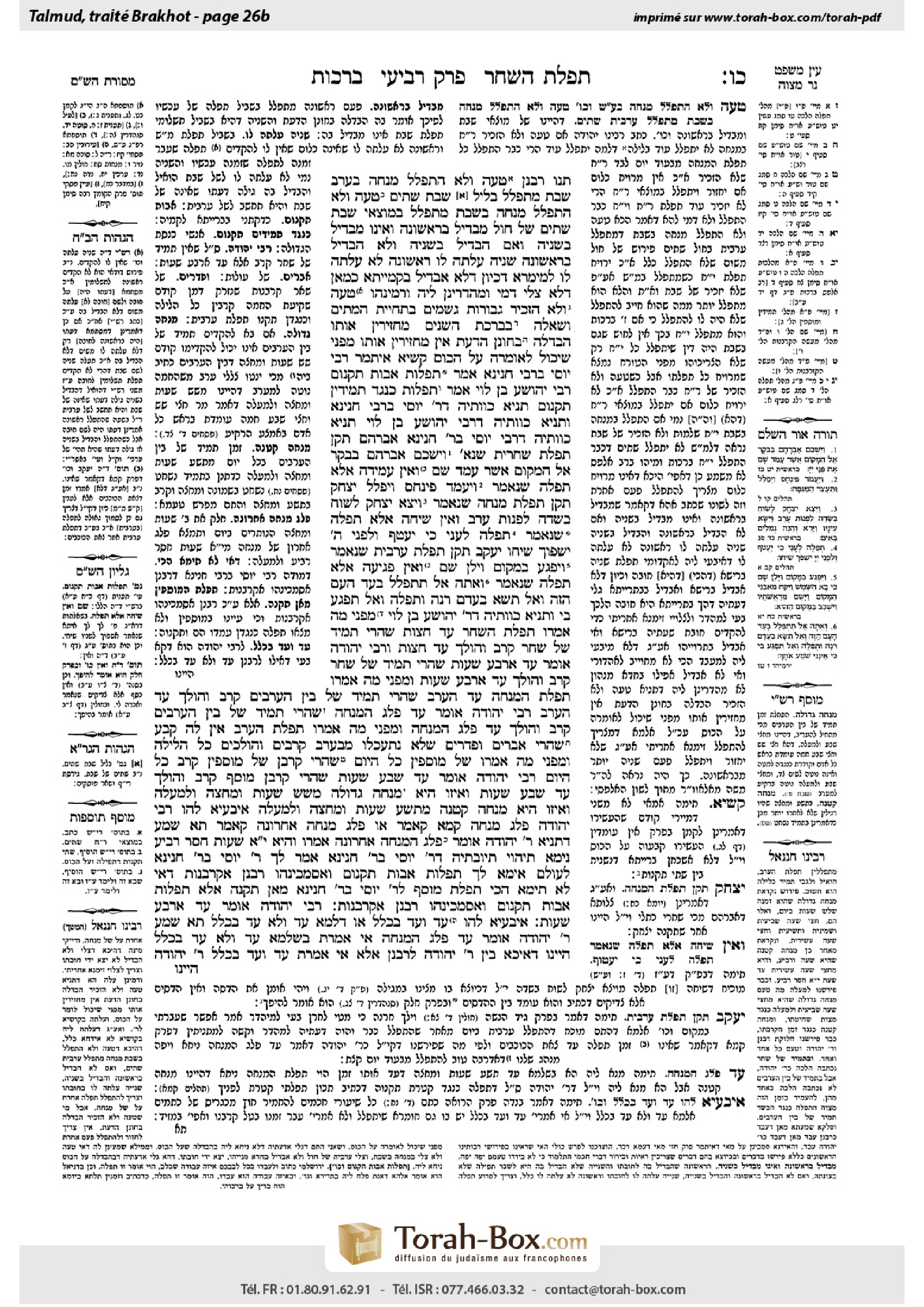
Berakhot 26b: Talmud study for Daf Yomi
Study the Talmud for Daf Yomi with scanned pages, Hebrew text, English translations from Sefaria and AI-generated French translations.
Passage selection and English or AI-generated French translation are available where the scan has annotations. Daf Study is independent of Torah-Box and Sefaria.
Browse Berakhot · ברכות · All tractatesBerakhot 26b text and translations
This page of Berakhot includes the Aramaic text, an English translation and an AI-generated French translation, alongside the scan above.
ברכות כ״ו ב · Aramaic and Hebrew text
תָּנוּ רַבָּנַן: טָעָה וְלֹא הִתְפַּלֵּל מִנְחָה בְּעֶרֶב שַׁבָּת — מִתְפַּלֵּל בְּלֵיל שַׁבָּת שְׁתַּיִם. טָעָה וְלֹא הִתְפַּלֵּל מִנְחָה בְּשַׁבָּת — מִתְפַּלֵּל בְּמוֹצָאֵי שַׁבָּת שְׁתַּיִם שֶׁל חוֹל. מַבְדִּיל בָּרִאשׁוֹנָה, וְאֵינוֹ מַבְדִּיל בִּשְׁנִיָּה. וְאִם הִבְדִּיל בַּשְּׁנִיָּה וְלֹא הִבְדִּיל בָּרִאשׁוֹנָה — שְׁנִיָּה עָלְתָה לוֹ, רִאשׁוֹנָה לֹא עָלְתָה לוֹ.
לְמֵימְרָא דְּכֵיוָן דְּלָא אַבְדִּיל בְּקַמַּיְיתָא כְּמַאן דְּלָא צַלִּי דָּמֵי, וּמַהְדְּרִינַן לֵיהּ?
וּרְמִינְהוּ: טָעָה וְלֹא הִזְכִּיר גְּבוּרוֹת גְּשָׁמִים בִּתְחִיַּית הַמֵּתִים וּשְׁאֵלָה בְּבִרְכַּת הַשָּׁנִים — מַחֲזִירִין אוֹתוֹ. הַבְדָּלָה בְּ״חוֹנֵן הַדַּעַת״ אֵין מַחֲזִירִין אוֹתוֹ, מִפְּנֵי שֶׁיָּכוֹל לְאוֹמְרָהּ עַל הַכּוֹס! קַשְׁיָא.
אִיתְּמַר, רַבִּי יוֹסֵי בְּרַבִּי חֲנִינָא אָמַר: תְּפִלּוֹת אָבוֹת תִּקְּנוּם. רַבִּי יְהוֹשֻׁעַ בֶּן לֵוִי אָמַר: תְּפִלּוֹת כְּנֶגֶד תְּמִידִין תִּקְּנוּם.
תַּנְיָא כְּווֹתֵיהּ דְּרַבִּי יוֹסֵי בְּרַבִּי חֲנִינָא, וְתַנְיָא כְּווֹתֵיהּ דְּרַבִּי יְהוֹשֻׁעַ בֶּן לֵוִי. תַּנְיָא כְּווֹתֵיהּ דְּרַבִּי יוֹסֵי בְּרַבִּי חֲנִינָא: אַבְרָהָם תִּקֵּן תְּפִלַּת שַׁחֲרִית, שֶׁנֶּאֱמַר: ״וַיַּשְׁכֵּם אַבְרָהָם בַּבֹּקֶר אֶל הַמָּקוֹם אֲשֶׁר עָמַד שָׁם״, וְאֵין ״עֲמִידָה״ אֶלָּא תְּפִלָּה, שֶׁנֶּאֱמַר: ״וַיַּעֲמֹד פִּינְחָס וַיְפַלֵּל״.
יִצְחָק תִּקֵּן תְּפִלַּת מִנְחָה, שֶׁנֶּאֱמַר ״וַיֵּצֵא יִצְחָק לָשׂוּחַ בַּשָּׂדֶה לִפְנוֹת עָרֶב״, וְאֵין ״שִׂיחָה״ אֶלָּא תְּפִלָּה, שֶׁנֶּאֱמַר ״תְּפִלָּה לְעָנִי כִי יַעֲטֹף וְלִפְנֵי ה׳ יִשְׁפֹּךְ שִׂיחוֹ״.
יַעֲקֹב תִּקֵּן תְּפִלַּת עַרְבִית, שֶׁנֶּאֱמַר: ״וַיִּפְגַּע בַּמָּקוֹם וַיָּלֶן שָׁם״, וְאֵין ״פְּגִיעָה״ אֶלָּא תְּפִלָּה, שֶׁנֶּאֱמַר: ״וְאַתָּה אַל תִּתְפַּלֵּל בְּעַד הָעָם הַזֶּה וְאַל תִּשָּׂא בַעֲדָם רִנָּה וּתְפִלָּה וְאַל תִּפְגַּע בִּי״
וְתַנְיָא כְּווֹתֵיהּ דְּרַבִּי יְהוֹשֻׁעַ בֶּן לֵוִי: מִפְּנֵי מָה אָמְרוּ תְּפִלַּת הַשַּׁחַר עַד חֲצוֹת — שֶׁהֲרֵי תָּמִיד שֶׁל שַׁחַר קָרֵב וְהוֹלֵךְ עַד חֲצוֹת. וְרַבִּי יְהוּדָה אוֹמֵר: עַד אַרְבַּע שָׁעוֹת שֶׁהֲרֵי תָּמִיד שֶׁל שַׁחַר קָרֵב וְהוֹלֵךְ עַד אַרְבַּע שָׁעוֹת.
וּמִפְּנֵי מָה אָמְרוּ תְּפִלַּת הַמִּנְחָה עַד הָעֶרֶב — שֶׁהֲרֵי, תָּמִיד שֶׁל בֵּין הָעַרְבַּיִם קָרֵב וְהוֹלֵךְ עַד הָעֶרֶב. רַבִּי יְהוּדָה אוֹמֵר: עַד פְּלַג הַמִּנְחָה, שֶׁהֲרֵי תָּמִיד שֶׁל בֵּין הָעַרְבַּיִם קָרֵב וְהוֹלֵךְ עַד פְּלַג הַמִּנְחָה.
וּמִפְּנֵי מָה אָמְרוּ תְּפִלַּת הָעֶרֶב אֵין לָהּ קֶבַע — שֶׁהֲרֵי אֵבָרִים וּפְדָרִים שֶׁלֹּא נִתְעַכְּלוּ מִבָּעֶרֶב, קְרֵבִים וְהוֹלְכִים כׇּל הַלַּיְלָה.
וּמִפְּנֵי מָה אָמְרוּ שֶׁל מוּסָפִין כׇּל הַיּוֹם — שֶׁהֲרֵי קׇרְבָּן שֶׁל מוּסָפִין קָרֵב כׇּל הַיּוֹם. רַבִּי יְהוּדָה אוֹמֵר: עַד שֶׁבַע שָׁעוֹת, שֶׁהֲרֵי קׇרְבַּן מוּסַף קָרֵב וְהוֹלֵךְ עַד שֶׁבַע שָׁעוֹת.
וְאֵיזוֹ הִיא מִנְחָה גְדוֹלָה מִשֵּׁשׁ שָׁעוֹת וּמֶחֱצָה וּלְמַעְלָה. וְאֵיזוֹ הִיא מִנְחָה קְטַנָּה מִתֵּשַׁע שָׁעוֹת וּמֶחֱצָה וּלְמַעְלָה.
אִיבַּעְיָא לְהוּ: רַבִּי יְהוּדָה, פְּלַג מִנְחָה קַמָּא קָאָמַר אוֹ פְּלַג מִנְחָה אַחֲרוֹנָה קָאָמַר? תָּא שְׁמַע דְּתַנְיָא, רַבִּי יְהוּדָה אוֹמֵר: פְּלַג הַמִּנְחָה אַחֲרוֹנָה אָמְרוּ, וְהִיא אַחַת עֶשְׂרֵה שָׁעוֹת חָסֵר רְבִיעַ.
נֵימָא תֶּיהְוֵי תְּיוּבְתֵּיהּ דְּרַבִּי יוֹסֵי בְּרַבִּי חֲנִינָא? אָמַר לְךָ רַבִּי יוֹסֵי בְּרַבִּי חֲנִינָא: לְעוֹלָם אֵימָא לָךְ, תְּפִלּוֹת, אָבוֹת תִּקְּנוּם, וְאַסְמְכִינְהוּ רַבָּנַן אַקׇּרְבָּנוֹת. דְּאִי לָא תֵּימָא הָכִי, תְּפִלַּת מוּסָף לְרַבִּי יוֹסֵי בְּרַבִּי חֲנִינָא מַאן תַּקְּנַהּ. אֶלָּא תְּפִלּוֹת אָבוֹת תִּקְּנוּם, וְאַסְמְכִינְהוּ רַבָּנַן אַקׇּרְבָּנוֹת.
רַבִּי יְהוּדָה אוֹמֵר עַד אַרְבַּע שָׁעוֹת. אִיבַּעְיָא לְהוּ: עַד וְעַד בַּכְּלָל, אוֹ דִילְמָא עַד וְלֹא עַד בַּכְּלָל?! תָּא שְׁמַע רַבִּי יְהוּדָה אוֹמֵר: עַד פְּלַג הַמִּנְחָה. אִי אָמְרַתְּ בִּשְׁלָמָא עַד וְלֹא עַד בַּכְּלָל — הַיְינוּ דְּאִיכָּא בֵּין רַבִּי יְהוּדָה לְרַבָּנַן. אֶלָּא אִי אָמְרַתְּ עַד וְעַד בַּכְּלָל, רַבִּי יְהוּדָה
Berakhot 26b · English translation
On a similar note, the Sages taught in a baraita: One who erred and did not recite the afternoon prayer on the eve of Shabbat, prays in the evening prayer two Amida prayers on Shabbat evening. One who erred and did not recite the afternoon prayer on Shabbat, recites two weekday Amida prayers in the evening prayer at the conclusion of Shabbat. He recites havdala [the prayer of distinction] between the sanctity of Shabbat and the profanity of the week by reciting: You have graced us, etc., in the fourth blessing of the Amida, which is: Who graciously grants knowledge, in the first prayer, as it is the actual evening prayer, but he does not recite havdala in the second prayer, which is in place of the afternoon prayer. Moreover, if he recited havdala in the second prayer and did not recite havdala in the first, the second prayer fulfilled his obligation, the first one did not fulfill his obligation.
The Gemara comments: Is that to say that since he did not recite havdala in the first prayer, he is as one who did not pray and we require him to return to the beginning of the prayer and repeat it? If so, the conclusion is that one who fails to recite havdala in the prayer must repeat that prayer.
The Gemara raises a contradiction to the above conclusion from the Tosefta: One who erred and did not mention the might of the rains: He makes the wind blow and rain fall in the second blessing of the Amida, the blessing on the revival of the dead, and one who erred and failed to recite the request for rain in the ninth blessing of the Amida, the blessing of the years, we require him to return to the beginning of the prayer and repeat it. However, one who erred and failed to recite havdala in the blessing: Who graciously grants knowledge, we do not require him to return to the beginning of the prayer and repeat it, as he can recite havdala over the cup of wine, independent of his prayer. This contradiction was not resolved and remains difficult.
The dispute between the Rabbis and Rabbi Yehuda with regard to the times beyond which the different prayers may not be recited is rooted in a profound disagreement, also manifest in a later amoraic dispute. It was stated: Rabbi Yosei, son of Rabbi Ḥanina, said: The practice of praying three times daily is ancient, albeit not in its present form; prayers were instituted by the Patriarchs. However, Rabbi Yehoshua ben Levi said that the prayers were instituted based on the daily offerings sacrificed in the Holy Temple, and the prayers parallel the offerings, in terms of both time and characteristics.
The Gemara comments: It was taught in a baraita in accordance with the opinion of Rabbi Yosei, son of Rabbi Ḥanina, and it was taught in a baraita in accordance with the opinion of Rabbi Yehoshua ben Levi. The Gemara elaborates: It was taught in a baraita in accordance with the opinion of Rabbi Yosei, son of Rabbi Ḥanina: Abraham instituted the morning prayer, as it is stated when Abraham came to look out over Sodom the day after he had prayed on its behalf: “And Abraham rose early in the morning to the place where he had stood before the Lord” (Genesis 19:27), and from the context as well as the language utilized in the verse, the verb standing means nothing other than prayer, as this language is used to describe Pinehas’ prayer after the plague, as it is stated: “And Pinehas stood up and prayed and the plague ended” (Psalms 106:30). Clearly, Abraham was accustomed to stand in prayer in the morning.
Isaac instituted the afternoon prayer, as it is stated: “And Isaac went out to converse [lasuaḥ] in the field toward evening” (Genesis 24:63), and conversation means nothing other than prayer, as it is stated: “A prayer of the afflicted when he is faint and pours out his complaint [siḥo] before the Lord” (Psalms 102:1). Obviously, Isaac was the first to pray as evening approached, at the time of the afternoon prayer.
Jacob instituted the evening prayer, as it is stated: “And he encountered [vayifga] the place and he slept there for the sun had set” (Genesis 28:11). The word encounter means nothing other than prayer, as it is stated when God spoke to Jeremiah: “And you, do not pray on behalf of this nation and do not raise on their behalf song and prayer, and do not encounter [tifga] Me for I do not hear you” (Jeremiah 7:16). Jacob prayed during the evening, after the sun had set.
And it was taught in a baraita in accordance with the opinion of Rabbi Yehoshua ben Levi that the laws of prayer are based on the laws of the daily offerings: Why did the Rabbis say that the morning prayer may be recited until noon? Because, although the daily morning offering is typically brought early in the morning, it may be sacrificed until noon. And Rabbi Yehuda says: My opinion, that the morning prayer may be recited until four hours into the day, is because the daily morning offering is sacrificed until four hours.
And why did the Rabbis say that the afternoon prayer may be recited until the evening? Because the daily afternoon offering is sacrificed until the evening. Rabbi Yehuda says that the afternoon prayer may be recited only until the midpoint of the afternoon because, according to his opinion, the daily afternoon offering is sacrificed until the midpoint of the afternoon.
And why did they say that the evening prayer is not fixed? Because the burning of the limbs and fats of the offerings that were not consumed by the fire on the altar until the evening. They remained on the altar and were offered continuously throughout the entire night.
And why did the Rabbis say that the additional prayer may be recited all day? Because the additional offering is brought throughout the entire day. However, Rabbi Yehuda says that the additional prayer may be recited until the seventh hour of the day, because the additional offering is sacrificed until the seventh hour.
The baraita continues and states that there are two times for the afternoon prayer. Greater, earlier minḥa [minḥa gedola] and lesser, later minḥa [minḥa ketana]. The Gemara clarifies the difference between them: Which is minḥa gedola? From six-and-a-half hours after sunrise and on, which is a half an hour after noon and on. It is the earliest time that the daily afternoon offering may be sacrificed, as in the case on the eve of Passover that occurs on Shabbat. Which is minḥa ketana? From nine-and-a-half hours and on, which is the standard time that the daily afternoon offering is sacrificed.
On that note, a dilemma was raised before them: Rabbi Yehuda, who holds that the afternoon prayer may be recited only until the midpoint of the afternoon, does he say the midpoint of the first minḥa, minḥa gedola? Or, does he say the midpoint of the last minḥa? Come and hear an explicit resolution to this dilemma: As it was taught in a baraita, Rabbi Yehuda says: They said the midpoint of the last minḥa, and that is eleven hours minus a quarter of an hour after sunrise, i.e., an hour-and-a-quarter hours before sunset.
In any case, it is clear that according to this baraita the halakhot of prayer are based on the Temple offerings. The Gemara suggests: Let us say that this is a conclusive refutation of the opinion of Rabbi Yosei, son of Rabbi Ḥanina, who held that the forefathers instituted the prayers. Rabbi Yosei, son of Rabbi Ḥanina, could have said to you: Actually, I will say to you that the Patriarchs instituted the prayers and the Sages based the times and characteristics of prayer on the Temple offerings, even though they do not stem from the same source. As, if you do not say so, that even Rabbi Yosei, son of Rabbi Ḥanina, would agree that the laws of offerings and those of prayers are related, then, according to Rabbi Yosei, son of Rabbi Ḥanina, who instituted the additional prayer? It is not one of the prayers instituted by the forefathers. Rather, even according to Rabbi Yosei, son of Rabbi Ḥanina, the prayers were instituted by the Patriarchs and the Sages based them on the laws of the offerings.
We learned in the mishna that Rabbi Yehuda says: The morning prayer may be recited until four hours of the day. A dilemma was raised before the yeshiva students: When Rabbi Yehuda says until, does he mean until and including the fourth hour, or, perhaps when he says “until” he means until and not including, in which case one may not pray during the fourth hour? Come and hear a resolution to this dilemma based on the mishna. Rabbi Yehuda says: The afternoon prayer may be recited only until the midpoint of the afternoon. Now, granted, if you say that until means until and not including, then there is a difference between the opinion of Rabbi Yehuda and the opinion of the Rabbis. However, if you say that until means until and including, then the opinion of Rabbi Yehuda
Berakhot 26b · Traduction française (IA)
Sur la même note, les Sages ont enseigné dans une baraïta : Celui qui s'est trompé et n'a pas récité la prière du soir le soir du Shabbat, récite deux prières d'Amida lors de la prière du soir du Shabbat. Celui qui s'est trompé et n'a pas récité la prière du soir le Shabbat, récite deux prières d'Amida du jour ordinaire lors de la prière du soir à la fin du Shabbat. Il récite la séparation entre la sainteté du Shabbat et la profanité de la semaine en récitant : Tu as honoré nous, etc., dans la quatrième bénédiction de l'Amida, qui est : Celui qui accorde gracieusement la connaissance, dans la première prière, car c'est la prière du soir réelle, mais il ne récite pas la séparation dans la deuxième prière, qui remplace la prière du milieu du jour. De plus, si il a récité la séparation dans la deuxième prière et n'a pas récité la séparation dans la première, la deuxième prière a accompli son obligation, la première n'a pas accompli son obligation.
Le Guemara commente : Est-ce que cela signifie que puisque il n'a pas récité la séparation dans la première prière, il est comme celui qui n'a pas prié et nous exigeons qu'il retourne au début de la prière et la répète ? Si c'est ainsi, la conclusion est que celui qui néglige de réciter la séparation dans la prière doit répéter cette prière.
Le Guemara soulève une contradiction avec la conclusion ci-dessus à partir de la Tosefta : Celui qui s'est trompé et n'a pas mentionné la puissance des pluies : Il fait souffler le vent et tomber la pluie dans la deuxième bénédiction de l'Amida, la bénédiction sur la résurrection des morts, et celui qui s'est trompé et n'a pas récité la prière pour la pluie dans la neuvième bénédiction de l'Amida, la bénédiction des années, nous exigeons qu'il retourne au début de la prière et la répète. Cependant, celui qui s'est trompé et n'a pas récité la séparation dans la bénédiction : Celui qui accorde gracieusement la connaissance, nous ne lui exigeons pas de retourner au début de la prière et de la répéter, car il peut réciter la séparation sur le verre de vin, indépendamment de sa prière. Cette contradiction n'a pas été résolue et reste difficile.
Le débat entre les Rabbins et Rabbi Yéhuda concernant les moments au-delà desquels les différentes prières ne peuvent être récitées est ancré dans un profond désaccord, également manifesté dans un débat ultérieur d'amora. Il a été dit : Rabbi Yosei, fils de Rabbi Chanina, a dit : La pratique de prier trois fois par jour est ancienne, bien qu'elle ne soit pas encore sous sa forme actuelle ; les prières ont été instituées par les Patriarches. Cependant, Rabbi Yéhoshua ben Levi a dit que les prières ont été instituées en fonction des offrandes quotidiennes sacrifiées dans le Temple Saint, et les prières s'alignent sur les offrandes, en termes de temps et de caractéristiques.
Le Guemara commente : Il a été enseigné dans une baraïta conformément à l'opinion de Rabbi Yosei, fils de Rabbi Chanina, et il a été enseigné dans une baraïta conformément à l'opinion de Rabbi Yéhoshua ben Levi. Le Guemara développe : Il a été enseigné dans une baraïta conformément à l'opinion de Rabbi Yosei, fils de Rabbi Chanina : Abraham a institué la prière du matin, car il est dit lorsqu'Abraham est venu regarder vers Sodome le jour après qu'il eut prié à son sujet : « Et Abraham se leva de bonne heure le matin vers le lieu où il avait été debout devant l'Éternel » (Genèse 19:27), et à partir du contexte ainsi que du langage utilisé dans la verset, le verbe « debout » signifie rien d'autre que la prière, car ce langage est utilisé pour décrire la prière de Pinhas après l'épidémie, comme il est dit : « Et Pinhas se leva et pria et l'épidémie cessa » (Psaumes 106:30). Évidemment, Abraham était habitué à se tenir en prière le matin.
Isaac a institué la prière de l'après-midi, car il est dit : « Et Isaac sortit pour converser [lasuaḥ] dans le champ vers le soir » (Genèse 24:63), et la conversation signifie rien d'autre que la prière, car il est dit : « Une prière du misérable lorsqu'il est faible et verse sa plainte [siḥo] devant l'Éternel » (Psaumes 102:1). Évidemment, Isaac était le premier à prier à l'approche du soir, à l'heure de la prière de l'après-midi.
Jacob institua la prière du soir, car il est dit : « Et il rencontra [vayifga] le lieu et il dormit là où le soleil s'était couché » (Genèse 28:11). Le mot « rencontrer » signifie rien d'autre que la prière, car il est dit lorsqu'Allah s'est adressé à Jérémie : « Et toi, ne prie pas en faveur de ce peuple et ne lèves pas pour eux chansons et prières, et ne rencontres [tifga] Moi car Je n'entends pas toi » (Jérémie 7:16). Jacob pria pendant le soir, après que le soleil se fut couché.
Et il a été enseigné dans une baraïta conformément à l'opinion de Rabbi Yéhoshua ben Levi que les lois de la prière sont basées sur les lois des offrandes quotidiennes : Pourquoi les Rabbins ont-ils dit que la prière du matin peut être récitée jusqu'à midi ? Parce que, bien que l'offrande matinale quotidienne soit généralement offerte tôt le matin, elle peut être sacrifiée jusqu'à midi. Et Rabbi Yéhuda dit : Mon opinion, que la prière du matin peut être récitée jusqu'à quatre heures de la journée, est parce que l'offrande matinale quotidienne est sacrifiée jusqu'à quatre heures.
Et pourquoi les Rabbins ont-ils dit que la prière de midi peut être récitée jusqu'au soir ? Parce que l'offrande de midi quotidienne est sacrifiée jusqu'au soir. Rabbi Yéhuda dit que la prière de midi peut être récitée uniquement jusqu'au milieu de l'après-midi, car, selon son opinion, l'offrande de midi quotidienne est sacrifiée jusqu'au milieu de l'après-midi.
Et pourquoi les Rabbins ont-ils dit que la prière du soir n'est pas fixe ? Parce que la combustion des membres et des graisses des offrandes qui n'ont pas été consumés par le feu sur l'autel jusqu'au soir. Ils restaient sur l'autel et étaient offerts continuellement toute la nuit.
Et pourquoi les Rabbins ont-ils dit que la prière supplémentaire peut être récitée toute la journée ? Parce que l'offrande supplémentaire est offerte toute la journée. Cependant, Rabbi Yéhuda dit que la prière supplémentaire peut être récitée jusqu'à la septième heure de la journée, car l'offrande supplémentaire est sacrifiée jusqu'à la septième heure.
La baraïta continue et affirme qu'il y a deux moments pour la prière de l'après-midi : la minḥa gedola, plus tôt, et la minḥa ketana, plus tard. La Guemara clarifie la différence entre elles : Quelle est la minḥa gedola ? Celle qui commence à six heures et demie après le lever du soleil et par la suite, c'est-à-dire une demi-heure après midi et par la suite. C'est le moment le plus tôt où l'offrande de l'après-midi peut être sacrifiée, comme dans le cas de la veille de Pessah qui tombe un samedi. Quelle est la minḥa ketana ? Celle qui commence à neuf heures et demie et par la suite, c'est-à-dire le moment standard où l'offrande de l'après-midi est sacrifiée.
En ce sens, un dilemme a été soulevé devant eux : Rabbi Yehuda, qui affirme que la prière de l'après-midi peut être récitée jusqu'au milieu de l'après-midi, dit-il que le milieu de la première minḥa, la minḥa gedola ? Ou bien, dit-il que le milieu de la dernière minḥa ? Venez écouter une résolution explicite à ce dilemme : Comme il a été enseigné dans une baraïta, Rabbi Yehuda dit : Ils ont dit que le milieu de la dernière minḥa, c'est-à-dire onze heures moins un quart après le lever du soleil, c'est-à-dire une heure et quart avant le coucher du soleil.
En tout cas, il est clair que selon cette baraïta, les halakhot de la prière sont basées sur les offrandes du Temple. La Guemara suggère : Disons que cela constitue une réfutation définitive de l'opinion de Rabbi Yosei, fils de Rabbi Ḥanina, qui affirmait que les pères fondèrent les prières. Rabbi Yosei, fils de Rabbi Ḥanina, aurait pu dire : En réalité, je vous dirai que les Patriarches instituèrent les prières et les Sages basèrent les moments et les caractéristiques des prières sur les offrandes du Temple, même s'ils ne proviennent pas du même source. En effet, si vous ne dites pas cela, même Rabbi Yosei, fils de Rabbi Ḥanina, serait d'accord que les lois des offrandes et celles des prières sont liées, alors, selon Rabbi Yosei, fils de Rabbi Ḥanina, qui institua la prière supplémentaire ? Ce n'est pas l'une des prières instituées par les pères. Au contraire, même selon Rabbi Yosei, fils de Rabbi Ḥanina, les prières furent instituées par les Patriarches et les Sages les basèrent sur les lois des offrandes.
Nous avons appris dans la mishna que Rabbi Yehuda dit : La prière du matin peut être récitée jusqu'à quatre heures de la journée. Un dilemme a été soulevé devant les étudiants de la yeshiva : Lorsque Rabbi Yehuda dit jusqu'à, entend-il jusqu'au et y compris la quatrième heure, ou, peut-être, lorsque dit-il « jusqu'à », entend-il jusqu'à et non y compris, dans ce cas, on ne peut pas prier pendant la quatrième heure ? Venez écouter une résolution à ce dilemme basée sur la mishna. Rabbi Yehuda dit : La prière de l'après-midi peut être récitée uniquement jusqu'au milieu de l'après-midi. Maintenant, en effet, si vous dites que « jusqu'à » signifie jusqu'à et non y compris, alors il y a une différence entre l'opinion de Rabbi Yehuda et celle des Rabbins. Cependant, si vous dites que « jusqu'à » signifie jusqu'à et y compris, alors l'opinion de Rabbi Yehuda est identique à celle des Rabbins.
Traduction française générée par IA à partir de l’édition anglaise de Sefaria. Vérifie toujours un passage avec le texte source.
Text from Sefaria: William Davidson Edition - Vocalized Aramaic (CC BY NC); William Davidson Edition - English (CC BY NC).