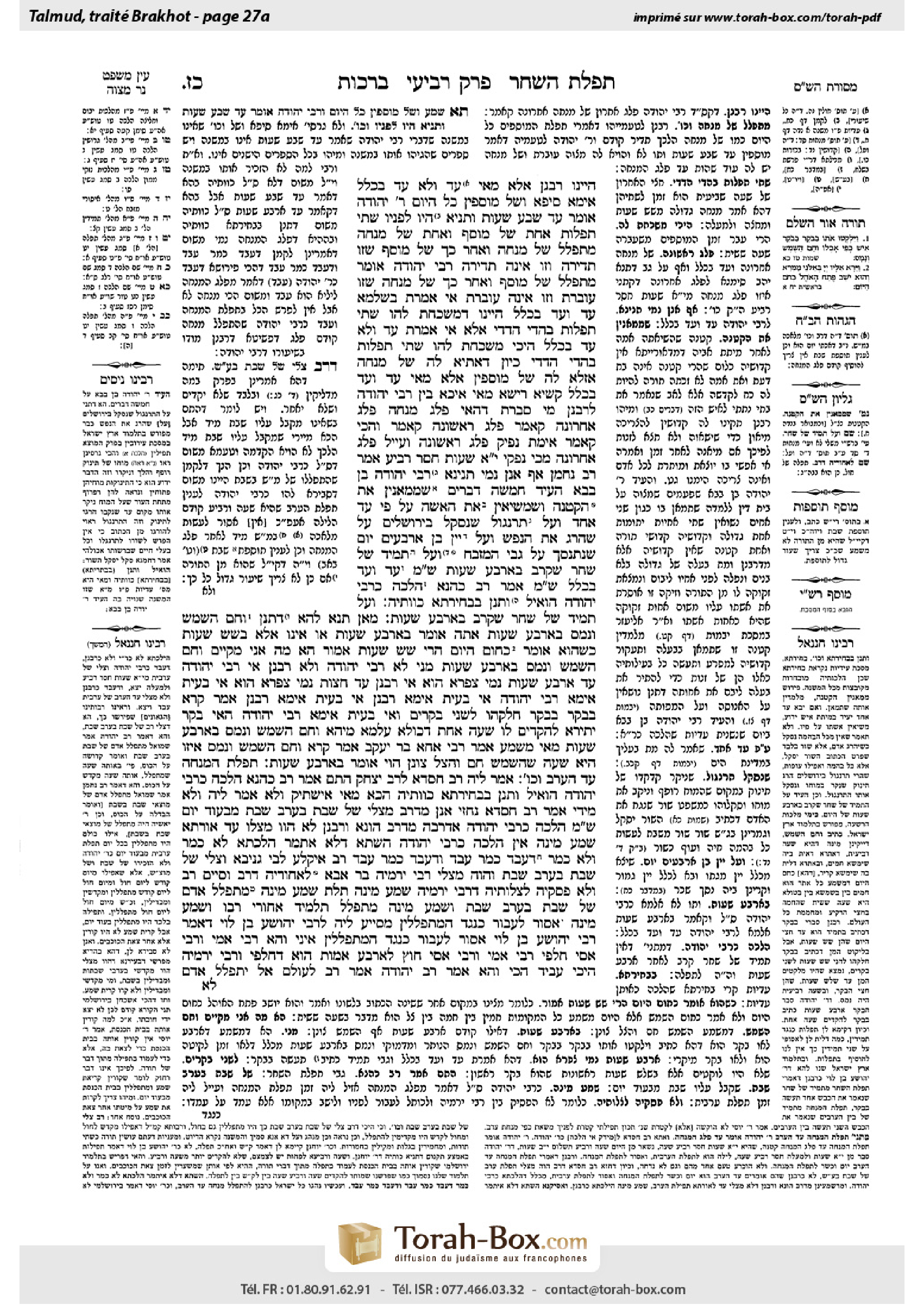
Berakhot 27a: Talmud study for Daf Yomi
Study the Talmud for Daf Yomi with scanned pages, Hebrew text, English translations from Sefaria and AI-generated French translations.
Passage selection and English or AI-generated French translation are available where the scan has annotations. Daf Study is independent of Torah-Box and Sefaria.
Browse Berakhot · ברכות · All tractatesBerakhot 27a text and translations
This page of Berakhot includes the Aramaic text, an English translation and an AI-generated French translation, alongside the scan above.
ברכות כ״ז א · Aramaic and Hebrew text
הַיְינוּ רַבָּנַן!
אֶלָּא מַאי, עַד וְלֹא עַד בַּכְּלָל? אֵימָא סֵיפָא: וְשֶׁל מוּסָפִין כׇּל הַיּוֹם. רַבִּי יְהוּדָה אוֹמֵר: עַד שֶׁבַע שָׁעוֹת. וְתַנְיָא: הָיוּ לְפָנָיו שְׁתֵּי תְּפִלּוֹת, אַחַת שֶׁל מוּסָף וְאַחַת שֶׁל מִנְחָה — מִתְפַּלֵּל שֶׁל מִנְחָה וְאַחַר כָּךְ שֶׁל מוּסָף, שֶׁזּוֹ תְּדִירָה, וְזוֹ אֵינָהּ תְּדִירָה. רַבִּי יְהוּדָה אוֹמֵר: מִתְפַּלֵּל שֶׁל מוּסָף וְאַחַר כָּךְ שֶׁל מִנְחָה, שֶׁזּוֹ עוֹבֶרֶת, וְזוֹ אֵינָהּ עוֹבֶרֶת.
אִי אָמְרַתְּ בִּשְׁלָמָא ״עַד וְעַד בַּכְּלָל״, הַיְינוּ דְּמַשְׁכַּחַתְּ לְהוּ שְׁתֵּי תְּפִלּוֹת בַּהֲדֵי הֲדָדֵי. אֶלָּא אִי אָמְרַתְּ ״עַד וְלֹא עַד בַּכְּלָל״, הֵיכִי מַשְׁכַּחַתְּ לְהוּ שְׁתֵּי תְּפִלּוֹת בַּהֲדֵי הֲדָדֵי? כֵּיוָן דְּאָתְיָא לַהּ שֶׁל מִנְחָה, אָזְלָא לַהּ שֶׁל מוּסָפִין!
אֶלָּא מַאי, ״עַד וְעַד בַּכְּלָל״? קַשְׁיָא רֵישָׁא, מַאי אִיכָּא בֵּין רַבִּי יְהוּדָה לְרַבָּנַן?! — מִי סָבְרַתְּ דְּהַאי ״פְּלַג מִנְחָה״ פְּלַג אַחֲרוֹנָה קָאָמַר? פְּלַג רִאשׁוֹנָה קָאָמַר, וְהָכִי קָאָמַר: אֵימַת נָפֵיק פְּלַג רִאשׁוֹנָה וְעָיֵיל פְּלַג אַחֲרוֹנָה — מִכִּי נָפְקִי אַחַת עֶשְׂרֵה שָׁעוֹת חָסֵר רְבִיעַ.
אָמַר רַב נַחְמָן: אַף אֲנַן נָמֵי תְּנֵינָא.
רַבִּי יְהוּדָה בֶּן בָּבָא הֵעִיד חֲמִשָּׁה דְּבָרִים: שֶׁמְמָאֲנִין אֶת הַקְּטַנָּה, וְשֶׁמַּשִּׂיאִין אֶת הָאִשָּׁה עַל פִּי עֵד אֶחָד, וְעַל תַּרְנְגוֹל שֶׁנִּסְקַל בִּירוּשָׁלַיִם עַל שֶׁהָרַג אֶת הַנֶּפֶשׁ, וְעַל יַיִן בֶּן אַרְבָּעִים יוֹם שֶׁנִּתְנַסֵּךְ עַל גַּבֵּי הַמִּזְבֵּחַ, וְעַל תָּמִיד שֶׁל שַׁחַר שֶׁקָּרֵב בְּאַרְבַּע שָׁעוֹת.
שְׁמַע מִינַּהּ ״עַד וְעַד בַּכְּלָל״. שְׁמַע מִינַּהּ.
אָמַר רַב כָּהֲנָא: הֲלָכָה כְּרַבִּי יְהוּדָה, הוֹאִיל וּתְנַן בִּבְחִירָתָא כְּווֹתֵיהּ.
וְעַל תָּמִיד שֶׁל שַׁחַר שֶׁקָּרֵב בְּאַרְבַּע שָׁעוֹת, מַאן תְּנָא לְהָא דִּתְנַן: ״וְחַם הַשֶּׁמֶשׁ וְנָמָס״, בְּאַרְבַּע שָׁעוֹת.
אַתָּה אוֹמֵר בְּאַרְבַּע שָׁעוֹת, אוֹ אֵינוֹ אֶלָּא בְּשֵׁשׁ שָׁעוֹת?! כְּשֶׁהוּא אוֹמֵר ״כְּחֹם הַיּוֹם״, הֲרֵי שֵׁשׁ שָׁעוֹת אָמוּר, הָא מָה אֲנִי מְקַיֵּים ״וְחַם הַשֶּׁמֶשׁ וְנָמָס״ — בְּאַרְבַּע שָׁעוֹת. מַנִּי? לָא רַבִּי יְהוּדָה וְלָא רַבָּנַן. אִי רַבִּי יְהוּדָה עַד אַרְבַּע שָׁעוֹת נָמֵי צַפְרָא הוּא! אִי רַבָּנַן — עַד חֲצוֹת נָמֵי צַפְרָא הוּא.
אִי בָּעֵית אֵימָא רַבִּי יְהוּדָה, אִי בָּעֵית אֵימָא רַבָּנַן: אִי בָּעֵית אֵימָא רַבָּנַן: אָמַר קְרָא ״בַּבֹּקֶר בַּבֹּקֶר״ — חַלְּקֵהוּ לִשְׁנֵי בְּקָרִים. וְאִי בָּעֵית אֵימָא רַבִּי יְהוּדָה: הַאי בֹּקֶר יַתִּירָא — לְהַקְדִּים לוֹ שָׁעָה אַחַת. דְּכוּלָּא עָלְמָא מִיהָא ״וְחַם הַשֶּׁמֶשׁ וְנָמָס״ בְּאַרְבַּע שָׁעוֹת.
מַאי מַשְׁמַע? אָמַר רַבִּי אַחָא בַּר יַעֲקֹב: אָמַר קְרָא ״וְחַם הַשֶּׁמֶשׁ וְנָמָס״ — אֵיזוֹ הִיא שָׁעָה שֶׁהַשֶּׁמֶשׁ חַם וְהַצֵּל צוֹנֵן — הֱוֵי אוֹמֵר בְּאַרְבַּע שָׁעוֹת.
תְּפִלַּת הַמִּנְחָה עַד הָעֶרֶב וְכוּ׳. אֲמַר לֵיהּ רַב חִסְדָּא לְרַב יִצְחָק: הָתָם אָמַר רַב כָּהֲנָא הֲלָכָה כְּרַבִּי יְהוּדָה, הוֹאִיל וּתְנַן בִּבְחִירָתָא כְּווֹתֵיהּ, הָכָא מַאי? אִישְׁתִּיק וְלָא אֲמַר לֵיהּ וְלָא מִידֵּי. אָמַר רַב חִסְדָּא: נֶחְזֵי אֲנַן, מִדְּרַב מְצַלֵּי שֶׁל שַׁבָּת בְּעֶרֶב שַׁבָּת מִבְּעוֹד יוֹם, שְׁמַע מִינַּהּ הֲלָכָה כְּרַבִּי יְהוּדָה.
אַדְּרַבָּה מִדְּרַב הוּנָא וְרַבָּנַן לָא הֲווֹ מְצַלּוּ עַד אוּרְתָּא, שְׁמַע מִינַּהּ אֵין הֲלָכָה כְּרַבִּי יְהוּדָה. הַשְׁתָּא דְּלָא אִתְּמַר הִלְכְתָא לָא כְּמָר וְלָא כְּמָר, דַּעֲבַד כְּמָר — עֲבַד, וְדַעֲבַד כְּמָר — עֲבַד.
רַב אִיקְּלַע לְבֵי גְּנִיבָא וְצַלִּי שֶׁל שַׁבָּת בְּעֶרֶב שַׁבָּת, וַהֲוָה מְצַלֵּי רַבִּי יִרְמְיָה בַּר אַבָּא לַאֲחוֹרֵי דְרַב, וְסַיֵּים רַב וְלָא פַּסְקֵיהּ לִצְלוֹתֵיהּ דְּרַבִּי יִרְמְיָה. שְׁמַע מִינַּהּ תְּלָת: שְׁמַע מִינַּהּ מִתְפַּלֵּל אָדָם שֶׁל שַׁבָּת בְּעֶרֶב שַׁבָּת. וּשְׁמַע מִינַּהּ מִתְפַּלֵּל תַּלְמִיד אֲחוֹרֵי רַבּוֹ. וּשְׁמַע מִינַּהּ אָסוּר לַעֲבוֹר כְּנֶגֶד הַמִּתְפַּלְּלִין.
מְסַיַּיע לֵיהּ לְרַבִּי יְהוֹשֻׁעַ בֶּן לֵוִי. דְּאָמַר רַבִּי יְהוֹשֻׁעַ בֶּן לֵוִי: אָסוּר לַעֲבוֹר כְּנֶגֶד הַמִּתְפַּלְּלִין. אִינִי?! וְהָא רַבִּי אַמֵּי וְרַבִּי אַסִּי חָלְפִי. רַבִּי אַמֵּי וְרַבִּי אַסִּי — חוּץ לְאַרְבַּע אַמּוֹת הוּא דְּחָלְפִי.
וְרַבִּי יִרְמְיָה הֵיכִי עָבֵיד הָכִי?! וְהָא אָמַר רַב יְהוּדָה אָמַר רַב: לְעוֹלָם אַל יִתְפַּלֵּל אָדָם
Berakhot 27a · English translation
is identical to the opinion of the Rabbis, as the end of the period that begins with the midpoint of the afternoon is sunset.
The Gemara immediately rejects this proof: Rather, what is the alternative? That until means until and not including? It remains problematic. Say the latter clause of the mishna: The additional prayer may be recited all day. Rabbi Yehuda says: It may be recited until the seven hours. And it was taught in a baraita: If the obligation to recite two prayers was before him, one the additional prayer and one the afternoon prayer, he prays the afternoon prayer first and the additional prayer thereafter, because this, the afternoon prayer, is recited on a frequent basis, and that, the additional prayer, is recited on a relatively infrequent basis as it is only recited on Shabbat, the New Moon, and Festivals. The principle states: When a frequent practice and an infrequent practice clash, the frequent practice takes precedence over the infrequent practice. Rabbi Yehuda says: He recites the additional prayer first and the afternoon prayer thereafter, because the time to recite this, the additional prayer, will soon elapse, and this, the time to recite the afternoon prayer, will not soon elapse, as one may recite it until the midpoint of the afternoon.
The relevant point is: Granted, if you say that until means until and including, that is how you can find a situation where the times to recite two prayers, the afternoon prayer and the additional prayer, overlap. But if you say that until means until and not including, and that until seven hours means until the beginning of the seventh hour, noon, then how can you find a situation where the times to recite two prayers overlap? Once the time to recite the afternoon prayer, a half hour past noon, has arrived, the time to recite the additional prayer is already gone?
Rather, what is the alternative? That until means until and including? Then the first clause of the mishna is difficult, as explained above with regard to the midpoint of the afternoon: What is the halakhic difference between the opinion of Rabbi Yehuda and the opinion of the Rabbis? The Gemara answers: Do you think that when this midpoint of the afternoon was mentioned it was speaking of the period following the midpoint, the last part of the afternoon, from an hour-and-a-quarter before sunset until sunset? This was not the intention. Rather, it was speaking of the period prior to the midpoint, the first part of the afternoon, which, as explained above, is from nine-and-a-half hours after sunrise until an hour-and-a-quarter before sunset. Consequently, until the midpoint of the afternoon means until the end of the first half of that afternoon period. And this is what he is saying: When does the first half leave and the second half enter? From when eleven hours minus a quarter have passed since sunrise. Rabbi Yehuda’s use of the term until always means until and including.
Practically speaking, this means that, according to Rabbi Yehuda, it is permissible to recite the morning prayer until the end of the fourth hour. In support of this Rav Naḥman said: We, too, learned this in a mishna:
Rabbi Yehuda ben Bava testified about five matters of halakha:
When an orphan girl, who was married off by her mother or brother before reaching the age of majority, reaches the age of majority, she may refuse to continue living with her husband and thereby retroactively annul their marriage. Normally, marriage refusals are discouraged. However, in specific instances where it is clear that if the marriage were to remain in effect it would engender problems related to levirate marriage and ḥalitza, Rabbi Yehuda ben Bava testified that one may persuade the minor girl to refuse to continue living with her husband, thereby resolving the complications involved in this case.
And he testified that one may allow a woman who, after hearing of her husband’s death, seeks to remarry, to marry based on the testimony of one witness, as opposed to the two witnesses required for other testimonies of the Torah.
And he testified about a rooster that was stoned to death in Jerusalem for killing a person, in order to teach that the Torah law (Exodus 21:28) which requires the stoning of an ox that killed a person, applies to other animals as well.
And he testified about forty-day-old wine that was used for libation on the altar.
And he testified about the daily morning offering that was sacrificed at four hours of the day.
Learn from this final testimony, which is in accordance with the opinion of Rabbi Yehuda, that until means until and including. The Gemara concludes: Indeed, learn from this.
Based on this mishna, Rav Kahana said: The halakha is in accordance with the opinion of Rabbi Yehuda since we learned in a mishna in the preferred tractate, Eduyyot, in accordance with his opinion. Since the halakha is ruled in accordance with all of the mishnayot in Eduyyot, the opinion of a tanna who rules in accordance with the opinion of Rabbi Yehuda in that mishna means that the halakha is in accordance with that opinion.
And about the daily morning offering that was sacrificed at four hours. Based on this, the Gemara attempts to identify the tanna who taught that which we learned in the mishna about the manna that fell for the children of Israel in the desert: “And they gathered it morning by morning, each according to what he eats, and when the sun grew hot it melted” (Exodus 16:21); that took place four hours into the day.
The baraita continues: Do you say that the time when the sun grew hot was at four hours, or perhaps it was only at six hours of the day? When the verse says: “In the heat of the day” (Genesis 18:1), six hours is already mentioned in the Torah as the heat of the day. How, then, do I establish the verse: “And when the sun grew hot it melted”? This must refer to an earlier time, at four hours. The Gemara asks: Who is the tanna of this mishna? It is neither Rabbi Yehuda nor the Sages. If it was in accordance with the opinion of Rabbi Yehuda, until four hours is also considered morning, as he holds that the daily morning offering may still be sacrificed then, while here it says that in the morning the manna was gathered and it melted after the morning. If it was in accordance with the opinion of the Rabbis, until noon is also considered morning, since, according to the Sages, the daily morning offering could be sacrificed until noon. Apparently, this is an entirely new position.
The Gemara responds: If you wish, say that the mishna is in accordance with the opinion of Rabbi Yehuda, and if you wish, say instead that the mishna is in accordance with the opinion of the Rabbis. The Gemara explains: If you wish, say in accordance with the opinion of the Rabbis. The verse states: Morning by morning, divide it into two mornings. Morning, according to the Rabbis, lasts until noon. The repetition of the term morning in the Torah indicates that the period when the manna was gathered ended at the conclusion of the first half of the morning, i.e., the end of the third hour. And if you wish, say instead in accordance with the opinion of Rabbi Yehuda, who would say that: This extra morning in the phrase morning by morning comes to make the end of the period when the manna was gathered an hour earlier. In any event, everyone agrees that the verse, And when the sun grew hot it melted, refers to four hours of the day.
The Gemara asks: From where is the inference drawn that this is the meaning of the verse? Rabbi Aḥa bar Ya’akov said: The verse states: “When the sun grew hot it melted.” Which is the hour that the sun is hot but the shade remains cool, before the heat of the day, when even the shade is hot? You must say at four hours.
We learned in the mishna: The Rabbis hold that the afternoon prayer may be recited until the evening. Rabbi Yehuda says: It may be recited only until the midpoint of the afternoon. Rav Ḥisda said to Rav Yitzḥak: There, with regard to the morning prayer, Rav Kahana said: The halakha is in accordance with the opinion of Rabbi Yehuda, since we learned in a mishna in the preferred tractate, Eduyyot, in accordance with his opinion. Here, what is the ruling? He was silent and said nothing to him, as he was familiar with no established ruling in this matter. Rav Ḥisda said: Let us see and try to resolve this ourselves from the fact that Rav prayed the Shabbat prayers on the eve of Shabbat while it was still day. Learn from this that the halakha is in accordance with the opinion of Rabbi Yehuda, and the time for the afternoon prayer ends at the midpoint of the afternoon, after which time one may recite the evening prayer.
The Gemara immediately rejects the proof based on Rav’s practice: On the contrary, from the fact that Rav Huna and the Sages, students of Rav, would not pray until evening, learn from that that the halakha is not in accordance with the opinion of Rabbi Yehuda. The Gemara concludes: Now that the halakha was stated neither in accordance with the opinion of this Sage nor in accordance with the opinion of that Sage, one who acted in accordance with the opinion of this Sage has acted legitimately, and one who acted in accordance with the opinion of that Sage has acted legitimately, as this halakha is left to the decision of each individual.
The Gemara relates: Rav happened by the house of the Sage, Geniva, and he prayed the Shabbat prayer on the eve of Shabbat before nightfall. Rabbi Yirmeya bar Abba was praying behind Rav, and Rav finished his prayer but did not take three steps back and interrupt the prayer of Rabbi Yirmeya. Derive from this incident three halakhot: Derive from this that one may pray the Shabbat prayer on the eve of Shabbat before nightfall. And derive from this that a student may pray behind his rabbi. And derive from this that it is prohibited to pass before those who are praying.
The Gemara responds: This supports the opinion of Rabbi Yehoshua ben Levi, as Rabbi Yehoshua ben Levi said: It is prohibited to pass before those who are praying. The Gemara asks: Is that so? Didn’t Rabbi Ami and Rabbi Asi pass before those who were praying? The Gemara responds: Rabbi Ami and Rabbi Asi were beyond four cubits from those who were praying when they passed.
One particular detail was surprising: How did Rabbi Yirmeya act that way and pray behind Rav? Didn’t Rav Yehuda say that Rav said: A person should never pray
Berakhot 27a · Traduction française (IA)
est identique à l'opinion des Sages, car la fin de la période qui commence au milieu de l'après-midi est le coucher du soleil.
La Guemara rejette immédiatement cette preuve : plutôt, quelle est l'alternative ? Que « jusqu'à » signifie jusqu'à et non inclus ? Il reste problématique. Dites la dernière clause de la Michna : la prière supplémentaire peut être récitée toute la journée. Rabbi Yéhuda dit : elle peut être récitée jusqu'à la septième heure. Et il a été enseigné dans une baraïta : si l'obligation de réciter deux prières était devant lui, l'une la prière supplémentaire et l'autre la prière de l'après-midi, il prie d'abord la prière de l'après-midi et ensuite la prière supplémentaire, car celle-ci, la prière de l'après-midi, est récitée fréquemment, et celle-là, la prière supplémentaire, est récitée relativement rarement, car elle est récitée seulement le sabbat, la nouvelle lune et les fêtes. Le principe stipule : lorsque la pratique fréquente et la pratique rare s'opposent, la pratique fréquente prévaut sur la pratique rare. Rabbi Yéhuda dit : il récite d'abord la prière supplémentaire et ensuite la prière de l'après-midi, car le temps de réciter celle-ci, la prière supplémentaire, s'écoule bientôt, et celui de réciter la prière de l'après-midi ne s'écoule pas bientôt, car on peut la réciter jusqu'au milieu de l'après-midi.
Le point crucial est : Admettons que vous disiez que « jusqu'à » signifie jusqu'à et y compris, c'est ainsi que vous pouvez trouver une situation où les moments de réciter deux prières, la prière de l'après-midi et la prière supplémentaire, s'overlappent. Mais si vous disiez que « jusqu'à » signifie jusqu'à et non y compris, et que « jusqu'à sept heures » signifie jusqu'au début de la septième heure, le midi, alors comment pouvez-vous trouver une situation où les moments de réciter deux prières s'overlappent ? Une fois que le moment de réciter la prière de l'après-midi, une demi-heure après le midi, est arrivé, le moment de réciter la prière supplémentaire est déjà passé ?
Plutôt, quelle est l'alternative ? Que « jusqu'à » signifie jusqu'à et y compris ? Alors la première clause de la Michna est problématique, comme expliqué ci-dessus concernant le milieu de l'après-midi : Quelle est la différence halakhique entre l'opinion de Rabbi Yéhuda et celle des Sages ? La Guemara répond : Pensez-vous que lorsqu'on a mentionné ce milieu de l'après-midi, on parlait de la période suivante, la fin de l'après-midi, de l'heure et quart avant le coucher du soleil jusqu'au coucher du soleil ? Cela n'était pas l'intention. Plutôt, on parlait de la période précédente, la première partie de l'après-midi, qui, comme expliqué ci-dessus, va de neuf heures et demie après l'aube jusqu'à l'heure et quart avant le coucher du soleil. Ainsi, « jusqu'au milieu de l'après-midi » signifie jusqu'à la fin de la première moitié de cette période de l'après-midi. Et c'est ce que l'on dit : Quand la première moitié s'achève et la deuxième moitié commence ? À partir de quand onze heures moins un quart ont passé depuis l'aube. L'utilisation par Rabbi Yéhuda du terme « jusqu'à » signifie toujours jusqu'à et y compris.
Pratiquement parlant, cela signifie que, selon Rabbi Yéhuda, il est permis de réciter la prière matinale jusqu'à la fin de la quatrième heure. En soutien de cela, Rav Naḥman a dit : Nous aussi, nous avons appris cela dans une Michna :
Rabbi Yéhuda ben Bava a témoigné sur cinq points de halakha : Lorsqu'une fille orpheline, mariée par sa mère ou son frère avant d'atteindre l'âge de majorité, atteint l'âge de majorité, elle peut refuser de continuer à vivre avec son mari et ainsi annuler rétroactivement leur mariage. Normalement, les refus de mariage sont déconseillés. Cependant, dans des cas spécifiques où il est clair que si le mariage restait en vigueur, cela générerait des problèmes liés au mariage levirique et à la ḥalitza, Rabbi Yéhuda ben Bava a témoigné que l'on peut convaincre la jeune fille mineure de refuser de continuer à vivre avec son mari, résolvant ainsi les complications de ce cas. Et il a témoigné que l'on peut permettre à une femme, après avoir appris de la mort de son mari, de se remarier sur la témoignage d'un seul témoin, contrairement aux deux témoins requis pour d'autres témoignages de la Torah. Et il a témoigné sur un coq qui a été lapidé à Jérusalem pour avoir tué une personne, afin d'enseigner que la loi du Torah (Exode 21:28) exigeant la lapidation d'un bœuf ayant tué une personne s'applique également aux autres animaux. Et il a témoigné sur du vin de quarante jours utilisé pour l'offrande sur l'autel. Et il a témoigné sur l'offrande matinale quotidienne sacrifiée à quatre heures de la journée.
Apprenez de ce dernier témoignage, qui est conforme à l'opinion de Rabbi Yéhuda, que « jusqu'à » signifie jusqu'à et y compris. La Guemara conclut : En effet, apprenez-en.
D'après cette Michna, Rav Kahana a dit : La halakha suit l'opinion de Rabbi Yéhuda, car nous avons appris dans une Michna du traité préféré, Eduyyot, conformément à son opinion. Puisque la halakha est décidée selon toutes les Michnayot d'Eduyyot, l'opinion d'un tanna qui décide selon l'opinion de Rabbi Yéhuda dans cette Michna signifie que la halakha suit cette opinion.
Et concernant l'offrande matinale quotidienne sacrifiée à quatre heures. D'après cela, la Guemara tente d'identifier le tanna qui a enseigné ce que nous avons appris dans la Michna sur le manna qui est tombé pour les enfants d'Israël dans le désert : « Et ils le réunirent matin par matin, chacun selon ce qu'il mangeait, et quand le soleil s'échauffa, il fondit » (Exode 16:21) ; cela s'est produit à quatre heures de la journée.
La baraïta continue : Dis-tu que le temps où le soleil devenait chaud était à quatre heures, ou peut-être était-il seulement à six heures de la journée ? Lorsque la parole dit : « Dans la chaleur du jour » (Genèse 18:1), six heures est déjà mentionnée dans la Torah comme la chaleur du jour. Comment alors établir la parole : « Et quand le soleil devenait chaud il fondait » ? Cela doit se référer à un temps plus tôt, à quatre heures. La Guemara demande : Qui est le tanna de cette mitsna ? Ce n'est ni Rabbi Yehuda ni les Sages. Si c'était selon l'opinion de Rabbi Yehuda, jusqu'à quatre heures est aussi considéré comme le matin, car il considère que l'offrande matinale peut encore être sacrifiée à ce moment-là, tandis que là il dit que le manna était récolté le matin et fondait après le matin. Si c'était selon l'opinion des Sages, jusqu'à midi est aussi considéré comme le matin, car, selon les Sages, l'offrande matinale pouvait être sacrifiée jusqu'à midi. Apparemment, c'est une position entièrement nouvelle.
La Guemara répond : Si tu veux, dis que la Michna est selon l'opinion de Rabbi Yehuda, et si tu veux, dis plutôt que la Michna est selon l'opinion des Sages. La Guemara explique : Si tu veux, dis selon l'opinion des Sages. La parole dit : « Matin par matin, divise-le en deux matins. » Le matin, selon les Sages, dure jusqu'à midi. La répétition du terme « matin » dans la Torah indique que la période où le manna était récolté s'achevait à la fin de la première moitié du matin, c'est-à-dire à la fin de la troisième heure. Et si tu veux, dis plutôt selon l'opinion de Rabbi Yehuda, qui dirait que : Ce matin supplémentaire dans la phrase « matin par matin » a pour but de faire finir la période où le manna était récolté une heure plus tôt. En tout cas, tout le monde convient que la parole « Et quand le soleil devenait chaud il fondait » se réfère à quatre heures du jour.
La Guemara demande : D'où tire-t-on cette interprétation de la parole ? Rabbi Acha bar Ya'akov dit : La parole dit : « Quand le soleil devenait chaud, il fondait. » Quelle heure est-ce que le soleil est chaud mais que l'ombre reste fraîche, avant la chaleur du jour, lorsque même l'ombre est chaude ? Tu dois dire à quatre heures.
Nous avons appris dans la Michna : Les Sages considèrent que la prière de l'après-midi peut être récitée jusqu'au soir. Rabbi Yehuda dit : Elle peut être récitée uniquement jusqu'au milieu de l'après-midi. Rav Hischda dit à Rav Yitzhak : Là, concernant la prière matinale, Rav Kahana dit : La halakha suit l'opinion de Rabbi Yehuda, car nous avons appris dans une Michna du traité préféré, Eduyyot, selon son opinion. Ici, quelle est la décision ? Il restait silencieux et ne disait rien à lui, car il ne connaissait aucun règlement établi à ce sujet. Rav Hischda dit : Voyons et essayons de résoudre cela nous-mêmes à partir du fait que Rav priait les prières du Shabbat sur la veille du Shabbat alors qu'il faisait encore jour. Apprends-en que la halakha suit l'opinion de Rabbi Yehuda, et que la période de la prière de l'après-midi s'achève au milieu de l'après-midi, après quoi on peut réciter la prière du soir.
La Guemara rejette immédiatement cette preuve basée sur la pratique de Rav : Au contraire, à partir du fait que Rav Huna et les Sages, élèves de Rav, ne prient pas jusqu'au soir, apprends-en que la halakha ne suit pas l'opinion de Rabbi Yehuda. La Guemara conclut : Maintenant que la halakha a été établie ni selon l'opinion de ce Sage ni selon celle de celui-là, celui qui agit selon l'opinion de ce Sage agit légitimement, et celui qui agit selon l'opinion de celui-là agit légitimement, car cette halakha est laissée à la décision de chaque individu.
La Guemara rapporte : Rav passa par la maison du Sage, Geniva, et il pria la prière du Shabbat sur la veille du Shabbat avant la nuit. Rabbi Yirmeya bar Abba priait derrière Rav, et Rav termina sa prière mais ne fit pas trois pas en arrière et ne perturba pas la prière de Rabbi Yirmeya. Trois halakhot sont tirées de cet incident : On peut prier la prière du Shabbat sur la veille du Shabbat avant la nuit. L'élève peut prier derrière son maître. Il est interdit de passer devant ceux qui prient.
La Guemara répond : Cela soutient l'opinion de Rabbi Yehoshua ben Levi, car Rabbi Yehoshua ben Levi dit : Il est interdit de passer devant ceux qui prient. La Guemara demande : Est-ce ainsi ? N'ont pas Rabbi Ami et Rabbi Asi passé devant ceux qui priaient ? La Guemara répond : Rabbi Ami et Rabbi Asi étaient à plus de quatre coudées des personnes qui priaient lorsqu'ils passaient.
Un détail particulier était surprenant : Comment Rabbi Yirmeya a-t-il agi ainsi et prié derrière Rav ? N'a-t-il pas dit Rav Yehuda que Rav dit : Une personne ne doit jamais prier
Traduction française générée par IA à partir de l’édition anglaise de Sefaria. Vérifie toujours un passage avec le texte source.
Text from Sefaria: William Davidson Edition - Vocalized Aramaic (CC BY NC); William Davidson Edition - English (CC BY NC).