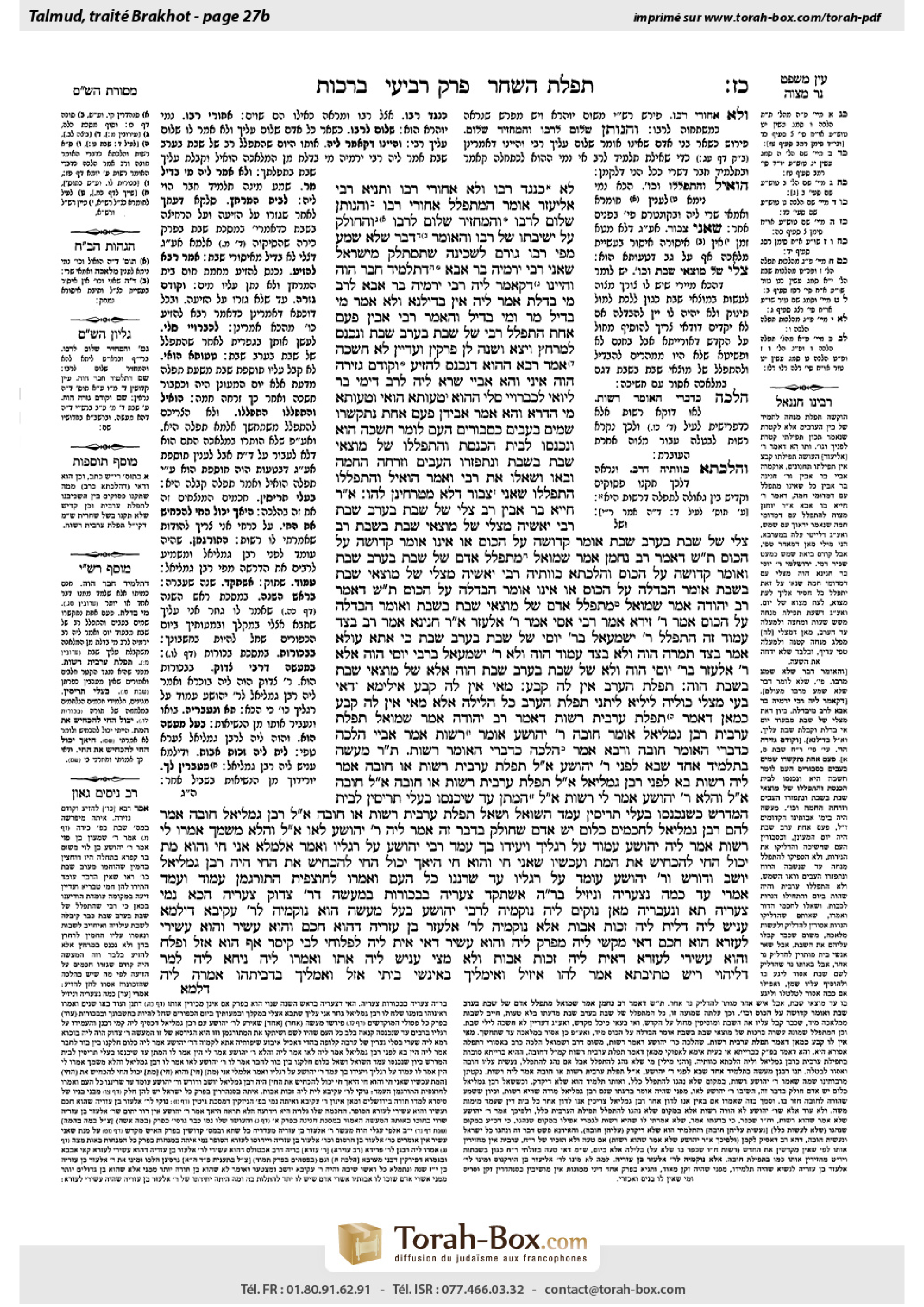
Berakhot 27b: Talmud study for Daf Yomi
Study the Talmud for Daf Yomi with scanned pages, Hebrew text, English translations from Sefaria and AI-generated French translations.
Passage selection and English or AI-generated French translation are available where the scan has annotations. Daf Study is independent of Torah-Box and Sefaria.
Browse Berakhot · ברכות · All tractatesBerakhot 27b text and translations
This page of Berakhot includes the Aramaic text, an English translation and an AI-generated French translation, alongside the scan above.
ברכות כ״ז ב · Aramaic and Hebrew text
לֹא כְּנֶגֶד רַבּוֹ, וְלֹא אֲחוֹרֵי רַבּוֹ.
וְתַנְיָא, רַבִּי אֱלִיעֶזֶר אוֹמֵר: הַמִּתְפַּלֵּל אֲחוֹרֵי רַבּוֹ, וְהַנּוֹתֵן שָׁלוֹם לְרַבּוֹ, וְהַמַּחֲזִיר שָׁלוֹם לְרַבּוֹ, וְהַחוֹלֵק עַל יְשִׁיבָתוֹ שֶׁל רַבּוֹ, וְהָאוֹמֵר דָּבָר שֶׁלֹּא שָׁמַע מִפִּי רַבּוֹ — גּוֹרֵם לַשְּׁכִינָה שֶׁתִּסְתַּלֵּק מִיִּשְׂרָאֵל!
שָׁאנֵי רַבִּי יִרְמְיָה בַּר אַבָּא דְּתַלְמִיד חָבֵר הֲוָה. וְהַיְינוּ דְּקָאָמַר לֵיהּ רַבִּי יִרְמְיָה בַּר אַבָּא לְרַב: מִי בְּדַלְתְּ? אָמַר לֵיהּ: אִין, בְּדֵילְנָא, וְלָא אֲמַר ״מִי בְּדֵיל מָר״?
וּמִי בְּדֵיל? וְהָאָמַר רַבִּי אָבִין: פַּעַם אַחַת הִתְפַּלֵּל רַבִּי שֶׁל שַׁבָּת בְּעֶרֶב שַׁבָּת, וְנִכְנַס לַמֶּרְחָץ, וְיָצָא וְשָׁנָה לַן פִּרְקִין, וַעֲדַיִין לֹא חָשְׁכָה! אָמַר רָבָא: הָהוּא דְּנִכְנַס לְהַזִּיעַ, וְקוֹדֶם גְּזֵירָה הֲוָה.
אִינִי, וְהָא אַבָּיֵי שְׁרָא לֵיהּ לְרַב דִּימִי בַּר לֵיוַאי לְכַבְרוֹיֵי סַלֵּי!
הַהוּא טָעוּתָא הֲוַאי.
וְטָעוּתָא מִי הָדְרָא? וְהָא אָמַר אֲבִידָן: פַּעַם אַחַת נִתְקַשְּׁרוּ שָׁמַיִם בֶּעָבִים, כִּסְבוּרִים הָעָם לוֹמַר חֲשֵׁכָה הוּא, נִכְנְסוּ לְבֵית הַכְּנֶסֶת וְהִתְפַּלְּלוּ שֶׁל מוֹצָאֵי שַׁבָּת בְּשַׁבָּת. וְנִתְפַּזְּרוּ הֶעָבִים וְזָרְחָה הַחַמָּה,
וּבָאוּ וְשָׁאֲלוּ אֶת רַבִּי. וְאָמַר: הוֹאִיל וְהִתְפַּלְּלוּ — הִתְפַּלְּלוּ! שָׁאנֵי צִבּוּר, דְּלָא מַטְרְחִינַן לְהוּ.
אָמַר רַבִּי חִיָּיא בַּר אָבִין: רַב צַלִּי שֶׁל שַׁבָּת בְּעֶרֶב שַׁבָּת, רַבִּי יֹאשִׁיָּה מְצַלֵּי שֶׁל מוֹצָאֵי שַׁבָּת בְּשַׁבָּת. רַב צַלִּי שֶׁל שַׁבָּת בְּעֶרֶב שַׁבָּת: אוֹמֵר קְדוּשָּׁה עַל הַכּוֹס, אוֹ אֵינוֹ אוֹמֵר קְדוּשָּׁה עַל הַכּוֹס? תָּא שְׁמַע דְּאָמַר רַב נַחְמָן אָמַר שְׁמוּאֵל: מִתְפַּלֵּל אָדָם שֶׁל שַׁבָּת בְּעֶרֶב שַׁבָּת וְאוֹמֵר קְדוּשָּׁה עַל הַכּוֹס. וְהִלְכְתָא כְּווֹתֵיהּ.
רַבִּי יֹאשִׁיָּה מְצַלֵּי שֶׁל מוֹצָאֵי שַׁבָּת בְּשַׁבָּת: אוֹמֵר הַבְדָּלָה עַל הַכּוֹס אוֹ אֵינוֹ אוֹמֵר הַבְדָּלָה עַל הַכּוֹס? תָּא שְׁמַע דְּאָמַר רַב יְהוּדָה אָמַר שְׁמוּאֵל: מִתְפַּלֵּל אָדָם שֶׁל מוֹצָאֵי שַׁבָּת בְּשַׁבָּת וְאוֹמֵר הַבְדָּלָה עַל הַכּוֹס.
אָמַר רַבִּי זֵירָא אָמַר רַבִּי אַסִּי אָמַר רַבִּי אֶלְעָזָר אָמַר רַבִּי חֲנִינָא אָמַר רַב: בְּצַד עַמּוּד זֶה הִתְפַּלֵּל רַבִּי יִשְׁמָעֵאל בְּרַבִּי יוֹסֵי שֶׁל שַׁבָּת בְּעֶרֶב שַׁבָּת
כִּי אֲתָא עוּלָּא אָמַר: בְּצַד תְּמָרָה הֲוָה, וְלֹא בְּצַד עַמּוּד הֲוָה. וְלֹא רַבִּי יִשְׁמָעֵאל בְּרַבִּי יוֹסֵי הֲוָה, אֶלָּא רַבִּי אֶלְעָזָר בְּרַבִּי יוֹסֵי הֲוָה, וְלֹא שֶׁל שַׁבָּת בְּעֶרֶב שַׁבָּת הֲוָה, אֶלָּא שֶׁל מוֹצָאֵי שַׁבָּת בְּשַׁבָּת הֲוָה.
תְּפִלַּת הָעֶרֶב אֵין לָהּ קֶבַע. מַאי אֵין לָהּ קֶבַע? אִילֵּימָא דְּאִי בָּעֵי מְצַלֵּי כּוּלֵּיהּ לֵילְיָא, לִיתְנֵי ״תְּפִלַּת הָעֶרֶב כׇּל הַלַּיְלָה״! אֶלָּא מַאי אֵין לָהּ קֶבַע —
כְּמַאן דְּאָמַר, תְּפִלַּת עַרְבִית רְשׁוּת. דְּאָמַר רַב יְהוּדָה אָמַר שְׁמוּאֵל: תְּפִלַּת עַרְבִית: רַבָּן גַּמְלִיאֵל אוֹמֵר חוֹבָה, רַבִּי יְהוֹשֻׁעַ אוֹמֵר רְשׁוּת. אָמַר אַבָּיֵי: הֲלָכָה כְּדִבְרֵי הָאוֹמֵר חוֹבָה. וְרָבָא אָמַר: הֲלָכָה כְּדִבְרֵי הָאוֹמֵר רְשׁוּת.
תָּנוּ רַבָּנַן: מַעֲשֶׂה בְּתַלְמִיד אֶחָד שֶׁבָּא לִפְנֵי רַבִּי יְהוֹשֻׁעַ. אָמַר לוֹ: תְּפִלַּת עַרְבִית רְשׁוּת אוֹ חוֹבָה? אָמַר לֵיהּ: רְשׁוּת.
בָּא לִפְנֵי רַבָּן גַּמְלִיאֵל, אָמַר לוֹ: תְּפִלַּת עַרְבִית רְשׁוּת אוֹ חוֹבָה? אָמַר לוֹ: חוֹבָה. אָמַר לוֹ: וַהֲלֹא רַבִּי יְהוֹשֻׁעַ אָמַר לִי רְשׁוּת?! אָמַר לוֹ: הַמְתֵּן עַד שֶׁיִּכָּנְסוּ בַּעֲלֵי תְּרִיסִין לְבֵית הַמִּדְרָשׁ.
כְּשֶׁנִּכְנְסוּ בַּעֲלֵי תְּרִיסִין, עָמַד הַשּׁוֹאֵל וְשָׁאַל: תְּפִלַּת עַרְבִית רְשׁוּת אוֹ חוֹבָה? אָמַר לוֹ רַבָּן גַּמְלִיאֵל: חוֹבָה. אָמַר לָהֶם רַבָּן גַּמְלִיאֵל לַחֲכָמִים: כְּלוּם יֵשׁ אָדָם שֶׁחוֹלֵק בְּדָבָר זֶה? אָמַר לֵיהּ רַבִּי יְהוֹשֻׁעַ: לָאו. אָמַר לוֹ: וַהֲלֹא מִשִּׁמְךָ אָמְרוּ לִי רְשׁוּת!
אָמַר לֵיהּ: יְהוֹשֻׁעַ, עֲמוֹד עַל רַגְלֶיךָ וְיָעִידוּ בְּךָ. עָמַד רַבִּי יְהוֹשֻׁעַ עַל רַגְלָיו וְאָמַר אִלְמָלֵא אֲנִי חַי וְהוּא מֵת — יָכוֹל הַחַי לְהַכְחִישׁ אֶת הַמֵּת. וְעַכְשָׁיו שֶׁאֲנִי חַי וְהוּא חַי — הֵיאַךְ יָכוֹל הַחַי לְהַכְחִישׁ אֶת הַחַי?
הָיָה רַבָּן גַּמְלִיאֵל יוֹשֵׁב וְדוֹרֵשׁ וְרַבִּי יְהוֹשֻׁעַ עוֹמֵד עַל רַגְלָיו, עַד שֶׁרִנְּנוּ כׇּל הָעָם וְאָמְרוּ לְחוּצְפִּית הַתּוּרְגְּמָן: עֲמוֹד! וְעָמַד.
אָמְרִי: עַד כַּמָּה נְצַעֲרֵיהּ וְנֵיזִיל, בְּרֹאשׁ הַשָּׁנָה אֶשְׁתָּקַד צַעֲרֵיהּ. בִּבְכוֹרוֹת בְּמַעֲשֵׂה דְרַבִּי צָדוֹק צַעֲרֵיהּ. הָכָא נָמֵי צַעֲרֵיהּ, תָּא וְנַעְבְּרֵיהּ!
מַאן נוֹקֵים לֵיהּ? נוֹקְמֵיהּ לְרַבִּי יְהוֹשֻׁעַ — בַּעַל מַעֲשֶׂה הוּא. נוֹקְמֵיהּ לְרַבִּי עֲקִיבָא — דִּילְמָא עָנֵישׁ לֵיהּ, דְּלֵית לֵיהּ זְכוּת אָבוֹת.
אֶלָּא נוֹקְמֵיהּ לְרַבִּי אֶלְעָזָר בֶּן עֲזַרְיָה, דְּהוּא חָכָם, וְהוּא עָשִׁיר, וְהוּא עֲשִׂירִי לְעֶזְרָא. הוּא חָכָם — דְּאִי מַקְשֵׁי לֵיהּ, מְפָרֵק לֵיהּ. וְהוּא עָשִׁיר — דְּאִי אִית לֵיהּ לְפַלּוֹחֵי לְבֵי קֵיסָר, אַף הוּא אָזֵל וּפָלַח. וְהוּא עֲשִׂירִי לְעֶזְרָא — דְּאִית לֵיהּ זְכוּת אָבוֹת, וְלָא מָצֵי עָנֵישׁ לֵיהּ. אֲתוֹ וַאֲמַרוּ לֵיהּ: נִיחָא לֵיהּ לְמָר דְּלֶיהְוֵי רֵישׁ מְתִיבְתָּא? אֲמַר לְהוּ: אֵיזִיל וְאִימְּלִיךְ בְּאִינָשֵׁי בֵּיתִי. אֲזַל וְאִמְּלִיךְ בִּדְבֵיתְהוּ. אֲמַרָה לֵיהּ:
Berakhot 27b · English translation
directly next to his rabbi, presumptuously indicating that he is his rabbi’s equal, and behind his rabbi as it creates the impression that he is bowing to him (Tosafot)?
And it was taught in a baraita, in a more extreme manner, as Rabbi Eliezer says: One who prays behind his rabbi and one who greets his rabbi without waiting for his rabbi to greet him first, one who returns his rabbi’s greeting without saying: Greetings to you, rabbi, one who rivals his rabbi’s yeshiva, i.e., establishes a yeshiva of his own and teaches during his rabbi’s lifetime without his consent (Rambam), and one who says something in the name of his rabbi which he did not hear directly from his rabbi, causes the Divine Presence to withdraw from Israel.
With regard to Rabbi Yirmeya’s conduct, the Gemara explains that Rabbi Yirmeya bar Abba is different, as he was not a mere student of Rav. Rather, he was a disciple-colleague and was, therefore, permitted to act that way. And that is why on one occasion, when Rav prayed the Shabbat prayer early, Rabbi Yirmeya bar Abba asked him: Did you distance yourself from labor and accept the sanctity of Shabbat? Rav said to him: Yes, I distanced myself. And Rabbi Yirmeya did not say to him: Did the Master distance himself, as would have been appropriate had he merely been Rav’s student.
Although Rav replied that he distanced himself from labor, did he indeed need to distance himself from labor? Didn’t Rabbi Avin say: Once Rabbi Yehuda HaNasi prayed the Shabbat prayer on the eve of Shabbat before nightfall. He then entered the bathhouse and emerged and taught us our chapters that we had learned, and it was not yet dark. Rava said: That is a case where he had entered the bathhouse to perspire, and it was before the Sages issued a decree prohibiting perspiring in a bathhouse on Shabbat.
The Gemara asks: Is that so, that he was required to refrain from labor? Didn’t Abaye permit Rav Dimi bar Liva’ei to fumigate baskets with sulfur even though he had already recited the Shabbat prayer, indicating that it is permitted to perform labor even after the Shabbat prayer?
The Gemara responds: That was an error, as Rav Dimi did not intend to begin Shabbat early. It was a cloudy day and he mistakenly thought that the sun had set and that was why he prayed. Consequently, even though he prayed, the Shabbat prayer did not obligate him to conduct himself in accordance with the sanctity of Shabbat and he was allowed to perform labor even after his prayer.
The Gemara goes on to ask: Can a mistake be reversed, enabling one to conduct himself as if he had not prayed? Didn’t Avidan, a student of Rabbi Yehuda HaNasi, say: Once the sky became overcast, leading the people to think that it was the dark of night; they entered the synagogue and recited the evening prayer of the conclusion of Shabbat on Shabbat. And later, the clouds cleared and the sun shone, indicating that it was still day.
And they came and asked Rabbi Yehuda HaNasi what they should do, and he said: Since they have prayed, they have prayed, and they need not pray again. Although they prayed erroneously, their mistake is not reversible and what was done remains. The Gemara responds: A community is different in that we do not burden them to pray again.
The Gemara continues to discuss the possibility of reciting the evening prayer early, even on Shabbat. Rabbi Ḥiyya bar Avin said: Rav prayed the Shabbat prayer on the eve of Shabbat before nightfall. Rabbi Yoshiya would pray the evening prayer of the conclusion of Shabbat on Shabbat. With regard to the fact that Rav prayed the Shabbat prayer on the eve of Shabbat before nightfall, the dilemma is raised: In those cases, did he recite kiddush over the cup of wine, or did he not recite kiddush over the cup of wine before the stars emerged? Come and hear a resolution to this, as Rav Naḥman said that Shmuel said: One prays the Shabbat prayer on the eve of Shabbat before nightfall and recites kiddush over the cup of wine. And the halakha is in accordance with his ruling.
A similar dilemma was raised concerning the fact that Rabbi Yoshiya would pray the evening prayer of the conclusion of Shabbat on Shabbat: After praying, while it is still Shabbat, does he recite havdala over the cup of wine or does one not recite havdala over the cup of wine? Come and hear a resolution to this, as Rav Yehuda said that Shmuel said: One prays the evening prayer of the conclusion of Shabbat on Shabbat and recites havdala over the cup of wine.
Rabbi Zeira said that Rabbi Asi said that Rabbi Elazar said that Rabbi Ḥanina said that Rav said: Alongside this specific pillar before me, Rabbi Yishmael, son of Rabbi Yosei, prayed the Shabbat prayer on the eve of Shabbat before nightfall.
But when Ulla came from the Eretz Yisrael to Babylonia, he related a different version of this story. He said that he had heard: This transpired beside a palm tree, not beside a pillar, and it was not Rabbi Yishmael, son of Rabbi Yosei, but it was Rabbi Elazar, son of Rabbi Yosei, and it was not the Shabbat prayer on Shabbat eve before nightfall, rather it was the prayer of the conclusion of Shabbat on Shabbat.
We learned in the mishna: The evening prayer may be recited throughout the night and is not fixed to a specific hour. The Gemara asks: What is the meaning of is not fixed? If you say that if one wishes, he may pray throughout the night, then let the mishna teach: The evening prayer may be recited throughout the night. Rather, what is the meaning of not fixed?
It is in accordance with the opinion of the one who said: The evening prayer is optional. As Rav Yehuda said that Shmuel said with regard to the evening prayer. Rabban Gamliel says: It is obligatory. Rabbi Yehoshua says: It is optional. Abaye said: The halakha is in accordance with the statement of the one who said: The evening prayer is obligatory. Rava said: The halakha is in accordance with the statement of the one who said: The evening prayer is optional.
The Sages taught: There was an incident involving a student, who came before Rabbi Yehoshua. The student said to him: Is the evening prayer optional or obligatory? Rabbi Yehoshua said to him: Optional.
The same student came before Rabban Gamliel and said to him: Is the evening prayer optional or obligatory? Rabban Gamliel said to him: Obligatory. The student said to Rabban Gamliel: But didn’t Rabbi Yehoshua tell me that the evening prayer is optional? Rabban Gamliel said to the student: Wait until the “masters of the shields,” a reference to the Torah scholars who battle in the war of Torah, enter the study hall, at which point we will discuss this issue.
When the masters of the shields entered, the questioner stood before everyone present and asked: Is the evening prayer optional or obligatory? Rabban Gamliel said to him: Obligatory. In order to ascertain whether or not Rabbi Yehoshua still maintained his opinion, Rabban Gamliel said to the Sages: Is there any person who disputes this matter? Rabbi Yehoshua said to him: No, no one disagrees. In deference to the Nasi, he did not wish to argue with him publicly (Tziyyun LeNefesh Ḥayya). Rabban Gamliel said to Rabbi Yehoshua: But was it not in your name that they told me that the evening prayer is optional?
Rabban Gamliel said to Rabbi Yehoshua: Yehoshua, stand on your feet and they will testify against you. Rabbi Yehoshua stood on his feet and said: If I were alive and the student were dead, the living can contradict the dead, and I could deny issuing that ruling. Now that I am alive and he is alive, how can the living contradict the living? I have no choice but to admit that I said it.
In the meantime, Rabban Gamliel, as the Nasi, was sitting and lecturing, and Rabbi Yehoshua all the while was standing on his feet, because Rabban Gamliel did not instruct him to sit. He remained standing in deference to the Nasi. This continued for some time, until it aroused great resentment against Rabban Gamliel, and all of the people assembled began murmuring and said to Ḥutzpit the disseminator: Stop conveying Rabban Gamliel’s lecture. And he stopped.
The Gemara relates that in their murmuring they said: How long will Rabban Gamliel continue afflicting him? Last year on Rosh HaShana, he afflicted him; Rabban Gamliel ordered Rabbi Yehoshua to come to him carrying his staff and bag, on the day on which Yom Kippur occurred, according to Rabbi Yehoshua’s calculations. Regarding the firstborn, in the incident involving the question of Rabbi Tzadok, he afflicted him just as he did now, and forced him to remain standing as punishment for his failure to defend his differing opinion. Here too, he is afflicting him. Let us remove him from his position as Nasi.
It was so agreed, but the question arose: Whom shall we establish in his place? Shall we establish Rabbi Yehoshua in his place? The Sages rejected that option because Rabbi Yehoshua was party to the incident for which Rabban Gamliel was deposed. Appointing him would be extremely upsetting for Rabban Gamliel. Shall we establish Rabbi Akiva in his place? The Sages rejected that option because Rabbi Akiva, who descended from a family of converts, would be vulnerable. Perhaps due to Rabban Gamliel’s resentment he would cause him to be divinely punished as he lacks the merit of his ancestors to protect him.
Rather, suggested the Sages, let us establish Rabbi Elazar ben Azarya in his place, his outstanding characteristics set him apart from the other candidates. He is wise, rich, and a tenth generation descendant of Ezra. The Gemara explains: He is wise, so if Rabban Gamliel raises a challenge in matters of Torah, he will answer it and not be embarrassed. And he is rich, so if the need arises to pay homage to the Caesar’s court and serve as a representative of Israel to lobby and negotiate, he has sufficient wealth to cover the costs of the long journeys, taxes, and gifts, so he too is able to go and pay homage. And he is a tenth generation descendant of Ezra, so he has the merit of his ancestors, and Rabban Gamliel will be unable to cause him to be punished. They came and said to him: Would the Master consent to being the Head of the Yeshiva? He said to them: I will go and consult with my household. He went and consulted with his wife. She said to him:
Berakhot 27b · Traduction française (IA)
Seoir à côté de son rabbin, présomptueusement indiquant qu'il est égal à son rabbin, et derrière son rabbin, ce qui donne l'impression qu'il lui rend hommage (Tosafot) ?
Et il a été enseigné dans une baraïta, de manière plus extrême, comme le dit Rabbi Eliezer : Celui qui prie derrière son rabbin, celui qui salue son rabbin sans attendre qu'il l'ait d'abord salué, celui qui répond au salut de son rabbin sans dire : Salut à toi, rabbin, celui qui rivalise avec la yeshiva de son rabbin, c'est-à-dire qui établit sa propre yeshiva et enseigne pendant la vie de son rabbin sans son accord (Rambam), et celui qui dit quelque chose au nom de son rabbin qu'il n'a pas entendu directement de la part de son rabbin, cause la Divine Présence de se retirer d'Israël.
En ce qui concerne le comportement de Rabbi Yirmeya, la Guemara explique que Rabbi Yirmeya bar Abba est différent, car il n'était pas simplement un étudiant de Rav. En effet, il était un disciple-collegue et était donc autorisé à agir ainsi. C'est pourquoi, lors d'une occasion, quand Rav pria la prière du Shabbat tôt, Rabbi Yirmeya bar Abba lui demanda : As-tu éloigné toi-même du travail et accepté la sainteté du Shabbat ? Rav répondit à lui : Oui, j'ai éloigné moi-même. Et Rabbi Yirmeya ne lui dit pas : Avez-vous éloigné le Maître, comme aurait dû être le cas s'il avait été simplement un étudiant de Rav.
Bien que Rav ait répondu qu'il s'était éloigné du travail, avait-il vraiment besoin de s'éloigner du travail ? N'a-t-il pas dit Rabbi Avin : Un jour, Rabbi Yehuda HaNasi a prié la prière du Shabbat sur la veille du Shabbat avant le coucher du soleil. Il est ensuite entré dans la baignoire, est sorti et a enseigné nos chapitres que nous avions appris, et il n'était pas encore nuit. Rava a dit : C'est un cas où il avait entré dans la baignoire pour transpirer, et c'était avant que les Sages n'aient émis un décret interdisant de transpirer dans une baignoire le Shabbat.
La Guemara pose la question : Est-ce ainsi, qu'il était tenu de se retirer du travail ? N'a-t-il pas permis Abaye à Rav Dimi bar Liva’ei de fumer des paniers avec du soufre même s'il avait déjà récité la prière du Shabbat, indiquant qu'il est permis d'accomplir un travail même après la prière du Shabbat ?
La Guemara répond : C'était une erreur, car Rav Dimi n'avait pas l'intention de commencer le Shabbat tôt. Il faisait un jour nuageux et il avait cru que le soleil était couché et c'est pourquoi il avait prié. Ainsi, même s'il avait prié, la prière du Shabbat ne l'obligeait pas à se comporter conformément à la sainteté du Shabbat et il était autorisé à accomplir un travail même après sa prière.
La Guemara continue en posant la question : Une erreur peut-elle être réversible, permettant ainsi de se comporter comme si on n'avait pas prié ? N'a-t-il pas dit Avidan, un étudiant de Rabbi Yehuda HaNasi : Un jour, le ciel s'est couvert, faisant croire aux gens qu'il était la nuit noire ; ils sont entrés dans la synagogue et ont récité la prière du soir de la fin du Shabbat sur le Shabbat. Et plus tard, les nuages se sont dissipés et le soleil s'est levé, indiquant qu'il était encore jour.
Et ils sont venus demander à Rabbi Yehuda HaNasi ce qu'ils devaient faire, et il a dit : Puisqu'ils ont prié, ils ont prié, et ils n'ont pas besoin de prier à nouveau. Bien qu'ils aient prié de manière erronée, leur erreur n'est pas réversible et ce qui a été fait reste. La Guemara répond : Une communauté est différente dans le sens où nous ne les chargeons pas de prier à nouveau.
La Guemara continue à discuter de la possibilité de réciter la prière du soir tôt, même le Shabbat. Rabbi Ḥiyya bar Avin a dit : Rav a prié la prière du Shabbat sur la veille du Shabbat avant le coucher du soleil. Rabbi Yoshiya priait la prière du soir de la fin du Shabbat sur le Shabbat. En ce qui concerne le fait que Rav ait prié la prière du Shabbat sur la veille du Shabbat avant le coucher du soleil, la question est posée : Dans ces cas, a-t-il récité le kaddish sur le verre de vin, ou n'a-t-il pas récité le kaddish sur le verre de vin avant que les étoiles ne soient apparues ? Venez et entendez une résolution à cela, car Rav Naḥman a dit que Shmuel a dit : On prie la prière du Shabbat sur la veille du Shabbat avant le coucher du soleil et on récite le kaddish sur le verre de vin. Et la halakha suit son jugement.
Un dilemme similaire a été posé concernant le fait que Rabbi Yoshiya priait la prière du soir de la fin du Shabbat sur le Shabbat : après avoir prié, alors que c'est encore le Shabbat, doit-il réciter la havdala sur le verre de vin ou ne doit-il pas réciter la havdala sur le verre de vin ? Venez et entendez une résolution à cela, car Rav Yehuda a dit que Shmuel a dit : On prie la prière du soir de la fin du Shabbat sur le Shabbat et on récite la havdala sur le verre de vin.
Rabbi Zeira a dit que Rabbi Asi a dit que Rabbi Elazar a dit que Rabbi Ḥanina a dit que Rav a dit : À côté de ce pilier spécifique devant moi, Rabbi Yishmael, fils de Rabbi Yosei, priait la prière du Shabbat sur la veille du Shabbat avant le coucher du soleil.
Mais quand Ulla est venu de la Terre d'Israël vers Babylone, il a rapporté une version différente de cette histoire. Il a dit qu'il avait entendu : Cela s'est produit à côté d'un palmier, pas à côté d'un pilier, et ce n'était pas Rabbi Yishmael, fils de Rabbi Yosei, mais c'était Rabbi Elazar, fils de Rabbi Yosei, et ce n'était pas la prière du Shabbat sur la veille du Shabbat avant le coucher du soleil, mais c'était la prière de la fin du Shabbat sur le Shabbat.
Nous avons appris dans la michna : La prière du soir peut être récitée toute la nuit et n'est pas fixée à une heure spécifique. La Guemara pose la question : Quelle est la signification de « n'est pas fixée » ? Si vous dites que si l'on veut, on peut prier toute la nuit, alors la michna devrait enseigner : La prière du soir peut être récitée toute la nuit. Plutôt, quelle est la signification de « n'est pas fixée » ?
C'est selon l'opinion de celui qui a dit : la prière du soir est facultative. Comme Rav Yehuda a dit que Shmuel a dit concernant la prière du soir. Rabban Gamliel dit : c'est obligatoire. Rabbi Yehoshua dit : c'est facultative. Abaye a dit : la halakha suit l'opinion de celui qui a dit : la prière du soir est obligatoire. Rava a dit : la halakha suit l'opinion de celui qui a dit : la prière du soir est facultative.
Les Sages enseignèrent : Il y avait un incident concernant un étudiant, qui est venu devant Rabbi Yehoshua. L'étudiant lui a dit : La prière du soir est-elle facultative ou obligatoire ? Rabbi Yehoshua lui a répondu : Facultative.
Le même étudiant est venu devant Rabban Gamliel et lui a dit : La prière du soir est-elle facultative ou obligatoire ? Rabban Gamliel lui a répondu : Obligatoire. L'étudiant a dit à Rabban Gamliel : Mais n'avez-vous pas dit à moi que la prière du soir est facultative ? Rabban Gamliel a dit à l'étudiant : Attendez que les « maîtres des boucliers », une référence aux savants de la Torah qui combattent dans la guerre de la Torah, entrent dans la salle de étude, à ce moment-là nous discuterons de cette question.
Quand les maîtres des boucliers sont entrés, le questionneur s'est présenté devant tous ceux qui étaient présents et a demandé : La prière du soir est-elle facultative ou obligatoire ? Rabban Gamliel lui a répondu : Obligatoire. Afin de vérifier si Rabbi Yehoshua maintenait encore son opinion, Rabban Gamliel a dit aux Sages : Y a-t-il quelqu'un qui conteste cette question ? Rabbi Yehoshua lui a répondu : Non, personne ne s'y oppose. Par respect pour le Nasi, il ne voulait pas argumenter publiquement (Tziyyun LeNefesh Ḥayya). Rabban Gamliel a dit à Rabbi Yehoshua : N'était-ce pas en votre nom que l'on m'a dit que la prière du soir est facultative ?
Rabban Gamliel a dit à Rabbi Yehoshua : Yehoshua, lève-toi et ils témoigneront contre toi. Rabbi Yehoshua s'est levé et a dit : Si j'étais vivant et que l'étudiant fût mort, le vivant pourrait contredire le mort, et je pourrais nier avoir rendu cette décision. Maintenant que je suis vivant et qu'il est vivant, comment le vivant pourrait-il contredire le vivant ? Je n'ai pas d'autre choix que d'admettre que j'ai dit cela.
Pendant ce temps, Rabban Gamliel, en tant que Nasi, était assis et donnait une leçon, et Rabbi Yehoshua était toujours debout, car Rabban Gamliel ne l'avait pas prié de s'asseoir. Il restait debout par respect pour le Nasi. Cela a duré quelque temps, jusqu'à ce qu'il provoque une grande colère contre Rabban Gamliel, et tous les gens présents ont commencé à murmurer et ont dit à Ḥutzpit le diffuseur : Arrête de transmettre la leçon de Rabban Gamliel. Et il a arrêté.
Le Guemara rapporte que dans leurs murmures ils dirent : Combien de temps Rabban Gamliel va-t-il continuer à affliger lui ? L'année dernière à Rosh HaShana, il l'a affligé ; Rabban Gamliel a ordonné à Rabbi Yehoshua de venir à lui en portant sa canne et son sac, le jour où Yom Kippur est célébré, selon les calculs de Rabbi Yehoshua. Concernant le premier-né, dans l'incident concernant la question de Rabbi Tzadok, il l'a affligé tout comme maintenant, et l'a forcé à rester debout en punition de son échec à défendre son opinion différente. Ici aussi, il l'afflige. Faisons-le partir de son poste de Nasi.
C'était ainsi convenu, mais une question s'est levée : Qui devons-nous établir à sa place ? Devons-nous établir Rabbi Yehoshua à sa place ? Les Sages ont rejeté cette option car Rabbi Yehoshua était partie prenante à l'incident pour lequel Rabban Gamliel a été destitué. L'établissement de lui serait extrêmement déstabilisant pour Rabban Gamliel. Devons-nous établir Rabbi Akiva à sa place ? Les Sages ont rejeté cette option car Rabbi Akiva, descendant d'une famille de convertis, serait vulnérable. Peut-être en raison de la résentiment de Rabban Gamliel, il pourrait causer à lui une punition divine, car il manque de la mérite de ses ancêtres pour le protéger.
Plutôt, suggérèrent les Sages, établisons Rabbi Elazar ben Azarya à sa place, ses qualités exceptionnelles le distinguent des autres candidats. Il est sage, riche et descendant à la dixième génération d'Ezra. La Guemara explique : Il est sage, donc si Rabban Gamliel soulève un défi dans les questions de Torah, il le résoudra et ne sera pas humilié. Et il est riche, donc si la situation le demande pour payer hommage à la cour du César et servir en tant que représentant d'Israël pour négocier et s'engager, il a suffisamment de richesse pour couvrir les coûts des longs voyages, des impôts et des présents, donc il est également capable de se rendre et de payer hommage. Et il est descendant à la dixième génération d'Ezra, donc il a le mérite de ses ancêtres, et Rabban Gamliel ne pourra pas le punir. Ils sont venus lui demander : Voulez-vous-vous consentir à être le chef de la Yeshiva ? Il a dit à eux : Je vais aller consulter ma famille. Il est allé consulter sa femme. Elle lui a dit :
Traduction française générée par IA à partir de l’édition anglaise de Sefaria. Vérifie toujours un passage avec le texte source.
Text from Sefaria: William Davidson Edition - Vocalized Aramaic (CC BY NC); William Davidson Edition - English (CC BY NC).