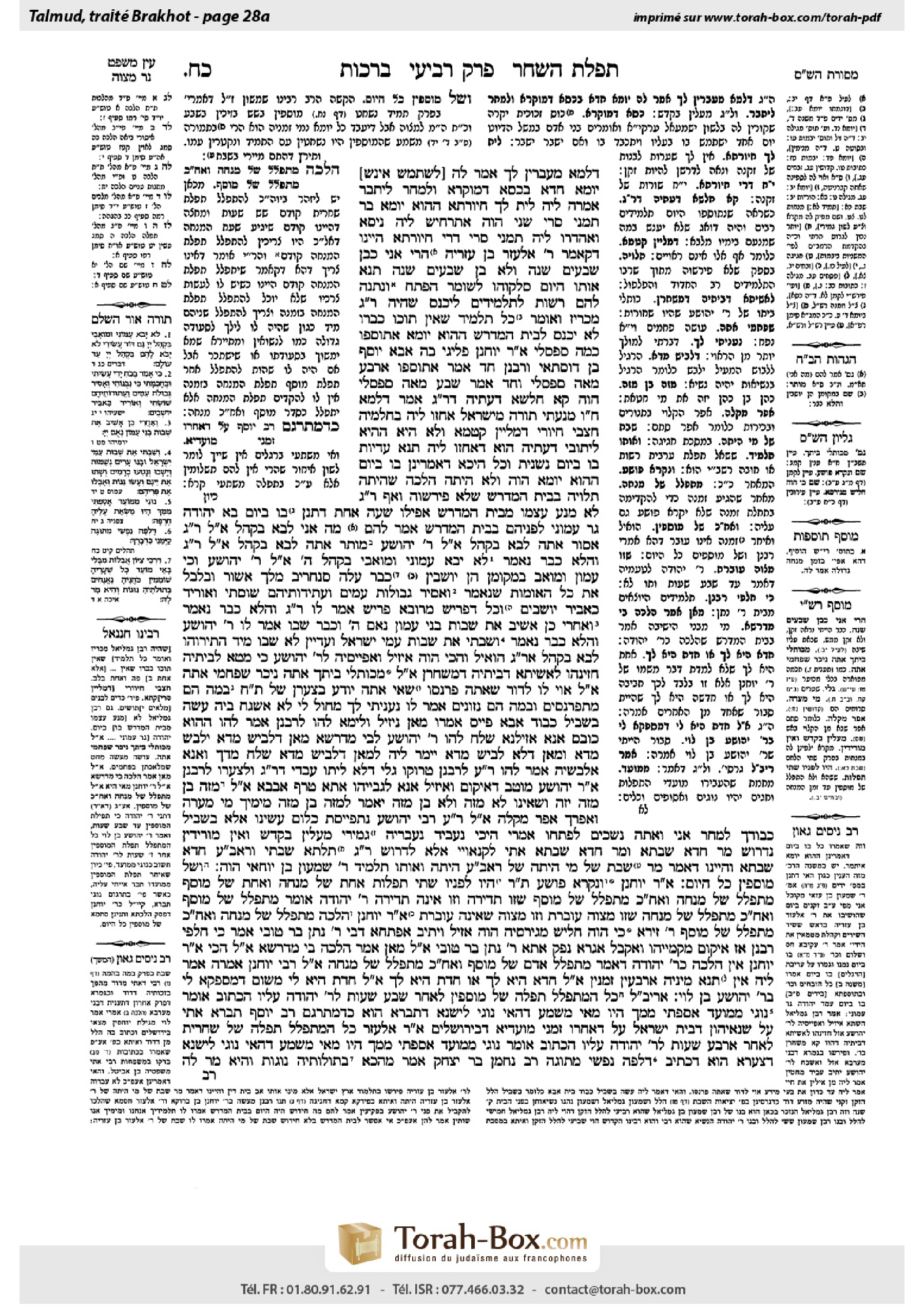
Berakhot 28a: Talmud study for Daf Yomi
Study the Talmud for Daf Yomi with scanned pages, Hebrew text, English translations from Sefaria and AI-generated French translations.
Passage selection and English or AI-generated French translation are available where the scan has annotations. Daf Study is independent of Torah-Box and Sefaria.
Browse Berakhot · ברכות · All tractatesBerakhot 28a text and translations
This page of Berakhot includes the Aramaic text, an English translation and an AI-generated French translation, alongside the scan above.
ברכות כ״ח א · Aramaic and Hebrew text
דִּלְמָא מְעַבְּרִין לָךְ. אֲמַר לַהּ: לִשְׁתַּמַּשׁ אִינָשׁ יוֹמָא חֲדָא בְּכָסָא דְמוֹקְרָא, וְלִמְחַר לִיתְּבַר. אֲמַרָה לֵיהּ: לֵית לָךָ חִיוָּרָתָא. הָהוּא יוֹמָא בַּר תַּמְנֵי סְרֵי שְׁנֵי הֲוָה, אִתְרְחִישׁ לֵיהּ נִיסָּא וְאִהַדַּרוּ לֵיהּ תַּמְנֵי סְרֵי דָּרֵי חִיוָּרָתָא. הַיְינוּ דְּקָאָמַר רַבִּי אֶלְעָזָר בֶּן עֲזַרְיָה: הֲרֵי אֲנִי כְּבֶן שִׁבְעִים שָׁנָה. וְלֹא ״בֶּן שִׁבְעִים שָׁנָה״.
תָּנָא אוֹתוֹ הַיּוֹם, סִלְּקוּהוּ לְשׁוֹמֵר הַפֶּתַח וְנִתְּנָה לָהֶם רְשׁוּת לַתַּלְמִידִים לִיכָּנֵס. שֶׁהָיָה רַבָּן גַּמְלִיאֵל מַכְרִיז וְאוֹמֵר: כׇּל תַּלְמִיד שֶׁאֵין תּוֹכוֹ כְּבָרוֹ, לֹא יִכָּנֵס לְבֵית הַמִּדְרָשׁ.
הַהוּא יוֹמָא אִתּוֹסְפוּ כַּמָּה סַפְסַלֵּי. אָמַר רַבִּי יוֹחָנָן: פְּלִיגִי בַּהּ אַבָּא יוֹסֵף בֶּן דּוֹסְתַּאי וְרַבָּנַן. חַד אָמַר: אִתּוֹסְפוּ אַרְבַּע מְאָה סַפְסַלֵּי. וְחַד אָמַר: שְׁבַע מְאָה סַפְסַלֵּי. הֲוָה קָא חָלְשָׁה דַּעְתֵּיהּ דְּרַבָּן גַּמְלִיאֵל, אֲמַר: דִּלְמָא חַס וְשָׁלוֹם מָנַעְתִּי תּוֹרָה מִיִּשְׂרָאֵל. אַחְזוֹ לֵיהּ בְּחֶלְמֵיהּ חַצְבֵי חִיוָּרֵי דְּמַלְיִין קִטְמָא. וְלָא הִיא, הַהִיא לְיַתּוֹבֵי דַּעְתֵּיהּ, הוּא דְּאַחְזוֹ לֵיהּ.
תָּנָא: עֵדֻיוֹת בּוֹ בַּיּוֹם נִשְׁנֵית. וְכׇל הֵיכָא דְּאָמְרִינַן ״בּוֹ בַּיּוֹם״, הַהוּא יוֹמָא הֲוָה. וְלֹא הָיְתָה הֲלָכָה שֶׁהָיְתָה תְּלוּיָה בְּבֵית הַמִּדְרָשׁ שֶׁלֹּא פֵּירְשׁוּהָ. וְאַף רַבָּן גַּמְלִיאֵל לֹא מָנַע עַצְמוֹ מִבֵּית הַמִּדְרָשׁ אֲפִילּוּ שָׁעָה אַחַת.
דִּתְנַן: בּוֹ בַּיּוֹם בָּא יְהוּדָה גֵּר עַמּוֹנִי לִפְנֵיהֶם בְּבֵית הַמִּדְרָשׁ. אָמַר לָהֶם: מָה אֲנִי לָבֹא בַּקָּהָל?
אָמַר לוֹ רַבָּן גַּמְלִיאֵל: אָסוּר אַתָּה לָבֹא בַּקָּהָל. אָמַר לוֹ רַבִּי יְהוֹשֻׁעַ: מוּתָּר אַתָּה לָבֹא בַּקָּהָל. אָמַר לוֹ רַבָּן גַּמְלִיאֵל: וַהֲלֹא כְּבָר נֶאֱמַר ״לֹא יָבֹא עַמּוֹנִי וּמוֹאָבִי בִּקְהַל ה׳״? אָמַר לוֹ רַבִּי יְהוֹשֻׁעַ: וְכִי עַמּוֹן וּמוֹאָב בִּמְקוֹמָן הֵן יוֹשְׁבִין? כְּבָר עָלָה סַנְחֵרִיב מֶלֶךְ אַשּׁוּר וּבִלְבֵּל אֶת כׇּל הָאוּמּוֹת, שֶׁנֶּאֱמַר: ״וְאָסִיר גְּבֻלוֹת עַמִּים וַעֲתוּדוֹתֵיהֶם שׁוֹשֵׂתִי וְאוֹרִיד כַּבִּיר יוֹשְׁבִים״, וְכׇל דְּפָרֵישׁ — מֵרוּבָּא פָּרֵישׁ.
אָמַר לוֹ רַבָּן גַּמְלִיאֵל: וַהֲלֹא כְּבָר נֶאֱמַר ״וְאַחֲרֵי כֵן אָשִׁיב אֶת שְׁבוּת בְּנֵי עַמּוֹן נְאֻם ה׳״, וּכְבָר שָׁבוּ!
אָמַר לוֹ רַבִּי יְהוֹשֻׁעַ: וַהֲלֹא כְּבָר נֶאֱמַר ״וְשַׁבְתִּי אֶת שְׁבוּת עַמִּי יִשְׂרָאֵל״, וַעֲדַיִין לֹא שָׁבוּ. מִיָּד הִתִּירוּהוּ לָבֹא בַּקָּהָל.
אָמַר רַבָּן גַּמְלִיאֵל: הוֹאִיל וְהָכִי הֲוָה, אֵיזִיל וַאֲפַיְּיסֵיהּ לְרַבִּי יְהוֹשֻׁעַ. כִּי מְטָא לְבֵיתֵיהּ, חֲזִינְהוּ לְאַשְׁיָתָא דְבֵיתֵיהּ דְּמַשְׁחֲרָן. אֲמַר לֵיהּ: מִכּוֹתְלֵי בֵיתְךָ אַתָּה נִיכָּר שֶׁפֶּחָמִי אַתָּה. אָמַר לוֹ: אוֹי לוֹ לַדּוֹר שֶׁאַתָּה פַּרְנָסוֹ, שֶׁאִי אַתָּה יוֹדֵעַ בְּצַעֲרָן שֶׁל תַּלְמִידֵי חֲכָמִים, בַּמֶּה הֵם מִתְפַּרְנְסִים וּבַמֶּה הֵם נִזּוֹנִים.
אָמַר לוֹ: נַעֲנֵיתִי לְךָ מְחוֹל לִי. לָא אַשְׁגַּח בֵּיהּ: עֲשֵׂה בִּשְׁבִיל כְּבוֹד אַבָּא. פַּיֵּיס.
אֲמַרוּ: מַאן נֵיזִיל וְלֵימָא לְהוּ לְרַבָּנַן. אֲמַר לְהוּ הַהוּא כּוֹבֵס: אֲנָא אָזֵילְנָא. שְׁלַח לְהוּ רַבִּי יְהוֹשֻׁעַ לְבֵי מִדְרְשָׁא: מַאן דְּלָבֵישׁ מַדָּא — יִלְבַּשׁ מַדָּא, וּמַאן דְּלָא לָבֵישׁ מַדָּא יֵימַר לֵיהּ לְמַאן דְּלָבֵישׁ מַדָּא: שְׁלַח מַדָּךְ וַאֲנָא אֶלְבְּשֵׁיהּ?! אֲמַר לְהוּ רַבִּי עֲקִיבָא לְרַבָּנַן: טְרוּקוּ גַּלֵּי דְּלָא לֵיתוּ עַבְדֵי דְרַבָּן גַּמְלִיאֵל וּלְצַעֲרוּ לְרַבָּנַן.
אֲמַר רַבִּי יְהוֹשֻׁעַ: מוּטָב דְּאֵיקוּם וְאֵיזִיל אֲנָא לְגַבַּיְיהוּ. אֲתָא טְרַף אַבָּבָא. אֲמַר לְהוּ: מַזֶּה בֶּן מַזֶּה יַזֶּה. וְשֶׁאֵינוֹ לֹא מַזֶּה וְלֹא בֶּן מַזֶּה יֹאמַר לְמַזֶּה בֶּן מַזֶּה מֵימֶיךָ מֵי מְעָרָה וְאֶפְרְךָ אֵפֶר מִקְלֶה. אָמַר לוֹ רַבִּי עֲקִיבָא: רַבִּי יְהוֹשֻׁעַ, נִתְפַּיַּיסְתָּ? כְּלוּם עָשִׂינוּ אֶלָּא בִּשְׁבִיל כְּבוֹדְךָ, לְמָחָר אֲנִי וְאַתָּה נַשְׁכִּים לְפִתְחוֹ.
אָמְרִי: הֵיכִי נַעֲבֵיד, נַעְבְּרֵיהּ — גְּמִירִי מַעֲלִין בַּקֹּדֶשׁ וְאֵין מוֹרִידִין. נִדְרוֹשׁ מָר חֲדָא שַׁבְּתָא וּמַר חֲדָא שַׁבְּתָא — אָתֵי לְקַנּאוֹיֵי. אֶלָּא: לִדְרוֹשׁ רַבָּן גַּמְלִיאֵל תְּלָתָא שַׁבָּתֵי וְרַבִּי אֶלְעָזָר בֶּן עֲזַרְיָה חֲדָא שַׁבְּתָא. וְהַיְינוּ דְּאָמַר מָר שַׁבָּת שֶׁל מִי הָיְתָה — שֶׁל רַבִּי אֶלְעָזָר בֶּן עֲזַרְיָה הָיְתָה. וְאוֹתוֹ תַּלְמִיד רַבִּי שִׁמְעוֹן בֶּן יוֹחַאי הֲוָה.
וְשֶׁל מוּסָפִין כׇּל הַיּוֹם. אָמַר רַבִּי יוֹחָנָן: וְנִקְרָא ״פּוֹשֵׁעַ״.
תָּנוּ רַבָּנַן: הָיוּ לְפָנָיו שְׁתֵּי תְּפִלּוֹת, אַחַת שֶׁל מִנְחָה וְאַחַת שֶׁל מוּסָף — מִתְפַּלֵּל שֶׁל מִנְחָה וְאַחַר כָּךְ מִתְפַּלֵּל שֶׁל מוּסָף, שֶׁזּוֹ תְּדִירָה, וְזוֹ אֵינָהּ תְּדִירָה. רַבִּי יְהוּדָה אוֹמֵר: מִתְפַּלֵּל שֶׁל מוּסָף וְאַחַר כָּךְ מִתְפַּלֵּל שֶׁל מִנְחָה, שֶׁזּוֹ מִצְוָה עוֹבֶרֶת, וְזוֹ מִצְוָה שֶׁאֵינָהּ עוֹבֶרֶת. אָמַר רַבִּי יוֹחָנָן: הֲלָכָה מִתְפַּלֵּל שֶׁל מִנְחָה וְאַחַר כָּךְ מִתְפַּלֵּל שֶׁל מוּסָף.
רַבִּי זֵירָא כִּי הֲוָה חֲלִישׁ מִגִּירְסֵיהּ הֲוָה אָזֵיל וְיָתֵיב אַפִּתְחָא דְּבֵי רַבִּי נָתָן בַּר טוֹבִי. אָמַר: כִּי חָלְפִי רַבָּנַן אָז אֵיקוּם מִקַּמַּיְיהוּ וַאֲקַבֵּל אַגְרָא. נְפַק אֲתָא רַבִּי נָתָן בַּר טוֹבִי, אֲמַר לֵיהּ: מַאן אֲמַר הֲלָכָה בֵּי מִדְרְשָׁא? אֲמַר לֵיהּ: הָכִי אָמַר רַבִּי יוֹחָנָן: אֵין הֲלָכָה כְּרַבִּי יְהוּדָה דְּאָמַר מִתְפַּלֵּל אָדָם שֶׁל מוּסָף וְאַחַר כָּךְ מִתְפַּלֵּל שֶׁל מִנְחָה.
אֲמַר לֵיהּ: רַבִּי יוֹחָנָן אַמְרַהּ? אֲמַר לֵיהּ: אִין. תְּנָא מִינֵּיהּ אַרְבְּעִין זִמְנִין. אֲמַר לֵיהּ: חֲדָא הִיא לָךְ, אוֹ חֲדַת הִיא לָךְ? אֲמַר לֵיהּ: חֲדַת הִיא לִי, מִשּׁוּם דִּמְסַפְּקָא לִי בְּרַבִּי יְהוֹשֻׁעַ בֶּן לֵוִי.
אָמַר רַבִּי יְהוֹשֻׁעַ בֶּן לֵוִי: כׇּל הַמִּתְפַּלֵּל תְּפִלָּה שֶׁל מוּסָפִין לְאַחַר שֶׁבַע שָׁעוֹת לְרַבִּי יְהוּדָה עָלָיו הַכָּתוּב אוֹמֵר: ״נוּגֵי מִמּוֹעֵד אָסַפְתִּי מִמֵּךְ הָיוּ״. מַאי מַשְׁמַע דְּהַאי נוּגֵי לִישָּׁנָא דִתְבָרָא הוּא? כְּדִמְתַרְגֵּם רַב יוֹסֵף: תְּבָרָא אָתֵי עַל שָׂנְאֵיהוֹן דְּבֵית יִשְׂרָאֵל עַל דְּאַחַרוּ זִמְנֵי מוֹעֲדַיָּא דְּבִירוּשְׁלֶם.
אָמַר רַבִּי אֶלְעָזָר: כׇּל הַמִּתְפַּלֵּל תְּפִלָּה שֶׁל שַׁחֲרִית לְאַחַר אַרְבַּע שָׁעוֹת לְרַבִּי יְהוּדָה עָלָיו הַכָּתוּב אוֹמֵר: ״נוּגֵי מִמּוֹעֵד אָסַפְתִּי מִמֵּךְ הָיוּ״. מַאי מַשְׁמַע דְּהַאי נוּגֵי לִישָּׁנָא דְצַעֲרָא הוּא? דִּכְתִיב: ״דָּלְפָה נַפְשִׁי מִתּוּגָה״. רַב נַחְמָן בַּר יִצְחָק אָמַר: מֵהָכָא: ״בְּתוּלוֹתֶיהָ נוּגוֹת וְהִיא מָר לָהּ״.
Berakhot 28a · English translation
There is room for concern. Perhaps they will remove you from office just as they removed Rabban Gamliel. He said to her, based on the folk saying: Let a person use an expensive goblet one day and let it break tomorrow. In other words, one should take advantage of an opportunity that presents itself and he need not concern himself whether or not it will last. She said to him: You have no white hair, and it is inappropriate for one so young to head the Sages. The Gemara relates: That day, he was eighteen years old, a miracle transpired for him and eighteen rows of hair turned white. The Gemara comments: That explains that which Rabbi Elazar ben Azarya said: I am as one who is seventy years old and he did not say: I am seventy years old, because he looked older than he actually was.
It was taught: On that day that they removed Rabban Gamliel from his position and appointed Rabbi Elazar ben Azarya in his place, there was also a fundamental change in the general approach of the study hall as they dismissed the guard at the door and permission was granted to the students to enter. Instead of Rabban Gamliel’s selective approach that asserted that the students must be screened before accepting them into the study hall, the new approach asserted that anyone who seeks to study should be given opportunity to do so. As Rabban Gamliel would proclaim and say: Any student whose inside, his thoughts and feelings, are not like his outside, i.e., his conduct and his character traits are lacking, will not enter the study hall.
The Gemara relates: On that day several benches were added to the study hall to accommodate the numerous students. Rabbi Yoḥanan said: Abba Yosef ben Dostai and the Rabbis disputed this matter. One said: Four hundred benches were added to the study hall. And one said: Seven hundred benches were added to the study hall. When he saw the tremendous growth in the number of students, Rabban Gamliel was disheartened. He said: Perhaps, Heaven forbid, I prevented Israel from engaging in Torah study. They showed him in his dream white jugs filled with ashes alluding to the fact that the additional students were worthless idlers. The Gemara comments: That is not the case, but that dream was shown to him to ease his mind so that he would not feel bad.
It was taught: There is a tradition that tractate Eduyyot was taught that day. And everywhere in the Mishna or in a baraita that they say: On that day, it is referring to that day. There was no halakha whose ruling was pending in the study hall that they did not explain and arrive at a practical halakhic conclusion. And even Rabban Gamliel did not avoid the study hall for even one moment, as he held no grudge against those who removed him from office and he participated in the halakhic discourse in the study hall as one of the Sages.
As we learned in a mishna: On that day, Yehuda, the Ammonite convert, came before the students in the study hall and he said to them: What is my legal status in terms of entering into the congregation of Israel, i.e., to marry a Jewish woman?
Rabban Gamliel said to him: You are forbidden to enter into the congregation. Rabbi Yehoshua said to him: You are permitted to enter into the congregation. Rabban Gamliel said to Rabbi Yehoshua: Wasn’t it already stated: “An Ammonite and a Moabite shall not enter into the congregation of the Lord; even to the tenth generation shall none of them enter into the congregation of the Lord forever” (Deuteronomy 23:4)? How can you permit him to enter the congregation? Rabbi Yehoshua said to Rabban Gamliel: Do Ammon and Moab reside in their place? Sennacherib already came and, through his policy of population transfer, scrambled all the nations and settled other nations in place of Ammon. Consequently, the current residents of Ammon and Moab are not ethnic Ammonites and Moabites, as it is stated in reference to Sennacherib: “I have removed the bounds of the peoples, and have robbed their treasures, and have brought down as one mighty the inhabitants” (Isaiah 10:13). And although it is conceivable that this particular convert is an ethnic Ammonite, nevertheless, there is no need for concern due to the halakhic principle: Anything that parts from a group parts from the majority, and the assumption is that he is from the majority of nations whose members are permitted to enter the congregation.
Rabban Gamliel said to Rabbi Yehoshua: But wasn’t it already stated: “But afterward I will bring back the captivity of the children of Ammon, says the Lord” (Jeremiah 49:6) and they have already returned to their land? Therefore, he is an ethnic Ammonite and he may not convert.
Rabbi Yehoshua said to Rabban Gamliel: That is no proof. Wasn’t it already stated in another prophecy: “And I will turn the captivity of My people Israel and they shall build the waste cities, and inhabit them; and they shall plant vineyards, and drink the wine thereof; they shall also make gardens, and eat the fruit of them” (Amos 9:14), and they have not yet returned? In rendering the ruling, only proven facts may be taken into consideration. They immediately permitted him to enter the congregation. This proves that Rabban Gamliel did not absent himself from the study hall that day and participated in the halakhic discourse.
Rabban Gamliel said to himself: Since this is the situation, that the people are following Rabbi Yehoshua, apparently he was right. Therefore, it would be appropriate for me to go and appease Rabbi Yehoshua. When he reached Rabbi Yehoshua’s house, he saw that the walls of his house were black. Rabban Gamliel said to Rabbi Yehoshua in wonderment: From the walls of your house it is apparent that you are a blacksmith, as until then he had no idea that Rabbi Yehoshua was forced to engage in that arduous trade in order to make a living. Rabbi Yehoshua said to him: Woe unto a generation that you are its leader as you are unaware of the difficulties of Torah scholars, how they make a living and how they feed themselves.
Rabban Gamliel said to him: I insulted you, forgive me. Rabbi Yehoshua paid him no attention and did not forgive him. He asked him again: Do it in deference to my father, Rabban Shimon ben Gamliel, who was one of the leaders of Israel at the time of the destruction of the Temple. He was appeased.
Now that Rabbi Yehoshua was no longer offended, it was only natural that Rabban Gamliel would be restored to his position. They said: Who will go and inform the Sages? Apparently, they were not eager to carry out the mission that would undo the previous actions and remove Rabbi Elazar ben Azarya from his position as Nasi. This launderer said to them: I will go. Rabbi Yehoshua sent to the Sages to the study hall: The one who wears the uniform will continue to wear the uniform, the original Nasi will remain in his position so that the one who did not wear the uniform will not say to the one who wears the uniform, remove your uniform and I will wear it. Apparently, the Sages believed that this emissary was dispatched at the initiative of Rabban Gamliel and they ignored him. Rabbi Akiva said to the Sages: Lock the gates so that Rabban Gamliel’s servants will not come and disturb the Sages.
When he heard what happened, Rabbi Yehoshua said: It is best if I go to them. He came and knocked on the door. He said to them with a slight variation: One who sprinkles pure water on those who are ritually impure, son of one who sprinkles water shall continue to sprinkle water. And it is inappropriate that he who is neither one who sprinkles nor son of one who sprinkles will say to one who sprinkles son of one who sprinkles: Your water is cave water and not the running water required to purify one exposed to ritual impurity imparted by a corpse and your ashes are burnt ashes and not the ashes of a red heifer. Rabbi Akiva said to him: Rabbi Yehoshua, have you been appeased? Everything we did was to defend your honor. If you have forgiven him, none of us is opposed. Early tomorrow you and I will go to Rabban Gamliel’s doorway and offer to restore him to his position as Nasi.
The question arose what to do with Rabbi Elazar ben Azarya? They said: What shall we do? Remove him from his position. That is inappropriate as we learned a halakha through tradition: One elevates to a higher level of sanctity and does not downgrade. Therefore, one who was the Nasi of the Sanhedrin cannot be demoted. Let one Sage lecture one week and the other Sage one week, they will come to be jealous one of another, as they will be forced to appoint one as the acting head of the Sanhedrin. Rather, Rabban Gamliel will lecture three weeks and Rabbi Elazar ben Azarya will lecture as head of the yeshiva one week. That arrangement was adopted and that is the explanation of the exchange in tractate Ḥagiga: Whose week was it? It was the week of Rabbi Elazar ben Azarya. One final detail: That student who asked the original question that sparked this entire incident was Rabbi Shimon ben Yoḥai.
We learned in the mishna: And the additional prayer may be recited all day. Rabbi Yoḥanan said: Nevertheless, one who postpones his prayer excessively is called negligent.
The Rabbis taught in a baraita: If the obligation to recite two prayers was before him, one, the afternoon prayer and one, the additional prayer, he recites the afternoon prayer first and the additional prayer thereafter, because this, the afternoon prayer, is recited on a frequent basis, and this one, the additional prayer, is recited on a relatively infrequent basis. Rabbi Yehuda says: He recites the additional prayer first and the afternoon prayer thereafter, because this, the additional prayer, is a mitzva whose time soon elapses, as it may only be recited until the seventh hour and this, the afternoon prayer, is a mitzva whose time does not soon elapse as one may recite it until the midpoint of the afternoon. Rabbi Yoḥanan said: The halakha is that he recites the afternoon prayer first and the additional prayer thereafter, in accordance with the opinion of the Rabbis.
The Gemara cites additional sources relating to this issue: When Rabbi Zeira would tire of his studies, he would go and sit in the doorway of Rabbi Natan bar Tovi’s study hall. He said to himself: When the entering and exiting Sages pass, I will rise before them and be rewarded for the mitzva of honoring Torah scholars. Rabbi Natan bar Tovi himself emerged and came to where Rabbi Zeira was seated. Rabbi Zeira said to him: Who just stated a halakha in the study hall? Rabbi Natan bar Tovi said to him: Rabbi Yoḥanan just said as follows: The halakha is not in accordance with the opinion of Rabbi Yehuda who said: He recites the additional prayer first and the afternoon prayer thereafter.
Rabbi Zeira said to him: Did Rabbi Yoḥanan himself say this halakha? Rabbi Natan said to him: Yes. He learned this statement from him forty times, etching it into his memory. Rabbi Natan said to him: Is this halakha so dear to you because it is singular for you, as it is the only halakha that you learned in the name of Rabbi Yoḥanan, or is it new to you, as you were previously unaware of this ruling? Rabbi Zeira said to him: It is somewhat new to me, as I was uncertain whether this halakha was said in the name of Rabbi Yoḥanan or in the name of Rabbi Yehoshua ben Levi. Now it is clear to me that this halakha is in the name of Rabbi Yoḥanan.
Rabbi Yehoshua ben Levi said: With regard to anyone who recites the additional prayer after seven hours of the day, according to Rabbi Yehuda, the verse states: “Those who are destroyed [nugei] far from the Festivals, I shall gather from you, they who carried for you the burden of insult” (Zephaniah 3:18). From where may it be inferred that nugei is an expression of destruction? As Rav Yosef translated the verse into Aramaic: Destruction comes upon the enemies of the house of Israel, a euphemism for Israel itself, for they have delayed the times of the Festivals in Jerusalem. This proves both that nugei means destruction and that destruction comes upon those who fail to fulfill a mitzva at its appointed time.
Similarly, Rabbi Elazar said: Regarding anyone who recites the morning prayer after four hours of the day, according to Rabbi Yehuda, the verse states: “Those who are in sorrow [nugei] far from the Festivals, I shall gather from you, they who carried for you the burden of insult” (Zephaniah 3:18). From where may it be inferred that nugei is an expression of sorrow? As it is written: “My soul drips in sorrow [tuga]” (Psalms 119:28). Rav Naḥman bar Yitzḥak said: The proof that nugei indicates suffering is from here: “Her virgins are sorrowed [nugot] and she is embittered” (Lamentations 1:4).
Berakhot 28a · Traduction française (IA)
Il y a lieu de s'inquiéter. Peut-être seront-ils destitués de leur poste comme ils ont destitué Rabban Gamliel. Il lui dit, fondé sur une maxime populaire : Qu'une personne utilise un verre coûteux un jour et le laisse brisé le lendemain. En d'autres termes, on devrait saisir l'opportunité qui se présente et ne pas s'attarder sur la durée de celle-ci. Elle lui dit : Vous n'avez pas de cheveux blancs, et il n'est pas approprié qu'une personne si jeune soit à la tête des Sages. La Guemara rapporte : Ce jour-là, il avait dix-huit ans, un miracle s'est produit pour lui et dix-huit rangées de cheveux sont devenues blancs. La Guemara commente : Cela explique ce que Rabbi Elazar ben Azarya a dit : Je suis comme celui qui a soixante-dix ans et il n'a pas dit : J'ai soixante-dix ans, car il semblait plus âgé qu'il ne l'était réellement.
Il a été enseigné : Le jour où Rabban Gamliel a été destitué de son poste et où Rabbi Elazar ben Azarya a été nommé à sa place, il y a eu aussi un changement fondamental dans l'approche générale de la salle de étude, car ils ont retiré le gardien à la porte et permis aux étudiants d'entrer. Au lieu de l'approche sélective de Rabban Gamliel, qui affirmait que les étudiants devaient être évalués avant d'être admis dans la salle de étude, l'approche nouvelle affirmait que tout celui qui souhaitait étudier devait être donné l'opportunité de le faire. Comme Rabban Gamliel proclamait et disait : Tout étudiant dont l'intérieur, ses pensées et sentiments, ne correspondent pas à son extérieur, c'est-à-dire dont les mœurs et les traits de caractère sont déficients, ne devra pas entrer dans la salle de étude.
La Guemara rapporte : Ce jour-là, plusieurs bancs furent ajoutés à la salle d'étude pour accueillir les nombreux étudiants. Rabbi Yoḥanan dit : Abba Yosef ben Dostai et les Rabbins disputèrent ce sujet. L'un disait : Quatre cents bancs furent ajoutés à la salle d'étude. Et l'autre disait : Sept cents bancs furent ajoutés à la salle d'étude. Lorsqu'il vit la croissance considérable du nombre d'étudiants, Rabban Gamliel s'effondra. Il dit : Peut-être, Dieu forbid, j'ai empêché Israël de s'engager dans l'étude de la Torah. Ils lui montrèrent dans son rêve des jarres blanches remplies de cendres, allusion au fait que les étudiants supplémentaires étaient inutiles et des loituriens. La Guemara commente : Ce n'est pas le cas, mais ce rêve lui fut montré pour le rassurer et qu'il ne se sente pas mal.
Il a été enseigné : Il y a une tradition selon laquelle le traité d'Eduyyot fut enseigné ce jour-là. Et partout dans la Michna ou dans une baraïta qu'ils disent : Ce jour-là, cela fait référence à ce jour-là. Il n'y avait pas de halakha dont la décision était en suspens dans la salle d'étude qu'ils n'expliquèrent pas et n'atteignirent pas une conclusion halakhique pratique. Et même Rabban Gamliel n'évita pas la salle d'étude pendant une seule minute, car il ne tenait pas rancune à ceux qui l'avaient enlevé de son poste et il participait au discours halakhique dans la salle d'étude comme l'un des Sages.
Comme nous l'avons appris dans une Michna : Ce jour-là, Yehuda, le converti d'Ammon, vint devant les étudiants de la salle d'étude et il leur dit : Quel est mon statut juridique en termes d'entrer dans la congrégation d'Israël, c'est-à-dire de se marier avec une femme juive ?
Rabban Gamliel lui a dit : Vous êtes interdit d'entrer dans la congrégation. Rabbi Yehoshua lui a dit : Vous êtes autorisé à entrer dans la congrégation. Rabban Gamliel a dit à Rabbi Yehoshua : N'était-ce pas déjà dit : « L'Ammonite et le Moabite ne doivent pas entrer dans la congrégation du Seigneur ; même à la dixième génération, aucun d'eux ne doit entrer dans la congrégation du Seigneur pour toujours » (Deutéronome 23:4) ? Comment pouvez-vous autoriser son entrée dans la congrégation ? Rabbi Yehoshua a dit à Rabban Gamliel : Les Ammon et Moab habitent-ils encore leur territoire ? Sennacherib est déjà venu et, grâce à sa politique de transfert de population, a désorganisé toutes les nations et a installé d'autres nations à leur place. Ainsi, les habitants actuels d'Ammon et Moab ne sont pas des Ammonites et Moabites ethniques, comme il est dit concernant Sennacherib : « J'ai enlevé les limites des peuples, et j'ai volé leurs trésors, et j'ai fait tomber comme un puissant les habitants » (Isaïe 10:13). Et même si cela semble concevable que ce converti particulier soit un Ammonite ethnique, néanmoins, il n'y a pas lieu de s'inquiéter en raison du principe halakhique : Tout ce qui s'éloigne d'un groupe s'éloigne de la majorité, et on suppose qu'il est de la majorité des nations dont les membres sont autorisés à entrer dans la congrégation.
Rabban Gamliel a dit à Rabbi Yehoshua : Mais n'était-ce pas déjà dit : « Mais après, je ramènerai l'expatriation des enfants d'Ammon, dit l'Éternel » (Jérémie 49:6) et ils sont déjà revenus dans leur terre ? Ainsi, il est un Ammonite ethnique et il ne peut pas se convertir.
Rabbi Yehoshua a dit à Rabban Gamliel : Cela n'est pas une preuve. N'était-ce pas déjà dit dans une autre prophétie : « Et je tournerai l'expatriation de mon peuple Israël et ils reconstruiront les villes dévastées, et ils y habitent ; et ils planteront des vignobles, et ils boiront leur vin ; ils feront aussi des jardins, et ils mangeront leurs fruits » (Amos 9:14), et ils n'ont pas encore revenu ? En rendant un jugement, seul les faits prouvés peuvent être pris en compte. Ils ont immédiatement permis son entrée dans la congrégation. Cela prouve que Rabban Gamliel n'a pas absenté de la salle de étude ce jour-là et a participé au discours halakhique.
Rabban Gamliel se dit à lui-même : Puisque c'est la situation, que le peuple suit Rabbi Yehoshua, apparemment il avait raison. Ainsi, il serait approprié pour moi d'aller apaiser Rabbi Yehoshua. Lorsqu'il est arrivé à la maison de Rabbi Yehoshua, il a vu que les murs de sa maison étaient noirs. Rabban Gamliel a dit à Rabbi Yehoshua avec étonnement : À partir des murs de votre maison, il est évident que vous êtes un forgeron, car jusqu'alors il ne savait pas que Rabbi Yehoshua était contraint de s'engager dans ce métier pénible pour subsister. Rabbi Yehoshua a dit à lui : Malheur à une génération dont vous êtes le chef, car vous ne connaissez pas les difficultés des savants de la Torah, comment ils vivent et comment ils se nourrissent.
Rabban Gamliel dit à lui : J'ai insulté, pardonnez-moi. Rabbi Yéhoshua ne lui prêta pas attention et ne le pardonna pas. Il lui demanda à nouveau : Fais-le en hommage à mon père, Rabban Shimon ben Gamliel, qui était l'un des chefs d'Israël à l'époque de la destruction du Temple. Il fut rassuré.
Maintenant que Rabbi Yéhoshua n'était plus offensé, il était naturel que Rabban Gamliel retrouve sa position. Ils dirent : Qui ira informer les Sages ? Apparemment, ils n'étaient pas pressés d'accomplir cette mission qui annulerait les actions précédentes et ferait retirer à Rabbi Eléazar ben Azarya sa position de Nasi. Ce lavandier dit à eux : Je vais y aller. Rabbi Yéhoshua envoya à la synagogue un message aux Sages : Celui qui porte l'uniforme continuera à porter l'uniforme, le Nasi original restera à sa place afin que celui qui n'a pas porté l'uniforme ne dise pas à celui qui le porte : Retire ton uniforme et je le porterai. Apparemment, les Sages pensaient que cet envoyé était parti à l'initiative de Rabban Gamliel et ils l'ignorèrent. Rabbi Akiva dit aux Sages : Verrouillez les portes afin que les serviteurs de Rabban Gamliel ne viennent pas troubler les Sages.
Quand il apprit ce qui s'était passé, Rabbi Yéhoshua dit : Il est préférable que je vais les voir. Il vint et frappa à la porte. Il dit à eux avec une légère variation : Celui qui asperge de l'eau pure sur ceux qui sont impurs rituellement, fils de celui qui asperge l'eau, continuera d'aspéger. Et il n'est pas approprié que celui qui n'est ni celui qui aspère ni fils de celui qui aspère dise à celui qui aspère, fils de celui qui aspère : Votre eau est de l'eau de cave et non l'eau courante nécessaire pour purifier celui qui a été touché par l'impureté rituelle imposée par un cadavre et vos cendres sont des cendres brûlées et non les cendres de la vache rouge. Rabbi Akiva dit à lui : Rabbi Yéhoshua, êtes-vous rassuré ? Tout ce que nous avons fait était pour défendre votre honneur. Si vous l'avez pardonné, aucun d'entre nous n'est opposé. Demain matin, vous et moi irons à la porte de Rabban Gamliel et offrirons de le restaurer à sa position de Nasi.
La question s'est posée sur ce qu'il fallait faire avec Rabbi Eléazar ben Azarya ? Ils dirent : Qu'allons-nous faire ? Le retirer de sa position. Cela n'est pas approprié car nous avons appris une halakha par la tradition : On élève à un niveau supérieur de sainteté et on ne dégrade pas. Donc celui qui fut le Nasi du Sanhédrin ne peut être dégradé. Laissons un Sage enseigner une semaine et l'autre Sage une semaine, ils viendront à être jaloux l'un de l'autre, car ils seront contraints d'élire l'un d'entre eux comme chef provisoire du Sanhédrin. Plutôt, Rabban Gamliel enseignera trois semaines et Rabbi Eléazar ben Azarya enseignera comme chef de la yéshiva une semaine. Cette disposition fut adoptée et c'est l'explication de l'échange dans le traité Ḥagiga : Qui était la semaine ? Celle de Rabbi Eléazar ben Azarya. Un dernier détail : Ce disciple qui posa la question originale qui déclencha cet incident entier était Rabbi Shimon ben Yochai.
Nous avons appris dans la Michna : Et la prière supplémentaire peut être récitée toute la journée. Rabbi Yoḥanan dit : Cependant, celui qui reporte sa prière excessivement est appelé négligent.
Les Rabbins enseignèrent dans une baraïta : Si l'obligation de réciter deux prières était devant lui, l'une, la prière de l'après-midi et l'autre, la prière supplémentaire, il récite d'abord la prière de l'après-midi et ensuite la prière supplémentaire, car celle-ci, la prière de l'après-midi, est récitée fréquemment, et celle-ci, la prière supplémentaire, est récitée relativement rarement. Rabbi Yéhuda dit : Il récite d'abord la prière supplémentaire et ensuite la prière de l'après-midi, car celle-ci, la prière supplémentaire, est une mitsva dont le temps s'écoule rapidement, car elle peut être récitée jusqu'à la septième heure, et celle-ci, la prière de l'après-midi, est une mitsva dont le temps ne s'écoule pas rapidement, car l'on peut la réciter jusqu'au milieu de l'après-midi. Rabbi Yoḥanan dit : La halakha est que l'on récite d'abord la prière de l'après-midi et ensuite la prière supplémentaire, conformément à l'opinion des Rabbins.
Le Guemara cite d'autres sources relatives à cette question : Quand Rabbi Zéira se lassait de ses études, il allait s'asseoir à la porte de la salle de récitation de Rabbi Natan bar Tovi. Il se disait : Quand les Sages qui entrent et sortent passent, je me leverai avant eux et serai récompensé pour la mitsva d'honorer les savants. Rabbi Natan bar Tovi lui-même sortit et vint où Rabbi Zéira était assis. Rabbi Zéira dit à lui : Qui a déclaré une halakha dans la salle de récitation ? Rabbi Natan bar Tovi dit à lui : Rabbi Yoḥanan vient de dire ainsi : La halakha n'est pas selon l'opinion de Rabbi Yéhuda qui dit : Il récite d'abord la prière supplémentaire et ensuite la prière de l'après-midi.
Rabbi Zéira dit à lui : A-t-il lui-même dit Rabbi Yoḥanan cette halakha ? Rabbi Natan dit à lui : Oui. Il l'a apprise quarante fois de lui, gravant cela dans sa mémoire. Rabbi Natan dit à lui : Est-ce que cette halakha est si précieuse pour vous parce qu'elle est unique pour vous, car c'est la seule halakha que vous avez apprise au nom de Rabbi Yoḥanan, ou est-ce nouveau pour vous, car vous n'étiez pas auparavant informé de cette décision ? Rabbi Zéira dit à lui : C'est un peu nouveau pour moi, car j'étais incertain si cette halakha était dite au nom de Rabbi Yoḥanan ou au nom de Rabbi Yéhoshua ben Levi. Maintenant, il est clair pour moi que cette halakha est au nom de Rabbi Yoḥanan.
Rabbi Yéhoshua ben Levi dit : Concernant celui qui récite la prière supplémentaire après sept heures de la journée, selon Rabbi Yéhuda, la verset dit : « Ceux qui sont détruits [nugei] loin des Fêtes, je les rassemblerai de vous, ceux qui portaient pour vous le fardeau de l'insulte » (Zephaniah 3:18). D'où peut-on déduire que nugei est une expression de destruction ? Comme Rav Yosef a traduit ce verset en araméen : La destruction tombe sur les ennemis de la maison d'Israël, une euphémisme pour Israël lui-même, car ils ont reporté les temps des Fêtes à Jérusalem. Cela prouve à la fois que nugei signifie destruction et que la destruction tombe sur ceux qui négligent une mitsva à son heure.
De même, le Rabbi Eléazar a dit : Concernant celui qui récite la prière du matin après quatre heures de la journée, selon le Rabbi Yéhuda, la Sainte Écriture dit : « Ceux qui sont en deuil [nugei] loin des Fêtes, je les rassemblerai parmi vous, ceux qui portaient pour vous le fardeau de l’insulte » (Zephaniah 3:18). D’où peut-on déduire que nugei signifie la douleur ? Comme il est écrit : « Mon âme déborde de douleur [tuga] » (Psaumes 119:28). Rav Naḥman bar Yitzḥak a dit : La preuve que nugei désigne la souffrance vient de là : « Ses vierges sont en deuil [nugot] et elle est amère » (Lamentations 1:4).
Traduction française générée par IA à partir de l’édition anglaise de Sefaria. Vérifie toujours un passage avec le texte source.
Text from Sefaria: William Davidson Edition - Vocalized Aramaic (CC BY NC); William Davidson Edition - English (CC BY NC).