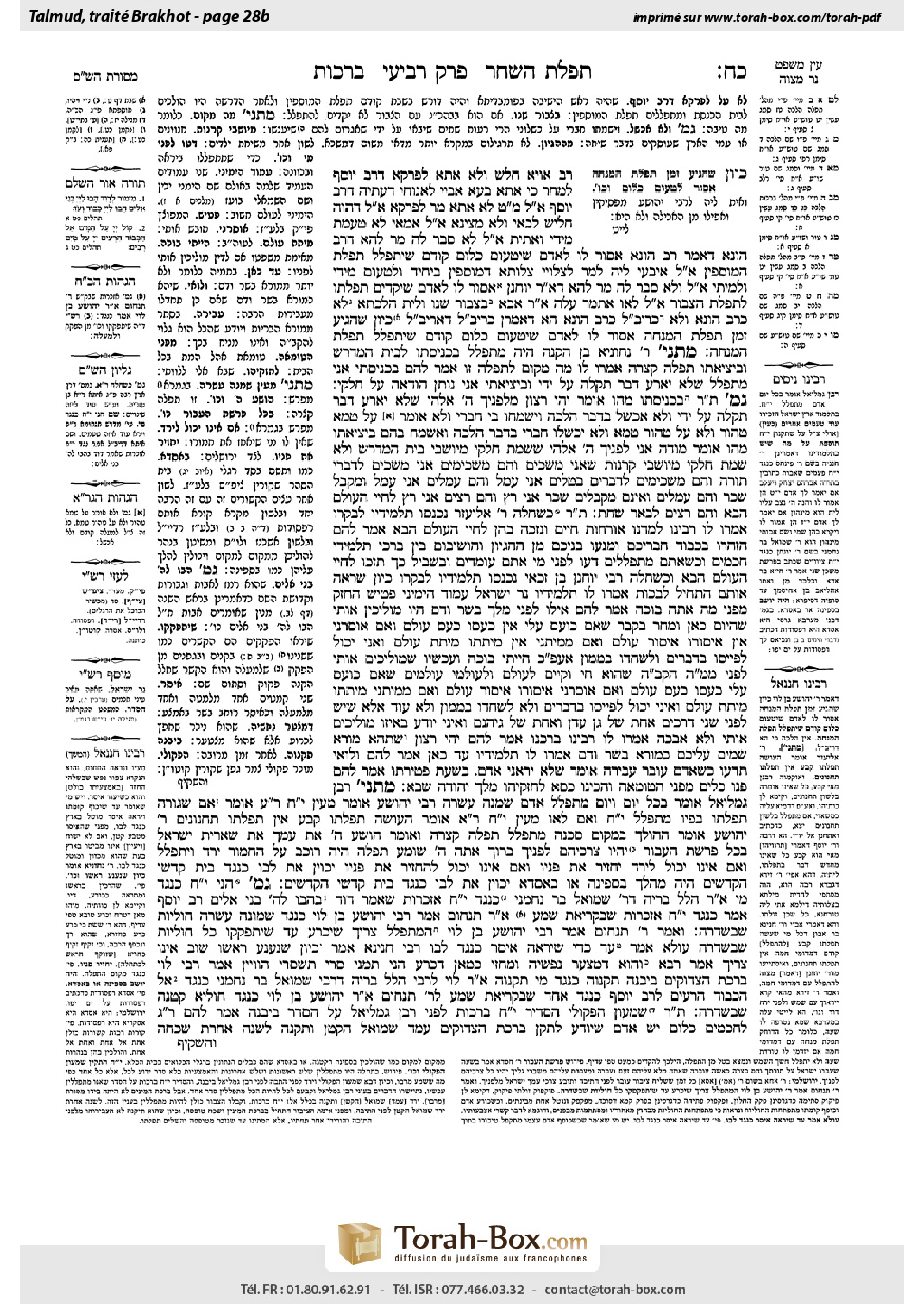
Berakhot 28b: Talmud study for Daf Yomi
Study the Talmud for Daf Yomi with scanned pages, Hebrew text, English translations from Sefaria and AI-generated French translations.
Passage selection and English or AI-generated French translation are available where the scan has annotations. Daf Study is independent of Torah-Box and Sefaria.
Browse Berakhot · ברכות · All tractatesBerakhot 28b text and translations
This page of Berakhot includes the Aramaic text, an English translation and an AI-generated French translation, alongside the scan above.
ברכות כ״ח ב · Aramaic and Hebrew text
רַב אַוְיָא חֲלַשׁ וְלָא אֲתָא לְפִרְקָא דְּרַב יוֹסֵף. לִמְחַר כִּי אֲתָא, בְּעָא אַבָּיֵי לְאַנּוֹחֵי דַּעְתֵּיהּ דְּרַב יוֹסֵף. אֲמַר לֵיהּ: מַאי טַעְמָא לָא אֲתָא מָר לְפִרְקָא? אָמַר לֵיהּ: דַּהֲוָה חֲלִישׁ לִבַּאי וְלָא מָצֵינָא. אֲמַר לֵיהּ: אַמַּאי לָא טְעַמְתְּ מִידֵּי וַאֲתֵית? אֲמַר לֵיהּ: לָא סָבַר לַהּ מָר לְהָא דְּרַב הוּנָא? דְּאָמַר רַב הוּנָא: אָסוּר לוֹ לְאָדָם שֶׁיִּטְעוֹם כְּלוּם קוֹדֶם שֶׁיִּתְפַּלֵּל תְּפִלַּת הַמּוּסָפִין! אֲמַר לֵיהּ: אִיבְּעִי לֵיהּ לְמָר לְצַלּוֹיֵי צְלוֹתָא דְּמוּסָפִין בְּיָחִיד, וְלִטְעוֹם מִידֵּי וּלְמֵיתֵי. אֲמַר לֵיהּ: וְלָא סָבַר לַהּ מָר לְהָא דְּאָמַר רַבִּי יוֹחָנָן: אָסוּר לוֹ לָאָדָם שֶׁיַּקְדִּים תְּפִלָּתוֹ לִתְפִלַּת הַצִּבּוּר? אֲמַר לֵיהּ: לָאו אִתְּמַר עֲלַהּ אָמַר רַבִּי אַבָּא בְּצִבּוּר שָׁנוּ.
וְלֵית הִלְכְתָא לָא כְּרַב הוּנָא וְלָא כְּרַבִּי יְהוֹשֻׁעַ בֶּן לֵוִי: כְּרַב הוּנָא — הָא דַּאֲמַרַן. כְּרַבִּי יְהוֹשֻׁעַ בֶּן לֵוִי — דְּאָמַר רַבִּי יְהוֹשֻׁעַ בֶּן לֵוִי: כֵּיוָן שֶׁהִגִּיעַ זְמַן תְּפִלַּת מִנְחָה, אָסוּר לוֹ לְאָדָם שֶׁיִּטְעוֹם כְּלוּם קוֹדֶם שֶׁיִּתְפַּלֵּל תְּפִלַּת הַמִּנְחָה.
מַתְנִי׳ רַבִּי נְחוּנְיָא בֶּן הַקָּנָה הָיָה מִתְפַּלֵּל בִּכְנִיסָתוֹ לְבֵית הַמִּדְרָשׁ וּבִיצִיאָתוֹ תְּפִלָּה קְצָרָה. אָמְרוּ לוֹ: מָה מָקוֹם לִתְפִלָּה זוֹ? אָמַר לָהֶם: בִּכְנִיסָתִי אֲנִי מִתְפַּלֵּל שֶׁלֹּא יֶאֱרַע דְּבַר תַּקָּלָה עַל יָדִי. וּבִיצִיאָתִי אֲנִי נוֹתֵן הוֹדָאָה עַל חֶלְקִי.
גְּמָ׳ תָּנוּ רַבָּנַן: בִּכְנִיסָתוֹ מַהוּ אוֹמֵר? ״יְהִי רָצוֹן מִלְּפָנֶיךָ ה׳ אֱלֹהַי שֶׁלֹּא יֶאֱרַע דְּבַר תַּקָּלָה עַל יָדִי, וְלֹא אֶכָּשֵׁל בִּדְבָר הֲלָכָה, וְיִשְׂמְחוּ בִּי חֲבֵרַי, וְלֹא אוֹמַר עַל טָמֵא טָהוֹר, וְלֹא עַל טָהוֹר טָמֵא. וְלֹא יִכָּשְׁלוּ חֲבֵרַי בִּדְבַר הֲלָכָה, וְאֶשְׂמַח בָּהֶם״.
בִּיצִיאָתוֹ מַהוּ אוֹמֵר? ״מוֹדֶה אֲנִי לְפָנֶיךָ ה׳ אֱלֹהַי שֶׁשַּׂמְתָּ חֶלְקִי מִיּוֹשְׁבֵי בֵּית הַמִּדְרָשׁ וְלֹא שַׂמְתָּ חֶלְקִי מִיּוֹשְׁבֵי קְרָנוֹת. שֶׁאֲנִי מַשְׁכִּים, וְהֵם מַשְׁכִּימִים. אֲנִי מַשְׁכִּים לְדִבְרֵי תוֹרָה, וְהֵם מַשְׁכִּימִים לִדְבָרִים בְּטֵלִים. אֲנִי עָמֵל וְהֵם עֲמֵלִים. אֲנִי עָמֵל וּמְקַבֵּל שָׂכָר, וְהֵם עֲמֵלִים וְאֵינָם מְקַבְּלִים שָׂכָר. אֲנִי רָץ וְהֵם רָצִים. אֲנִי רָץ לְחַיֵּי הָעוֹלָם הַבָּא וְהֵם רָצִים לִבְאֵר שַׁחַת״.
תָּנוּ רַבָּנַן: כְּשֶׁחָלָה רַבִּי אֱלִיעֶזֶר נִכְנְסוּ תַּלְמִידָיו לְבַקְּרוֹ. אָמְרוּ לוֹ: רַבֵּינוּ לַמְּדֵנוּ אוֹרְחוֹת חַיִּים וְנִזְכֶּה בָּהֶן לְחַיֵּי הָעוֹלָם הַבָּא.
אָמַר לָהֶם: הִזָּהֲרוּ בִּכְבוֹד חַבְרֵיכֶם, וּמִנְעוּ בְּנֵיכֶם מִן הַהִגָּיוֹן, וְהוֹשִׁיבוּם בֵּין בִּרְכֵּי תַּלְמִידֵי חֲכָמִים, וּכְשֶׁאַתֶּם מִתְפַּלְּלִים — דְּעוּ לִפְנֵי מִי אַתֶּם עוֹמְדִים. וּבִשְׁבִיל כָּךְ תִּזְכּוּ לְחַיֵּי הָעוֹלָם הַבָּא.
וּכְשֶׁחָלָה רַבִּי יוֹחָנָן בֶּן זַכַּאי נִכְנְסוּ תַּלְמִידָיו לְבַקְּרוֹ. כֵּיוָן שֶׁרָאָה אוֹתָם הִתְחִיל לִבְכּוֹת. אָמְרוּ לוֹ תַּלְמִידָיו: ״נֵר יִשְׂרָאֵל, עַמּוּד הַיְמָנִי, פַּטִּישׁ הֶחָזָק״, מִפְּנֵי מָה אַתָּה בּוֹכֶה?
אָמַר לָהֶם: אִילּוּ לִפְנֵי מֶלֶךְ בָּשָׂר וָדָם הָיוּ מוֹלִיכִין אוֹתִי, שֶׁהַיּוֹם כָּאן וּמָחָר בַּקֶּבֶר, שֶׁאִם כּוֹעֵס עָלַי אֵין כַּעֲסוֹ כַּעַס עוֹלָם, וְאִם אוֹסְרֵנִי — אֵין אִיסּוּרוֹ אִיסּוּר עוֹלָם, וְאִם מְמִיתֵנִי — אֵין מִיתָתוֹ מִיתַת עוֹלָם, וַאֲנִי יָכוֹל לְפַיְּיסוֹ בִּדְבָרִים וּלְשַׁחֲדוֹ בְּמָמוֹן, אַף עַל פִּי כֵן הָיִיתִי בּוֹכֶה, וְעַכְשָׁיו שֶׁמּוֹלִיכִים אוֹתִי לִפְנֵי מֶלֶךְ מַלְכֵי הַמְּלָכִים הַקָּדוֹשׁ בָּרוּךְ הוּא, שֶׁהוּא חַי וְקַיָּים לְעוֹלָם וּלְעוֹלְמֵי עוֹלָמִים, שֶׁאִם כּוֹעֵס עָלַי — כַּעֲסוֹ כַּעַס עוֹלָם, וְאִם אוֹסְרֵנִי — אִיסּוּרוֹ אִיסּוּר עוֹלָם, וְאִם מְמִיתֵנִי — מִיתָתוֹ מִיתַת עוֹלָם, וְאֵינִי יָכוֹל לְפַיְּיסוֹ בִּדְבָרִים וְלֹא לְשַׁחֲדוֹ בְּמָמוֹן. וְלֹא עוֹד, אֶלָּא שֶׁיֵּשׁ לְפָנַי שְׁנֵי דְרָכִים, אַחַת שֶׁל גַּן עֵדֶן וְאַחַת שֶׁל גֵּיהִנָּם, וְאֵינִי יוֹדֵעַ בְּאֵיזוֹ מוֹלִיכִים אוֹתִי, וְלֹא אֶבְכֶּה?!
אָמְרוּ לוֹ: רַבֵּינוּ, בָּרְכֵנוּ. אָמַר לָהֶם: ״יְהִי רָצוֹן שֶׁתְּהֵא מוֹרָא שָׁמַיִם עֲלֵיכֶם כְּמוֹרָא בָּשָׂר וָדָם״. אָמְרוּ לוֹ תַּלְמִידָיו: עַד כָּאן? אָמַר לָהֶם: וּלְוַאי, תֵּדְעוּ כְּשֶׁאָדָם עוֹבֵר עֲבֵירָה אוֹמֵר: ״שֶׁלֹּא יִרְאַנִי אָדָם״.
בִּשְׁעַת פְּטִירָתוֹ, אָמַר לָהֶם: פַּנּוּ כֵּלִים מִפְּנֵי הַטּוּמְאָה, וְהָכִינוּ כִּסֵּא לְחִזְקִיָּהוּ מֶלֶךְ יְהוּדָה שֶׁבָּא.
מַתְנִי׳ רַבָּן גַּמְלִיאֵל אוֹמֵר: בְּכָל יוֹם וְיוֹם מִתְפַּלֵּל אָדָם שְׁמֹנֶה עֶשְׂרֵה. רַבִּי יְהוֹשֻׁעַ אוֹמֵר: מֵעֵין שְׁמוֹנֶה עֶשְׂרֵה. רַבִּי עֲקִיבָא אוֹמֵר: אִם שְׁגוּרָה תְּפִלָּתוֹ בְּפִיו — מִתְפַּלֵּל שְׁמוֹנֶה עֶשְׂרֵה, וְאִם לָאו — מֵעֵין שְׁמוֹנֶה עֶשְׂרֵה.
רַבִּי אֱלִיעֶזֶר אוֹמֵר: הָעוֹשֶׂה תְּפִלָּתוֹ קֶבַע — אֵין תְּפִלָּתוֹ תַּחֲנוּנִים.
רַבִּי יְהוֹשֻׁעַ אוֹמֵר: הַהוֹלֵךְ בִּמְקוֹם סַכָּנָה, מִתְפַּלֵּל תְּפִלָּה קְצָרָה, וְאוֹמֵר: ״הוֹשַׁע ה׳ אֶת עַמְּךָ אֵת שְׁאֵרִית יִשְׂרָאֵל, בְּכָל פָּרָשַׁת הָעִבּוּר יִהְיוּ צׇרְכֵיהֶם לְפָנֶיךָ. בָּרוּךְ אַתָּה ה׳ שׁוֹמֵעַ תְּפִלָּה״.
הָיָה רוֹכֵב עַל הַחֲמוֹר — יֵרֵד וְיִתְפַּלֵּל, וְאִם אֵינוֹ יָכוֹל לֵירֵד — יַחֲזִיר אֶת פָּנָיו. וְאִם אֵינוֹ יָכוֹל לְהַחֲזִיר אֶת פָּנָיו — יְכַוֵּין אֶת לִבּוֹ כְּנֶגֶד בֵּית קׇדְשֵׁי הַקׇּדָשִׁים. הָיָה מְהַלֵּךְ בִּסְפִינָה אוֹ בְּאַסְדָּא — יְכַוֵּין אֶת לִבּוֹ כְּנֶגֶד בֵּית קׇדְשֵׁי הַקׇּדָשִׁים.
גְּמָ׳ הָנֵי שְׁמוֹנֶה עֶשְׂרֵה כְּנֶגֶד מִי?
אָמַר רַבִּי הִלֵּל בְּרֵיהּ דְּרַבִּי שְׁמוּאֵל בַּר נַחְמָנִי: כְּנֶגֶד שְׁמוֹנֶה עֶשְׂרֵה אַזְכָּרוֹת שֶׁאָמַר דָּוִד בְּ״הָבוּ לַה׳ בְּנֵי אֵלִים״. רַב יוֹסֵף אָמַר: כְּנֶגֶד שְׁמוֹנֶה עֶשְׂרֵה אַזְכָּרוֹת שֶׁבִּקְרִיאַת שְׁמַע. אָמַר רַבִּי תַּנְחוּם אָמַר רַבִּי יְהוֹשֻׁעַ בֶּן לֵוִי: כְּנֶגֶד שְׁמוֹנֶה עֶשְׂרֵה חוּלְיוֹת שֶׁבַּשִּׁדְרָה.
וְאָמַר רַבִּי תַּנְחוּם אָמַר רַבִּי יְהוֹשֻׁעַ בֶּן לֵוִי: הַמִּתְפַּלֵּל צָרִיךְ שֶׁיִּכְרַע עַד שֶׁיִּתְפַּקְּקוּ כׇּל חוּלְיוֹת שֶׁבַּשִּׁדְרָה.
עוּלָּא אָמַר: עַד כְּדֵי שֶׁיִּרְאֶה אִיסָּר כְּנֶגֶד לִבּוֹ. רַבִּי חֲנִינָא אָמַר: כֵּיוָן שֶׁנִּעְנַע רֹאשׁוֹ — שׁוּב אֵינוֹ צָרִיךְ. אָמַר רָבָא: וְהוּא דִּמְצַעַר נַפְשֵׁיהּ, וּמִחְזֵי כְּמַאן דְּכָרַע.
הָנֵי תַּמְנֵי סְרֵי?! תְּשַׁסְרֵי הָוְויָן!
אָמַר רַבִּי לֵוִי: בִּרְכַּת הַמִּינִים בְּיַבְנֶה תִּקְּנוּהָ. כְּנֶגֶד מִי תִּקְּנוּהָ.
אָמַר רַבִּי לֵוִי לְרַבִּי הִלֵּל בְּרֵיהּ דְּרַבִּי שְׁמוּאֵל בַּר נַחְמָנִי: כְּנֶגֶד ״אֵל הַכָּבוֹד הִרְעִים״. לְרַב יוֹסֵף, כְּנֶגֶד ״אֶחָד״ שֶׁבִּקְרִיאַת שְׁמַע. לְרַבִּי תַּנְחוּם אָמַר רַבִּי יְהוֹשֻׁעַ בֶּן לֵוִי, כְּנֶגֶד חוּלְיָא קְטַנָּה שֶׁבַּשִּׁדְרָה.
תָּנוּ רַבָּנַן: שִׁמְעוֹן הַפָּקוֹלִי הִסְדִּיר שְׁמוֹנֶה עֶשְׂרֵה בְּרָכוֹת לִפְנֵי רַבָּן גַּמְלִיאֵל עַל הַסֵּדֶר בְּיַבְנֶה. אָמַר לָהֶם רַבָּן גַּמְלִיאֵל לַחֲכָמִים: כְּלוּם יֵשׁ אָדָם שֶׁיּוֹדֵעַ לְתַקֵּן בִּרְכַּת הַמִּינִים? עָמַד שְׁמוּאֵל הַקָּטָן וְתִקְּנָהּ.
לְשָׁנָה אַחֶרֶת שְׁכָחָהּ,
Berakhot 28b · English translation
After mentioning until when the additional prayer may be recited, the Gemara relates: Rav Avya was ill and did not come to Rav Yosef’s Shabbat lecture. When Rav Avya came the following day, Abaye sought to placate Rav Yosef, and through a series of questions and answers sought to make clear to him that Rav Avya’s failure to attend the lecture was not a display of contempt for Rav Yosef.
To this end, he asked him: Why did the Master not attend the Shabbat lecture?
Rav Avya said to him: Because my heart was faint and I was unable to attend.
Abaye said to him: Why did you not eat something and come?
Rav Avya said to him: Does the Master not hold in accordance with that statement of Rav Huna? As Rav Huna said: A person may not taste anything before he recites the additional prayer.
Abaye said to him: My Master should have recited the additional prayer individually, eaten something, and then come to the lecture.
Rav Avya said to him: Does my Master not hold in accordance with that statement of Rabbi Yoḥanan: A person may not recite his individual prayer prior to the communal prayer?
Abaye said to him: Was it not stated regarding this halakha, Rabbi Abba said: They taught this in a communal setting?
In other words, only one who is part of a congregation is prohibited from praying alone prior to the prayer of the congregation. Even though Rav Avya was incorrect, the reason for his failure to attend the lecture was clarified through this discussion.
And the Gemara summarizes: The halakha is neither in accordance with the statement of Rav Huna nor in accordance with the statement of Rabbi Yehoshua ben Levi. The Gemara explains: It is not in accordance with the statement of Rav Huna, as we said above with regard to the prohibition to eat prior to the additional prayer. It is not in accordance with the statement of Rabbi Yehoshua ben Levi, as Rabbi Yehoshua ben Levi said: Once the time to recite the afternoon prayer has arrived, a person may not taste anything before he recites the afternoon prayer.
MISHNA: In addition to the halakhot relating to the fixed prayers, the Gemara relates: Rabbi Neḥunya ben Hakana would recite a brief prayer upon his entrance into the study hall and upon his exit. They said to him: The study hall is not a dangerous place that would warrant a prayer when entering and exiting, so what room is there for this prayer? He said to them: Upon my entrance, I pray that no mishap will transpire caused by me in the study hall. And upon my exit, I give thanks for my portion.
GEMARA: The Sages taught in a baraita the complete formula of Rabbi Neḥunya ben Hakana’s prayer: Upon his entrance, what does he say? May it be Your will, Lord my God, that no mishap in determining the halakha transpires caused by me, and that I not fail in any matter of halakha, and that my colleagues, who together with me engage in clarifying the halakha, will rejoice in me. He specified: And that I will neither declare pure that which is impure, nor declare impure that which is pure and that my colleagues will not fail in any matter of halakha, and that I will rejoice in them.
Upon his exit, what did he say? I give thanks before You, Lord my God, that You have placed my lot among those who sit in the study hall, and that you have not given me my portion among those who sit idly on street corners. I rise early, and they rise early. I rise early to pursue matters of Torah, and they rise early to pursue frivolous matters. I toil and they toil. I toil and receive a reward, and they toil and do not receive a reward. I run and they run. I run to the life of the World-to-Come and they run to the pit of destruction.
On a similar note, the Gemara recounts related stories with different approaches. The Sages taught: When Rabbi Eliezer fell ill, his students entered to visit him. They said to him: Teach us paths of life, guidelines by which to live, and we will thereby merit the life of the World-to-Come.
He said to them: Be vigilant in the honor of your counterparts, and prevent your children from logic when studying verses that tend toward heresy (ge’onim), and place your children, while they are still young, between the knees of Torah scholars, and when you pray, know before Whom you stand. For doing that, you will merit the life of the World-to-Come.
A similar story is told about Rabbi Eliezer’s mentor, Rabban Yoḥanan ben Zakkai: When Rabbi Yoḥanan ben Zakkai fell ill his students entered to visit him. When he saw them, he began to cry. His students said to him: Lamp of Israel, the right pillar, the mighty hammer, the man whose life’s work is the foundation of the future of the Jewish people, for what reason are you crying? With a life as complete as yours, what is upsetting you?
He said to them: I cry in fear of heavenly judgment, as the judgment of the heavenly court is unlike the judgment of man. If they were leading me before a flesh and blood king whose life is temporal, who is here today and dead in the grave tomorrow; if he is angry with me, his anger is not eternal and, consequently, his punishment is not eternal; if he incarcerates me, his incarceration is not an eternal incarceration, as I might maintain my hope that I would ultimately be freed. If he kills me, his killing is not for eternity, as there is life after any death that he might decree. Moreover, I am able to appease him with words and even bribe him with money, and even so I would cry when standing before royal judgment. Now that they are leading me before the supreme King of Kings, the Holy One, Blessed be He, Who lives and endures forever and all time; if He is angry with me, His anger is eternal; if He incarcerates me, His incarceration is an eternal incarceration; and if He kills me, His killing is for eternity. I am unable to appease Him with words and bribe him with money. Moreover, but I have two paths before me, one of the Garden of Eden and one of Gehenna, and I do not know on which they are leading me; and will I not cry?
His students said to him: Our teacher, bless us. He said to them: May it be His will that the fear of Heaven shall be upon you like the fear of flesh and blood. His students were puzzled and said: To that point and not beyond? Shouldn’t one fear God more? He said to them: Would that a person achieve that level of fear. Know that when one commits a transgression, he says to himself: I hope that no man will see me. If one is as concerned about avoiding shame before God as he is before man, he will never sin.
The Gemara relates that at the time of his death, immediately beforehand, he said to them: Remove the vessels from the house and take them outside due to the ritual impurity that will be imparted by my corpse, which they would otherwise contract. And prepare a chair for Hezekiah, the King of Judea, who is coming from the upper world to accompany me.
MISHNA: The mishna cites a dispute with regard to the obligation to recite the Amida prayer, also known as Shemoneh Esreh, the prayer of eighteen blessings, or simply as tefilla, prayer. Rabban Gamliel says: Each and every day a person recites the prayer of eighteen blessings. Rabbi Yehoshua says: A short prayer is sufficient, and one only recites an abridged version of the prayer of eighteen blessings. Rabbi Akiva says an intermediate opinion: If he is fluent in his prayer, he recites the prayer of eighteen blessings, and if not, he need only recite an abridged version of the prayer of eighteen blessings.
Rabbi Eliezer says: One whose prayer is fixed, his prayer is not supplication and is flawed. The Gemara will clarify the halakhic implications of this flaw.
Rabbi Yehoshua says: One who cannot recite a complete prayer because he is walking in a place of danger, recites a brief prayer and says: Redeem, Lord, Your people, the remnant of Israel, at every transition [parashat ha’ibur], the meaning of which will be discussed in the Gemara. May their needs be before You. Blessed are You, Lord, Who listens to prayer.
While praying, one must face toward the direction of the Holy Temple. One who was riding on a donkey should dismount and pray calmly. If he is unable to dismount, he should turn his face toward the direction of the Temple. If he is unable to turn his face, it is sufficient that he focus his heart opposite the Holy of Holies. Similarly, one who was traveling in a ship or on a raft [asda] and is unable to turn and face in the direction of Jerusalem, should focus his heart opposite the Holy of Holies.
GEMARA: Since the mishna deals with the fundamental obligation to recite the Amida prayer, the Gemara seeks to resolve fundamental problems pertaining to this prayer. Corresponding to what were these eighteen blessings instituted? When the Shemoneh Esreh was instituted by the Sages, on what did they base the number of blessings?
Rabbi Hillel, son of Rabbi Shmuel bar Naḥmani, said: Corresponding to the eighteen mentions of God’s name that King David said in the psalm: “Give unto the Lord, O you sons of might” (Psalms 29). Rav Yosef said: Corresponding to the eighteen mentions of God’s name in Shema. Rabbi Tanḥum said that Rabbi Yehoshua ben Levi said: Corresponding to the eighteen vertebrae in the spine beneath the ribs.
Since Rabbi Yehoshua ben Levi’s opinion based the Amida prayer on the spinal vertebrae, the Gemara cites another statement of his that connects the two: Rabbi Tanḥum said that Rabbi Yehoshua ben Levi said: In those blessings where one is required to bow, one who prays must bow until all the vertebrae in the spine protrude.
Establishing a different indicator to determine when he has bowed sufficiently, Ulla said: Until he can see a small coin [issar], on the ground before him opposite his heart (Rav Hai Gaon). Rabbi Ḥanina said: There is room for leniency; once he moves his head forward, he need not bow any further. Rava said: But that applies only if he is exerting himself when doing so, and he appears like one who is bowing. However, if he is able, he should bow further.
Until now, the prayer of eighteen blessings has been discussed as if it was axiomatic. The Gemara wonders: Are these eighteen blessings? They are nineteen.
Rabbi Levi said: The blessing of the heretics, which curses informers, was instituted in Yavne and is not included in the original tally of blessings. Nevertheless, since the number of blessings corresponds to various allusions, the Gemara attempts to clarify: Corresponding to what was this nineteenth blessing instituted?
Rabbi Levi said: According to Rabbi Hillel, son of Rabbi Shmuel bar Naḥmani, who said that the eighteen blessings correspond to the eighteen mentions of God’s name that King David said in the psalm, the nineteenth blessing corresponds to a reference to God in that psalm, where a name other than the tetragrammaton was used: “The God of glory thunders” (Psalms 29:3). According to Rav Yosef, who said that the eighteen blessings correspond to the eighteen mentions of God’s name in Shema, the additional blessing corresponds to the word one that is in Shema. Although it is not the tetragrammaton, it expresses the essence of faith in God. According to what Rabbi Tanḥum said that Rabbi Yehoshua ben Levi said, that the eighteen blessings correspond to the eighteen vertebrae in the spine, the additional blessing corresponds to the small vertebra that is at the bottom of the spine.
In light of the previous mention of the blessing of the heretics, the Gemara explains how this blessing was instituted: The Sages taught: Shimon HaPakuli arranged the eighteen blessings, already extant during the period of the Great Assembly, before Rabban Gamliel, the Nasi of the Sanhedrin, in order in Yavne. Due to prevailing circumstances, there was a need to institute a new blessing directed against the heretics. Rabban Gamliel said to the Sages: Is there any person who knows to institute the blessing of the heretics, a blessing directed against the Sadducees? Shmuel HaKatan, who was one of the most pious men of that generation, stood and instituted it.
The Gemara relates: The next year, when Shmuel HaKatan served as the prayer leader, he forgot that blessing,
Berakhot 28b · Traduction française (IA)
Après avoir mentionné jusqu'à quel moment la prière supplémentaire peut être récitée, le Guemara rapporte que Rav Avya était malade et n'était pas venu à la conférence du Shabbat de Rav Yosef. Quand Rav Avya est venu le lendemain, Abaye a cherché à apaiser Rav Yosef, et par une série de questions et de réponses, il a cherché à lui faire comprendre que l'absence de Rav Avya à la conférence n'était pas un affront envers Rav Yosef. A cet effet, il lui a demandé : Pourquoi le Maître n'est-il pas venu à la conférence du Shabbat ? Rav Avya lui a répondu : Parce que mon cœur était faible et que je n'étais pas capable de venir. Abaye lui a dit : Pourquoi ne pas avoir mangé quelque chose et être venu ? Rav Avya lui a répondu : Le Maître ne tient-il pas selon la déclaration de Rav Huna ? Comme Rav Huna a dit : Une personne ne peut pas goûter quelque chose avant de réciter la prière supplémentaire. Abaye lui a dit : Mon Maître aurait dû réciter la prière supplémentaire seul, manger quelque chose, puis venir à la conférence. Rav Avya lui a répondu : Le Maître ne tient-il pas selon la déclaration de Rabbi Yoḥanan : Une personne ne peut pas réciter sa prière individuelle avant la prière communautaire ? Abaye lui a dit : N'a-t-il pas été dit concernant cette halakha, Rabbi Abba a dit : Ils l'ont enseignée dans un cadre communautaire ? Autrement dit, seul celui qui fait partie d'une congrégation est interdit de prier seul avant la prière de la congrégation. Même si Rav Avya avait tort, la raison de son absence à la conférence a été clarifiée grâce à cette discussion.
Et la Guemara résume : La halakha n'est ni selon la déclaration de Rav Huna ni selon celle de Rabbi Yehoshua ben Levi. La Guemara explique : Ce n'est pas selon la déclaration de Rav Huna, comme nous l'avons dit ci-dessus concernant l'interdiction de manger avant la prière supplémentaire. Ce n'est pas selon la déclaration de Rabbi Yehoshua ben Levi, comme Rabbi Yehoshua ben Levi a dit : Une fois que l'heure de réciter la prière de l'après-midi est arrivée, une personne ne peut pas goûter quelque chose avant de réciter la prière de l'après-midi.
MICHNA : En plus des halakhot concernant les prières fixes, la Guemara rapporte : Rabbi Neḥunya ben Hakana récitait une prière brève lorsqu'il entrait dans la salle de étude et lorsqu'il en sortait. Ils lui dirent : La salle de étude n'est pas un lieu dangereux qui justifierait une prière lors de l'entrée et de la sortie, alors quelle place y a-t-il pour cette prière ? Il leur répondit : Lorsque j'entre, je prie que aucun malheur ne survienne à cause de moi dans la salle de étude. Et lors de ma sortie, je remercie pour ma part.
GUEMARA : Les Sages ont enseigné dans une baraïta la formule complète de la prière de Rabbi Neḥunya ben Hakana : Lorsqu'il entre, que dit-il ? Que ton vœu, Seigneur mon Dieu, que aucun malheur dans la détermination de la halakha ne survienne à cause de moi, et que je ne défaillisse en aucun point de halakha, et que mes collègues, qui avec moi clarifient la halakha, se réjouissent de moi. Il spécifia : Et que je ne déclare pure ce qui est impur, ni impur ce qui est pur, et que mes collègues ne défaillent en aucun point de halakha, et que je me réjouisse d'eux.
Lorsqu'il sort, que dit-il ? Je te remercie, Seigneur mon Dieu, que Tu as placé ma part parmi ceux qui siègent dans la salle d'étude, et que Tu n'as pas donné ma part parmi ceux qui siègent inactifs sur les coins des rues. Je me lève tôt, et ils se lèvent tôt. Je me lève tôt pour poursuivre les affaires de la Torah, et ils se lèvent tôt pour poursuivre des affaires vains. Je m'efforce et ils s'efforcent. Je m'efforce et reçois une récompense, et ils s'efforcent et ne reçoivent pas de récompense. Je cours et ils courent. Je cours vers la vie du Monde à Venir et ils courent vers le puits de destruction.
Sur un point similaire, la Guemara raconte des histoires connexes avec des approches différentes. Les Sages enseignèrent : Quand Rabbi Eliezer fut malade, ses élèves entrèrent le voir. Ils lui dirent : Enseigne-nous les chemins de la vie, les directives par lesquelles vivre, et nous mériterons ainsi la vie du Monde à Venir.
Il leur dit : Soyez vigilants envers l'honneur de vos pairs, et empêchez vos enfants de s'engager dans la logique lorsqu'ils étudient des versets qui tendent vers l'hérésie (géonim), et placez vos enfants, alors qu'ils sont encore jeunes, entre les genoux des savants de la Torah, et lors de vos prières, savez devant qui vous êtes. En faisant cela, vous mériterez la vie du Monde à Venir.
Une histoire semblable est racontée à propos du mentor de Rabbi Eliezer, Rabban Yoḥanan ben Zakkai : Quand Rabbi Yoḥanan ben Zakkai tomba malade, ses élèves entrèrent le voir. Quand il les vit, il commença à pleurer. Ses élèves lui dirent : Lampe d'Israël, le pilier droit, le marteau puissant, l'homme dont l'œuvre de vie est la fondation du futur du peuple juif, pour quelle raison pleures-tu ? Avec une vie aussi complète que la tienne, que t'attriste-t-il ?
Il leur dit : Je pleure en crainte du jugement céleste, car le jugement du tribunal céleste est différent du jugement d'un homme. S'ils m'avaient conduit devant un roi terrestre dont la vie est temporaire, qui est ici aujourd'hui et mort dans la tombe demain ; s'il était en colère contre moi, sa colère n'est pas éternelle et, par conséquent, sa punition n'est pas éternelle ; s'il m'emprisonnait, son emprisonnement n'est pas éternel, car j'aurais peut-être l'espoir de me libérer un jour. S'il me tuait, sa mort n'est pas pour l'éternité, car il y a une vie après toute mort qu'il pourrait décréter. De plus, je suis capable d'apaiser lui avec des paroles et même de le corrompre avec de l'argent, et même ainsi je pleurerais devant le jugement royal. Maintenant qu'ils m'ont conduit devant le Roi Suprême des Rois, le Saint, le Béni soit-Il, Qui vit et endure pour toujours et toute l'éternité ; s'il est en colère contre moi, sa colère est éternelle ; s'il m'emprisonne, son emprisonnement est éternel ; et s'il me tue, sa mort est pour l'éternité. Je ne suis pas capable d'apaiser Lui avec des paroles et de le corrompre avec de l'argent. De plus, j'ai deux chemins devant moi, l'un du Jardin d'Éden et l'autre de Gehenna, et je ne sais sur quel chemin ils m'ont conduit ; et ne pleurerai-je pas ?
Ses élèves lui dirent : Notre maître, bénis-nous. Il leur répondit : Que ce soit selon Sa volonté, que la crainte du Royaume des Cieux soit sur vous comme la crainte des hommes. Ses élèves furent perplexes et dirent : À ce point et pas au-delà ? Ne devrait-on pas avoir plus de crainte de Dieu ? Il leur répondit : Que Dieu nous permette d'atteindre ce niveau de crainte. Sachez que lorsqu'on commet une transgression, on se dit à soi-même : J'espère que personne ne me verra. Si l'on est aussi préoccupé par éviter la honte devant Dieu que devant les hommes, il ne commettra jamais de péché.
La Guemara rapporte que lors de sa mort, immédiatement avant, il leur dit : Retirez les vases de la maison et portez-les à l'extérieur en raison de l'impureté rituelle que leur transmettra mon corps, qu'ils ne contracteraient autrement. Et préparez une chaise pour Hachia, roi de Juda, qui vient du monde supérieur pour m'accompagner.
MICHNA : La mishna cite un débat concernant l'obligation de réciter la prière d'Amida, également connue sous le nom de Shemoneh Esreh, la prière de dix-huit bénédictions, ou simplement comme tefilla, prière. Rabban Gamliel dit : Chaque jour, une personne récite la prière de dix-huit bénédictions. Rabbi Yehoshua dit : Une prière courte suffit, et l'on récite seulement une version abrégée de la prière de dix-huit bénédictions. Rabbi Akiva dit un avis intermédiaire : Si l'on maîtrise sa prière, on récite la prière de dix-huit bénédictions, et si non, on récite seulement une version abrégée de la prière de dix-huit bénédictions.
Rabbi Eliezer dit : Celui dont la prière est fixe, sa prière n'est pas une supplication et est défectueuse. La Guemara expliquera les implications halakhiques de cette défectuosité.
Rabbi Yehoshua dit : Celui qui ne peut réciter une prière complète en raison de la dangerosité de l'endroit où il se trouve, récite une prière brève et dit : Rédempteur, Seigneur, votre peuple, le reste d'Israël, à chaque transition [parashat ha’ibur], dont la signification sera discutée dans la Guemara. Que leurs besoins soient devant Vous. Béni sois-Tu, Seigneur, Celui qui écoute la prière.
Tandis qu'on prie, on doit se tourner dans la direction du Temple Saint. Celui qui montait sur un âne doit descendre et prier calmement. Si l'on ne peut descendre, on doit tourner son visage dans la direction du Temple. Si l'on ne peut pas tourner son visage, il suffit que l'on oriente son cœur opposé au Saint des Saints. De même, celui qui voyageait sur un bateau ou sur une pirogue [asda] et ne pouvait pas se tourner pour se diriger vers Jérusalem, doit orienter son cœur opposé au Saint des Saints.
GUEMARA : Puisque la Michna traite de l'obligation fondamentale de réciter la prière d'Amida, la Guemara cherche à résoudre les problèmes fondamentaux liés à cette prière. Correspondant à quoi ces dix-huit bénédictions furent instituées ? Lorsque la Shemoneh Esreh fut instituée par les Sages, sur quoi basaient-ils le nombre des bénédictions ?
Rabbi Hillel, fils de Rabbi Shmuel bar Naḥmani, dit : Correspondant aux dix-huit mentions du nom de Dieu que le roi David dit dans le psaume : « Donnez au Seigneur, ô fils de puissance » (Psaumes 29). Rav Yosef dit : Correspondant aux dix-huit mentions du nom de Dieu dans le Chéma. Rabbi Tanḥum dit que Rabbi Yehoshua ben Levi dit : Correspondant aux dix-huit vertèbres dans la colonne vertébrale sous les côtes.
Puisque l'avis de Rabbi Yehoshua ben Levi basait la prière d'Amida sur les vertèbres, la Guemara cite une autre déclaration de lui qui relie les deux : Rabbi Tanḥum dit que Rabbi Yehoshua ben Levi dit : Dans les bénédictions où l'on est tenu de se courber, celui qui prie doit se courber jusqu'à ce que toutes les vertèbres de la colonne vertébrale soient visibles.
Pour établir un autre indicateur afin de déterminer quand il a suffisamment courbé la tête, Ulla dit : Jusqu'à ce qu'il puisse voir une petite pièce [issar], sur le sol devant lui, opposé à son cœur (Rav Hai Gaon). Rabbi Ḥanina dit : Il y a de la leniété ; une fois qu'il a mouvementé sa tête en avant, il n'a plus besoin de se courber davantage. Rava dit : Mais cela s'applique seulement si l'on s'efforce lorsqu'on le fait et qu'on a l'air de se courber. Cependant, si l'on peut, on devrait se courber davantage.
Jusqu'à présent, la prière de dix-huit bénédictions a été discutée comme si elle était axiomaque. La Guemara se demande : Sont-ce bien dix-huit bénédictions ? Elles sont dix-neuf.
Rabbi Levi dit : La bénédiction des hérétiques, qui maudit les informateurs, fut instituée à Yavne et n'est pas incluse dans le compte initial des bénédictions. Cependant, puisque le nombre des bénédictions correspond à diverses allusions, la Guemara tente de clarifier : Correspondant à quoi fut cette dix-neuvième bénédiction instituée ?
Rabbi Levi dit : Selon Rabbi Hillel, fils de Rabbi Shmuel bar Naḥmani, qui affirmait que les dix-huit bénédictions correspondent aux dix-huit mentions du nom de Dieu que le roi David mentionnait dans le psaume, la dix-neuvième bénédictions correspond à une référence à Dieu dans ce psaume, où un nom autre que le tétragramme était utilisé : « Le Dieu de gloire tonne » (Psaumes 29:3). Selon Rav Yosef, qui affirmait que les dix-huit bénédictions correspondent aux dix-huit mentions du nom de Dieu dans le Chéma, la bénédictions supplémentaire correspond au mot qui est dans le Chéma. Bien qu'il ne soit pas le tétragramme, il exprime l'essence de la foi en Dieu. Selon ce que Rabbi Tanḥum rapportait que Rabbi Yehoshua ben Levi avait dit, que les dix-huit bénédictions correspondent aux dix-huit vertèbres de la colonne vertébrale, la bénédictions supplémentaire correspond à la petite vertèbre qui est en bas de la colonne vertébrale.
En lumière de la mention précédente de la bénédiction des hérétiques, la Guemara explique comment cette bénédiction a été instituée : Les Sages enseignèrent : Siméon HaPakuli a organisé les dix-huit bénédictions, déjà existantes durant la période de la Grande Assemblée, devant Rabban Gamliel, le Nasi du Sanhédrin, à Yavne. En raison des circonstances prévalantes, il y avait besoin d'instituer une nouvelle bénédiction dirigée contre les hérétiques. Rabban Gamliel dit aux Sages : Y a-t-il une personne qui sait instituer la bénédiction des hérétiques, une bénédiction dirigée contre les Sadducéens ? Shmuel HaKatan, qui était l'un des hommes les plus pieux de cette génération, se leva et l'institua.
La Guemara rapporte : L'année suivante, lorsque Shmuel HaKatan était le chef de prière, il oublia cette bénédiction,
Traduction française générée par IA à partir de l’édition anglaise de Sefaria. Vérifie toujours un passage avec le texte source.
Text from Sefaria: William Davidson Edition - Vocalized Aramaic (CC BY NC); William Davidson Edition - English (CC BY NC).