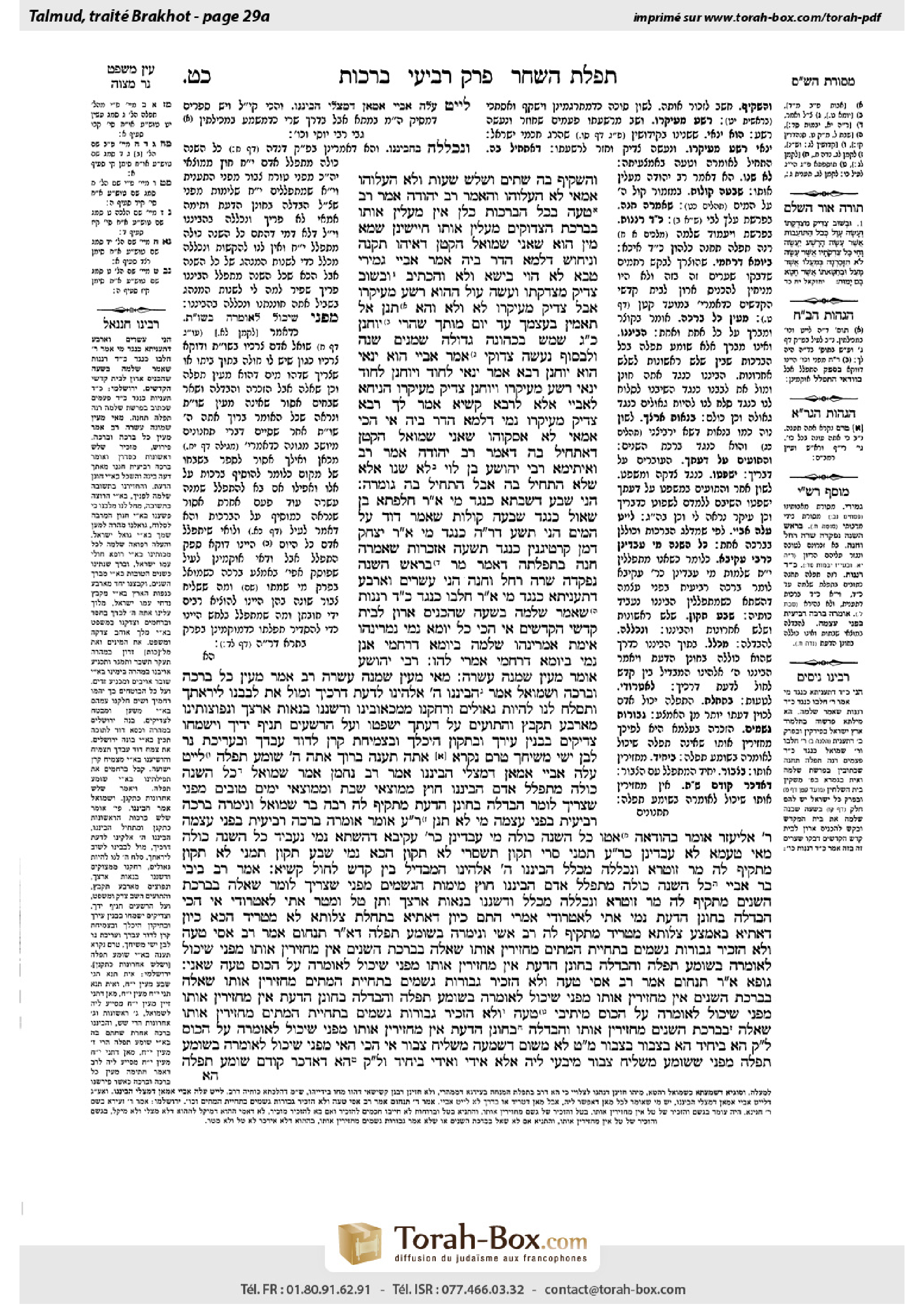
Berakhot 29a: Talmud study for Daf Yomi
Study the Talmud for Daf Yomi with scanned pages, Hebrew text, English translations from Sefaria and AI-generated French translations.
Passage selection and English or AI-generated French translation are available where the scan has annotations. Daf Study is independent of Torah-Box and Sefaria.
Browse Berakhot · ברכות · All tractatesBerakhot 29a text and translations
This page of Berakhot includes the Aramaic text, an English translation and an AI-generated French translation, alongside the scan above.
ברכות כ״ט א · Aramaic and Hebrew text
וְהִשְׁקִיף בָּהּ שְׁתַּיִם וְשָׁלֹשׁ שָׁעוֹת, וְלֹא הֶעֱלוּהוּ.
אַמַּאי לֹא הֶעֱלוּהוּ? וְהָאָמַר רַב יְהוּדָה אָמַר רַב: טָעָה בְּכָל הַבְּרָכוֹת כֻּלָּן — אֵין מַעֲלִין אוֹתוֹ, בְּבִרְכַּת הַמִּינִים — מַעֲלִין אוֹתוֹ. חָיְישִׁינַן שֶׁמָּא מִין הוּא?
שָׁאנֵי שְׁמוּאֵל הַקָּטָן דְּאִיהוּ תַּקְּנַהּ.
וְנֵיחוּשׁ דִּלְמָא הֲדַר בֵּיהּ. אָמַר אַבָּיֵי: גְּמִירִי, טָבָא לָא הָוֵי בִּישָׁא.
וְלָא?! וְהָכְתִיב: ״וּבְשׁוּב צַדִּיק מִצִּדְקָתוֹ וְעָשָׂה עָוֶל״. הָהוּא רָשָׁע מֵעִיקָּרוֹ, אֲבָל צַדִּיק מֵעִיקָּרוֹ — לָא.
וְלָא?! וְהָא תְּנַן: אַל תַּאֲמִין בְּעַצְמְךָ עַד יוֹם מוֹתְךָ, שֶׁהֲרֵי יוֹחָנָן כֹּהֵן גָּדוֹל שִׁמֵּשׁ בִּכְהוּנָּה גְּדוֹלָה שְׁמֹנִים שָׁנָה וּלְבַסּוֹף נַעֲשָׂה צָדוֹקִי.
אָמַר אַבָּיֵי: הוּא יַנַּאי, הוּא יוֹחָנָן. רָבָא אָמַר: יַנַּאי לְחוּד וְיוֹחָנָן לְחוּד, יַנַּאי — רָשָׁע מֵעִיקָּרוֹ, וְיוֹחָנָן — צַדִּיק מֵעִיקָּרוֹ. הַנִּיחָא לְאַבָּיֵי, אֶלָּא לְרָבָא קַשְׁיָא.
אָמַר לָךְ רָבָא: צַדִּיק מֵעִיקָּרוֹ נָמֵי דִּלְמָא הָדַר בֵּיהּ. אִי הָכִי, אַמַּאי לָא אַסְּקוּהוּ?
שָׁאנֵי שְׁמוּאֵל הַקָּטָן דְּאַתְחֵיל בַּהּ. דְּאָמַר רַב יְהוּדָה אָמַר רַב, וְאִיתֵּימָא רַבִּי יְהוֹשֻׁעַ בֶּן לֵוִי: לֹא שָׁנוּ, אֶלָּא שֶׁלֹּא הִתְחִיל בָּהּ, אֲבָל הִתְחִיל בָּהּ — גּוֹמְרָהּ.
הָנֵי שֶׁבַע דְּשַׁבְּתָא כְּנֶגֶד מִי? אָמַר רַבִּי חֲלַפְתָּא בֶּן שָׁאוּל: כְּנֶגֶד שִׁבְעָה ״קוֹלוֹת״ שֶׁאָמַר דָּוִד עַל הַמַּיִם.
הָנֵי תֵּשַׁע דְּרֹאשׁ הַשָּׁנָה כְּנֶגֶד מִי? אָמַר רַבִּי יִצְחָק דְּמִן קַרְטִיגְנִין: כְּנֶגֶד תִּשְׁעָה אַזְכָּרוֹת שֶׁאָמְרָה חַנָּה בִּתְפִלָּתָהּ, דְּאָמַר מָר: בְּרֹאשׁ הַשָּׁנָה נִפְקְדָה שָׂרָה רָחֵל וְחַנָּה.
הָנֵי עֶשְׂרִים וְאַרְבַּע דְּתַעֲנִיתָא כְּנֶגֶד מִי? אָמַר רַבִּי חֶלְבּוֹ: כְּנֶגֶד עֶשְׂרִים וְאַרְבַּע ״רְנָנוֹת״ שֶׁאָמַר שְׁלֹמֹה בְּשָׁעָה שֶׁהִכְנִיס אָרוֹן לְבֵית קׇדְשֵׁי הַקׇּדָשִׁים: אִי הָכִי, כׇּל יוֹמָא נָמֵי נֵמְרִינְהוּ! אֵימַת אַמְרִינְהוּ שְׁלֹמֹה — בְּיוֹמָא דְרַחֲמֵי, אֲנַן נָמֵי בְּיוֹמָא דְרַחֲמֵי אָמְרִינַן לְהוּ.
רַבִּי יְהוֹשֻׁעַ אוֹמֵר: מֵעֵין שְׁמֹנֶה עֶשְׂרֵה. מַאי ״מֵעֵין שְׁמוֹנֶה עֶשְׂרֵה״? רַב אָמַר: מֵעֵין כׇּל בְּרָכָה וּבְרָכָה. וּשְׁמוּאֵל אָמַר: ״הֲבִינֵנוּ ה׳ אֱלֹהֵינוּ לָדַעַת דְּרָכֶיךָ, וּמוֹל אֶת לְבָבֵנוּ לְיִרְאָתֶךָ, וְתִסְלַח לָנוּ לִהְיוֹת גְּאוּלִים, וְרַחֲקֵנוּ מִמַּכְאוֹבֵינוּ, וְדַשְּׁנֵנוּ בִּנְאוֹת אַרְצֶךָ, וּנְפוּצוֹתֵינוּ מֵאַרְבַּע תְּקַבֵּץ, וְהַתּוֹעִים עַל דַּעְתְּךָ יִשְׁפְּטוּ, וְעַל הָרְשָׁעִים תָּנִיף יָדֶיךָ, וְיִשְׂמְחוּ צַדִּיקִים בְּבִנְיַן עִירֶךָ וּבְתִקּוּן הֵיכָלֶךָ, וּבִצְמִיחַת קֶרֶן לְדָוִד עַבְדֶּךָ וּבַעֲרִיכַת נֵר לְבֶן יִשַׁי מְשִׁיחֶךָ, טֶרֶם נִקְרָא אַתָּה תַעֲנֶה. בָּרוּךְ אַתָּה ה׳ שׁוֹמֵעַ תְּפִלָּה״.
לָיֵיט עֲלַהּ אַבָּיֵי אַמַּאן דִּמְצַלֵּי ״הֲבִינֵנוּ״.
אָמַר רַב נַחְמָן אָמַר שְׁמוּאֵל: כׇּל הַשָּׁנָה כּוּלָּהּ מִתְפַּלֵּל אָדָם ״הֲבִינֵנוּ״, חוּץ מִמּוֹצָאֵי שַׁבָּת וּמִמּוֹצָאֵי יָמִים טוֹבִים, מִפְּנֵי שֶׁצָּרִיךְ לוֹמַר הַבְדָּלָה בְּ״חוֹנֵן הַדָּעַת״.
מַתְקִיף לַהּ רַבָּה בַּר שְׁמוּאֵל: וְנֵימְרַהּ בְּרָכָה רְבִיעִית בִּפְנֵי עַצְמָהּ! מִי לָא תְּנַן רַבִּי עֲקִיבָא אוֹמֵר: אוֹמְרָהּ בְּרָכָה רְבִיעִית בִּפְנֵי עַצְמָהּ. רַבִּי אֱלִיעֶזֶר אוֹמֵר: בַּהוֹדָאָה.
אַטּוּ כׇּל הַשָּׁנָה כּוּלָּהּ מִי עָבְדִינַן כְּרַבִּי עֲקִיבָא, דְּהַשְׁתָּא נָמֵי נַעֲבֵיד?! כׇּל הַשָּׁנָה כּוּלָּהּ מַאי טַעְמָא לָא עָבְדִינַן כְּרַבִּי עֲקִיבָא תַּמְנֵי סְרֵי תַּקּוּן, תְּשַׁסְרֵי לָא תַּקּוּן, הָכָא נָמֵי שֶׁבַע תַּקּוּן תַּמְנֵי לָא תַּקּוּן.
מַתְקִיף לַהּ מָר זוּטְרָא: וְנִכְלְלָה מִכְלָל: ״הֲבִינֵנוּ ה׳ אֱלֹהֵינוּ הַמַּבְדִּיל בֵּין קֹדֶשׁ לְחוֹל״! קַשְׁיָא.
אָמַר רַב בִּיבִי בַּר אַבָּיֵי: כׇּל הַשָּׁנָה כּוּלָּהּ מִתְפַּלֵּל אָדָם ״הֲבִינֵנוּ״, חוּץ מִימוֹת הַגְּשָׁמִים, מִפְּנֵי שֶׁצָּרִיךְ לוֹמַר שְׁאֵלָה בְּבִרְכַּת ״הַשָּׁנִים״. מַתְקִיף לַהּ מָר זוּטְרָא: וְנִכְלְלָה מִכְלָל: ״וְדַשְּׁנֵנוּ בִּנְאוֹת אַרְצֶךָ, וְתֵן טַל וּמָטָר״!
אָתֵי לְאִטְּרוֹדֵי. אִי הָכִי, הַבְדָּלָה בְּ״חוֹנֵן הַדָּעַת״, נָמֵי אָתֵי לְאִטְּרוֹדֵי!
אָמְרִי: הָתָם כֵּיוָן דְּאָתְיָא בִּתְחִלַּת צְלוֹתָא — לָא מִטְּרִיד, הָכָא כֵּיוָן דְּאָתְיָא בְּאֶמְצַע צְלוֹתָא — מִטְּרִיד.
מַתְקִיף לַהּ רַב אָשֵׁי: וְנֵימְרַהּ בְּ״שׁוֹמֵעַ תְּפִלָּה״, דְּאָמַר רַבִּי תַּנְחוּם אָמַר רַב אַסִּי: טָעָה וְלֹא הִזְכִּיר גְּבוּרוֹת גְּשָׁמִים בִּ״תְחִיַּית הַמֵּתִים״ — מַחֲזִירִין אוֹתוֹ. שְׁאֵלָה בְּבִרְכַּת הַשָּׁנִים — אֵין מַחֲזִירִין אוֹתוֹ, מִפְּנֵי שֶׁיָּכוֹל לְאוֹמְרָהּ בְּ"שׁוֹמֵעַ תְּפִלָּה". וְהַבְדָּלָה בְּ״חוֹנֵן הַדָּעַת״ — אֵין מַחֲזִירִין אוֹתוֹ, מִפְּנֵי שֶׁיָּכוֹל לְאוֹמְרָהּ עַל הַכּוֹס. טָעָה שָׁאנֵי.
גּוּפָא, אָמַר רַבִּי תַּנְחוּם אָמַר רַב אַסִּי: טָעָה וְלֹא הִזְכִּיר גְּבוּרוֹת גְּשָׁמִים בִּ״תְחִיַּית הַמֵּתִים״ — מַחֲזִירִין אוֹתוֹ. שְׁאֵלָה בְּבִרְכַּת ״הַשָּׁנִים״ — אֵין מַחֲזִירִין אוֹתוֹ, מִפְּנֵי שֶׁיָּכוֹל לְאוֹמְרָהּ בְּ״שׁוֹמֵעַ תְּפִלָּה״. וְהַבְדָּלָה בְּ״חוֹנֵן הַדָּעַת״ — אֵין מַחֲזִירִין אוֹתוֹ, מִפְּנֵי שֶׁיָּכוֹל לְאוֹמְרָהּ עַל הַכּוֹס.
מֵיתִיבִי: טָעָה וְלֹא הִזְכִּיר גְּבוּרוֹת גְּשָׁמִים בִּ״תְחִיַּית הַמֵּתִים״ — מַחֲזִירִין אוֹתוֹ. שְׁאֵלָה בְּבִרְכַּת ״הַשָּׁנִים״ — מַחֲזִירִין אוֹתוֹ, וְהַבְדָּלָה בְּ״חוֹנֵן הַדָּעַת״ — אֵין מַחֲזִירִין אוֹתוֹ, מִפְּנֵי שֶׁיָּכוֹל לְאוֹמְרָהּ עַל הַכּוֹס.
לָא קַשְׁיָא, הָא בְּיָחִיד, הָא בְּצִבּוּר.
בְּצִבּוּר מַאי טַעְמָא לָא — מִשּׁוּם דְּשַׁמְעַהּ מִשְּׁלִיחַ צִבּוּר, אִי הָכִי, הַאי ״מִפְּנֵי שֶׁיָּכוֹל לְאוֹמְרָהּ בְּשׁוֹמֵעַ תְּפִילָּה״, ״מִפְּנֵי שֶׁשּׁוֹמֵעַ מִשְּׁלִיחַ צִיבּוּר״ מִיבְּעֵי לֵיהּ.
אֶלָּא אִידֵּי וְאִידֵּי בְּיָחִיד, וְלָא קַשְׁיָא: הָא דְּאִדְּכַר קוֹדֶם ״שׁוֹמֵעַ תְּפִלָּה״,
Berakhot 29a · English translation
and scrutinized it, in an attempt to remember the blessing for two or three hours, and they did not remove him from serving as prayer leader.
The Gemara asks: Why did they not remove him? Didn’t Rav Yehuda say that Rav said: One who was serving as the prayer leader before the congregation and erred in reciting any of the blessings, they do not remove him from serving as the prayer leader. However, one who erred while reciting the blessing of the heretics they remove him, as we suspect that perhaps he is a heretic and intentionally omitted the blessing to avoid cursing himself. Why, then, did they not remove Shmuel HaKatan?
The Gemara answers: Shmuel HaKatan is different because he instituted this blessing and there is no suspicion of him.
The Gemara continues: Let us suspect that perhaps he reconsidered and, although he had been righteous, he had a change of heart? Abaye said: We learned through tradition that a good person does not become wicked.
The Gemara challenges this: And does he not become wicked? Isn’t it explicitly written: “And when the righteous one returns from his righteousness and does wicked like all of the abominations that the wicked one has done, will he live? All of the righteous deeds that he has done will not be remembered given the treachery that he has carried out, and in his sin that he has transgressed, for these he shall die” (Ezekiel 18:24)? Abaye responds: That verse refers to a righteous individual who was initially wicked and repented, but ultimately returned to his evil ways. However, one who is initially righteous does not become wicked.
The Gemara asks: And does he not become wicked? Didn’t we learn in a mishna: Do not be sure of yourself until the day you die, as Yoḥanan the High Priest served in the High Priesthood for eighty years and ultimately became a Sadducee. Even one who is outstanding in his righteousness can become a heretic.
Abaye responded: He is Yannai he is Yoḥanan. In other words, from its inception, the entire Hasmonean dynasty had the same positive attitude toward the Sadducees, and there was no distinction between Yoḥanan Hyrcanus and Alexander Yannai. Yoḥanan the High Priest had Sadducee leanings from the outset. Rava said: Yannai is distinct and Yoḥanan is distinct. They did not share the same position in this regard. Yannai was wicked from the outset and Yoḥanan was righteous from the outset. If so, it works out well according to Abaye’s opinion; however, according to Rava’s opinion, it is difficult. How could Yoḥanan, a righteous individual, have changed and turned wicked?
The Gemara responds: Rava could have said to you: There is also room for concern that one who is righteous from the outset will perhaps reconsider and turn wicked, as was the case with Yoḥanan the High Priest. If so, the original question is difficult: Why did they not remove Shmuel HaKatan from serving as the prayer leader?
The Gemara answers: The case of Shmuel HaKatan is different, as he began reciting the blessing of the heretics and while reciting it he became confused and forgot the end of the blessing. Consequently, he was not suspected of heretical leanings. Indeed, Rav Yehuda said that Rav, and some say that Rabbi Yehoshua ben Levi, said: They only taught that one who errs while reciting the blessing of the heretics is removed in a case where he did not begin reciting it. But if he began reciting it, then we allow him to collect his thoughts and finish reciting it.
To this point, the Gemara discussed allusions to the nineteen blessings that constitute the weekday Amida prayer. The Gemara asks: Corresponding to what were these seven blessings of the Shabbat Amida prayer instituted? The Gemara answers: Rabbi Ḥalafta ben Shaul said: Corresponding to the seven “voices” which David mentioned on the waters; in other words, the seven times that “the voice of God” is mentioned in Psalms 29, which served as the source for the weekday prayer.
The Gemara asks further: Corresponding to what were these nine blessings of the Rosh HaShana additional prayer instituted? Rabbi Yitzḥak of Kartignin said: They correspond to the nine mentions of God’s name that Hannah said in her prayer (I Samuel 2:10). The connection between Hannah’s prayer and Rosh HaShana is based on what the Master said: On Rosh HaShana, Sarah, Rachel, and Hannah were remembered and the divine decree that they would conceive their sons was issued.
The Gemara continues: Corresponding to what were these twenty-four blessings of the Amida prayer of the fast days instituted? Rabbi Ḥelbo said: They correspond to the twenty-four “songs” that Solomon said when he brought the ark into the Holy of Holies during the dedication of the Temple, as there are twenty-four expressions of song, prayer, and supplication there (I Kings 8). The Gemara asks: If so, then let us say these twenty-four blessing every day. The Gemara answers: When did Solomon say them? On a day of supplication for mercy. We, too, say them on a day of supplication for mercy.
We learned in the mishna that Rabbi Yehoshua says that each day one recites an abridged version of the prayer of eighteen blessings. The Gemara asks: What is the abridged version of the prayer of eighteen blessings? There are different opinions. Rav said: One recites an abridged version of each and every blessing. Shmuel said: An abridged version of the prayer of eighteen blessings refers to a blessing composed specifically to be recited in place of the thirteen middle blessings. It contains references to each of the thirteen middle blessings. The formula for that blessing is: Grant us understanding, Lord our God, to know Your ways, and sensitize our hearts so that we may revere You, and forgive us so that we may be redeemed, and keep us far from our suffering, and satisfy us with the pastures of Your land, and gather our scattered people from the four corners of the earth, and those who go astray shall be judged according to Your will, and raise Your hand against the wicked, and may the righteous rejoice in the rebuilding of Your city, and the restoration of Your Sanctuary, and in the flourishing of Your servant David, and in establishing a light for Your Messiah, son of Yishai. Before we call, may You answer. Blessed are You, Lord, Who listens to prayer.”
Although Shmuel mentioned this abridged prayer, Abaye would curse anyone who recited the prayer: Grant us understanding, as he held that one may recite it only in exigent circumstances (Rabbi Ḥananel, Me’iri).
The Gemara further restricts the occasions when one may recite the abridged prayer. Rav Naḥman said that Shmuel said: One may recite: Grant us understanding throughout the entire year, except for in the evening prayer at the conclusion of Shabbat and at the conclusion of Festivals, because he must recite the prayer of distinction [havdala] in the blessing: Who graciously grants knowledge.
Rabba bar Shmuel strongly objects to this: After reciting the three initial blessings, let us say havdala as an independent fourth blessing, and afterwards recite the prayer of Grant us understanding. This is feasible. Didn’t we learn in a mishna that Rabbi Akiva says: He says havdala as an independent fourth blessing? Rabbi Eliezer says: He says havdala in the blessing of thanksgiving.
The Gemara responds: Do we practice in accordance with the opinion of Rabbi Akiva throughout the entire year regarding this issue, that we will also practice this way now? Throughout the entire year, what is the reason that we do not practice in accordance with the opinion of Rabbi Akiva? Because they instituted eighteen blessings, they did not institute nineteen. Here too, they instituted seven blessings, they did not institute eight. Therefore, the possibility to recite havdala as an independent fourth blessing is rejected.
Mar Zutra strongly objects to this: Let us include havdala in the framework of the abridged blessing: Grant us understanding, Lord our God, Who distinguishes between sacred and profane. No response was offered to this objection, and it remains difficult.
Rav Beivai bar Abaye said: There is an additional restriction that applies to the abridged prayer. One may recite Grant us understanding throughout the entire year, except during the rainy season, because he must recite the request for rain in the blessing of the years. Mar Zutra strongly objects to this: Let us include the request for rain in the framework of the abridged blessing: And satisfy us with the pastures of Your land, and grant dew and rain.
The Gemara responds: That is unfeasible, as he will become confused by introducing a new element to the standard formula of the blessing. The Gemara asks: If so, by introducing havdala in the framework of the abridged blessing in the section alluding to the blessing, Who graciously grants knowledge, he will also become confused. Why did the Gemara fail to respond to Mar Zutra’s strong objection with regard to havdala in that manner?
The Gemara answers: They say that these cases are different: There, regarding havdala, since the introduction of the new element comes at the beginning of the prayer, he will not become confused. Here, since the request for rain comes in the middle of the prayer, he will become confused.
Rav Ashi strongly objects to this: If so, let us say the request for rain in the framework of the abridged blessing in the section alluding to the blessing Who listens to prayer. As Rabbi Tanḥum said that Rav Asi said: One who erred and did not mention the might of the rains in the blessing on the revival of the dead, we require him to return to the beginning of the prayer and repeat it. However, one who erred and failed to recite the request for rain in the ninth blessing of the Amida, the blessing of the years, we do not require him to return to the beginning of the prayer and repeat it because he can recite it in the blessing Who listens to prayer. And one who erred and failed to recite havdala in the blessing Who graciously grants knowledge, we do not require him to return to the beginning of the prayer and repeat it, as he can recite havdala over the cup of wine. One can ask for rain in the blessing Who listens to prayer, and, consequently, can introduce it at the end of the abridged blessing without becoming confused. The Gemara responds: One who erred is different, and only then does he have the option to ask for rain in the blessing Who listens to prayer. Ab initio, the request for rain may not be inserted there.
The statement that Rabbi Tanḥum said that Rav Asi said was incidental to the previous discussion. The Gemara attempts to understand the matter itself. Rabbi Tanḥum said that Rav Asi said: One who erred and did not mention the might of the rains in the blessing on the revival of the dead, we require him to return to the beginning of the prayer and repeat it. However, one who erred and failed to recite the request for rain in the blessing of the years, we do not require him to return to the beginning of the prayer and repeat it because he can recite it in the blessing Who listens to prayer. And one who erred and failed to recite havdala in the blessing Who graciously grants knowledge, we do not require him to return to the beginning of the prayer and repeat it, as he can recite havdala over the cup of wine.
The Gemara raised an objection based on what was taught in the Tosefta: One who erred and did not mention the might of the rains in the blessing on the revival of the dead, we require him to return to the beginning of the prayer and repeat it. One who erred and failed to recite the request for rain in the blessing of the years, we require him to return to the beginning of the prayer and repeat it. However, one who erred and failed to recite havdala in the blessing Who graciously grants knowledge, we do not require him to return to the beginning of the prayer and repeat it, as he can recite havdala over the cup of wine. The Tosefta contradicts the statement of Rabbi Tanḥum with regard to one who erred and failed to recite the request for rain in the blessing of the years.
The Gemara responds: This is not difficult. This case, where we require him to return to the beginning of the prayer and repeat it, refers to a situation where he is praying as an individual. While that case, where we do not require him to return to the beginning of the prayer and repeat it, refers to a situation where he is praying as part of a congregation.
The Gemara raises a difficulty: When praying as part of a congregation, what is the reason that he need not need return to the beginning of the prayer and repeat it? Because he can fulfill his obligation when he hears it from the communal prayer leader in the repetition of the Amida prayer. If so, Rabbi Tanḥum’s formulation is imprecise. That which he said that he need not return to the beginning of the prayer and repeat it because he can recite it in the blessing: Who listens to prayer, should have been: Because he hears it from the communal prayer leader. This proves that the attempt to rebuff the challenge from the Tosefta to Rabbi Tanḥum was incorrect.
Rather, both this statement of Rabbi Tanḥum and that statement in the Tosefta refer to one praying as an individual, and it is, nevertheless, not difficult. This case, where we do not require him to return to the beginning of the prayer and repeat it, refers to a case where he recalls his error before he reaches the blessing: Who listens to prayer, in which case he can ask for rain in that blessing.
Berakhot 29a · Traduction française (IA)
et il l'a examiné, dans l'intention de se souvenir de la bénédiction pendant deux ou trois heures, et ils ne l'ont pas retiré de sa fonction de chef de prière.
La Guemara pose la question : Pourquoi ne l'ont-ils pas retiré ? N'a-t-il pas dit Rav Yéhuda que Rav a dit : Celui qui était chef de prière devant la congrégation et s'est trompé dans la récitation de l'une des bénédictions, on ne le retire pas de sa fonction de chef de prière. Cependant, celui qui s'est trompé pendant la récitation de la bénédiction des hérétiques, on le retire, car on soupçonne qu'il pourrait être hérétique et avoir intentionnellement omis la bénédiction pour éviter de se maudire lui-même. Pourquoi, alors, ne l'ont-ils pas retiré Shmuel HaKatan ?
La Guemara répond : Shmuel HaKatan est différent car il a institué cette bénédiction et il n'y a pas de soupçon contre lui.
La Guemara continue : Supposons qu'il ait réfléchi et, bien qu'il ait été juste, il ait changé d'avis ? Abaye a dit : Nous avons appris par la tradition que la personne juste ne devient pas méchante.
La Guemara conteste cela : Et ne devient-il pas méchant ? N'est-il pas explicitement écrit : « Et quand le juste revient de sa justice et fait le mal comme tous les abominations que le méchant a fait, vivra-t-il ? Toutes les bonnes œuvres qu'il a faites ne seront pas souvenues à cause de la trahison qu'il a commise, et en son péché qu'il a transgressé, pour ces choses il mourra » (Ezéchiel 18:24) ? Abaye répond : Ce verset fait référence à un juste qui était initialement méchant et s'est repenti, mais finalement est revenu à ses mauvaises habitudes. Cependant, celui qui est initialement juste ne devient pas méchant.
La Guemara pose la question : Et ne devient-il pas méchant ? N'avons-nous pas appris dans une mitsna : Ne sois pas sûr de toi jusqu'au jour de ta mort, car Yoḥanan le grand prêtre a exercé la fonction de grand prêtre pendant soixante-dix ans et finalement est devenu un Sadducéen. Même celui qui est exceptionnel dans sa justice peut devenir hérétique.
Abaye répondit : Il est Yannai, il est Yoḥanan. En d'autres termes, dès le début, la dynastie hasmonéenne avait la même attitude positive envers les Sadducéens, et il n'y avait pas de distinction entre Yoḥanan Hyrcanus et Alexandre Yannai. Yoḥanan le grand prêtre avait des tendances sadducéennes dès le début. Rava dit : Yannai est distinct et Yoḥanan est distinct. Ils n'avaient pas la même position à ce sujet. Yannai était méchant dès le début et Yoḥanan était juste dès le début. Si tel est le cas, cela s'aligne bien selon l'opinion d'Abaye ; cependant, selon l'opinion de Rava, cela est difficile. Comment Yoḥanan, une personne juste, a-t-il pu changer et devenir méchant ?
La Guemara répond : Rava pourrait avoir dit à vous : Il y a aussi lieu de soupçonner que celui qui est juste dès le début puisse réfléchir et se tourner vers le mal, comme c'était le cas avec Yoḥanan le grand prêtre. Si tel est le cas, la question originale est difficile : Pourquoi ne l'ont-ils pas retiré de sa fonction de chef de prière ?
La Guemara répond : Le cas de Shmuel HaKatan est différent, car il a commencé à réciter la bénédiction des hérétiques et pendant sa récitation il s'est perdu et a oublié la fin de la bénédiction. Ainsi, il n'était pas soupçonné de tendances hérétiques. En effet, Rav Yéhuda a dit que Rav, et certains disent que Rabbi Yéhoshua ben Levi, a dit : Ils n'ont enseigné que celui qui s'est trompé pendant la récitation de la bénédiction des hérétiques est retiré dans le cas où il n'a pas commencé à la réciter. Mais si il a commencé à la réciter, alors on lui permet de reprendre ses esprits et de finir la récitation.
Jusqu'à présent, la Guemara a discuté des allusions aux dix-neuf bénédictions qui constituent la prière Amida du jour ordinaire. La Guemara pose la question : Correspondant à quoi ces sept bénédictions de la prière Amida du Sabbat ont-elles été instituées ? La Guemara répond : Rabbi Ḥalafta ben Shaul a dit : Correspondant aux sept « voix » mentionnées par David sur les eaux ; c'est-à-dire les sept fois où « la voix de Dieu » est mentionnée dans les Psaumes 29, qui ont servi de source pour la prière du jour ordinaire.
La Guemara pose la question de plus : Correspondant à quoi ces neuf bénédictions de la prière additionnelle de Rosh HaShana ont-elles été instituées ? Rabbi Yitzḥak de Kartignin a dit : Elles correspondent aux neuf mentions du nom de Dieu que Hannah a dites dans sa prière (I Samuel 2:10). Le lien entre la prière de Hannah et Rosh HaShana est basé sur ce que le Maître a dit : Sur Rosh HaShana, Sarah, Rachel et Hannah ont été souvenues et le décret divin qui leur permettrait d'engendrer leurs fils a été émis.
La Guemara continue : Correspondant à quoi ces vingt-quatre bénédictions de la prière Amida des jours de jeûne ont-elles été instituées ? Rabbi Ḥelbo a dit : Elles correspondent aux vingt-quatre « chansons » que Salomon a dites lorsqu'il a apporté l'arche dans le Saint des Saints lors de la dédicace du Temple, car il y a vingt-quatre expressions de chanson, de prière et de supplication là (I Rois 8). La Guemara pose la question : Si tel est le cas, disons ces vingt-quatre bénédictions chaque jour. La Guemara répond : Quand Salomon les a-t-il dites ? Le jour de supplication pour la miséricorde. Nous aussi, nous les disons le jour de supplication pour la miséricorde.
Nous avons appris dans la Michna que Rabbi Yéhoshua dit que chaque jour on récite une version abrégée de la prière des dix-huit bénédictions. La Guemara demande : Quelle est cette version abrégée de la prière des dix-huit bénédictions ? Il y a des opinions différentes. Rav dit : On récite une version abrégée de chaque bénédiction. Shmuel dit : Une version abrégée de la prière des dix-huit bénédictions signifie une bénédiction spécifiquement composée pour être récitée à la place des treize bénédictions centrales. Elle contient des références à chacune des treize bénédictions centrales. La formule de cette bénédiction est : Donnez-nous la sagesse, Seigneur notre Dieu, pour connaître Vos voies, et sensibilisez nos cœurs afin que nous puissions Vous adorer, et pardonnez-nous afin que nous soyons rachetés, et gardez-nous loin de notre souffrance, et satisfassez-nous des pâturages de Votre terre, et rassemblez notre peuple dispersé des quatre coins de la terre, et ceux qui s'écartent seront jugés selon Votre volonté, et levez Votre main contre les méchants, et que les justes se réjouissent dans la reconstruction de Votre ville, et la restauration de Votre Sanctuaire, et dans la prospérité de Votre serviteur David, et dans l'établissement d'une lumière pour Votre Messie, fils de Yishai. Avant que nous appelions, répondez à nous. Béni sois Tu, Seigneur, Celui qui écoute la prière.
Bien que Shmuel ait mentionné cette prière abrégée, Abaye maudissait quiconque la récitait : Donnez-nous la sagesse, car il considérait qu'on ne pouvait la réciter qu'en cas d'urgence (Rabbi Ḥananel, Me’iri).
La Guemara restreint davantage les occasions où l'on peut réciter cette prière abrégée. Rav Naḥman dit que Shmuel dit : On peut réciter : Donnez-nous la sagesse tout au long de l'année, sauf lors de la prière du soir à la fin du Shabbat et à la fin des fêtes, car il faut réciter la prière de distinction [havdala] dans la bénédiction : Celui qui accorde gracieusement la connaissance.
Rabba bar Shmuel s'oppose fermement à cela : Après avoir récité les trois premières bénédictions, disons havdala comme une quatrième bénédiction indépendante, et ensuite récitons la prière : Donnez-nous la sagesse. Cela est possible. N'avons-nous pas appris dans une mitsna que Rabbi Akiva dit : Il dit havdala comme une quatrième bénédiction indépendante ? Rabbi Eliezer dit : Il dit havdala dans la bénédiction de remerciement.
La Guemara répond : Pratiquons-nous selon l'opinion de Rabbi Akiva tout au long de l'année concernant cette question, que nous pratiquerons ainsi maintenant ? Tout au long de l'année, quelle est la raison pour laquelle nous ne pratiquons pas selon l'opinion de Rabbi Akiva ? Parce qu'ils ont institué dix-huit bénédictions, ils n'ont pas institué dix-neuf. Ici aussi, ils ont institué sept bénédictions, ils n'ont pas institué huit. Par conséquent, la possibilité de réciter havdala comme une quatrième bénédiction indépendante est rejetée.
Mar Zutra s'oppose fermement à cela : Incluons havdala dans le cadre de la bénédiction abrégée : Donnez-nous la sagesse, Seigneur notre Dieu, Celui qui distingue entre le sacré et le profane. Aucune réponse n'a été offerte à cette objection, et elle reste difficile.
Rav Beivai bar Abaye dit : Il y a une restriction supplémentaire qui s'applique à cette prière abrégée. On peut réciter : Donnez-nous la sagesse tout au long de l'année, sauf pendant la saison des pluies, car il faut réciter la prière de demande de pluie dans la bénédiction des années. Mar Zutra s'oppose fermement à cela : Incluons la demande de pluie dans le cadre de la bénédiction abrégée : Et satisfassez-nous des pâturages de Votre terre, et donnez la rosée et les pluies.
La Guemara répond : Cela est impossible, car il deviendrait confus en introduisant un nouvel élément dans la formule standard de la bénédiction. La Guemara demande : Si ainsi, en introduisant havdala dans le cadre de la bénédiction abrégée dans la section allusive à la bénédiction : Celui qui accorde gracieusement la connaissance, il deviendrait également confus. Pourquoi la Guemara n'a-t-elle pas répondu à l'objection forte de Mar Zutra concernant havdala de cette manière ?
La Guemara répond : Ils disent que ces cas sont différents : Là, concernant havdala, puisque l'introduction du nouvel élément vient au début de la prière, il ne deviendrait pas confus. Ici, puisque la demande de pluie vient au milieu de la prière, il deviendrait confus.
Rav Ashi s'oppose fermement à cela : Si c'est ainsi, disons la demande de pluie dans le cadre de la bénédiction abrégée dans la section allusive à la bénédiction : Celui qui écoute la prière. Comme Rabbi Tanḥum a dit que Rav Asi a dit : Celui qui s'est trompé et n'a pas mentionné la puissance des pluies dans la bénédiction sur la résurrection des morts, nous exigeons qu'il revienne au début de la prière et la répète. Cependant, celui qui s'est trompé et n'a pas récité la demande de pluie dans la neuvième bénédiction de l'Amida, la bénédiction des années, nous ne lui exigeons pas de revenir au début de la prière et de la répéter, car il peut la réciter dans la bénédiction : Celui qui écoute la prière. Et celui qui s'est trompé et n'a pas récité havdala dans la bénédiction : Celui qui accorde gracieusement la connaissance, nous ne lui exigeons pas de revenir au début de la prière et de la répéter, car il peut réciter havdala sur le verre de vin. On peut demander la pluie dans la bénédiction : Celui qui écoute la prière, et, par conséquent, peut l'introduire à la fin de la bénédiction abrégée sans devenir confus. La Guemara répond : Celui qui s'est trompé est différent, et seulement alors a-t-il l'option de demander la pluie dans la bénédiction : Celui qui écoute la prière. Initialement, la demande de pluie ne peut pas être insérée là.
La déclaration que Rabbi Tanḥum a faite, que Rav Asi a dite, était incidentelle à la discussion précédente. La Guemara tente de comprendre la question elle-même. Rabbi Tanḥum a dit que Rav Asi a dit : Celui qui s'est trompé et n'a pas mentionné la puissance des pluies dans la bénédiction sur la résurrection des morts, nous exigeons qu'il revienne au début de la prière et la répète. Cependant, celui qui s'est trompé et n'a pas récité la demande de pluie dans la bénédiction des années, nous ne lui exigeons pas de revenir au début de la prière et de la répéter, car il peut la réciter dans la bénédiction Qui écoute la prière. Et celui qui s'est trompé et n'a pas récité la séparation (havdala) dans la bénédiction Qui accorde gracieusement la connaissance, nous ne lui exigeons pas de revenir au début de la prière et de la répéter, car il peut réciter la séparation sur le verre de vin.
La Guemara a soulevé un objet basé sur ce qui a été enseigné dans la Tosefta : Celui qui s'est trompé et n'a pas mentionné la puissance des pluies dans la bénédiction sur la résurrection des morts, nous exigeons qu'il revienne au début de la prière et la répète. Celui qui s'est trompé et n'a pas récité la demande de pluie dans la bénédiction des années, nous exigeons qu'il revienne au début de la prière et la répète. Cependant, celui qui s'est trompé et n'a pas récité la séparation (havdala) dans la bénédiction Qui accorde gracieusement la connaissance, nous ne lui exigeons pas de revenir au début de la prière et de la répéter, car il peut réciter la séparation sur le verre de vin. La Tosefta contredit la déclaration de Rabbi Tanḥum concernant celui qui s'est trompé et n'a pas récité la demande de pluie dans la bénédiction des années.
La Guemara répond : Ce n'est pas difficile. Ce cas, où nous exigeons qu'il revienne au début de la prière et la répète, fait référence à un cas où il prie seul. Alors que ce cas, où nous ne lui exigeons pas de revenir au début de la prière et de la répéter, fait référence à un cas où il prie en communauté.
La Guemara soulève une difficulté : Lorsqu'on prie en communauté, quelle est la raison pour laquelle il n'a pas besoin de revenir au début de la prière et de la répéter ? Parce qu'il peut accomplir son obligation lorsqu'il l'entend du chef de prière communautaire dans la répétition de la prière Amida. Si c'est ainsi, la formulation de Rabbi Tanḥum est imprecise. Ce qu'il a dit, à savoir qu'il n'a pas besoin de revenir au début de la prière et de la répéter car il peut la réciter dans la bénédiction : Qui écoute la prière, aurait dû être : Parce qu'il l'entend du chef de prière communautaire. Cela prouve que l'effort pour répondre à l'objection de la Tosefta contre Rabbi Tanḥum était incorrect.
Au contraire, à la fois cette déclaration de Rabbi Tanḥum et celle de la Tosefta font référence à celui qui prie seul, et cependant, ce n'est pas difficile. Ce cas, où nous ne lui exigeons pas de revenir au début de la prière et de la répéter, fait référence à un cas où il se souvient de son erreur avant d'atteindre la bénédiction : Qui écoute la prière, dans lequel cas il peut demander la pluie dans cette bénédiction.
Traduction française générée par IA à partir de l’édition anglaise de Sefaria. Vérifie toujours un passage avec le texte source.
Text from Sefaria: William Davidson Edition - Vocalized Aramaic (CC BY NC); William Davidson Edition - English (CC BY NC).