Berakhot 29b: Talmud study for Daf Yomi
Study the Talmud for Daf Yomi with scanned pages, Hebrew text, English translations from Sefaria and AI-generated French translations.
Passage selection and English or AI-generated French translation are available where the scan has annotations. Daf Study is independent of Torah-Box and Sefaria.
Browse Berakhot · ברכות · All tractatesBerakhot 29b text and translations
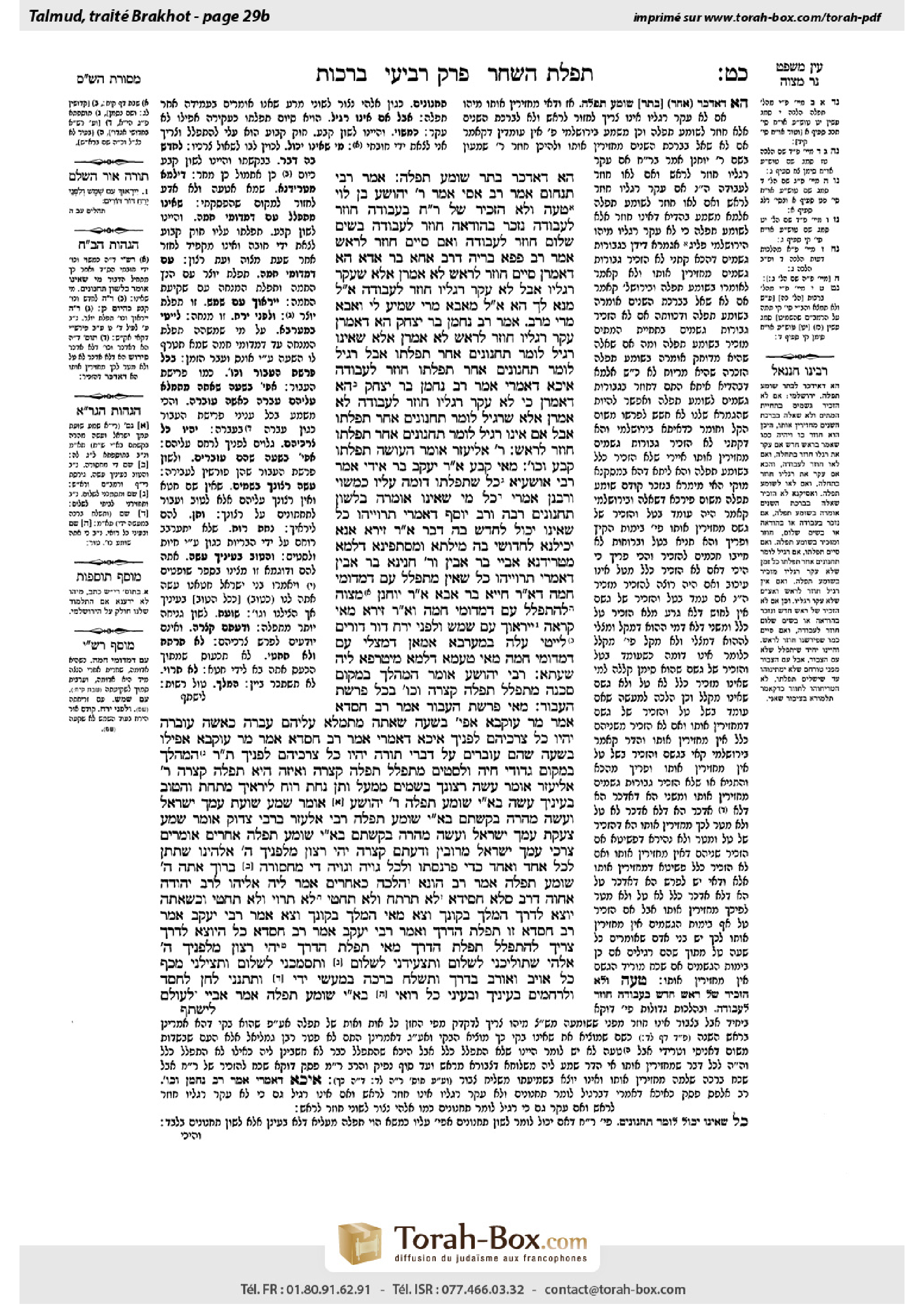
This page of Berakhot includes the Aramaic text, an English translation and an AI-generated French translation, alongside the scan above.
ברכות כ״ט ב · Aramaic and Hebrew text
הָא דְּאִדְּכַר בָּתַר ״שׁוֹמֵעַ תְּפִלָּה״.
אָמַר רַבִּי תַּנְחוּם אָמַר רַב אַסִּי אָמַר רַבִּי יְהוֹשֻׁעַ בֶּן לֵוִי: טָעָה וְלֹא הִזְכִּיר שֶׁל רֹאשׁ חֹדֶשׁ בָּ״עֲבוֹדָה״ — חוֹזֵר לָ״עֲבוֹדָה״. נִזְכַּר בַּ״הוֹדָאָה״ — חוֹזֵר לָ״עֲבוֹדָה״. בְּ״שִׂים שָׁלוֹם״ — חוֹזֵר לָ״עֲבוֹדָה״. וְאִם סִייֵּם — חוֹזֵר לָרֹאשׁ.
אָמַר רַב פָּפָּא בְּרֵיהּ דְּרַב אַחָא בַּר אַדָּא: הָא דַּאֲמַרַן סִייֵּם — חוֹזֵר לָרֹאשׁ, לָא אֲמַרַן אֶלָּא שֶׁעָקַר רַגְלָיו, אֲבָל לֹא עָקַר רַגְלָיו — חוֹזֵר לָעֲבוֹדָה.
אֲמַר לֵיהּ: מְנָא לָךְ הָא? אֲמַר לֵיהּ: מֵאַבָּא מָרִי שְׁמִיעַ לִי, וְאַבָּא מָרִי מֵרַב.
אָמַר רַב נַחְמָן בַּר יִצְחָק: הָא דַּאֲמַרַן עָקַר רַגְלָיו חוֹזֵר לָרֹאשׁ לָא אֲמַרַן אֶלָּא שֶׁאֵינוֹ רָגִיל לוֹמַר תַּחֲנוּנִים אַחַר תְּפִלָּתוֹ, אֲבָל רָגִיל לוֹמַר תַּחֲנוּנִים אַחַר תְּפִלָּתוֹ — חוֹזֵר לַעֲבוֹדָה.
אִיכָּא דְאָמְרִי אָמַר רַב נַחְמָן בַּר יִצְחָק: הָא דַּאֲמַרַן כִּי לֹא עָקַר רַגְלָיו חוֹזֵר לַעֲבוֹדָה לָא אֲמַרַן אֶלָּא שֶׁרָגִיל לוֹמַר תַּחֲנוּנִים אַחַר תְּפִלָּתוֹ, אֲבָל אִם אֵינוֹ רָגִיל לוֹמַר תַּחֲנוּנִים אַחַר תְּפִלָּתוֹ — חוֹזֵר לָרֹאשׁ.
רַבִּי אֱלִיעֶזֶר אוֹמֵר כׇּל הָעוֹשֶׂה תְּפִלָּתוֹ קֶבַע וְכוּ׳: מַאי ״קֶבַע״? אָמַר רַבִּי יַעֲקֹב בַּר אִידֵּי אָמַר רַבִּי אוֹשַׁעְיָא: כֹּל שֶׁתְּפִלָּתוֹ דּוֹמָה עָלָיו כְּמַשּׂוֹי. וְרַבָּנַן אָמְרִי: כׇּל מִי שֶׁאֵינוֹ אוֹמְרָהּ בִּלְשׁוֹן תַּחֲנוּנִים. רַבָּה וְרַב יוֹסֵף דְאָמְרִי תַּרְוַיְיהוּ: כֹּל שֶׁאֵינוֹ יָכוֹל לְחַדֵּשׁ בָּהּ דָּבָר.
אָמַר רַבִּי זֵירָא: אֲנָא יָכֵילְנָא לְחַדּוֹשֵׁי בַּהּ מִילְּתָא, וּמִסְתְּפֵינָא דִּלְמָא מִטְּרִידְנָא.
אַבָּיֵי בַּר אָבִין וְרַבִּי חֲנִינָא בַּר אָבִין דְאָמְרִי תַּרְוַיְיהוּ: כֹּל שֶׁאֵין מִתְפַּלֵּל עִם דִּמְדּוּמֵי חַמָּה. דְּאָמַר רַבִּי חִיָּיא בַּר אַבָּא אָמַר רַבִּי יוֹחָנָן: מִצְוָה לְהִתְפַּלֵּל עִם דִּמְדּוּמֵי חַמָּה. וְאָמַר רַבִּי זֵירָא: מַאי קְרָאָה — ״יִירָאוּךָ עִם שָׁמֶשׁ וְלִפְנֵי יָרֵחַ דּוֹר דּוֹרִים״. לָיְיטִי עֲלַהּ בְּמַעְרְבָא אַמַּאן דִּמְצַלֵּי עִם דִּמְדּוּמֵי חַמָּה. מַאי טַעְמָא — דִּלְמָא מִיטַּרְפָא לֵיהּ שַׁעְתָּא.
רַבִּי יְהוֹשֻׁעַ אוֹמֵר הַמְהַלֵּךְ בִּמְקוֹם סַכָּנָה מִתְפַּלֵּל תְּפִלָּה קְצָרָה וְכוּ׳ בְּכָל פָּרָשַׁת הָעִבּוּר: מַאי ״פָּרָשַׁת הָעִבּוּר״? אָמַר רַב חִסְדָּא אָמַר מָר עוּקְבָא: אֲפִילּוּ בְּשָׁעָה שֶׁאַתָּה מִתְמַלֵּא עֲלֵיהֶם עֶבְרָה כְּאִשָּׁה עוּבָּרָהּ — יִהְיוּ כׇּל צׇרְכֵיהֶם לְפָנֶיךָ. אִיכָּא דְאָמְרִי אָמַר רַב חִסְדָּא אָמַר מָר עוּקְבָא: אֲפִילּוּ בְּשָׁעָה שֶׁהֵם עוֹבְרִים עַל דִּבְרֵי תוֹרָה — יִהְיוּ כׇּל צׇרְכֵיהֶם לְפָנֶיךָ.
תָּנוּ רַבָּנַן: הַמְהַלֵּךְ בִּמְקוֹם גְּדוּדֵי חַיָּה וְלִסְטִים מִתְפַּלֵּל תְּפִלָּה קְצָרָה, וְאֵיזֶה הִיא תְּפִלָּה קְצָרָה — רַבִּי אֱלִיעֶזֶר אוֹמֵר: ״עֲשֵׂה רְצוֹנְךָ בַּשָּׁמַיִם מִמַּעַל, וְתֵן נַחַת רוּחַ לִירֵאֶיךָ מִתַּחַת, וְהַטּוֹב בְּעֵינֶיךָ עֲשֵׂה, בָּרוּךְ אַתָּה ה׳ שׁוֹמֵעַ תְּפִלָּה״.
רַבִּי יְהוֹשֻׁעַ אוֹמֵר: ״שְׁמַע שַׁוְעַת עַמְּךָ יִשְׂרָאֵל, וַעֲשֵׂה מְהֵרָה בַּקָּשָׁתָם, בָּרוּךְ אַתָּה ה׳ שׁוֹמֵעַ תְּפִלָּה״.
רַבִּי אֶלְעָזָר בְּרַבִּי צָדוֹק אוֹמֵר: ״שְׁמַע צַעֲקַת עַמְּךָ יִשְׂרָאֵל, וַעֲשֵׂה מְהֵרָה בַּקָּשָׁתָם, בָּרוּךְ אַתָּה ה׳ שׁוֹמֵעַ תְּפִלָּה״.
אֲחֵרִים אוֹמְרִים: ״צׇרְכֵי עַמְּךָ יִשְׂרָאֵל מְרוּבִּין וְדַעְתָּם קְצָרָה. יְהִי רָצוֹן מִלְּפָנֶיךָ ה׳ אֱלֹהֵינוּ שֶׁתִּתֵּן לְכׇל אֶחָד וְאֶחָד כְּדֵי פַרְנָסָתוֹ, וּלְכׇל גְּוִיָּה וּגְוִיָּה דֵּי מַחְסוֹרָהּ, בָּרוּךְ אַתָּה ה׳ שׁוֹמֵעַ תְּפִלָּה״.
אָמַר רַב הוּנָא: הֲלָכָה כַּאֲחֵרִים.
אֲמַר לֵיהּ אֵלִיָּהוּ לְרַב יְהוּדָה אֲחוּהּ דְּרַב סַלָּא חֲסִידָא: לָא תִּרְתַּח וְלָא תִּחְטֵי. לָא תִּרְוֵי וְלָא תִּחְטֵי. וּכְשֶׁאַתָּה יוֹצֵא לַדֶּרֶךְ, הִמָּלֵךְ בְּקוֹנְךָ וָצֵא. מַאי הִמָּלֵךְ בְּקוֹנְךָ וָצֵא? אָמַר רַבִּי יַעֲקֹב אָמַר רַב חִסְדָּא: זוֹ תְּפִלַּת הַדֶּרֶךְ. וְאָמַר רַבִּי יַעֲקֹב אָמַר רַב חִסְדָּא: כׇּל הַיּוֹצֵא לַדֶּרֶךְ צָרִיךְ לְהִתְפַּלֵּל תְּפִלַּת הַדֶּרֶךְ.
מַאי תְּפִלַּת הַדֶּרֶךְ? ״יְהִי רָצוֹן מִלְּפָנֶיךָ ה׳ אֱלֹהַי, שֶׁתּוֹלִיכֵנִי לְשָׁלוֹם, וְתַצְעִידֵנִי לְשָׁלוֹם, וְתִסְמְכֵנִי לְשָׁלוֹם, וְתַצִּילֵנִי מִכַּף כׇּל אוֹיֵב וְאוֹרֵב בַּדֶּרֶךְ, וְתִשְׁלַח בְּרָכָה בְּמַעֲשֵׂי יָדַי, וְתִתְּנֵנִי לְחֵן לְחֶסֶד וּלְרַחֲמִים בְּעֵינֶיךָ וּבְעֵינֵי כׇּל רוֹאַי, בָּרוּךְ אַתָּה ה׳ שׁוֹמֵעַ תְּפִלָּה״.
אָמַר אַבָּיֵי: לְעוֹלָם
Berakhot 29b · English translation
This case, where we require him to return to the beginning of the prayer and repeat it, refers to a situation where he recalls his error after he reaches the blessing: Who listens to prayer, in which case the option of asking for rain in that blessing no longer exists and he must return to the beginning of the prayer.
On a similar note, the Gemara cites an additional statement of Rabbi Tanḥum. Rabbi Tanḥum said that Rav Asi said that Rabbi Yehoshua ben Levi said: One who erred and did not mention the New Moon, the addition: May there rise and come [ya’aleh veyavo] in the blessing of Temple service, the seventeenth blessing in the Amida prayer, he returns to the blessing of Temple service. So too, if he remembers during the blessing of thanksgiving, he returns to the blessing of Temple service. If he remembers in the blessing: Grant peace, he returns to the blessing of Temple service. If he remembers after he completed the Amida prayer, he returns to the beginning of the prayer.
Rav Pappa son of Rav Aḥa bar Adda said: That which we said that if he already finished the Amida prayer he returns to the beginning, we only said that in a case where he already moved his feet from where he stood in prayer. However, if he did not yet move his feet, he need only return to the blessing of Temple service, and include the addition for the New Moon therein.
He said to him: From where do you derive this halakha? He said to him: My father my teacher told it to me and my father my teacher heard it from Rav.
On a similar note, Rav Naḥman bar Yitzḥak said: That which we said that if he already moved his feet he returns to the beginning, we only said that in a case where he is unaccustomed to reciting additional supplications after his prayer. However, if he is accustomed to reciting supplications after his prayer, and while reciting them he remembers that he omitted mention of the New Moon from his prayer, he need only return to the blessing of Temple service, and he includes the addition for the New Moon therein.
Some say, Rav Naḥman bar Yitzḥak said: That which we said that if he did not yet move his feet, he need only return to the blessing of Temple service, we only said that in a case where he is accustomed to reciting additional supplications after his prayer. However, if he is unaccustomed to reciting supplications after his prayer, he must return to the beginning of the prayer, as it is considered as if he already completed it.
We learned in the mishna that Rabbi Eliezer says: One whose prayer is fixed, his prayer is not supplication. The Gemara asks: What is the meaning of fixed in this context? Rabbi Ya’akov bar Idi said that Rabbi Oshaya said: It means anyone for whom his prayer is like a burden upon him, from which he seeks to be quickly unburdened. The Rabbis say: This refers to anyone who does not recite prayer in the language of supplication, but as a standardized recitation without emotion. Rabba and Rav Yosef both said: It refers to anyone unable to introduce a novel element, i.e., something personal reflecting his personal needs, to his prayer, and only recites the standard formula.
Rabbi Zeira said: I could introduce a novel element in every prayer, but I am afraid that perhaps I will become confused. Consequently, there is no room to require the masses to introduce a novel element into their prayers.
The brothers, Abaye bar Avin and Rabbi Ḥanina bar Avin, both said: One whose prayer is fixed refers to anyone who does not make the effort to pray with the reddening of the sun, just after sunrise and just before sunset, which are auspicious times for prayer. As Rabbi Ḥiyya bar Abba said that Rabbi Yoḥanan said: It is a mitzva to pray with the reddening of the sun. And Rabbi Zeira said: What is the verse that alludes to this? “Let them fear You with the sun and before the moon, generation after generation” (Psalms 72:5). Prayer, the manifestation of the fear of God, should be undertaken adjacent to sunrise and sunset. Nevertheless, in the West, Eretz Yisrael, they cursed one who prays with the reddening of the sun, adjacent to sunset. What is the reason? Perhaps, due to preoccupation, he will become confused about the hour and the time for prayer will pass.
We learned in the mishna that Rabbi Yehoshua says: One who is walking in a place of danger, recites a brief prayer…at parashat ha’ibur. The Gemara asks: What is the meaning of parashat ha’ibur? Rav Ḥisda said that Mar Ukva said: This can be interpreted in a manner underscoring two connotations of the term ibur: Even at a time when You are as filled with anger [evra], towards them, as a pregnant woman [ubara], may all of their needs be before You. Some say a different version of what Rav Ḥisda said that Mar Ukva said: Even when they violate [ovrim] the commandments of the Torah, may all of their needs be before You.
One formula for the prayer recited in places of danger is cited in the mishna. Additional formulas are cited in the Tosefta. The Sages taught: One who walks in a place where there are groups of wild beasts and robbers recites an abbreviated prayer. Which is an abbreviated prayer? Rabbi Eliezer says, “Carry out Your will in the heavens above, and give peace of mind to those who fear You below, and perform that which is good in Your eyes. Blessed are You, Lord, Who listens to prayer.”
Rabbi Yehoshua says that he recites: Hear the cry of Your nation, Israel, and quickly fulfill their request. Blessed are You, Lord, Who listens to prayer.
Rabbi Elazar, son of Rabbi Tzadok says that he recites: Hear the shout of Your nation, Israel, and quickly fulfill their request. Blessed are You, Lord, Who listens to prayer.
Aḥerim say that he recites: The needs of Your nation, Israel, are many and their intelligence is limited, and, consequently, they are unable to effectively articulate their thoughts in prayer (Maharsha). So may it be Your will, Lord our God, to provide each and every one with his necessary sustenance, and to each and every body all that it lacks. Blessed are You, Lord, Who listens to prayer.
Rav Huna said: The halakha with regard to the version of the prayer recited in a place of danger is in accordance with the opinion of Aḥerim.
On the topic of prayers recited while traveling and in times of danger, the Gemara discusses the traveler’s prayer. When he appeared to him, Elijah the Prophet said to Rav Yehuda brother of Rav Sala Ḥasida: Do not get angry and you will not sin. Do not get drunk and you will not sin. And when you set out on a journey, consult with your Creator, and then set out. The Gemara asks: What is the meaning of: Consult with your Creator, and then set out? Rabbi Ya’akov said that Rav Ḥisda said: That is the traveler’s prayer. And Rabbi Ya’akov said that Rav Ḥisda said: It is not only good advice, but established halakha that anyone who sets out on a journey must recite the traveler’s prayer prior to embarking on his journey.
The Gemara asks: What is the formula for the traveler’s prayer? The Gemara answers: May it be Your will, Lord my God, to lead me to peace, direct my steps to peace, and guide me to peace, and rescue me from the hands of any enemy or ambush along the way, and send blessing to the work of my hands, and let me find grace, kindness, and compassion in Your eyes and in the eyes of all who see me. Blessed are You, Lord, Who hears prayer.
Abaye said: At all times
Berakhot 29b · Traduction française (IA)
Ce cas, où l'on exige qu'il revienne au début de la prière et la répète, concerne une situation où il se souvient de son erreur après avoir atteint la bénédiction : Celui qui écoute la prière, dans lequel cas l'option de demander la pluie dans cette bénédiction n'existe plus et il doit revenir au début de la prière.
Sur un plan similaire, le Guemara cite une autre déclaration du Rabbi Tanḥum. Le Rabbi Tanḥum a dit que Rav Asi a dit que le Rabbi Yéhoshua ben Levi a dit : Celui qui s'est trompé et n'a pas mentionné la Nouvelle Lune, l'addition : Que monte et vienne [ya’aleh veyavo] dans la bénédiction du service du Temple, la dix-septième bénédiction de la prière Amida, il revient à la bénédiction du service du Temple. De même, si l'on se souvient pendant la bénédiction de remerciement, il revient à la bénédiction du service du Temple. Si l'on se souvient dans la bénédiction : Fais la paix, il revient à la bénédiction du service du Temple. Si l'on se souvient après avoir terminé la prière Amida, il revient au début de la prière.
Rav Pappa fils de Rav Aḥa bar Adda a dit : Ce que nous avons dit que s'il a déjà terminé la prière Amida il revient au début, nous l'avons dit uniquement dans le cas où il a déjà bougé ses pieds de l'endroit où il priait. Cependant, si il n'a pas encore bougé ses pieds, il suffit qu'il revienne à la bénédiction du service du Temple et qu'il inclue l'addition pour la Nouvelle Lune là.
Il lui a dit : D'où tirez-vous cette halakha ? Il lui a dit : Mon père, mon maître me l'a dit et mon père, mon maître l'a entendu de Rav.
Sur un plan similaire, Rav Naḥman bar Yitzḥak a dit : Ce que nous avons dit, que s'il a déjà bougé ses pieds, il revient au début, nous l'avons dit uniquement dans le cas où il n'est pas habitué à réciter des suppliques supplémentaires après sa prière. Cependant, si il est habitué à réciter des suppliques après sa prière, et pendant qu'il les récite, il se souvient qu'il a omis la mention de la Nouvelle Lune de sa prière, il suffit qu'il revienne à la bénédiction du service du Temple et qu'il inclue l'addition pour la Nouvelle Lune là.
Certains disent, Rav Naḥman bar Yitzḥak a dit : Ce que nous avons dit, que s'il n'a pas encore bougé ses pieds, il suffit qu'il revienne à la bénédiction du service du Temple, nous l'avons dit uniquement dans le cas où il est habitué à réciter des suppliques supplémentaires après sa prière. Cependant, si il n'est pas habitué à réciter des suppliques après sa prière, il doit revenir au début de la prière, car on le considère comme s'il avait déjà terminé.
Nous avons appris dans la mishna que Rabbi Eliezer dit : Celui dont la prière est fixe, sa prière n'est pas une supplique. La Guemara demande : Quelle est la signification de "fixe" dans ce contexte ? Rabbi Ya’akov bar Idi a dit que Rabbi Oshaya a dit : Cela signifie quiconque dont la prière est comme une charge, d'où il cherche à se décharger rapidement. Les Rabbins disent : Cela fait référence à quiconque ne récite pas la prière dans la langue de la supplique, mais comme une récitation standardisée sans émotion. Rabba et Rav Yosef ont tous les deux dit : Cela fait référence à quiconque n'est pas capable d'introduire un élément nouveau, c'est-à-dire quelque chose personnel reflétant ses besoins personnels, dans sa prière, et récite uniquement la formule standardisée.
Rabbi Zeira a dit : Je peux introduire un élément nouveau dans chaque prière, mais j'ai peur que peut-être je me perde. Par conséquent, il n'y a pas de place pour exiger que la masse introduise un élément nouveau dans leurs prières.
Les frères, Abaye bar Avin et Rabbi Ḥanina bar Avin, ont tous les deux dit : Celui dont la prière est fixe fait référence à quiconque ne fait pas l'effort de prier avec le rougeoiement du soleil, juste après l'aube et juste avant le coucher du soleil, qui sont des moments propices à la prière. Comme Rabbi Ḥiyya bar Abba a dit que Rabbi Yoḥanan a dit : Il est un mitsva de prier avec le rougeoiement du soleil. Et Rabbi Zeira a dit : Quel est le verset qui sous-entend cela ? « Faites-leur craindre Toi avec le soleil et avant la lune, génération après génération » (Psaumes 72:5). La prière, la manifestation de la crainte de Dieu, doit être entreprise à côté du lever et du coucher du soleil. Cependant, en Occident, en Terre d'Israël, on maudissait celui qui priait avec le rougeoiement du soleil, à côté du coucher du soleil. Quelle est la raison ? Peut-être, en raison de l'occupation, il se perdra sur l'heure et le moment de la prière passera.
Nous avons appris dans la mishna que Rabbi Yéhoshua dit : Celui qui marche dans un lieu de danger, récite une prière brève… à la parashat ha’ibur. Le Guemara demande : Quelle est la signification de parashat ha’ibur ? Rav Ḥisda a dit que Mar Ukva a dit : Cela peut être interprété de manière à souligner deux connotations du terme ibur : Même lorsqu'ils sont remplis de colère [evra], envers eux, comme une femme enceinte [ubara], que toutes leurs besoins soient devant Toi. Certains disent une version différente de ce que Rav Ḥisda a dit que Mar Ukva a dit : Même lorsqu'ils transgressent [ovrim] les commandements de la Torah, que toutes leurs besoins soient devant Toi.
Une formule pour la prière récitée dans les lieux de danger est citée dans la mishna. D'autres formules sont citées dans la Tosefta. Les Sages ont enseigné : Celui qui marche dans un lieu où il y a des groupes d'animaux sauvages et de voleurs récite une prière abrégée. Quelle est une prière abrégée ? Rabbi Eliezer dit, « Faites se réaliser votre volonté dans les cieux au-dessus, et donnez la paix d'esprit à ceux qui craignent Toi en bas, et accomplissez ce qui est bon à vos yeux. Béni sois Tu, Seigneur, Qui écoute la prière. »
Rabbi Yéhoshua dit qu'il récite : Écoute la voix de ton peuple, Israël, et remplis rapidement leur demande. Béni sois Tu, Seigneur, Qui écoute la prière.
Rabbi Eléazar, fils de Rabbi Tzadok dit qu'il récite : Écoute le cri de ton peuple, Israël, et accomplis rapidement leur demande. Béni sois Tu, Seigneur, Qui écoute la prière.
D'autres disent qu'il récite : Les besoins de votre peuple, Israël, sont nombreux et leur intelligence est limitée, et, conséquemment, ils ne peuvent pas exprimer efficacement leurs pensées dans la prière (Maharsha). Que ce soit votre volonté, Seigneur notre Dieu, de fournir à chacun ce dont il a besoin, et à chaque corps tout ce qu'il manque. Béni sois-tu, Seigneur, Qui écoute la prière.
Rav Huna a dit : La halakha concernant la version de la prière récitée dans un lieu de danger suit l'opinion des autres.
Sur le sujet des prières récitées lors de voyages et en temps de danger, le Guemara discute de la prière du voyageur. Lorsqu'il lui apparut, Elie le Prophète dit à Rav Yéhouda, frère de Rav Sala Ḥasida : Ne te fâche pas et tu ne commettras pas de péché. Ne bois pas en excès et tu ne commettras pas de péché. Et lorsqu'il entreprendra un voyage, il devra consulter son Créateur, puis entreprendre le voyage. Le Guemara demande : Quelle est la signification de : Consulte ton Créateur, puis entreprends le voyage ? Rabbi Ya'akov a dit que Rav Ḥisda a dit : C'est la prière du voyageur. Et Rabbi Ya'akov a dit que Rav Ḥisda a dit : Ce n'est pas seulement un bon conseil, mais une halakha établie : celui qui entreprend un voyage doit réciter la prière du voyageur avant de partir.
Le Guemara demande : Quelle est la formule de la prière du voyageur ? Le Guemara répond : Que ce soit votre volonté, Seigneur mon Dieu, de me conduire à la paix, de diriger mes pas vers la paix, et de me guider vers la paix, et de me sauver des mains de tout ennemi ou embuscade sur le chemin, et d'envoyer la béatitude sur l'œuvre de mes mains, et de me trouver la grâce, la bonté et la compassion dans vos yeux et dans les yeux de tous ceux qui me voient. Béni sois-tu, Seigneur, Qui écoute la prière.
Abaye a dit : À tous les moments
Traduction française générée par IA à partir de l’édition anglaise de Sefaria. Vérifie toujours un passage avec le texte source.
Text from Sefaria: William Davidson Edition - Vocalized Aramaic (CC BY NC); William Davidson Edition - English (CC BY NC).