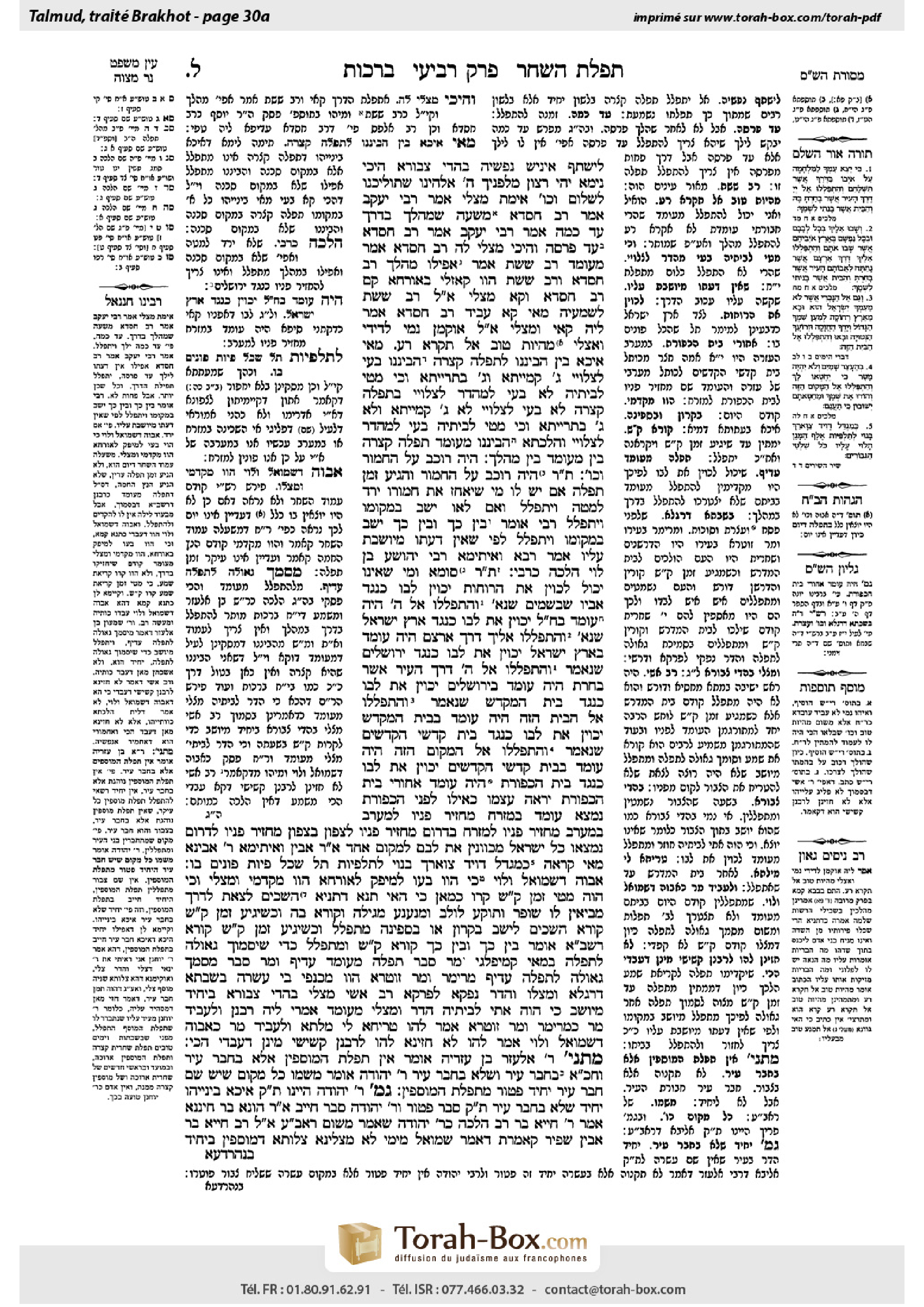
Berakhot 30a: Talmud study for Daf Yomi
Study the Talmud for Daf Yomi with scanned pages, Hebrew text, English translations from Sefaria and AI-generated French translations.
Passage selection and English or AI-generated French translation are available where the scan has annotations. Daf Study is independent of Torah-Box and Sefaria.
Browse Berakhot · ברכות · All tractatesBerakhot 30a text and translations
This page of Berakhot includes the Aramaic text, an English translation and an AI-generated French translation, alongside the scan above.
ברכות ל׳ א · Aramaic and Hebrew text
לִישַׁתֵּף אִינָשׁ נַפְשֵׁיהּ בַּהֲדֵי צִבּוּרָא. הֵיכִי נֵימָא? — ״יְהִי רָצוֹן מִלְּפָנֶיךָ ה׳ אֱלֹהֵינוּ שֶׁתּוֹלִיכֵנוּ לְשָׁלוֹם״ וְכוּ׳.
אִימַּת מְצַלֵּי? אָמַר רַבִּי יַעֲקֹב אָמַר רַב חִסְדָּא: מִשָּׁעָה שֶׁמְּהַלֵּךְ בַּדֶּרֶךְ. עַד כַּמָּה? אָמַר רַבִּי יַעֲקֹב אָמַר רַב חִסְדָּא: עַד פַּרְסָה. וְהֵיכִי מְצַלֵּי לַהּ? רַב חִסְדָּא אָמַר: מְעוּמָּד. רַב שֵׁשֶׁת אָמַר: אֲפִילּוּ מְהַלֵּךְ.
רַב חִסְדָּא וְרַב שֵׁשֶׁת הֲווֹ קָאָזְלִי בְּאוֹרְחָא, קָם רַב חִסְדָּא וְקָא מְצַלֵּי. אָמַר לֵיהּ רַב שֵׁשֶׁת לְשַׁמָּעֵיהּ: מַאי קָא עָבֵיד רַב חִסְדָּא? אָמַר לֵיהּ קָאֵי וּמְצַלֵּי. אָמַר לֵיהּ: אוֹקְמַן נָמֵי לְדִידִי וַאֲצַלֵּי, ״מֵהֱיוֹת טוֹב אַל תִּקָּרֵא רַע״.
מַאי אִיכָּא בֵּין ״הֲבִינֵנוּ״ לִתְפִלָּה קְצָרָה? ״הֲבִינֵנוּ״ בָּעֵי לְצַלּוֹיֵי שָׁלֹשׁ קַמָּיָיתָא וְשָׁלֹשׁ בָּתְרָיָיתָא, וְכִי מָטֵי לְבֵיתֵיהּ לָא בָּעֵי לְמֶהְדַּר לְצַלּוֹיֵי, בִּתְפִלָּה קְצָרָה, לָא בָּעֵי לְצַלּוֹיֵי לָא שָׁלֹשׁ קַמָּיָיתָא וְלָא שָׁלֹשׁ בָּתְרָיָיתָא, וְכִי מָטֵי לְבֵיתֵיהּ בָּעֵי לְמֶהְדַּר לְצַלּוֹיֵי.
וְהִלְכְתָא: ״הֲבִינֵנוּ״, מְעוּמָּד, תְּפִלָּה קְצָרָה, בֵּין מְעוּמָּד בֵּין מְהַלֵּךְ.
הָיָה רוֹכֵב עַל הַחֲמוֹר וְכוּ׳. תָּנוּ רַבָּנַן: הָיָה רוֹכֵב עַל הַחֲמוֹר וְהִגִּיעַ זְמַן תְּפִלָּה, אִם יֵשׁ לוֹ מִי שֶׁיֹּאחַז אֶת חֲמוֹרוֹ — יֵרֵד לְמַטָּה וְיִתְפַּלֵּל, וְאִם לָאו — יֵשֵׁב בִּמְקוֹמוֹ וְיִתְפַּלֵּל. רַבִּי אוֹמֵר: בֵּין כָּךְ וּבֵין כָּךְ יֵשֵׁב בִּמְקוֹמוֹ וְיִתְפַּלֵּל, לְפִי שֶׁאֵין דַּעְתּוֹ מְיוּשֶּׁבֶת עָלָיו.
אָמַר רָבָא, וְאִיתֵּימָא רַבִּי יְהוֹשֻׁעַ בֶּן לֵוִי: הֲלָכָה כְּרַבִּי.
תָּנוּ רַבָּנַן: סוֹמֵא וּמִי שֶׁאֵינוֹ יָכוֹל לְכַוֵּין אֶת הָרוּחוֹת — יְכַוֵּין לִבּוֹ כְּנֶגֶד אָבִיו שֶׁבַּשָּׁמַיִם, שֶׁנֶּאֱמַר: ״וְהִתְפַּלְלוּ אֶל ה׳״.
הָיָה עוֹמֵד בְּחוּץ לָאָרֶץ — יְכַוֵּין אֶת לִבּוֹ כְּנֶגֶד אֶרֶץ יִשְׂרָאֵל, שֶׁנֶּאֱמַר: ״וְהִתְפַּלְלוּ אֵלֶיךָ דֶּרֶךְ אַרְצָם״. הָיָה עוֹמֵד בְּאֶרֶץ יִשְׂרָאֵל — יְכַוֵּין אֶת לִבּוֹ כְּנֶגֶד יְרוּשָׁלַיִם, שֶׁנֶּאֱמַר: ״וְהִתְפַּלְלוּ אֶל ה׳ דֶּרֶךְ הָעִיר אֲשֶׁר בָּחַרְתָּ״. הָיָה עוֹמֵד בִּירוּשָׁלַיִם — יְכַוֵּין אֶת לִבּוֹ כְּנֶגֶד בֵּית הַמִּקְדָּשׁ, שֶׁנֶּאֱמַר: ״וְהִתְפַּלְלוּ אֶל הַבַּיִת הַזֶּה״. הָיָה עוֹמֵד בְּבֵית הַמִּקְדָּשׁ — יְכַוֵּין אֶת לִבּוֹ כְּנֶגֶד בֵּית קׇדְשֵׁי הַקֳּדָשִׁים, שֶׁנֶּאֱמַר: ״וְהִתְפַּלְלוּ אֶל הַמָּקוֹם הַזֶּה״. הָיָה עוֹמֵד בְּבֵית קׇדְשֵׁי הַקֳּדָשִׁים — יְכַוֵּין אֶת לִבּוֹ כְּנֶגֶד בֵּית הַכַּפּוֹרֶת. הָיָה עוֹמֵד אֲחוֹרֵי בֵּית הַכַּפּוֹרֶת — יִרְאֶה עַצְמוֹ כְּאִילּוּ לִפְנֵי הַכַּפּוֹרֶת. נִמְצָא עוֹמֵד בַּמִּזְרָח מַחֲזִיר פָּנָיו לַמַּעֲרָב. בַּמַּעֲרָב מַחֲזִיר פָּנָיו לַמִּזְרָח. בַּדָּרוֹם — מַחֲזִיר פָּנָיו לַצָּפוֹן. בַּצָּפוֹן — מַחֲזִיר פָּנָיו לַדָּרוֹם. נִמְצְאוּ כׇּל יִשְׂרָאֵל מְכַוְּונִין אֶת לִבָּם לְמָקוֹם אֶחָד.
אָמַר רַבִּי אָבִין, וְאִיתֵּימָא רַבִּי אֲבִינָא: מַאי קְרָאָה — ״כְּמִגְדַּל דָּוִיד צַוָּארֵךְ בָּנוּי לְתַלְפִּיּוֹת״ — תֵּל שֶׁכָּל פִּיּוֹת פּוֹנִים בּוֹ.
אֲבוּהּ דִּשְׁמוּאֵל וְלֵוִי, כִּי הֲווֹ בָּעוּ לְמִיפַּק לְאוֹרְחָא, הֲווֹ מְקַדְּמִי וּמְצַלִּי, וְכִי הֲוָה מָטֵי זְמַן קְרִיאַת שְׁמַע קָרוּ.
כְּמַאן — כִּי הַאי תַּנָּא. דְּתַנְיָא: הִשְׁכִּים לָצֵאת לַדֶּרֶךְ, מְבִיאִין לוֹ שׁוֹפָר וְתוֹקֵעַ, לוּלָב וּמְנַעְנֵעַ, מְגִילָּה וְקוֹרֵא בָּהּ, וּכְשֶׁיַּגִּיעַ זְמַן קְרִיאַת שְׁמַע — קוֹרֵא. הִשְׁכִּים לֵישֵׁב בַּקָּרוֹן אוֹ בִּסְפִינָה — מִתְפַּלֵּל, וּכְשֶׁיַּגִּיעַ זְמַן קְרִיאַת שְׁמַע — קוֹרֵא.
רַבִּי שִׁמְעוֹן בֶּן אֶלְעָזָר אוֹמֵר: בֵּין כָּךְ וּבֵין כָּךְ קוֹרֵא קְרִיאַת שְׁמַע וּמִתְפַּלֵּל, כְּדֵי שֶׁיִּסְמוֹךְ גְּאוּלָּה לִתְפִלָּה.
בְּמַאי קָמִיפַּלְגִי? מָר סָבַר תְּפִלָּה מְעוּמָּד עָדִיף, וּמָר סָבַר מִסְמָךְ גְּאוּלָּה לִתְפִלָּה עָדִיף.
מָרִימָר וּמָר זוּטְרָא הֲווֹ מְכַנְּפִי בֵּי עַשְׂרָה בְּשַׁבְּתָא דְרִגְלָא וּמְצַלּוּ, וַהֲדַר נָפְקִי לְפִרְקָא.
רַב אָשֵׁי מְצַלֵּי בַּהֲדֵי צִבּוּרָא בְּיָחִיד, מְיוּשָּׁב. כִּי הֲוָה אָתֵי לְבֵיתֵיהּ, הָדַר וּמְצַלֵּי מְעוּמָּד. אָמְרִי לֵיהּ רַבָּנַן: וְלַעֲבֵיד מָר כְּמָרִימָר וּמָר זוּטְרָא! אֲמַר לְהוּ: טְרִיחָא לִי מִלְּתָא. וְלַעֲבֵיד מָר כַּאֲבוּהּ דִּשְׁמוּאֵל וְלֵוִי! אֲמַר לְהוּ: לָא חֲזֵינָא לְהוּ לְרַבָּנַן קַשִּׁישֵׁי מִינַּן דְּעָבְדִי הָכִי.
מַתְנִי׳ רַבִּי אֶלְעָזָר בֶּן עֲזַרְיָה אוֹמֵר: אֵין תְּפִלַּת הַמּוּסָפִין אֶלָּא בְּחֶבֶר עִיר. וַחֲכָמִים אוֹמְרִים: בְּחֶבֶר עִיר וְשֶׁלֹּא בְּחֶבֶר עִיר. רַבִּי יְהוּדָה אוֹמֵר מִשְּׁמוֹ: כׇּל מָקוֹם שֶׁיֵּשׁ שָׁם חֶבֶר עִיר — יָחִיד פָּטוּר מִתְּפִלַּת הַמּוּסָפִין.
גְּמָ׳ רַבִּי יְהוּדָה הַיְינוּ תַּנָּא קַמָּא! אִיכָּא בֵּינַיְיהוּ יָחִיד שֶׁלֹּא בְּחֶבֶר עִיר, תַּנָּא קַמָּא סָבַר פָּטוּר. וְרַבִּי יְהוּדָה סָבַר חַיָּיב.
אָמַר רַב הוּנָא בַּר חִינָּנָא אָמַר רַב חִיָּיא בַּר רַב: הֲלָכָה כְּרַבִּי יְהוּדָה שֶׁאָמַר מִשּׁוּם רַבִּי אֶלְעָזָר בֶּן עֲזַרְיָה. אָמַר לֵיהּ רַב חִיָּיא בַּר אָבִין: שַׁפִּיר קָאָמְרַתְּ, דְּאָמַר שְׁמוּאֵל: מִימַי לָא מְצַלֵּינָא צְלוֹתָא דְמוּסָפִין בְּיָחִיד
Berakhot 30a · English translation
a person should associate himself with the congregation and should not pray for himself alone. How should he say it? May it be Your will, Lord our God, that You lead us to peace, etc., in the plural.
The Gemara discusses specific details pertaining to this prayer. When does one pray? Rabbi Ya’akov said that Rav Ḥisda said: From when one sets out on his journey, and not before. How long must one’s planned journey be in order to require him to recite this prayer (Ba’al Halakhot Gedolot)? Rabbi Ya’akov said that Rav Ḥisda said: At least a parasang. How does he recite this prayer? Rav Ḥisda said: Only while standing in one place. Rav Sheshet said: Even walking or sitting.
The Gemara relates: Rav Ḥisda and Rav Sheshet were walking along the path, Rav Ḥisda stood and recited the traveler’s prayer. Since he was blind and did not see his colleague, Rav Sheshet asked his servant: What is Rav Ḥisda doing now? His servant said to him: He is standing and praying. Rav Sheshet said to his servant: Stand me up as well and I will pray. Even though Rav Sheshet held that there is no need to stand during this prayer, nevertheless: From being good, do not be called wicked. In other words, one should do better if he is able. Rav Sheshet said that one is not required to stop and stand. He did not say that it is preferable to walk or sit. Since standing in this case required no special effort on his part, as Rav Ḥisda had stopped to stand and pray anyway, why insist on sitting?
The mishna mentioned both a brief prayer recited in times of danger and an abridged prayer, with regard to which there was a dispute between the tanna’im. The Gemara asks: What is the practical halakhic difference between the abridged prayer: Grant us understanding and the brief prayer recited in times of danger? The Gemara answers: One who recites: Grant us understanding is required to recite the first three blessings and the last three blessings of the Amida prayer, and when he reaches his home, he need not pray again. One who recites the brief prayer, however, need recite neither the first three blessings nor the last three blessings of the Amida prayer. However, when he reaches his home, he must pray again. Grant us understanding has the legal status of the Amida prayer, despite its brevity, while the brief prayer is merely recited in place of the Amida prayer in exigent circumstances.
The halakha is: Grant us understanding, as mentioned above, has the legal status of the Amida prayer, and must therefore be recited while standing. The brief prayer, since it does not have that status, may be recited whether one is standing or whether one is walking.
We learned in the mishna: One who was riding on a donkey should dismount and pray. Only in exigent circumstances may he pray while riding, focusing his heart toward Jerusalem and the Holy of Holies. The Sages taught in a Tosefta: One who was riding on a donkey and the time for prayer arrived, if he has someone to hold onto the donkey, he should dismount and pray. If not, he should sit in his place atop the donkey and pray. Rabbi Yehuda HaNasi says: In any case, whether or not there is someone to hold onto the donkey, he should sit in his place atop the donkey and pray, as his mind will not be calm. Since he is hurrying to arrive at his destination, the need to dismount the donkey, stand in prayer, and remount the donkey would delay his journey, and the delay is likely to interfere with his concentration during prayer.
Rava, and some say Rabbi Yehoshua ben Levi, said: The halakha here is in accordance with the opinion of Rabbi Yehuda HaNasi.
The Sages taught in a Tosefta: A blind person and one who is unable to approximate the directions and, therefore, is unable to face Jerusalem in order to pray, may focus his heart towards his Father in Heaven, as it is stated: “And they shall pray to the Lord” (I Kings 8:44).
One who was standing in prayer in the Diaspora should focus his heart toward Eretz Yisrael, as it is stated: “And they shall pray to You by way of their land which You have given to their fathers” (I Kings 8:48).
One who was standing in Eretz Yisrael should focus his heart toward Jerusalem, as it is stated: “And they shall pray to the Lord by way of the city that You have chosen” (I Kings 8:44).
One who was standing in Jerusalem should focus his heart toward the Temple, as it is stated: “And they shall pray toward this house” (II Chronicles 6:32).
One who was standing in the Temple should focus his heart toward the Holy of Holies, as it is stated: “And they shall pray toward this place” (I Kings 8:35).
One who was standing in the Holy of Holies should focus his heart toward the seat of the ark-cover [kapporet], atop the ark, the dwelling place of God’s glory.
One who was standing behind the seat of the ark-cover should visualize himself as if standing before the ark-cover and turn toward it.
Consequently, one standing in prayer in the East turns to face west, and one standing in the West turns to face east. One standing in the South turns to face north, and one standing in the North turns to face south; Consequently, all of the people of Israel focus themselves focusing their hearts toward one place, the Holy of Holies in the Temple.
An allusion to this is found in what Rabbi Avin, and some say Rabbi Avina, said: What verse alludes to this? “Your neck is like the Tower of David, built with turrets [talpiyyot], one thousand shields hang from it, all of the armor of the mighty” (Song of Songs 4:4). He interprets the word talpiyyot as the hill [tel] toward which all mouths [piyyot] turn, i.e., the Temple Mount.
With regard to prayer while traveling, the Gemara relates: When Shmuel’s father and Levi wanted to set out on a journey in the morning, they would pray early before sunrise. When, during their journey, the time to recite Shema would arrive, they recited it.
The Gemara asks: In accordance with whose opinion did they do this? In accordance with this tanna, as it was taught in the Tosefta: One who rose early to set out on his path before the time to recite Shema arrives, they bring him a shofar and he sounds it, if it was Rosh HaShana; a lulav and he takes it on Sukkot; a megilla, the Scroll of Esther, and he reads it on Purim; and when the time comes to recite Shema, he recites it. So too, one who rose early to sit in a wagon or in a boat prays, and when the time comes to recite Shema, he recites it.
Rabbi Shimon ben Elazar, says: In either case, it is preferable to recite Shema and then pray the Amida prayer in the wagon so that he will juxtapose redemption and prayer.
The Gemara explains: Regarding what do they disagree? The Gemara answers: This Sage, the first tanna, holds that prayer while standing is preferable. Therefore, one should pray earlier, at home, while standing. This Sage, Rabbi Shimon ben Elazar, holds that the juxtaposition of redemption and prayer is preferable, even if in doing so one is unable to stand while praying.
On a similar note, the Gemara cites additional circumstances where Sages were forced to make exceptional arrangements to pray. Mareimar and Mar Zutra would gather ten people on the Shabbat of the festival and pray, and set out to deliver their lecture [pirka]. Due to the crowds that gathered to hear the lectures of the Sages on the festival, they were unable to pray at the proper time, so they were forced to pray earlier.
In similar circumstances, Rav Ashi would pray with the congregation individually while seated, so that they would not notice that he was praying. Afterwards, when he would come to his house, he would pray again while standing in order to pray without distraction. The Sages said to him: The Master should do as Mareimar and Mar Zutra do, i.e., gather a prayer quorum at home to pray before the lecture. He said to them: It is burdensome to me to delay the lecture so much. The Sages said to him: The Master should do as Shmuel’s father and Levi did and pray before sunrise. He said to them: I have not seen Sages older than us do that, indicating that this is not the accepted halakha.
MISHNA: Rabbi Elazar ben Azarya says: The additional prayer is only recited in a city where there is a quorum of ten [ḥever ir]. The Rabbis say: One may recite the additional prayer with a ḥever ir or without a ḥever ir. Rabbi Yehuda says another opinion in his name, the name of Rabbi Elazar ben Azarya: Any place where there is a ḥever ir, an individual is completely exempt from reciting the additional prayer.
GEMARA: There is no apparent difference between the opinion of Rabbi Elazar ben Azarya and the opinion cited in his name by Rabbi Yehuda. The Gemara asks: Rabbi Yehuda’s opinion is identical to the opinion of Rabbi Elazar ben Azarya cited by the first tanna. The Gemara answers: There is a practical halakhic difference between them: The case of an individual who is not in a place where there is a ḥever ir. In other words, in a place where there is not a prayer quorum of ten people, the first tanna holds that Rabbi Elazar ben Azarya’s opinion is that the individual is exempt from reciting the additional prayer, as it was only instituted to be recited with a quorum. And Rabbi Yehuda holds that Rabbi Elazar ben Azarya’s opinion is that the individual is obligated to recite the additional prayer, as he is only exempt in a place where there is a prayer quorum, and, therefore, a communal prayer leader fulfills his obligation.
Rav Huna bar Ḥinnana said that Ḥiyya bar Rav said: The halakha is in accordance with the opinion of Rabbi Yehuda, who said it in the name of his mentor, Rabbi Elazar ben Azarya. Rav Ḥiyya bar Avin said to him: You have spoken well, as proven by what Shmuel said: In all my days I have never prayed the additional prayer as an individual
Berakhot 30a · Traduction française (IA)
Une personne devrait s'associer à la communauté et ne pas prier seul. Comment doit-il le dire ? Que ton vœu soit, Seigneur notre Dieu, que tu nous conduises à la paix, etc., au pluriel.
La Guemara discute des détails spécifiques concernant cette prière. Quand prie-t-on ? Rabbi Ya’akov a dit que Rav Ḥisda a dit : À partir du moment où l'on commence son voyage, et non avant. Combien doit être le voyage planifié pour que l'on doive réciter cette prière (Ba’al Halakhot Gedolot) ? Rabbi Ya’akov a dit que Rav Ḥisda a dit : Au moins un parasang. Comment doit-on réciter cette prière ? Rav Ḥisda a dit : Seulement en restant debout à un seul endroit. Rav Sheshet a dit : Même en marchant ou en étant assis.
La Guemara rapporte : Rav Ḥisda et Rav Sheshet marchaient sur le chemin, Rav Ḥisda s'est arrêté et a récité la prière du voyageur. Puisqu'il était aveugle et n'avait pas vu son collègue, Rav Sheshet a demandé à son serviteur : Qu'est-ce que Rav Ḥisda fait maintenant ? Son serviteur lui a répondu : Il est debout et prie. Rav Sheshet a dit à son serviteur : Lève-moi et je prierai aussi. Même si Rav Sheshet pensait qu'il n'était pas nécessaire de se tenir debout pendant cette prière, néanmoins : De la bonté, ne sois pas appelé méchant. Autrement dit, on devrait faire mieux s'il est possible. Rav Sheshet a dit qu'on n'était pas tenu de s'arrêter et de se tenir debout. Il n'a pas dit que c'était préférable de marcher ou d'être assis. Puisqu'être debout dans ce cas ne nécessitait pas un effort spécial de sa part, comme Rav Ḥisda avait arrêté pour se tenir debout et prier, pourquoi insister sur l'assise ?
La mitsna mentionne à la fois une prière brève récitée en temps de danger et une prière abrégée, concernant laquelle il y avait un débat entre les tannaïm. La Guemara pose la question : Quelle est la différence halakhique pratique entre la prière abrégée : Donnez-nous la compréhension et la prière brève récitée en temps de danger ? La Guemara répond : Celui qui récite : Donnez-nous la compréhension doit réciter les trois premières bénédictions et les trois dernières bénédictions de la prière Amida, et lorsqu'il arrive à la maison, il n'a pas besoin de prier à nouveau. Celui qui récite la prière brève, en revanche, n'a pas besoin de réciter ni les trois premières bénédictions ni les trois dernières bénédictions de la prière Amida. Cependant, lorsqu'il arrive à la maison, il doit prier à nouveau. Donnez-nous la compréhension a le statut juridique de la prière Amida, malgré sa brièveté, tandis que la prière brève est simplement récitée à la place de la prière Amida en cas d'urgence.
La halakha est : Donnez-nous la compréhension, comme mentionné ci-dessus, a le statut juridique de la prière Amida, et doit donc être récitée debout. La prière brève, puisqu'elle n'a pas ce statut, peut être récitée qu'en se tenant debout ou en marchant.
Nous avons appris dans la mitsna : Celui qui était monté sur un âne devrait descendre et prier. Seul en cas d'urgence peut-il prier en montant, en orientant son cœur vers Jérusalem et le Saint des Saints. Les Sages ont enseigné dans une Tosefta : Celui qui était monté sur un âne et l'heure de la prière est arrivée, s'il a quelqu'un pour tenir l'âne, il devrait descendre et prier. S'il n'en a pas, il devrait s'asseoir à sa place sur l'âne et prier. Rabbi Yehuda HaNasi dit : Dans tous les cas, qu'il y ait ou non quelqu'un pour tenir l'âne, il devrait s'asseoir à sa place sur l'âne et prier, car son esprit ne sera pas calme. Puisqu'il est pressé d'arriver à sa destination, le besoin de descendre de l'âne, de se tenir debout pour prier et de remonter l'âne retarderait son voyage, et ce retard pourrait interférer avec sa concentration pendant la prière.
Rava, et certains disent Rabbi Yehoshua ben Levi, a dit : La halakha ici est selon l'opinion de Rabbi Yehuda HaNasi.
Les Sages ont enseigné dans une Tosefta : Un aveugle et celui qui ne peut pas déterminer les directions et, par conséquent, ne peut pas se tourner vers Jérusalem pour prier, peut orienter son cœur vers son Père dans le Ciel, car il est dit : « Et ils prieront à l'Éternel » (I Rois 8:44).
Celui qui priait debout en dehors de la Terre d'Israël devrait orienter son cœur vers la Terre d'Israël, car il est dit : « Et ils prieront à Toi par le biais de leur terre que Tu as donnée à leurs pères » (I Rois 8:48). Celui qui priait debout en Terre d'Israël devrait orienter son cœur vers Jérusalem, car il est dit : « Et ils prieront à l'Éternel par le biais de la ville que Tu as choisie » (I Rois 8:44). Celui qui priait debout à Jérusalem devrait orienter son cœur vers le Temple, car il est dit : « Et ils prieront vers cette maison » (II Chroniques 6:32). Celui qui priait debout dans le Temple devrait orienter son cœur vers le Saint des Saints, car il est dit : « Et ils prieront vers cette place » (I Rois 8:35). Celui qui priait debout dans le Saint des Saints devrait orienter son cœur vers le siège de la couverture de l'ark, au sommet de l'ark, le lieu de la gloire de Dieu. Celui qui priait debout derrière le siège de la couverture de l'ark devrait visualiser lui-même comme s'il était debout devant la couverture de l'ark et se tourner vers elle. Par conséquent, celui qui prie debout à l'Est se tourne vers l'Ouest, et celui qui prie debout à l'Ouest se tourne vers l'Est. Celui qui prie debout au Sud se tourne vers le Nord, et celui qui prie debout au Nord se tourne vers le Sud. Par conséquent, tous les Israélites orientent leur cœur vers un seul lieu, le Saint des Saints dans le Temple.
Une allusion à cela se trouve dans ce que Rabbi Avin, et certains disent Rabbi Avina, a dit : Quel verset allude à cela ? « Ton cou est comme la tour de David, construite avec des tours [talpiyyot], mille boucliers pendent de lui, toutes les armures des puissants » (Chant des Chants 4:4). Il interprète le mot talpiyyot comme la colline [tel] vers laquelle tous les bouches [piyyot] se tournent, c'est-à-dire le Mont du Temple.
Concernant la prière en voyage, la Guemara rapporte : Lorsque le père de Shmuel et Levi voulaient partir en voyage le matin, ils priaient tôt avant l'aube. Lors de leur voyage, lorsqu'il était l'heure de réciter le Chéma, ils le récitaient.
La Guemara pose la question : Selon l'opinion de quel tanna ont-ils agi ? Selon celui-ci, comme il est enseigné dans la Tosefta : Celui qui se lève tôt pour partir avant que le temps de réciter le Chéma ne soit arrivé, on lui apporte un cor et il le sonne, si c'était le Rosh HaShana ; un lulav et il le prend pendant la fête des Tabernacles ; un megilla, le livre d'Esther, et il le lit pendant la fête de Purim ; et lorsqu'il est temps de réciter le Chéma, il le récite. De même, celui qui se lève tôt pour s'installer dans un chariot ou dans une barque prie, et lorsqu'il est temps de réciter le Chéma, il le récite.
Rabbi Shimon ben Elazar dit : Dans tous les cas, il est préférable de réciter le Chéma et ensuite de prier la prière de l'Amida dans le chariot, afin de juxtaposer la rédemption et la prière.
La Guemara explique : À propos de quoi discutent-ils ? La Guemara répond : Ce sage, le premier tanna, considère que la prière debout est préférable. Par conséquent, on devrait prier plus tôt, à la maison, debout. Ce sage, Rabbi Shimon ben Elazar, considère que la juxtaposition de la rédemption et de la prière est préférable, même si cela implique de ne pas pouvoir prier debout.
Sur un point similaire, la Guemara cite d'autres circonstances où les Sages ont été contraints de faire des arrangements exceptionnels pour prier. Mareimar et Mar Zutra réunissaient dix personnes le sabbat de la fête et priaient, puis partaient donner leur lecture [pirka]. En raison des foules qui se rassemblaient pour écouter les lectures des Sages pendant la fête, ils n'ont pu prier à l'heure appropriée, et ont été contraints de prier plus tôt.
Dans des circonstances similaires, Rav Ashi priait avec la communauté, assis, afin qu'ils ne remarquent pas qu'il priait. Plus tard, lorsqu'il arrivait chez lui, il priait à nouveau debout afin de prier sans distraction. Les Sages lui dirent : Le Maître devrait faire comme Mareimar et Mar Zutra, c'est-à-dire réunir une quinzaine de prière à la maison pour prier avant la lecture. Il leur dit : Cela me semble trop lourd de retarder la lecture autant. Les Sages lui dirent : Le Maître devrait faire comme Shmuel père et Levi ont fait, prier avant l'aube. Il leur dit : Je n'ai pas vu de Sages plus âgés que nous faire cela, ce qui indique que cela n'est pas la halakha acceptée.
MICHNA : Rabbi Elazar ben Azarya dit : La prière supplémentaire est uniquement récitée dans une ville où il y a une quinzaine [ḥever ir]. Les Rabbins disent : On peut réciter la prière supplémentaire avec une quinzaine ou sans quinzaine. Rabbi Yehuda dit une autre opinion en son nom, le nom de Rabbi Elazar ben Azarya : Tout lieu où il y a une quinzaine, un individu est entièrement exempt de réciter la prière supplémentaire.
GUEMARA : Il n'y a pas de différence apparente entre l'opinion de Rabbi Elazar ben Azarya et l'opinion citée en son nom par Rabbi Yehuda. La Guemara pose la question : L'opinion de Rabbi Yehuda est identique à l'opinion de Rabbi Elazar ben Azarya citée par le premier tanna. La Guemara répond : Il y a une différence halakhique pratique entre eux : Le cas d'un individu qui n'est pas dans un lieu où il y a un ḥever ir. En d'autres termes, dans un lieu où il n'y a pas un quorum de dix personnes, le premier tanna considère que l'opinion de Rabbi Elazar ben Azarya est que l'individu est exempt de réciter la prière supplémentaire, car elle a été instituée pour être récitée avec un quorum. Et Rabbi Yehuda considère que l'opinion de Rabbi Elazar ben Azarya est que l'individu est tenu de réciter la prière supplémentaire, car il est exempt uniquement dans un lieu où il y a un quorum, et donc un leader communautaire remplit son obligation.
Rav Huna bar Ḥinnana dit que Ḥiyya bar Rav dit : La halakha suit l'opinion de Rabbi Yehuda, qui l'a dit en nom de son maître, Rabbi Elazar ben Azarya. Rav Ḥiyya bar Avin lui dit : Tu as raison, comme le prouve ce que Shmuel a dit : Dans toute ma vie, je n'ai jamais prié la prière supplémentaire seul.
Traduction française générée par IA à partir de l’édition anglaise de Sefaria. Vérifie toujours un passage avec le texte source.
Text from Sefaria: William Davidson Edition - Vocalized Aramaic (CC BY NC); William Davidson Edition - English (CC BY NC).