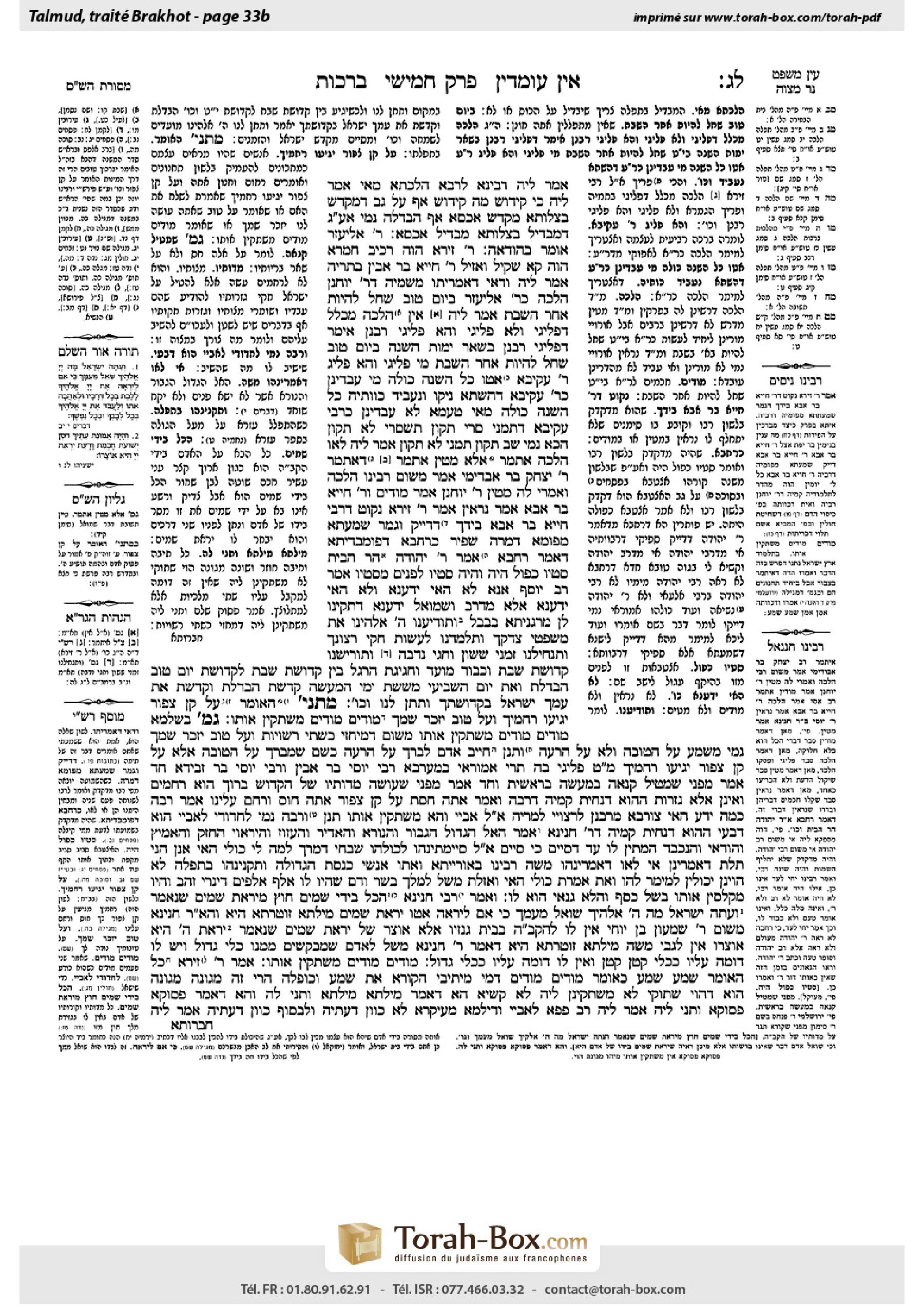
Berakhot 33b: Talmud study for Daf Yomi
Study the Talmud for Daf Yomi with scanned pages, Hebrew text, English translations from Sefaria and AI-generated French translations.
Passage selection and English or AI-generated French translation are available where the scan has annotations. Daf Study is independent of Torah-Box and Sefaria.
Browse Berakhot · ברכות · All tractatesBerakhot 33b text and translations
This page of Berakhot includes the Aramaic text, an English translation and an AI-generated French translation, alongside the scan above.
ברכות ל״ג ב · Aramaic and Hebrew text
אֲמַר לֵיהּ רָבִינָא לְרָבָא: הִלְכְתָא מַאי? אֲמַר לֵיהּ, כִּי קִידּוּשׁ: מָה קִידּוּשׁ אַף עַל גַּב דִּמְקַדֵּשׁ בִּצְלוֹתָא מְקַדֵּשׁ אַכָּסָא, אַף הַבְדָּלָה נָמֵי, אַף עַל גַּב דְּמַבְדֵּיל בִּצְלוֹתָא מַבְדֵּיל אַכָּסָא.
רַבִּי אֱלִיעֶזֶר אוֹמֵר: בְּ״הוֹדָאָה״.
רַבִּי זֵירָא הֲוָה רְכִיב חֲמָרָא, הֲוָה קָא שָׁקֵיל וְאָזֵיל רַבִּי חִיָּיא בַּר אָבִין בָּתְרֵיהּ. אֲמַר לֵיהּ: וַדַּאי דְּאָמְרִיתוּ מִשְּׁמֵיהּ דְּרַבִּי יוֹחָנָן, הֲלָכָה כְּרַבִּי אֱלִיעֶזֶר בְּיוֹם טוֹב שֶׁחָל לִהְיוֹת אַחַר הַשַּׁבָּת? אֲמַר לֵיהּ: אִין.
הֲלָכָה — מִכְלָל דִּפְלִיגִי?
וְלָא פְּלִיגִי? וְהָא פְּלִיגִי רַבָּנַן.
אֵימַר דִּפְלִיגִי רַבָּנַן בִּשְׁאָר יְמוֹת הַשָּׁנָה, בְּיוֹם טוֹב שֶׁחָל לִהְיוֹת אַחַר הַשַּׁבָּת מִי פְּלִיגִי?
וְהָא פְּלִיג רַבִּי עֲקִיבָא!
אַטּוּ כׇּל הַשָּׁנָה כּוּלָּהּ מִי עָבְדִינַן כְּרַבִּי עֲקִיבָא, דְּהַשְׁתָּא נֵיקוּ וְנַעֲבֵיד כְּווֹתֵיהּ?! כׇּל הַשָּׁנָה כּוּלָּהּ מַאי טַעְמָא לָא עָבְדִינַן כְּרַבִּי עֲקִיבָא — דְּתַמְנֵי סְרֵי תַּקּוּן, תְּשַׁסְרֵי לָא תַּקּוּן. הָכָא נָמֵי, שָׁב תַּקּוּן תַּמְנֵי לָא תַּקּוּן.
אֲמַר לֵיהּ: לָאו ״הֲלָכָה״ אִתְּמַר, אֶלָּא ״מַטִּין״ אִתְּמַר.
דְּאִתְּמַר, רַבִּי יִצְחָק בַּר אַבְדִּימִי אָמַר מִשּׁוּם רַבֵּנוּ: הֲלָכָה, וְאָמְרִי לַהּ: מַטִּין.
רַבִּי יוֹחָנָן אָמַר: מוֹדִים. וְרַבִּי חִיָּיא בַּר אַבָּא אָמַר: נִרְאִין.
אָמַר רַבִּי זֵירָא: נְקוֹט דְּרַבִּי חִיָּיא בַּר אַבָּא בִּידָךְ, דְּדָיֵיק וְגָמַר שְׁמַעְתָּא מִפּוּמָּא דְמָרַהּ שַׁפִּיר כְּרַחֲבָא דְפוּמְבְּדִיתָא.
דְּאָמַר רַחֲבָא אָמַר רַבִּי יְהוּדָה: הַר הַבַּיִת סְטָיו כָּפוּל הָיָה, וְהָיָה סְטָיו לְפָנִים מִסְּטָיו.
אָמַר רַב יוֹסֵף: אֲנָא לָא הַאי יָדַעְנָא וְלָא הַאי יָדַעְנָא, אֶלָּא מִדְּרַב וּשְׁמוּאֵל יָדַעְנָא, דְּתַקִּינוּ לַן מַרְגָּנִיתָא בְּבָבֶל.
״וַתּוֹדִיעֵנוּ ה׳ אֱלֹהֵינוּ אֶת מִשְׁפְּטֵי צִדְקֶךָ וַתְּלַמְּדֵנוּ לַעֲשׂוֹת חֻקֵּי רְצוֹנֶךָ, וַתַּנְחִילֵנוּ זְמַנֵּי שָׂשׂוֹן וְחַגֵּי נְדָבָה, וַתּוֹרִישֵׁנוּ קְדוּשַּׁת שַׁבָּת וּכְבוֹד מוֹעֵד וַחֲגִיגַת הָרֶגֶל. בֵּין קְדוּשַּׁת שַׁבָּת לִקְדוּשַּׁת יוֹם טוֹב הִבְדַּלְתָּ, וְאֶת יוֹם הַשְּׁבִיעִי מִשֵּׁשֶׁת יְמֵי הַמַּעֲשֶׂה קִדַּשְׁתָּ. הִבְדַּלְתָּ וְקִדַּשְׁתָּ אֶת עַמְּךָ יִשְׂרָאֵל בִּקְדוּשָּׁתֶךָ. וַתִּתֶּן לָנוּ וְכוּ׳״.
מַתְנִי׳ הָאוֹמֵר: ״עַל קַן צִיפּוֹר יַגִּיעוּ רַחֲמֶיךָ״, וְ״עַל טוֹב יִזָּכֵר שְׁמֶךָ״, ״מוֹדִים, מוֹדִים״ — מְשַׁתְּקִין אוֹתוֹ.
גְּמָ׳ בִּשְׁלָמָא, ״מוֹדִים, מוֹדִים״ מְשַׁתְּקִין אוֹתוֹ — מִשּׁוּם דְּמֶיחְזֵי כִּשְׁתֵּי רָשׁוּיוֹת. וְ״עַל טוֹב יִזָּכֵר שְׁמֶךָ״ נָמֵי, מַשְׁמַע עַל הַטּוֹבָה וְלֹא עַל הָרָעָה, וּתְנַן: חַיָּיב אָדָם לְבָרֵךְ עַל הָרָעָה כְּשֵׁם שֶׁמְּבָרֵךְ עַל הַטּוֹבָה. אֶלָּא ״עַל קַן צִפּוֹר יַגִּיעוּ רַחֲמֶיךָ״ מַאי טַעְמָא?
פְּלִיגִי בַּהּ תְּרֵי אָמוֹרָאֵי בְּמַעְרְבָא, רַבִּי יוֹסֵי בַּר אָבִין וְרַבִּי יוֹסֵי בַּר זְבִידָא: חַד אָמַר: מִפְּנֵי שֶׁמֵּטִיל קִנְאָה בְּמַעֲשֵׂה בְּרֵאשִׁית. וְחַד אָמַר: מִפְּנֵי שֶׁעוֹשֶׂה מִדּוֹתָיו שֶׁל הַקָּדוֹשׁ בָּרוּךְ הוּא רַחֲמִים, וְאֵינָן אֶלָּא גְּזֵרוֹת.
הַהוּא דִּנְחֵית קַמֵּיהּ דְּרַבָּה וַאֲמַר: אַתָּה חַסְתָּ עַל קַן צִפּוֹר, אַתָּה חוּס וְרַחֵם עָלֵינוּ. אֲמַר רַבָּה: כַּמָּה יָדַע הַאי צוּרְבָּא מֵרַבָּנָן לְרַצּוֹיֵי לְמָרֵיהּ! אֲמַר לֵיהּ אַבָּיֵי: וְהָא מְשַׁתְּקִין אוֹתוֹ תְּנַן!
וְרַבָּה נָמֵי, לְחַדּוֹדֵי אַבָּיֵי הוּא דְּבָעֵי.
הַהוּא דִּנְחֵית קַמֵּיהּ דְּרַבִּי חֲנִינָא, אֲמַר ״הָאֵל הַגָּדוֹל הַגִּבּוֹר וְהַנּוֹרָא וְהָאַדִּיר וְהָעִזּוּז וְהַיָּראוּי, הֶחָזָק וְהָאַמִּיץ וְהַוַּדַּאי וְהַנִּכְבָּד״.
הִמְתִּין לוֹ עַד דְּסַיֵּים. כִּי סַיֵּים אֲמַר לֵיהּ: סַיֵּימְתִּינְהוּ לְכוּלְּהוּ שִׁבְחֵי דְמָרָךְ?! לְמָה לִי כּוּלֵּי הַאי? אֲנַן, הָנֵי תְּלָת דְּאָמְרִינַן אִי לָאו דְּאַמְרִינְהוּ מֹשֶׁה רַבֵּנוּ בְּאוֹרָיְיתָא, וַאֲתוֹ אַנְשֵׁי כְּנֶסֶת הַגְּדוֹלָה וְתַקְּנִינְהוּ בִּתְפִלָּה — לָא הֲוֵינַן יְכוֹלִין לְמֵימַר לְהוּ, וְאַתְּ אָמְרַתְּ כּוּלֵּי הַאי וְאָזְלַתְּ! מָשָׁל לְמֶלֶךְ בָּשָׂר וָדָם שֶׁהָיוּ לוֹ אֶלֶף אֲלָפִים דִּינְרֵי זָהָב, וְהָיוּ מְקַלְּסִין אוֹתוֹ בְּשֶׁל כֶּסֶף. וַהֲלֹא גְּנַאי הוּא לוֹ!
וְאָמַר רַבִּי חֲנִינָא: הַכֹּל בִּידֵי שָׁמַיִם, חוּץ מִיִּרְאַת שָׁמַיִם. שֶׁנֶּאֱמַר: ״וְעַתָּה יִשְׂרָאֵל מָה ה׳ אֱלֹהֶיךָ שׁוֹאֵל מֵעִמָּךְ כִּי אִם לְיִרְאָה״.
אַטּוּ יִרְאַת שָׁמַיִם מִילְּתָא זוּטַרְתָּא הִיא? וְהָאָמַר רַבִּי חֲנִינָא מִשּׁוּם רַבִּי שִׁמְעוֹן בֶּן יוֹחַי: אֵין לוֹ לְהַקָּדוֹשׁ בָּרוּךְ הוּא בְּבֵית גְּנָזָיו אֶלָּא אוֹצָר שֶׁל יִרְאַת שָׁמַיִם, שֶׁנֶּאֱמַר ״יִרְאַת ה׳ הִיא אוֹצָרוֹ״.
אִין, לְגַבֵּי מֹשֶׁה מִילְּתָא זוּטַרְתָּא הִיא. דְּאָמַר רַבִּי חֲנִינָא: מָשָׁל לְאָדָם שֶׁמְבַקְּשִׁים מִמֶּנּוּ כְּלִי גָּדוֹל, וְיֵשׁ לוֹ — דּוֹמֶה עָלָיו כִּכְלִי קָטָן. קָטָן, וְאֵין לוֹ — דּוֹמֶה עָלָיו כִּכְלִי גָּדוֹל.
״מוֹדִים מוֹדִים״ מְשַׁתְּקִין אוֹתוֹ.
אָמַר רַבִּי זֵירָא: כׇּל הָאוֹמֵר ״שְׁמַע שְׁמַע״ — כְּאוֹמֵר ״מוֹדִים מוֹדִים״ דָּמֵי.
מֵיתִיבִי: הַקּוֹרֵא אֶת שְׁמַע וְכוֹפְלָהּ — הֲרֵי זֶה מְגוּנֶּה. מְגוּנֶּה הוּא דְּהָוֵי, שַׁתּוֹקֵי לָא מְשַׁתְּקִינַן לֵיהּ!
לָא קַשְׁיָא: הָא, דְּאָמַר מִילְּתָא מִילְּתָא וְתָנֵי לַהּ. וְהָא, דְּאָמַר פְּסוּקָא פְּסוּקָא וְתָנֵי לֵיהּ.
אֲמַר לֵיהּ רַב פָּפָּא לְאַבָּיֵי: וְדִילְמָא מֵעִיקָּרָא לָא כַּוֵּון דַּעְתֵּיהּ, וּלְבַסּוֹף כַּוֵּון דַּעְתֵּיהּ?
אֲמַר לֵיהּ:
Berakhot 33b · English translation
There are conflicting opinions with regard to reciting havdala over the cup of wine after reciting it in the Amida prayer. One opinion holds that it is appropriate to recite havdala a second time, while the other holds that it is prohibited. Ravina said to Rava: What is the halakha? Rava said to him: The halakha in the case of havdala is like the halakha in the case of kiddush. Just as in the case of kiddush, although one recited kiddush in the Amida prayer he must, nevertheless, recite kiddush again over the cup of wine, so too with havdala, although one recited havdala in the Amida prayer he must recite havdala again over the cup of wine.
The mishna states that Rabbi Eliezer says: It is recited in the seventeenth blessing of the Amida prayer, the blessing of thanksgiving.
The Gemara cites the conclusion with regard to this halakha by relating a story: Rabbi Zeira was riding a donkey while Rabbi Ḥiyya bar Avin was coming and walking after him. He said to him: Is it true that you said in the name of Rabbi Yoḥanan that the halakha is in accordance with the opinion of Rabbi Eliezer in the case of a Festival that occurs directly after Shabbat? Since in that case, one cannot recite havdala in the blessing of Who graciously grants knowledge, as it is not included in the Amida prayer on the Festival, there is no alternative but to adopt Rabbi Eliezer’s ruling. He said to him: Yes.
The Gemara wonders: Saying that the halakha is in accordance with the opinion of Rabbi Eliezer, indicates that his peers dispute his opinion. Where do we find that dispute?
The Gemara rejects this: And don’t they dispute his opinion? Don’t the Rabbis dispute his opinion, as, in their opinion the blessing of havdala is recited in the blessing: Who graciously grants knowledge?
The Gemara replies: Say that the Rabbis dispute Rabbi Eliezer’s opinion during the rest of the days of the year, when the option to recite havdala in the blessing: Who graciously grants knowledge exists, but in the case of a Festival that occurs directly after Shabbat, do they dispute his opinion? The Rabbis would agree with him in that case.
The Gemara continues: Doesn’t Rabbi Akiva dispute his opinion? He holds that havdala is recited as an independent fourth blessing, in which case there is a dispute.
The Gemara responds: Is that to say that throughout the entire year we act in accordance with the opinion of Rabbi Akiva in this matter, so that now, on a Festival that occurs directly after Shabbat, we will stand and act in accordance with his opinion? What is the reason that throughout the whole, entire year, we do not act in accordance with the opinion of Rabbi Akiva? Because the Sages instituted eighteen blessings, they did not institute nineteen blessings. Here, too, the Sages instituted seven blessings, they did not institute eight blessings. Therefore, Rabbi Akiva’s opinion is not taken into consideration in this case.
In response to these questions, Rabbi Zeira said to him that it was not that the halakha is in accordance with the opinion of Rabbi Eliezer that was stated in the name of Rabbi Yoḥanan, from which one could infer that there was in fact a dispute; rather it was that one is inclined to favor the opinion of Rabbi Eliezer that was stated in the name of Rabbi Yoḥanan.
As indeed it was stated that there is a dispute among the Sages in this matter. Rav Yitzḥak bar Avdimi said in the name of Rabbeinu, Rav: The halakha is in accordance with the opinion of Rabbi Eliezer. And some say this statement: One is inclined to favor the opinion of Rabbi Eliezer.
Rabbi Yoḥanan said that there is no dispute here, and the Rabbis agree with Rabbi Eliezer. And Rabbi Ḥiyya bar Abba said that it was established that Rabbi Eliezer’s opinion appears to be correct.
With regard to this difference of opinion Rabbi Zeira said: Take this statement of Rabbi Ḥiyya bar Abba in your hand, as he is scrupulous and he learned the halakha well from the mouth of its originator, like the Sage Raḥava from the city Pumbedita. Raḥava was famous for the precision with which he would transmit material that he learned from his teacher.
The Gemara cites an example: Raḥava said that Rabbi Yehuda said: The Temple Mount was a double stav, and there was a stav within a stav. Here Raḥava used his Rabbi’s language in describing the structure of the Temple and the rows of columns it contained, a row within a row; but he did not employ the common term itzteba, portico, but rather stav, as he heard it from his Rabbi.
Rav Yosef said the conclusive halakha on this topic: I don’t know this and I don’t know that, but I do know from the statements of Rav and Shmuel they have instituted a pearl for us in Babylonia. They established a version that combines the first blessing of the Festival with the formula of havdala, parallel to the opinion of the Rabbis who include havdala in the first blessing that follows the first three blessings. They instituted to recite:
You have made known to us, Lord our God, Your righteous laws,
and taught us to perform Your will’s decrees.
You have given us as our heritage seasons of joy and Festivals of voluntary offerings.
You have given us as our heritage the holiness of Shabbat, the glory of the festival and the festive offerings of the Pilgrim Festivals.
You have distinguished between the holiness of Shabbat and the holiness of the Festival,
and have made the seventh day holy over the six days of work.
You have distinguished and sanctified Your people Israel with Your holiness,
And You have given us, etc.
MISHNA: Concluding the laws of prayer in this tractate, the mishna raises several prayer-related matters. This mishna speaks of certain innovations in the prayer formula that warrant the silencing of a communal prayer leader who attempts to introduce them in his prayers, as their content tends toward heresy. One who recites in his supplication: Just as Your mercy is extended to a bird’s nest, as You have commanded us to send away the mother before taking her chicks or eggs (Deuteronomy 22:6–7), so too extend Your mercy to us; and one who recites: May Your name be mentioned with the good or one who recites: We give thanks, we give thanks twice, they silence him.
GEMARA: Our mishna cited three instances where the communal prayer leader is silenced. The Gemara clarifies: Granted, they silence one who repeats: We give thanks, we give thanks, as it appears like he is acknowledging and praying to two authorities. And granted that they also silence one who says: May Your name be mentioned with the good, as clearly he is thanking God only for the good and not for the bad, and we learned in a mishna: One is required to bless God for the bad just as he blesses Him for the good. However, in the case of one who recites: Just as Your mercy is extended to a bird’s nest, why do they silence him?
Two amora’im in Eretz Yisrael disputed this question; Rabbi Yosei bar Avin and Rabbi Yosei bar Zevida; one said that this was because he engenders jealousy among God’s creations, as it appears as though he is protesting the fact that the Lord favored one creature over all others. And one said that this was because he transforms the attributes of the Holy One, Blessed be He, into expressions of mercy, when they are nothing but decrees of the King that must be fulfilled without inquiring into the reasons behind them.
The Gemara relates that a particular individual descended before the ark as prayer leader in the presence of Rabba, and said in his prayers: You have shown mercy to the bird’s nest, now have mercy and pity upon us. Rabba said: How much does this Torah scholar know to appease the Lord, his Master. Abaye said to him: Didn’t we learn in a mishna that they silence him?
The Gemara explains: And Rabba too held in accordance with this mishna but merely acted this way because he wanted to hone Abaye’s intellect. Rabba did not make his statement to praise the scholar, but simply to test his nephew, Abaye, and to encourage him to articulate what he knows about that mishna.
With regard to additions to prayers formulated by the Sages, The Gemara relates that a particular individual descended before the ark as prayer leader in the presence of Rabbi Ḥanina. He extended his prayer and said: God, the great, mighty, awesome, powerful, mighty, awe-inspiring, strong, fearless, steadfast and honored.
Rabbi Ḥanina waited for him until he completed his prayer. When he finished, Rabbi Ḥanina asked him: Have you concluded all of the praises of your Master? Why do I need all of this superfluous praise? Even these three praises that we recite: The great, mighty and awesome, had Moses our teacher not said them in the Torah and had the members of the Great Assembly not come and incorporated them into the Amida prayer, we would not be permitted to recite them. And you went on and recited all of these. It is comparable to a king who possessed many thousands of golden dinars, yet they were praising him for silver ones. Isn’t that deprecatory? All of the praises we could possibly lavish upon the Lord are nothing but a few silver dinars relative to many thousands of gold dinars. Reciting a litany of praise does not enhance God’s honor.
Tangentially, the Gemara cites an additional statement by Rabbi Ḥanina concerning principles of faith. And Rabbi Ḥanina said: Everything is in the hands of Heaven, except for fear of Heaven. Man has free will to serve God or not, as it is stated: “And now Israel, what does the Lord your God ask of you other than to fear the Lord your God, to walk in all of His ways, to love Him and to serve the Lord your God with all your heart and with all your soul” (Deuteronomy 10:12). The Lord asks man to perform these matters because ultimately, the choice is in his hands.
The verse says: What does the Lord your God ask of you other than to fear the Lord your God. The Gemara asks: Is fear of Heaven a minor matter that it can be presented as if God is not asking anything significant? Didn’t Rabbi Ḥanina say in the name of Rabbi Shimon ben Yoḥai: The Holy One, Blessed be He, has nothing in his treasury other than a treasure of fear of Heaven, as it is stated: “Fear of the Lord is his treasure” (Isaiah 33:6). The Lord values and treasures fear of Heaven over all else.
The Gemara responds: Indeed, for Moses fear of Heaven is a minor matter. As Rabbi Ḥanina stated: It is comparable to one who is asked for a large vessel and he has one, it seems to him like a small vessel because he owns it. However, one who is asked for just a small vessel and he does not have one, it seems to him like a large vessel. Therefore, Moses could say: What does the Lord your God ask of you other than to fear, because in his eyes it was a minor matter.
We learned in the mishna if one repeats: We give thanks, we give thanks, they silence him.
Rabbi Zeira said: One who repeats himself while reciting Shema and says: Listen Israel, Listen Israel is like one who says: We give thanks, we give thanks.
The Gemara raises an objection: It was taught in a baraita: One who recites Shema and repeats it, it is reprehensible. One may infer: It is reprehensible, but they do not silence him.
The Gemara answers: This is not difficult; this case, where although it is reprehensible when one repeats Shema, they do not silence him, is referring to one who recites and repeats each individual word as he says it. In so doing he ruins the recitation of Shema. However, this case, where Rabbi Zeira holds that one who repeats Shema they silence him, refers to one who recites and repeats an entire verse, as it appears that he is worshiping separate authorities.
Rav Pappa said to Abaye with regard to this halakha: And perhaps initially he did not focus his attention on the recitation of Shema, so he repeated it and ultimately he focused his attention as he recited it the second time?
Abaye said to him:
Berakhot 33b · Traduction française (IA)
Il y a des opinions divergentes concernant la récitation de la séparation (havdala) sur le verre de vin après avoir prononcé la prière de l'Amida. L'une des opinions affirme qu'il est approprié de réciter à nouveau la séparation, tandis que l'autre affirme qu'il est interdit. Ravina dit à Rava : Quel est la halakha ? Rava lui répond : La halakha concernant la séparation est comme la halakha concernant le sanctification (kiddush). Comme, dans le cas du sanctification, même si l'on a prononcé le sanctification dans la prière de l'Amida, il faut néanmoins réciter à nouveau le sanctification sur le verre de vin, de même pour la séparation, même si l'on a prononcé la séparation dans la prière de l'Amida, il faut réciter à nouveau la séparation sur le verre de vin.
La mitsna affirme que Rabbi Eliezer dit : Elle est récitée dans la dix-septième bénédiction de la prière de l'Amida, la bénédiction de remerciement.
Le Guemara cite la conclusion concernant cette halakha en racontant une histoire : Rabbi Zeira montait un âne, tandis que Rabbi Ḥiyya bar Avin marchait derrière lui. Il lui dit : Est-ce vrai que vous avez dit en nom de Rabbi Yoḥanan que la halakha suit l'opinion de Rabbi Eliezer dans le cas d'un festival qui suit directement la Shabbat ? Puisque dans ce cas, on ne peut pas réciter la séparation dans la bénédiction : Celui qui accorde la connaissance, car elle n'est pas incluse dans la prière de l'Amida lors du festival, il n'y a pas d'autre choix que d'adopter la décision de Rabbi Eliezer. Il lui répondit : Oui.
Le Guemara se demande : Dire que la halakha suit l'opinion de Rabbi Eliezer indique que ses pairs contestent son opinion. Où trouvons-nous cette contestation ?
Le Guemara rejette cette idée : Et ne contestent-ils pas son opinion ? Ne contestent-ils pas les Rabbins son opinion, car, selon leur opinion, la bénédiction de séparation est récitée dans la bénédiction : Celui qui accorde la connaissance ?
Le Guemara répond : Dites que les Rabbins contestent l'opinion de Rabbi Eliezer durant les autres jours de l'année, lorsque l'option de réciter la séparation dans la bénédiction : Celui qui accorde la connaissance existe, mais dans le cas d'un festival qui suit directement la Shabbat, contestent-ils son opinion ? Les Rabbins accepteraient son opinion dans ce cas.
Le Guemara continue : Ne conteste-t-il pas son opinion, Rabbi Akiva ? Il considère que la séparation est récitée comme une quatrième bénédiction indépendante, dans ce cas il y a une contestation.
Le Guemara répond : Est-ce que cela signifie que tout au long de l'année nous agissons selon l'opinion de Rabbi Akiva dans ce cas, de sorte que maintenant, lors d'un festival qui suit directement la Shabbat, nous agirions selon son opinion ? Quel est le motif que tout au long de l'année nous ne suivons pas l'opinion de Rabbi Akiva ? Parce que les Sages ont institué dix-huit bénédictions, ils n'ont pas institué dix-neuf bénédictions. Ici aussi, les Sages ont institué sept bénédictions, ils n'ont pas institué huit bénédictions. Par conséquent, l'opinion de Rabbi Akiva n'est pas prise en compte dans ce cas.
En réponse à ces questions, Rabbi Zeira dit à lui que ce n'était pas que la halakha suit l'opinion de Rabbi Eliezer qui a été déclarée en nom de Rabbi Yoḥanan, d'où l'on pourrait en déduire qu'il y avait effectivement une contestation ; plutôt, c'était que l'on est enclin à favoriser l'opinion de Rabbi Eliezer qui a été déclarée en nom de Rabbi Yoḥanan.
En effet, il a été dit qu'il y a un désaccord parmi les Sages concernant cette question. Rav Yitzḥak bar Avdimi a dit en nom de Rabbeinu, Rav : La halakha suit l'opinion de Rabbi Eliezer. Et certains disent cette déclaration : On a tendance à favoriser l'opinion de Rabbi Eliezer.
Rabbi Yoḥanan a dit qu'il n'y a pas de désaccord ici, et les Rabbins sont d'accord avec Rabbi Eliezer. Et Rabbi Ḥiyya bar Abba a dit que cela a été établi que l'opinion de Rabbi Eliezer semble être la bonne.
Concernant cette différence d'opinion, Rabbi Zeira a dit : Prenez cette déclaration de Rabbi Ḥiyya bar Abba en main, car il est minutieux et il a appris la halakha directement de la bouche de son origineur, comme le Sage Raḥava de la ville de Pumbedita. Raḥava était célèbre pour la précision avec laquelle il transmettait les enseignements qu'il avait appris de son maître.
Le Guemara cite un exemple : Raḥava a dit que Rabbi Yehuda a dit : Le mont du Temple était une double stav, et il y avait une stav à l'intérieur d'une stav. Ici, Raḥava a utilisé la langue de son maître pour décrire la structure du Temple et les rangées de colonnes qu'il contenait, une rangée à l'intérieur d'une rangée ; mais il n'a pas employé le terme commun itzteba, portique, mais plutôt stav, car il l'avait entendu de son maître.
Rav Yosef a dit la halakha conclusive sur ce sujet : Je ne sais pas cela et je ne sais pas cela, mais je sais bien à partir des déclarations de Rav et de Shmuel qu'ils ont institué un joyau pour nous en Babylone. Ils ont établi une version qui combine la première bénédiction du festival avec la formule de havdala, parallèle à l'opinion des Rabbins qui incluent la séparation dans la première bénédiction qui suit les trois premières bénédictions. Ils ont institué de réciter :
Vous avez fait connaître à nous, Seigneur notre Dieu, Vos lois justes, Et vous avez enseigné à nous d'accomplir les décrets de Votre volonté. Vous avez donné à nous comme héritage des jours de joie et des festivals de sacrifices volontaires. Vous avez donné à nous comme héritage la sainteté du Shabbat, la gloire du festival et les offrandes festives des festivals de pèlerinage. Vous avez distingué entre la sainteté du Shabbat et la sainteté du festival, Et vous avez fait le septième jour saint par rapport aux six jours de travail. Vous avez distingué et sanctifié votre peuple d'Israël avec Votre sainteté, Et vous avez donné à nous, etc.
MICHNA: Terminant les lois de la prière dans ce traité, la Michna aborde plusieurs questions liées à la prière. Cette Michna parle de certaines innovations dans la formule de la prière qui justifient de faire taire un leader de prière communautaire qui tente de les introduire dans ses prières, car leur contenu tend vers l'hérésie. Celui qui récite dans sa supplication : Comme votre miséricorde s'étend à un nid d'oiseau, comme vous avez commandé de faire partir la mère avant de prendre ses petits ou ses œufs (Lévitique 22:6-7), ainsi étendez votre miséricorde sur nous ; et celui qui récite : Que votre nom soit mentionné avec le bien ou celui qui récite : Nous remercions, nous remercions deux fois, ils le font taire.
GUEMARA : Notre mishna cite trois cas où le leader de prière communautaire est fait taire. La Guemara clarifie : C'est certain, ils font taire celui qui répète : Nous remercions, nous remercions, car cela semble comme s'il reconnaissait et priait devant deux autorités. Et c'est certain qu'ils font également taire celui qui dit : Que votre nom soit mentionné avec le bien, car il est clair qu'il remercie Dieu uniquement pour le bien et non pour le mal, et nous avons appris dans une mishna : On doit bénir Dieu pour le mal aussi bien que pour le bien. Cependant, dans le cas de celui qui récite : Comme votre miséricorde s'étend à un nid d'oiseau, pourquoi les font-ils taire ?
Deux amoraïm en Terre d'Israël ont disputé cette question ; Rabbi Yosei bar Avin et Rabbi Yosei bar Zevida ; l'un disait que c'était parce qu'il suscitait la jalousie parmi les créations de Dieu, car cela semblait comme s'il protestait contre le fait que l'Éternel avait favorisé une créature par rapport à toutes les autres. Et l'autre disait que c'était parce qu'il transformait les attributs de l'Éternel, béni soit-il, en expressions de miséricorde, alors qu'ils ne sont que des décrets du Roi qui doivent être accomplis sans en chercher les raisons.
La Guemara rapporte qu'un individu particulier est descendu devant l'arche en tant que chef des prières en présence de Rabba, et a dit dans ses prières : Vous avez montré de la miséricorde au nid d'oiseau, maintenant montrez-nous de la miséricorde et de la pitié. Rabba a dit : Combien ce savant connaît-il pour apaiser l'Éternel, son Maître. Abaye a dit à lui : N'avons-nous pas appris dans une mishna que l'on fait taire celui-ci ?
La Guemara explique : Et Rabba aussi suivait cette mishna, mais il agissait ainsi simplement pour affiner l'intelligence d'Abaye. Rabba n'a pas fait cette déclaration pour louer le savant, mais simplement pour tester son neveu, Abaye, et l'encourager à exprimer ce qu'il savait à propos de cette mishna.
Concernant les additions aux prières formulées par les Sages, la Guemara rapporte qu'un individu particulier est descendu devant l'arche en tant que chef des prières en présence de Rabbi Ḥanina. Il a prolongé sa prière et a dit : Éternel, le Grand, le Puissant, l'Ineffable, le Puissant, l'Ineffable, le Fort, le Sans crainte, le Solide et le Digne de vénération.
Rabbi Ḥanina l'a attendu jusqu'à ce qu'il ait terminé sa prière. Lorsqu'il a fini, Rabbi Ḥanina lui a demandé : Avez-vous terminé toutes les louanges de votre Maître ? Pourquoi ai-je besoin de toutes ces louanges superflues ? Même ces trois louanges que nous récitons : Le grand, le puissant et l'effrayant, n'avions-nous pas besoin que Moïse notre maître les ait dites dans la Torah et que les membres de la Grande Assemblée les aient incorporées dans la prière Amida, nous ne serions pas autorisés à les réciter. Et vous avez récité toutes ces louanges. C'est comparable à un roi qui possédait des milliers de dinars d'or, et pourtant ils le louaient pour des dinars d'argent. N'est-ce pas dépréciatif ? Toutes les louanges que nous pouvons offrir à l'Éternel sont à peine quelques dinars d'argent par rapport à des milliers de dinars d'or. La récitation d'une litanie de louanges ne renforce pas le prestige de Dieu.
Par ailleurs, la Guemara cite une autre déclaration de Rabbi Ḥanina concernant les principes de foi. Et Rabbi Ḥanina a dit : Tout est entre les mains de l'Éternel, sauf la crainte de l'Éternel. L'homme a la liberté de servir l'Éternel ou non, comme il est dit : « Et maintenant, Israël, que demande l'Éternel votre Dieu de vous autre que de craindre l'Éternel votre Dieu, de marcher dans toutes ses voies, d'aimer Lui et de servir l'Éternel votre Dieu avec tout votre cœur et avec toute votre âme » (Deutéronome 10:12). L'Éternel demande à l'homme de faire ces choses, car finalement, le choix est entre ses mains.
Le verset dit : Que demande l'Éternel votre Dieu de vous autre que de craindre l'Éternel votre Dieu. La Guemara pose la question : La crainte de l'Éternel est-elle une chose mineure qu'on présente comme si l'Éternel ne demandait rien de significatif ? N'a-t-il pas dit Rabbi Ḥanina en nom de Rabbi Shimon ben Yoḥai : L'Éternel, béni soit Il, n'a rien dans son trésor autre qu'un trésor de crainte de l'Éternel, comme il est dit : « La crainte de l'Éternel est son trésor » (Yachout 33:6). L'Éternel valorise et tient en haute estime la crainte de l'Éternel par rapport à tout autre chose.
La Guemara répond : En effet, pour Moïse la crainte de l'Éternel est une chose mineure. Comme Rabbi Ḥanina a dit : C'est comparable à celui qui est demandé un grand vase et il en a un, cela lui semble comme un petit vase parce qu'il le possède. Cependant, celui qui est demandé juste un petit vase et il n'en a pas, cela lui semble comme un grand vase. Par conséquent, Moïse pouvait dire : Que demande l'Éternel votre Dieu de vous autre que de craindre, car pour lui cela était une chose mineure.
Nous avons appris dans la Michna que si l'on répète : Nous remercions, nous remercions, ils le font taire.
Rabbi Zeira a dit : Celui qui se répète pendant la récitation du Chéma et dit : Écoute Israël, Écoute Israël est comme celui qui dit : Nous remercions, nous remercions.
La Guemara soulève une objection : Il a été enseigné dans une baraïta : Celui qui récite le Chéma et le répète, c'est répréhensible. On peut en déduire : C'est répréhensible, mais ils ne le font pas taire.
La Guemara répond : Ce n'est pas difficile ; ce cas, où il est blâmable de répéter le Chéma, mais qu'on ne le fait pas taire, se réfère à celui qui récite et répète chaque mot individuel à mesure qu'il le dit. En faisant cela, il corrompt la récitation du Chéma. Cependant, ce cas, où Rabbi Zéira affirme que celui qui répète le Chéma doit être fait taire, se réfère à celui qui récite et répète une verset entier, car il semble ainsi vénérer des autorités distinctes.
Rav Pappa dit à Abaye concernant cette halakha : Et peut-être qu'initialement il n'avait pas concentré son attention sur la récitation du Chéma, donc il l'a répétée, et finalement il a concentré son attention lorsqu'il l'a récitée la deuxième fois ?
Abaye dit à lui :
Traduction française générée par IA à partir de l’édition anglaise de Sefaria. Vérifie toujours un passage avec le texte source.
Text from Sefaria: William Davidson Edition - Vocalized Aramaic (CC BY NC); William Davidson Edition - English (CC BY NC).