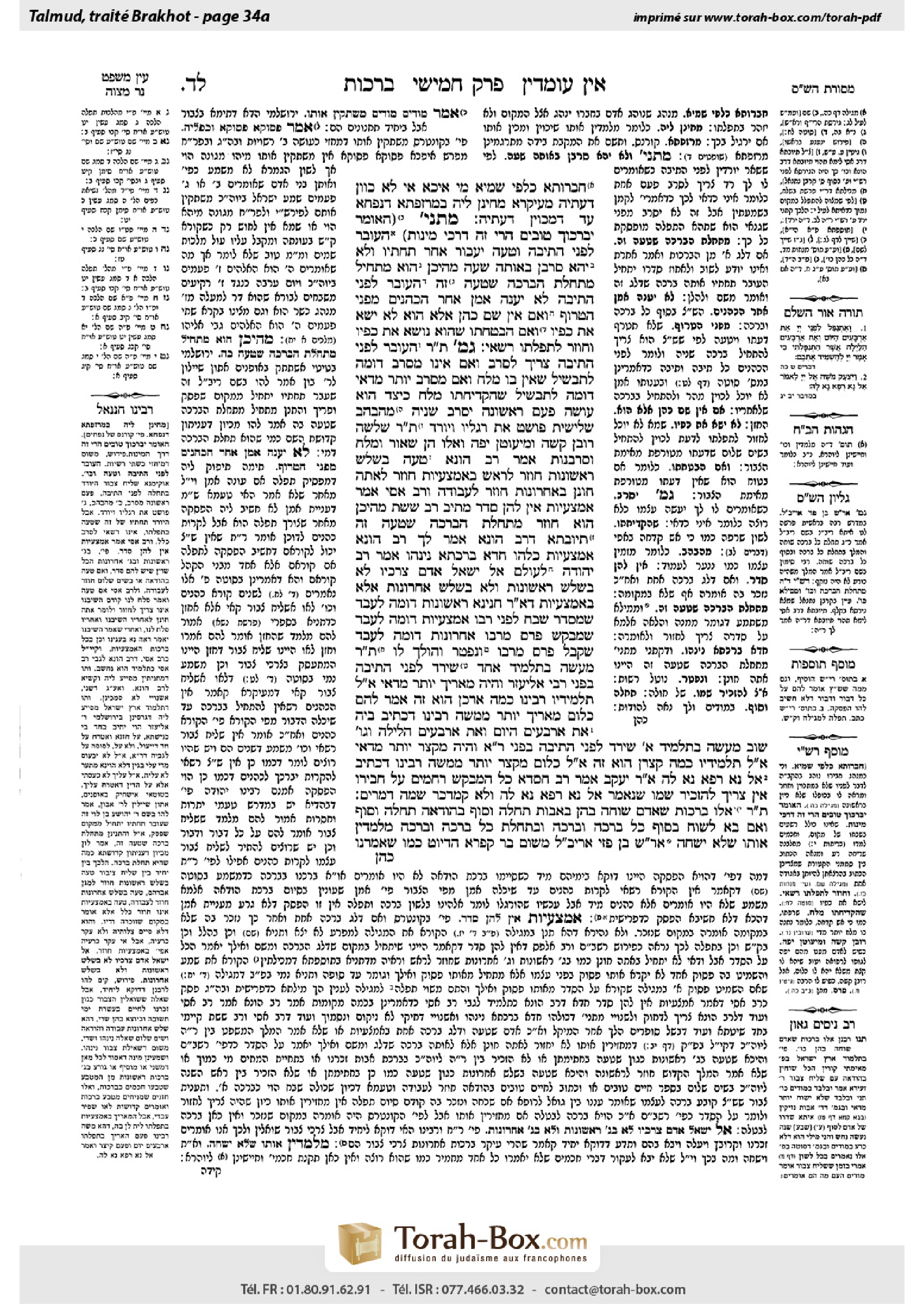
Berakhot 34a: Talmud study for Daf Yomi
Study the Talmud for Daf Yomi with scanned pages, Hebrew text, English translations from Sefaria and AI-generated French translations.
Passage selection and English or AI-generated French translation are available where the scan has annotations. Daf Study is independent of Torah-Box and Sefaria.
Browse Berakhot · ברכות · All tractatesBerakhot 34a text and translations
This page of Berakhot includes the Aramaic text, an English translation and an AI-generated French translation, alongside the scan above.
ברכות ל״ד א · Aramaic and Hebrew text
חַבְרוּתָא כְּלַפֵּי שְׁמַיָּא מִי אִיכָּא?! אִי לָא כַּוֵּון דַּעְתֵּיהּ מֵעִיקָּרָא — מָחֵינַן לֵיהּ בְּמַרְזַפְתָּא דְנַפָּחָא עַד דִּמְכַוֵּין דַּעְתֵּיהּ.
מַתְנִי׳ (הָאוֹמֵר: ״יְבָרְכוּךָ טוֹבִים״ — הֲרֵי זֶה דַּרְכֵי מִינוּת). הָעוֹבֵר לִפְנֵי הַתֵּיבָה וְטָעָה — יַעֲבוֹר אַחֵר תַּחְתָּיו, וְלֹא יְהֵא סָרְבָן בְּאוֹתָהּ שָׁעָה. מֵהֵיכָן הוּא מַתְחִיל? מִתְּחִלַּת הַבְּרָכָה שֶׁטָּעָה זֶה.
הָעוֹבֵר לִפְנֵי הַתֵּיבָה לֹא יַעֲנֶה ״אָמֵן״ אַחַר הַכֹּהֲנִים, מִפְּנֵי הַטֵּרוּף. וְאִם אֵין שָׁם כֹּהֵן אֶלָּא הוּא — לֹא יִשָּׂא אֶת כַּפָּיו. וְאִם הַבְטָחָתוֹ שֶׁהוּא נוֹשֵׂא אֶת כַּפָּיו, וְחוֹזֵר לִתְפִלָּתוֹ — רַשַּׁאי.
גְּמָ׳ תָּנוּ רַבָּנַן: הָעוֹבֵר לִפְנֵי הַתֵּיבָה — צָרִיךְ לְסָרֵב. וְאִם אֵינוֹ מְסָרֵב — דּוֹמֶה לְתַבְשִׁיל שֶׁאֵין בּוֹ מֶלַח. וְאִם מְסָרֵב יוֹתֵר מִדַּאי — דּוֹמֶה לְתַבְשִׁיל שֶׁהִקְדִּיחַתּוּ מֶלַח. כֵּיצַד הוּא עוֹשֶׂה: פַּעַם רִאשׁוֹנָה — יְסָרֵב, שְׁנִיָּה — מְהַבְהֵב, שְׁלִישִׁית — פּוֹשֵׁט אֶת רַגְלָיו וְיוֹרֵד.
תָּנוּ רַבָּנַן: שְׁלֹשָׁה רוּבָּן — קָשֶׁה, וּמִיעוּטָן — יָפֶה, וְאֵלּוּ הֵן: שְׂאוֹר, וּמֶלַח, וְסָרְבָנוּת.
אָמַר רַב הוּנָא: טָעָה בְּשָׁלֹשׁ רִאשׁוֹנוֹת — חוֹזֵר לָרֹאשׁ. בְּאֶמְצָעִיּוֹת — חוֹזֵר לְ״אַתָּה חוֹנֵן״. בְּאַחֲרוֹנוֹת — חוֹזֵר לָ״עֲבוֹדָה״.
וְרַב אַסִּי אָמַר: אֶמְצָעִיּוֹת אֵין לָהֶן סֵדֶר.
מֵתִיב רַב שֵׁשֶׁת: מֵהֵיכָן הוּא חוֹזֵר — מִתְּחִלַּת הַבְּרָכָה שֶׁטָּעָה זֶה. תְּיוּבְתָּא דְרַב הוּנָא.
אָמַר לְךָ רַב הוּנָא: אֶמְצָעִיּוֹת כּוּלְּהוּ חֲדָא בִּרְכְתָא נִינְהוּ.
אָמַר רַב יְהוּדָה: לְעוֹלָם אַל יִשְׁאַל אָדָם צְרָכָיו לֹא בְּשָׁלֹשׁ רִאשׁוֹנוֹת, וְלֹא בְּשָׁלֹשׁ אַחֲרוֹנוֹת, אֶלָּא בְּאֶמְצָעִיּוֹת. דְּאָמַר רַבִּי חֲנִינָא: רִאשׁוֹנוֹת — דּוֹמֶה לְעֶבֶד שֶׁמְּסַדֵּר שֶׁבַח לִפְנֵי רַבּוֹ. אֶמְצָעִיּוֹת — דּוֹמֶה לְעֶבֶד שֶׁמְבַקֵּשׁ פְּרָס מֵרַבּוֹ. אַחֲרוֹנוֹת — דּוֹמֶה לְעֶבֶד שֶׁקִּבֵּל פְּרָס מֵרַבּוֹ, וְנִפְטָר וְהוֹלֵךְ לוֹ.
תָּנוּ רַבָּנַן: מַעֲשֶׂה בְּתַלְמִיד אֶחָד שֶׁיָּרַד לִפְנֵי הַתֵּיבָה בִּפְנֵי רַבִּי אֱלִיעֶזֶר, וְהָיָה מַאֲרִיךְ יוֹתֵר מִדַּאי. אָמְרוּ לוֹ תַּלְמִידָיו: כַּמָּה אָרְכָן הוּא זֶה! אָמַר לָהֶם: כְּלוּם מַאֲרִיךְ יוֹתֵר מִמֹּשֶׁה רַבֵּינוּ, דִּכְתִיב בֵּיהּ: ״אֵת אַרְבָּעִים הַיּוֹם וְאֶת אַרְבָּעִים הַלַּיְלָה וְגוֹ׳״?!
שׁוּב מַעֲשֶׂה בְּתַלְמִיד אֶחָד שֶׁיָּרַד לִפְנֵי הַתֵּיבָה בִּפְנֵי רַבִּי אֱלִיעֶזֶר, וְהָיָה מְקַצֵּר יוֹתֵר מִדַּאי. אָמְרוּ לוֹ תַּלְמִידָיו: כַּמָּה קַצְרָן הוּא זֶה! אָמַר לָהֶם: כְּלוּם מְקַצֵּר יוֹתֵר מִמֹּשֶׁה רַבֵּינוּ, דִּכְתִיב: ״אֵל נָא רְפָא נָא לָהּ״.
אָמַר רַבִּי יַעֲקֹב אָמַר רַב חִסְדָּא: כׇּל הַמְבַקֵּשׁ רַחֲמִים עַל חֲבֵירוֹ — אֵין צָרִיךְ לְהַזְכִּיר שְׁמוֹ, שֶׁנֶּאֱמַר: ״אֵל נָא רְפָא נָא לָהּ״, וְלָא קָמַדְכַּר שְׁמַהּ דְּמִרְיָם.
תָּנוּ רַבָּנַן: אֵלּוּ בְּרָכוֹת שֶׁאָדָם שׁוֹחֶה בָּהֶן: בְּ״אָבוֹת״, תְּחִלָּה וָסוֹף. בַּ״הוֹדָאָה״, תְּחִלָּה וָסוֹף. וְאִם בָּא לָשׁוּחַ בְּסוֹף כׇּל בְּרָכָה וּבְרָכָה, וּבִתְחִלַּת כׇּל בְּרָכָה וּבְרָכָה — מְלַמְּדִין אוֹתוֹ שֶׁלֹּא יִשְׁחֶה.
אָמַר רַבִּי שִׁמְעוֹן בֶּן פַּזִּי אָמַר רַבִּי יְהוֹשֻׁעַ בֶּן לֵוִי מִשּׁוּם בַּר קַפָּרָא: הֶדְיוֹט, כְּמוֹ שֶׁאָמַרְנוּ.
Berakhot 34a · English translation
Can one have that degree of familiarity with Heaven, to the extent that he can take his words lightly and say them however he likes? If he did not focus his attention initially, we beat him with a blacksmith’s hammer until he focuses his attention, as conduct of that sort is unacceptable.
MISHNA: This mishna and the next one deal with the communal prayer leader. (If one says: “May the good bless You,” this is a path of heresy.) One who is passing before the ark, as prayer leader, and erred, another should immediately pass in his place, and at that moment, this replacement should not refuse in the interest of courtesy. The Amida prayer was interrupted and he should replace him as quickly as possible. From where does the replacement commence? From the beginning of the blessing in which the former had erred.
In order to prevent the prayer leader from erring in his prayer, it was said that one who passes before the ark should not respond amen after the blessing of the priests, because of potential confusion. Since the mishna is describing a situation in which he was praying without a prayer book, responding amen would interrupt the order of the prayer and potentially lead him to begin a different blessing. For this reason, even if there is no priest other than the communal prayer leader, he does not lift his hands to bless the people, lest he become confused. And, however, if he is certain that he can lift his hands and resume his prayer without becoming confused, he is permitted to recite the blessing.
GEMARA: The mishna teaches that one who replaces a communal prayer leader who erred in the middle of the Amida prayer should not refuse when approached. The Gemara cites the general halakha with regard to proper conduct when one is approached to serve as prayer leader. The Sages taught in a baraita: One who is approached to pass before the ark to serve as prayer leader, for the sake of propriety should refuse, to avoid creating the impression that he is too eager. And if he does not refuse, but jumps at the opportunity, he is like cooked food without salt, which is to say that he acts in bad taste. However, if he refuses too much this is similarly inappropriate, as he is like cooked food that was ruined by too much salt. So how should he act? The appropriate conduct when approached to serve as communal prayer leader is as follows: When approached the first time, one should refuse; the second time, one should vacillate like a wick that has just begun to catch a flame but is not yet burning; and the third time, he should stretch his legs and descend before the ark.
On this note, the Gemara cites that which the Sages taught in a baraita: There are three things that are harmful in excess but are beneficial when used sparingly. They are: Leavening in dough, salt in a cooked dish and refusal for the sake of propriety.
The mishna states that when one replaces the communal prayer leader, he commences from the beginning of the blessing in which the former had erred. However that is not universally true, as Rav Huna said: One who erred in any of the first three blessings he must return to the beginning of the Amida prayer because the first three blessing comprise a single entity. Likewise, if one erred in any of the thirteen middle blessings, he returns to the blessing of: You grace humanity, the first of the middle blessings. If one erred in any of the three final blessings, he must return to the blessing of Temple service, which is the first of the final blessings.
And Rav Asi disputes one aspect of Rav Huna’s opinion, as he said: The middle blessings have no set order. If one erred in any of them he may insert it at whatever point he becomes aware of his error.
Rav Sheshet raised an objection based on a baraita: From where does he commence repetition of the Amida prayer? He commences from the beginning of the blessing in which the former had erred. If so, this is a conclusive refutation of Rav Huna’s opinion, as Rav Huna said that if one erred in one of the middle blessings, he returns to the beginning of the middle blessings, not to the beginning of that particular blessing.
Rav Huna could have said to you: The middle blessings are all considered one blessing; commencing from the beginning of the blessing means returning to the beginning of the middle blessings.
Rav Yehuda said: There is an additional distinction between the various sections of the Amida prayer: One must never request his own needs in the first three or in the last three blessings; rather, he should do so in the middle blessings. As Rabbi Ḥanina said: During the first three blessings, he is like a servant who arranges praise before his master; during the middle blessings, he is like a servant who requests a reward from his master; during the final three blessings, one is like a servant who already received a reward from his master and is taking his leave and departing.
Continuing on the subject of prayer, the Sages taught: There was an incident where one student descended to serve as prayer leader before the ark in the presence of Rabbi Eliezer, and he was excessively prolonging his prayer. His students complained and said to him: How long-winded he is. He said to them: Is this student prolonging his prayer any more than Moses our teacher did? As about Moses it is written: “And I prostrated myself before the Lord for the forty days and forty nights that I prostrated myself” (Deuteronomy 9:25). There is no limit to the duration of a prayer.
There was again an incident where one student descended to serve as prayer leader before the ark in the presence of Rabbi Eliezer, and he was excessively abbreviating his prayer. His students protested and said to him: How brief is his prayer. He said to them: Is he abbreviating his prayer any more than Moses our teacher did? As it is written with regard to the prayer Moses recited imploring God to cure Miriam of her leprosy: “And Moses cried out to the Lord, saying: ‘Please, God, heal her, please’” (Numbers 12:13). This student’s prayer was certainly no briefer than the few words recited by Moses.
Having mentioned Moses’ prayer for Miriam, the Gemara cites what Rabbi Ya’akov said that Rav Ḥisda said: Anyone who requests mercy on behalf of another need not mention his name, as it is stated: “Please, God, heal her, please,” and he did not mention Miriam’s name.
The Sages taught in a Tosefta: These are the blessings in the Amida prayer in which a person bows: In the first blessing, the blessing of the Patriarchs, one bows at the beginning and the end; in the blessing of thanksgiving, one bows at the beginning and the end; and if one seeks to bow at the end of each and every blessing and at the beginning of each and every blessing, they teach him not to bow so as not to go beyond the ordinance instituted by the Sages.
Rabbi Shimon ben Pazi said that Rabbi Yehoshua ben Levi said in the name of the tanna bar Kappara: An ordinary person [hedyot], conducts himself as we said; he bows at the beginning and the end of the blessings of Patriarchs and thanksgiving and is admonished if he seeks to bow at the beginning and end of the other blessings.
Berakhot 34a · Traduction française (IA)
Peut-on avoir ce degré de familiarité avec le Ciel, au point de pouvoir prendre ses paroles à la légère et de les dire comme on veut ? Si l'on n'a pas concentré son attention au départ, on le frappe avec un marteau de forge jusqu'à ce qu'il concentre son attention, car un tel comportement est inacceptable.
MICHNA : Cette mishna et la suivante traitent de l'homme qui conduit la prière communautaire. (Si l'on dit : « Que le Bien te bénisse », c'est un chemin de hérésie.) Celui qui passe devant l'arche, en tant que leader de la prière, et s'est trompé, un autre devrait immédiatement prendre sa place, et à ce moment-là, ce remplaçant ne doit pas refuser par politesse. La prière Amida a été interrompue et il devrait le remplacer aussi rapidement que possible. De quelle manière commence-t-il la prière ? À partir du début de la bénédiction dans laquelle l'autre s'était trompé.
Afin d'éviter que le leader de la prière ne commette d'erreur dans sa prière, on a dit que celui qui passe devant l'arche ne devrait pas répondre « amen » après la bénédiction des prêtres, en raison du risque de confusion. Puisque la mishna décrit une situation où il priait sans livre de prière, répondre « amen » interromprait l'ordre de la prière et pourrait potentiellement le faire commencer une autre bénédiction. Pour cette raison, même s'il n'y a pas de prêtre autre que le leader de la prière, il ne lève pas les mains pour bénir le peuple, de peur de se tromper. Cependant, si l'on est certain qu'il peut lever les mains et reprendre sa prière sans se tromper, il est autorisé à réciter la bénédiction.
GUEMARA : La mishna enseigne que celui qui remplace un leader de prière communautaire qui s'est trompé au milieu de la prière Amida ne doit pas refuser quand on le lui propose. La Guemara cite la halakha générale concernant le comportement approprié lorsqu'on est approché pour servir de leader de prière. Les Sages ont enseigné dans une baraïta : Celui qui est approché pour passer devant l'arche afin de servir de leader de prière, pour la politesse, devrait refuser, afin d'éviter d'avoir l'air trop désireux. Et si l'on ne refuse pas, mais s'empresse de l'occasion, il est comme un plat sans sel, c'est-à-dire qu'il agit de mauvais goût. Cependant, si l'on refuse trop, cela est également inapproprié, car il est comme un plat ruiné par trop de sel. Alors, comment devrait-on agir ? Le comportement approprié lorsqu'on est approché pour servir de leader de prière communautaire est le suivant : Lorsqu'on est approché la première fois, on devrait refuser ; la deuxième fois, on devrait hésiter comme une mèche qui vient juste de commencer à brûler mais n'est pas encore en flammes ; et la troisième fois, on devrait étirer ses jambes et descendre devant l'arche.
Sur ce point, la Guemara cite ce que les Sages ont enseigné dans une baraïta : Il y a trois choses qui sont nuisibles en excès mais bénéfiques en usage modéré. Elles sont : le levain dans la pâte, le sel dans un plat cuit et le refus par politesse.
La mishna affirme que lorsqu'on remplace le leader de prière communautaire, on commence à partir du début de la bénédiction dans laquelle l'autre s'était trompé. Cependant cela n'est pas universellement vrai, car Rav Huna a dit : Celui qui s'est trompé dans l'une des trois premières bénédictions doit retourner au début de la prière Amida, car les trois premières bénédictions forment une seule entité. De même, si l'on s'est trompé dans l'une des treize bénédictions intermédiaires, on retourne à la bénédiction : Tu donnes la beauté à l'humanité, la première des bénédictions intermédiaires. Si l'on s'est trompé dans l'une des trois dernières bénédictions, il doit retourner à la bénédiction du service du Temple, qui est la première des bénédictions finales.
Et Rav Asi conteste un aspect de l'opinion de Rav Huna, car il a dit : Les bénédictions intermédiaires n'ont pas d'ordre fixe. Si l'on s'est trompé dans l'une d'entre elles, on peut l'insérer à n'importe quel moment où l'on devient conscient de son erreur.
Rav Sheshet a soulevé un objet basé sur une baraïta : D'où commence-t-on la répétition de la prière Amida ? On commence à partir du début de la bénédiction dans laquelle l'autre s'était trompé. Si c'est ainsi, cela constitue une réfutation concluante de l'opinion de Rav Huna, car Rav Huna a dit que si l'on s'était trompé dans l'une des bénédictions intermédiaires, on devait retourner au début des bénédictions intermédiaires, pas au début de cette bénédiction particulière.
Rav Huna aurait pu dire à l'égard de vous : Les bénédictions intermédiaires sont toutes considérées comme une seule bénédiction ; commencer à partir du début de la bénédiction signifie retourner au début des bénédictions intermédiaires.
Rav Yehuda a dit : Il y a une distinction supplémentaire entre les différentes parties de la prière Amida : On ne doit jamais demander ses propres besoins dans les trois premières ou les trois dernières bénédictions ; plutôt, on doit le faire dans les bénédictions intermédiaires. Comme Rabbi Ḥanina a dit : Durant les trois premières bénédictions, il est comme un serviteur qui dispose des louanges devant son maître ; durant les bénédictions intermédiaires, il est comme un serviteur qui demande une récompense à son maître ; durant les trois dernières bénédictions, on est comme un serviteur qui a déjà reçu une récompense de son maître et qui s'apprête à partir.
En poursuivant sur le sujet de la prière, les Sages ont enseigné : Il y avait un incident où un étudiant descendit pour servir de leader de prière devant l'arche en présence de Rabbi Eliezer, et il prolongeait excessivement sa prière. Ses élèves se plaignirent et lui dirent : Combien il est bavard. Il leur répondit : Est-ce que ce disciple prolonge sa prière plus que Moïse notre maître ? Comme il est écrit à propos de Moïse : « Et je me prosternai devant l'Éternel pendant quarante jours et quarante nuits que je me prosternai » (Deutéronome 9:25). Il n'y a pas de limite à la durée d'une prière.
Il y avait encore un incident où un étudiant descendit pour servir de chef de prière devant l'arche en présence du Rabbi Eliezer, et il réduisait excessivement sa prière. Ses élèves protestèrent et lui dirent : Combien cette prière est brève. Il leur répondit : Est-ce qu'il réduit sa prière davantage que notre maître Moïse ? Comme il est écrit concernant la prière que Moïse prononça en implorant Dieu de guérir Miriam de sa lepra : « Et Moïse pria l'Éternel, disant : « S'il te plaît, Éternel, guéris-la, s'il te plaît » (Nombres 12:13). La prière de ce disciple n'était certainement pas plus brève que les quelques mots prononcés par Moïse.
Ayant mentionné la prière de Moïse pour Miriam, la Guemara cite ce que dit Rabbi Ya'akov, rapporté par Rav Ḥisda : Quiconque demande la miséricorde en faveur d'un autre n'a pas besoin de mentionner son nom, car il est dit : « S'il te plaît, Éternel, guéris-la, s'il te plaît », et il n'a pas mentionné le nom de Miriam.
Les Sages enseignèrent dans une Tosefta : Ces sont les bénédictions de la prière d'Amida dans lesquelles une personne s'incline : Dans la première bénédictions, la bénédictions des patriarches, on s'incline au début et à la fin ; dans la bénédictions de remerciement, on s'incline au début et à la fin ; et si l'on veut s'incliner à la fin de chaque bénédictions et au début de chaque bénédictions, ils lui apprennent de ne pas s'incliner afin de ne pas dépasser l'ordonnance instituée par les Sages.
Rabbi Shimon ben Pazi dit que Rabbi Yéhoshua ben Levi dit au nom du tanna bar Kappara : Un homme ordinaire [hedyot], se conduit comme nous l'avons dit ; il s'incline au début et à la fin des bénédictions des patriarches et du remerciement, et est réprimandé s'il veut s'incliner au début et à la fin des autres bénédictions.
Traduction française générée par IA à partir de l’édition anglaise de Sefaria. Vérifie toujours un passage avec le texte source.
Text from Sefaria: William Davidson Edition - Vocalized Aramaic (CC BY NC); William Davidson Edition - English (CC BY NC).